
Specs are compiled from manufacturer listings and verified buyer reviews and can change over time — please confirm the key details on the product page before buying.
If you have ever watched a fat black and yellow carpenter bee drill a perfect half-inch hole into the fascia of your house, you know the feeling — a mix of awe and dread. These wood-borers are not your average garden-variety bee; they tunnel into decks, eaves, and siding to lay their eggs, and over a few seasons that cosmetic hole becomes a structural headache. The right trap stops them at the source, before the wood damage starts stacking up.
I’m Mohammad Maruf — the founder and writer behind KitchPrep. This guide is built by comparing the manufacturers’ published specifications and the patterns across verified customer reviews, so you get each pick’s real strengths and trade-offs instead of marketing spin.
You want the most effective defense without wasting time on traps that sit empty all season. We have matched each product to a specific real-world scenario, so you can choose the best carpenter bee trap for your home’s unique setup and your tolerance for handling full traps.
Our Picks at a Glance

How To Choose The Best Carpenter Bee Trap
You have two main choices when buying a carpenter bee trap. Sticky-surface traps use visual patterns to lure bees onto a glue board that you throw away after the season. Wood-box traps mimic a natural nest cavity and are reusable — you empty them and re-bait them year after year.
Sticky Traps vs. Wood-Box Traps
A sticky trap like the RESCUE! TrapStik uses a brightly colored panel covered in adhesive. The bee lands on it and stays put. Wood-box traps, by contrast, have pre-drilled angled holes that lead into a jar or chamber — the bee enters thinking it has found a nest, then cannot navigate back out. Sticky traps are simpler and often catch a broader range of insects (wasps, mud daubers). Wood-box traps are more selective and reusable.
The Role of Baiting and Pheromones
Many wood-box traps work best when you place a dead carpenter bee inside. The corpse releases pheromones that signal to other carpenter bees, “this is a safe nesting spot.” Without that bait, a fresh trap may sit empty for weeks. If the thought of handling dead bees is a non-starter for you, a sticky-surface trap that relies on visual appeal alone is the better path.
Placement and Coverage
Carpenter bees are sun-lovers — they are most active when temperatures hit 77-86°F, and they prefer traps hung 5 to 7 feet above the ground, facing south or southwest. A trap placed in deep shade will catch far fewer bees. Some premium traps advertise a 15-foot coverage radius, meaning one unit can protect a broad section of eaves or a single side of a house.
Quick Comparison
| Model | Best For | Type | Coverage Radius | Capacity | Amazon |
|---|---|---|---|---|---|
| RESCUE! TrapStik 4-Pack★ Best Overall | Multi-insect control | Sticky panel | — | 4 panels, replaceable | Amazon |
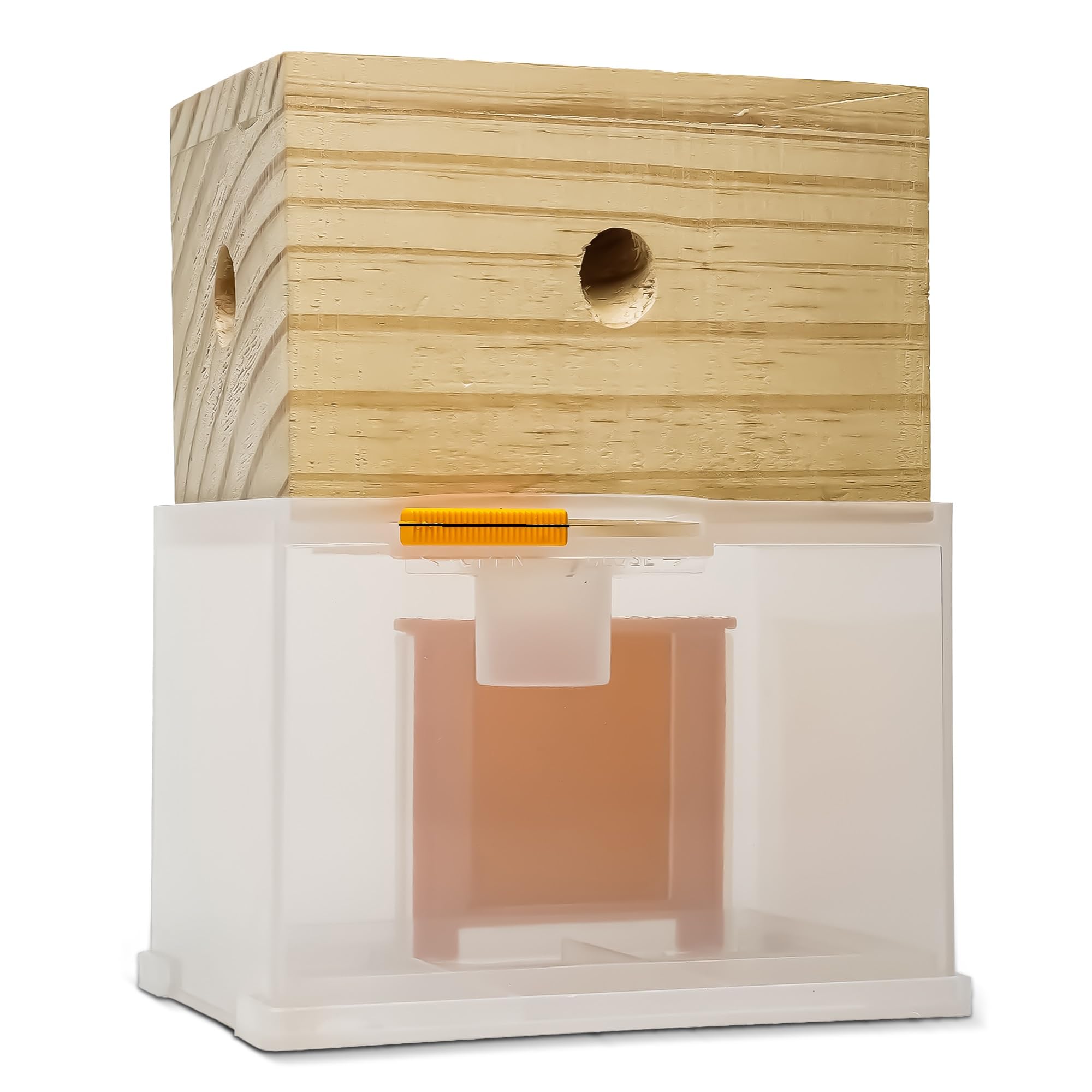
| Bee Warehouse Catch & ReleaseSelective Pick | Selective capture | Wood-box with jar | 5–15 ft | Large chamber, empty yearly | Amazon |
| Best Bee Trap Nature Hanging | Bait-assisted trapping | Wood-box with jar | — | Plastic jar | Amazon |
| Best Bee Trap Shed Style | Compact wood-box | Wood-box with removable jar | — | Plastic vault jar | Amazon |
| Best Bee Brothers Ultimate | Large external viewport | Wood-box with clear vault | 15 ft | Large external receptacle | Amazon |
| Best Bee Brothers Turbo Trap 2.0 | High-volume, long-term | Wood-box with internal funnel | 15 ft | — | Amazon |
| Amish-Made Cedar 2-Pack | Natural cedar aesthetics | Wood-box with jar | — | 2 units per pack | Amazon |
In‑Depth Reviews
1. RESCUE! Carpenter Bee TrapStik – 4 Pack
Our pick — over 4★ from 350+ verified ratings; the strongest balance of quality and price.
The disposable-season panel that catches everything with wings — from wasps to mud daubers.
The first line of defense here is not a box or jar but a sticky green panel printed with VisiLure — a multi-dimensional pattern that attracts carpenter bees, red wasps, and mud daubers purely through color and shape. You hang it up, peel the backing, and it starts working in seconds. The clever detail is the Glue Guard, a raised barrier that keeps the sticky surface from accidentally trapping butterflies or passing birds.
Buyers report replacing these about three times over the course of the summer, which lines up with the four-pack count. The top praise — effectiveness — comes from owners who watch the panel fill up fast, especially near active nests. A single buyer noted that it also caught non-target bees (good for cotton), so if your sole mission is sparing every pollinator, the trade-off is a broader catch radius than a selective wood box.
What fills the panel
- No baiting required — visual lure works immediately
- Four panels per pack cover a full season
- Glue Guards reduce accidental catches of larger animals
One limitation
- Sticky surface also traps beneficial bees occasionally
Grab it if: you want a no-fuss, hang-and-forget solution that hits multiple flying pests, not just carpenter bees.
Think twice if: you are committed to 100% selective capture — a wood-box-style trap is more precise.
2. Bee Warehouse Catch & Release Wood Boring Bee Trap
The rectangular trap that is designed to target only carpenter bees and leave honeybees alone.
This is a wood-and-plastic box with pre-drilled holes sized specifically for carpenter bees. The design philosophy is selectivity — the holes are supposed to be too small for bumblebees and honeybees, so you are not accidentally killing beneficial pollinators. An extra-large catch chamber means you might only need to empty it once a year, saving trips up a ladder.
A unique catch-and-release latch lets you close the chamber door, detach the trap, and carry the bees to a remote spot if you prefer relocation over killing them. The manufacturer rates coverage at 5 to 15 feet, and you get a five-pack of bee dams (internal one-way inserts that let bees in but not out). Effectiveness gets the most chatter in reviews, and it is genuinely mixed. Some owners mention catching bees within days, while others say the trap sat empty and the included plug (used to seal existing nest holes) did the real work.
Honest take: This trap suits you if you want to avoid harming other insects and are willing to experiment with placement. The mixed reviews mean you may need a few tries to find the balance near active nests.
Best for: homeowners who prioritize selective catch and want the option to release rather than kill.
Not for: those who need guaranteed results on the first hang — the Bee Warehouse trap works best when paired with plugging existing nest holes.
3. Best Bee Brothers Turbo Trap 2.0
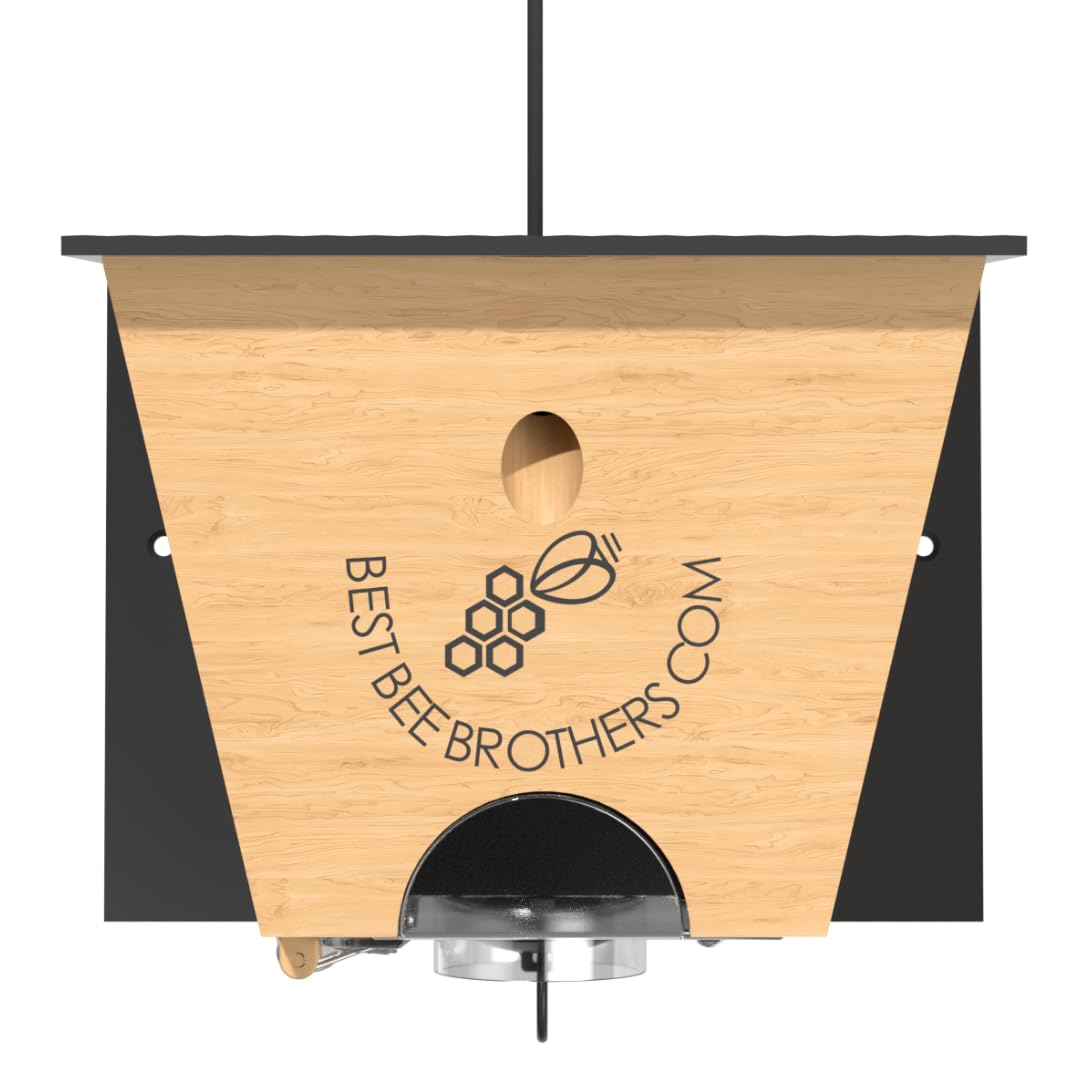
The professional-grade pick with an internal four-chamber funnel and a 9-foot pull string for no-touch emptying.
Best Bee Brothers updated their original trap with an internal four-chamber Turbo funnel that makes it harder for trapped bees to escape. The trap is built from pine wood and recycled ocean-bound plastic, giving it a rugged feel that survives weather. A large viewing window on the front lets you check the bee level without dismounting the unit.
The standout feature is the spring-loaded release door paired with a 9-foot pull string. You stand on the ground, pull the string, and the door flips open — zero contact with the bees. Effectiveness is the most-discussed aspect here, and it earns high marks: one buyer watched 8 carpenter bees drop out on the first pull of the string. The trap covers a 15-foot radius, and owners note that hanging it in direct sunlight (facing south or southwest) dramatically improves catch rates. A recurring honest note is that the included bait paste helps kick-start the first catch, after which the scent of trapped bees takes over.
Why owners love it
- Funnel 2.0 design prevents escape better than simpler jar traps
- No-touch disposal via pull string is genuinely convenient
- Rated for a 15 ft radius — one trap covers a wide section of eaves
The trade-off
- Requires initial baiting (included paste) to see fast results
Reach for this if: you want a reusable, high-capacity trap that you never have to touch when it is full.
Look elsewhere if: you prefer a completely chemical-free solution — the bait paste is low-impact but still an added substance.
4. 1 PCS Wood Carpenter Bee Trap – Best Bee Trap (Nature Hanging)
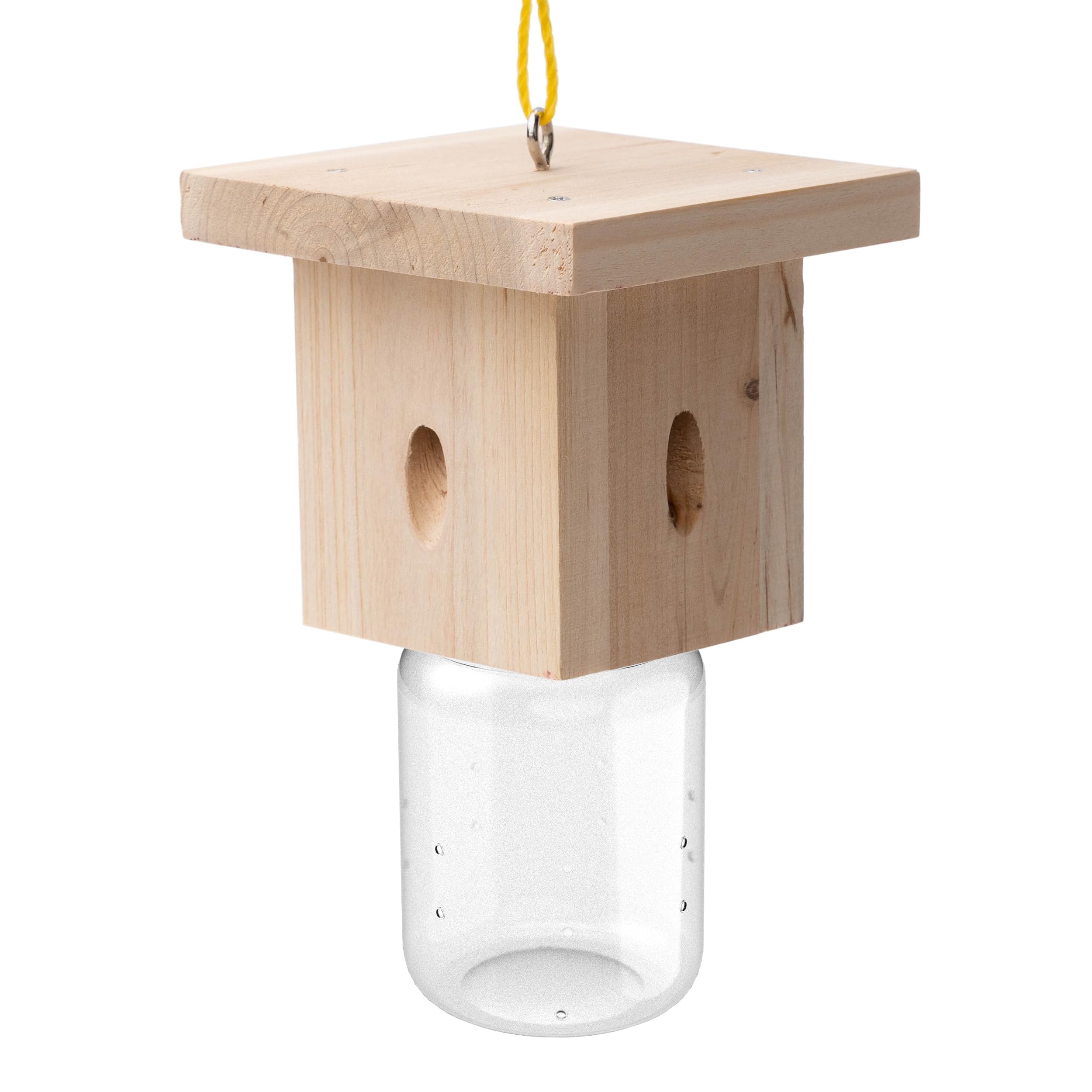
The best-value wood-box trap that needs one dead bee as bait to start a chain reaction.
At its core, this is a simple wooden box with a plastic jar underneath, built under the U.S. patent RE46,421. The design relies on a well-known behavior: carpenter bees are territorial and attracted to the pheromones of dead carpenter bees. The trick revealed by the most successful owners is to capture one female early in the season, stun her, and place her inside the trap. Her scent draws in males, and the cascade begins.
One reviewer noted catching 9 bees from a trap placed in mid-April, with no new nests forming in the surrounding wood. The trap measures 5.1 inches per side and stands 8.7 inches tall, reinforced with screws and horse nails against weather. The honest limitation is that if you do not “seed” the trap with a dead bee, it can sit empty for weeks — the price-to-expectation gap shows in the mixed value-for-money feedback.
The bottom line: If you are comfortable with the baiting ritual (catch one, kill it, drop it in), this trap delivers excellent results for the money. If the idea of handling a dead bee bothers you, a sticky trap is the simpler choice.
Best for: budget-minded homeowners who are willing to learn the baiting trick and check the trap every couple of days.
skip it if: you want a set-and-forget solution — this one demands active participation in year one.
5. Carpenter Bee Trap for Outside – Shed Style (Best Bee Trap)
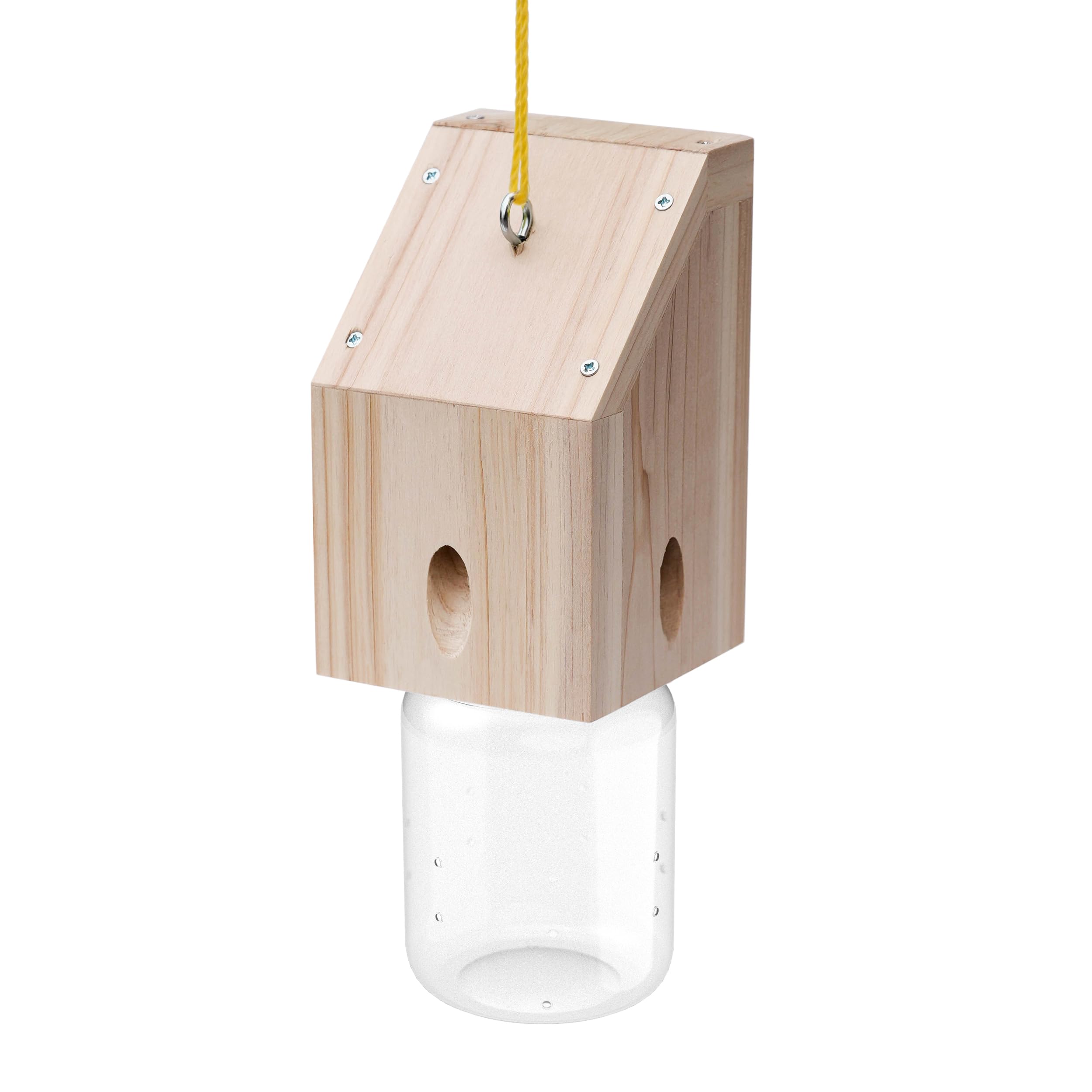
The shed-shaped wood trap with a clear removable jar that makes monitoring feel natural.
This is the same patent family as the earlier nature-hanging trap, but shaped like a miniature shed with a removable plastic jar at the bottom. The jar acts as the catch chamber, and you can unscrew it to release or empty the bees. The wood construction is reinforced with screws and horse nails, and the design is intended to survive rain and sun without warping.
Effectiveness remains the top positive feedback — customers note catching carpenter bees within days of hanging. The trick again is baiting: one owner caught their first bee after a week, then nabbed five more the following day, eventually reaching around ten total. The compact footprint (3.5 inches by 3.5 inches by 9.8 inches tall) means it fits on porch beams or beneath eaves without looking bulky. Durability draws mixed notes — some units arrived with small defects or took weather poorly over a full season.
What works
- Shed shape looks intentional, not like a pest-control device
- Removable jar makes emptying simple
- Small base fits tight spaces
What to watch
- Durability is a mixed bag — some reviewers point out splitting after a season
Choose this if: you want a visually unobtrusive wood trap that you can empty by unscrewing the jar from the ground.
Pass if: you need a trap that will withstand multiple seasons of harsh weather without maintenance.
6. Best Bee Brothers Ultimate Carpenter Bee Trap
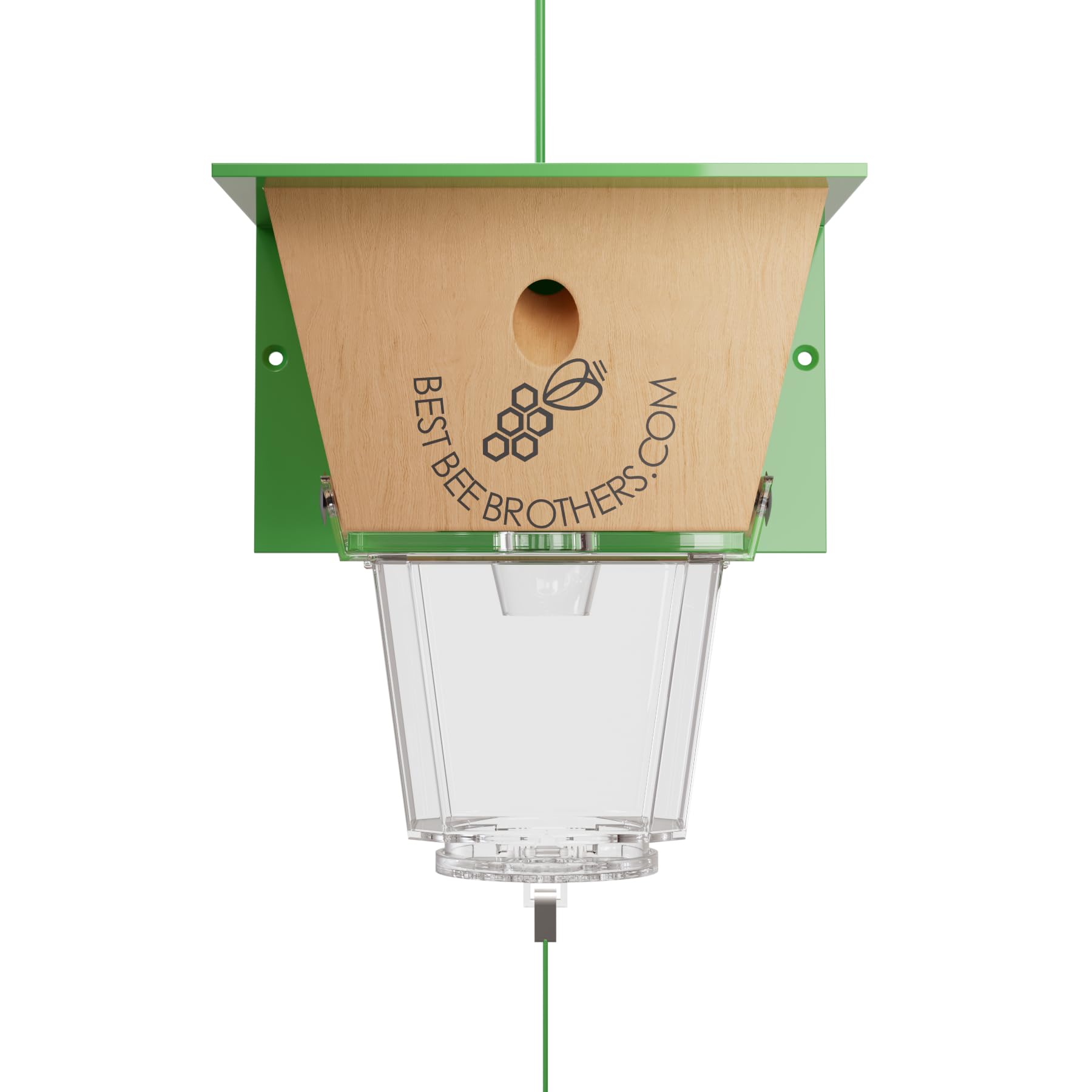
The trap with a large clear vault you can see across the yard, with a pull-string door for clean outs.
This model from Best Bee Brothers puts the catch chamber front and center — a large, clear external receptacle that monitors bee levels from any vantage point. The aerated design is intentional: it releases the pheromones and sounds of trapped bees, convincing more carpenter bees that the territory is occupied and worth investigating. The unit measures 5.75 inches by 6 inches by 4.5 inches, with a 15-foot coverage radius.
Assembly is required, and it is the most common friction point: a few owners found the roof attachment tricky or the instruction unclear. But once assembled, the results speak for themselves. One buyer caught 3 carpenter bees within the first hour of hanging it. The spring-loaded door on a 9-foot pull string offers the same no-touch convenience as the Turbo Trap, and the included bee bait cup gives you a place to drop pheromone-rich bait without messing with the main chamber.
The key insight: This trap is the best choice if you want visual confirmation of your catch rate and value the “set it and check it from the ground” design. The mixed assembly feedback means you should budget 10-15 minutes for setup.
Ideal for: homeowners who want to monitor the trap from a distance and enjoy seeing their progress against the pest population.
Not ideal if: you have limited patience for assembly or want a fully pre-assembled unit from the box.
7. Amish-Made Rustic Cedar Carpenter Bee Trap – 2 Pack
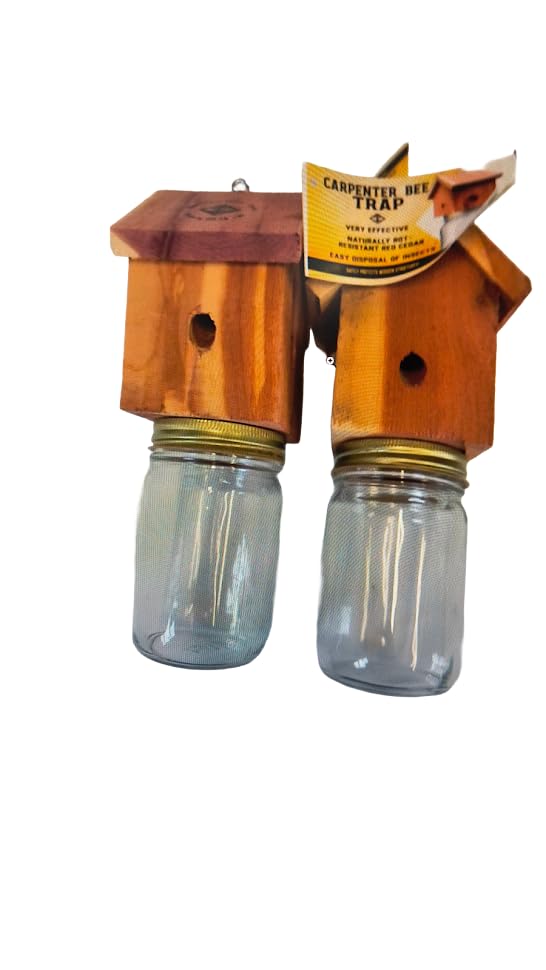
The beautifully hand-crafted cedar trap that looks like decor while catching dozens.
This two-pack is distinguished by its material: natural cedar, which smells pleasant, resists rot, and blends into wooden siding and decking far better than painted traps. The design follows the same nest-mimicking principle — pre-drilled holes lead into a collection jar, and carpenter bees enter thinking they have found a home. The most effective users leave the first few dead bees in the jar to lure more in.
Owners describe catching “dozens of carpenter bees” in a single spring, with the traps working within 24 hours of hanging. One buyer mentioned that after a month of heavy catches, they saw no new bees at all. The cedar construction is a double-edged sword: it looks excellent and is naturally chemical-free, but a small number of owners reported joints separating after a few weeks. You will also need to supply your own hanging string. Effectiveness is overwhelmingly praised, and for a two-pack at this price tier, the cost-per-trap is very competitive against some single-unit wood traps.
Why it stands out
- Natural cedar is weather-resistant and visually appealing
- Two traps per pack provide broad coverage for the price
- 100% chemical-free — safe around kids and pets
Worth noting
- Some units have build-quality inconsistencies (joint separation)
- No hanging hardware included — you provide your own string
Reach for these if: aesthetics matter — these are the best-looking traps on the list and they work fast when properly baited.
Skip this two-pack if you prefer a single, more robustly built trap — some shoppers say a slightly higher defect risk with the two-pack design.
Understanding the Specs
Coverage Radius (Feet)
This is the distance a trap can effectively attract carpenter bees from. A 15-foot radius means bees within a 15-foot circle of the trap are drawn to it. Hanging the trap in direct sunlight near active nests significantly extends its effective range because the bees are most active in warmer, brighter conditions.
Baiting & Pheromones
Many wood-box traps work best when seeded with a dead carpenter bee. The corpse slowly releases pheromones (chemical scents) that signal to other carpenter bees that the location is a safe, occupied nest. Without this bait, a brand-new trap can sit idle for weeks. Sticky traps like the RESCUE! TrapStik bypass this by using visual patterns (VisiLure).
FAQ
Will a carpenter bee trap attract honeybees or bumblebees?
How high should I hang a carpenter bee trap?
Do I have to put dead bees in the trap to make it work?
How often do I need to empty a carpenter bee trap?
Will these traps catch wasps or yellow jackets?
Can I leave a carpenter bee trap outside all winter?
What do I do if the trap is not catching any bees?
Are wood carpenter bee traps safe for kids and pets?
Final Thoughts: The Verdict
For the majority of shoppers, the best carpenter bee trap winner is the RESCUE! TrapStik 4-Pack because its VisiLure technology works immediately with zero baiting, and the four-panel count covers an entire season of peak activity. If you want a reusable wood-box trap that you never have to touch when full, grab the Best Bee Brothers Turbo Trap 2.0 with its 9-foot pull-string door and 15-foot coverage radius. And for the most natural-looking solution that blends into cedar siding while catching dozens of bees, the Amish-Made Cedar 2-Pack is the one to reach for — just bring your own hanging string.
How We Picked
We do not accept paid placement. Every pick is matched to a real buyer and a real use-case; we do not hands-on test units.
Sources & Methodology
Specifications: manufacturer listings and product documentation. Review insights: verified customer reviews, as of July 2026. Pricing: not shown on this page (it changes often); check the current price via the retailer link.
As an Amazon Associate, KitchPrep earns from qualifying purchases. This does not affect which products we feature.
Related Guides
