
If you love hard sears, blistered veggies, and eggs that slide like they’re on ice, the right carbon steel pan can quietly take over your whole stove. It’s the sweet spot between cast iron and stainless: hot and rugged, but light enough that you actually want to grab it every day.
The tricky part? Picking the best carbon steel cookware for how you really cook. Some pans arrive slick and ready to go, others want a little seasoning ritual. Some are thin and lightning fast for gas ranges; others are thicker workhorses that behave better on induction or glass tops.
In this guide, we’ll walk through 16 seriously good carbon steel picks—from French chef favorites that can outlive you, to beginner‑friendly, pre‑seasoned skillets and full starter sets that replace your old nonstick in one shot. We’ll pull in what brands promise, what long‑term owners actually say, and what really matters if you want your new pan to be your personal best carbon steel cookware, not just another experiment.
In this article
- How to choose the best carbon steel cookware for your kitchen.
- Quick comparison table of 16 standout pans and sets.
- In‑depth reviews of each pan, with expert‑style pros and cons.
- How carbon steel actually cooks (and how to get that slick patina).
- Answers to common carbon steel questions, plus final buying tips.
How to Choose the Best Carbon Steel Cookware for Your Stove, Style & Sanity
Before you get seduced by those deep‑bronze patina photos, it helps to zoom out and think about how carbon steel will actually live in your kitchen. A little planning here means you buy once, use it constantly, and don’t end up babying a pan that’s secretly wrong for your stove or recipes.
1. Start with what you cook 80% of the time
Think in meals, not metals:
- Eggs, omelettes, grilled cheese, quick lunches: A dedicated 8–10″ skillet or omelette pan is your hero.
- Family dinners & one‑pan meals: Reach for 11–12″ skillets or 13.5″ woks; you need room to spread food out.
- High‑heat searing & steaks: Thicker, heavier pans or larger diameters help you keep heat when cold meat hits the surface.
- Apartment / dorm / first kitchen: A small starter set or one medium pan that can fry, sauté, and shallow‑braise is perfect.
If you’re constantly cooking in batches now, it’s usually smarter to size up. If you mostly reheat leftovers, fry eggs, and toast tortillas, a smaller pan heats faster, uses less oil, and feels less fussy—while still counting as some of the best carbon steel cookware you can own.
2. Match thickness and shape to your stove
A lot of reviews talk about “warping,” “doming,” or oil running to the edges. That’s usually not random quality issues—it’s about how thin the pan is and how fast it’s heated.
- Thin, fast pans (like many Merten & Storck, GreenPan x Bobby Flay): great on gas, more sensitive on powerful induction or glass tops.
- Thicker, heavier pans (Matfer Bourgeat, de Buyer, most Lodge carbon steel): slower to heat, but more resistant to warping and hot rings.
- Flat‑bottom woks (Yosukata): ideal for modern stoves—no more balancing a round wok on a burner ring.
If you’re on induction or a glass electric cooktop, treat ultra‑thin pans gently: start on low, ramp heat gradually, and don’t crank empty pans to max. If you’re on gas, you can get away with more abuse—but a thicker pan still gives you nicer sears and fewer temperature swings.
3. Decide how much “maintenance ritual” you actually want
All bare carbon steel behaves a bit like cast iron: it wants seasoning and a little care. But not all pans start from the same place:
- Traditional bare steel (Matfer, de Buyer MINERAL B): Come with beeswax or light protection; you’ll do the initial seasoning yourself.
- Pre‑seasoned carbon steel (Lodge, Merten & Storck, OXO, Yosukata): Usable out of the box, then improve as you cook and re‑oil.
- Enameled or ceramic‑coated carbon steel (BrBrGo skillet, Gibson set): Behave more like nonstick—no patina to manage, but no “forever pan” patina either.
If the idea of seasoning sounds fun and satisfying, the classic French and Lodge pans are a joy. If you’d rather just wash, dry, and start cooking, an enameled carbon steel skillet or pre‑seasoned option lowers the friction.
4. Think realistically about weight and handle comfort
One of the biggest real‑world wins of carbon steel over cast iron is weight—but some pans are still hefty:
- Lightest options: Small Merten & Storck skillets, GreenPan x Bobby Flay 10″, Viking 10″, smaller Lodge 10″.
- Medium‑heavy all‑rounders: De Buyer MINERAL B, Matfer Bourgeat, Lodge 12″, OXO Outdoor 12″.
- Big boys: Lodge 15″, Yosukata 13.5″ wok—amazing for volume, but you’ll be tossing food with a spatula, not wrist‑flicks.
If you have wrist issues or arthritis, stick with 8–10″ skillets and avoid the enormous carbon steel pizza‑pan style pieces. A pan that feels slightly heavy but still tossable will actually become your best carbon steel cookware; one that scares you to lift will live in a cupboard.
5. Safety, coatings & what “non‑toxic” really means
A big reason cooks are moving to carbon steel is to get away from mystery nonstick coatings. Here’s what to know:
- Bare carbon steel is just iron + a little carbon. Seasoning is polymerized oil—not a sprayed chemical coating.
- Patina can be stripped & rebuilt if you mess up, unlike flaking PTFE/PFAS coatings that mean the pan is done.
- Enameled / ceramic‑coated carbon steel still uses a coating, but it’s typically PFAS‑free and fired on, not plastic‑based.
If you’re deeply focused on “clean” materials, the French‑style bare carbon steel pans and most Lodge & Merten pieces are about as simple as it gets. The trade‑off: you accept a little learning curve instead of out‑of‑box slipperiness.
Quick Comparison: 16 Best Carbon Steel Cookware Picks
Here’s a bird’s‑eye view of the 16 pieces and sets we’ll be reviewing. Use this table to spot which models match your stove type, hand strength, and cooking style, then jump to the full review for the nerdy details.
On smaller screens, swipe or scroll sideways to see the full table.
| Model | Type | Size / Pieces | Best match | Amazon |
|---|---|---|---|---|
| Matfer Bourgeat Black Carbon Steel Frying Pan | Pro French skillet | 11.75″ | Serious home cooks & steak fanatics | Amazon |
| de Buyer MINERAL B Carbon Steel Omelette Pan | Omelette pan | 8″ | Eggs & French‑style omelettes | Amazon |
| Lodge Pre‑Seasoned Carbon Steel Skillet | All‑round skillet | 10″ | First serious carbon steel pan | Amazon |
| Lodge Pre‑Seasoned Carbon Steel Skillet | All‑round skillet | 12″ | Family dinners & big sautés | Amazon |
| Lodge Pre‑Seasoned Carbon Steel Skillet | XL skillet | 15″ | Paella, pizza & grill feasts | Amazon |
| Lodge Carbon Steel Skillet w/ Silicone Holder | Heavy‑gauge skillet | 12″ | Induction & daily stove workhorse | Amazon |
| Merten & Storck Pre‑Seasoned Carbon Steel Fry Pan | Budget workhorse | 8″ | Lightweight starter pan | Amazon |
| Merten & Storck Pre‑Seasoned Carbon Steel Fry Pan | Budget workhorse | 10″ | Everyday go‑to for 1–3 people | Amazon |
| Merten & Storck Pre‑Seasoned Carbon Steel Fry Pan | Budget workhorse | 12″ | Light but large family skillet | Amazon |
| Armorbear 11″ Nitrided Carbon Steel Frying Pan | Nitrided skillet | 11″ | PFAS‑free nonstick feel, lighter than cast iron | Amazon |
| BrBrGo 11″ Enameled Carbon Steel Skillet | Enameled skillet | 11″ | Non‑seasoning, acid‑friendly pan | Amazon |
| Gibson Home Helensburgh 7‑Piece Set | Cookware set | 4 pans + 3 lids | First apartment or dorm kitchen | Amazon |
| YOSUKATA 13.5″ Flat‑Bottom Carbon Steel Wok | Wok | 13.5″ | Stir‑fry and high‑heat Asian cooking | Amazon |
| GreenPan x Bobby Flay Carbon Steel Fry Pan | Chef collab | 10″ | Gas or grill searing, PFAS‑free | Amazon |
| OXO Outdoor 12″ Carbon Steel Frying Pan | Outdoor skillet | 12″ | Camping & tiny kitchens (detachable handle) | Amazon |
| Viking Blue Carbon Steel Frying Pan Set | 2‑pan set | 10″ + 12″ | Enthusiasts upgrading from nonstick | Amazon |
In‑Depth Reviews: 16 Standout Carbon Steel Pans & Sets
Now let’s zoom in on each pick. Use these reviews to match the strengths—like warp‑resistance, weight, or outdoor‑friendliness—to what actually matters most in your kitchen, so you walk away feeling genuinely confident in your choice.
1. Matfer Bourgeat Black Carbon Steel Frying Pan, 11 3/4″ – Restaurant Classic for Serious Home Cooks

If you’ve seen chefs swirling a dark pan under roaring flames, it was probably something like this. Matfer Bourgeat’s black carbon steel skillet is a true workhorse: thick, heavy, and built from a single piece of steel with a welded handle (no rivets to trap gunk). Once seasoned, owners routinely say it’s more nonstick than their old PTFE pans and gives them the best sear they’ve ever had on steak or vegetables.
There’s no factory patina beyond a light protective layer, so you’ll do the initial seasoning yourself. The payoff is a pan that feels tailored to you: the color, slickness, and response all build from your own cooking. Once it’s there, food releases beautifully—as long as you respect heat and use a bit of oil or fat.
Why it stands out
- Thick, warp‑resistant steel – Compared with budget pans, Matfer’s heavier gauge resists doming and distributes heat very evenly.
- Rivet‑less interior – The welded handle means no screw heads inside the pan, so nothing to scrape, trap sauce, or mess with your spatula.
- Superb searing power – Once preheated, it browns steak, potatoes, and pancakes evenly—even on stoves with uneven burners.
- True “forever pan” potential – Many owners treat it like heirloom cookware; the more you cook, the better the patina gets.
Good to know
- It’s heavy. If you’re buying carbon steel specifically to escape cast iron weight, this one might still feel beefy.
- Requires real seasoning work upfront—rushing that step is the fastest way to end up in “everything sticks” territory.
- The raw handle gets hot; most people use a silicone sleeve or towel when cooking at higher heat.
Ideal for: home cooks who are excited to baby a pan through its first few seasonings and want pro‑grade best carbon steel cookware they can keep for life.
2. de Buyer MINERAL B Omelette Pan, 8″ – Tiny Powerhouse for Eggs & Quick Sautés

This MINERAL B omelette pan is de Buyer’s love letter to eggs. The curved, higher sides make it easy to tilt, swirl, and roll French omelettes or flip crepes without catching a corner. It arrives coated in beeswax, which protects the steel in transit and encourages your first thin layer of seasoning.
Owners who take the time to strip the wax and do a careful first seasoning often report hilarious “egg on an air hockey table” moments—pancakes skating around, omelettes sliding into plates. It’s lighter than cast iron but still has enough thickness to hold heat for a 2–3 egg omelette or a quick steak.
Why you’ll like it
- Purpose‑built shape – The rounded walls make folding, rolling, and sliding eggs dramatically easier than in straight‑sided skillets.
- Natural, clean materials – Just carbon steel and beeswax; no synthetic coatings to scratch or worry about.
- Brilliant once seasoned – With good prep, it becomes more nonstick than many PFAS‑free coated pans, especially for eggs.
- Compact but capable – Great for 1–2 person meals, grilled cheese, burgers, and sautéed veg when it’s not doing breakfast duty.
Good to know
- You must remove the beeswax properly; skimping leaves sticky residue that makes seasoning blotchy.
- Like other traditional carbon steel, it’s not a fan of long tomato or wine sauces—the acid can strip patina.
- Handle gets hot in the oven and under high heat; a sleeve or towel is non‑negotiable.
Ideal for: anyone who wants a dedicated egg and omelette pan, plus a small, premium piece of best carbon steel cookware to anchor a minimalist setup.
3. Lodge 10″ Pre‑Seasoned Carbon Steel Skillet – Friendly Starter With Serious Cred

If you’re moving away from mystery nonstick and want something trustworthy but not intimidating, the 10″ Lodge carbon steel skillet is a perfect entry point. It’s pre‑seasoned with vegetable oil, made in the U.S., and sized to handle “for two” dinners, single‑pan breakfasts, and grilled sandwiches without hogging your cooktop.
Owners who take the time to learn a few carbon steel basics (preheat, a film of oil, heat down before eggs) often end up ditching Teflon entirely. They love being able to use metal spatulas, cook at high heat, and then just wipe or rinse the pan instead of babying a coating that gets worse over time.
Highlights
- Ready to cook – The factory seasoning is genuinely usable out of the box—no all‑day oven ritual required.
- Balanced size & weight – Easier to grab than a 12″ beast, but still big enough for everyday cooking for 1–3 people.
- Robust reputation – Tons of long‑term user feedback and techniques are easy to find because Lodge is everywhere.
- “Real pan” feel – You can crank heat, scrape fond, and handle it like stainless or cast iron—just with less weight.
Good to know
- The factory seasoning is a starting point, not magic—expect the pan to get slicker over a few weeks of use.
- A few owners notice seasoning thinning in the center with very acidic dishes; that’s a cue to reseason lightly.
- On small electric elements the heat center can be hotter than the edges; preheat gently and rotate if needed.
Ideal for: first‑time carbon steel users who want the best carbon steel cookware “gateway pan” with minimal fuss and maximum longevity.
4. Lodge 12″ Pre‑Seasoned Carbon Steel Skillet – Big Everyday Pan for Families

Take everything that’s good about the 10″ Lodge and size it up for families, and you get the 12″ carbon steel skillet. For a lot of long‑time users, this becomes their default pan: stir‑fries, potato hashes, seared chicken thighs, even shallow pizzas all happen here.
It holds enough heat to sear while full, but is still noticeably lighter than a comparable cast iron piece. Many owners report that after a few months they forget what their old nonstick even looked like—this does almost all the daily work.
Why it’s a keeper
- Serious surface area – You can actually keep food in a single layer, which is key for browning instead of steaming.
- Excellent heat retention – Once hot, it shrugs off cold ingredients far better than typical aluminum nonstick.
- Durable enough for metal tools – Scraping fond or using a metal spatula isn’t a heart‑stopping moment.
- Great all‑round “best carbon steel cookware” candidate – For many kitchens, this one pan does 80–90% of the work.
Good to know
- Larger diameter plus gauge means noticeable weight; one‑handed tosses are a workout.
- Heat distribution mirrors your burner—on small coils you’ll see a hotter center unless you move the pan.
- Like all bare carbon steel, it wants to be dried and lightly oiled after washing to prevent flash rust.
Ideal for: households of 3–5 who want one main skillet to leave on the stove and use for nearly everything.
5. Lodge 15″ Pre‑Seasoned Carbon Steel Skillet – Party‑Size For Paella, Pizza & Griddle Duty

The 15″ Lodge carbon steel is less “everyday skillet” and more “table‑sized stage” for food. Think massive hash breakfasts, paella for guests, or big-format pizzas baked on the grill. On a standard home burner, the very center will run hotter than the edges, but used over a wide gas burner or grill grates, it becomes a superb outdoor platform.
Owners who love it typically treat it like a hybrid between a plancha and a skillet—searing steaks in the center, while vegetables or potatoes ride a slightly cooler outer ring. Once seasoned, it cleans up shockingly easily for its size.
Where it shines
- Huge diameter – Enough room to cook breakfast for a crowd or pan pizzas without crowding.
- Fantastic grill partner – Solves the “my burners are too small” issue by using the wide, even heat of a grill.
- Excellent crusts – Paella, potatoes, and hash browns get that coveted bottom crunch.
- Same Lodge seasoning logic – Arrives pre‑seasoned and strengthens with use like the smaller sizes.
Good to know
- On standard electric or gas stoves, expect a hot center and cooler edges unless you move things around.
- It’s big. Storage and maneuvering require some planning and two‑handed handling.
- Best as a second or third piece—not the pan you learn carbon steel on.
Ideal for: grill enthusiasts, entertainers, and anyone who wants a giant “do‑everything” steel surface for outdoor cooking and oven feasts.
6. Lodge 12″ Carbon Steel Skillet with Silicone Holder – Heavy‑Gauge, Induction‑Loving Workhorse

This version of Lodge’s 12″ skillet uses heavy 12‑gauge steel and includes a silicone handle sleeve rated to 500°F. Compared to the lighter Merten pans, it’s more resistant to warping and feels closer to a “forever” piece—especially on induction, where thin pans can flex if blasted on high.
Owners like that it behaves much closer to cast iron in terms of heat retention and durability, without quite as much weight, and that once seasoned properly it’s an easy everyday pan for searing, sautéing, and even oven roasting.
Why you’ll appreciate it
- Thicker steel – More forgiving on induction and glass tops, and slower to warp than thinner budget options.
- Included handle sleeve – Makes high‑heat cooking less nerve‑wracking without needing a separate accessory.
- Reliable seasoning – Many users report that once the pan is “broken in,” it cleans easier than their cast iron.
- Great price‑to‑lifespan ratio – Costs far less than French pro pans, but will realistically last decades.
Good to know
- The silicone holder can feel “stuck” once the pan is hot; remove it before putting the pan under broilers.
- Heavier than some 12″ competitors; not ideal if you’re chasing ultra‑light.
- Factory finish is functional, but not as glass‑smooth as high‑end French pans until seasoning builds.
Ideal for: induction or electric users who want one stout 12″ skillet to leave on the stove and treat like their main pan.
7. Merten & Storck 8″ Pre‑Seasoned Frying Pan – Lightweight “Taste Test” Carbon Steel

Merten & Storck’s 8″ pan is one of the cheapest respectable ways to dip a toe into carbon steel. New York Magazine’s Strategist called the line a “no‑nonsense kitchen workhorse,” and that’s about right: it’s thin, heats quickly, and arrives pre‑seasoned and wax‑coated to get you cooking fast.
Long, nerdy owner reviews often double as short carbon steel masterclasses—people discover the difference between sticky residue from too much oil, true patina, and how a hot‑water deglaze after cooking can actually restore nonstick behavior by removing micro‑gunk.
Why it’s a smart starter
- Budget‑friendly – Easy to justify if you’re “carbon steel curious” and don’t want to jump straight to French pricing.
- Light and nimble – Much lighter than cast iron, and easy to maneuver with one hand.
- Useful pre‑seasoning – Once you wash off the wax layer properly, it’s impressively slick from day one.
- Great for learning – The small size makes mistakes less painful; you can always graduate to its 10″/12″ siblings later.
Good to know
- Thin gauge is prone to warping if you blast high heat on an empty pan, especially on glass or induction.
- Some users confuse factory wax flaking with seasoning flaking—wash thoroughly before first use.
- Oil pooling toward edges can happen if it domes slightly; tilting the pan to re‑spread oil becomes second nature.
Ideal for: eggs, small sides, and anyone who wants cheap, low‑risk practice before committing to a bigger investment.
8. Merten & Storck 10″ Pre‑Seasoned Frying Pan – Lightweight Daily Driver

The 10″ version is where the Merten & Storck line hits that “daily driver” sweet spot. It’s big enough for two steaks or a full hash, but light enough that you’ll happily grab it on a Tuesday. Plenty of owners have retired their nonstick after this pan clicked into place.
One particularly detailed long‑term reviewer went from calling it “the all‑stick pan” to loving it after discovering that deglazing with hot water and scraping more aggressively removed invisible gunk that was sabotaging the seasoning. Once that clicked, the pan basically turned into the non‑toxic nonstick they’d been chasing all along.
Why it’s compelling
- Quick responsiveness – Thin carbon steel means you can actually lower heat mid‑cook and see a difference fast.
- Good pre‑seasoning – With proper wax removal, the initial patina genuinely works for eggs, veggies, and fish.
- Affordable “best carbon steel cookware” candidate – For many home cooks, this is all they need.
- Induction compatible – Works on pretty much anything: gas, electric, ceramic, induction, or even campfire.
Good to know
- Like the 8″, it can warp if heated aggressively while empty—especially on high‑powered induction.
- Center doming causes oil to run outward; tilt or swirl the pan as you preheat to keep the center oiled.
- Not as tank‑like as Lodge or French pro pans; treat it as a nimble daily tool, not an heirloom piece.
Ideal for: home cooks wanting an affordable, lightweight pan that can genuinely become their main skillet with a little practice.
9. Merten & Storck 12″ Pre‑Seasoned Frying Pan – Large, Light, and Campfire‑Ready

Step up to the 12″ Merten & Storck if you love the idea of a big pan but hate the idea of heavy lifting. At roughly half the weight of a cast iron equivalent, it’s popular with campers, van‑lifers, and anyone who wants a pan that can bounce between stove, oven, and grill.
The trade‑offs are similar to the smaller sizes: excellent heat speed and lighter handling, in exchange for more careful heat management to avoid warping and a bit more hands‑on maintenance as the seasoning evolves.
Why it earns a spot
- Big but agile – Feels much friendlier in the hand than a 12″ cast iron, especially when moving on and off grills.
- Flexible use – Works on induction, in ovens, and over campfires, making it an easy multi‑environment pan.
- Non‑precious finish – Scratches and discoloration don’t end the pan; you can strip and reseason if needed.
- Great value – Tough to beat this footprint and performance at the price point.
Good to know
- Again, the thin steel is sensitive to high, uneven heat—on induction, ramp up gradually.
- Some users are surprised by staining after fish or acidic foods; this is normal for carbon steel, not a defect.
- Plan to do occasional touch‑up seasoning if you cook very lean or very acidic dishes often.
Ideal for: budget‑minded cooks who want a large, light pan they can beat up a bit and still rely on indoors and out.
10. Armorbear 11″ Nitrided Carbon Steel Pan – Cast‑Iron Feel, Lighter Body, Wooden Handle

Armorbear takes a slightly different route: this pan uses a nitriding treatment (a high‑tech process that hardens the surface) plus a subtle texture. The idea is to create a rust‑resistant, low‑maintenance surface that bonds with oil more easily and needs less babying than raw carbon steel.
Happy owners rave about how nonstick it feels for bacon, burgers, and everyday sautéing—especially compared with older ceramic pans that warped or chipped. A minority mention early warping on very high heat, which suggests the steel isn’t as thick as heavy French or Lodge pans, so it’s worth warming it more gradually, especially on glass or induction.
Why it’s appealing
- Nitrided surface – Better rust resistance and less “babysitting” than completely bare steel.
- Comfortable wooden handle – Stays cool and feels reassuringly chunky in the hand, good if you hate grabbing hot steel.
- Lighter than cast iron – Long‑time cast iron fans like it as a similar‑feeling pan that’s easier to lift.
- Great everyday nonstick feel – Once broken in, people happily cook eggs, meats, and veggies with minimal sticking.
Good to know
- A few users reported warping at 200–250°C when heated hard; go steady on high heat and preheat with some oil.
- The textured surface feels different from glass‑smooth French pans; some love it, some prefer sleek.
- Like all carbon steel, user technique (heat + oil + timing) still matters a lot for eggs and delicate foods.
Ideal for: cooks who want cast‑iron‑style results, value a cool‑touch wooden handle, and don’t mind treating the pan gently on very high heat.
11. BrBrGo 11″ Enameled Carbon Steel Skillet – Nonstick Feel Without Teflon

Want the responsiveness of carbon steel but don’t want to think about seasoning at all? This BrBrGo skillet wraps a 1.88 mm carbon steel core in an enamel coating, so it behaves more like a tough nonstick: no rust, no patina to protect, and you can cook tomato sauces or wine reductions without stripping anything.
Owners love the combination of even heat, a genuinely slippery surface for omelettes and everyday cooking, and a stay‑cool wooden handle. Over time, a few users noticed the base very slightly rounding and a bit more sticking than day one, which is typical of enameled surfaces as they wear in—but overall, it’s one of the more convincing “nonstick without chemicals” options in the carbon steel world.
Why it’s interesting
- No seasoning required – Open box, rinse, cook. That alone will sell a lot of people.
- Acid‑safe – Unlike bare carbon steel, you can happily simmer wine or tomato sauces here.
- Excellent heat distribution – The carbon steel core heats fast and evenly, giving you cast‑iron‑like browning.
- Cool‑touch handle – Wooden handle stays comfortable during stove‑top cooking sessions.
Good to know
- Once enamel is damaged or badly scratched, you can’t really “fix” it the way you can strip and reseason bare steel.
- A few reports of rounding / doming at the base, which can reduce flat contact on glass tops.
- While marketed “nonstick,” it still likes a film of oil or butter for the best release on eggs.
Ideal for: cooks who want carbon‑steel performance but a nonstick‑style routine: soap, water, dry, done—no patina anxiety.
12. Gibson Home Helensburgh 7‑Piece Carbon Steel Cookware Set – Budget First Kitchen Kit

This isn’t the pan you buy to hand down to grandkids—it’s the set you buy when you’re outfitting a first apartment, dorm, or vacation rental in one shot. You get a 9.5″ fry pan, two saucepans with lids, and a 4.5‑quart Dutch oven with lid in matching blue carbon steel with PFA‑free nonstick interiors.
Reviews are honest: quality is “starter,” not luxury. The pieces are on the thinner side, handles can feel a bit wiggly, and the nonstick isn’t meant for a decade of daily searing. But for the price, it gives someone everything they need to actually cook real food instead of living on takeout.
Why it earns a mention
- Complete starter kit – Fry pan, saucepans, Dutch oven, lids—enough to handle most simple recipes.
- Fast‑heating carbon steel – Responds quickly to stove changes, which is nice on basic apartment ranges.
- Nonstick interiors – Great for beginners who just need food to come out of the pan without drama.
- Induction‑friendly – Works on modern cooktops as well as old coil or gas stoves.
Good to know
- Thin gauge means these are not lifetime pieces; expect 2–3 years of good service with gentle care.
- Handles and hardware feel budget, which is fair at this price.
- If you already cook a lot, you’ll likely prefer buying one or two higher‑end pans instead.
Ideal for: outfitting a first kitchen on a tight budget when you want “everything in one box” more than heirloom‑level gear.
13. YOSUKATA 13.5″ Flat‑Bottom Wok – Restaurant‑Style Stir‑Fry at Home
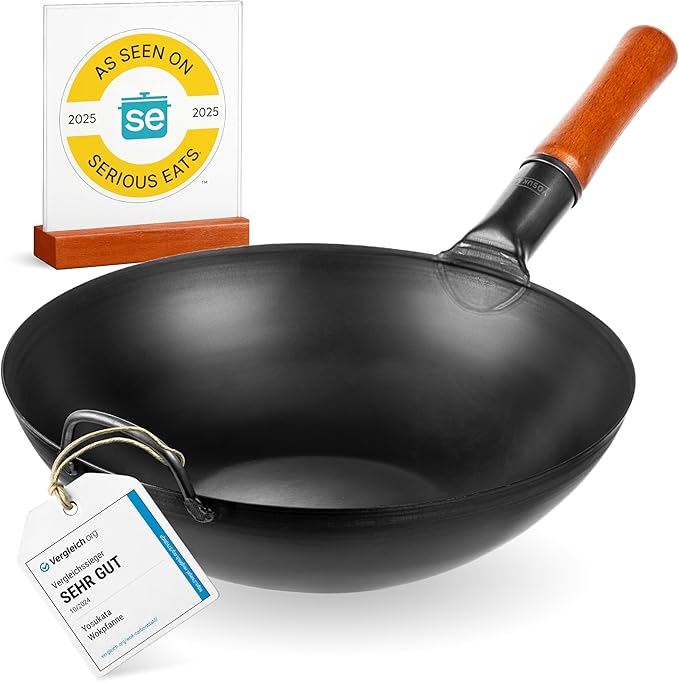
If your idea of the best carbon steel cookware is “the wok that never leaves the stove,” YOSUKATA’s 13.5″ flat‑bottom pan is a standout. It’s pre‑seasoned at over 600°F, giving you a head start on that slick black patina. The base is flat enough for induction and glass tops, but the sides stay beautifully curved for tossing.
Owners who follow the seasoning instructions and take their time rave about it. Many end up using it not just for stir‑fry but for deep‑frying, braising, and even making gravies. A few frustrated reviewers struggled with rust spots out of the box and underestimated the time required to strip and reseason—woks are more demanding than skillets simply because there’s more surface area to perfect.
Why it’s special
- Flat bottom, round sides – Works on modern stoves without giving up proper stir‑fry geometry.
- High‑temp pre‑seasoning – Helps food release from day one and builds into a fantastic patina with use.
- Heavy but solid – Substantial enough to hold heat for big batches (4–6 servings) without losing sizzle.
- Versatile beyond stir‑fry – Great for pan‑frying, shallow deep‑frying, and even fish‑and‑chips nights.
Good to know
- At 13.5″ with tall sides, it’s not a “flick one‑handed” vessel—plan to use a wok spatula.
- If your unit arrives with rust or rough patches, be ready to invest some elbow grease into stripping and reseasoning.
- The wooden handle angle is slightly upturned, which can feel high if you’re short or using a very tall range.
Ideal for: stir‑fry fans, fried‑rice devotees, and anyone who wants a true high‑heat wok that still plays nicely with flat cooktops.
14. GreenPan x Bobby Flay 10″ Carbon Steel – TV‑Chef Energy, Real‑World Learning Curve

This GreenPan x Bobby Flay collab leans into chef branding: pre‑seasoned, PFAS‑free, oven safe to 660°F, and pitched as the kind of pan you can take from induction to grill grates without blinking. When treated gently and seasoned a bit more at home, it does build a nice patina and cooks extremely well.
Where some users trip up is blasting it on high induction out of the gate. Like most thinner carbon steel, that can cause the base to bow temporarily, making it wobble on glass tops and creating a hot “ring.” Once owners switch to gradual preheats and medium‑high work, many find it becomes a very reliable everyday pan for eggs, meats, and veg.
Reasons to consider it
- High heat tolerance – Oven safe to 660°F, making it grill and broiler friendly.
- PFAS‑free – No synthetic nonstick coating to worry about, just carbon steel and seasoning.
- Solid, riveted handle – Ergonomic and secure even when you’re searing hard.
- Great once dialed in – With proper heat control, it sears beautifully and releases food well.
Good to know
- On induction, you must preheat gradually; aggressive high heat can bow the base.
- Some users report staining and cosmetic changes after washing with soap—normal for carbon steel, but unexpected if you’re new.
- The chef branding doesn’t change physics; treat it like any other thin carbon steel when it comes to heat and oil.
Ideal for: gas or grill users who like the idea of a Bobby Flay‑endorsed pan and are willing to respect a bit of carbon steel nuance.
15. OXO Outdoor 12″ Carbon Steel – Detachable Handle, Big Performance

This is one of the smarter designs on the list: a 12″ pre‑seasoned carbon steel pan with a clip‑on handle that pops off for storage or for direct heat over a grill or campfire. Think camp‑friendly performance without having to lug a Dutch oven everywhere.
Owners love how fast it heats, how surprisingly nonstick it becomes with use, and how much easier it is to pack thanks to that removable handle. Some do note that the handle can wobble slightly if you’re expecting cast‑iron‑style solidity, and a few report spring failures with very hard use. But for most campers and tiny‑kitchen dwellers, the trade‑off is worth it.
Why it stands out
- Detachable handle – Huge win for packing, oven use, and sliding into small cabinets.
- Pre‑seasoned – You can cook literally on day one, then deepen the patina over camp trips.
- Indoor / outdoor versatility – Works on induction, gas, electric, grills, and over coals.
- Good nonstick with use – When treated right, it delivers classic “carbon steel but easier” performance.
Good to know
- Handle mechanism has moving parts; it’s more delicate than a welded stick of steel.
- Some users with MS or grip issues note that a failed handle is a real problem—keep an eye on wear.
- Like all outdoor‑leaning pans, expect cosmetic scuffs and patina changes from open‑flame cooking.
Ideal for: campers, van‑lifers, and tiny‑kitchen cooks who want a serious 12″ pan that shrinks down neatly when not in use.
16. Viking Blue Carbon Steel Frying Pan Set, 10″ & 12″ – Lighter, Premium Upgrade from Nonstick

If you’re stepping up from tri‑ply stainless or high‑end nonstick and want something that feels “nice” in the hand, Viking’s blue carbon steel set hits a sweet spot. You get 10″ and 12″ pans, both pre‑seasoned, with well‑shaped ergonomic handles and lighter weight than many cast iron or French pans.
Owners who understand carbon steel absolutely love them—especially the combination of fast heat, lighter feel, and natural nonstick once the seasoning is dialed in. A few buyers expecting zero‑maintenance nonstick were disappointed when rust appeared after air‑drying or washing with soap and not reseasoning. These are still carbon steel at heart; they reward care, not neglect.
Why they’re tempting
- Two useful sizes – 10″ for everyday, 12″ for big meals—this pair can easily replace a whole nonstick stack.
- Lighter than many rivals – Great if you have weaker wrists but still want “real” pans.
- Sturdy build and feel – Users compare the quality favorably against other big names at similar prices.
- Pre‑seasoned – Skip the beeswax scrub and get straight to cooking (though extra seasoning still helps).
Good to know
- Rust and discoloration can appear quickly if you use soap and air‑dry—dry thoroughly, then wipe with a thin oil film.
- Not “nonstick” in the Teflon sense—eggs still want a bit of fat and moderate heat.
- Some pieces arrive with cosmetic scratches that disappear under seasoning but can disappoint perfectionists out of the box.
Ideal for: enthusiastic home cooks looking to replace multiple coated pans with a handsome, long‑lasting two‑piece carbon steel set.
How Carbon Steel Actually Cooks (and How to Get That Slick Patina)
On paper, most of the best carbon steel cookware looks similar: steel, a handle, maybe some beeswax or seasoning. In practice, a few key habits decide whether you get magical “nothing sticks” moments or pan‑scrubbing regret.
Heat, oil & timing: your new holy trinity
- Preheat, but don’t incinerate – Warm the pan on low–medium first, then nudge it up. Blasting a thin pan on high, empty, is how you warp it.
- Add a film of high‑smoke‑point oil – Avocado, refined canola, grapeseed. Swirl to coat, then let it shimmer—not smoke—before adding food.
- Let proteins release naturally – Steak, chicken, and burgers will stick at first. When a proper crust forms, they’ll loosen on their own.
- Use medium more than high – Most stoves go hotter than restaurants ever need; consistent medium heat almost always wins.
Once you internalize those habits, it’s hard to go back—carbon steel rewards deliberate cooking with sears and textures that cheap nonstick just can’t match.
Building and protecting the patina
- Think thin with seasoning – Multiple micro‑thin layers beat one thick gummy coat every time.
- Clean while warm – A splash of hot water and a scrub with a brush or soft pad usually beats full soap sessions.
- Deglaze gunk, not patina – If food starts sticking more than usual, try a vigorous hot‑water deglaze and scrape before reseasoning.
- Keep acid in check – Occasional wine splash is fine; repeated long tomato braises will strip patina and call for re‑oiling.
- Finish with a whisper of oil – After drying on low heat, wipe with a few drops of oil, then wipe almost all of it back off.
Do that, and your favorite pan will go from mottled gray to a deep coffee‑brown or near‑black, with food releasing better each month. That patina is why many cooks call carbon steel the long‑term best carbon steel cookware choice for both flavor and durability.
FAQ: Carbon Steel Cookware, Answered
Is carbon steel really better than cast iron?
Will carbon steel rust easily?
Can I use carbon steel on induction or a glass cooktop?
Do I need to season pre‑seasoned pans?
Can carbon steel replace nonstick?
Final Thoughts: Choosing Your Best Carbon Steel Cookware (Without Regret)
A good carbon steel pan doesn’t just make better steak—it quietly changes how you cook. Suddenly searing, roasting, and stir‑frying feel faster, cleaner, and more satisfying. You scrape up fond instead of babying coatings, and you stop worrying whether a scratch just ruined an expensive pan.
Here’s a quick way to turn this guide into a confident, one‑and‑done decision:
- Want one main skillet to replace nonstick? Reach for the Lodge 10″ Carbon Steel for smaller households, or the Lodge 12″ Carbon Steel if you regularly cook for 3–5 people.
- Cook on induction or hate warping? Pick thicker, more stable pans like the Lodge 12″ with Silicone Holder or pro‑grade Matfer Bourgeat.
- Want a “forever” pro pan and don’t mind seasoning? Go straight to Matfer Bourgeat or de Buyer MINERAL B. They take work up front, but pay you back for decades.
- Need a full upgrade from coated pans? Consider sets like the Viking Blue Carbon Steel pair, or pair a Lodge 12″ skillet with a YOSUKATA 13.5″ wok for a two‑pan dream team.
- Short on space or cooking over fire? Look hard at the OXO Outdoor 12″ or the Lodge 15″ for grill and camp‑focused cooking.
- Just starting out and need everything? The Gibson Helensburgh set is a sensible temporary solution while you slowly add higher‑end pieces one by one.
Whether you go for a single Lodge skillet, a French‑made heirloom, or a clever detachable‑handle camping pan, the key is matching the pan’s strengths to your stove, your hands, and your favorite meals. Do that, and your new pick won’t just be the best carbon steel cookware on paper—it’ll be the pan you reach for on autopilot, every time real cooking starts.
