
There’s a moment on every trip when water stops being a “nice-to-have” and becomes the whole plan. You’re sweaty, the sun is dropping, your bottle is lighter than it should be, and the creek you found is… not exactly postcard-clear. This is where a smart purifier choice quietly changes everything. The right system turns a sketchy source into a confident sip, without turning your whole campsite into a plumbing project.
Here’s the honest truth most buying guides skip: the “best” option isn’t the one with the most buzzwords. It’s the one you’ll actually use when you’re tired, cold, distracted, or hiking with kids who want water right now. Some people thrive with an ultralight squeeze filter. Others need a press-style purifier that handles travel taps and questionable water without mixing dirty and clean. And if you’re camping with a group, gravity systems are basically a cheat code—fill a bag, hang it, and let water happen while you make dinner.
This guide is built around what matters in real life: how much effort it takes to get a liter, what clogs first, what tastes “clean” to kids, what’s a joy to pack—and what’s a pain when you’re in a hurry. I’ve combined hands-on style reasoning with patterns in owner feedback and brand technical details to help you choose with clarity (not anxiety). If you came here looking for the best camping water purifier, you’re in the right place.
In this article
How to Choose the Best Camping Water Purifier for Your Trip
Before you fall in love with any single product, zoom out and decide what “safe water” means for your trips. A weekend in a familiar mountain range, a family basecamp with kids, and a trip that includes international travel are three totally different water problems. Choose for the problem you’ll actually face—and everything gets easier.
1. Filter vs purifier: what you’re truly buying
People mix these terms constantly, so let’s make it practical:
- Filters are designed to remove bacteria, protozoa (like giardia/cryptosporidium), and particulates (dirt, silt, microplastics). Many also include carbon to improve taste and reduce some chemicals.
- Purifiers go a step further by targeting viruses too. Viruses are the reason many travelers and disaster-prep folks choose a purifier even if they mostly camp domestically.
In much of North American backcountry hiking, a high-quality filter is usually the standard approach. But if your water sources include crowded areas, questionable taps, or situations where human contamination is more likely, a purifier gives you a bigger safety margin without adding “wait time” like chemical drops.
2. Choose a format you’ll use when you’re tired
Here’s the real buyer’s guide that matters: which system still feels easy on day three.
- Press-style purifier bottles: Fill, press, drink (or pour). Best for travel, families, and anyone who wants strict separation between dirty and clean.
- Squeeze/inline filters: Ultralight champs. You squeeze water through a filter into your bottle, or run it inline with a hydration bladder. Amazing when weight matters and sources are frequent.
- Gravity systems: Your camp faucet. Fill a “dirty” bag, hang it, and let gravity do the work. Fantastic for groups, cooking water, and basecamps.
- Pump filters: Old-school, still brilliant. Pumps excel when you’re filtering from shallow water, filling hydration bladders, or when you want consistent output without squeezing a soft bag.
- Electric / solar pumps: High convenience and surprisingly useful for car camping, disaster kits, van life, and anyone who wants “hands-free” water production. The trade-off is complexity: hoses, charging, and more points of failure.
3. Your water source matters more than your gear list
A clear, moving stream is easy mode. A silty pond is hard mode. You’ll get much better performance if you plan for your usual sources:
- Clear, moving water: Most systems perform well. Your main decision is weight and convenience.
- Silty/floaty sediment water: This is where filters clog and pressing gets harder. A prefilter (or even a bandana/coffee filter) becomes a superpower.
- Shallow trickles: Pump filters and press bottles shine. Some gravity bags are awkward to fill without a scoop.
- Rainwater catch: A surprising number of owners use electric systems to process rainwater for household backup. Flow rate and easy cleaning matter more than ultralight weight.
One “expert move” that improves almost every setup: bring a small scoop (a cut bottle bottom works) or a zip bag you can use as a dipper. It turns annoying sources into easy fills for gravity bags and squeeze pouches.
4. Flow rate is real, but effort is the hidden cost
Specs love listing liters per minute. What matters in the field is: how tired your hands feel, and how quickly performance drops in real water.
- Press bottles: Fast per cycle, but effort rises sharply with murky water. They reward prefiltering and patience.
- Squeeze filters: Fast when clean, slower when clogged. Backflushing is the difference between “wow” and “why is this miserable?”
- Gravity systems: Fast enough for groups, especially when hung high. They’re also the least annoying way to make cooking water.
- Pumps: Consistent output, but your arms do the work. Some pumps are easier because of ergonomics and anti-clog designs.
- Electric pumps: Effort-free output—until hoses kink or a battery dies. The best ones include redundant charging methods or manual backup.
5. Maintenance and storage: where great systems quietly fail
Most “bad reviews” aren’t about filtration quality. They’re about preventable maintenance pain. Here’s what actually keeps systems working:
- Backflush early, not late: If flow slows, don’t “push through.” Clean it before it becomes stubborn.
- Keep dirty & clean separate: Dedicated bags, caps on hose ends, and a simple habit of not letting clean hoses touch raw water is everything.
- Drying and storage: Some cartridges want to dry between uses; others are stored wet with a specific method. Follow the system’s logic so it doesn’t get funky.
- Freezing: Hollow fiber filters can be damaged if they freeze when wet. If nights dip low, sleep with the filter in your bag or pocket.
6. The features that actually matter (and the ones you can ignore)
Helpful features that change real outcomes:
- Carbon stage: Not just taste—carbon often makes kids more willing to drink and can reduce odors from taps.
- Field-cleaning design: Anti-clog elements, easy rinsing, or backwash syringes keep flow strong.
- True separation of dirty & clean: Press bottles do this naturally, which is huge for families and travel.
- Redundancy: For emergency kits, “one is none” thinking is common: manual + electric or filter + chemical backup.
What you can usually ignore: dozens of fancy accessories you won’t pack, “tactical” marketing, or any feature that adds complexity without solving a problem you actually have.
Quick Comparison: 15 Best Camping Water Purifier Picks
Use this table to get oriented fast, then jump to the deep reviews to see how each one behaves in real conditions—especially when water is silty, you’re filtering for a group, or you need something that doubles for travel and emergencies.
On smaller screens, swipe or scroll sideways to see the full table.
| Model | Purifier style | Capacity | Best match | Amazon |
|---|---|---|---|---|
| GRAYL UltraPress 16.9 oz | Press purifier | 16.9 oz / 500 ml per press | Best all-around for travel + trail confidence | Amazon |
| GRAYL GeoPress 24 oz | Press purifier | 24 oz / 710 ml per press | Families, kids, and fast refills for multiple bottles | Amazon |
| Katadyn Hiker Pro | Hand pump | Fast pumping, field-cleanable | Classic pump reliability for 1–2 people | Amazon |
| Sawyer Squeeze System | Squeeze / inline | Ultralight, modular setup | Backpackers who want the light, proven workhorse | Amazon |
| LifeStraw Peak 1L Squeeze | Squeeze bottle | 1L bottle + filter | Travel + day hikes + “filter water into anything” use | Amazon |
| LifeStraw Peak Compact Gravity 3L | Gravity | 3L bag | Small-group camp faucet that packs small | Amazon |
| Gravity Filtration System (2 × 6L bags) | Gravity | Dirty + clean bag set | Group camping, cooking water, basecamp convenience | Amazon |
| Survivor Filter PRO | Hand pump | 0.01 micron class filtration | Emergency kits and longer-term filtering plans | Amazon |
| Purewell Hand Pump Filter | Hand pump | Fast-flow pump style | Budget-friendly pump option with good taste results | Amazon |
| FS-TFC 4-Stage Pump | Hand pump | High flow on paper | Personal or small-group pumping with ergonomic feel | Amazon |
| Trailgo 3-Stage Purifier Kit | High-volume pump | Designed for bulk water | Basecamp & emergency “make gallons fast” scenarios | Amazon |
| BKLES 3-in-1 Solar Electric Filter (BK3000) | Electric + manual | Hands-free + backup pump | Family trips, solar redundancy, device charging backup | Amazon |
| Greeshow Electric Portable Filter | Electric + crank | Hands-free filtering | Van life, car camping, go-bags, multi-charge options | Amazon |
| BKLES Electric Filter (Green) | Electric | Compact pump style | Quick breaks, group hydration, easy “push button” water | Amazon |
| BKLES BK-2000 Electric Portable Filter | Electric | Hands-free pump style | Longer trips, rainwater use, and camp convenience | Amazon |
In-Depth Reviews: 15 Standout Camping Water Purifiers
Now let’s zoom in. These reviews are written the way you’d explain gear to a friend you actually care about: what it’s like to use, what people love, what annoys them, and which small habits keep each system performing at its best.
1. GRAYL UltraPress 16.9 oz – The “Just Do It” Purifier for Travel + Trail

If you want one system that feels “obviously safe” without turning you into a water-engineer, the UltraPress is the move. It’s the rare purifier that’s both simple and confidence-building: scoop, press, drink—or press and pour into someone else’s bottle. Owners who travel internationally love it because it can turn questionable taps into clean-tasting water with far less fuss than buying bottles everywhere. Hikers love it because there are no hoses to kink, no bags to blow out, and no “did my clean hose touch the dirty bag?” second-guessing.
From an expert standpoint, the UltraPress’s biggest strength is separation: raw water stays in the outer cup, and clean water ends up in the inner bottle. That sounds basic, but it’s a huge real-world advantage when you’re filtering around kids, in a hotel sink, or at a campsite where everyone’s passing gear around. Multiple reviewers also describe it as “peace of mind gear”—they stop worrying and simply hydrate more, which is exactly what you want out of water treatment.
Why you’ll like it
- Purifier-level protection – Built for scenarios where virus protection matters, not just “clear mountain streams.”
- Fast, clean workflow – No hoses, no hanging, no setup. It’s the quickest path from “source” to “drink.”
- Great taste output – Owners often mention the water tastes “normal,” which helps kids and travel companions drink enough.
- Easy to pack – Slides into side pockets and doubles as your drinking bottle.
Good to know
- You’re treating half-liter batches. If you’re supplying a whole group, you’ll be pressing repeatedly (still fast, but it’s a rhythm).
- Pressing takes technique: use body weight on a stable surface. With silty water, the effort climbs.
- Cartridges last longer when you prefilter murky water (even a quick settle-and-scoop helps).
Expert use tip: Press at waist height on a rock or picnic table, not at shoulder height. You want your core weight doing the work, not your forearms. If the source is silty, let it settle in the outer cup for a minute, then carefully scoop from the top layer.
Ideal for: travelers, day hikers, emergency kits, and anyone who wants purifier-level confidence with the least learning curve.
2. GRAYL GeoPress 24 oz – The “Refill Everyone’s Bottles” Purifier

The GeoPress is the UltraPress’s bigger sibling, and the reason it has such a loyal fanbase is simple: it makes more water per cycle. If your trips include kids, family members who drink constantly, or situations where you’re filling multiple bottles from a sink or stream, that extra volume feels like a real upgrade. One parent review essentially calls it a “home run” for hiking with kids because the water comes out clear, normal-tasting, and fast enough that children don’t end up dehydrated while you wrestle with a slow system.
What most people don’t realize until they use it: the GeoPress is as much about behavior as filtration. When water treatment is easy, people drink more. When it’s slow or gross-tasting, people “save water” and end up with headaches, cramps, and bad decisions. The GeoPress tends to shift the whole vibe toward “refill often, keep moving.” Travelers also love it for turning questionable hotel taps into something that tastes closer to bottled water, cutting plastic waste and constant store runs.
Why it stands out
- More water per press – Great for families and for refilling multiple bottles quickly.
- Dirty/clean separation – The outer cup keeps raw water away from the clean bottle in a very intuitive way.
- Kid-friendly results – Clear, better-tasting water means kids drink without complaining.
- Travel versatility – Works from sinks, fountains, wells, and natural sources without hoses or batteries.
Good to know
- It can be harder to press than smaller models, especially for smaller hands—technique matters.
- Overfilling can cause water to spill from the sides; follow the fill line and vent instructions.
- In very silty sources, you’ll want to prefilter or let water settle so pressing doesn’t feel like a gym session.
Expert use tip: If pressing feels hard, don’t “fight it” with your arms. Put the bottle on the ground or a sturdy rock, align your shoulders over it, and use steady body weight. For family trips, consider making the press bottle the “refill station” and pour into everyone’s bottles to reduce cross-contamination.
Ideal for: families, travel-heavy campers, and anyone who wants purifier-level protection with fewer refill cycles.
3. Katadyn Hiker Pro – The Pump Filter That Still Earns Its Reputation

Pump filters aren’t trendy anymore, but the Hiker Pro is one of the reasons pumps refuse to die: it’s straightforward, fast enough, and feels built for real outdoor use. In reviews, it shows up in serious contexts—survival training with preteens and teenagers, multi-day hikes, and emergency prep—because it’s easy to explain, hard to misuse, and durable enough to survive imperfect handling.
The “expert-level” advantage of a pump is control. You can keep your clean bottle clean, you can filter from shallow water without needing to fill a floppy bag, and you can hook the output to hydration bladders with fewer gymnastics. The Hiker Pro also tends to shine in mixed water conditions because the filter can be cleaned in the field. That one feature—being able to restore flow without special tools—often matters more than a slightly better micron rating on paper.
Why people trust it
- Easy to use under stress – If you can pump, you can make water. Great for training and emergencies.
- Field cleanable – Designed to reduce clogging and keep output consistent.
- Good taste – Carbon stages in pump filters often make creek water taste surprisingly pleasant.
- Great for shallow sources – No need to fill a bag; drop the intake hose into the stream and pump.
Good to know
- Pumping is still work. If you’re filtering for a group, it becomes a team task.
- Like most filters, it’s not designed as a “virus-first” solution—pair with an additional method if virus risk is a concern.
- Some users note the first flush can look cloudy; running a small initial rinse is a smart habit.
Expert use tip: If your intake hose wants to float and suck air, clip a small weight (even a clean rock in a mesh bag) near the inlet so it stays submerged. And don’t underestimate organization: keep the “dirty hose” in its own small bag so it never touches your clean output end.
Ideal for: 1–2 person backpacking, training environments, and emergency kits where simple, durable pumping beats fiddly setups.
4. Sawyer Squeeze – The Modular Workhorse Most Backpackers End Up Using

The Sawyer Squeeze is popular for a reason: it’s light, proven, and flexible enough to grow with your style. You can squeeze into a bottle, drink straight from it, run it as a gravity setup at camp, or set it inline with a hydration bladder. That modularity is why experienced hikers keep it as a “default” even after trying pumps, drops, and other systems.
Where most guides get it wrong is pretending it’s perfect out of the box. Real owners consistently point to the same truth: the filter is excellent; the included pouches are the weak link for many people. The smartest way to use a Squeeze long-term is to treat the filter as the core piece and build the container system around it—tougher bags, compatible bottles, and a habit of backflushing before it becomes sluggish. Do that, and you get a system that can handle big mileage with very little weight.
Why it earns the hype
- Ridiculously light – One of the best “weight-to-confidence” ratios in the category.
- Multiple setups – Squeeze, gravity, inline hydration… you can adapt it to your trip.
- Strong performance when maintained – With routine backflushing, flow can stay impressively fast.
- Easy to expand – Pair with better bags or bottles without replacing the filter.
Good to know
- Pouches can wear out; many hikers eventually switch to sturdier options.
- It’s a filter, not a press-style purifier—choose accordingly for your risk profile.
- Silky-silt water can slow it down quickly if you don’t prefilter or backflush.
Expert use tip: Backflush earlier than you think you need to. The Squeeze is at its best when you maintain flow proactively. Also: in freezing conditions, keep it warm on your body at night—hollow fiber filters and freezing water are not friends.
Ideal for: backpackers who want the lightest reliable system and are happy to build a smart “bottle + bag” routine around it.
5. LifeStraw Peak Series 1L Squeeze – The “Filter Into Anything” Bottle

The Peak 1L is for people who don’t want a “system,” they want a bottle that happens to filter. Owners use it on overseas trips to turn hotel water into something they trust for brushing teeth, rinsing gear, and refilling bottles. Others love it on day hikes because it’s simple: fill, drink, or squeeze filtered water into a pot or mug.
The “Peak” redesign is all about durability and long-term flow. It’s made to be tougher than old-style soft bags, with a backwash method to restore performance. Real-world feedback tends to be positive on packability and leak resistance, with a few consistent notes: you may notice a bit of taste at first, and some people prefer to drink filtered water right away rather than storing it in the bag overnight. That’s less a “flaw” and more a habit choice—this kind of soft bottle is designed for moving water through it, not long-term fridge storage.
Why it’s useful
- One-piece simplicity – Bottle + filter in one compact package.
- Great for travel tasks – Rinse bottles, brush teeth, fill cups, and squeeze into cookware.
- Backwash support – You’re not “done” the moment it slows; you can restore performance.
- Durable materials – Built to survive being squeezed hard and tossed into packs.
Good to know
- Filling from shallow sources can be awkward—bring a scoop method if you expect trickles.
- Some users notice a slight taste early on; it often fades after a couple of uses.
- It’s a filter-based solution; decide if you need purifier-level coverage for your scenarios.
Expert use tip: Treat the bottle like a “throughput tool.” Fill, filter, and consume or transfer. If you need to store water, store it in your regular clean bottle after filtering, not in the soft bag overnight.
Ideal for: travel-heavy users, day hikers, and anyone who wants a simple bottle that can also “make water” for cooking and hygiene.
6. LifeStraw Peak Series Compact Gravity 3L – The Packable Camp Faucet

If you’ve never used a gravity filter at camp, it feels like magic the first time: you fill a bag, hang it from a branch, and clean water appears while you do literally anything else. The Peak 3L hits a sweet spot for small groups because it’s large enough to matter (cooking water, coffee, bottles) but compact enough to carry without feeling like you packed a full home water system.
The most common real-world praise is efficiency and taste, especially when used for longer trips where the “hands-free” part is a quality-of-life upgrade. The most common real-world complaint is filling: slow-moving water or shallow sources can make filling a hanging bag awkward. That’s not unique to LifeStraw—gravity bags in general benefit from a scoop or dipper method. Once you solve the fill step, gravity systems are often the least annoying way to supply water for multiple people.
Why it’s great at camp
- Hands-free output – Hang it, then cook, set up tents, or relax while water filters.
- Perfect for cooking water – Gravity setups make it easy to get “a lot of water” without squeezing.
- Packs reasonably small – More portable than many group gravity systems.
- Easy to share – Great when you’re filtering for more than one person.
Good to know
- Filling can be tricky in shallow sources—bring a scoop approach.
- Gravity flow depends on height; hang it higher for faster output.
- Like all filters, it performs best with routine cleaning/backwash habits.
Expert use tip: Treat height as “pressure.” Hang the bag as high as practical. Even an extra foot can noticeably improve flow. If your campsite has no trees, carry a short length of cord and hang it from a trekking pole or vehicle rack.
Ideal for: small groups, basecamps, and trips where you want a low-effort way to make enough water for drinking and cooking.
7. Gravity Water Filtration System (2 Bags) – The “Family Bugout” Style Setup

This is the kind of kit that makes sense when you’re thinking like a planner: a “dirty” bag, a “clean” bag, connectors, and a filter that can support longer-term use. Owners who camp in groups like the speed of producing bulk water and the convenience of filling other containers from a spigot-style output. In other words: it behaves less like a personal bottle and more like a mini water station.
From an expert perspective, the best thing about a two-bag gravity setup is contamination control. You always know which bag is raw water and which bag is treated water. That’s incredibly useful when people are tired and kids are helping. The trade-off is bulk and a few more connection points. Some reviewers mention small leaks at seams or joints if the system is laid down or if fittings aren’t seated perfectly. That’s not a dealbreaker, but it does mean: treat it like a hanging system, keep it upright, and do a quick “home dry run” before your trip.
Why groups like it
- High capacity – Makes enough water for multiple people without constant refilling.
- Clear dirty/clean workflow – Two bags reduce confusion and accidental contamination.
- Great for camp chores – Perfect for cooking, coffee, and filling multiple bottles fast.
- Modular threads – Designed to work with common bottle-thread filter styles.
Good to know
- Bulkier than a solo gravity bag—this is basecamp gear, not minimalist ultralight gear.
- Connection points can leak if not seated well; keep it upright and check gaskets.
- Filling big bags from shallow sources is easier with a scoop/dipper method.
Expert use tip: Keep a small microfiber cloth in the kit. Wipe connectors before assembly and keep caps on hose ends. Gravity kits succeed when you treat them like clean plumbing, not like loose camping noodles.
Ideal for: families, group camping, and emergency preparedness setups where “make a lot of clean water” beats ultralight minimalism.
8. Survivor Filter PRO – A Serious Pump System with Long-Term Thinking

The Survivor Filter PRO is often bought by people who are thinking beyond weekend hikes—storm seasons, emergency kits, rural properties, and “what if the water infrastructure fails?” Reviews tend to highlight two themes: confidence and support. People like the idea of a multi-stage system, and multiple owners mention strong customer service and warranty follow-through, which matters a lot for gear you may rely on under pressure.
In real backcountry use, pump systems like this can be fast and practical, but they reward good technique. One backpacking group described it as effective for filling multiple liters for a group, with clean-tasting results from clear creeks. They also noticed a truth that applies to almost every pump: the hose management can turn it into a two-person job if you want it to be efficient. That’s not “bad”—it’s just the reality of pumping clean water quickly into multiple containers.
Why it’s compelling
- Built for preparedness – Designed as a real “system,” not just a straw filter.
- Good group potential – Pumps can produce steady output without squeezing bags.
- Includes maintenance tools – Backwashing support helps restore performance in real water.
- Strong support reputation – Owners frequently praise warranty and responsiveness.
Good to know
- Pumping for many liters is still effort; groups may want to share the work.
- Hose clips can be easy to lose; a spare clip or small carabiner solves that.
- In moving water, intake hoses can float—add a small weight or clip to keep it submerged.
Expert use tip: Build a “clean fill routine.” Person one pumps. Person two holds and caps bottles. You’ll move faster and you’ll avoid the classic mistake of touching bottle mouths with wet, dirty hands.
Ideal for: emergency kits, families in storm regions, and hikers who prefer pump mechanics over squeeze-bag workflows.
9. Purewell Hand Pump Filter – Practical, Quick, and Surprisingly “Nice” to Use

Purewell is one of those brands that wins people over the old-fashioned way: it works, it’s straightforward, and it doesn’t feel flimsy in your hands. Owners consistently describe the pump action as smooth and the construction as solid. The big “experience” benefit is flow: a good pump filter can fill a bottle in minutes without the hand-crampy squeeze routine—especially if you’re making water for cooking or refilling a larger bladder.
In practice, this is a great “middle path” between ultralight squeeze systems and heavier basecamp rigs. It packs more than a tiny filter, but it gives you the confidence of a multi-stage system and better-tasting output than basic hollow fiber filters alone. Reviewers also like that the filter cartridge is replaceable, which makes the system feel like a long-term tool instead of a disposable gadget.
Why it’s a smart buy
- Comfortable pumping – Smooth action makes it easier to produce more water without hating life.
- Good taste results – Carbon stages help reduce odors and improve drinkability.
- Replaceable filters – More economical over time than replacing an entire system.
- Good balance of size & output – Works for personal trips and small groups.
Good to know
- It’s still a pump system with hoses—organization matters to avoid contamination.
- Filtering for a whole group takes time; share the pumping workload.
- Prefiltering very dirty water keeps performance strong and extends filter life.
Expert use tip: Pump filters shine when you pair them with a wide-mouth bottle or bladder adapter. If you’re filling a soft bladder, have someone hold it steady and keep the outlet tube secure to prevent messy splash-back.
Ideal for: campers and hikers who want better taste and good flow without the complexity (or weight) of large basecamp systems.
10. FS-TFC 4-Stage Pump – Quick Output with an Ergonomic Feel

The FS-TFC pump sits in an interesting spot: it aims to deliver a “real pump filter experience” with a kit that’s still compact enough for packs. Owners often mention smooth operation and fast filling, especially when pumping from a lake or relatively clear source. Several reviews also highlight that it can improve taste—even removing that “plasticky” taste from water stored in certain containers—which is a sign the carbon stage is doing something helpful from a user-experience standpoint.
The trade-off you should know going in is durability under daily abuse. One reviewer loved the filtration results but had the handle fail after heavy daily use, while others describe it as well-constructed. The practical takeaway: if you’re using a pump every day for large volumes, it’s smart to be gentle with the stroke and avoid side-loading the handle. For occasional camping and emergency preparedness use, it’s a compelling option with a strong value vibe.
What people like
- Quick personal output – Good speed for filling bottles on hikes and trips.
- Smooth pump feel – Less “sticky” than some budget pumps.
- Complete kit – Includes the basics to go from source to bottle without extra purchases.
- Taste improvement – Carbon stages can make water more pleasant to drink.
Good to know
- Hose management can feel fiddly; rubber bands or small straps help keep it tidy.
- Heavy daily use can stress the handle; keep your pumping straight and smooth.
- As with most pumps, prefiltering dirty water dramatically improves experience.
Expert use tip: Pack the hoses in a way that avoids tight bends. Kinks reduce flow and make pumping feel harder than it should. A quick “coil, don’t fold” habit extends hose life and keeps setup pleasant.
Ideal for: personal or small-group hikers who want pump speed and good taste without stepping into bulky basecamp gear.
11. Trailgo 3-Stage Purifier Kit – When You Need Gallons, Not Sips
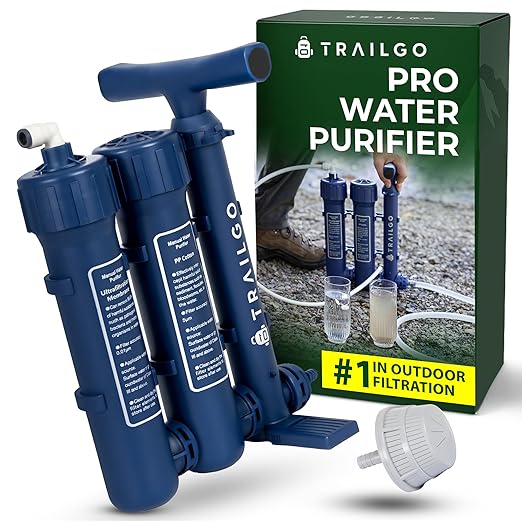
Trailgo is a different category than the pocket filters. This is for people who want a “make a lot of water” solution—group camping, rainwater processing, emergency readiness, or situations where you’re filtering into jugs, not just bottles. Reviews tend to focus on output and usability: people like that it works well for small groups, that setup videos are helpful, and that the filters are easy to pull and rinse. That last point matters more than you’d think when you’re filtering repeatedly over days.
The most honest user complaint is one that experienced campers instantly recognize: hose packaging can cause kinks, and kinks wreck flow. This is not a performance issue with the filter itself—it’s a setup issue. If you treat the hoses gently, store them coiled, and keep your inlet/outlet clean and separate, this kind of kit can be a powerhouse. The key is to accept what it is: basecamp gear. If you try to justify it for ultralight backpacking, you’ll resent the bulk. If you use it where it belongs, it’s a joy.
Why it shines
- High-volume output – Designed to supply multiple people quickly.
- Easy filter access – Rinsing/cleaning filters is straightforward.
- Good for preparedness – Fits the “water plan” mindset for disasters and backups.
- Simple operation – Owners say setup is easy once you’ve seen it once.
Good to know
- It’s bulky for backpacking; it makes more sense for car camping, basecamp, or emergency storage.
- Hoses can kink if folded; store rolled/coiled.
- Replacement filters and long-term upkeep matter—treat it like a system, not a toy.
Expert use tip: Do a “living room setup test” once. Fill a bucket, run a few cycles, and learn where you naturally place inlet/outlet. That one rehearsal prevents 90% of real-life campsite fumbling.
Ideal for: basecamp crews, preparedness households, and anyone who wants to process bulk water with less hand fatigue.
12. BKLES 3-in-1 Solar Electric Filter (BK3000) – Electric Convenience with Manual Backup

This is the kind of product that makes sense the moment you imagine filtering water with sore shoulders, cold hands, or kids asking for a refill. Owners describe it as a “favorite item we brought” on family trips because it produces clean water quickly and frees your hands while it runs. That “hands-free” part is not just comfort—it’s campsite efficiency. You can set it up and do other tasks (tent, stove, packing) while water is being processed.
What makes the BK3000 stand out in the electric category is redundancy. It’s designed to run electronically, charge via solar or USB, and still operate via a manual pump if power runs out. That’s exactly what preparedness-minded users want: multiple ways to keep water flowing when the grid isn’t friendly. Reviews also highlight helpful add-ons like emergency lighting and reverse charging. The real-world constraint is the same as with all hose-based systems: avoid kinks, keep the clean outlet from touching dirty surfaces, and rinse/maintain filters so performance doesn’t fall off.
Why it’s a strong “system”
- Electric + manual modes – When batteries die, you still have a way to make water.
- Solar charging support – Useful for longer trips and power-out scenarios.
- Fast, hands-free filtering – Owners love being able to set it and handle other camp tasks.
- Emergency utility – Lighting and device charging features are genuinely useful in storms or outages.
Good to know
- Heavier than ultralight filters; it makes more sense for family camping, vehicle-based trips, or preparedness kits.
- Hose kinks reduce output—lay hoses out cleanly.
- Filter replacement cadence matters; treat maintenance as part of the system.
Expert use tip: Create a “clean outlet discipline.” Clip the clean hose to the rim of your clean container so it never dips into the water you just filtered. That one habit prevents the most common contamination mistake with hose systems.
Ideal for: families, car campers, and emergency planners who want redundancy and hands-free water production.
13. Greeshow Electric Portable Filter – Solar + Crank Convenience in a Compact Case

Greeshow’s electric unit is built for a specific kind of user: someone who wants a compact “survival utility” that filters water with minimal effort and also functions as light and emergency power. A van-life reviewer describes filling two large jugs on one charge—slow and steady, but hands-free, which is exactly how many people want an electric filter to behave. Another reviewer bought it specifically for go-bags and wildfire preparedness, liking that it bundles multiple functions in one box.
Here’s the expert perspective: electric filters are less about ultralight hiking and more about removing friction. They’re for car camping, basecamp, storm kits, and travel scenarios where you want to process more water without squeezing or pumping. The trade-off is always the same: more complexity. With Greeshow, the charging options (USB, solar, hand crank) reduce the “dead battery” fear, but long-term reliability matters, and one negative review mentions a motor failure after heavy use. Greeshow’s reported customer follow-up and replacement behavior is exactly what you want to see with a powered device—because if something breaks, support is part of the product.
Why it’s useful
- Hands-free filtering – Great for processing water while you do other camp tasks.
- Multiple charging methods – Solar, USB, and crank options reduce “no power” anxiety.
- Emergency features – Light modes and a built-in power bank can be clutch in real emergencies.
- Compact, organized kit – Case-driven storage keeps accessories from becoming a tangled mess.
Good to know
- Electric pumps can fail; for high-stakes preparedness, redundancy (backup filter or chemical method) is smart planning.
- It’s not the lightest choice for long backpacking trips where ounces matter.
- Certification claims can be hard to verify from listing images—focus on performance and your risk context.
Expert use tip: Think of this as a “water station,” not a bottle. Keep a dedicated clean container, clip the outlet hose, and let it run. If your water is visibly silty, use the included prefilter and let sediment settle first—electric pumps like cleaner input.
Ideal for: van life, car camping, go-bags, and emergency readiness where hands-free water + power + light is more useful than ultralight packing.
14. BKLES Electric Filter (Green) – Quick Stops, Big Convenience

This BKLES electric model is loved for one thing: speed with low effort. On trips where everyone is stopping briefly and wants to refill quickly, an electric pump can make you look like the hydration hero. One reviewer describes using it on a river trip where friends relied on gravity filters at night—while the electric pump made quick stops dramatically faster. Another reviewer was impressed enough to build a “belt-and-suspenders” setup by adding a Sawyer filter inline on the intake side, using the electric pump mainly for fast transfer and convenience.
From an expert angle, that tells you exactly what this device is: a strong pump + workflow tool. It can pull water from below (useful when the bank is steep), it doesn’t require squeezing, and it can serve a group without making one person do constant manual labor. The biggest caution is sanitation of hoses. If the outlet hose touches raw water, muddy fabric, or the inside of your “dirty bag,” your filtered water is no longer as clean as you think. The fix is simple: clip the clean hose so it never touches anything questionable.
Why people buy it
- Effort-free refills – Excellent for quick hydration stops and group refills.
- Strong suction ability – Useful when water is below you or hard to reach safely.
- Battery efficiency – Some owners report multiple days of use without recharging.
- Great taste feedback – Multiple people note the water tastes better than expected.
Good to know
- Hose hygiene is everything; prevent clean hoses from contacting raw water or dirty surfaces.
- Some users find the unit smaller than expected; set realistic expectations for “station” use vs “bottle” use.
- As with all electric systems, have a backup plan for true emergencies.
Expert use tip: Carry a simple hose clip or use a small carabiner to secure the clean outlet to your bottle or jug rim. This prevents the single most common mistake with electric filters: “clean water touching dirty hose.”
Ideal for: group hiking, river trips, and campers who want quick refills without squeezing bags or pumping by hand.
15. BKLES BK-2000 Electric Portable Filter – A “Set It and Forget It” Camp Helper
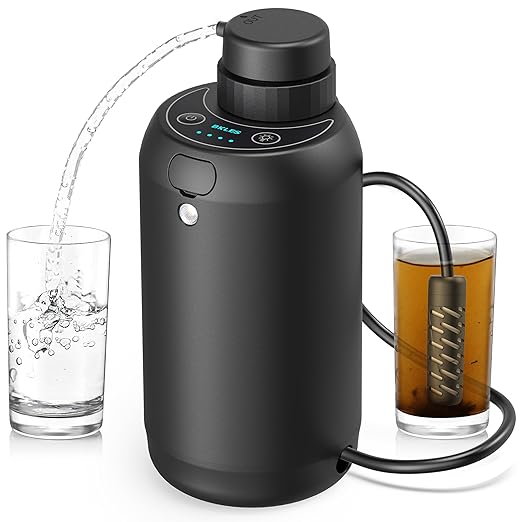
The BK-2000 is another electric option with a loyal following, and the reviews tell you why: it reduces effort, it can run while you do other tasks, and it’s surprisingly useful for non-traditional filtering jobs (including rainwater processing). One owner ran a large amount of dirty rainwater through it and described the output as clear as tap water. Another mentioned that it can overflow a container if you “walk away,” which is both a funny problem and a real one—this thing will keep doing its job until you stop it, so you need a stable setup.
What experienced users learn quickly is that electric systems demand a little “clean-room discipline.” Keep intake and outlet parts separated, keep the clean hose elevated or clipped, and avoid packing the clean hose against the dirty hose in the same pouch. One reviewer even designed a clip to keep the outlet hose off surfaces—an excellent idea. If you adopt that habit, the BK-2000 becomes a true convenience tool for longer trips, day hikes, and emergency scenarios where your energy should be spent on shelter and planning, not squeezing water bags.
Why it’s loved
- Hands-free water production – Great for camp routines: filter water while you set up or cook.
- Simple button workflow – Less effort and less “training” than pump systems.
- Good for longer trips – Owners describe it as useful across multi-day hikes and emergency preparedness.
- Extra utility – Lighting and device charging features can matter in real scenarios.
Good to know
- Some units have occasional hose-fit issues; test everything at home before relying on it.
- It can overflow containers if left unattended—set up a stable catch container.
- As with all hose systems, outlet hygiene is critical for truly clean results.
Expert use tip: Make a “filtering station” habit: stable container on level ground, outlet clipped to the rim, intake in moving/cleanest available water. Then set a timer on your phone so you don’t accidentally create a puddle.
Ideal for: longer trips, rainwater and camp utility use, and preparedness kits where convenience and low effort are top priorities.
How Camping Water Purifiers Actually Clean Water (and How to Get Better Results)
Most frustration with water treatment comes from mismatched expectations. People buy a system that’s perfect for clear alpine streams and then use it in silty pond water… or they buy a group gravity kit and expect it to feel like a personal bottle. Once you understand what each technology is actually doing, you can pick the right tool and use it in a way that feels effortless.
The “how” in plain English
- Hollow fiber filtration (common in squeeze, gravity, and many pumps) is like a super-fine sieve. It’s excellent for particulates and many biological contaminants, but it can clog if you feed it mud and silt.
- Carbon stages are about taste, smell, and some chemicals. This is why some systems make water taste “normal” and others taste like a lake.
- Press-style purifiers are built around separation and a controlled press process: raw water in the outer cup, treated water in the bottle. This makes them great for travel and family use.
- Electric pumps don’t “filter differently” so much as they change the human experience. They remove the effort barrier, but you must manage hoses and keep dirty/clean separation disciplined.
The reason flow rates change so much in the real world is simple: water quality and maintenance. Clear stream water behaves one way. Silty water acts like sandpaper on performance. Great systems stay great when you prefilter, backwash, and don’t wait until the filter is already miserable.
Five field habits that make any system better
- Take the cleanest water you can reach – moving water beats stagnant water; clearer water extends filter life.
- Prefilter when it’s dirty – a bandana, coffee filter, or letting sediment settle saves effort and extends performance.
- Backflush early – don’t wait for the flow to become painful; quick maintenance keeps it fast.
- Separate dirty and clean gear – store intake hoses and dirty bags away from clean hoses and bottle mouths.
- Protect filters from freezing – if nights are cold, keep the filter warm in your bag or jacket.
If you only adopt one habit from this entire guide, make it this: treat your “clean output” like a sterile zone. Most water-treatment failures in the field are not filtration failures—they’re handling failures.
FAQ: Camping Water Purifiers, Answered
Do I need a purifier, or is a filter enough for camping?
Why do some filters feel fast at home but slow in the wild?
Which system is best for families and kids?
Can I store filtered water in the bag or bottle overnight?
What’s the simplest way to avoid cross-contamination?
Final Thoughts: Choosing Your Best Camping Water Purifier
The goal isn’t to buy the fanciest gadget. The goal is to remove friction between you and hydration—so you drink enough, cook comfortably, and stop mentally negotiating with yourself about whether a source is “probably fine.”
Here’s how to turn everything you just read into one confident choice:
- Want the most confident, least-fussy “one and done” pick? Start with the GRAYL UltraPress. It’s the cleanest workflow and the easiest system to trust fast.
- Filtering for kids, family, or friends who keep asking for refills? The GRAYL GeoPress is built for high-output, repeat refills with a simple routine.
- Backpacking and counting ounces? The Sawyer Squeeze is the modular ultralight staple—especially if you build a smart bag/bottle routine and backflush regularly.
- Want “camp faucet” convenience? Go gravity: LifeStraw Peak 3L for small groups, or the larger two-bag gravity system if you’re supplying multiple people at basecamp.
- Prefer a classic “I control the flow” approach? A pump like the Katadyn Hiker Pro is still a smart, durable choice—especially for shallow sources and hydration bladders.
- Want hands-free water production and emergency utility? Electric options like the BKLES BK3000 or Greeshow shine for car camping, storms, and go-bags—especially if you maintain clean hose habits.
At the end of the day, your best camping water purifier is the one that matches your water sources and your habits: you can use it tired, you can use it fast, and you can keep it clean without turning camp into a chore. Pick the format that fits your trips, adopt two or three of the “field habits” above, and you’ll have safe, great-tasting water wherever you roam.
