
There’s a very specific kind of confidence that shows up when you cook with cast iron at camp. Not “I followed a recipe” confidence—more like “I can feed my people anywhere” confidence. A real camp Dutch oven is one of the only tools that can sear, simmer, roast, and bake using nothing but hot coals and a little patience.
If you’re hunting for the best camp dutch oven, you’re not actually shopping for a pot. You’re shopping for outcomes: chili that tastes deeper than it does at home, bread that smells like a bakery in the woods, and cobbler that makes strangers wander over from the next campsite “just to say hi.”
This buyer’s guide is built differently than the usual surface-level “pick the biggest one” advice. I used the real-world patterns that keep showing up in owner feedback—lid fit, casting quality, handle design, how the lid behaves with coals, how annoying clean-up becomes when you’re dry camping, and which “included accessories” actually make a difference when it’s dark and your gloves are already greasy.
Below you’ll find 12 camp Dutch ovens that are genuinely popular on Amazon (from classic Lodge workhorses to feature-packed value kits), plus a field-practical way to choose the right one on the first try. If you read this once, you’ll know what you’re buying and why—and you’ll cook better because of it.
How to Choose the Best Camp Dutch Oven for Real Campfire Cooking
A camp Dutch oven is simple—just iron and a lid—yet it’s also wildly easy to buy the wrong one. Not because the brands are confusing, but because most people shop by “quarts” and ignore the details that actually decide your results: diameter, lid shape, handle geometry, and how the oven behaves when you’re cooking with coals instead of a thermostat.
1. Decide where you’ll cook: coals, grill, stove, or all of the above
Every product in this guide is cast iron, which means it can handle serious heat and it rewards you with stable temperatures. But how you plan to heat it should shape your choice:
- Direct coals / campfire cooking: Prioritize a flanged lid (raised rim) to hold coals, and legs so the pot sits above bottom coals without smothering them.
- Hanging over fire with a tripod: A solid bail handle matters more than you think. Thin bails can feel sketchy when the pot is full and swinging.
- Grill, pellet grill, or wood stove: Legs are still helpful, but a stable base and a lid that seals well become the main story. You’re “oven-roasting” with convection-like heat from the chamber.
- Home oven / backyard: Almost any of these will work beautifully—especially if you love baking bread and cobbler without heating up the kitchen in summer.
If you’ll cook across multiple heat sources, pick the Dutch oven that’s easiest to handle safely. That usually means a comfortable lid handle, a bail handle you trust, and an accessory kit that isn’t a gimmick.
2. Quart size tells you “volume.” Diameter tells you “results.”
Here’s the most helpful mental model:
- Bigger diameter = better browning. More surface area means less stacking and less steaming.
- Deeper pot = better for stews and big roasts. More headroom, better simmering, more “one pot” space.
- Deep lid design = better baking control. Deep-dish lids often trap and distribute top heat more evenly for biscuits, cornbread, and cobbler.
A 6-quart Dutch oven can feel “bigger” than an 8-quart one if the 6-quart has more usable diameter and the 8-quart is mostly extra depth. That’s why people sometimes buy a “huge” oven and still end up cooking in batches.
3. Match size to your crew (and your packing reality)
These are field-realistic size matches—meaning they account for what you can cook without stacking too high:
- 4–4.1 qt (10-inch class): Ideal for couples, side dishes, desserts, beans, and “one-pan breakfast” for a smaller group.
- 6 qt (12-inch class): The sweet spot for most campers. Big enough for chili, stew, a whole chicken, and real baking—still manageable to lift and clean.
- 8–9 qt: A better “family basecamp” size. You can cook bigger cuts and not feel cramped when adding potatoes, carrots, onions, and broth.
- 10–12 qt (14–16-inch class): For groups, troops, cookouts, and “we’re feeding everybody” weekends. Amazing… but not subtle in weight or fuel use.
If you’re car camping with friends, big can be perfect. If you’re moving camp daily, you’ll appreciate a smaller pot you’ll actually use every morning.
4. The lid is your second pan—choose it like you mean it
A good camp lid does three jobs: holds top coals, seals moisture, and behaves like a cooking surface when flipped. But lids vary a lot:
- Flanged lids: The raised rim keeps coals from rolling off. This is non-negotiable if you want real top heat for baking.
- Skillet / griddle lids: When inverted, you can fry eggs, crisp bacon, toast tortillas, or sear shrimp while the main pot rests.
- Deep-dish lids with legs: These can be surprisingly powerful for baking because they sit close to the food and encourage even top heat.
If you plan to bake, prioritize a lid you can load with coals confidently and a fit that doesn’t leak heat. If you plan to fry breakfast daily, prioritize a lid that sits flat and feels stable as a skillet.
5. Lid fit is the “hidden feature” that changes everything
This is where experienced Dutch oven cooks get picky (for good reason). A lid that rocks noticeably can leak heat, burn coals faster, and make baking inconsistent. It doesn’t mean the product is “bad,” but it does mean you should check it early—while returns are easy.
- Quick test: Set the lid on the pot and gently press opposite edges. A tiny amount of movement can be normal; large rocking is a problem for baking.
- Field workaround: Bake with a parchment liner and rotate more often; stews and braises are usually forgiving even with imperfect lids.
- Best practice: If the lid fit is clearly off, exchange it. Don’t try to “fix” a poor casting with heroic seasoning.
6. Bail handles, coil handles, and why “hot” is not the same as “usable”
Every cast iron handle will get hot. The difference is whether it gets hot in a way you can manage:
- Bail handles: Great for tripods and moving the pot, but they can swing, rattle, and get in the way when you’re stirring. You’ll want gloves or a hook tool.
- Coiled handles: The coil design adds length and reduces direct heat transfer compared to a straight bar. It doesn’t make it cool—it makes it less aggressive.
- Side handles: Easier for controlled lifting with two hands, especially when the pot is heavy and full.
A Dutch oven that “looks portable” can still be annoying if the lid handle is tiny or the bail feels thin. When you’re cooking at dusk, that’s the kind of annoyance that turns into burnt food.
7. Accessories: which ones actually matter at camp
Some kits include extras that are genuinely helpful. Others include things you’ll never unpack. Here’s what I consider real value:
- Lid lifter: Essential. You can cook without it, but you’ll hate yourself. Length matters: too short means your knuckles get close to heat.
- Lid stand: Underrated. It keeps a coal-covered lid off the ground and stops ash from getting into your food when you set the lid down.
- Storage bag: Great for transport—but only if the pot is bone-dry. Bags can trap moisture and invite surface rust if you pack away damp iron.
- Tripod: Helpful for hanging and controlled heat, especially for long stews. Just make sure it’s sturdy enough for a full pot.
- Thermometer notch / channel: Nice when present. It lets you check temps without lifting the lid and dumping heat (especially helpful for baking and roasts).
8. The cast-iron care reality (that keeps it easy, not fussy)
Camp Dutch ovens last forever when you keep two habits consistent:
- Dry it completely after washing. At camp, that might mean setting it near coals for a minute or putting it on a warm grill to drive off moisture.
- Oil it thinly while warm. You’re not greasing it—you’re protecting it. A thin wipe is the goal, not a sticky coat.
Don’t overthink seasoning on day one. Pre-seasoned cast iron still improves with use, and “nonstick” becomes real when you cook the right foods in it repeatedly (breads, cornbread, sautéed onions, bacon, and roasts are all seasoning-friendly).
Quick Comparison: 12 Best Camp Dutch Oven Picks
Use this table to find the models that match your crew size, camp setup, and the kind of cooking you actually do. Then jump into the reviews for the “why” that product pages rarely explain—like how a lid behaves with coals or why certain kits feel easier in the dark.
On smaller screens, swipe or scroll sideways to see the full table.
| Model | Camp style | Capacity | Best match | Amazon |
|---|---|---|---|---|
| Lodge 8 Qt Camp Dutch Oven (L12DCO3) | Legs + flanged lid | 8 qt | Best all-around balance of heritage quality and real camp performance | Amazon |
| Lodge 6 Qt Camp Dutch Oven | Legs + flanged lid | 6 qt | The “most people, most trips” size with classic camp design | Amazon |
| Camp Chef 14″ Dutch Oven + Lid Lifter | Deep lid + notch | 12 qt class | Premium big-group pot with a lid that really functions as a skillet/griddle | Amazon |
| Overmont 9 Qt Camp Dutch Oven | Skillet lid kit | 9 qt | Big capacity for groups without going into ultra-heavy 12-qt territory | Amazon |
| NSIRONS 12 Qt Camping Dutch Oven | Mega batch | 12 qt | Large gatherings, pot roast weekends, and “feed the whole campsite” cooking | Amazon |
| Velaze 10 Qt Camping Dutch Oven | Stand + lifter | 10 qt | Troops, cookouts, and family basecamps that want extra kit features | Amazon |
| Overmont 6 Qt Camp Dutch Oven | Skillet lid kit | 6 qt | Value-focused sweet spot with baking-friendly lid design | Amazon |
| Uno Casa 6 Qt Dutch Oven + Bag | Bag + lifter | 6 qt | Travel-ready kit for frequent campers who want easy packing | Amazon |
| EDGING CASTING 6 Qt + Tripod Kit | Tripod-ready | 6 qt | All-in-one “hang it and cook” approach for campfire setups | Amazon |
| Camp Chef SDO10 10″ Double Seasoned | Compact 10″ | 4 qt | Portable side-dish and dessert king (beans, cobbler, cornbread) | Amazon |
| Lodge 4 Qt Camp Dutch Oven | Compact Lodge | 4 qt | Small-group classic with the same “generations” durability mindset | Amazon |
| Crucible Cookware 4.1 Qt + Lid Stand | Accessory-smart | 4.1 qt | Thoughtful details (pour lip + lid stand) for cleaner, calmer camp cooking | Amazon |
In‑Depth Reviews: 12 Best Camp Dutch Oven Options
These reviews go beyond “it’s cast iron and it’s big.” I’ll show you what matters once you’ve actually cooked three meals in a row: how the lid behaves with coals, how annoying the handle feels when the pot is full, how easy it is to keep seasoning healthy while camping, and which designs make baking feel predictable.
1. Lodge 8 Quart Pre‑Seasoned Cast Iron Camp Dutch Oven – The Classic That Earns Its Reputation

If you want one camp Dutch oven that can handle almost anything—stew, chili, pot roast, baked bread, cobbler, even roasting poultry— the Lodge 8 quart is the model I trust to behave the most consistently across the widest range of cooks. It’s not “fancy,” but it’s the kind of tool you buy once, learn deeply, and keep using for years.
Where this oven shines is the camp geometry: sturdy legs to keep it above bottom coals, and a flanged lid that actually holds a ring of top coals without them constantly sliding off. Flip that lid and you’ve got a real griddle surface—perfect for bacon, tortillas, or finishing vegetables while the main pot rests.
Real-world campers love it for slow-cooked meals where the oven holds heat like a battery. One of the most common “Lodge moments” is the set-it-and-return-to-magic experience: prep stew ingredients, set the pot over coals, go do camp things, and come back to fork-tender food. And because cast iron seals moisture so well, stews and braises taste richer than you expect from “camp food.”
Now, the honest expert note: large castings can vary slightly. Some buyers have reported lids that rock more than they’d like. My advice is simple—check lid fit early. A tiny amount of movement can be normal, but if it’s clearly excessive, exchange it while it’s easy. A good lid fit is worth it, especially if you plan to bake.
Why you’ll like it
- True camp design – Legs + flanged lid make coal cooking feel controlled instead of chaotic.
- Big, practical capacity – Ideal for family meals: stew with vegetables, larger roasts, and real baking volume.
- Lid becomes a griddle – A real second cooking surface when you’re cooking multiple components.
- Seasoning improves with use – Once you cook a few rounds of onions, bacon, and cornbread, it gets increasingly easy-release.
Good to know
- It’s heavy—especially when full. Plan your cooking spot so you’re not carrying it far.
- Lid fit can vary slightly; check for rocking early and exchange if needed.
- Like most cast iron, it rewards routine: dry thoroughly and oil lightly after cleaning.
Ideal for: campers who want one “do-it-all” Dutch oven that covers family meals, basecamp baking, and long, slow stews without drama.
2. Lodge 6 Quart Pre‑Seasoned Cast Iron Camp Dutch Oven – The Sweet Spot for Most Trips
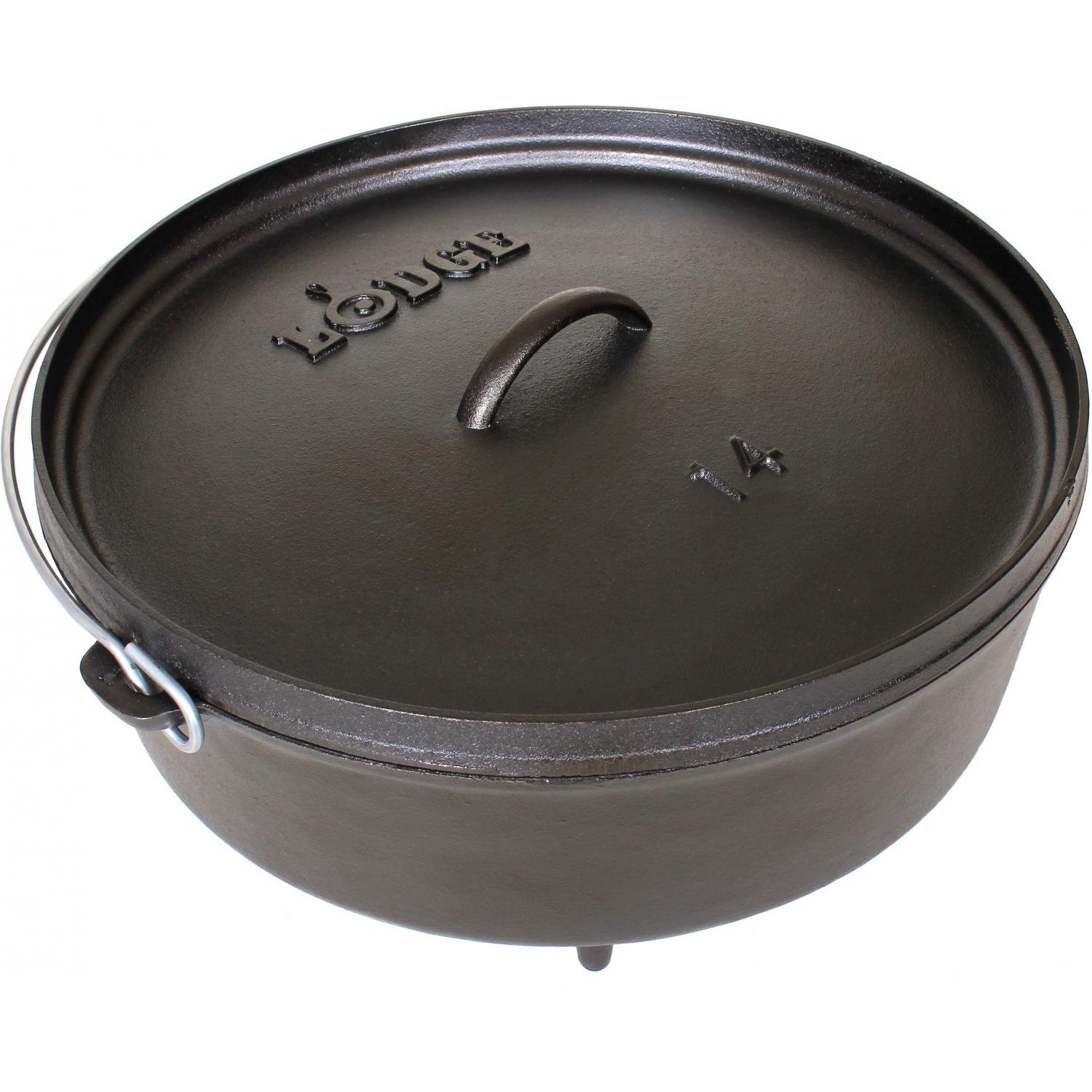
The 6 quart Lodge is the size I recommend when someone says, “I want to cook real meals at camp, but I don’t want to wrestle a cauldron.” It’s large enough to feel powerful—yet small enough that you’ll actually use it for breakfast, dinner, and dessert in the same weekend.
The design is the same core Lodge camp layout: legs that keep airflow under the pot and a flanged lid that welcomes top coals. That matters because camp cooking is a heat-management game. If your pot sits flat on ash, bottom heat becomes patchy. If your lid can’t hold coals, baking becomes guesswork. This oven gives you a stable platform to learn on.
From an expert perspective, 6 quarts is the “repeatable results” zone. You can brown meat without overflowing the pot, you can add vegetables without crushing everything, and you can bake biscuits or cornbread without needing a huge coal budget. It’s also easier to rotate and reposition than an 8–12 quart oven, which makes it easier to avoid hot spots.
One underrated advantage: this size cleans up faster. When you’re dry camping, water is precious. A pot you can wipe, rinse quickly, heat-dry, and oil in a few minutes is the difference between “camp cooking is fun” and “why did we do this to ourselves?”
Why it’s a smart pick
- Best all-around capacity – Big enough for real meals; manageable enough for frequent use.
- Coal-friendly design – Legs + flanged lid are exactly what you want for baking and roasting.
- Great learning oven – Easier to control and rotate than very large ovens.
- Versatile beyond camp – Works beautifully on grills, wood stoves, and in home ovens too.
Good to know
- Still heavy compared to kitchen cookware—cast iron is a commitment.
- If you regularly feed 6–10 people, you’ll wish you’d gone bigger.
- The bail handle is excellent for tripods, but it can get in the way while stirring.
Ideal for: campers who want one Dutch oven that fits most trips—couples, small families, and friend groups that cook one main dish at a time.
3. Camp Chef 14‑inch Cast Iron Dutch Oven + Lid Lifter – The Basecamp Powerhouse

If you’re the person who ends up feeding everybody—family reunions, hunting weekends, big-group camping, or even backyard gatherings—the Camp Chef 14-inch is the kind of Dutch oven that turns “camp cooking” into a real outdoor kitchen. It’s big, confident, and built around the idea that the lid is a tool, not just a cover.
The standout design choice is the deep lid with legs. When you flip it, it becomes a legitimate skillet/griddle surface that can sit directly over coals. That means you can cook breakfast on the lid—bacon, eggs, hash—then move straight into a stew or roast in the pot. And because the lid has a notch/channel for checking temperatures (and letting a thermometer probe pass), you can monitor heat without repeatedly lifting the lid and dumping your carefully built top heat.
This model shines with “big proteins” and long cooks: whole birds, large roasts, goulash, stew, and “everything in one pot” meals. Owners routinely use it for cobbler and cornbread too, and big diameter helps baking because you can spread batter more evenly. The tradeoff is fuel and handling: a 14–16 inch class oven needs more coals, more attention to rotation, and a stable place to sit.
Here’s the expert move if you buy this size: treat it like a basecamp oven. Set up one dedicated cooking station (flat ground, safe clearance), keep your lid lifter and gloves in the same exact place every time, and build a routine for rotating top and bottom heat. Once you do that, big ovens stop feeling intimidating and start feeling luxurious.
Why it earns its space
- Huge cooking capacity – Designed for groups and big meals without batching.
- Deep lid becomes a skillet – A real second pan for breakfast or quick sears.
- Thermometer notch – Helps you check temps without lifting the lid and losing heat.
- Great for roasting and baking – Big diameter gives you better spreading and browning control.
Good to know
- This is a heavy, large-format oven—best for car camping, basecamps, and backyard cooking.
- Bigger size means you’ll burn more coals and you’ll need a wider cooking area.
- Large lids are heavy too—use the lid lifter and plan where you’ll set the lid down.
Ideal for: big-group campers and backyard cooks who want one oven that can roast, bake, and do breakfast on the lid without feeling cramped.
4. Overmont 9 Qt Camp Dutch Oven – The “Bigger Than 6 Qt” Upgrade That Still Feels Packable

The jump from 6 qt to 9 qt is the jump you feel when you’re cooking for more than two hungry adults. Suddenly you can do “real portions” without the pot feeling full before you even add vegetables. That’s the niche the Overmont 9 qt serves best: it’s big enough to feed a group, but it doesn’t push into the ultra-heavy “12 qt class” handling zone.
Overmont’s appeal is practical camp versatility: a reversible lid that can act as a skillet, legs that work with coals, and a kit-style approach that usually includes the essential tool (a lid lifter) so you’re not scrambling for accessories. This matters because the first camp Dutch oven experience often fails due to handling—not cooking. If you can’t safely lift the lid, you can’t manage heat, and everything else becomes stress.
Owner feedback tends to fall into a consistent pattern: the cooking performance is solid, the size is genuinely useful, and the value is strong. The critiques are also consistent: some people wish the casting were smoother, and some pay special attention to handle behavior when hanging on a kettle hook or tripod. That’s not a deal-breaker—just a reminder to set up your station thoughtfully. If you hang it, test the stability before the pot is full of food.
Expert tip: in a 9 qt oven, layering becomes tempting. Resist the urge to stack food too high when you want browning. Use the lid as a skillet to brown meat in batches, then build your stew in the main pot. You get better flavor and you protect your final texture.
Why it’s a smart “bigger” move
- Meaningful capacity upgrade – More room for meat + veg + broth without crowding.
- Lid doubles as a skillet – Makes multi-part meals easier at camp.
- Good heat retention – Excellent for slow cooking, stews, and “leave it and come back” meals.
- Value-focused build – A strong option if you want size without paying for a legacy-name premium.
Good to know
- Casting can be a bit rougher than premium models; seasoning improves it over time.
- Hanging setups deserve a stability check before you commit to a full pot.
- It’s still heavy—9 qt is not a casual lift when loaded with food.
Ideal for: campers who cook for 3–6 people and want to stop feeling cramped in a 6 qt without stepping up into massive 12 qt territory.
5. NSIRONS 12 Qt Camping Dutch Oven – The “Pot Roast Weekend” Crowd‑Feeder
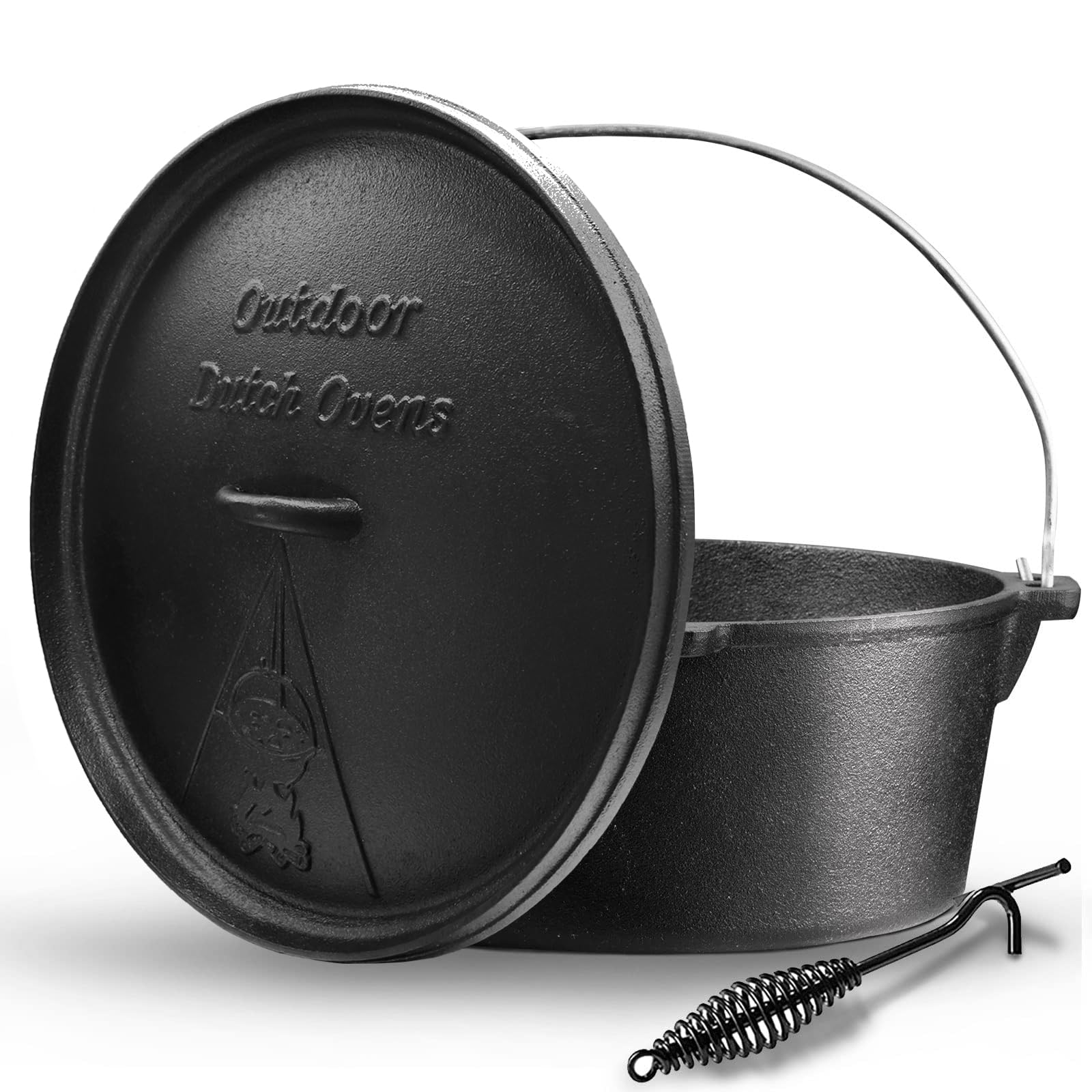
A 12 quart camp Dutch oven is not subtle. It’s a statement: “We’re cooking for everybody, and we’re doing it properly.” The NSIRONS 12 qt sits in that big-cook category where the pot becomes the center of camp life—especially for long roasts and large stews.
Owners love it for exactly the meals you’d hope: pot roast with vegetables, beef stew, baked potatoes, biscuits, and big-batch breakfast cooking. One of the most useful real-world notes is how well it performs on alternative heat sources: pellet grills, wood stoves, and outdoor cooking stations where stable heat can build over time. That “slow, steady heat” is where cast iron turns basic ingredients into something memorable.
Design-wise, it leans into practical safety: a spiral-style handle intended to reduce aggressive heat transfer, and the classic two-in-one approach where the lid can be used as a skillet. In big ovens, that lid-as-skillet feature is extra valuable because it lets you brown meat, cook onions, or fry eggs without dragging a second skillet into your kit. You can cook on the lid while the main pot rests, or vice versa.
Expert reality check: big ovens demand setup discipline. They’re heavy even empty, and they become serious once loaded with food. Pick a flat cooking station, keep tools within arm’s reach, and plan your lid landing spot so you’re not balancing a coal-covered lid on a rock. If you do that, the size becomes a luxury instead of a hassle.
Why big-group campers love it
- Massive capacity – Built for large roasts, big stews, and feeding groups without batching.
- Two-in-one lid – Lets you fry and sear while still running a “main pot” cook.
- Even heat distribution – Excellent for long cooks on grills, stoves, and coal setups.
- Practical safety accessories – Lid lifter and handle design reduce handling stress.
Good to know
- This is a heavy-duty piece of gear—best for basecamps and car camping, not constant moving.
- Large diameter means more coals/fuel and more heat-management attention.
- If you only cook for 2–4 people, this will feel oversized quickly.
Ideal for: big families, group camps, and anyone who wants one pot that can roast, stew, and bake for 6–10 people.
6. Velaze 10 Qt Camping Dutch Oven – Big Capacity With a “Ready to Cook” Kit Feel

The Velaze 10 qt is built for campers who want one pot that can do the full camp menu: whole chicken, stew, cinnamon rolls, fried eggs, and even cookies—without feeling like you’re pushing the limits of the pot. That 10 qt size is a great “large but not ridiculous” middle ground for groups.
What makes Velaze interesting is the kit approach. Owners talk about how much fun it is for family cooking (especially when cooking becomes an activity for kids), and the included pieces—like a lid lifter and a stand/support—add convenience that matters when you’re working over real heat. If you’ve ever tried to lift a coal-covered lid with improvised tools, you already know why this matters.
In real use, Velaze is often praised for meal variety: people use it for stews, breakfast, baking, and “cook one thing, flip the lid, cook the next thing” routines. That lid-as-griddle functionality is especially valuable in camp settings because it reduces the number of pans you need to bring. One family cooked a whole chicken, then flipped the lid and cooked shrimp—exactly the kind of “camp kitchen flexibility” you want.
Expert note: pre-seasoned doesn’t always mean “perfectly seasoned.” Some owners add a quick extra oiling/seasoning pass before the first cook and report better early results. That’s not a flaw—it’s just cast iron reality. A single evening of cooking onions and bacon often upgrades the surface dramatically.
Why it’s great for groups
- Generous 10 qt capacity – Feeds groups without forcing batches for main dishes.
- Camp-friendly lid design – Flanged lid supports top coals for roasting and baking.
- Skillet/griddle lid use – Cook breakfast or sear sides right on the lid.
- Accessory-forward kit – Lifter and support pieces reduce “camp cooking friction.”
Good to know
- You may want to add one extra seasoning layer before heavy use for best early nonstick feel.
- Large cast iron is heavy—plan a stable cooking station and safe lid landing spot.
- It’s best for car camping or basecamps where you’re not carrying gear far.
Ideal for: families, groups, and organizations that want one big, versatile oven with a practical accessory set for safer handling.
7. Overmont 6 Qt Camp Dutch Oven – The “Minimal Stuff, Maximum Meals” Workhorse

Overmont’s 6 qt has become a favorite for a very specific type of camper: the person who wants fewer items, more capability. Full-time RV nomads and frequent campers often describe it as the one pot that replaces multiple pans. And that makes sense—6 qt is the most usable “do everything” size for real meals.
The lid design is a big part of that story. The lid can act as a skillet, and the overall geometry is friendly to coal cooking. Owners talk about cooking eggs cleanly, making soups and stews, roasting meats, and—most telling—baking bread and scones successfully without an oven. That’s the moment a camp Dutch oven becomes more than a stew pot.
This is also a great pick if you’re learning. Because the pot is big enough to be forgiving, but not so big that you’re juggling a mountain of coals and a heavy lid every time. A 6 qt teaches you heat management habits: how to build a coal bed, how to rotate, how to check doneness without dumping heat, and how to keep your seasoning healthy.
Expert note on value brands: casting smoothness can vary more than premium models. That usually doesn’t change cooking performance, but it does change the “feel” of cleaning and seasoning. If you treat it like a lifetime tool—dry thoroughly, oil lightly, avoid thermal shock—it becomes easier with time.
Why it’s a strong everyday camp oven
- 6 qt sweet spot – Big enough for real dinners; manageable enough for frequent use.
- Skillet lid versatility – Makes breakfast and multi-component cooking easier.
- Great for baking – Many owners report successful breads and camp pastries.
- Value-focused durability – With good care, it becomes a long-term piece of gear.
Good to know
- May benefit from an extra seasoning layer early on for best performance.
- Rougher casting can mean slightly more effort to wipe perfectly clean at first.
- Like all cast iron, it demands consistent drying and oiling to prevent rust.
Ideal for: campers and RVers who want one pot to handle breakfast, dinner, and baking without bringing a full cookware set.
8. Uno Casa 6 Qt Camping Dutch Oven – The “Pack It Cleanly” Choice With a Storage Bag

Uno Casa’s 6 qt stands out for one reason that matters more than people admit: it’s easier to keep your camp kit organized. The included storage bag makes it simple to transport the oven without coating your trunk in soot or oil, and for frequent campers, that convenience adds up fast.
Cooking-wise, it’s the right size for the “classic camp menu.” Owners use it for egg-and-potato hash over coals, goulash hung from a tripod, stews, and baking. And a recurring compliment is that it cooks evenly over coals without aggressive hot spots—especially when you stir and rotate like you should. That’s exactly what you want from cast iron: stable temperatures and predictability.
The lid’s dual-use role matters too. When your lid can become a skillet, you can do breakfast and dinner more cleanly: brown sausage on the lid, then build a stew in the pot, then bake cornbread while your stew rests. That “one system, many meals” rhythm is what makes camp cooking feel smooth instead of messy.
Expert caution (friendly, not scary): bags are amazing for transport, but moisture is the enemy. Make sure the pot is fully dry and lightly oiled before you store it. If you pack it away damp, a bag can trap humidity and create surface rust. When you treat the storage bag like a “clean transport tool,” it becomes a real advantage.
Why it’s practical
- Storage bag included – Easier transport and cleaner packing between trips.
- 6 qt capacity – The most usable size for real meals without oversized handling.
- Tripod and coal friendly – Works well over coals and hung over a fire.
- Skillet lid function – Adds cooking flexibility without extra pans.
Good to know
- Some owners report occasional accessory omissions—check your kit immediately after delivery.
- Depth may feel slightly shallow for some “big stew” recipes (easy fix: cook in batches or choose 8–9 qt).
- Always store fully dry; bags can trap moisture if you pack damp iron.
Ideal for: frequent campers who want a 6 qt oven and a clean, organized way to store and transport it between trips.
9. EDGING CASTING 6 Qt Camp Dutch Oven + Tripod – Built for “Hang It Over the Fire” Camps

The most overlooked problem in camp Dutch oven cooking isn’t heat—it’s setup. If you don’t have a stable way to position the oven, you end up improvising with rocks, half-burnt logs, or uneven grates. That’s why a kit that includes a tripod can be genuinely useful for certain campsites. EDGING CASTING leans directly into that “hang and cook” approach.
In owner feedback, this oven shows up at deer camps and multi-day trips because it’s used hard: chili, whole chicken, stew, and camp bread—cooked repeatedly over fire and on stoves. A recurring compliment is heat distribution: the pot heats evenly and holds temperature, which is the whole cast-iron promise. Another practical note: some buyers mention choosing it because it feels lighter than comparable legacy-name options in a similar size.
The lid-as-skillet functionality also gets real use. This is not a gimmick when you’re feeding people: flip the lid and you’ve got a surface to fry or sear while your main dish rests. It’s also useful for “top heat management” because you can move coals onto the lid when baking, then flip and use the same lid as a hot cooking surface once you’re done.
Expert approach for kits like this: treat the tripod as a control tool, not a decoration. Hanging is excellent for long, gentle simmers and stews. If you want hard searing, you’ll often do better over coals with the pot sitting on legs—then hang it for the slow finish. That “hybrid” method is how you get both flavor and tenderness.
Why it’s useful for certain camps
- Tripod included – Helps create a stable camp cooking station where grates are unreliable.
- Solid 6 qt capacity – Big enough for family meals, stew, bread, and roasts.
- Lid doubles as skillet – Adds flexibility without extra cookware.
- Real-world “used all week” feedback – Owners often describe repeated successful cooks, not just one-off tests.
Good to know
- Less-known brands can have more variation in finishing—plan to build seasoning over time.
- Tripod cooking is best for simmering and slow cooking; searing often works better directly over coals.
- Like all cast iron, it demands careful drying/oiling after washing.
Ideal for: campers who prefer hanging over a fire (or who camp where stable grates are unpredictable) and want a 6 qt size that fits most meals.
10. Camp Chef SDO10 10″ Double Black Seasoned Dutch Oven – The Portable “Beans & Cobbler” Specialist

The Camp Chef SDO10 is a 10-inch class, 4-quart camp Dutch oven that hits a sweet spot most people ignore: it’s small enough to pack easily, but big enough to feed a crowd when you cook the right recipes. That’s why owners rave about chili, beans, nachos, and breakfast hash—foods that scale well without requiring massive volume.
Camp Chef’s “Double Black” seasoned finish is designed to be ready-to-cook, and many users report easy clean-up after the first few cooks. The more interesting field detail is how people use it on real trips: dry camping with liners, parchment paper, and efficient cleanup methods where water is scarce. When you’re camping without hookups, easy cleanup becomes a feature—because it determines how often you’ll cook.
The lid design also has small but real advantages. A flanged lid makes top coals stable, and the thermometer notch/channel lets you check temperatures without lifting the lid. That matters most when baking cornbread or cobbler, where repeated lid lifting can ruin your top heat and cause uneven browning.
Expert tip: a 10-inch oven is a brilliant “dessert oven.” It’s easier to hold stable baking heat because you’re managing fewer coals, and the smaller surface area makes rotation and heat balancing easier. If you want confident cobbler on your next trip, a compact oven like this is one of the fastest ways to get there.
Why it’s a sleeper hit
- Portable size – Easier to carry, store, and use frequently than larger ovens.
- Great for sides and desserts – Beans, cornbread, cobbler, and breakfast hash cook beautifully.
- Thermometer notch – Helps control heat without lifting the lid repeatedly.
- Good heat retention – Stays hot for a long time, which is great for serving at camp.
Good to know
- 4 quarts is limiting for big roasts or “feed everyone” stews.
- Some owners mention seasoning differences between lid and pot at first; it evens out with use.
- Compact ovens can run hot if you overload coals—start conservative and adjust.
Ideal for: campers who want a compact Dutch oven for desserts, sides, and small-batch meals—and who value easy packing and control.
11. Lodge 4 Quart Pre‑Seasoned Camp Dutch Oven – Heritage Quality in a Smaller, Friendlier Size

Not every trip needs an 8–12 quart monster. Sometimes you want a small, dependable oven for beans, sauces, side dishes, and desserts— or for couples who cook real meals but don’t want leftovers for a week. That’s where the Lodge 4 qt camp oven fits beautifully.
The design still has the essential camp features: legs for bottom airflow and a flanged lid for holding coals. So even though it’s small, it’s still a real camp Dutch oven—not a kitchen pot pretending to be one. That makes it especially good for baking biscuits, cornbread, and small cobblers, because you can build top heat confidently without fighting coal slide-off.
From an expert perspective, the smaller Lodge is also a “confidence builder.” It’s easier to rotate, easier to move, and easier to clean. And because it has less thermal mass than huge ovens, it responds a bit faster to adjustments. When you’re learning coal control, that feedback loop helps you improve quickly.
If you camp with a larger group, this can still have a place as a second oven: use it for dessert or a side dish while your main Dutch oven handles the stew or roast. Two ovens at camp feels like a cheat code—especially if one is compact and easy to manage.
Why it’s worth owning
- Compact, controllable cooking – Great for learning heat management and baking basics.
- Real camp features – Legs + flanged lid mean it behaves properly over coals.
- Easy cleanup – Smaller pot = quicker wipe-down and less water used.
- Perfect “second oven” – Great for desserts or sides alongside a larger main pot.
Good to know
- Capacity is limited; it won’t cover big roasts or large-group stews.
- Small ovens can over-brown if you run too many coals—start gentle.
- Still cast iron heavy compared to typical cookware, just more manageable than big ovens.
Ideal for: couples, small families, and campers who want a compact, high-quality Dutch oven for desserts, sides, and controlled baking.
12. Crucible Cookware 4.1 Qt Camp Dutch Oven – The Clean, Clever Choice With a Lid Stand
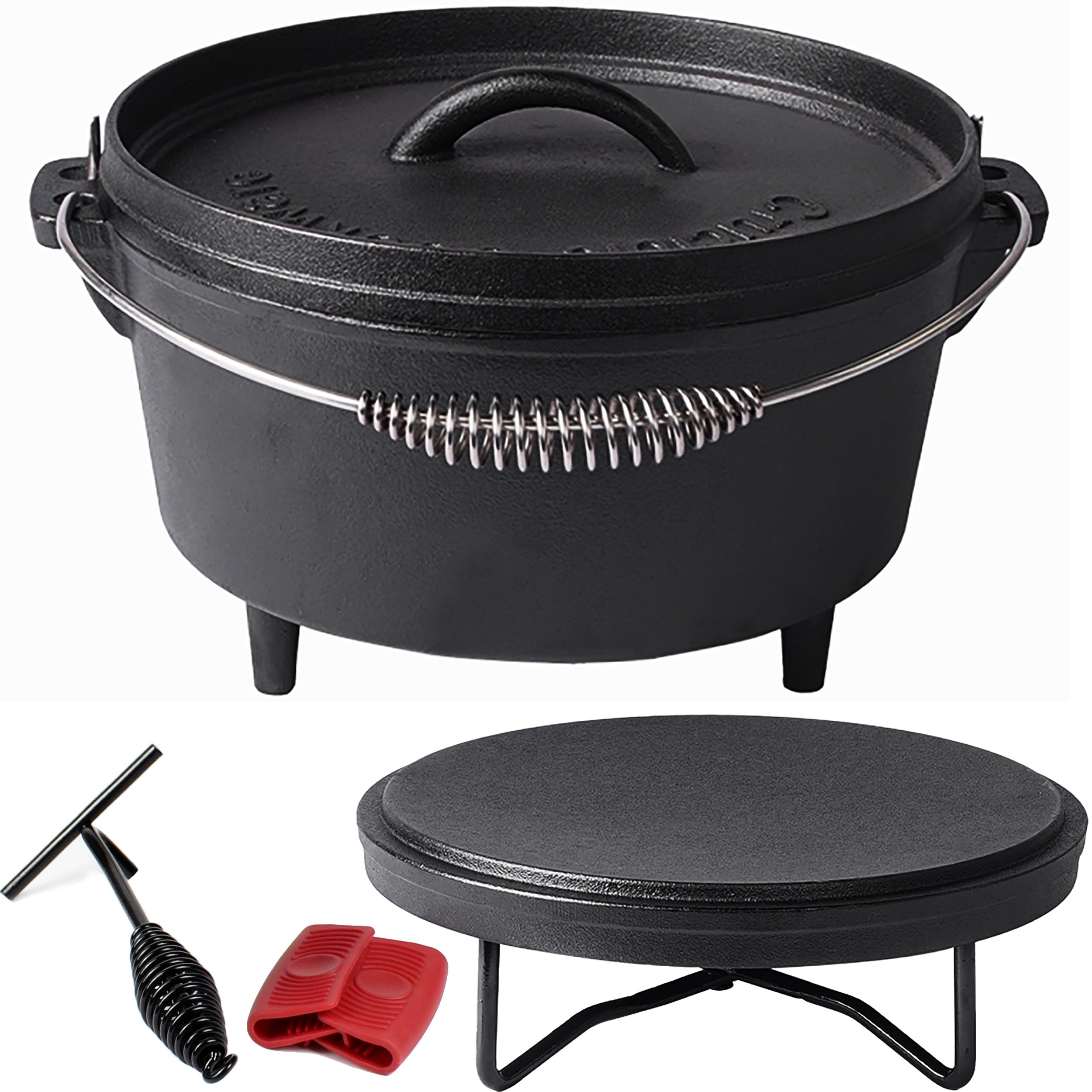
Crucible Cookware’s 4.1 qt camp oven is one of the most “thoughtfully designed” picks in this guide, because it focuses on the small problems that annoy people at camp—and solves them with smart accessories. The headliner is the lid stand, which is a bigger deal than it sounds: it gives you a clean, stable place to set a coal-covered lid without dumping ash into your food or onto the ground.
The pot also includes practical design touches campers appreciate: a coiled handle that improves control when moving the pot, and a pouring lip that makes serving stews and soups less messy. Those are the little details that matter when you’re serving food by lantern light. Owners who already own multiple Dutch ovens often mention being pleasantly surprised by the finish quality and design.
In real use, people love this size for biscuits, cornbread, smaller stews, and everyday cooking that fits typical camp group sizes. It also nests well with larger ovens, which is a nerdy but real advantage if you like building a “modular” camp kit. If you already own a big 8–12 quart oven, this is an excellent companion oven for sides and desserts.
Expert note: some owners mention the lid lifter being a bit short. It still works, but if you have big hands or you cook over very hot coal piles, you’ll appreciate longer tools. The good news is that the lid stand reduces the “awkward lid moment” so you’re less likely to fumble.
Why it’s uniquely useful
- Lid stand included – Cleaner camp workflow and less ash/ground mess.
- Pouring lip – Makes serving stews and soups easier and less splashy.
- Great small-batch size – Perfect for biscuits, sides, desserts, and smaller meals.
- Modular “second oven” vibe – Pairs well with a larger Dutch oven for full camp menus.
Good to know
- The lid lifter may feel short for some users; gloves help a lot.
- 4.1 qt won’t satisfy big-group cooking needs by itself.
- Like all cast iron, it needs thorough drying and light oiling after cleaning.
Ideal for: campers who care about clean workflow and smart accessories—or anyone who wants a compact companion oven for sides and dessert.
How Camp Dutch Ovens Actually Cook (and How to Get “Pro” Results With Coals)
The magic of camp Dutch oven cooking is not the recipe—it’s heat control. Cast iron gives you steady temperatures, but you still have to “drive” the heat. Once you understand a few rules, your results become repeatable and your food stops surprising you.
Heat control that actually works outdoors
- Think “top heat + bottom heat,” not “campfire.” Baking needs both. Stews mostly need bottom heat.
- Start conservative with coals. You can add heat faster than you can undo burning the bottom.
- Build a stable coal bed first. Flames are chaotic; coals are controllable. Let your fire burn down to the cooking stage.
- Use rotation like a thermostat. Rotate the pot a little and rotate the lid the opposite direction. This evens out hot spots.
- Wind changes everything. Wind strips heat and makes you overcompensate. If possible, shield your cooking area.
- Use the lid as a tool. Need more top heat for browning? Add coals. Need gentle simmer? Reduce top coals and focus bottom heat.
If you bake often, consider keeping a simple written “coal starting point” in your camp kit (even a note in your phone). Not because you’ll follow it perfectly—but because it helps you make small adjustments intentionally instead of guessing.
Seasoning, cleanup, and the “dry camping” method
- Line when it makes sense. Parchment paper (or foil for certain cooks) can cut cleanup dramatically, especially for cobbler and bread.
- Don’t shock hot iron. Avoid pouring cold water into a hot pot. Let it cool a bit, then clean with hot water and a brush.
- Dry with heat. After washing, set it near coals or on a warm grill briefly to evaporate moisture from pores.
- Oil thinly while warm. You want a whisper of oil, not a sticky layer. Wipe off excess with paper towel.
- Store with airflow. If you use a bag, ensure the pot is fully dry. Consider placing a paper towel inside to absorb any humidity.
The best “nonstick” camp Dutch ovens aren’t the ones that arrive perfect—they’re the ones you keep in good shape. After a few trips, the surface gets better, food releases more easily, and cleanup becomes a quick routine instead of a chore.
FAQ: Camp Dutch Ovens, Answered
Do I really need legs and a flanged lid for camping?
What size should I buy first?
Why does my food burn on the bottom but stay pale on top?
Can I use my camp Dutch oven on a home stove or in the oven?
How do I prevent rust while camping?
Is a lid stand actually worth it?
Final Thoughts: Pick the Camp Dutch Oven That Fits Your Real Trips
Here’s the best way to choose: picture your next three camp meals. Not your fantasy feast—your real rhythm: breakfast, dinner, and something fun (usually dessert). Then pick the Dutch oven that makes those three meals feel easiest.
- Want the most reliable “do it all” choice? Go with the Lodge 8 Qt Camp Dutch Oven. It’s the classic for a reason, and it scales to family meals effortlessly.
- Want the most versatile size for most campers? Start with the Lodge 6 Qt Camp Dutch Oven or the value-friendly Overmont 6 Qt. These are the sizes you’ll actually use constantly.
- Cooking for a crowd? Look at the Camp Chef 14-inch, NSIRONS 12 Qt, or Velaze 10 Qt depending on how big you typically cook.
- Want a travel-friendly kit with easier storage? The Uno Casa 6 Qt with storage bag keeps packing cleaner between trips.
- Want compact control for desserts and sides? The Camp Chef SDO10 10-inch, Lodge 4 Qt, or Crucible 4.1 Qt with lid stand make baking and small meals feel easy.
No matter which one you choose, your results will improve fast once you lock in two habits: rotate for even heat, and dry/oil after cleaning. Match the size to your real crew, pick the lid style that matches how you cook, and you’ll end up with a best camp dutch oven experience that feels like a permanent upgrade to every trip.
