
You’ve spent 12–16 hours nursing a brisket, nailed the bark, and let it rest like a saint. Then you grab a random chef’s knife, saw back and forth, and watch all those juices bleed out into shredded, ragged slices. Ouch.
A dedicated carving blade fixes that in one move. A long, thin slicer glides through the meat in a single stroke, protecting the bark, keeping the smoke ring intact, and giving you those perfect, Instagram‑ready slices with zero sawing. The trick is picking the one knife that actually feels like your personal Best Brisket Carving Knife instead of just another shiny gadget.
In this guide, we’ll walk through 10 seriously capable brisket carving knives and BBQ knife sets—from single 12‑inch German‑steel slicers to Japanese‑style sets that include flexible boning knives for trimming and breaking down whole packers. I’ve dug through spec sheets, metallurgy details, independent testing, and hundreds of real‑world pitmaster reviews to figure out what actually matters once the meat hits the board: blade length, flex, grind, steel, handle comfort, and how easy these knives are to maintain over time.
In this article
How to Choose the Best Brisket Carving Knife for Your BBQ
Before you fall in love with any single blade, it helps to zoom out and think about how you actually cook and serve meat. Do you trim whole packers every weekend? Mostly slice flat‑only briskets for family dinners? Occasionally carve turkey at the holidays? A little planning here means you buy once, use it constantly, and don’t end up with a gorgeous knife that lives in a drawer.
1. Start with how you cook and serve brisket
Think less about “12 inches is what the pros use” and more about your board in real life:
- Small roasts & half briskets: A 10″ slicer is plenty and often easier to control in a home kitchen.
- Full packer briskets: A 12″ slicer lets you make long, single strokes that keep slices even and juicy.
- Multi‑protein cooks: If you’re also carving pork shoulder, ham, and turkey, a 12″ knife still works—but a matching boning knife makes prep way easier.
- Occasional BBQ, lots of weeknight roasts: A slightly shorter, more all‑rounder blade (10–11″) might feel less intimidating and more versatile.
If you routinely cook big briskets for a crowd, go long. If you’re making smaller cooks or just learning, a slightly shorter blade can build confidence without sacrificing performance.
2. Pick your blade length & profile
The knives in this guide fall into two main shapes, with a couple of hybrids:
- Straight “sujihiki”‑style slicers: Long, narrow blades with a gentle curve—like the Cutluxe, Dalstrong, Sunnecko and HOSHANHO 12″ slicers. These are made to pull through meat in one smooth motion and minimize drag, especially with a hollow (Granton) edge.
- Curved breaking / butcher knives: More belly and a higher tip, like the SYOKAMI multifunction slicer and curved HOSHANHO knives. You still get great long slices, but the curve lets you rock and maneuver when trimming fat caps, breaking down primals, or tackling large fruits and melons.
If your main goal is silky, even slices on brisket, flat‑ish slicers with a thin grind win. If you also want one knife that can trim, portion steaks, and tackle big butchery jobs, a curved breaking profile is extremely handy.
3. Understand steel, hardness & edge holding
All of these knives use modern high‑carbon stainless steels, but they’re tuned a little differently:
- German‑style steels (like the X50CrMoV15 used in the Cutluxe and Dalstrong slicers) run around 56 HRC. They’re tough, chip‑resistant, and forgiving to sharpen—great if you’d rather touch up your edge quickly than baby something ultra‑hard.
- Japanese‑style high‑carbon steels (like HOSHANHO’s 10Cr15CoMoV and SYOKAMI’s high‑carbon stainless) are typically heat‑treated a notch harder, which means they can take a very fine, aggressive edge and hold it longer—at the cost of being a bit less tolerant of abuse.
For most home pitmasters, both families are more than tough enough. The bigger question is how comfortable you are with sharpening. If you already own stones or a guided sharpener, those harder Japanese‑leaning steels can be incredibly rewarding. If you’re newer to knife care, the German‑style blades are very forgiving and pair beautifully with a simple honing rod.
4. Handle, balance & grip security
You’re going to be cutting in long strokes with a slippery, juicy piece of meat under your hand. Handle design matters more than you think:
- Pakkawood & natural woods: Many of the knives here use stabilized wood handles. They feel warm and traditional, with just enough texture for grip. They do best with hand‑washing and occasional drying rather than soaking.
- POM / polymer handles: Dalstrong’s Vanquish series uses a high‑quality synthetic that’s grippy when wet and NSF‑certified for pro kitchens. It’s a bit less romantic, but incredibly practical.
- Gear‑texture & spine details: SYOKAMI’s gear‑tooth patterns and spine grooves are there to give your thumb and fingers extra bite, especially when your hands are slick with fat. Some users love the extra security; a few find aggressive texturing takes a moment to get used to.
Whatever handle you choose, look for full‑tang construction (the steel runs through the handle) and at least two or three rivets. That gives you a solid, durable feel you can trust when you’re bearing down on a big cut.
5. Decide: one great slicer or a full BBQ set?
You’ll see a clear split in the reviews below between single knives and 2‑piece sets:
- Single 12″ slicer: Perfect if you already own a decent boning or trimming knife, or mostly carve finished meats that are already trimmed. One knife, one job, maximum focus.
- Slicer + boning set: Sets like the Cutluxe BBQ & brisket kit, Sunnecko and SYOKAMI pairs give you a long slicer plus a smaller, flexible blade for trimming hard fat, removing silver skin, or following bones on rib roasts and whole turkeys.
- Slicer + honing rod: The Cutluxe set with a 10″ steel is ideal if you’re happy with your current knives but want a dedicated brisket blade and an easy way to keep all your knives tuned up between full sharpenings.
If you’re building a BBQ kit from scratch, a two‑knife set is usually the best bang for your buck. If you’ve already collected a few good blades but your slicing game is weak, a single high‑quality slicer is the cleanest upgrade.
6. Safety, storage & maintenance
All of these knives arrive seriously sharp. A few practical details help keep them that way:
- Sheath or box: The Cutluxe single brisket knife and several Japanese‑style options ship with sheaths or gift boxes, which double as safe storage if you don’t have a block.
- Honing vs sharpening: A rod (like the 10″ steel from Cutluxe) realigns the edge between cooks; it doesn’t replace occasional sharpening with stones or a guided system.
- Hand wash only: High‑carbon steels and wood handles hate dishwashers. A quick wash, rinse, and dry right after slicing will do more for your knives than any miracle product.
- Respect the tip: Long slicers are thin by design. Avoid twisting in hard bark or chopping through bone; that’s what your cleaver or heavy chef’s knife is for.
Quick Comparison: 10 Best Brisket Carving Knife Picks
Here’s a bird’s‑eye view of the 10 knives we’ll be reviewing. Use this table to spot which models match your slicing style, preferred blade length, and budget, then jump to the full review for the details.
On smaller screens, swipe or scroll sideways to see the full table.
| Model | Blade style | Blade length | Best for | Amazon |
|---|---|---|---|---|
| Cutluxe 12" Brisket Knife – Artisan Series | Straight granton slicer | 12" | One‑knife upgrade for most home pitmasters | Amazon |
| Dalstrong 12" Vanquish Slicing & Carving Knife | Heavy‑duty slicer | 12" | Premium feel, pro‑kitchen toughness | Amazon |
| Cutluxe Carving Knife Set for BBQ & Brisket | Slicer + boning set | 12" + 6" | Complete brisket trimming and slicing kit | Amazon |
| SYOKAMI Brisket Slicing Knife Set | Japanese‑style set | 12" + 6.7" | Hardcore BBQ hobbyists & gift‑worthy sets | Amazon |
| Cutluxe BBQ Knife Carving Set + Honing Rod | Slicer + 10" rod | 12" + 10" | Brisket slicer plus easy edge maintenance | Amazon |
| Sunnecko Professional BBQ Carving Knife Set | German steel set | 12" + 7" | Giftable set with high‑hardness steel | Amazon |
| HOSHANHO 12" Carving Knife – Straight Slicer | Japanese straight slicer | 12" | Long, thin slicing strokes on full packers | Amazon |
| HOSHANHO 12" Curved Brisket Knife | Curved breaking knife | 12" | Trimming fat caps & breaking down big cuts | Amazon |
| SYOKAMI 12" Multifunction Brisket Slicing Knife | Japanese multifunction | 12" | One knife for brisket, roasts & cakes | Amazon |
| HOSHANHO 10" Carving Slicing Knife | Compact brisket slicer | 10" | Smaller kitchens, shorter arms, tight spaces | Amazon |
In‑Depth Reviews: 10 Brisket Knives Pitmasters Swear By
Now let’s zoom in on each knife. Use these reviews to match specific strengths—blade length, weight, steel, and overall “feel” on the board—to how you actually cook, not just what looks cool in photos.
1. Cutluxe 12" Brisket Knife – Effortless Slices, Friendly Price
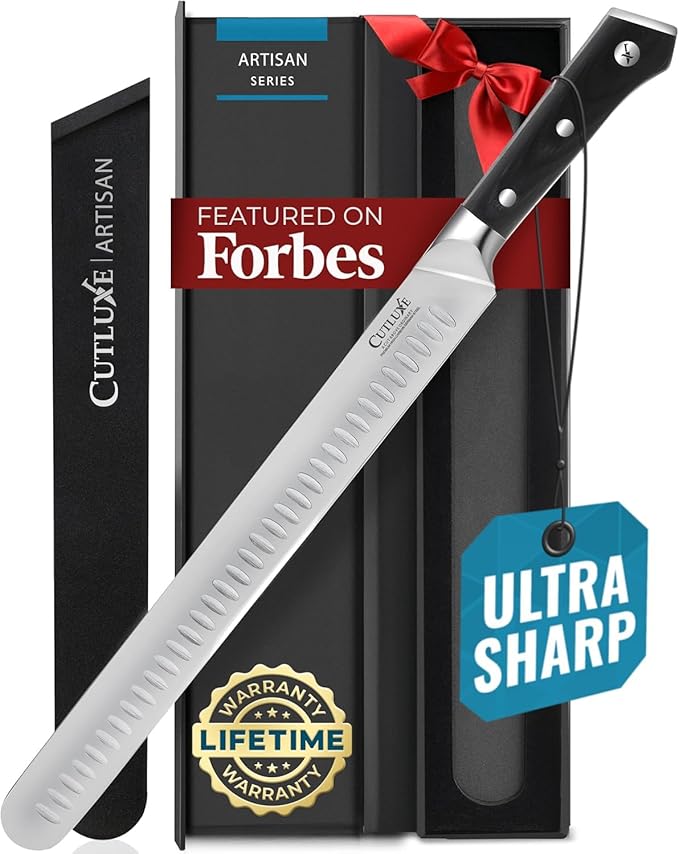
If you want one knife that simply makes brisket slicing easy, this is it. The Cutluxe 12″ brisket knife uses a classic German high‑carbon stainless formula (X50CrMoV15) hardened to about 56 HRC, with a thin, narrow blade and a Granton (hollow) edge that helps meat release cleanly instead of clinging to the steel. Each side of the edge is ground to roughly 14–16°, which is aggressive enough to feel laser‑sharp but still tough enough for home use.
In practice, that means you can set the knife down at the edge of a rested brisket and simply pull it toward you in a single stroke. Owners talk about slicing 8‑bone prime ribs, whole packers and even watermelons with almost no pressure—just guiding the blade and letting the weight of the knife do the work. Many also point out how surprisingly light and agile it feels for a 12″ slicer, which helps if you’re not used to long blades.
The full‑tang pakkawood handle is triple‑riveted and shaped with a gentle palm swell, so it fills bigger hands nicely but doesn’t feel blocky. Cutluxe backs the knife with a lifetime warranty against material and workmanship defects, and includes a fitted sheath—handy if you’re tossing it in a BBQ kit or drawer instead of a dedicated block.
Why you’ll like it
- Ridiculously smooth slicing – Long, thin blade with Granton edge glides through bark and smoke ring with minimal drag.
- Forgiving German steel – Easy to sharpen, resistant to staining, and tough enough for backyard abuse.
- Comfortable handle – Pakkawood scales and a full tang give good heft and secure grip, even for larger hands.
- Great value – You get pro‑level performance at a mid‑range price, plus a sheath and lifetime warranty.
Good to know
- The blade has a hint of flex by design; that’s great for feel, but it’s not meant for twisting in bone or frozen food.
- Out‑of‑box sharpness is very high—treat it with the same respect you’d give a razor until you get used to it.
- Like most long slicers, it needs a cutting board at least as wide as your brisket to really shine.
Ideal for: anyone who wants a single, do‑it‑all brisket slicer that feels approachable, slices incredibly cleanly, and doesn’t require pro‑level sharpening skills.
2. Dalstrong 12" Vanquish Slicing & Carving Knife – Heavy, Precise & NSF‑Ready
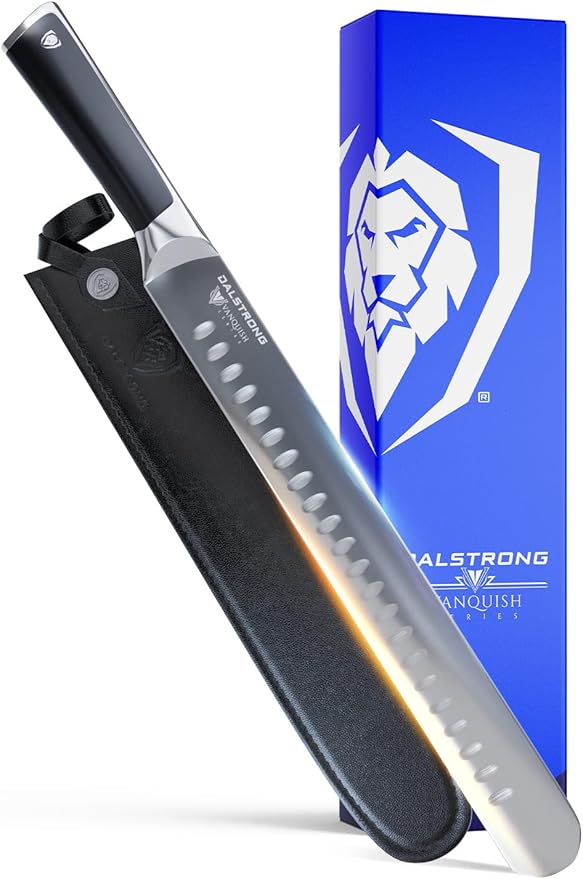
Dalstrong knives are a little polarizing online—people either think they’re overhyped, or they buy one and end up collecting the whole line. The 12″ Vanquish slicer sits in a nice middle ground: premium fit and finish, serious weight, and very strong performance, without reaching the eye‑watering prices of high‑end Japanese customs.
The blade is forged from high‑carbon German steel, again in that mid‑50s Rockwell sweet spot, but with a thicker spine and more substantial weight than most of the other slicers here. That heft is part of the appeal: once you’ve lined up your slice, the knife drops through large roasts with a confident, almost gravity‑assisted feel. The Vanquish handle is made from black POM (a dense, durable polymer) and is NSF certified, which is reassuring if you’re using it in a small catering or commercial setting.
User feedback consistently mentions scary sharp edges out of the box and excellent edge retention, even when the knife is used for more than just carving (think crusty breads and big melons as well as brisket). A few folks comment that it’s heavier than expected for a slicer—but most ultimately see that as a feature, not a bug, especially if they’re used to restaurant‑grade cutlery.
Why it stands out
- Serious, pro‑grade feel – Thick spine and extra weight make long slicing strokes feel very stable.
- NSF‑certified construction – Great if you cook in shared or professional kitchens with hygiene rules.
- Excellent out‑of‑box sharpness – Many owners are genuinely surprised at how sharp it arrives.
- Robust build – Good choice if you’re hard on gear or want something that feels “overbuilt” for home use.
Good to know
- Heavier than most slicers—if you prefer feather‑light blades, this may feel like overkill.
- The polished blade and bold branding are a bit flashy; some cooks prefer a more understated look.
- Price lands at the upper end of this list; you’re paying for build quality and branding.
Ideal for: home pitmasters who love pro‑grade gear, or anyone carving brisket in a semi‑commercial setting who wants a heavy, durable, easy‑to‑sanitize workhorse.
3. Cutluxe BBQ & Brisket Carving Set – 12" Slicer + 6" Boning Knife

If you’re starting from scratch and want a small, focused BBQ kit, this set hits a sweet spot. You get a 12″ granton‑edge brisket slicer similar to the standalone Cutluxe knife plus a 6″ curved boning knife with just the right flex for trimming fat caps, following ribs, and cleaning up whole briskets, packer roasts, and tenderloins. Both are forged from high‑carbon German steel and built on full tangs with pakkawood handles.
Owners who upgraded from random mixed knife blocks consistently describe this pair as “night and day.” The slicer stays in its lane, giving long, straight, almost effortless cuts, while the boning knife handles all the pre‑smoke grunt work: opening up the point, removing deckle fat, and tidying ribs. Several reviewers mention using the slicer for thin jerky prep and the boning knife for fish filleting and whole chicken breakdown—so you’re not limited to BBQ duty.
Edge holding is very solid; people doing multiple briskets a month report only needing light honing and occasional sharpening. The set ships in a presentation box that also works as simple storage, though you may eventually want a blade guard or roll if you travel with your kit.
Why you’ll like it
- Two knives, full workflow – One for trimming and boning, one for that silky final slice.
- Comfortable, matching handles – Both knives share the same pakkawood feel and balance, so switching mid‑cook is seamless.
- Excellent value per piece – Buying these two quality blades as a set usually costs less than assembling them individually.
- BBQ‑friendly design choices – Granton edge on the slicer and flex on the boning knife are exactly what you want for smoked meats.
Good to know
- No honing rod included—pair it with a simple steel or pull‑through sharpener if you don’t already have one.
- The boning knife is on the larger side compared with delicate fish boners; great for brisket, slightly overbuilt for tiny jobs.
- Like all wood‑handled knives, these prefer hand‑washing and drying immediately after use.
Ideal for: backyard smokers who want a compact “do everything” meat kit that covers trimming, boning, and slicing without buying a full pro roll.
4. SYOKAMI Brisket Slicing Knife Set – Aggressive Edges, Gorgeous Looks

SYOKAMI’s brisket set feels like it was designed by someone who actually trims and carves a lot of meat. The 12″ slicer uses a long, narrow blade with hollow dimples to shed meat, while the 6.7″ boning knife has a flexible, high‑carbon stainless blade that can bend around bones and cartilage without feeling flimsy. Both are hardened to around 56+ HRC and ground to very keen 13–15° edge angles, so they arrive genuinely razor‑sharp.
The handles are full‑tang wood with a distinctive “gear tooth” texture toward the front, giving your fingers extra bite even when they’re slick with fat. Several buyers specifically call out the balance and heft as feeling “like a much more expensive Japanese set,” and online BBQ communities frequently recommend this duo as a cost‑effective alternative to traditional sujihiki plus boning combos.
One of the nicest things about this set is how it straddles home and pro use. The presentation box and Damascus‑style blade pattern make it an easy gift for grill‑obsessed friends, but the steel and geometry are serious enough for competition cooks. The trade‑off is that the harder, thinner edges appreciate a bit more care—avoid torquing them through bone and give them a gentle touch‑up when they stop gliding.
Why you’ll like it
- Very sharp, very refined – Aggressive edge angles and hard steel give addictively smooth cuts.
- Thoughtful handle design – Gear‑style grip and full tang handles feel locked‑in, even with greasy hands.
- Flexible boning companion – Perfect for spatchcocking birds, trimming rib racks, and cleaning briskets.
- Gift‑worthy presentation – Looks and feels a lot more expensive than it is.
Good to know
- The thinner edges can chip if you twist into bone or cut on glass or stone—keep it to wood or plastic boards.
- Wood handles benefit from occasional oiling if you use them heavily and wash them often.
- Some chefs find the spine grooves slightly aggressive until they adapt to the grip.
Ideal for: brisket fans who love Japanese‑style knives, want a slicer and boning knife in one set, and don’t mind showing off a little on the cutting board.
5. Cutluxe BBQ Knife Carving Set – 12" Slicer with 10" Honing Rod

This set takes the same general idea as the single Cutluxe brisket knife but bundles it with a matching 10″ honing rod. The slicer is a 12″ granton‑edge blade in German high‑carbon stainless, while the honing rod is also hardened steel with a fine, consistent surface for realigning your edges between cooks. Both pieces share full‑tang construction and polished pakkawood handles, so the set looks and feels cohesive on the counter.
In reviews, people who were previously scared of honing rods often comment that having a matching steel next to the knife encourages them to actually use it—and they notice their knives staying sharp longer as a result. Others praise the balance and feel of the rod itself, saying it feels closer to pro‑grade butchers’ steels than the skinny rods that come with cheap blocks.
The main thing to understand here is that a honing rod doesn’t replace sharpening. It’s fantastic at straightening the microscopic edge after a slicing session, but eventually you’ll still want to refresh the bevel on stones or a guided sharpener. If you accept that, this bundle is a smart way to grab a quality slicer and finally get serious about maintaining the knives you already own.
Why it’s worth a look
- Complete edge‑care starter – You get a great slicer and a tool to keep it sharp between real sharpenings.
- Matching handles – Pakkawood grips on both pieces feel comfortable and upscale.
- Pro‑style honing rod – Longer length makes it easier to use safely and effectively.
- Nice presentation – Boxed set works well as a gift for the BBQ person who “has everything.”
Good to know
- The set doesn’t include a boning or trimming knife; it assumes you already own one.
- No sheath for the slicer in this bundle—consider a blade guard if it lives in a drawer.
- If you’re not interested in learning to hone, a slicer‑plus‑boning set might suit you better.
Ideal for: cooks who want a dedicated brisket slicer and a matching, good‑quality honing rod to take care of their entire knife drawer.
6. Sunnecko Professional BBQ Carving Knife Set – High‑Hardness German Steel Pair

Sunnecko flies a bit under the radar compared with Cutluxe and Dalstrong, but among BBQ gear reviewers this set pops up often. You get a 12″ brisket slicer and a 7″ boning knife, both forged from high‑carbon German stainless hardened to around 58+ HRC—noticeably harder than many mainstream German blades. The edges are sharpened to about 12–15° per side, so they arrive keen and stay that way with modest care.
Owners praise how “laser‑like” the slicer feels on properly rested brisket and prime rib, and how the boning knife has just enough flex to follow bones without feeling wobbly. Several long‑term users note that the knives still look new after months of regular use, with no obvious staining or handle swelling—good signs that the steel and pakkawood are properly treated.
Sunnecko bundles the set with sheaths and a neat gift box, plus a small pair of tweezers that’s handy for pulling stray bones or pin bones in fish. It’s a small touch, but it reinforces that this is a considered kit, not just two random knives bundled together.
Highlights
- Harder German steel – Higher Rockwell rating helps the edge stay crisp through long slicing sessions.
- Balanced, comfortable handles – Ergonomic pakkawood grips feel secure for both large and small hands.
- Complete BBQ duo – Slicer + boner covers most smoked‑meat prep tasks.
- Nicely packaged – Great choice when you want something that feels special straight out of the box.
Good to know
- This steel will reward proper sharpening—but may feel slightly slower to grind than softer blades.
- There’s no honing rod included, so you’ll want to add your own or sharpen a bit more often.
- Availability can fluctuate compared with bigger brands; if you see it in stock at a good price, don’t wait too long.
Ideal for: gifters and home pitmasters who want a handsome, hard‑wearing German‑steel set that behaves more like pro‑grade cutlery than budget starter knives.
7. HOSHANHO 12" Carving Knife – Long, Thin, and Surprisingly Versatile

This HOSHANHO 12″ slicer leans more toward Japanese knife culture than the German‑style blades above. It uses 10Cr15CoMoV high‑carbon steel—similar to some mid‑range Japanese formulations—cryo‑treated for extra hardness and sharpened to about 15° per side. In plain English: it gets very sharp, stays that way impressively long, and feels a little more “surgical” than many Western slicers.
The blade itself is long, slim, and relatively light for its size, which makes it fantastic for long, sweeping pulls across full packer briskets or big eye‑of‑round roasts. Reviewers mention using it interchangeably as a brisket knife, bread knife, and general carving knife for pork loin and turkey—because the thin blade and consistent edge leave clean, attractive slices with minimal tearing.
The pakkawood handle is shaped in a gentle Western style rather than a traditional Japanese octagon, so it will feel familiar if you’re used to European knives. If there’s a downside, it’s mostly scale: some buyers are surprised by how big a true 12″ blade feels in hand and on the board. If your kitchen is tight or your cutting board is small, consider the 10″ HOSHANHO instead.
Why you’ll like it
- Very fine edge – Japanese‑leaning steel and a tight 15° grind produce extremely clean cuts.
- Light for the length – Easier to maneuver than some heavier Western slicers.
- Multipurpose – Doubles nicely as a bread and general carving knife thanks to the thin profile.
- High perceived quality – Many users compare it favorably with much more expensive knives they own.
Good to know
- Length can be awkward in shallow drawers or tiny kitchens—measure your storage and board first.
- Harder steel prefers proper sharpening gear; cheap pull‑through sharpeners aren’t ideal.
- Like other HOSHANHO blades, it’s strictly hand‑wash and dry; don’t leave it soaking in the sink.
Ideal for: cooks who love the idea of a Japanese‑style brisket slicer that can also tackle bread and roasts, and who aren’t intimidated by a full 12″ blade.
8. HOSHANHO 12" Curved Brisket Knife – Breaking Knife Power for BBQ

Where the straight 12″ HOSHANHO behaves like a classic sujihiki, this curved version leans firmly into breaking‑knife territory. The same Japanese high‑carbon stainless steel and pakkawood handle show up here, but the edge has more pronounced belly and a taller heel, giving you extra knuckle clearance and a slightly more robust feel when you’re trimming or portioning heavy cuts.
That curve is surprisingly useful for BBQ. It lets you rock through cartilage, follow the contour of rib bones, and cleanly separate point from flat. Once the meat is cooked, you can still use it as a slicer—especially on shorter cuts or when you like a bit of forward “rock” as you pull through the slice. Many buyers mention using it on everything from chuck roasts and pork shoulders to bread and big fruit, treating it as a general‑purpose butcher’s knife that also behaves nicely on brisket.
Because the blade is long and slightly heavier than a pure slicer, it rewards good technique: let the weight and curve do the work rather than forcing it straight down. Used that way, it feels powerful and secure rather than unwieldy.
Why it’s interesting
- Breaking + slicing in one – Great for people who do as much trimming and portioning as final carving.
- Plenty of knuckle room – Taller heel and curved profile keep your fingers off the board.
- Durable, handsome construction – Same steel and pakkawood quality as other HOSHANHO knives.
- Multi‑tasker – Doubles as a big prep knife for fruit and veg when you’re not smoking meat.
Good to know
- Not quite as laser‑straight in its slices as a pure sujihiki‑style blade.
- The long, curved tip demands respect when working quickly in crowded kitchens.
- Better suited to medium and large hands; smaller users may prefer the 10″ model.
Ideal for: pitmasters who want one knife that can trim, break down, and carve big cuts—and who like the feel of a traditional breaking knife with modern steel.
9. SYOKAMI 12" Multifunction Brisket Slicing Knife – One Blade, Many Jobs

Think of this knife as the “Swiss Army” brisket slicer of the group. SYOKAMI uses a high‑carbon stainless steel hardened to the mid‑50s HRC, with a long, narrow blade, hollow dimples along the side, and a Damascus‑style etched pattern that makes it look far more expensive than it is. The handle is full‑tang wood with triple rivets, plus a gear‑tooth pattern near the front and grippy texturing along the spine for thumb control.
Beyond brisket, people love this knife for cakes, lasagna, layered desserts and large loaves—the very thin blade and scalloping help stop sticky foods from clinging. Professional butchers and home users alike comment that it arrives “scary sharp” and that the blade geometry strikes a nice balance between thinness and durability. A few note that the spine grooves are a bit aggressive out of the box, but the payoff is excellent grip even with wet or greasy hands.
If you mainly want one long, sharp, showpiece knife that can carve meat beautifully and also pull double‑duty on other big slicing tasks, this is a genuinely fun option. It looks dramatic, behaves predictably, and doesn’t demand advanced sharpening skills to keep humming along.
Why it’s a standout single
- Extremely versatile – Equally happy slicing brisket, trimming roasts, or cutting tall layer cakes.
- Good balance of thin and tough – Feels refined without being fragile.
- Secure grip – Gear‑textured handle and spine grooves help when your hands are slick.
- Great value – Looks and specs usually seen on pricier knives.
Good to know
- Like other decorative blades, the Damascus‑style finish may show scratches over years of heavy use.
- Spine grooves can feel a bit sharp if you choke up aggressively; some users lightly sand a spot for their thumb.
- No matching boning knife—if you trim a lot of raw meat, pair it with a separate narrow blade.
Ideal for: home cooks who want a single, do‑it‑all slicer that feels special, looks great on the board, and can handle everything from smoked brisket to birthday cakes.
10. HOSHANHO 10" Carving Slicing Knife – Shorter Blade, Same Bite

Not everyone wants—or needs—a full 12″ blade. If you mostly cook smaller briskets, roasts, or turkey breasts, this 10″ HOSHANHO offers a more compact, confidence‑boosting option without sacrificing steel quality. It uses the same Japanese high‑carbon stainless and 15° edge angle as the brand’s larger brisket knives, with an ergonomic pakkawood handle and a subtle curve that works well for both slicing and general carving.
Reviewers who’ve cooked for decades with shorter carving knives often describe this as the knife they “didn’t know they needed.” It’s long enough to handle an eye‑of‑round or a modest packer flat in a couple of passes, but short enough that storing and maneuvering it in a small kitchen feels trivial. Users report clean, low‑resistance cuts on everything from pork tenderloin and roasted chicken to crusty bread.
Because the blade is shorter, it’s slightly more forgiving if your board is narrow or your space is crowded—you’re less likely to bump walls or handles as you work. If you eventually graduate to 12″, this still earns its keep as a general slicer and bread knife.
Why it’s a smart pick
- More approachable length – Easier to handle and store than a 12″ slicer, especially for newer cooks.
- Same quality steel – You’re not “downgrading” on materials by going shorter.
- Curved versatility – Great for everyday carving as well as BBQ duty.
- Excellent value – Priced in line with many basic carving knives but with better materials and grind.
Good to know
- For full‑width packer briskets, you’ll probably need two strokes per slice instead of one.
- Like its 12″ siblings, it’s not dishwasher‑safe—hand wash and dry promptly.
- If you already own a good 8″ or 9″ slicer, the size jump may feel less dramatic.
Ideal for: smaller households, tighter kitchens, or anyone who wants brisket‑level slicing performance in a more compact, less intimidating package.
How Brisket Carving Knives Actually Slice (and Why Technique Matters)
On paper, a lot of brisket knives look similar: 10–12″ blades, high‑carbon stainless steel, full tangs. In the real world, subtle differences in thickness, grind, and how you use the blade have a huge impact on how your slices turn out.
Blade geometry & steel: what’s really going on
- Thin, narrow blades = less drag. The sujihiki‑style slicers in this guide are deliberately narrow and thin behind the edge, so they disturb less meat as they pass through. That’s how you get a clean smoke ring instead of ragged edges.
- Long blades = fewer strokes. A 12″ knife lets you take one long, smooth pull instead of three short sawing motions, which helps keep all that hard‑won moisture inside the slice instead of on the board.
- Harder steels = longer‑lasting sharpness. Japanese‑leaning steels like HOSHANHO’s and SYOKAMI’s hold a keen edge well, while classic German formulas on Cutluxe, Sunnecko and Dalstrong trade a bit of edge life for extra toughness and easier sharpening.
- Hollow / Granton edges reduce sticking. Those scallops you see along the sides of many blades trap a tiny bit of air, which helps meat release instead of suction‑cupping to the steel—especially useful on fatty, sticky brisket slices.
The upshot: for brisket, you want a long, relatively narrow blade that’s thin behind the edge, made from a steel that will stay sharp for the length of a cook or service. Every knife in this guide ticks those boxes; they just lean more German‑forgiving or Japanese‑precise depending on your taste.
Simple technique tweaks for cleaner slices
- Let the meat rest properly. No knife can save a brisket that hasn’t rested. Give it time for juices to redistribute, then slice.
- Use the full length of the blade. Plant the tip near the far edge of the brisket and pull toward you in one long stroke. Avoid “see‑saw” motions that tear meat and destroy bark.
- Slice across the grain. This matters more than the knife you choose. Take a second to locate the grain in the flat and rotate the meat so your slices cut across it, not with it.
- Keep your edge tuned. A few light passes on a honing rod before each slicing session keeps the edge aligned, which often feels like an instant upgrade in performance.
- Pick the right thickness. For competition‑style slices, aim for roughly pencil thickness. For sandwiches, a little thinner. Your knife will tell you what feels natural once you’ve used it a few times.
Once you’ve matched the right knife to your style and dialed in these small habits, slicing becomes almost meditative: line up, glide, stack perfect slices, repeat. The big win isn’t just prettier BBQ—it’s more consistent texture from slice to slice, and fewer “oops” pieces you have to hide in chopped beef.
FAQ: Brisket Carving Knives, Answered
Do I really need a dedicated brisket carving knife?
What length is best: 10" or 12"?
What’s the difference between a brisket knife and a bread knife?
Are Granton (hollow) edges actually better?
How often should I sharpen a brisket carving knife?
Can I put these knives in the dishwasher?
Final Thoughts: Choosing Your Best Brisket Carving Knife
A good slicer doesn’t just make your brisket look prettier—it changes the whole end of your cook. Slicing stops being stressful and starts feeling like the payoff: smooth, confident strokes, neat stacks of slices, and happy faces at the table.
Here’s a quick way to turn everything in this guide into a decision you can feel great about:
- Want the simplest one‑knife upgrade? Start with the Cutluxe 12" Brisket Knife. It’s forgiving, affordable, and sharp enough that you’ll notice the difference on your very first cook.
- Want a premium, pro‑feeling slicer? Go for the Dalstrong Vanquish 12". It’s heavier, more imposing, and built with restaurant kitchens in mind.
- Need trimming and boning covered too? Look at focused sets like the Cutluxe BBQ & Brisket Set, SYOKAMI brisket set, or Sunnecko BBQ carving set. They give you a long slicer and a flexible boning knife in one buy.
- Care about maintenance and already own other knives? The Cutluxe slicer + honing rod combo is a smart way to add a great brisket knife and start keeping your whole drawer sharper.
- Prefer Japanese‑leaning steel and styling? Look at HOSHANHO’s 12" straight slicer, the curved 12" breaking knife, or the SYOKAMI 12" multifunction slicer. They bring a bit more edge bite and visual drama to the board.
- Short on space or nervous about long blades? The HOSHANHO 10" slicer gives you most of the performance of a full‑size brisket knife in a more compact, easy‑to‑store package.
Any of the knives above can become your Best Brisket Carving Knife once you match its length, steel and shape to how you actually cook. Measure your cutting board, be honest about how often you’ll sharpen, pick the style that excites you—and then enjoy the moment your knife glides through that first rested brisket like it’s just saying “thanks” for all those hours you spent tending the fire.
