
If you’re dreaming of tall, nutty loaves that stay soft for days, a good bread machine can turn whole wheat bread from “project for the weekend” into “oh, that’s just our everyday loaf.”
Whole grain dough is heavier and fussier than white. It wants more kneading, a gentler rise, and just the right amount of water. The right machine quietly handles all that in the background while you go about your day, then rewards you with a fragrant loaf that slices cleanly instead of crumbling into rustic chaos.
In this guide I’ve pulled together 15 carefully chosen machines on Amazon and put them in an order that makes sense for real-world home bakers—from highly programmable “lab nerd” models to forgiving budget picks that just work. The focus is simple: which machines actually make reliable, great-tasting whole wheat and multigrain bread, without you hovering over the dough bowl.
I’ve dug through manuals, recipes, and a mountain of owner feedback to find out where each bread maker quietly excels: longer wheat cycles, stronger motors for heavy doughs, ceramic pans for people avoiding classic nonstick, and smart little features that make it easier to get repeatable results in your kitchen, not just in a test lab.
How to Choose the Best Breadmaker For Whole Wheat Bread
Whole wheat baking is where bread machines really separate themselves. The same appliance that makes a fluffy white loaf on autopilot can turn out a short, dense brick if the wheat cycle is too rushed or the kneading is weak. A bit of planning here makes the difference between “occasionally used gadget” and “we haven’t bought bread in months.”
1. Decide how “whole” your whole wheat really is
First, think about the kind of bread that actually lives in your bread box:
- 50/50 or light wheat: Part whole wheat, part white flour, softer crumb, taller rise.
- 100% whole wheat sandwich loaves: Heavier dough that needs more kneading and a longer, warmer rise.
- Hearty multigrain & seeded loaves: Add‑ins (seeds, oats, nuts) make dough heavier again and soak up moisture.
If you’re serious about 100% whole wheat and multigrain, you want a machine with a dedicated wheat program and the ability to tweak things (longer knead and proof times, slightly warmer rise, or even fully custom cycles). If you mostly bake 50/50 loaves, a simpler machine with a solid “whole wheat” or “multigrain” button is often enough.
2. Pick a loaf shape that matches how you eat
Bread machines usually fall into two pan styles:
- Horizontal pans: Rectangular loaf that looks like store bread—great for sandwiches and toast that fits a toaster without acrobatics. Many of the machines below (West Bend, Briskind, Neretva 3.3LB) fall into this camp.
- Vertical pans: Taller, more compact footprint on the counter, but slices can be more square or even slightly domed. Cuisinart’s CBK‑110 is the classic example.
Functionally, both work for whole wheat. Horizontal pans tend to spread dough out more, so you’ll often see a lower, wider loaf that looks familiar but needs enough dough strength to avoid collapsing. Vertical pans can support a slightly taller rise, but the top can dome or sink if the recipe is off. Decide what shape will actually make your weekday sandwiches easier.
3. Look at motor strength, paddles & kneading style
Whole wheat dough needs more persuasion than white dough. It’s slightly rougher, heavier, and takes longer to develop gluten. Helpful design details:
- More powerful motors (600–850W): Help keep the paddle turning smoothly in stiff, high‑whole‑grain dough without straining or under‑kneading.
- Dual paddles: Machines like the West Bend Hi‑Rise and the big 3.3‑lb Neretva use two paddles to move heavy dough from both ends of the pan, which is great for large whole wheat loaves.
- Longer wheat knead cycles: Look for dedicated whole wheat programs that knead longer and give the dough extra time to relax before the rise.
If you’re baking at altitude or love tinkering with hydration and dough strength, fully custom cycles (like on KitchenArm and Briskind) are gold—you can lengthen kneads and rises until you’re getting the crumb you want.
4. Pay attention to pan material & coating
For most people, the two big options are classic nonstick and newer ceramic‑style coatings:
- Standard nonstick (often called Teflon‑type): Very common and extremely easy to release. As long as you protect the coating from scratches (no metal utensils, soft sponge only), it’s safe and long‑lasting.
- Ceramic‑coated pans: Found on KBS, Neretva, Briskind and others. These avoid traditional PTFE/PFOA and still give a slick, easy‑to‑clean surface. Great if you’re trying to minimize classic nonstick in your kitchen.
Whichever you choose, treat the pan kindly—no knives inside, let stuck bits soak, and use the included paddle hook or a plastic tool to remove the kneader so you’re not prying against the coating.
5. Check the whole wheat smarts, not just the total programs
Every box boasts “15‑in‑1!” or “29 programs!” but we care about how they handle whole grains. Especially useful are:
- Dedicated whole wheat / multigrain cycles with longer, warmer rises.
- Custom programs where you can adjust knead, rise, and bake times (KitchenArm, Briskind, several KBS models).
- Fruit & nut dispensers that drop seeds and mix‑ins late in kneading so they don’t shred the gluten network.
- Pause & paddle‑removal alerts so you can pull the paddle before baking and avoid a giant hole in the loaf.
- Weight‑based recipes in the manual—whole wheat is far happier when measured in grams than in cups.
6. Don’t forget footprint, noise & everyday convenience
Whole wheat loaves take time, so this probably won’t be a “once a month” machine. Make sure it’s pleasant to live with:
- Footprint: Will it tuck under your cabinets? Can you leave it plugged in for delay‑start overnight?
- Noise level: If you’re running it at night, look for quieter motors or at least solid reviews around noise.
- Viewing window & interior light: Handy for checking rise on your first few wheat recipes without opening the lid.
- Delay timer & keep‑warm: Perfect if you want hot bread with breakfast or when you get in from work.
Quick Comparison: 15 Best Breadmaker For Whole Wheat Bread Picks
Here’s a bird’s‑eye view of the 15 bread makers we’ll be reviewing. I’ve ordered them starting with machines that give serious whole‑wheat bakers the most control, then through large‑capacity and mid‑range picks, and finally the best budget options that still deliver reliable, hearty loaves.
On smaller screens, swipe or scroll sideways to see the full table.
| Model | Loaf style | Capacity | Best match | Amazon |
|---|---|---|---|---|
| KitchenArm 29‑in‑1 SMART Bread Machine | Vertical | 1–2 lb | Serious whole‑wheat & special‑diet bakers | Amazon |
| West Bend Hi‑Rise Dual‑Paddle 3‑Lb | Horizontal | 2, 2.5, 3 lb | Big traditional loaves & high‑rise wheat | Amazon |
| KBS Premium Convection Dual‑Heater | Vertical / ceramic | 1, 1.5, 2 lb | Premium ceramic pan & even crusts | Amazon |
| Briskind Ceramic Horizontal Bread Maker | Horizontal / ceramic | 1, 1.5, 2 lb | Design‑forward, customisable wheat loaves | Amazon |
| KBS Pro 710W 17‑in‑1 Bread Maker | Vertical / ceramic | 1, 1.5, 2 lb | Strong motor for dense whole wheat dough | Amazon |
| Cuisinart CBK‑110 Compact Automatic | Vertical | 1, 1.5, 2 lb | Trusted brand & compact footprint | Amazon |
| Neretva 3.3LB 15‑in‑1 Dual‑Paddle | Horizontal / large | 2.2, 2.76, 3.3 lb | Extra‑large family loaves & party bread | Amazon |
| Neretva 2.2LB 15‑in‑1 with Nut Dispenser | Vertical / ceramic | 1.56, 2.2 lb | Seeded & nut‑heavy whole wheat loaves | Amazon |
| Neretva 20‑in‑1 2LB (Silver) | Vertical / ceramic | 1.65, 2 lb | Quiet all‑metal mid‑range wheat machine | Amazon |
| OSIPOTO 17‑in‑1 2LB Stainless Bread Maker | Vertical | 1, 1.5, 2 lb | Beginner‑friendly, straightforward whole wheat | Amazon |
| Neretva 20‑in‑1 2LB (Green) | Vertical / ceramic | 1.65, 2 lb | Retro‑styled everyday whole wheat loaves | Amazon |
| Neretva 20‑in‑1 2LB (Light Green) | Vertical / ceramic | 1.65, 2 lb | Compact all‑metal wheat maker with flair | Amazon |
| Elite Gourmet EBM8103SS Stainless | Vertical | 1, 1.5, 2 lb | Value stainless pick for daily loaves | Amazon |
| Elite Gourmet EBM8103B (Black) | Vertical | 1, 1.5, 2 lb | Cheapest reliable whole wheat option | Amazon |
| Elite Gourmet EBM8103M (Mint) | Vertical | 1, 1.5, 2 lb | Budget workhorse with fun color pop | Amazon |
In‑Depth Reviews: 15 Standout Bread Makers for Whole Wheat
Let’s zoom in on what it’s actually like to live with each machine. I’ll call out where they shine for whole wheat and multigrain, where they’re extra forgiving, and where you may need to tweak a setting or two to get your perfect daily loaf.
1. KitchenArm 29‑in‑1 – Best Breadmaker For Whole Wheat Bread Overall

If you want a machine you can grow into—and one that takes whole grains, special diets, and “I saw this recipe on the internet” experiments seriously—KitchenArm is a stellar starting point. It’s engineered as a sort of bread‑making lab for home cooks, but the basics are still plug‑and‑go.
You get 21 bread menus (with dedicated programs for whole wheat, dark rye, multigrain, gluten‑free, low‑salt, and low‑sugar loaves), seven non‑bread menus (jam, yogurt, cake, etc.), plus a powerful HOME MADE mode that lets you program up to four totally custom cycles. Owners who bake a lot of whole wheat love that they can lengthen knead times, add an extra rest, or warm up the rise if they’re using denser flours or freshly milled grain.
Why it’s a standout for whole wheat
- Serious recipe support: The included recipe book is unusually detailed, with weights in grams and specific guidance for whole wheat, rye and gluten‑free.
- Customisable cycles: Being able to tweak knead, rise, and bake times (and even adjust mid‑cycle) makes this ideal if you’re chasing a softer, taller wheat crumb.
- Health‑oriented menus: Built‑in programs for 100% whole wheat, dark rye, low‑salt, low‑sugar and keto mean less guesswork for special diets.
- Thoughtful extras: Add‑nuts and remove‑paddle alarms, 15‑hour delay timer, 1‑hour keep‑warm, and a power‑fail backup that rescues the loaf after a short outage.
Good to know
- To really see what it can do, you’ll want a small digital scale and a little patience with the manual on your first few loaves.
- The learning curve is steeper than super‑basic machines if you dive straight into custom profiles instead of starting with the “Basic” recipes.
- It uses a classic nonstick pan—treat it gently and avoid metal tools if you want the coating to last.
Ideal for: home bakers who want one machine to handle daily whole wheat loaves, no‑salt recipes, gluten‑free, and experiments with their own formulas without feeling constrained by factory presets.
2. West Bend Hi‑Rise 3‑Lb – Dual‑Paddle Classic for Tall Wheat Loaves

West Bend has been in the bread‑machine game for decades, and this Hi‑Rise model feels like a love letter to people who just want a big, traditional sandwich loaf that slices beautifully. The pan is a long horizontal rectangle, and the two kneading paddles work from both ends so heavy dough gets pulled into a smooth, even ball instead of lazily smearing around the bottom.
For whole wheat, owners repeatedly mention that the included recipes are better than expected—several call the book’s wheat loaf the best they’ve ever made. The machine does tend to bake on the hot side, so many wheat bakers end up discovering the custom “Menu 11” mode, where you can shorten the bake or tweak the rise to avoid an overly thick crust. Once dialed in, it quietly cranks out tall, family‑sized loaves week after week.
Why whole wheat fans like it
- True horizontal loaves: Slices look like store‑bought bread, which makes sandwiches and toast feel instantly familiar.
- Dual paddles for heavy dough: The two‑paddle system does a great job with big 2.5–3 lb batches of whole wheat or raisin‑and‑nut dough.
- Surprisingly flexible programming: Custom mode lets you stretch knead times and shorten bakes if your wheat crust is getting too dark.
- Good value for the size: A big horizontal dual‑paddle machine at this price point is rare; many comparable models sit much higher.
Good to know
- The pan can be a little stubborn to remove the first few times—there’s a knack to the twist‑and‑lift motion.
- Because it bakes hot, start with light or medium crust for whole wheat; you can always bump it up later.
- Like all dual‑paddle machines, you’ll get two small holes in the base of the loaf unless you pause and pull the paddles before the final rise.
Ideal for: families who want big, traditional sandwich loaves, prefer a horizontal slice, and don’t mind spending a loaf or two learning the custom settings to really nail their favourite whole wheat recipe.
3. KBS Premium Convection Dual‑Heater – Even Heat & Ceramic Pan

This is KBS’s flagship model, and it’s built for people who care about both performance and materials. Inside you’ll find a ceramic‑coated pan (no PTFE/PFOA) and dual heaters working with a convection fan to push hot air evenly around the loaf. That combo is especially nice for whole wheat, which can otherwise end up pale on top and too dark on the bottom.
You get 17 programs including whole wheat, multigrain, gluten‑free and sourdough, three loaf sizes, three crust colors, and an automatic fruit‑and‑nut dispenser that drops add‑ins at the right moment. Owners who bake a lot of seeded and multigrain loaves love that they can simply load the pan and dispenser, press start, and walk away—no listening for a beep to throw the sunflower seeds in by hand.
Where it shines for whole wheat
- Dual heaters + convection: Help the dense crumb of whole wheat cook through without a scorched base or gummy centre.
- Ceramic pan: Non‑reactive, slick, and easy to clean, with no classic nonstick chemicals for anyone trying to avoid them.
- Nut dispenser: Great for multigrain loaves loaded with seeds, nuts, or dried fruit—everything gets added at the right time automatically.
- Quiet but powerful knead: The 710W motor has no trouble with stiff doughs, and users often comment on how smooth and quiet it runs.
Good to know
- The documentation and recipe book are just okay—many owners end up using third‑party bread‑machine recipes for best results.
- The glossy touch panel looks premium but will show floury fingerprints; keep a soft cloth handy.
- It’s a fairly tall unit; measure under‑cabinet clearance if you plan to keep it tucked under cupboards.
Ideal for: whole wheat fans who want a ceramic pan, very even crusts, and the convenience of an auto nut dispenser and convection baking in a single well‑finished machine.
4. Briskind Ceramic Bread Maker – Horizontal Loaves & Custom Menu

Briskind’s machine occupies a sweet spot: it looks sleek enough to leave out full‑time, gives you a horizontal loaf for proper sandwich slices, and still offers a custom program for fine‑tuning whole wheat. The ceramic‑coated pan is wide and shallow compared with many vertical machines, so your loaves bake in a more traditional shape instead of a tall block.
The angled glass touch panel is genuinely pleasant to use—big icons, a bright white backlit display, and a dedicated mute option if you don’t want beeps during late‑night bakes. There are 19 programs including whole wheat, low‑carb, multigrain, gluten‑free, sourdough starter, jam, and yogurt, plus a true “Custom” mode where you can program your own knead, rise, and bake profile if you want to perfect that one favourite wheat recipe.
Why it’s great for whole wheat
- Horizontal ceramic pan: Gives you a classic loaf profile and easy release without traditional nonstick coatings.
- Custom program: Lets you lengthen whole wheat kneads and rises if you’re working with 100% whole grain or freshly milled flour.
- Nice user experience: The glass touch panel and backlit display make it easy to see where you are in the cycle at a glance.
- Smart safety & backup: Overheat and overload protection, 15‑minute power‑fail recovery, and a solid 2‑year warranty.
Good to know
- The pan locks in with a twist; it takes a couple of tries to learn the “clockwise to lock” motion without bumping the heater.
- There’s no automatic nut dispenser—you’ll add seeds and raisins by hand when the machine beeps.
- The footprint is more like a compact toaster oven; not huge, but you’ll want a dedicated spot on the counter.
Ideal for: bakers who want a horizontal, ceramic‑lined loaf pan, appreciate a well‑designed interface, and are excited by the idea of tailoring a custom whole wheat program over time.
5. KBS Pro 710W – Compact Powerhouse for Dense Wheat Dough
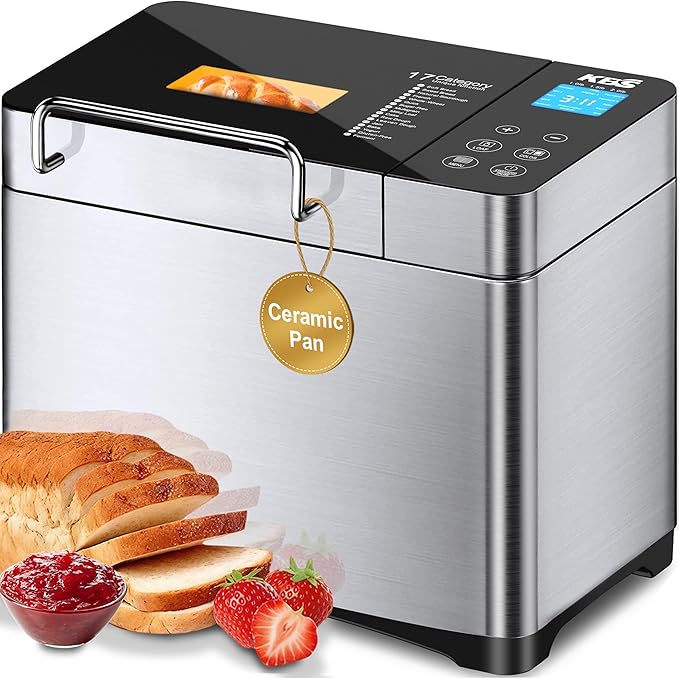
Think of the KBS Pro as the slightly more compact sibling of the Premium Convection model above. You still get a ceramic pan, strong 710W motor, nut dispenser, and a clean tempered‑glass touch panel, but without the dual‑heater convection setup. For most home bakers who want to focus on whole wheat and everyday loaves, that trade‑off makes a lot of sense.
Owners lean on it heavily for dough as well as baked loaves—pizza, rolls, and even hamburger buns—because the knead cycle is strong and consistent. Many people also use it as their “set it and forget it” pizza‑dough assistant and bake whole wheat loaves right in the machine on weekends. The ceramic pan releases easily even when you forget to oil it, which makes thicker, stickier doughs much less stressful.
Where it earns its keep
- Strong motor: Handles stiff, high‑whole‑grain doughs without stalling or under‑kneading.
- Ceramic nonstick: Easy to clean and avoids traditional Teflon‑style coatings while still releasing bread nicely.
- Automatic nut dispenser: Great for multigrain, seed‑heavy or fruit‑and‑nut loaves.
- Compact footprint: Smaller than many large‑loaf machines, so it’s easier to leave out on the counter full‑time.
Good to know
- The included recipes are basic; if you’re picky about crumb and flavour, you’ll likely migrate to your own whole wheat formulas.
- There’s no dual‑heater convection here, so crusts will be more like a standard bread maker’s than an oven‑baked loaf.
- Like several touch‑panel machines, it’s easy to hit a button with a stray wrist—double‑check settings before you walk away.
Ideal for: bakers who want a ceramic pan and a strong knead for dense whole wheat loaves, but don’t feel they need full convection for everyday bread.
6. Cuisinart CBK‑110NAS – Trusted Name, Reliable Wheat Loaves

If you’d rather buy once from a familiar name and not think about it again, Cuisinart’s CBK‑110 is the safe, sensible choice. It has a small footprint, a clear front‑mounted control panel, and a straightforward set of 12 programs that cover white, whole wheat, rapid, dough, cake, jam and more.
For whole wheat, the dedicated program runs longer kneads and rises than the basic cycle, and many owners report excellent 50/50 and partial‑wheat loaves right out of the manual. Fully 100% whole wheat will benefit from careful measuring and possibly a touch more water, but once you’ve made a couple of loaves you’ll likely stick to the same formula and let the machine repeat it on autopilot for months at a time.
Why it’s popular
- Compact, counter‑friendly design: Vertical pan and modest footprint make it easy to keep out.
- Foolproof basic and wheat cycles: Great if you mostly bake one everyday loaf and don’t want endless menus.
- Good documentation: The manual and included recipes are clearer and more reliable than many budget brands.
- Long warranty: A 3‑year limited warranty stands out in a category where 1 year is common.
Good to know
- The machine can “walk” during kneading on slick counters—set it a bit back from the edge and keep the cord loosely restrained.
- Vertical loaves are slightly taller; you may need to turn slices in a standard toaster to brown evenly.
- There’s no nut dispenser; you’ll listen for the add‑ins beep to toss in seeds or dried fruit.
Ideal for: households that want a dependable, compact bread maker from a big brand and mainly bake one go‑to whole wheat or mixed‑grain loaf every few days.
7. Neretva 3.3LB 15‑in‑1 – Dual‑Paddle Giant for Hungry Households
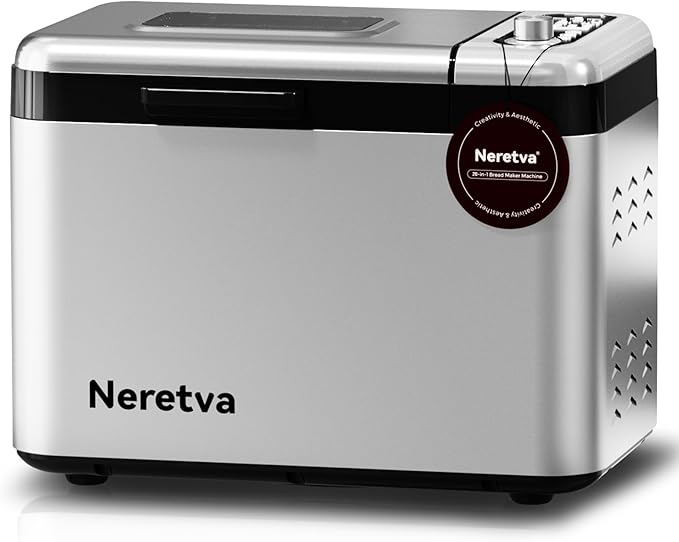
If two‑pound loaves vanish in a day at your place, this big Neretva is worth a look. It’s one of the few affordable machines that will produce up to a 3.3‑lb horizontal loaf using dual paddles and a ceramic‑coated pan. For whole wheat, that much dough is a serious workout, so the twin kneaders are very welcome.
There are 15 programs (including whole wheat, gluten‑free, sugar‑free, jam, yogurt and more), three loaf sizes, three crust colors, dual heaters, and an automatic fruit‑and‑nut dispenser. Owners appreciate waking up to huge loaves ready for toast, sandwiches, and freezing. Just be prepared for the loaf to be on the denser side unless you follow the included recipes closely or adjust hydration for your flour.
Why it works for big wheat loaves
- Dual paddles + dual heaters: Help move and bake very large batches of whole grain dough more evenly.
- Massive capacity: Up to 3.3 lb—great for large families, batch baking, or anyone who slices and freezes bread.
- Nut dispenser: Helpful for giant multigrain loaves packed with seeds and nuts.
- Quiet operation for its size: Many users are pleasantly surprised at how soft the motor sounds during kneading.
Good to know
- The control panel icons take some learning—keep the manual handy for the first few weeks.
- Recipes in the booklet lean sweet; if you cut back sugar, you may also want to tweak yeast and water to maintain rise.
- Because the pan is large, smaller loaf sizes can look a little squat unless the dough is strong and well‑hydrated.
Ideal for: big families or serious batch bakers who want huge horizontal loaves of whole wheat or multigrain bread and don’t mind a little experimenting to dial in their favourite recipe.
8. Neretva 2.2LB 15‑in‑1 – Auto Nut Dispenser for Seeded Wheat

If your ideal loaf is more seeds than crumb, this Neretva model is purpose‑built for you. The detachable fruit‑and‑nut dispenser drops mix‑ins automatically during the knead, and the ceramic pan plus dual heaters help everything bake through without leaving raw pockets where big add‑ins clumped together.
You get 15 programs including whole wheat, gluten‑free, sugar‑free, dough, jam and yogurt, along with three crust settings and a 15‑hour delay. Owners with celiac disease or gluten sensitivity like that they can dedicate the machine to gluten‑free and whole grain recipes and control every ingredient; others simply lean on it to throw in sunflower seeds, oats, nuts, or dried fruit without babysitting the cycle.
Why it’s great for seeded whole wheat
- Automatic dispenser: Adds seeds and nuts at the ideal time, saving your gluten network from being shredded early on.
- Ceramic pan: Helps sticky, mix‑in‑heavy doughs release cleanly and makes cleanup painless.
- Dual heaters: Promote even baking top and bottom, important for dense, add‑in‑packed loaves.
- Good gluten‑free support: The dedicated GF cycle plus ceramic pan are appealing if you’re baking whole‑grain gluten‑free breads too.
Good to know
- Kneading is on the louder side—think washing‑machine‑on‑low rather than whisper quiet.
- The display uses small icons instead of words; expect a little squinting or frequent manual checks at first.
- The manual recipes are serviceable but not inspiring; you’ll probably borrow formulas from other bread‑machine cookbooks.
Ideal for: bakers who love heavily seeded or nutty whole wheat loaves, or who need a flexible machine that can handle both gluten‑free and whole grain baking with minimal fuss.
9. Neretva 20‑in‑1 2LB (Silver) – Ceramic Pan in a Compact Metal Shell

This silver Neretva is a tidy, all‑metal unit that aims to be your everyday bread, dough, and yogurt machine. It shares the same basic platform as the green and light‑green models later in the list: ceramic pan, dual heaters, 20 programs (including whole wheat, gluten‑free, potato, corn, sugar‑free, jam, yogurt, and even somewhat quirky options like “meat floss”), plus a 15‑hour delay and 1‑hour keep‑warm.
For whole wheat, the dedicated program plus dual heaters do a nice job of baking through without floppy pale tops. The motor is relatively quiet, with many owners commenting that they can run it overnight without bothering anyone. It’s also easier to fit than some bulky horizontal machines, so if you’re trying to keep counters clear, the compact footprint helps.
Why it’s a solid wheat machine
- Ceramic, chemical‑free pan: Good for anyone who wants to avoid traditional nonstick coatings.
- Dual‑heater design: Helps with even browning on denser wheat and multigrain loaves.
- Quiet & compact: Less than 40 dB during kneading, with a smaller footprint than many competitors.
- Generous program list: Whole wheat, gluten‑free, sugar‑free and dough programs cover most needs without hacking the basic cycle.
Good to know
- The recipe book is minimal and sometimes vague—plan to find a favourite third‑party whole wheat recipe and stick with it.
- Some program names (“toast dough”, “dessert”, “meat floss”) aren’t well‑explained and may take some experimenting.
- The buttons lock once the machine starts; press and hold Start/Pause to unlock and change anything mid‑cycle.
Ideal for: home bakers who want a quiet, compact, metal‑bodied bread maker with a ceramic pan and solid wheat and gluten‑free programs, but don’t need huge 3‑lb loaves.
10. OSIPOTO 17‑in‑1 2LB – Easy, Modern Starter for Homemade Wheat Bread

OSIPOTO’s 17‑in‑1 machine is a great entry point if you’ve never owned a bread maker before but really want to replace store loaves with something fresher. The interface is clean, the presets cover all the basics (including whole wheat, gluten‑free, cake, jam and yogurt), and the 600W motor plus 360° heating do a solid job without making the unit feel oversized or intimidating.
Reviews from first‑time bread‑machine users are consistently enthusiastic. People who’d been putting off the purchase for years find themselves making bread several times a week and experimenting with French, whole wheat, and pizza dough. For whole wheat, the dedicated program gets you most of the way there, and you can refine crust color and loaf size to suit your family over a couple of weekends.
Why it’s friendly for new wheat bakers
- Simple interface: Clearly labelled programs and crust/loaf size buttons keep things from feeling overwhelming.
- Good everyday capacity: 2‑lb max loaf with options for 1 and 1.5 lb—perfect for one to four people.
- Quiet & compact: Around 50 dB with a sleek stainless shell that doesn’t hog the counter.
- Solid basic performance: Owners report tender crumbs and good crusts on both white and whole wheat once they pick their favourite settings.
Good to know
- Like many machines in this range, it can brown the bottom more aggressively; start with “light” crust for whole wheat.
- The instructions assume melted butter in some recipes—easy to miss if you skim the manual.
- You don’t get advanced custom programming; if you know you’ll want to fine‑tune every stage, KitchenArm or Briskind are better fits.
Ideal for: beginners who want an approachable, stainless bread maker that makes whole wheat and everyday loaves easy, without a lot of tinkering or extras to manage.
11. Neretva 20‑in‑1 2LB (Green) – Cute Look, Serious Wheat Performance

Functionally, this green Neretva is the same machine as the silver model above, just dressed in a soft retro color that looks surprisingly charming on the counter. You still get a ceramic pan, dual heaters, 20 programs, and the low‑noise/compact‑footprint combo that makes it easy to live with in a small kitchen.
Owners praise how simple it is to toss in ingredients, choose the wheat or basic cycle, and end up with a loaf that disappears before it fully cools. The 15‑hour delay and 1‑hour keep‑warm also mean you can set it up before bed and wake up to fresh bread scent without needing to think through timings in the morning.
Why it’s appealing
- All‑metal body + ceramic pan: Feels more premium than many plastic competitors in this price range.
- Good everyday wheat results: The whole wheat program and dual heaters handle partial and full whole wheat loaves reliably with little fuss.
- Low noise: The motor is quiet enough that overnight baking doesn’t disturb light sleepers in most homes.
- Nice included accessories: Measuring cup, spoons, paddle hook, and glove make it easy to get started immediately.
Good to know
- The recipe booklet is small and the translations a bit rough; treat it as a starting point rather than a bible.
- Oddball program names like “toast dough” and “dessert” aren’t explained well; you’ll discover their best uses by trying them.
- European buyers will need a voltage converter; this model is designed for 120V markets.
Ideal for: anyone who wants a cute but capable ceramic‑pan bread maker that lives on the counter and quietly turns out regular whole wheat loaves without drama.
12. Neretva 20‑in‑1 2LB (Light Green) – Slim, Stylish Whole Wheat Helper

This light‑green variant is another spin on the same Neretva platform, again with an all‑metal shell and ceramic pan, but tweaked styling that feels a bit more minimalist. From a whole‑wheat perspective the strengths are identical: dedicated wheat and gluten‑free cycles, a reasonably gentle knead, and dual heaters that help avoid pale tops.
Many owners find themselves baking a small wheat loaf weekly and storing the machine in a large drawer or pantry between uses—the compact footprint and modest weight make that realistic in a way huge horizontal machines aren’t. If you’re tight on counter space but still determined to stop buying supermarket bread, it’s a neat compromise.
Why it earns a spot
- Space‑saving shape: Easy to stash yet still produces 2‑lb loaves.
- Ceramic coating: Makes hand‑washing quick, even when wheat dough rides up the sides a little.
- Friendly controls: Once you learn the icons, it’s very much “load, tap wheat, tap start, walk away.”
- Good value: Often priced very competitively against big brands while offering ceramic plus dual heaters.
Good to know
- A few owners wish for a clearer, brighter display—numbers and symbols are small.
- There’s no auto nut dispenser; you’ll listen for beeps if you want to add seeds or nuts.
- If you bake constantly and want heavy‑duty internals, you may feel more confident with KBS or Cuisinart instead.
Ideal for: smaller kitchens and renters who want a ceramic‑pan bread maker that tucks away easily but still handles regular whole wheat baking.
13. Elite Gourmet EBM8103SS – Affordable Stainless Everyday Loaves

Elite Gourmet’s stainless model is a lot of machine for the money. Under the simple shell you’ll find 19 programs (basic, whole wheat, rye, gluten‑free, rice, sandwich bread, sweet, quick, dough, jam, yogurt and more), three loaf sizes, three crust colors, and a 15‑hour delay timer. For many families, this is all they’ll ever need.
In whole wheat mode, it tends to produce slightly denser, hearty loaves—exactly what many people are after when switching away from supermarket bread. Owners love the suction cups on the feet (no “walking” during knead), the thorough manual and troubleshooting guide, and the fact that the pan releases easily as long as you follow the recommended order of ingredients and keep an eye on dough consistency the first five minutes.
Why it’s a strong value
- Lots of programs for the price: Whole wheat, rye, gluten‑free and dough options rival more expensive models.
- Suction‑cup stability: Keeps the machine firmly planted during vigorous kneads.
- Helpful manual: Includes troubleshooting tips for flat or sunken loaves, sticky dough, and crust color.
- Good capacity range: 1‑lb loaves for singles, up to 2 lb for families.
Good to know
- The display isn’t backlit on all units, which can be annoying in dim kitchens.
- Like many budget machines, it uses classic nonstick—avoid scratchy tools and hand‑wash the pan.
- Whole wheat recipes may benefit from a tablespoon or two more flour than printed to tighten up the dough ball.
Ideal for: budget‑conscious buyers who still want stainless styling, multiple wheat‑friendly programs, and a decent instruction book to lean on while they learn.
14. Elite Gourmet EBM8103B (Black) – Cheapest Way Into Good Whole Wheat

This black version of the Elite Gourmet machine has the same guts as the stainless and mint models, just in a basic black shell that blends into most kitchens and often hits the very lowest price point of the three. If you want to dip your toes into bread‑machine baking and aren’t sure how often you’ll use it yet, this is about as wallet‑friendly as it gets without falling into “total lottery” territory.
For whole wheat, the dedicated cycle makes a pleasantly dense, rustic loaf that’s fantastic with soup or toasted with butter and honey. Several first‑time bakers report loading ingredients, pressing start, and then eating half the loaf out of the pan because it smells so good. As with many budget machines, small flour adjustments and close attention to the dough ball during the first five minutes will pay you back with more consistent results.
Why it’s worth a look
- Very affordable: Great entry point if you’re curious about making your own wheat bread but nervous about spending a lot.
- Full 19‑program suite: Same functionality as the pricier colorways in the Elite range.
- Quiet and stable: Suction cups and a lighter body mean it doesn’t dance across the counter.
- Simple cleanup: The nonstick pan wipes clean quickly if you don’t let crumbs bake on.
Good to know
- Displays and buttons are basic—don’t expect the polish of premium machines.
- Recipes sometimes benefit from small flour or water tweaks depending on your local humidity and flour brand.
- Loaves tend toward the denser side; if you want towering whole wheat sandwich bread, KitchenArm or West Bend are better bets.
Ideal for: anyone who wants to stop buying bagged bread and start making simple whole wheat loaves at home with the smallest possible investment.
15. Elite Gourmet EBM8103M (Mint) – Fun, Compact Starter Machine

Same machine, new outfit. The mint Elite Gourmet is mechanically identical to the black model but adds a soft pop of color that looks great in lighter kitchens or small apartments. Under the cute exterior it’s still a very capable everyday loaf machine with 19 programs, 3 loaf sizes, 3 crust colors, and a 15‑hour delay.
Owners who live far from town or go through a lot of bread rave about being able to dump ingredients in before heading out to work, then coming home to a fresh whole wheat loaf that costs a fraction of the store version. And because the footprint is modest, it’s one of the easier machines to leave out on the counter even in a small space.
Why it’s a fun starter
- Cheerful design: The mint shell makes it feel more like a fun appliance than a clunky box.
- Easy to use: Recipes in the booklet walk beginners through the first few loaves clearly.
- Great for families: 2‑lb max loaf is enough for a couple of days of breakfasts and sandwiches.
- Very forgiving: Owners report good results even when they’re not measuring with laboratory precision.
Good to know
- Like its siblings, the pan is hand‑wash only; the dishwasher will shorten its life.
- The paddle leaves a noticeable “belly button” hole; you can pause before baking to remove it if you care.
- If you get seriously hooked on bread making, you may eventually want custom cycles and ceramic pans—but this is a great way to find out.
Ideal for: students, small families, or anyone who wants an inexpensive, friendly way to get into homemade whole wheat bread with a little extra style.
How Bread Makers Handle Whole Wheat (and Why Settings Matter)
On paper most of these machines look similar: 500–850 watts, a paddle, a pan, and a handful of programs. In practice, small differences in motor strength, heater layout, and how the factory programs are written make a big difference in how your whole wheat loaves look and feel.
What power, heaters & cycles actually do
- Motor wattage affects how confidently the paddle moves heavy dough. More power isn’t about speed; it’s about not bogging down when the dough gets stiff.
- Single vs. dual heaters can change how evenly the crumb bakes—dual‑heater and convection designs are kinder to dense whole grain loaves.
- Whole wheat programs usually have longer knead and rise stages, letting the bran hydrate and gluten relax instead of rushing straight to bake.
- Dual paddles shine when you’re making 2.5–3 lb loaves or adding lots of seeds; they move the dough from both ends of a long pan so nothing hides in the corners.
The machines at the top of this list lean into those details: longer wheat cycles, stronger motors, or extra heaters. The budget models later on still make tasty loaves, but you may need to watch the dough ball on your first few bakes and nudge things with a spoon or a splash of water.
Pro tips for better whole wheat in any machine
- Measure by weight when you can. Whole wheat flour packs differently than white; grams beat cups every time.
- Watch the dough ball for 5 minutes. You’re aiming for a smooth, soft ball that clears the sides of the pan. Too sticky? Add a spoon of flour. Too stiff? Add a spoon of water.
- Use the wheat cycle, not basic. Even if the loaf could bake on basic, the longer knead and rise in a wheat program usually gives you a softer crumb.
- Consider vital wheat gluten. A tablespoon or two per loaf can help 100% whole wheat rise higher, especially in less powerful machines.
- Let loaves cool completely. Whole wheat needs time to set—cutting it hot can make it seem gummy even if it’s perfectly baked.
Once you’re familiar with how your particular machine behaves, you’ll find you can glance at the dough early on, tweak a tablespoon or two of water or flour, and get consistently tall, tender whole wheat loaves with very little effort. That’s what turns a basic appliance into your personal best breadmaker for whole wheat bread.
FAQ: Whole Wheat Bread Makers, Answered
Are bread machines really good for 100% whole wheat bread?
Why do my whole wheat loaves come out short or dense?
Do I need a dual‑paddle machine for whole wheat?
Is a ceramic pan better than a traditional nonstick pan?
How do I avoid the big hole from the kneading paddle?
Can I use my own recipes instead of the book that comes with the machine?
Final Thoughts: Picking the Best Breadmaker For Whole Wheat Bread For Your Kitchen
Homemade whole wheat bread is one of those small upgrades that quietly changes how your whole kitchen feels. Suddenly there’s always something wholesome to slice, toast, or pack into lunches, and you know exactly what went into it.
Here’s a quick way to turn this guide into a decision you feel great about:
- Want the most control over whole grains and special diets? Start with the KitchenArm 29‑in‑1. It’s feature‑rich without being fussy and is especially good if you bake 100% whole wheat, low‑salt, or gluten‑free.
- Love classic horizontal sandwich loaves? Look at the dual‑paddle West Bend Hi‑Rise 3‑lb or the ceramic‑pan Briskind Bread Maker. They turn out slices that look just like store bread, only better.
- Want premium materials and very even bakes? Check out the ceramic, convection‑equipped KBS Premium Dual‑Heater or the strong‑motor KBS Pro 710W.
- Short on counter space? Compact picks like the Cuisinart CBK‑110, OSIPOTO 17‑in‑1, or the slim Neretva 20‑in‑1 models keep their footprint small but still treat whole wheat kindly.
- Watching your budget? The Elite Gourmet EBM8103SS, EBM8103B and EBM8103M give you full‑size wheat loaves, dough, jam and more for the cost of a few weeks of store‑bought bread.
Any of the 15 machines above can absolutely become your best breadmaker For Whole Wheat Bread once you match its strengths to your space, your household, and your baking personality. Decide how much you want to tweak versus just pressing start, pick the size and pan style that fit your daily bread, and then enjoy the moment you realise you haven’t bought a loaf in months—and don’t miss it at all.
