
Specs are compiled from manufacturer listings and verified buyer reviews and can change over time — please confirm the key details on the product page before buying.
Wooden stairs look great, but they turn into a hazard the moment socks, a toddler, or a tired dog meets them. That is exactly why Berber carpet for stairs is worth a real look—it brings a soft, flecked loop pile that masks dirt while giving your feet something to bite into. The real question is which format fits you: a full runner you cut to length, or individual treads you peel and stick in minutes.
I’m Mohammad Maruf — the founder and writer behind KitchPrep. This guide is built by comparing the manufacturers’ published specifications and the patterns across verified customer reviews, so you get each pick’s real strengths and trade-offs instead of marketing spin.
You will learn which style suits your staircase, how the materials differ in grip and care, and how to pick the right berber carpet for stairs without wasting money on the wrong format.
Our Picks at a Glance

How To Choose The Best Berber Carpet for Stairs
Berber carpet is defined by its looped pile—those tight little loops give it that classic flecked look and a texture that hides footprints and vacuum marks. When you move it onto stairs, the two big decisions are format and grip, not just color.
Runner vs. individual treads
You have two ways to cover your stairs with Berber carpet. A runner is one long strip that spans the full width of each stair and runs down the entire flight, giving a smooth, wall-to-wall look—but you must cut it to length and often tack or glue it along the whole run. Individual treads are pre-cut rectangles that cover just the top of each step; they install in minutes with peel-and-stick backing, and you can replace one easily when it wears out.
Backing is the safety feature
The part you cannot see does the most important job. A natural rubber or skid-resistant backing keeps the carpet planted on the step, which is the whole point on a staircase. Check what the backing is made of before you buy, because a carpet that slides underfoot is worse than no carpet at all.
Fiber and pile for daily abuse
Stairs take more concentrated wear than any hallway, so the fiber and pile height matter. Thicker, heavier fibers resist crushing and stay looking fresh under constant foot traffic, while low pile gives a firmer, more stable surface underfoot. A carpet that is too plush can feel unstable on a step edge.
Quick Comparison
| Model | Best For | Format | Material | Backing | Amazon |
|---|---|---|---|---|---|
| iCustomRug Striped Carpet Runner★ Best Overall | Full smooth runner coverage | 240″L x 24″W runner | Polypropylene | Natural rubber | Amazon |
| Essential Carpet Stair Treads | Quick peel-and-stick install | 15 treads, 24.5″ x 8″ | Olefin | Skid-resistant rubber | Amazon |
| Oak Valley Designs Wool Stair Treads | Premium wool with bullnose edge | 14 treads, 12″ deep | New Zealand wool | Non-skid fiber pad | Amazon |
In-Depth Reviews
1. iCustomRug Striped Carpet Runner
Our pick — 4.5★ from 150+ verified ratings; the strongest balance of quality and price.
This one-piece runner gives your entire staircase a smooth, custom-cut Berber look without any visible seams.
This is the pick for anyone who wants the clean, wall-to-wall aesthetic of a fitted runner rather than a patchwork of individual pads. It comes as a single 240″L x 24″W strip—20 feet of coverage—made from 100% polypropylene with a soft loop pile that carries the classic Berber texture. Because it is one continuous piece, you measure, cut, and lay it to fit your exact flight, which is why buyers mention ordering custom lengths like 16 or 14 feet for their specific stairs.
Safety here comes from the backing: natural rubber that grips the step without damaging your floor underneath. The medium cut pile height means it sits flat and neat underfoot rather than feeling like a plush cushion, and the 12-pound weight tells you this is a substantial runner, not a flimsy mat. For upkeep, spills wipe clean and tougher marks survive a machine wash, which is a rare convenience for stair carpet.
The honest catch is color accuracy. Buyers report the “sand” option arrives far more grey than the warm tan-beige shown online—as one puts it, “There isn’t a tinge of beige or brown in the ‘sand’ option.” A few also note the stripes can sit slightly crooked against the cut edge. If you order, treat the swatch photo more as a suggestion than a guarantee, and buy expecting the silver grey to be the truest shade.
Why it wins
- Single continuous runner for a smooth, fitted look across the whole flight
- Natural rubber backing grips steps firmly without harming the wood
- Machine washable for deep cleaning, not just spot wiping
- Soft loop pile carries the classic flecked Berber texture
Know before you order
- Sand color runs noticeably greyer than the photos suggest
- Pattern can sit slightly off-parallel to the cut edge on some units
- Requires measuring and cutting to fit your specific staircase
Reach for this if: you want a full, smooth runner you cut to your own staircase length and can toss in the washing machine.
Look elsewhere if: you need a simple to use, no-measure install or you are set on a warm beige tone rather than grey.
2. Essential Carpet Stair Treads

The peel-and-stick set that upgrades a whole staircase in an afternoon, no tools required.
If the thought of measuring and cutting a runner puts you off, these treads are the answer. You get a set of 15 pre-cut pieces, each 24.5″L x 8″W, with a peel-and-stick adhesive backing that goes down in minutes—just remove the liner, press onto the step, and move on. That ease of installation is exactly what wins people over, along with the appearance once they are down.
Built from needle-punched olefin with a 50-ounce fiber face weight, these are engineered to take a beating. The construction means the fibers cannot unravel at the edges, and the skid-resistant rubber backing with adhesive strips keeps them planted. At just 0.38 inches thick, they sit low and unobtrusive on the step, so the treads stay out of the way underfoot.
The recurring gripe is inconsistency from the start. A few buyers found the color runs much greyer than the beige shown, and some units arrived missing adhesive strips on several treads, which blocks installation entirely. Check each piece for its backing strip before you start laying them down, and go in expecting a cooler grey tone rather than a warm beige.
The value read: for the price of a modest runner, you get a full 15-step set that installs in minutes with no cutting and no tools, and the thick 50-ounce fiber holds up to daily traffic.
Best for: renters, quick weekend upgrades, and anyone who wants grip without committing to a permanent runner.
Not for: anyone who expects a true warm beige shade or who cannot tolerate checking every piece for its adhesive.
3. Oak Valley Designs Wool Stair Treads
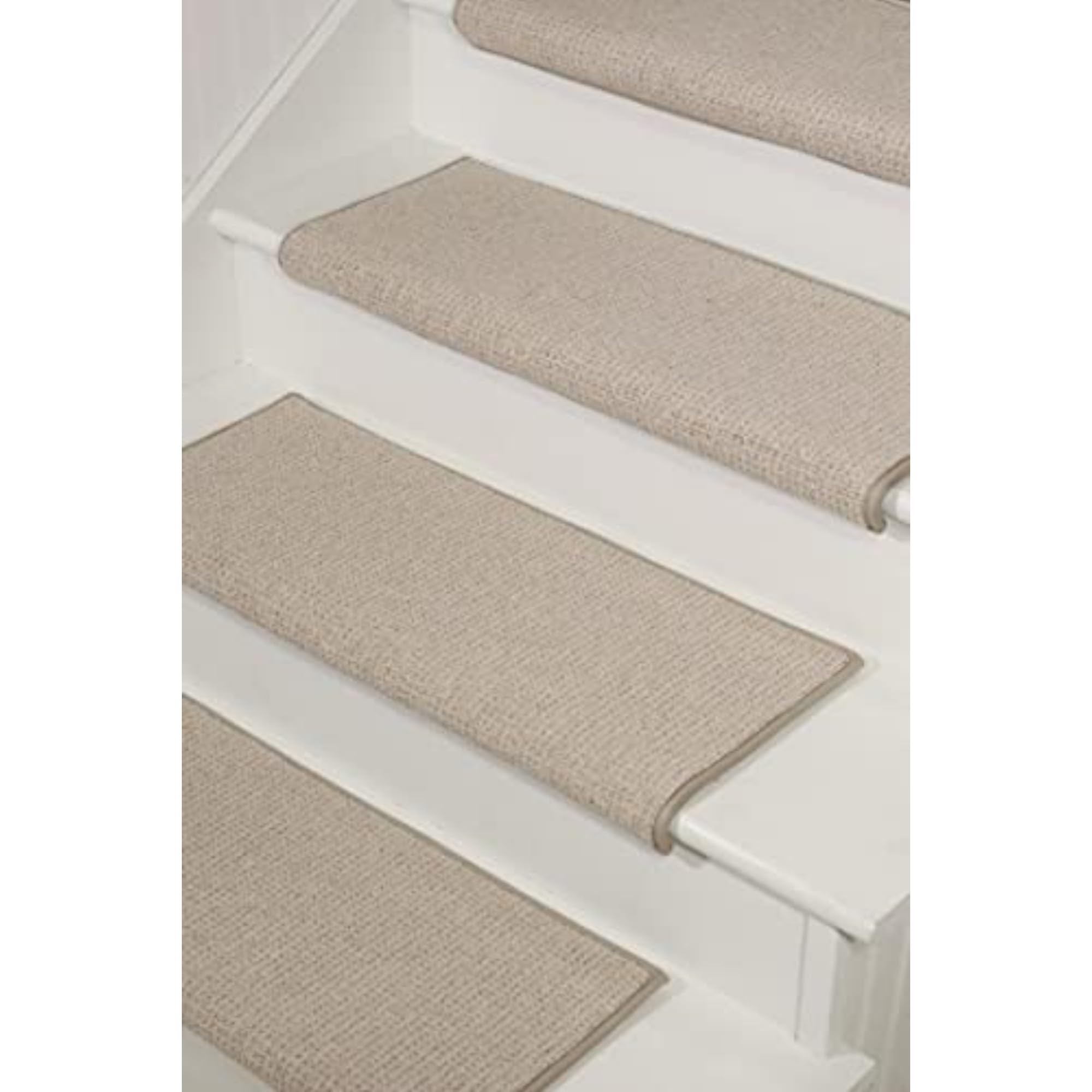
The wool upgrade that wraps over the step edge, protecting the bullnose while it grips.
This is the premium end of stair carpet, and the defining feature is the triple-reinforced rounded bullnose front—the lip that folds over the front edge of the step where most wear and scuffs happen. Made from 100% New Zealand wool, it is naturally resistant to soiling and staining, so accidents wipe up without leaving a mark. Wool is also free of chemicals and a natural fit for households that care about indoor air quality.
Each of the 14 treads measures 28″L x 12″W and sits 2 inches thick—a far more substantial pad than the 0.38-inch Essential treads, and the difference is obvious underfoot. The weight difference tells the story too: at 2 pounds per tread, this wool set has real substance against the Essential’s feather-light build. Installation is the same peel-and-stick routine, roughly 25 minutes for the whole set, with no nails or staples touching your hardwood. The rubber-backed fiber pad leaves no residue, and owners mention the treads stay firmly attached and do not slip—a genuine safety win for households with toddlers and dogs on wooden stairs.
The trade-off is price and value perception. While the quality and look earn consistent praise—buyers call them beautiful and easy to clean, and several have purchased a second set for another home—some still feel the cost runs high for what you get, and durability feedback is mixed rather than universally glowing. If you want the softest, most premium step surface that protects the leading edge of each stair, this is the set. If budget is the deciding factor, the value-minded alternatives cover the safety job for far less.
The premium payoff
- Triple-reinforced bullnose wraps over and protects the step edge
- 100% New Zealand wool resists soiling and staining naturally
- 2-inch thickness feels soft and substantial underfoot
- Rubber backing stays put without leaving residue on hardwood
The honest cost
- Premium price tag that some buyers feel is hard to justify
- Durability over years gets mixed feedback rather than universal praise
- Wool needs gentler cleaning than synthetic pile
The standout-spec mic-drop: genuine New Zealand wool with a protective bullnose edge—nothing else in this lineup cradles the front of the step like this.
The one caveat: you pay a real premium for that wool, so it only makes sense if the softness and edge protection matter more than the price.
Understanding the Specs
Pile height and fiber weight
Pile height is how tall the carpet loops stand above the backing. Low pile—like the 0.38-inch Essential treads—feels firm and stable, which suits stairs where you do not want a squishy surface underfoot. Fiber weight, measured in ounces per square yard, tells you how much material is packed in; a 50-ounce face weight is a dense, durable carpet that resists crushing under daily traffic. Thicker, heavier carpet lasts longer on stairs because that is where wear concentrates.
Backing and grip
The backing is the real safety feature on a staircase. Natural rubber backing, as on the iCustomRug runner, grips the step while staying gentle on the wood underneath. Peel-and-stick treads add an adhesive layer so the carpet plants firmly and stays put—the Essential set relies on this, while the Oak Valley treads use a non-skid fiber pad with rubber. Whichever you choose, the backing is what stops the carpet from sliding underfoot, and that is the entire point on stairs.
FAQ
Will carpet stair treads fit standard residential stairs?
How do I install peel-and-stick stair treads?
Which lasts longer on stairs: polypropylene, olefin, or wool?
Will these treads damage my hardwood stairs?
Can I machine wash a Berber stair runner?
How many treads do I need for my staircase?
Are Berber stair treads safe for toddlers and dogs on wooden stairs?
Will the color match the photos online?
Do stair treads work on carpeted stairs?
Which is easier: a runner or individual treads?
Final Thoughts: The Verdict
For most people, the berber carpet for stairs winner is the iCustomRug Striped Carpet Runner because it delivers that smooth, custom-fitted look with a natural rubber grip and the rare luxury of machine washing. If you want the fastest install with no tools and a budget-friendly price, grab the Essential Carpet Stair Treads for peel-and-stick ease across a full 15-step set. And if you want the softest, most premium step surface that also protects the leading edge of each stair, the Oak Valley Designs Wool Stair Treads is the one to reach for—just be ready for the premium price that comes with real New Zealand wool.
How We Picked
We do not accept paid placement. Every pick is matched to a real buyer and a real use-case; we do not hands-on test units.
Sources & Methodology
Specifications: manufacturer listings and product documentation. Review insights: verified customer reviews, as of August 2026. Pricing: not shown on this page (it changes often); check the current price via the retailer link.
As an Amazon Associate, KitchPrep earns from qualifying purchases. This does not affect which products we feature.
Related Guides
