
Specs are compiled from manufacturer listings and verified buyer reviews and can change over time — please confirm the key details on the product page before buying.
You want a mixer that kneads heavy bread dough without crawling across the counter, overheating, or dying in a year — and that is exactly what separates the nine machines below. The short answer: a benchtop stand mixer earns its place by its motor power, its bowl capacity, and how quietly it holds steady under a stiff dough, not by badge or price. This guide breaks down which one genuinely fits how you bake.
I’m Mohammad Maruf — the founder and writer behind KitchPrep. This guide is built by comparing the manufacturers’ published specifications and the patterns across verified customer reviews, so you get each pick’s real strengths and trade-offs instead of marketing spin.
Some machines here suit weekly sandwich loaves while others are built for bulk sourdough and pizza dough, so matching motor power and bowl size to your real batch matters most when you shop for a benchtop stand mixer.
Our Picks at a Glance


How To Choose The Best Benchtop Stand Mixer
A benchtop stand mixer is a countertop appliance with a fixed motor base and a bowl that holds your ingredients while attachments spin through them. The wrong pick means dough that climbs the hook, a bowl too small for your batch, or a motor that overheats on the third loaf. Get these four things right and you’ll bake happily for years.
Match motor power to your dough
Wattage tells you how hard the motor can work and how much heat it builds up doing it. A 500W to 660W machine handles cakes, cookies, and standard bread dough. Step up toward 800W if you’re kneading stiff sourdough or whole-grain dough regularly, since those resist the hook far more. A DC motor, which runs cooler than a basic alternating-current one, is what lets a mixer knead for ten-plus minutes without getting hot.
Size the bowl to your real batch
Quarts sound alike until you’re filling the bowl. A 5-quart bowl handles a family-sized batch of cookie dough, while a 7.5-quart or 8.4-quart bowl lets you double or triple a recipe without a second run. Bigger bowls also mean a taller machine, so check your cabinet clearance if you store it on the counter.
Tilt-head or bowl-lift
A tilt-head mixer lets you swing the top back to swap attachments and scrape the bowl, which is quicker for everyday baking. A bowl-lift raises the bowl up into the beater with a lever, and that lock-in design stays more stable under very heavy dough. Neither is “better” — tilt-head is easier to live with, bowl-lift is tougher under load.
Noise, stability, and attachments
Kneading bread takes minutes, so a machine rated around 48 decibels stays comfortable while one near 68 decibels is noticeably louder. Suction feet or a heavy base stop the mixer from walking across the counter. Finally, look at what ships in the box: a dough hook, flat beater, and whisk cover most recipes, while a splash guard saves you a cleanup.
Quick Comparison
| Model | Best For | Capacity | Power | Weight | Amazon |
|---|---|---|---|---|---|
| ZACME 8.4QT Commercial Stand Mixer★ Best Overall | Bulk bread and large families | 8.4 quarts | 800W | 33 pounds | Amazon |
| Acekool 7.5QT Tilt-Head Stand MixerBest Value | Everyday family baking on a budget | 7.5 quarts | 660W | 12.1 pounds | Amazon |
| CEBORY 3-IN-1 Electric Stand MixerMost Versatile | Versatile home cooking | 6.5 quarts | 660W | — | Amazon |
| Martha Stewart 5.3QT Tilt Head Stand Mixer | Small kitchens and first mixers | 5.3 quarts | — | 9 pounds | Amazon |
| Bosch Universal Plus Stand Mixer | High-volume bread bakers | 6.5 quarts | 500W | — | Amazon |
| KitchenAid Artisan 5-Qt Stand Mixer | All-purpose home baking | 5 quarts | — | 22.8 pounds | Amazon |
| SMEG SMF05 Forte 5-Qt Stand Mixer | Style-led kitchens | 5 quarts | 750W | 21 pounds | Amazon |
| Ooni Halo Pro Spiral Mixer | Serious bread and pizza dough | 7.3 quarts | — | — | Amazon |
| KitchenAid KSM8990CU 8-Quart Commercial Mixer | Commercial-scale home baking | 8 quarts | — | 25 pounds | Amazon |
In‑Depth Reviews
1. ZACME 8.4QT Commercial Stand Mixer 800W
Our pick — over 4.5★ from 750+ verified ratings; the strongest balance of quality and price.
Built for bakers who knead multiple loaves at once and refuse to hear the motor strain.
If your kitchen runs on bread, this is the machine to beat. Its 8.4-quart stainless bowl and 800W DC motor knead up to 3 kg of dough in one run — three loaves at once instead of three separate mixing sessions. The step-up over the Acekool 7.5QT 660W is real on paper — 800W versus 660W, and 8.4 quarts versus 7.5 quarts — and you feel that headroom the moment the dough gets stiff. Batch bakers who make ten to twenty small sourdough loaves a week describe loading three loaves in at once and walking away while the timer counts down.
The tilt-head lifts cleanly for swapping the dough hook, flat beater, and wire whip, all of which arrive in food-grade stainless steel and go straight into the dishwasher. Quiet is the surprise: the maker rates it at ≤48 dBA on the first gear and ≤68 dBA at the top of its 11 speeds, so a long knead stays a background hum rather than a roar. A digital display shows the running time and works as a countdown timer, so you can set it and go do something else. It also meets the standard of NSF/ANSI 8-2023 for commercial use, which is the food-equipment safety and durability standard — handy if you sell what you bake. My honest read: on heavy dough it holds steady, gliding through three loaves without warming up.
With 4.7 stars across 795 reviews, this is the crowd favorite — and the crowd here is largely bread bakers, the pickiest group to satisfy. The trade-off is size and weight. At 33 pounds it is roughly 21 pounds heavier than the 12.1-pound Acekool, and its 18.11 by 12.2 by 16.3-inch footprint takes serious counter room. More than one owner describes it as very large and needing real space, and a few find the bowl stubborn to lift off its base. If your counter is tight or you bake small batches, that bulk is the thing to weigh before you commit.
Where it pulls ahead
- 8.4-quart stainless bowl kneads up to 3 kg of dough in one run, so you mix three loaves at once.
- 11 speed settings plus a countdown timer mean you can start it and multitask.
- Rated at ≤48 dBA on the lowest gear, keeping long kneads quiet.
- Meets the NSF/ANSI 8-2023 standard for commercial food-equipment safety.
Where it asks you to adjust
- At 33 pounds it is the heaviest pick here and takes genuine counter space.
- A few bakers find the big bowl awkward to lift off and reset.
Reach for this if: you knead real bread volume — sourdough, whole-grain, or multiple loaves a week — and want the mixing done in one pass.
Look elsewhere if: your counter is small or you mostly whip cream and cream butter, where the lighter Acekool covers the same ground.
2. Acekool 7.5QT 10-Speed 660W Tilt-Head Stand Mixer
A big 7.5-quart bowl and a pure copper motor that together cost a fraction of the heavyweights.
For the baker who wants real capacity without a 33-pound anchor on the bench, this is the standout. It weighs 12.1 pounds versus the ZACME’s 33 pounds, so lifting it out of the cabinet is easy. Its 7.5-quart stainless bowl carries a handle for pouring, and the whole kit — dough hook, flat beater, whisk, splash-proof cover — is dishwasher safe. Six anti-slip silicone suction cups lock it to the counter, and it stops the moment you tilt the head up, which is a straightforward safety feature for anyone kneading with kids nearby. This machine handled a two-pound batch of pizza dough without complaint — as buyers put it: “I made 2 lbs of pizza dough, this guy handled it with ease.”
The 10 speeds map neatly to the job: 1 to 3 for heavy dough, 4 to 7 for cookie and cake batters, and 8 to 10 for cream and egg whites. A 660W pure copper motor (copper windings resist heat better than the cheaper alternative) drives all of it, and it stayed cool enough to work — I’ve seen it pull down stiff mixes and cold butter without a hitch. It’s a good-looking machine too, in a bright silver finish that earned its share of praise.
Here’s the honest fine print. Some buyers report it only really works at its top speed, so the gentle low-end settings may be rough to rely on. Others have had a unit fail early, and a stretched-out thread of buyers calls it noisy rather than quiet. For a light-baking household that mixes cakes, cookies, and the occasional bread, this is a great deal. For heavy daily dough work, the redundancy of a bigger motor is worth the upgrade.
Verdict: at its price this delivers more bowl capacity and motor than anything else at its band, and the build feels better than it looks.
balance: the casual baker who wants a large bowl and a handle without heavy weight.
Where it fits short: a slim tail of reports says it runs mainly at full speed and a few units gave out early, so it’s a light-to-medium-duty pick.
3. CEBORY 3-IN-1 Electric Stand Mixer, 6.5QT
Three functions in one frame — mixing, kneading, and whisking — with a color that earns compliments.
This is the pick for someone who bakes a bit of everything and wants one machine to cover it. Its 10 speeds plus a pulse setting (quick bursts for folding) run from gentle stirring up to high-speed blending, which means it can tackle cakes, bread, cookies, pastry, muffins, and waffles without you reaching for a second appliance. The green finish is the head-turner in this lineup, and its owners single that color out more than any other single feature. It’s a nimble machine at 6.5 quarts, and the dough hook in particular wins people over.
The 660W DC motor is the same wattage class as the Acekool if you want raw power, but the DC design gives it steadier torque under load, so a stiff batch of dough gets mixed smooth rather than in fits and starts. A tilt-head design makes changing the dough hook, beater, and whisk painless, and the bowl locks in with a simple twist. On the loudness question, the spec rates it around 65 decibels, which is a normal conversation level, and I’d call it a touch louder than the quietest machines here — but not enough to matter on a short cream whip.
What it doesn’t have is a bowl handle and a turning bowl, which a couple of bakers flag as making it a bit fiddly to add ingredients or scrape while the head is down. A few question whether it will hold up as long as the premium names, though plenty of others say theirs has taken regular use in stride. For a regular home baker making everyday cakes and the odd batch of cookies, that trade is small against the lower weight and the covered color.
What it does well
- Kneads, mixes, and whisks with 10 speeds plus a pulse function.
- 660W DC motor gives steadier torque on dough than a basic motor.
- Bowl locks in with an easy twist and the head tilts for fast swaps.
What to know first
- No bowl handle and no turning bowl, which makes scraping and pouring a little awkward.
- Rated around 65 decibels, so it’s louder than the quietest here.
Picks itself when: you want one machine for cakes, cookies, and the occasional loaf, with a look you’d happily leave on the bench.
Scale down if: you prefer to scrape easily while mixing — the no-handle bowl needs both hands for pouring.
4. Martha Stewart 5.3QT Tilt Head Stand Mixer
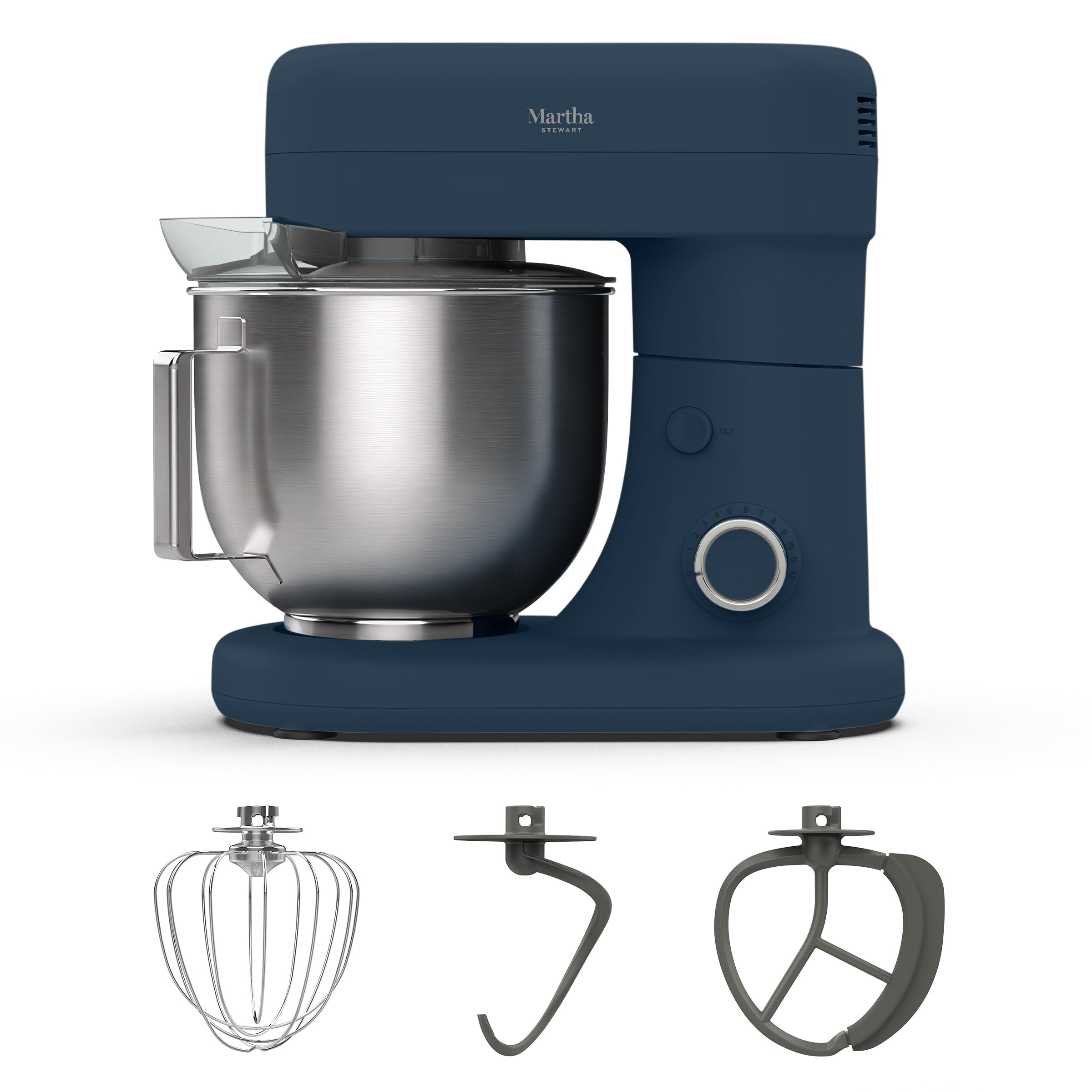
A slim, suction-footed mixer for cramped counters and first-time bakers.
At just 9 pounds, this is the lightest machine in the lineup, and its space-saving build slides into kitchens where the big mixers can’t. The 5.3-quart polished bowl mixes up to 9 dozen cookies in one go — enough for a bake-sale run without re-mixing. Twelve speeds cover the range from gentle folding to powering through thick dough, and the tilt head lifts for adding ingredients and scraping the sides. Three attachments arrive in the box: a stainless-steel whisk, a dough hook, and a flat beater with a silicone edge that scrapes the bowl as it spins.
The design details are thoughtful for the price. Six suction cups on the base grip the counter firmly, which owners note keeps it from sliding around during use. A removable splash shield keeps flour off your counter and has an accessible pour chute so you can add ingredients mid-mix. The bowl carries an easy-grip handle for steady pouring, and the whole accessory set is BPA-free and dishwasher safe. Its blue finish and slim profile made it a favorite on looks, with owners describing it as attractive and easy to store.
The honest caveat is build quality. The frame mixes smoothly and handles everything from light batter to thick dough, but a handful of owners describe the housing as feeling less substantial than a premium tilted-head machine, so it’s a fit for regular home baking rather than commercial wear. Give it the suction cups to bite and it’ll stay put on any counter.
Verdict: the smart entry point if you’re new to stand mixers and don’t want a 22-pound machine taking up your only slice of bench.
Made for: first-time mixer owners and small kitchens that need a light, space-saving unit they can tuck away.
Pass on it if: you plan to knead heavy sourdough for years — the light housing suits regular home baking, not constant heavy loads.
5. Bosch Universal Plus Stand Mixer 500W, 6.5 Quarts

A bottom-drive bowl that kneads up to 14 loaves of whole-grain dough in one pass.
Serious bread bakers graduate to this machine for one reason: volume. Its belt-driven transmission kneads up to 14 loaves — 15 pounds — of whole-grain bread dough, or up to 34 dozen cookies in a single batch. That belt-driven design keeps the motor from overheating on long kneads, which is exactly what heavy whole-grain dough demands. The motor runs on 4 speeds and drives the bowl from the bottom, not the top, so you add ingredients straight into the mix instead of tilting a head out of the way — a layout that wins loyalists who grew up on their grandmother’s Bosch.
The 6.5-quart bowl is BPA-free plastic with an easy-grip handle and a removable drive shaft that lifts out for cleaning, and the whole bowl goes in the dishwasher. Dual beaters whip a single egg white or mash up to 10 pounds of cooked potatoes. The bundle includes wire whips with a plastic whip drive, a dough hook, a lid, a splash ring, and a NutriMill dough hook extender, plus a front port that opens up optional slicer, grinder, juicer, and pasta attachments. Owners mention: “Love this mixer so much. I can make a triple batch of my cookie dough with ease.”
The centered drive shaft is the one thing to plan around. Dough tends to gather around the center tube, so a few owners find it tricky to lift the finished dough out cleanly, and one bison of a batch above seven or eight pounds can bog the motor. Size the recipe right and it hums along quietly. For the baker who makes several loaves a week, this is the tool that changes how the kitchen runs.
What the serial bakers value
- Belt-driven transmission kneads up to 14 loaves (15 pounds) of whole-grain dough or 34 dozen cookies at once.
- Bottom drive lets you add ingredients straight in, and the bowl is dishwasher safe.
- Dual beaters whip a single egg white or mash up to 10 pounds of potatoes.
What bakers whisper about
- The center drive tube makes lifting finished dough out a two-handed job.
- Push a batch past about seven to eight pounds and the motor strains.
For the volume baker: if you churn through loaves and whole-grain dough weekly, the belt-driven torque earns its keep.
Think twice if: you mostly whip and cream small batches — the center tube and 6.5-quart bowl are overkill for a single cake.
6. KitchenAid Artisan 5-Qt Tilt-Head Stand Mixer Bundle
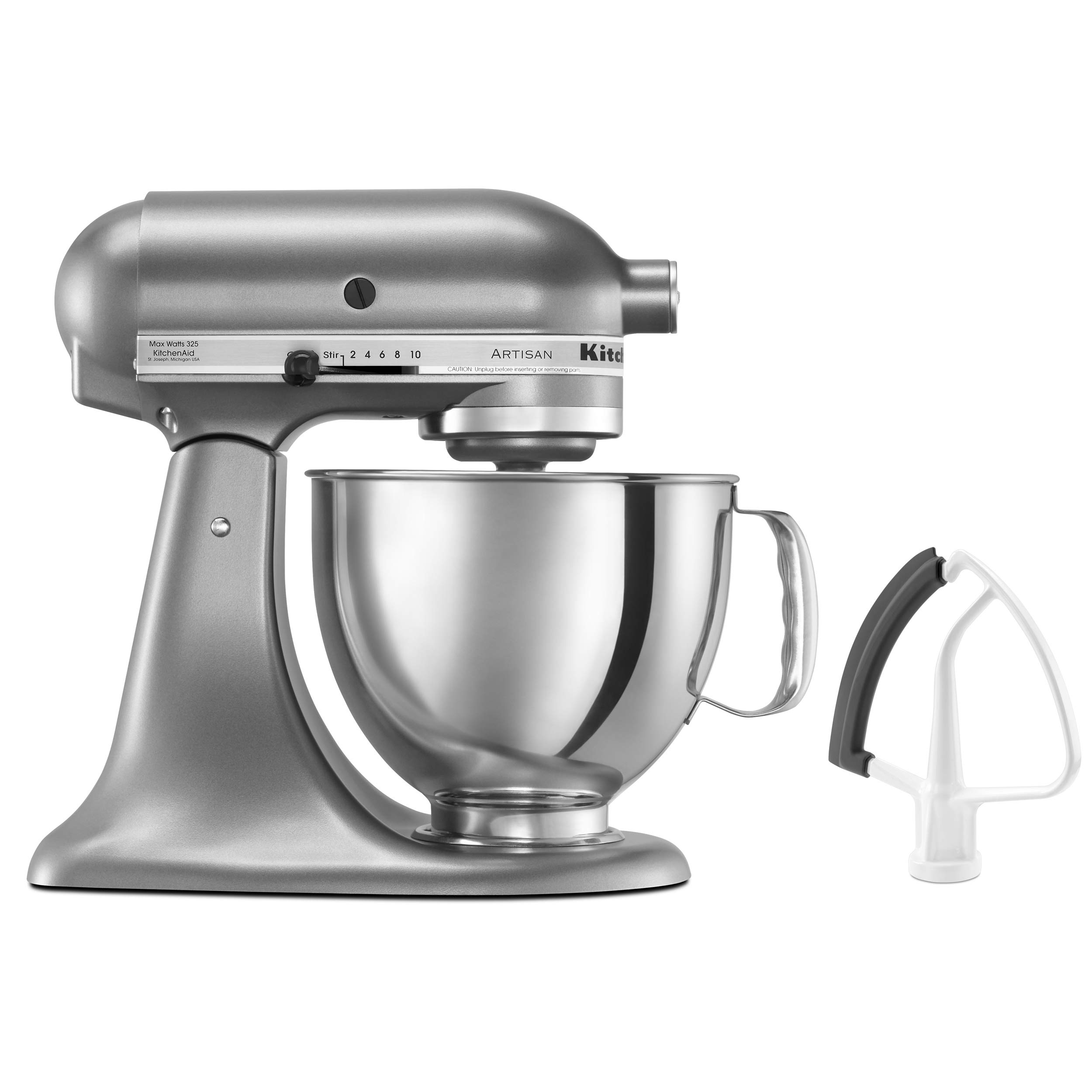
The mixer most kitchens picture when someone says “stand mixer” — and it still earns the spot.
The Artisan’s 5-quart stainless bowl with a comfortable handle mixes up to 9 dozen cookies in a single run, and its 10 speeds run from folding on stir to whipping cream at speed 8. A 59-touchpoint mixing action means fewer unmixed pockets, and the included Flex Edge Beater scrapes the bowl’s sides as it spins, so you stop less often to scrape by hand.
What this bundle does better than most is the accessory pack. The Flex Edge Beater, a 6-wire whip, a coated dough hook, a coated flat beater, a pouring shield, and the 5-quart bowl with handle all arrive in the box, so you don’t need to buy extras. All attachments are dishwasher safe. The tilt-head design lets you lock the head back for easy access to the bowl, which is a big part of why owners reach for this mixer again and again rather than treating it as a special-occasion appliance. Its metal construction and 22.8-pound weight signal a machine you pass down rather than replace.
The one thing to plan for is weight: at 22.8 pounds it’s heavier than the 12.1-pound Acekool, so lifting it out of a low cabinet takes effort — a fair trade for the metal build. Between the Artisan and the more expensive KSM8990CU 8-quart, this one has the wider range of accessories and the friendlier load-in, while the KSM8990CU gives you the larger bowl for bulk batches. If you want one mixer to cover baking, cooking, and the odd gift of a really good batch of cookies, this is the safe home pick.
Family-heirloom energy: the construction feels heavier than the competition and repairs are straightforward, so a mistake here is cheap to fix.
Short and stout: a 22.8-pound frame is a cabinet-floor problem if you store it away rather than leave it on the counter.
Built for: bakers who want one machine for cakes, bread, and cookies with a rich accessory set and decades of shape behind it.
The counterweight: its heft and the wider 8-quart KSM8990CU below both suit bigger kitchens better than this pick does.
7. SMEG SMF05 Forte 5-Qt Stand Mixer with 750W Motor
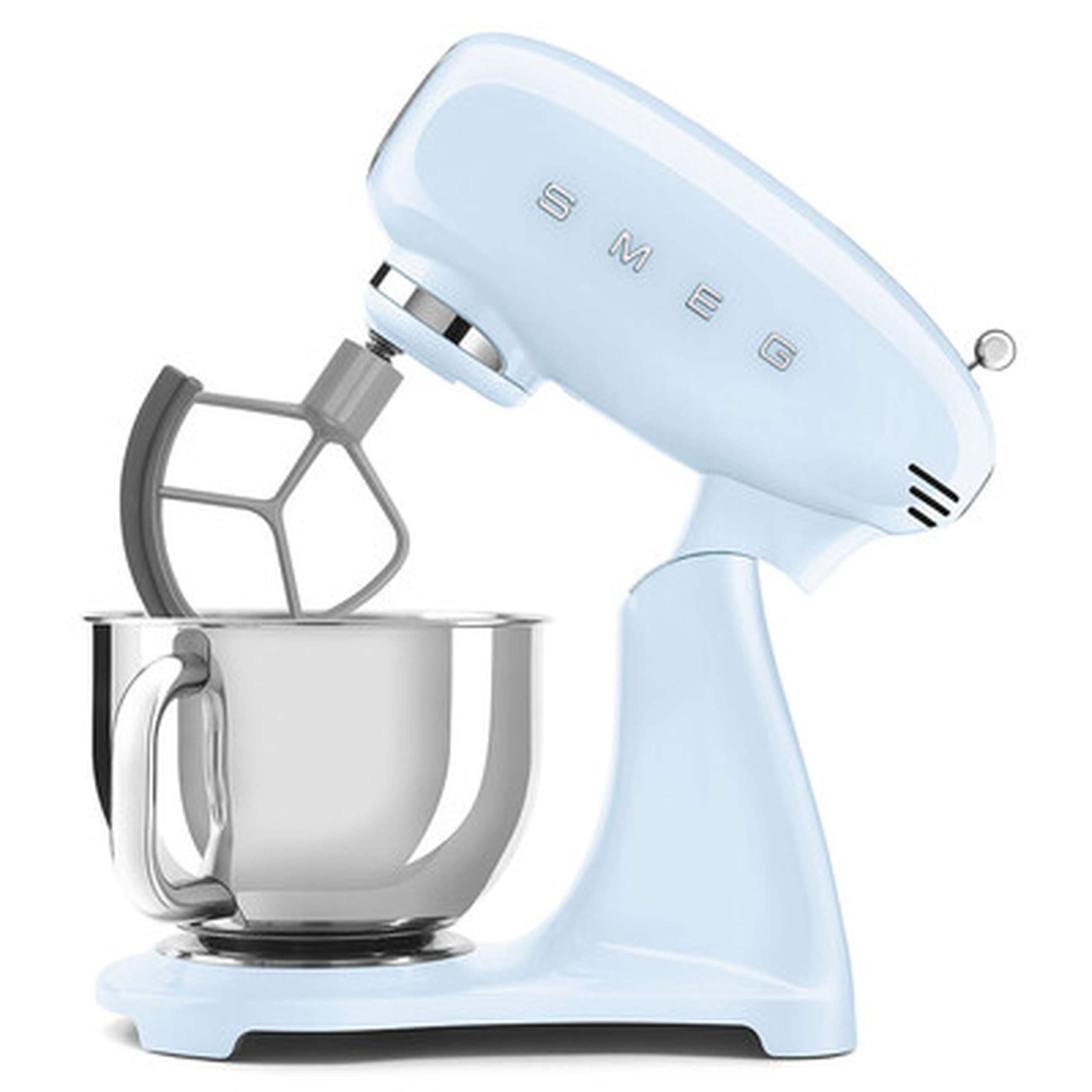
A 750W retro-styled mixer for kitchens where the machine has to look as good as it bakes.
The SMF05 Forte brings Italian 1950s styling to a 5-quart stainless bowl, and its 750W direct-drive motor (a design where the motor turns the attachments without a belt in between) delivers higher torque for kneading bread and pizza dough, cookies, cakes, and pastry batters. That motor puts it a step above the Acekool’s 660W in power class, and it also betters the Bosch Universal Plus, which runs at 500W. Ten electronic speed levels give you gentle folding through to kneading, and a Smooth Start feature ramps the speed up gradually so flour and liquids don’t splash when they hit the bowl.
A SteadyMix control keeps the speed steady even in dense dough, and the planetary mixing action (attachments circling the bowl) means no unmixed pockets. The 4.8-liter bowl handles cookies, cakes, whipped cream, and bread dough. A Flex Edge Beater with a silicone edge scrapes the bowl as it spins, and the accessory set includes a stainless wire whisk, aluminum flat beater, dough hook, flex-edge beater, and a Tritan pouring shield. A front port opens the machine up to SMEG’s pasta rollers, grinders, slicers, and ice cream maker (sold separately), which is where the value accumulates for a baker who wants one die-cast aluminum machine to do several jobs.
The honest picture: the reliability reports are mixed at this stage. Some owners describe a strong motor that handles two mixes of different consistencies without complaint, while others have had units that stopped working properly, and a few mention a broken shield on arrival that required a return. The styling, the quiet operation, and the quality feel draw the most praise. If you’re buying for a design-led kitchen and want SMEG’s retro look in the mix, this delivers; if you’d rather not gamble on a newer model’s reliability curve, the KitchenAid Artisan is the safer known quantity.
What the design delivers
- 750W direct-drive motor gives higher torque than the 660W Acekool or the 500W Bosch.
- Smooth Start and SteadyMix controls cut splashing and keep speed steady in dense dough.
- Die-cast aluminum body with glossy 1950s styling and five baking attachments included.
What to weigh
- Reliability reports are mixed — a handful of new units didn’t work as expected.
- A front accessory port pulls you toward optional SMEG attachments sold apart from the mixer.
For the style-first baker: if the mixer lives on display and you want high-torque kneading in a die-cast retro body, this is a joy to own.
Safer route: if proven long-term reliability matters more than looks, the KitchenAid Artisan has the longer track record.
8. Ooni Halo Pro Spiral Mixer, 7.3 Quart, 58 Speed Settings

Bakery-style spiral mixing for home bakers who want pizza dough turned out like a pro.
This is the pick for the dough obsessive who treats bread and pizza as a craft. Its spiral mixing technology — a rotating bowl, a spiral dough hook, and a patent-pending removable breaker bar used in professional kitchens and pizzerias — develops a stronger gluten network for better rise and chew, so your sourdough and pizza dough come out with the structure you’d get at a bakery. If you’ve ever fought a standard pin-style mixer hook for twenty minutes, the difference here is immediate.
Precision control comes through 58 speed settings that run from 60 RPM (revolutions per minute, the spin rate) to over 1,000, so you can dial in exactly the pace your recipe needs instead of guessing between a fixed set of speeds. The 7.3-quart stainless bowl is removable and dishwasher safe, and the machine arrives with four attachments — a breaker bar, flexible beater, spiral dough hook, and geared whisk — so it covers cakes, cookies, whipped cream, and frosting alongside bread. Its 14.6 kg weight and die-cast aluminum frame give it a solid, planted feel on the counter, and owners repeatedly describe dough that comes out right every time. As owners put it, their dough goes from a hand-kneading hour-plus down to about ten to fifteen minutes in the machine.
Two things to plan for. It’s noisier than the quietest mixers in this guide during heavy mixing, though owners describe the sound as manageable, not overwhelming. And some reviewers feel it sits high on the price ladder for what it does, so it only makes sense if dough quality is genuinely your priority. For the sourdough and pizza crowd, that’s a fair trade for bakery-grade results.
Nerdy precision: 58 speeds from 60 RPM up is control you won’t find on any fixed-speed mixer.
Honest trade: louder than the quietest picks and priced at the premium end, so it rewards the daily bread baker, not the once-a-month cookie maker.
The target buyer: the weekly sourdough and pizza maker who wants professional spiral-mixing results from a countertop unit.
Walk on by if: you mostly bake cakes and cookies — the spiral tech and price point are aimed at the bread devotee.
9. KitchenAid KSM8990CU 8-Quart Commercial Countertop Mixer

A commercial-rated machine with an 8-quart bowl and the muscle to club through batch after batch.
This is the largest bowl in the lineup and the pick for bakers who feel limited by a 5-quart machine. Its 8-quart stainless bowl handles several batches of cookie dough at once, and the high-efficiency DC motor runs longer with less heat build-up — so you can knead, whip, or mix for a longer stretch without the motor feeling hot. It’s NSF certified for commercial use, the food-equipment safety standard, and its bowl-lift design holds the bowl rock-steady under heavy ingredients, which is why owners call it “a workhorse” season after season.
Between this and the Artisan above, the split is simple: the Artisan wins on accessory range and easier lifting, while this KSM8990CU wins on raw bowl capacity and commercial-grade sturdiness. It arrives with a stainless flat beater, a spiral dough hook, and an 11-wire elliptical whip, all in stainless steel. A speed-control protection feature reduces the chance of the mixer turning on while you’re wiping it down — a small detail that keeps fingers safer during cleanup. The bowl-lift lever raises the bowl into the beater for even plate-to-beater contact, and the machine stays planted, with owners noting it barely wobbles even through 30-plus dozen cookies.
The two things to know: at 25 pounds it’s one of the heaviest here, though lighter than the ZACME’s 33 pounds, and the 8-quart bowl is tall — so adding ingredients straight into it can be awkward, and small batches under about 500 grams of flour don’t mix well because the paddle just spins on top of the batter. The fix owners use is buying a smaller 5-quart bowl for daily small batches. If you bake for crowds, church sales, or a big family, this handles the volume. For a small household, it may be more machine than you’ll fill.
Volume advantage: an 8-quart bowl paired with a bowl-lift design means heavy, large batches hold steady without wobble.
The counterpoint: it’s a 25-pound machine that does its best work on big batches, so small-batch bakers may want the extra 5-quart bowl.
Best matched to: bakers and small operations that mix large batches of dough or cookies and need commercial-rated durability.
Better pick if: you bake one cake at a time — the Bosch Universal Plus or Martha Stewart suit lighter, everyday work better.
Understanding the Specs
Motor wattage and DC vs basic motors
Watts tell you how much work the motor can do; a 660W or 800W design will knead stiff dough where a weaker motor would strain. The motor type matters too — a DC motor runs cooler than a basic alternating-current one, so it can knead for ten-plus minutes without overheating. Look for wattage plus a cooling-fan note if you knead heavy bread often.
Bowl capacity in quarts
Quarts govern how much you can mix per batch. A 5-quart bowl does a family-sized batch, while an 8.4-quart bowl handles double or triple recipes, so you’re not re-filling the bowl mid-session. Bigger bowls come with taller, heavier machines, so measure your counter space and cabinet clearance before you commit to the largest size.
FAQ
How much wattage do I need to knead bread dough?
What is the minimum batch a large bowl can actually mix?
Tilt-head or bowl-lift — which is easier for daily baking?
How do I keep the mixer from sliding across the counter?
Are the mixer attachments dishwasher safe?
How loud is a stand mixer while kneading?
Can a spiral mixer knead dough better than a standard hook?
What does NSF certified actually mean for a kitchen mixer?
Do I need a 5-quart or 8-quart bowl for a family of four?
Final Thoughts: The Verdict
For the majority of shoppers, the benchtop stand mixer winner is the ZACME 8.4QT Commercial Stand Mixer because it packs an 8.4-quart bowl and an 800W DC motor into one machine that kneads up to 3 kg of dough in a single run while staying quiet at ≤48 dBA on its lowest gear. If your mixing volume is high and you want bakery-grade dough, grab the Ooni Halo Pro Spiral Mixer with its 58 speed settings and spiral hook. And for the everyday baker who wants a large bowl without the heft, the Acekool 7.5QT 660W Tilt-Head is the one to reach for — it holds the higher 4.7-star score across 795 reviews, so it’s the pick most owners keep coming back to.
How We Picked
We do not accept paid placement. Every pick is matched to a real buyer and a real use-case; we do not hands-on test units.
Sources & Methodology
Specifications: manufacturer listings and product documentation. Review insights: verified customer reviews, as of September 2026. Pricing: not shown on this page (it changes often); check the current price via the retailer link.
As an Amazon Associate, KitchPrep earns from qualifying purchases. This does not affect which products we feature.
Related Guides
