
Specs are compiled from manufacturer listings and verified buyer reviews and can change over time — please confirm the key details on the product page before buying.
If you cut trim, baseboard, or framing lumber in a garage or a spare bedroom, the saw has to earn its space. A benchtop miter saw is the compact class of miter saw that sits on a bench or stand instead of owning the floor, and the right one cuts square every time while staying light enough to move. The wrong one buries the bench in sawdust and stalls on a 2×4. This guide sorts the strongest benchtop options by what actually matters at the cut line: blade size, bevel and miter range, cutting capacity, and if you want a cord or a battery.
I’m Mohammad Maruf — the founder and writer behind KitchPrep. This guide is built by comparing the manufacturers’ published specifications and the patterns across verified customer reviews, so you get each pick’s real strengths and trade-offs instead of marketing spin.
Corded saws bring more muscle for thick stock, while battery models trade a little grunt for real freedom from outlets. Below are the sharpest picks in each lane, screened for what buyers actually live with at the bench — including the best benchtop miter saw for tight shops where every inch of clearance counts.
Our Picks at a Glance
How To Choose The Best Benchtop Miter Saw
Every benchtop miter saw spins a toothed blade down onto a workpiece clamped against a fence, and the differences between models come down to four things you can measure: the blade diameter, the bevel and miter angles it reaches, the maximum material it swallows in one pass, and how much the whole unit weighs when you carry it. Match those four numbers to your work, and the model picks itself.
Blade Size And Cutting Capacity
Blade diameter sets how deep and how wide the saw can cut in a single pass. A 10-inch blade handles most trim, baseboard, and framing stock, while a 7-1/4-inch blade is lighter and easier to carry but caps out on thicker boards — the CRAFTSMAN V20, for instance, stops on wood around 3 inches thick because the motor housing meets the material. If your projects are trim, casing, and shelving, a 7-1/4-inch saw is plenty. If you regularly cut 4x4s, step up to 10 inches.
Bevel, Miter, And Sliding Rails
Miter angle rotates the blade side to side for corner cuts; bevel tilts the blade head sideways for angled cuts like crown molding. A single-bevel saw tilts one direction, which covers most trim work, while a compound cut combines both motions for crown and picture frames. A sliding rail lets the blade travel forward through the cut, extending cross-cut reach to wider boards. That rail does add footprint, though — a fixed compact rail like the SKIL MS6306-00 keeps the saw flat against a wall.
Corded Versus Cordless
Corded saws draw steady wall power, so a 15-amp model holds speed through hard stock without needing a battery platform. Cordless saws run on a battery pack and free you from outlets, which matters on job sites, decks, and anywhere the nearest plug is a long walk. The trade-off is that battery runtime and cost depend on the platform you already own, so a cordless saw makes the most sense if you are already stocked with that brand’s batteries.
Quick Comparison
| Model | Best For | Blade Size | Power Source | Miter Range | Amazon |
|---|---|---|---|---|---|
| DEWALT 20V MAX* 7-1/4-Inch Miter Saw (DCS361M1)★ Best Overall | Cordless accuracy on the move | 7.25 inches | 20V battery | 48 degrees | Amazon |
| Metabo HPT 10-Inch Compound Miter Saw (C10FCG2)Top Corded Value | Straight trim and flooring work | 10 inches | 15-Amp corded | 52 degrees | Amazon |
| VEVOR Compound Miter Saw 10-InchBest Value | Angle work on a budget | 10 inches | 15-Amp corded | 45 degrees | Amazon |
| Genesis GMS1015LC 10-Inch Compound Miter Saw | Home projects and trim | 10 inches | 15-Amp corded | 45 degrees | Amazon |
| DOVAMAN 10-Inch Sliding Miter Saw (DMS01A) | Multi-material cutting | 10 inches | 15-Amp corded | 45 degrees | Amazon |
| CRAFTSMAN V20 Cordless Sliding Miter Saw (CMCS714M1) | Jobsite trim without a cord | 7-1/4 inch | 20V battery | 90 degrees | Amazon |
| SKIL 10 Amp 7-1/4″ Miter Saw (MS6306-00) | Small shops and wall clearance | 7-1/4 inch | 10-Amp corded | 47 degrees | Amazon |
| RYOBI ONE+ 18V Cordless 7-1/4 in. Sliding Compound Miter Saw | Existing ONE+ owners | 7.25 inches | 18V battery | 45 degrees | Amazon |
| Evolution Power Tools R255SMS+ PLUS 10-Inch Sliding Miter Saw | Cutting metal and wood on one blade | 10 inches | 15-Amp corded | 50 degrees | Amazon |
| Delta 10 in. Compound Sliding Miter Saw | Deep throat cuts on a stand | 10 inches | 15-Amp corded | 45 degrees | Amazon |
| Makita LS1040 10″ Compound Miter Saw | Precision trim in cramped shops | 10 inches | 15-Amp corded | 52 degrees | Amazon |
In‑Depth Reviews
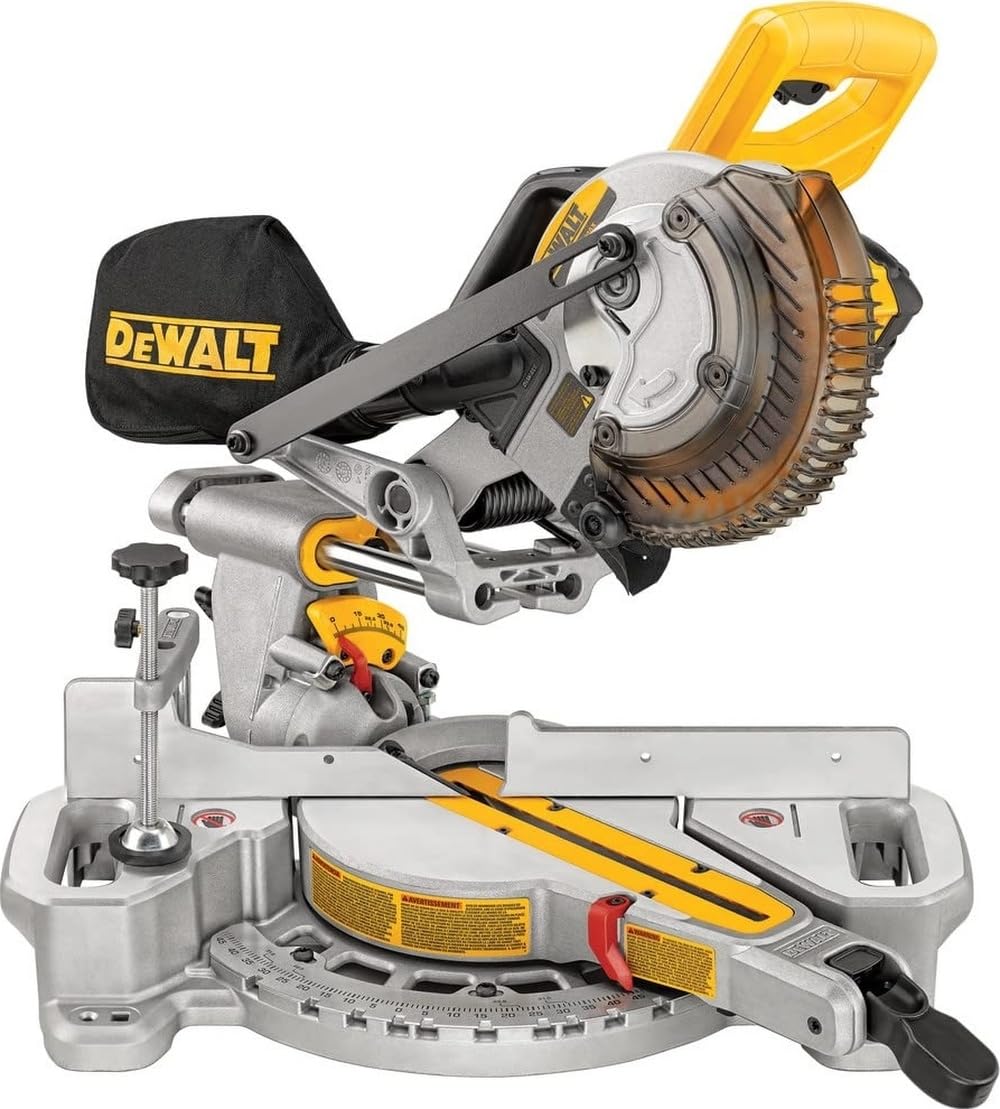
1. DEWALT 20V MAX* 7-1/4-Inch Miter Saw, Cordless (DCS361M1)
Our pick — over 4.5★ from 800+ verified ratings; the strongest balance of quality and price.
A 20V cordless 7-1/4-inch saw that runs 183 cuts of 2×4 pine per charge and carries in one hand.
This is the benchtop pick for anyone who moves between rooms, decks, and job sites without a cord trailing behind. The DEWALT DCS361M1 runs on a 20V MAX battery pack, and buyers report the standard DCB204 pack delivers on average 183 cuts of 2×4 pine or 275 cuts of 3-1/4 pine baseboard on a charge. Its 7.25-inch blade is the smallest here, but that size is exactly what makes the whole saw easy to pick up and park on a shelf. It is the crowd favorite of the group, holding 4.8 stars across 800+ ratings, and size is the trait buyers bring up most when they talk about it — the compact footprint is what wins them over.
Accuracy is where this saw quietly separates itself. The integrated cut-line cross-cut positioning system gives you an adjustment-free cut line indication — a shadow-style guide that shows exactly where the blade will land, so you line up trim against a pencil mark without squinting at a laser. The stainless steel miter detent plate carries 11 positive stops, which click solidly into the common angles and keep you from drifting off-square between cuts. The cam lock miter handle locks those angles fast, and the oversized bevel scale makes setting a bevel angle a quick visual read rather than a guess.
Where a corded saw leans on wall power, this one leans on the battery you already own from the 20V MAX platform. That is the real reason it tops the list: you can carry it to the lumber aisle, cut a board to fit in the parking lot, and never haul a long plank home in the truck. The stocked blade is the weak link — buyers describe it as the first thing worth upgrading, since a sharper blade is what the saw’s precision is actually built around. The sightline guide’s cleverness gets called out again and again as the feature that makes this saw feel smarter than its size suggests.
cordless jobsite freedom
- Battery runtime that real owners measure in hundreds of cuts — 183 cuts of 2×4 pine and 275 cuts of 3-1/4 pine baseboard on the included DCB204 pack
- 11 positive miter stops plus a cam lock handle for fast, repeatable angle changes
- Adjustment-free cut line indication means less time marking and re-marking
- Capacity for 3 5/8″ nested crown and 3 1/2″ base vertically, so trim work stays on this saw instead of a bigger one
blade changes slow
- The included blade is the first upgrade most buyers make
- The material clamp feels flimsy next to the rest of the build
- At 7.25 inches it is the shortest blade in this lineup — thick framing stock belongs on a 10-inch saw
mover’s pick: pick this if you cut trim, baseboard, and shelving across multiple spots and want one battery to run the whole job.
battery cost adds up: it runs best on the DEWALT 4AH-class packs, and the stock blade is the first thing to swap.
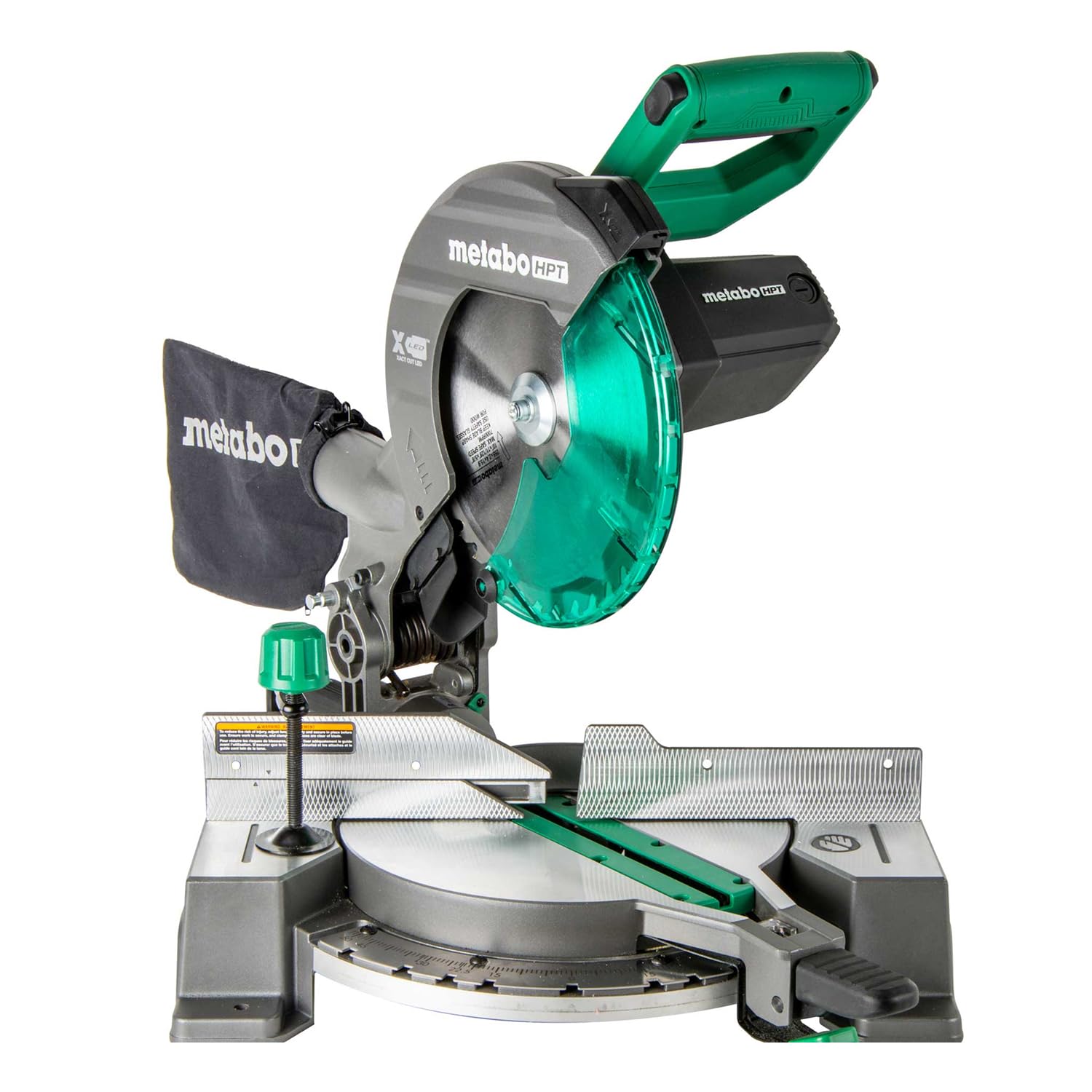
2. Metabo HPT 10-Inch Compound Miter Saw, 15-Amp, Single Bevel (C10FCG2)
A 15-amp corded 10-inch saw with a 0–52 degree miter range, wider than nearly everything else here.
If your work is straight trim, baseboards, and flooring in one spot, this is the saw to set up and leave set up. The Metabo HPT C10FCG2 pairs a 10-inch tungsten carbide blade with a 15-amp motor spinning up to a no-load speed of 5,000 RPM, and its miter range reaches 0–52 degrees left and right — wider than the VEVOR’s 45-degree sweep, so steeper corner cuts are reachable without workarounds. Weight lands at 24.2 pounds, which is what makes it portable enough to haul to a job and back without a helper.
Setup is where this saw earns its keep. It arrives well-calibrated from the start, so the first cut lands square without a full alignment session, and the adjustable bevel stops hold their settings for repeat work. The vice clamping system secures the workpiece for precision and safety, and the large 10-inch table gives longer stock better support so it does not tip as you finish a cut. Power is there — this thing handles 2x4s, 2x6s, and trim without bogging, and the electric brake stops the blade quickly when you release the trigger.
The honest catch is durability around the blade guard. The saw’s overall quality is the trait buyers rave about most, and build quality and functionality sit right behind it, but the guard is the one part with a pattern of breakage reports. It is a single component on an otherwise sturdy tool, and the rest of the saw — the square fence, the accurate detents — holds up to daily trim work. The dust collection, as on most saws this size, is modest and pairs best with a shop vacuum.
The Metabo HPT’s 5,000 RPM and 15-amp motor put it in the same muscle class as the corded 10-inch Makita and Delta saws, while its 24.2 pounds undercuts the 30-pound Delta — a real difference when you are the one carrying it up stairs.
set and forget: the right call for trim carpenters and DIYers who want a calibrated, powerful 10-inch corded saw for straight and beveled cuts.
wide board limits: keep an eye on the blade guard — it is the part with the most breakage reports.
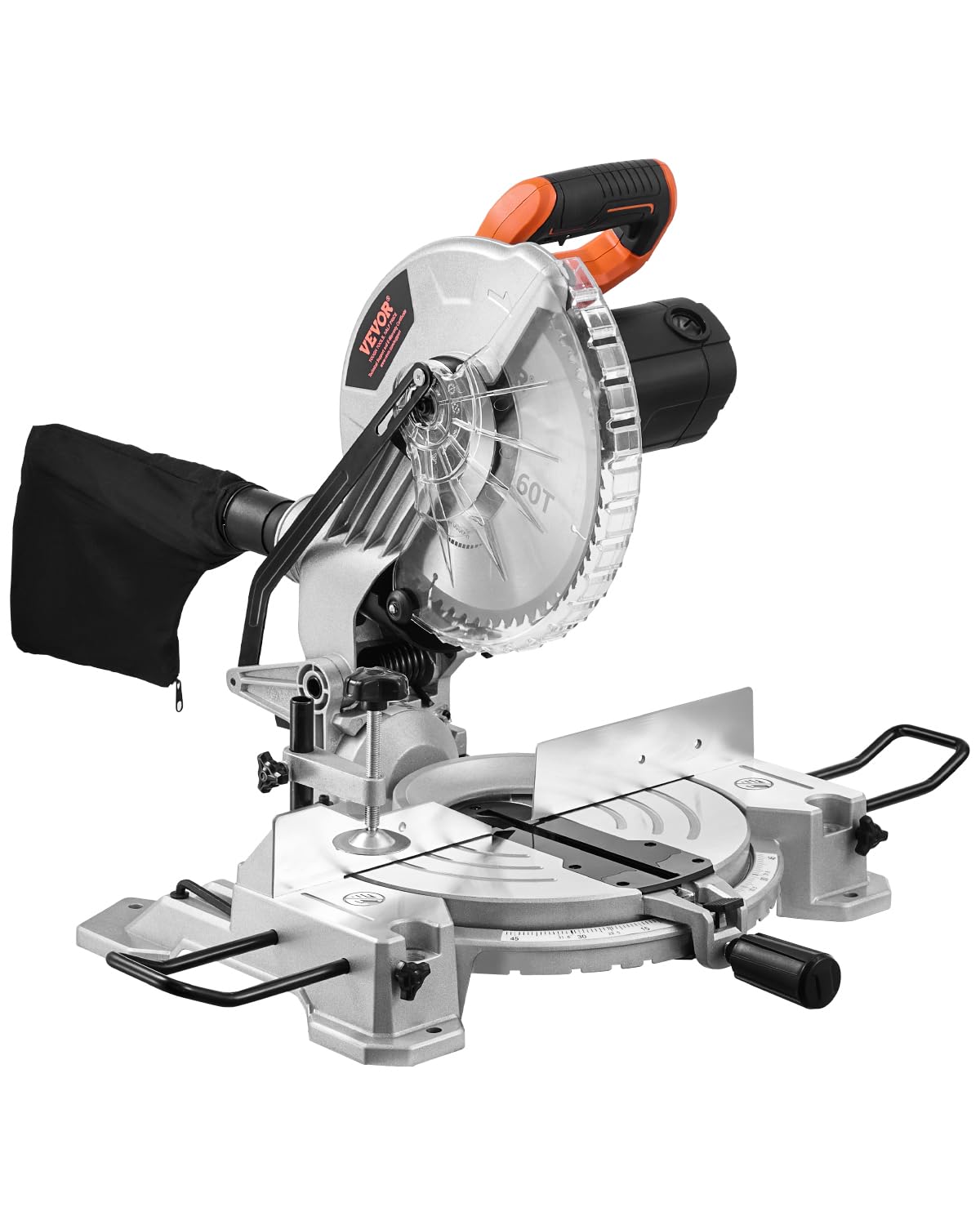
3. VEVOR Compound Miter Saw, 10-Inch Blade, 15 Amp Motor, 60-Tooth
A 10-inch compound saw with a cast aluminum base and an LED shadow line at a budget price.
Angle work is what this saw is built around. The VEVOR’s head tilts from 0° to 45° to the left, so picture frames, decorative joints, and crown work are all on the table for a fraction of premium money. It carries 2800W of straight-cutting power and 3000W of bevel-cutting power at a 5000RPM speed, and the 60-tooth blade is included to leave a smoother surface than a coarse framing blade would. The cast aluminum base is lighter than traditional cast iron and also helps dissipate heat, which matters if you are running it through a long stretch of decking boards.
The LED guide system projects a clear cutting line to the workpiece, which is what pulls people in on this saw. Owners mention the shadow guide works better than a typical laser — which stays true across this category, since the shadow approach shows a useful silhouette of blade width rather than a thin dot. Between the LED guide, the precision scale, and the locking system, dialing in an angle is a quick job. Both the dual-button activation that prevents accidental startups and the splash guard that deflects debris are there for safety, and the aluminum base keeps the whole unit manageable to move.
Real-world demands on this saw are modest, and the design mostly keeps up. It is not intended for professional daily production — several owners point out it is a beginner-friendly, hobbyist-grade machine — but for home use, decking, and framing it gets the job done. The knobs are plastic, and are the first thing likely to wear under heavy use. The stock blade in some three-thousand-watt cut-throughs can occasionally struggle if you push harder than the material warrants. But at this price tier, the value is the headline feature.
budget 15 amp power: the aluminum base and the LED shadow line land at a tier where most saws give you neither — and the included 60-tooth blade upgrades cuts you would otherwise pay more to get.
fence flexes slightly: this is a home-shop saw, not a production one, and the plastic adjustment knobs will show their age before the motor does.
value starter: ideal for DIYers, hobbyist woodworkers, and deck builders who want a compound 10-inch with a true cutting-line guide.
precision trim only: you need a saw that runs eight hours a day in a production shop — this one is tuned for home-duty cycles.
4. Genesis GMS1015LC 15-Amp 10-Inch Compound Miter Saw with Laser Guide

A 15-amp 10-inch compound saw with 9 detent stops and an electric blade brake for weekend framing jobs.
For hobbyists framing up planter boxes, benches, or cedar window boxes, this Genesis is a strong starting point. The 15-amp motor with a 10-inch carbide blade has the muscle to slice through 4x4s, 2x6s, and 2x4s without complaint, and the 9 positive detent stops click into the common angles so you are not fighting to hold a setting. The electric brake, meanwhile, stops the blade in seconds instead of letting it coast — a real safety plus when you are reaching for the next board.
The 45-degree bevel range on the left side and the compound cutting capability open up crown molding, shadow boxes, and picture frames as real options. The die cast aluminum base keeps the whole unit portable — and paired with the well-placed laser guide, setup between projects is quick. The laser itself is the standout for buyers, with recurring feedback that it lines up the cut cleanly and lets you see where the blade lands before you commit.
Two quirks you should know about. First, the laser alignment can take some fiddling — customers note it needs adjustment on arrival, and a few units go through a re-zeroing process before it settles. Second, the saw is loud, and ear protection is recommended while it is running. Neither point undermines the tool for home projects, but they are worth factoring in if you share a wall with the family or run this in an apartment-style space. The dust bag is functional but better paired with a shop vacuum for clean work.
weekend projects: a solid pick for home woodworkers who need a 10-inch compound saw for small projects and want a laser guide to speed setup.
finish carpentry no: the laser may need re-aligning when it arrives — and you will want ear protection once it is running.
5. DOVAMAN 10-Inch Sliding Miter Saw, Multi-Material, 2-Speed, 15A (DMS01A)

Three blades, two speeds, and one sliding rail that reaches further than most saws in this lineup.
The 13-inch sliding rail and extendable side tables on the DOVAMAN DMS01A are the story here, giving you a cutting range up to 4 x 13 inches — enough for wide boards that would choke a fixed-rail benchtop saw. A pair of 40-tooth blades and one 48-tooth TCT blade are included, and the dual-speed setting switches between 5000RPM and 3200RPM so you can fine-tune the cut to wood, PVC, or softer metals. A 15-amp pure copper motor keeps the whole setup running, and the ambidextrous design means both left- and right-handed cutters can work it comfortably.
Owners put this saw to work on 2x12s, 4x4s, pressure-treated lumber, and composite 1/2 x 12 fascia without complaint — a real range for a saw at this price point. The included laser guide lines up quickly, and the whole package is complete from the start. The extra blades mean less stopping to swap over when you move from framing stock to trim, and the extra pair of carbon brushes in the box tells you the maker expects this motor to run for a while.
Two trade-offs to weigh honestly. First, blade durability is the recurring note — the stock blades do not hold up to repeated long cuts the way a premium blade does, and the saw does not have a blade brake, so it coasts to a stop after each cut. Second, some units arrive needing a bit of alignment work on the backplate. On the plus side, the build quality gets called out repeatedly, and the customer service has surprised several buyers by going beyond the expected response.
Where the Metabo HPT asks you to leave the saw in one spot, this DOVAMAN leans hard into versatility: one motor that handles PVC, soft metal, and wood in the same afternoon means fewer tools on the bench overall.
sliding multi material
- 13-inch sliding rail stretches cross-cut reach up to 4 x 13 inches, well past what a fixed-rail saw handles
- Dual speed — 5000RPM for fast wood cuts, 3200RPM for PVC and softer metals
- Three TCT blades and two extra carbon brushes ship in the box
- Ambidextrous layout works comfortably with either hand
stock blade coarse
- The stock blades dull under repeated cutting — budget for a premium blade swap
- No blade brake, so the blade coasts down after each cut
- Some units arrive with alignment that needs a touch of adjustment
variety cutter: the one to grab if you cut wood, PVC, and soft metal from the same bench and want one saw doing all three.
fine trim upgrade: the stock blades dull quickly under heavy use — pair this saw with a quality TCT blade and it earns its keep.
6. CRAFTSMAN V20 Cordless Sliding Miter Saw, 7-1/4 inch (CMCS714M1)

Quiet enough to cut trim in the garage at midnight, with a battery that keeps going.
Anyone who has to cut without waking the house will appreciate what the CRAFTSMAN CMCS714M1 offers. It makes up to 585 cuts in 3-1/4-inch MDF baseboard on a single charge from the included 4.0AH V20 battery pack, and buyers describe the battery as cutting all day. The 3,800 RPM motor handles 2x dimensional lumber, hardwoods, baseboard, and trim with ease, and the slide rail gives you an 8-inch cross cut at 90 degrees and 5-1/2-inch cross cut at 45 degrees. It also swallows 3-5/8-inch nested crowns and 3-1/2-inch baseboards vertically, so crown work stays on this saw.
The LED cut line positioning system marks the cut cleanly, and the 9 casted miter detent stops let you click into the common angles quickly. This one is genuinely quiet, and owners who cut in a garage at midnight notice the difference against a heavy corded saw. Weight lands at 21.8 pounds, which is light enough to carry one-handed across a jobsite, and the 20V platform means the batteries you already own for other CRAFTSMAN tools run this saw too.
The one real limit is stock thickness. Reviewers point out the saw struggles with material 3 inches or thicker, because the motor housing meets the wood and there is no blade height adjustment to work around it. That makes this a trim-and-framing saw, not a timber saw — but for the 2x4s, baseboards, and crown molding that fill a typical deck or trim project, it holds up without complaint. The included material clamp also blocks 45-degree cuts, so you get used to working around it.
quiet compact cordless: the running time and the low noise. Several buyers working late in the garage describe cutting complete projects and reaching for a battery swap far less often than expected, and the quieter motor is the running theme on the review pages.
small cut depth: cutting thickness caps around 3 inches because of the fixed motor height — fine for trim, tight for framing timber.
garage friendly: the right saw for trim crews and home remodelers who want a cordless benchtop that makes long sessions without a cord trail.
thick lumber struggles: your work regularly involves stock over 3 inches thick — the motor housing will bump the wood.
7. SKIL 10 Amp 7-1/4″ Single Bevel Miter Saw with Compact Rail System (MS6306-00)

A bench saw designed around wall-hugging cuts in a tight shop footprint.
The SKIL MS6306-00 is built for the small workshop problem: saws whose sliding rails shove the body far off the back of the bench, right into the wall behind it. This one uses a fixed compact rail system that minimizes the benchtop-to-wall footprint, so you can work flush against the wall and still cut 2×10 crosscuts at 0 degrees. A 10-amp motor spins the 7-1/4-inch carbide blade up to 4,800 RPM for quick, detailed cuts, and the miter capacity runs 0 to 47 degrees left and 0 to 50 degrees right, with detents at 0, 15, 22.5, 31.6, and 45 degrees on both sides.
Materials the saw swallows cleanly include 3-1/2-inch crown molding nested, and 2×6 at 45 degrees left or right miter. The LED shadow line shows the blade’s footprint on the workpiece and delivers cutting accuracy beyond what lasers typically give, which is why owners mention it so often — the shadow approach lets you cut right to a mark even in bright light. The single bevel tilts 0 to 45 degrees left, covering the corner cuts most home trim work needs.
What gets mentioned most by people who own this saw is the overall quality — it is described as a sweet-spot saw, quiet enough for a small garage, and steady enough to tackle 900 square feet of engineered hardwood flooring and baseboard without losing accuracy. Owners do note it is not the biggest saw on the market, so overly thick boards are not its lane. The quick work clamp secures materials well for safer cutting, and the quick miter lock makes angle changes a fast move.
tight shop saw: the pick for homeowners cutting trim, shelving, and flooring in a garage or spare room where the bench back sits close to the wall.
crown molding hard: it is a 7-1/4-inch class saw, so oversized framing stock belongs on a 10-inch model.
8. RYOBI ONE+ 18V Cordless 7-1/4 in. Sliding Compound Miter Saw (PBT01B)

The cordless saw that only makes sense if you already own the batteries.
This RYOBI PBT01B is aimed at a specific buyer — someone already stocked with RYOBI ONE+ 18V batteries from other tools. The saw runs on the same ONE+ 18V platform as over 260 other tools, so the batteries you own already work here. It delivers up to 800 cuts per charge, and its 2×10 cross-cut capacity is class-leading in the 7-1/4-inch cordless category. The 7.25-inch high-speed steel blade spins through pine, oak, MDF, and laminate flooring with the right blade aboard.
The sliding feature is what makes the extra cost worth it against a non-sliding cordless saw, letting it handle more of the projects a heavy 12-inch sliding saw would otherwise be dragged out for, especially trim and molding miters. Owners run this saw for finish trim and say it works well for the vast majority of their mitering needs. The 30-day limited warranty is short for the category, though many cordless platforms run short coverage — this is not a case where the platform carries an extended tool warranty.
Two things to note on the buy side. The battery and charger are sold separately, so this is a saw for existing ONE+ owners rather than someone building a battery collection from scratch. And the stock blade falls short of the saw’s capabilities — buyers swap in a 60-tooth blade for cleaner crosscuts and keep a more aggressive blade on the saw’s rough-work days. This is a saw designed for the person already on the platform, and for that buyer, the convenience is hard to argue with.
ryobi owners: the one to pick if you already own ONE+ 18V batteries and want cordless trim cutting without starting a new battery collection.
beginner frustration risk: the battery and charger sell separately, so the total cost climbs if you are buying into the platform from scratch.
9. Evolution Power Tools R255SMS+ PLUS 10-Inch Sliding Miter Saw

One TCT blade that eats mild steel, wood, and composite decking without switching saws.
Most benchtop miter saws are wood-only, but the Evolution R255SMS+ PLUS is built around multi-material cutting. With one blade it cuts wood, wood with embedded nails, composite decking, mild steel, plastic, and more — no abrasive wheel and no blade swap. The miter range spans 50°–50°, the bevel runs 0°–45°, and the saw includes dual quick-release clamps, taller fences, a slide rail protector, and integrated carry handles. The soft start feature ramps the motor up gradually, which keeps it from tripping breakers on startup.
Shoppers say cutting through 1/8″ metal, angle iron, and 3/16″ angle iron with a 52-tooth blade while staying sharp after roughly 50 miter cuts on 3/16″ angle iron. The trade-off is the technique — you ease into the work rather than pushing through, and you always clamp material because the saw is powerful enough to throw small pieces hard. The 3-year warranty gives it long backing for a home shop saw at this tier.
Some honest notes: the included all-purpose blade leaves a rougher finish on wood than a dedicated wood blade would, so woodworkers trimming finish stock will want to swap it. The saw throws hot chips, so a face shield and long sleeves make sense when cutting metal, and the chip bag does not catch everything. A few plastic parts suggest the saw is more homeowner than job-site production grade, but for someone who cuts wood and steel from the same bench, it is a serious space saver.
steel and wood cuts: the multi-material capability means you do not need a second saw for metal — the R255SMS+ PLUS handles wood, mild steel, composite decking, and even wood with embedded nails with the same blade.
blade guard stiff: clamp every piece before cutting, especially metal, and wear a face shield — the saw is powerful enough that unclamped pieces move.
dual material saw: the right pick for a home shop that cuts trim and light metal furniture from the same bench and wants to avoid buying a separate metal-cutting saw.
soft metal only: the included blade leaves a rough finish on wood, so keep a dedicated wood blade for visible trim work.
10. Delta 10 in. Compound Sliding Miter Saw (S26-263L)

A ten-inch slider with a 5,500 RPM motor and bevel it takes clean down through 2×12 lumber.
The Delta S26-263L is a solid mid-level corded slider for weekend woodworkers who need real throat capacity. The 15-amp, 120V motor spins at 5,500 RPM, the highest RPM in this lineup, and the bevel does 0° to 45° to the left, cutting nominal 2 in. x 12 in. at full bevel. The sliding rail adds reach that a fixed saw will never match, and the cord exits the rear of the slide bar so it stays protected from the blade during a cut. A spindle lock holds the spindle securely while the blade nut loosens or tightens, so blade swaps are safer than on saws without one.
Weight lands at 29-1/2 pounds, which makes this a move-it-once-per-project saw rather than one you carry around a jobsite. The 24-tooth blade that ships with it cuts smooth enough for framing, and several owners upgrade to a 60-tooth for oak or visible trim work. The base build is solid — no flimsy plastic body flex — and the safety features are thoughtfully laid out, which is why the saw gets recommended for weekend-warrior use where a bigger 12-inch saw would be overkill.
Two points to weigh before buying. The laser on this saw is weak and best indoors — one owner’s blunt take is that it is fine in dim light but not on a bright site. And the dust bag is ineffective without a shop vacuum backing it up. Both have easy workarounds. The 5,500 RPM motor, deep throat, and 2×12 beveled capacity, meanwhile, mean this saw cuts stock that a 10-inch fixed miter box cannot, which is the real reason it holds its spot on this list.
midrange depth: a good fit for the weekend woodworker who needs the throat of a 12-inch class cut in a 10-inch blade platform and does not need to port it across town.
parts wait times: the laser works best indoors and the dust bag really needs a shop vacuum behind it.
11. Makita LS1040 10″ Compound Miter Saw

No rails, no lasers, no coast-down — just a rock-solid 10-inch that repeats the same cut.
For trim carpenters who need precision over features, the Makita LS1040 is built around a dual post compound pivoting arm that eliminates the side-to-side play some sliders develop over time. The 15-amp direct-drive motor runs at 4,600 RPM with a soft start, and the machined aluminum base with dual slide rails keeps the cut square. Miter range runs 0°–45° left and 0°–52° right, with 9 positive stops at 15°, 22.5°, 30°, 45°, and 0° on both sides, and the bevel tilts up to 45° left.
Two firm advantages of the no-slide-rail design. First, size and portability — the saw is compact enough to fit cramped shops and light enough at 25 pounds that a trim carpenter can carry it into a client’s home without a cart. Second, precision — the fixed-arm design holds the cut line steady, so you can repeat identical cuts through a room of baseboard and know each intersection lands square. This is a saw that has earned its reputation over years in the field for repeated accuracy on trim stock.
There is one honest quirk: the saw is loud. Buyers describe it starting off with a bang rather than a soft ramp, and hearing protection is a genuine requirement. It also does not fit stock wider than about 1×6 fully through the blade in a single pass — the workaround is a shim. Neither caveat undermines the fundamentals for the trim carpenter audience, but both are worth knowing before this Makita lands on your bench.
finish workhorse: the pick for carpenters and finish woodworkers who value repeatable accuracy and a small footprint over sliding rails and lasers.
weight conscious buyers: this Makita is loud and drives the blade with authority — hearing protection is not optional.
Understanding the Specs
Blade Diameter And What It open up
Blade diameter is the size of the round cutting disc, and it decides how deep and how wide the saw can slice in a single pass. A 10-inch blade, like the one on the Metabo HPT C10FCG2, handles wide trim and framing stock. A 7-1/4-inch blade, like the DEWALT DCS361M1 or the SKIL MS6306-00, is lighter and easier to carry, but it caps out on thick boards — the CRAFTSMAN CMCS714M1 stops around 3-inch stock because the motor housing bumps the wood. Pick the blade size that matches the thickest material you actually cut, and let the saw’s weight follow from there.
Miter Versus Bevel — The Two Angles That Matter
Miter angle rotates the blade side to side for cutting corners, while bevel angle tilts the blade head sideways for cutting slopes, crown molding, and picture-frame joints. A single-bevel saw tilts one direction (usually left), which covers most home trim work. A compound cut combines both motions at once, which is what you need for crown molding and shadow boxes. The wider the miter range, the steeper the angle you can reach — the Metabo HPT hits 0-52 degrees, while the VEVOR covers 0-45 degrees, so a steep corner cut lands within reach on the wider saw.
FAQ
What is the difference between a benchtop miter saw and a full-size sliding miter saw?
Do I need a sliding rail on a benchtop miter saw?
Can a benchtop miter saw cut metal as well as wood?
How many miter stops should I look for?
How long should a benchtop miter saw’s blade last?
Is a cordless benchtop miter saw as powerful as a corded one?
Will a 7-1/4-inch miter saw cut 4×4 lumber?
How do I keep a benchtop miter saw accurate over years of use?
What dust collection setup do benchtop miter saws actually need?
Do I need to bolt a benchtop miter saw to a stand?
Final Thoughts: The Verdict
For most buyers, the benchtop miter saw winner is the DEWALT 20V MAX* 7-1/4-Inch Miter Saw (DCS361M1) because it delivers 183 cuts of 2×4 pine on one charge, cuts square on the first try thanks to its cut-line positioning system, and lets you work anywhere the work actually is. It holds the highest rating in this group at 4.8 stars, on 800+ ratings — and while a couple of saws here have collected more total reviews, none beats its score. If you would rather have 15 amps of wall power and a wider 52-degree miter range, grab the Metabo HPT C10FCG2. And for multi-material cutting — wood, mild steel, composite decking, and wood with embedded nails on one blade — the Evolution R255SMS+ PLUS is the one to reach for.
How We Picked
We do not accept paid placement. Every pick is matched to a real buyer and a real use-case; we do not hands-on test units.
Sources & Methodology
Specifications: manufacturer listings and product documentation. Review insights: verified customer reviews, as of September 2026. Pricing: not shown on this page (it changes often); check the current price via the retailer link.
As an Amazon Associate, KitchPrep earns from qualifying purchases. This does not affect which products we feature.
Related Guides
