
Specs are compiled from manufacturer listings and verified buyer reviews and can change over time — please confirm the key details on the product page before buying.
Here is the bottom line before you scroll: to grind a knife bevel without torching the steel, you need a machine that runs slow, runs cool, and tracks a belt dead straight. Fast fixed-speed sanders will blue an edge in seconds, and a belt that wanders off the platen ruins a blade just as quickly. The seven grinders below all do those two jobs properly — some for a hobby budget, some for a full shop build.
I’m Mohammad Maruf — the founder and writer behind KitchPrep. This guide is built by comparing the manufacturers’ published specifications and the patterns across verified customer reviews, so you get each pick’s real strengths and trade-offs instead of marketing spin.
Below you’ll find a plain-English pick for every budget and bench size, plus the spec numbers that actually affect blade work. Every entry here was checked for variable speed or a workable platen setup, the two features that separate a real blade tool from a general-use sander. That is the core filter behind this list of the best belt sanders for knife making.
Our Picks at a Glance


How To Choose The Best Belt Sanders for Knife Making
Knife making is a specific job, not general woodworking. Your sander has to shape a bevel, set a plunge line, and finish a handle without overheating the steel. A machine that is brilliant on a pine board can be useless on a hardened blade. So the checklist is short but strict.
Start with speed control, not raw power
Variable speed lets you dial the belt down for a micro bevel and open it up to hog off material. A fixed-speed machine only gives you one speed, and if that speed is too fast the friction heat builds up and stains the steel. Look for a speed range that drops low enough to be gentle. For most home makers, speed control matters more than horsepower.
Belt size decides your whole workflow
A 1 x 30 inch belt is compact, cheap, and forgiving for a first blade. A 2 x 42 inch or 2 x 72 inch belt gives you a wider grind face, so bevels come out flatter and faster. Wider belts also hold more grit for a given cut. The larger the belt, the more room you have to work, but the more floor space the machine eats.
Measuring your electrical reality first
Some of the bigger grinders here ship with a transformer to step 110-volt house power up to the 220 volts the motor wants. Others ask for a dedicated circuit. Before you buy anything, walk over and look at your outlet. A grinder that needs a circuit you do not have is a grinder you cannot use.
Quick Comparison
| Model | Best For | Belt Size | Max Speed | Motor / Power | Amazon |
|---|---|---|---|---|---|
| BUCKTOOL 1×30 Low Speed Grinder Combo★ Best Overall | First-time blade makers | 1 x 30 in. | 1790 rpm | 2.1 A / 1/3 HP | Amazon |
| KFMK 2×42 Belt & 6″ Disc ComboBest Versatility | Shaping knives and handles | 2 x 42 in. + 6 in. disc | 3580 rpm | 3.5 A / 1/2 HP | Amazon |
| RIKON 50-161VS Variable Speed Combo | Thin stock and precise bevels | 1 x 30 in. + 6 in. disc | 3400 rpm | 2 A / 3/4 HP | Amazon |
| VEVOR 1×30 Belt Grinder with VFD | Compact shop with real control | 1 x 30 in. | 5000 rpm | 5 A / 550 W | Amazon |
| BUCKTOOL Pro 4×36 Belt & 8″ Disc Sander | Metal work and volume grinding | 4 x 36 in. + 8 in. disc | 3450 rpm | 5 A / 1 HP | Amazon |
| Jinlida 2×72 Belt Grinder with VFD | Serious hollow grinds | 2 x 72 in. | 3000 rpm | 10 A / 1500 W | Amazon |
| JLD Professional 2×72 with 2.2KW VFD | A full shop build | 2 x 72 in. | 3000 rpm | 10 A / 1500 W | Amazon |
In‑Depth Reviews
1. BUCKTOOL Low Speed Belt Grinder Combo for Metal, 1×30″ Belt, 6″ Grinder, 2.1A
Our pick — over 4.5★ from 150+ verified ratings; the strongest balance of quality and price.
The slow-running beginner’s machine that keeps a blade cool while you learn the bevel.
Your blade stays cool while you shape a bevel, because this grinder runs at 1790 rpm (revolutions per minute — how fast the belt spins). That is roughly half the spin of the fastest combo in this guide, the KFMK at 3580 rpm. Less speed means less friction heat, so a hardened edge stays cool instead of turning blue. You get a 1 x 30 inch belt paired with a 6 inch grinder wheel, both on one benchtop frame. It runs on ordinary 120-volt corded power, so no special outlet needed.
What wins people over is the sharpening performance, and it shows in the workflow. A 1/3 HP direct-drive motor turns that belt, and the direct-drive layout is built to put the motor’s output straight onto the abrasive instead of losing it through a belt-and-pulley system. Belts track true and swap in seconds thanks to the one-button belt cover and quick-release system. There is even a built-in holder for the Allen wrench, so the tool you need to adjust tracking does not walk off the bench.
For knife work specifically, the low speed lets you set a clean bevel and then refine it without burning the tip. Buyers report it works with a separate angle guide to hit consistent grind angles. It also stands up over time — long-term owners describe the machine as still running without vibration well past the first year, with replaceable parts rather than a throwaway build. The honest catch: this is not a high-speed metal hogger. On startup after sitting for days, the belt can occasionally bog down for a moment, cause unclear. If you want a dedicated fast grinder for heavy stock removal, aim higher.
Where it earns its keep
- 1790 rpm low speed resists heat build-up on a fine edge
- Direct-drive 1/3 HP motor for steady power on light passes
- One-button belt cover and quick belt release speed up changes
- Built-in wrench storage keeps setup tools on the machine
What to go in knowing
- Not a high-speed machine; it trades speed for control
- Occasional startup bog-down after days of sitting, cause unclear
- 1 x 30 in. belt is compact, so wide bevels take more passes
Reach for this if: you are building your first knife and want a low-speed grinder that will not scorch the steel.
Look elsewhere if: you need to hog off large amounts of metal fast on thick stock.
2. 2×42 in. Belt Sander & 6″ Disc Sander Combo, 3.5Amp Bench & 1/2HP Belt Sander for Knife Making
A wider 2 x 42 inch belt for flattening bevels, plus a 6 inch disc for squaring handle blocks.
You get flatter, faster bevels across more of the blade at once, because this KFMK gives you a 2 x 42 inch belt — double the width of the BUCKTOOL above. Where the smaller 1 x 30 machines make you work a narrow strip, this wider belt covers more steel. It pairs that with a 6 inch disc sander on its own 6-1/8 x 9 inch table that tilts to 45 degrees, so you can true up a handle block or square a guard without a second machine. The 3.5 A (amps — a measure of electrical current), 1/2 HP (horsepower — a measure of motor power) induction motor spins the belt at up to 3580 rpm.
You can flip the belt sander from vertical to horizontal to match how you like to stand at the bench. A tool rest supports the belt for straight grinding, and the package includes a miter gauge for the disc plus 8mm/19mm flat wrench and 5mm, 6mm, and 8mm hex keys, so you can assemble and adjust it without hunting for tools. Owners mention it runs on an external variable speed controller for finer work — one reviewer noted the belt runs at 75% on the controller, dropping to 60% with fine grit. That gives you a slow option the spec sheet alone does not show.
What the machine does best, owners consistently say, is shaping blades and handles: it is not a powerhouse, but it is excellent for turning a rough blank into a finished shape. One 4/5 review pointed out the motor is closer to 1/3 HP than the advertised 1/2 HP, and that the belt rest table grooves can be uneven. The included honing stone also drew a poor note as warped from the start. None of that stops the machine doing its core job — but if you want flawless accessories, budget to swap the stone.
Wider belt, real advantage: the 2 inch belt face spreads heat and cuts a flatter bevel than a 1 inch strip, and the 6 inch disc handles handle work.
The honest trade: motor output is closer to 1/3 HP than the 1/2 HP label, so heavy hogging is not its strong suit — shaping and finishing are.
Best fit for: a maker who wants one bench machine to both shape a blade and square up handles.
Think twice if: you plan to grind thick hardened steel in long, heavy passes.
3. RIKON 50-161VS 1 x 30-Inch Belt / 6-Inch Disc Variable Speed Sander

The dial-a-speed 3/4 HP combo that makes one machine feel like three.
This is the grinder to reach for when you want the process tuned, not just run. Its 3/4 HP, 120-volt motor adjusts from 2,000 to 3,400 rpm, with belt speed from 1,909 to 3,248 SFPM — a real speed range, not a token low setting. That range is why it matters for knife work: you can slow the belt right down for a thin, delicate piece so it does not burn, then open it up to cut a bevel faster. The 3/4 HP rating is a step above the 1/3 HP direct-drive class.
You get two sanding surfaces — a 1 x 30 inch belt and a 6 inch PSA disc — and both work tables tilt from 0 to 45 degrees for straight or angled passes. A miter gauge slots into the disc table, and belt tracking adjustment keeps the abrasive sitting where it should. Two separate dust ports, one for the belt and one for the disc, mean you can hook up shop dust collection at both ends. Mounting holes in the base let you bolt it to a bench or stand so it does not walk.
The trade-offs are real and worth naming. Belt mobility is the recurring gripe — the belt does not always want to center, and one long-term reviewer had a wandering belt cut into the housing. The motor can also run extremely hot during long sessions, so give it some breathing room between heavy passes. Assembly quirks and a loose miter slot show up too. Still, the machine’s performance and its adjustable speed are what owners rave about most, and with a 5-year manufacturer warranty it is built to be repaired rather than replaced. If you want a compact combo where the same machine covers bevels and handle work, this is the one to beat.
Three jobs, one bench: belt and disc tables that both tilt to 45 degrees plus a multi-speed motor cover bevels, touch-ups, and handle shaping without swapping machines.
Acknowledged rough edges: the belt does not always settle dead-center and the motor runs hot on long grinds — plan your passes and it stays manageable.
Who it beats everything for: the maker who wants the widest speed control and two sanding surfaces in a small footprint.
Who should keep looking: anyone who expects the belt to track perfectly with zero fiddling.
4. VEVOR Belt Grinder Sander, 30 x 1-Inch Variable Speed Belt Polisher with VFD, 550W

A 550W VFD grinder that packs serious control into a very small footprint.
You get stepless speed adjustment across the whole range, because the VEVOR uses a VFD (variable frequency drive — a controller that changes the motor’s electrical frequency to set its speed smoothly) instead of a simple speed dial. The pure copper motor puts out 550W (watts — a measure of power) and spins to 5500 rpm, with a belt line speed of 26m/min (meters per minute — how fast the belt surface moves). Add the two grinding modes, circular and flat, and you have a machine that handles curved and flat work on the same compact frame.
The kit is generous for the money. It ships with 3 sanding belts in 100, 180, and 240 grit — a worn-in sequence running from coarser shaping right down to fine polishing. The reinforced steel body keeps it steady, and the detachable workbench plus vertical-or-horizontal orientation lets you find the angle that suits your hands. It is small and light enough to tuck onto a crowded bench, which is its quiet advantage.
Quality is the thing owners praise most, and it shows in the finish and the smoothness of the drive. The variable speed and the ability to switch between the two grinding modes both earn steady praise. The honest notes: belt tracking can take some fiddling, and the flat platen bearings arrived too tight on some units, running hot until the rollers were reamed to free them. Assembly directions range from easy to frustrating depending on the unit. A few buyers also made small alignment tweaks before the platen sat true. For a compact VFD grinder, though, it earns its bench space.
Why makers keep it
- Stepless VFD speed control across the full range
- Three belts included: 100, 180, 240 grit for shaping to polishing
- Two grinding modes, circular and flat, on one small machine
- Reinforced steel body and detachable bench for placement freedom
Bumps in real use
- Belt tracking may need adjustment from the start
- Pla ten bearings can run hot until broken in
- Assembly instructions are inconsistent
Grab this one if: your bench is tight and you want VFD speed control in the smallest package.
Pass if: you would rather not touch a wrench to set tracking and bearing looseness on arrival.
5. BUCKTOOL Pro 1HP Bench Belt Sander for Metal Working, 4 x 36 in Belt and 8 in Disc Sander

A 1HP metal eater with a 4 inch belt that refuses to stall on steel.
Where the compact grinders make you nurse the motor, this one does not care. Its 1 HP fully enclosed induction motor drives the belt hard, and the direct-drive design sends that power straight to the abrasive instead of losing it through belts and pulleys. Put the 4 x 36 inch belt against a strip of high-carbon steel and it keeps cutting. The 8 inch disc runs alongside it, giving you a big flat surface for squaring up a piece. Spin tops out at 3450 rpm.
Two features stand out for blade work specifically. First, the belt work table tilts from 0 to 90 degrees, so you can grind horizontal or flip to vertical without unbolting anything. Second, the driven drum lets you sand curved workpieces — handy for shaping a handle, a ricasso, or a rounded spine. The cast aluminum base with rubber feet holds the machine still so vibration does not blur your grind line, and the switch box sits on top for quick reach. The dust port removes to give you bonus work area for long stock, and the whole two-in-one package handles both metal and wood.
Owners are direct about what makes this a keeper: the power does not bog down on steel, tracking is easy to dial in, and belt changes are quick. It is also quiet in operation, which makes long sessions less punishing. The real caveats are setup and accessories. The instructions are thin and there is no model-specific video, so assembly turns into guesswork with a few leftover parts. The disc uses a hook-and-loop face rather than PSA, and 8 inch replacement discs are harder to source locally. A plastic dust guard has been known to soften on heavy use. Those are fixable annoyances, not deal-breakers.
Built for metal: the 1 HP direct-drive motor and 4 inch belt give you real cutting power where smaller machines slow down.
The setup tax: weak instructions and a hard-to-find 8 inch hook-and-loop disc mean you should plan to source consumables ahead of time.
The one for: makers doing steady metalwork who want power and a wide belt that will not stall.
Not the one for: someone who wants a plug-and-play machine with clear instructions from the start.
6. Jinlida 2×72-inch Belt Grinder Sander with VFD, 1500W 2HP Variable Speed, 3 Grinding Tools
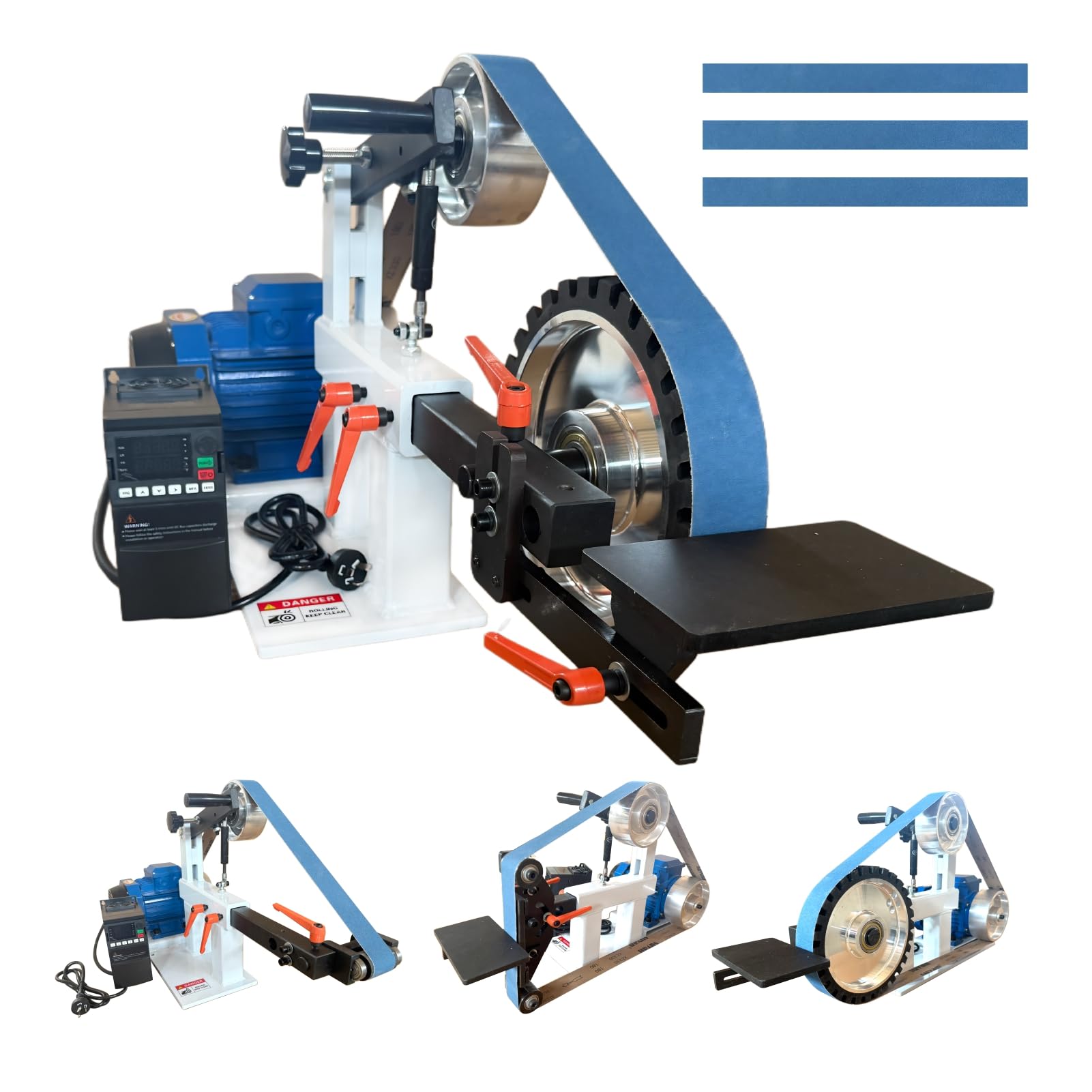
The 2 x 72 inch steel eater that lets you grind a full hollow bevel in one pass.
This is the machine you graduate to when a 1 inch belt stops being enough. The 2 x 72 inch belt is the standard tooling size for serious knife grinders — a wide, long run of abrasive that spreads heat and lets you lay down a long bevel in a single smooth pass. A 1500W pure copper motor drives it at 2900 rpm, and the VFD lets you switch between fast and low speeds, with an MFK reverse button on the controller that helps polishing and protects the motor. Belt speed runs at 36m/s.
The grinder gives you three ways to attack steel: circular, flat, and arc grinding via three sets of grinding tools. That covers polishing, deburring, rust removal, and welding clean-up on one frame. The kit ships with belts in three particle sizes — 60 mesh for coarse stock removal, 100 mesh for medium work, and 180 mesh for fine polishing. The 100 mesh belt strips burrs and deep defects efficiently, while finer belts bring the surface down smooth. A welded steel frame and thickened base keep vibration out of the equation.
One thing to sort out before you buy: the motor’s rated voltage is AC 220V, and if your shop runs on 110V you will need the included transformer to step it up. A dedicated 30-amp plug is the cleanest setup, though some customers note it runs fine on a power strip. Set-up is easy without a manual, and belt tracking holds well. The honest caveats: the control box is not sealed, so keep it clear of grinding dust, and heavier fabrication or repair may be needed on a few connections. Weighing 110 pounds, unboxing is a two-person job. For the price, you get a full 2 x 72 inch grinder with VFD control.
The draw
- 2 x 72 in. belt handles full-length bevels in fewer passes
- 1500W motor with VFD for smooth speed changes and reverse polishing
- Three grinding tools — circular, flat, and arc — cover most blade tasks
- We ld-welded steel frame holds steady under heavy use
Before you commit
- Motor is 220V; the 110V transformer is required for standard shop power
- Control box is not sealed against grinding dust
- 110 lb unit is heavy to unbox and set up alone
Worth it for: the maker doing hollow grinds and larger blades who wants a full-size 2 x 72 belt.
Skip if: your shop is 110V only and you do not want to deal with a step-up transformer.
7. JLD Professional Belt Grinder Sander, 2×72 Inch Belt, 1500W Motor with 2.2KW VFD
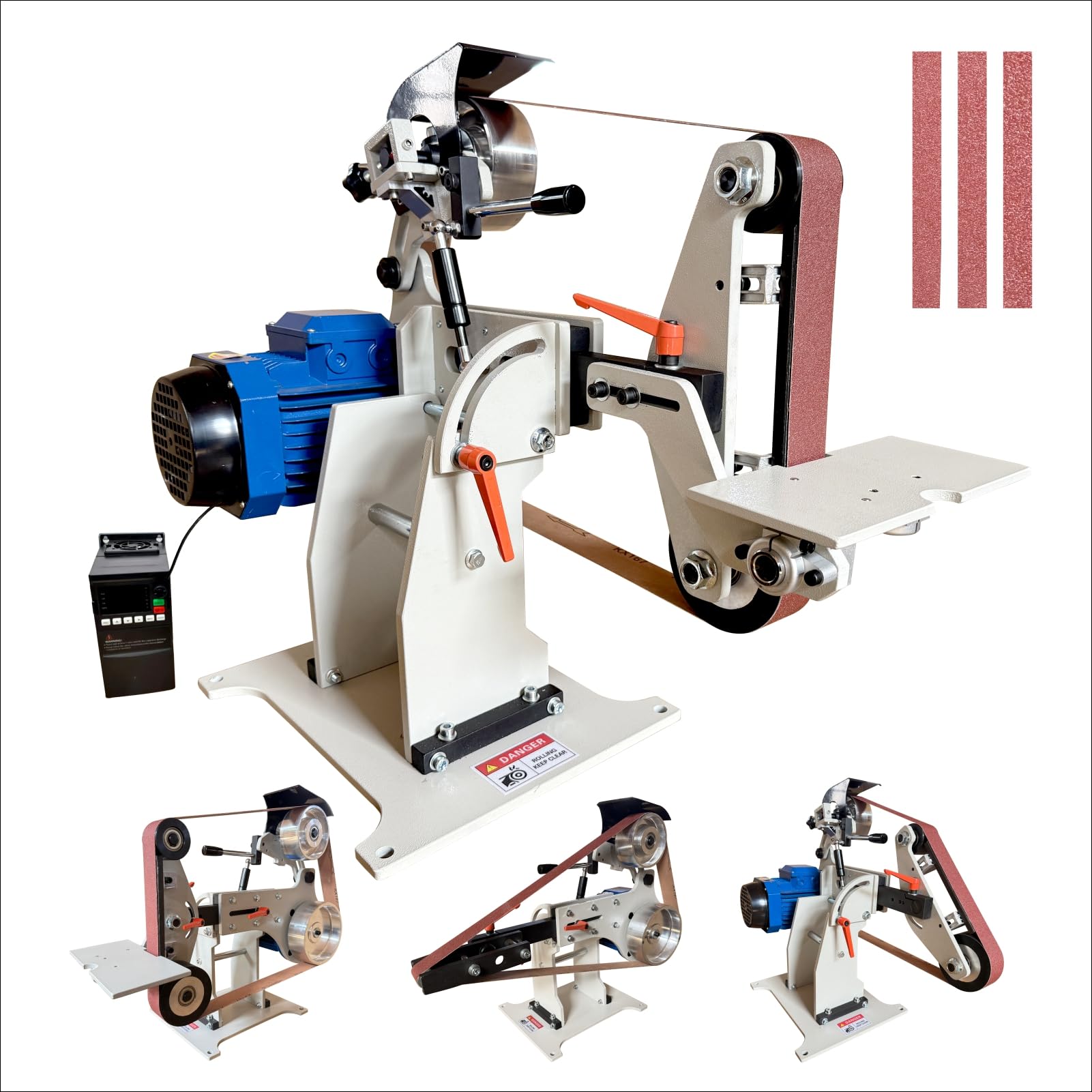
A 190-pound 2 x 72 inch grinder with the biggest VFD in this lineup.
The correct angle: this is the premium end of the guide, a full 2 x 72 inch grinder built for a dedicated shop. A 1500W pure copper motor pairs with a 2.2KW VFD, the biggest controller in this lineup, supporting stepless speed adjustment from 0-2800 rpm. That smooth, jerk-free regulation lets you match the belt to the material — slower for softwood or a fine polish, faster for hogging steel.
The grinding kit is built for range. Two professional grinding kits enable circular grinding for curved work, flat grinding for plates and profiles, and arc grinding for irregular shapes, all on one frame. Three belts come in 60-grit for coarse deburring, 100-grit for medium shaping, and 180-grit for fine refining — the full sequence from rough stock to a finished surface. The one-piece steel frame is powder-coated against rust and stays vibration-free even during long heavy grinding, which is exactly what you want when precision matters.
Two things to plan around. First, the included transformer steps 110V up to 220V, and a dedicated 220 outlet is recommended though not strictly required — one owner reports it runs fine with the converter in place. Second, there is a separate transformer before the VFD that adds an extra startup switch, which some owners find clunky. Set against that, the motor is powerful, the bearings run smooth, and belt tension holds via a gas piston that keeps the belt tracking true. Reviewers point out the machine works as advertised and exceeds expectations.
The control ceiling: a 2.2KW VFD giving stepless 0-2800 rpm is the finest speed control in this group, matched to a 1500W motor.
The setup reality: a separate transformer and an extra startup switch are part of the wiring, plus you will want a dedicated 220 outlet for clean power.
For the committed maker: someone building a proper blade shop who wants maximum speed control and a vibration-free 2 x 72 frame.
Not for: anyone who wants to plug into a standard 110V outlet and grind five minutes later.
Understanding the Specs
RPM and belt speed
RPM measures how fast the drive spins; belt speed (often listed in SFPM or m/s) measures how fast the abrasive actually moves past your steel. For knife work, lower is safer: a slow belt gives the heat time to escape instead of building up and staining the blade. Machin es that drop to a low setting let you refine a fine edge without burning it, while the fastest settings are for hogging off stock when you do not care about heat. Set the belt speed to the steel and the grit you are running.
Belt size and platen
Belt width sets how wide a grind face you can cut. A 1 inch belt is nimble for small blades and detail work. A 2 inch or 4 inch belt flattens bevels across more of the edge in fewer passes. The platen is the flat backing plate behind the belt, and its condition shapes your bevels — a dead-flat platen cuts a clean line, while a soft or misaligned one rounds it off. Some makers upgrade to a harder platen for sharper plunge lines.
FAQ
Can a 1 x 30 belt sander handle real knife making?
Do I need variable speed for grinding knife bevels?
What is a platen and why does it matter for knifemaking?
Which grit belts should I keep on hand for knife work?
Will these grinders run on standard 110 volt shop power?
Is a 2 x 72 belt grinder worth it over a small combo sander?
What does the VFD do on a belt grinder?
How much bench space does a knife grinder take up?
Can a belt grinder also sharpen kitchen knives and tools?
What causes a belt to wander off the platen?
Final Thoughts: The Verdict
If you are starting out, the BUCKTOOL Low Speed Belt Grinder Combo is the smart first machine — its 1790 rpm low speed keeps a beginner’s blade cool while you learn to shape a bevel, and it is the top-rated pick in this group for good reason. If you want a wider belt and a disc for handle work without a second machine, the KFMK 2×42 combo is the versatile middle. And when you are ready to build a real shop, the JLD Professional 2×72 with its 2.2KW VFD gives you the finest speed control and a vibration-free frame that will outlast a string of cheap upgrades.
How We Picked
We do not accept paid placement. Every pick is matched to a real buyer and a real use-case; we do not hands-on test units.
Sources & Methodology
Specifications: manufacturer listings and product documentation. Review insights: verified customer reviews, as of September 2026. Pricing: not shown on this page (it changes often); check the current price via the retailer link.
As an Amazon Associate, KitchPrep earns from qualifying purchases. This does not affect which products we feature.
Related Guides
