
Specs are compiled from manufacturer listings and verified buyer reviews and can change over time — please confirm the key details on the product page before buying.
Two sanding surfaces in one benchtop machine is the whole point — a narrow belt for edges, curves and knife bevels, plus a round disc for squaring ends and flattening faces. If you only buy one sanding tool for a small shop, a combination belt and disc sander covers the most ground. The trick is finding one whose belt stays centered under load, because a drifting belt chews your workpiece and your patience. This guide covers nine combination machines that put both surfaces on one frame, sorted by what each does best.
I’m Mohammad Maruf — the founder and writer behind KitchPrep. This guide is built by comparing the manufacturers’ published specifications and the patterns across verified customer reviews, so you get each pick’s real strengths and trade-offs instead of marketing spin.
Belt width, disc diameter, motor amperage and how the belt tracks are the four things that decide whether a combination sander earns bench space. Whether you square cabinet parts or grind a knife bevel, the picks below show which of those four specs matters most for your work.
Our Picks at a Glance


How To Choose The Best Belt Sander with Disc
Start with the belt, not the motor. The belt is the surface that does ninety percent of shaping work in a home shop, and its width decides whether you can grind a knife bevel, sand a cabinet stile, or only touch up small parts. Everything else — disc size, amperage, dust ports — supports that decision.
Match belt width to your actual projects
A 1-inch belt is the detail machine. It reaches into curves, handle profiles and blade bevels that a wide belt simply cannot touch. A 4 x 36 inch belt covers far more surface per pass, so cabinet doors, table tops and long edges go faster with fewer streaks. One measurement that appears repeatedly across this category is belt speed in FPM (feet per minute — how fast the abrasive surface moves past your wood). Woodskil publishes 1732 FPM; Bucktool’s BD4603A lists 2161 FPM. Higher belt speed removes material quicker but heats thin stock faster too.
Why the disc is not an afterthought
The disc squares ends and flattens faces that a belt struggles to reach. Disc diameter typically ranges from 5 inches on the compact machines up to 8 inches on the heavier units, and the worktable under it should tilt to 45 degrees for bevel work. On several models here the disc uses a hook-and-loop backing so you can peel paper off and press new paper on; on others the paper is glued down, which makes grit changes a chore. Check which system your shortlist uses before you buy.
Direct drive versus belt drive
On a belt-driven machine, a rubber belt transfers power from motor to sanding drum. That belt eventually stretches or breaks and needs replacing — which is why Bucktool advertises its direct-drive models as needing no belt-tension adjustment. Direct drive couples the drum straight to the motor shaft, so there is one less wear part. The trade-off is that direct-drive motors tend to run hotter and louder at higher loads.
Quick Comparison
| Model | Best For | Belt Size | Disc Size | Motor | Amazon |
|---|---|---|---|---|---|
| WEN 6502T★ Best Overall | All-round small shop | 4 x 36 in. | 6 in. | 4.3 A / 3600 rpm | Amazon |
| VEVOR BSH1510CMost Versatile | Budgets and DIY first-timers | 4 x 36 in. | 6 in. | 3.3 A / 3550 rpm | Amazon |
| Woodskil 610452351737Best Value | Cabinet parts and long edges | 4 x 36 in. | 6 in. | 4.3 A / 3570 rpm | Amazon |
| KFMK KFBD6242 | Knife making and sharpening | 2 x 42 in. | 6 in. | 3.5 A / 3580 rpm | Amazon |
| Bucktool BD4603A | High-volume woodworking | 4 x 36 in. | 6 in. | 5 A / 3200 rpm | Amazon |
| RIKON 50-161VS | Variable speed control | 1 x 30 in. | 6 in. | 2 A / 3400 rpm | Amazon |
| Einhell TC-US 350 | Compact hobby benches | Belt and disc combo | 150 mm | 350 W / 1 A | Amazon |
| Bucktool BD4801-M | Metal and steel sanding | 4 x 36 in. | 8 in. | 5 A / 3450 rpm | Amazon |
In‑Depth Reviews
1. WEN Benchtop Belt and Disc Sander 6502T
Our pick — over 4.5★ from 5,000+ verified ratings; the strongest balance of quality and price.
The bench sander that behaves like a much pricier machine — cast iron and all
If you want one benchtop sander that handles cabinet work, craft projects and weekend repairs without shaking itself off the bench, this is the one to beat. It runs a 4 x 36 inch belt for long edges plus a 6 x 6 inch disc for squaring ends, powered by a 4.3 A motor that spins up to 3600 rpm. The frame is cast iron, and that single material choice is why it stays planted: cast iron adds mass, mass kills vibration, and a vibration-free machine leaves a smoother scratch pattern on your wood.
Compared with the VEVOR BSH1510C below, this WEN carries 4.3 A against the VEVOR’s 3.3 A, and it spins at 3600 rpm against 3550 rpm — the WEN holds a slight edge in both motor strength and top speed. Its 22″ x 11″ x 12.5″ footprint against the VEVOR’s 19.9″ x 15.7″ x 12″ means the WEN trades some bench depth for a narrower, longer stance, which suits a long countertop better than a cramped corner. The belt tilts anywhere from 0 to 90 degrees, so you can switch from horizontal edge sanding to vertical end-grain work by tilting the platen instead of rebuilding your setup. Sandpaper changes come via a tension release lever — you flip the lever, the belt goes slack, and a new grit slides on. Buyers single out the fence and the build quality, reporting two years of frequent use with no reliability problems and belt changes that take one pivot bolt.
The honest trade-offs: the fence sits a little high for some work, the disc deck can drift out of alignment, and the dust port struggles when you sand flat, so a shop vac alone will not capture everything. The disc paper comes glued down from the factory, so swapping disc grits means peeling and re-gluing rather than releasing a hook-and-loop backing. And one owner resealed a split dust port with tape and hot glue. None of these are deal-enders for a home shop — but if your workflow depends on a razor-flat disc table or perfect dust extraction, budget for a little fettling.
Where It Shines
- Cast iron base holds the machine steady without bolting it down
- Belt tilts 0 to 90 degrees for horizontal and vertical sanding
- Tension release lever makes grit changes a one-lever job
- 4.3 A motor runs to 3600 rpm — a step above the VEVOR’s 3.3 A and 3550 rpm
- Handles stone, wood and light metal without stalling
The Fine Print
- Disc paper is factory-glued, so swapping disc grit is slow
- Dust port splits and captures poorly when sanding flat
- Fence sits high and the disc deck can shift out of square
- Assembly instructions are thin
Best overall: Pick it if you want one benchtop machine for wood, craft and light metal work, and you value a heavy base that stays put.
Consider alternatives if: dust extraction or a hook-and-loop disc change is a daily need for you.
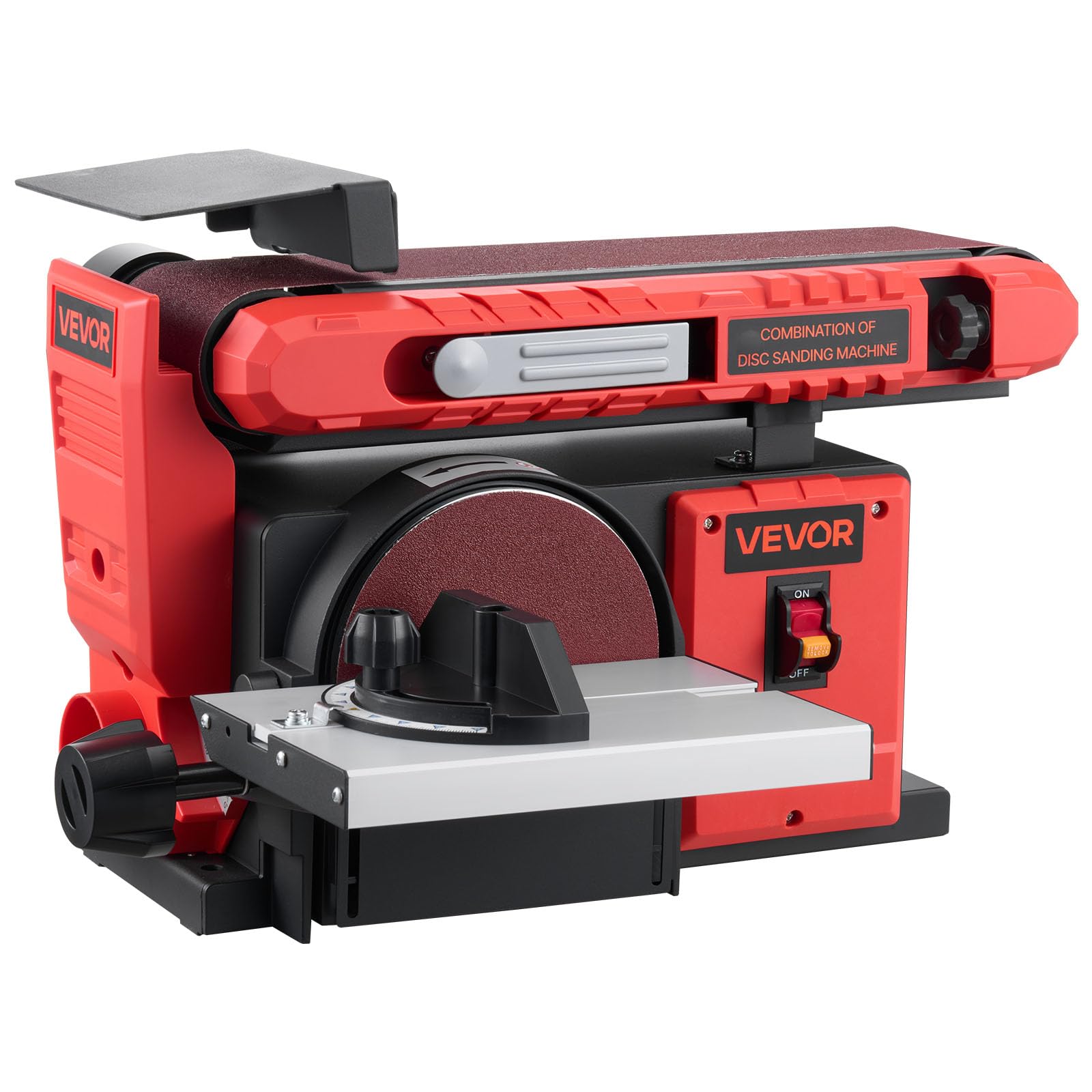
2. VEVOR 6″ Disc & 4″ x 36″ Belt Sander BSH1510C
Two sanding surfaces, one tilting worktable, and a footprint that fits a bench corner
For a first shop or a tight garage corner, this VEVOR combo earns its keep on flexibility rather than raw muscle. You get a 4 x 36 inch belt and a 6 inch disc from a 400 W motor, with the disc turning at 3550 rpm and the belt at a much slower 600 rpm. That slow belt speed matters: a belt crawling along at 600 rpm is far less likely to burn thin stock or grab a small part out of your fingers than a fast-moving abrasive.
The belt tilts from 0 to 90 degrees, and the disc worktable tilts from 0 to 45 degrees — so angled bevels and contoured shapes are both reachable. A miter gauge ships in the box and slots into the disc table for squaring cuts. The 19.9″ x 15.7″ x 12″ frame is compact, but there is a catch the reviews flag repeatedly: some buyers find it smaller than they pictured, and belt tightness drew enough negative feedback that alignment is the recurring gripe. It is the lightest motor here at 3.3 A against, say, the Bucktool BD4603A’s 5 A, so if you plan to hog material off hardwood all afternoon, this is not the frame for that job. Where it delivers is honest versatility: it sands, shapes, refinishes and sharpens, and for a DIYer who wants one machine that does a bit of everything the compromises are fair. Treat the stock belt and disc as consumables and buy spares early.
What this machine lacks is the reserve of power that experienced woodworkers reach for — buy it as a starter, not a production tool.
Power where it counts: the slow 600 rpm belt speed makes small-part sanding safer, while the 3550 rpm disc still squares ends quickly.
Watch the belt: keeping it tight and centered takes fussing, so check tension before every session or alignment drifts.
Reach for this if: you are building a first home workshop and want both surfaces plus an adjustable table without spending much.
Look elsewhere if: you sand big hardwood panels regularly and need a beefier motor.
3. Woodskil 4.3A Belt Disc Sander Combo 610452351737
Set up in five minutes and start chewing through rough stock
The Woodskil gets you a 4 x 36 inch belt and a 6 x 6 inch disc on a 3/4 HP motor drawing 4.3 A, turning 3570 rpm and pushing 1732 FPM of belt speed. Assembly is simple enough that you are sanding wood within five minutes of opening the box, which is the sort of thing that matters on a Saturday morning when the project is already on the bench.
What separates this from the WEN 6502T above is the dust handling. Woodskil ran two dust exhaust ports — one for the belt and one for the disc — instead of the single shared port the WEN uses, so you are not choking the disc airflow every time you hook a shop vac to the belt side. The belt tilts from 0 to 90 degrees for horizontal and vertical work, and the worktable adjusts 0 to 45 degrees with a miter gauge for bevels. On belt life, Woodskil uses a multi-wedge belt drive mechanism, which is a design choice aimed at making the belt last longer than a single-rubber-ring setup. Belt tension is adjustable, and there is a transparent PC guard so you can watch the belt run while it works.
The catch is that this machine is light and portable rather than heavy and bolted — the 25 lb frame is easy to move, but a couple of owners find the disc work support wants a second screw or firmer mounting before it feels rock solid. The stock 4 x 36 belts from some third-party sellers run long and struggle to stay tracked under pressure, so buy belts sized correctly for the machine. It is the right tool for home projects on wood, metal and plastic, not a production machine.
What Earns the Space
- Two separate dust ports — belt and disc exhaust independently
- Fast five-minute assembly for a weekend workflow
- Belt tilts 0 to 90 degrees and table tilts 0 to 45 degrees
- Transparent guard lets you watch the belt run
Where It Gives Ground
- Light 25 lb frame wants anchoring for heavier disc work
- Disc work support can feel under-fastened
- Third-party belts may run long and lose tracking
The value play: buy it if you want serious belt and disc work on a home bench and dust collection matters.
The honest limit: it is built for hobby and home projects, so heavy daily production is beyond its reach.
4. KFMK 2 x 42 in. Belt & 6″ Disc Sander Combo KFBD6242

The 2-inch belt that knife makers reach for — and a 6-inch disc alongside it
If you are sharpening blades, chisels or shaping handles, a 2 x 42 inch belt is the width serious knife makers pick, and this KFMK is one of the few combination machines that gives you that belt alongside a 6 inch disc. The larger 6-3/4 x 9 inch belt work table makes long bevels easier to keep flat, and the belt can be run horizontally or vertically to suit different shaping angles. The disc table is 6-1/8 x 9 in. and adjusts to 45 degrees for angled detailing. A 3.5 A motor turns 3580 rpm through a direct-drive structure, which removes the rubber transfer belt that some other machines use.
What makes this machine flexible is that the belt itself can be positioned either vertically or horizontally without much fuss, so one tool covers both bevel grinding and flat edge sanding. The kit includes a tool rest for the belt, a miter gauge for the disc, and a set of hex keys plus a wrench for assembly. Reviews remark on the functionality and overall quality of the machine, and the variable speed controller that ships with it gets plenty of use — owners run it around 75% for general grits and down to 60% for finer paper, which helps prevent overheating on thin steel. Ceramic belts in higher grits fit without scraping the platen, and a removable top cover lets you use the drum for curved sanding. The honest notes: two owners mention the disc rest table is not precision-grade, and one experienced buyer measured the motor at 1/3 HP rather than the nominal 1/2 HP, so treat the horsepower number as a ballpark.
Do not expect a full production knife grinder from this frame — but for a hobby knife maker or a woodworker who also sharpens, it covers real ground.
Belt geometry: a 2 x 42 inch belt positions this machine in the knife-making balance, between narrow detail belts and wide cabinet belts.
Power realism: the direct-drive layout is efficient, but expect the actual motor output to read below the advertised 1/2 HP figure.
Built for edges: choose it if you sharpen blades and chisels or shape knife handles and want a 2 x 42 belt plus a disc in one frame.
Not for: precision flatness-critical disc work, where the rest table is not tight enough.
5. BUCKTOOL Bench Belt Disc Sander BD4603A

Five amps, a direct-drive motor, and enough pull to keep up with real projects
When your sibling machine is the 2.3 A MM493C above, the upgrade to this BD4603A is obvious: 5.0 A and 3/4 HP through a direct-drive motor, on a 4 x 36 inch belt and 6 inch disc combo. The direct-drive design skips the rubber transfer belt entirely, so you do not chase belt tension and you do not replace a worn drive belt — the motor shaft spins the drum directly. Bucktool advertises this layout as 25% more efficient than a traditional belt-driven setup.
Both work surfaces — disc and belt — share a single angle-adjustable work table with a miter gauge, and the belt tilts 0 to 90 degrees for horizontal or vertical work. Two cast aluminium worktables support more convenient sanding, and the cast aluminium base with rubber feet keeps vibration down. Buyers highlight the solid construction, enough weight to stay put, quiet operation, and a workhorse feel with no stalling during cuts. Against the WEN 6502T, you are trading the WEN’s cast iron base for cast aluminium, but gaining 0.7 A of motor and a heavier direct-drive layout. Against the Woodskil above, the same 4 x 36 belt and 6 inch disc, but 5 A against the Woodskil’s 4.3 A — more reserve for hard woods and long sessions. Belt changes are quick and the track control function keeps the belt from wandering off the drum. The honest caveat: the disc table mount can develop a wobble over time, and a couple of owners say it needs shimming to stay square and level. Vacuum ports are small enough that some shop vac hoses will not fit without a reducer.
Mount it on a bench and it will do the heavy sanding work you bought it for — just plan on dialing in the disc table once.
Why It Earns the Bench
- 5.0 A / 3/4 HP direct-drive motor handles hardwood without bogging
- 4 x 36 inch belt plus 6 inch disc on one angle-adjustable table
- Direct drive means no drive belt to replace or re-tension
- Cast aluminium base and rubber feet cut vibration
- Runs quietly for a motor this size
Where Users Pause
- Disc table mount can loosen and lose square
- Vacuum ports too small for some shop vac hoses
- Advertised 5.0 A / 3/4 HP rating questioned by some
Workhorse pick: the right choice if you sand hardwood steadily and want a direct-drive frame that will not stall.
Tiny caveat: budget a shim or two for the disc table if square corners matter.
6. RIKON 50-161VS Belt / Disc Variable Speed Sander

Dial the speed down for thin stock and up for bevels — on the same machine
Variable speed is the feature that sets this RIKON apart. Its 3/4 HP, 120 V motor adjusts from 2,000 to 3,400 RPM, and the belt speed ranges from 1,909 to 3,248 SFPM (surface feet per minute — how fast the abrasive passes your workpiece). A 1 x 30 inch belt and a 6 inch PSA disc sit on separate tables that each tilt from 0 to 45 degrees, and a miter gauge slots into the disc table for accurate angled work.
For knife makers and fine woodworkers, variable speed is worth chasing. Full speed grinds bevels fast; dial it down and you can work thin stock or micro-bevels without burning the edge, which is why knife makers in the reviews call the speed control the deciding feature. Against other 1 x 30 inch machines — including the BUCKTOOL MM493C above — the RIKON adds speed adjustment and a bigger separation between the disc and belt stations. Some owners also note that the larger overall size pushes the 6 inch disc farther from the belt, which makes switching between surfaces easier with less reaching. The belt-and-disc tables each tilt 0 to 45 degrees, and the belt tracking adjustment keeps the abrasive centered. Belt and disc have separate dust ports for hooking to a shop vacuum, and base mounting holes let you bolt the machine to a bench.
The honest downside here is motor heat and belt mobility. Heat builds up during long runs — some owners find the motor gets extremely hot during operation — and the belt itself can be stubborn about centering, a recurring complaint in the reviews. There is also a fit-and-finish note: the housing is cast pot metal, and a couple of buyers report screws and fittings that strip easily under normal adjustment. Bearing in mind the 5-year manufacturer warranty, treat this as a machine for careful operators who want speed control and accept that some fettling comes with the territory.
The variable speed edge: 2,000 to 3,400 RPM plus belt speeds from 1,909 to 3,248 SFPM let you match the abrasion to the material.
The belt-tracking caveat: centering the belt can take patience, and heat builds during long sessions.
For the speed-sensitive: choose it if you work thin stock or fine bevels and want to match belt speed to the job.
The one caution: budget some setup time to get the belt running true and expect heat on long runs.
7. Einhell TC-US 350 Belt and Disc Sander

A compact stationary sander built for small German-style home workshops
This Einhell is the sander you buy when bench space is scarce and touch-ups are frequent. It runs a double belt and disc sanding function off a 350 W motor, includes a coarse-grained disc and an abrasive belt in the box, and occupies a 12.91″L x 8.54″W x 13.31″H footprint — compact enough for a small workbench. It also comes with a side-closed protective cap and tool-free adjustable spark protection, so it makes sense in a metal-touching hobby shop as well as for wood.
What people say about this machine in the reviews is largely about reliability and hobby-grade quality, and the motor does not disappoint for the price tier. One owner notes that even with a coarse belt on the disc side, the machine runs with almost no vibration and the sander-side noise stays low — mostly from the belt rolling over the idler drum rather than the motor itself. Four rubber pads dampen what vibration there is. The disc paper can be removed and swapped quickly, and the machine adapts to each job by changing the sanding level and swapping grits. It is a stationary design that is meant to sit on a bench rather than get bolted down. The catch is speed — there is no variable-speed control, so you get one belt speed and one disc speed for every job, which frustrates owners who want to dial down for delicate work. The Einhell runs on European-spec power (230 V cable), which limits where it can be used without an adapter, and its EU spare-part availability window is listed at 2 years.
Buy it for careful hobby work — not for high-volume material removal where you need to control the belt speed.
Small-shop fit: ideal if you have limited bench space and sand in short hobby bursts, on wood or light metal.
Know before you buy: it runs on a 230 V cord, and there is no way to slow the belt down.
8. BUCKTOOL Pro 1HP Bench Belt Sander BD4801-M

One horsepower, an eight-inch disc, and enough torque to grind steel
If you are sanding steel as often as wood, this machine is the pick of the article. The BD4801-M runs a 1 HP fully-enclosed induction motor through a direct drive, drives a 4 x 36 inch belt and an 8 inch disc, and turns 3450 rpm. The 8 inch disc is the biggest anywhere on this list — the BD4603A above uses a 6 inch and the Woodskil the same — and a wider disc means more sanding surface for squaring large faces and flattening wide metal parts.
The belt work table tilts from 0 to 90 degrees for horizontal and vertical sanding, and the disc table adjusts 0 to 45 degrees for angled work. The disc paper uses a hook-and-loop backing so grit changes are pull-and-press rather than peel-and-glue, and an aluminium dust outlet on the belt prevents heat buildup from melting the work. There are three threaded hole pairs on the arm for bolting on a table or jigs, and a small platen for knife notches. What earns the machine its place is the raw grinding power — the 1 HP motor pulls through high-carbon steel without bogging, where most hobby machines would stall, and it does so quietly for its size. Owners describe it as an upgrade from a Harbor Freight 4 x 36 rather than a side-grade. Against the BD4603A above, the BD4801-M trades the smaller disc for an 8 inch one and doubles the horsepower; against the WEN 6502T, it doubles horsepower and expands the disc by 2 inches — but it is also a bigger machine that takes bench space.
The one flaw to know about is the plastic dust guard on the disc side — one owner reports it catch fire and melt under heavy metal grinding, which is exactly the kind of hazard you want to remove before running hot metal work. A cast iron table that is not perfectly square from the start, and no angle markings or stops for the disc table, are the other niggles. Setup instructions are thin, and a few leftover parts have gone unidentified. None of these cancel out the machine’s strength on steel.
Why Steel Workers Choose It
- 1 HP fully-enclosed induction motor grinds steel without stalling
- 8 inch disc — the largest in this group — for squaring wide parts
- Hook-and-loop disc paper for quick grit swaps
- Belt tilts 0 to 90 degrees and disc table tilts to 45 degrees
- Aluminium dust outlet on the belt prevents heat from melting the work
What to Expect
- Plastic disc dust guard can melt under sustained metal grinding
- Cast iron table may not be perfectly square from the start
- No angle markings or stops on the disc table
- Setup instructions are sparse
The metal specialist: go here if your day involves steel, high-carbon blades and long grinding sessions.
Bench-space trade: it takes up more room than the compact picks and wants a solid bench to sit on.
Understanding the Specs
Amperage and Horsepower
Amperage tells you how much current the motor draws at full load, and horsepower estimates how hard it can push. The 2.3 A unit here (Bucktool MM493C) is a detail machine; 4.3 A to 5 A models (WEN 6502T, Woodskil, Bucktool BD4603A) handle hardwood without stalling; 1 HP units (Bucktool BD4801-M) chew steel. Note that advertised horsepower sometimes reads high — one KFMK buyer who measured his unit found a 1/3 HP motor inside a machine listed as 1/2 HP. Treat the amperage figure as the more reliable number for comparing machines.
Belt Tracking and Tension
Tracking keeps the belt running centered on the drums; tension keeps it tight enough to grip without slipping. Nearly every machine here has some form of tracking adjustment, and the biggest complaint across the category is a belt that drifts off-center under load. There are two designs for tension: an adjustable knob or lever that lets you retension the belt, and a direct-drive layout that skips belt tension entirely because there is no transfer belt. Direct-drive machines like the Bucktool BD4603A and BD4801-M still need belt tracking adjustment for the sanding belt itself, but they avoid the maintenance of a separate drive belt.
Disc Diameter and Worktable Tilt
Disc size runs from 5 inches (Bucktool MM493C) to 8 inches (Bucktool BD4801-M) in this group. A larger disc removes more material per pass and gives you more room to square a wide surface, but it also needs more clearing room around the machine. The disc table should tilt to 45 degrees for bevel work; the belt table on most models here tilts from 0 to 90 degrees, which lets you go from horizontal edge sanding to vertical end-grain sanding without repositioning your whole setup.
Dust Collection
Sanding produces fine dust that clogs your lungs and coats your shop. Most machines here offer a dust port you hook to a shop vac, but single-port vs dual-port makes a real difference. Woodskil’s design uses two separate ports for belt and disc; WEN’s single shared port is criticized for capturing poorly when sanding flat. Some machines have a dust outlet that needs a specific adapter for standard shop-vac hoses, which is worth checking before you buy. A shop vac with a proper reducer is the minimum kit.
FAQ
What size belt and disc do I need for a home shop?
Why does my belt keep drifting to one side?
Is direct drive better than belt drive on a bench sander?
Can a belt and disc sander sharpen knives and chisels?
How much amperage do I need for hardwood sanding?
Do I need a shop vacuum for a belt disc sander?
Is a variable speed belt sander worth the extra cost?
How do I stop the sander from vibrating across the bench?
What is the difference between belt speed in FPM and disc speed in RPM?
Can I sand metal on the same belt as wood?
Final Thoughts: The Verdict
For most home workshops, the belt sander with disc winner is the WEN 6502T — a 4 x 36 inch belt plus 6 inch disc on a cast iron base, with a 4.3 A motor at 3600 rpm and a tilting belt from 0 to 90 degrees. The heavy cast iron frame is what makes the difference: it stays put under load, which is the one thing a combination sander has to get right. It carries the most reviews and the highest rating of the nine machines here.
If you want stronger motor pull for hardwood sessions, go with the Bucktool BD4603A — 5.0 A and 3/4 HP direct drive on the same 4 x 36 inch belt and 6 inch disc layout, with the direct-drive design that skips the transfer belt altogether. And if you need to grind steel as much as wood, the Bucktool BD4801-M throws a 1 HP motor and an 8 inch disc at the job — no other machine here matches that combination.
Whichever you pick, the belt should track true and the base should hold still — those two things decide whether it earns its bench space for years.
How We Picked
We do not accept paid placement. Every pick is matched to a real buyer and a real use-case; we do not hands-on test units.
Sources & Methodology
Specifications: manufacturer listings and product documentation. Review insights: verified customer reviews, as of September 2026. Pricing: not shown on this page (it changes often); check the current price via the retailer link.
As an Amazon Associate, KitchPrep earns from qualifying purchases. This does not affect which products we feature.
Related Guides
