
Specs are compiled from manufacturer listings and verified buyer reviews and can change over time — please confirm the key details on the product page before buying.
If your kitchen knives have gone from slicing tomatoes to crushing them, a belt sander built for sharpening is the fastest way back to a real edge. This guide covers nine machines that put a moving abrasive belt against your blade — some are compact benchtop units aimed squarely at kitchen knives, pocket knives, scissors, and garden tools, while others are heavier metalworking grinders that happen to excel at blades. Before you buy, know that belt speed and belt grit — not pressure — determine how a blade sharpens. A slow-moving belt with the right grit removes steel in a controlled way without cooking the temper out of your blade, which is exactly why low-speed machines dominate this list.
I’m Mohammad Maruf — the founder and writer behind KitchPrep. This guide is built by comparing the manufacturers’ published specifications and the patterns across verified customer reviews, so you get each pick’s real strengths and trade-offs instead of marketing spin.
You will see how motor speed, belt width, and grit choices decide whether a machine sharpens a paring knife cleanly or burns a blue mark into a chef’s knife — so keep reading to match the specs to the knives you actually own with the best belt sander knife sharpener for your bench.
Our Picks at a Glance


How To Choose The Best Belt Sander Knife Sharpener
Choosing between these machines is really about matching one number — belt speed — to the blades you plan to sharpen. Get that wrong and you either burn your edges or sit forever waiting for a dull blade to come back to life. Match belt speed to your blades and you can maintain your own edges at home.
Belt speed is the number that decides everything
Speed is measured two ways on these machines: rotational speed in RPM (how fast the motor spins) and belt line speed in SFPM (surface feet per minute, the actual speed of the moving belt under your blade). A slow belt is forgiving — it lets heat escape the steel instead of trapping it at the edge. If you are sharpening thin kitchen blades, low speed plus a light pass is the safe combination.
Belt size tells you what you can actually buy
The two belt sizes on this list are 1×30 (one inch wide, thirty inches around) and 1×42. Both take cheap, widely available abrasives. Buying a machine locked to one belt size matters because your belts are a recurring cost — and swapping grits is how you move from removing a damaged edge to polishing a clean one.
Grit is your progress-o-meter
Grit is the abrasiveness rating of the belt: lower numbers cut fast and rough, higher numbers smooth and refine. A 100 grit belt removes metal quickly; a 240 grit belt polishes. Most owners run a coarse belt to reshape an edge, then step up through finer grits to finish it. A machine that ships with three grit levels (100/180/240) gives you that whole progression from the start.
Quick Comparison
| Model | Best For | Motor / Speed | Belt Size | Grit Included | Amazon |
|---|---|---|---|---|---|
| Work Sharp MK2★ Best Overall | Kitchen and pocket knives | Two-speed, adjustable | Compact belt system | Medium, multi-belt | Amazon |
| BUCKTOOL 1×30 ComboTop Value | Wood and metal sharpening | 2.1 A, 1790 RPM | 1×30 belt + 6″ grinder | 120 grit fine | Amazon |
| Work Sharp Ken OnionPrecision Pick | Precision blade enthusiasts | Electronic speed control | Flexible abrasive belts | Fine | Amazon |
| KFMK Variable Speed Combo | Knife makers and woodworkers | 3/4 HP, 2000–3400 RPM | 1×30 belt + 6″ disc | 80 grit coarse | Amazon |
| GOLDSAND Belt Sander | Multi-material workshop sanding | 550W, 5500 RPM | 1×30 belt | 100/180/240 grit | Amazon |
| BUCKTOOL 1×42 Dual Speed | Metalwork and knife making | 4.8A, 1750 & 3450 RPM | 1×42 belt + 8″ disc | 80 grit fine | Amazon |
| VEVOR Belt Grinder Sander | Detailed grinding on a budget | 550W, up to 5000 RPM | 1×30 belt | 100/180/240 grit | Amazon |
| KFMK 1×30 with KSAG-5 | Bevel grinding and knife making | 5 A, up to 5000 RPM | 1×30 belt | 100 grit coarse | Amazon |
| JAYEUW 1×30 Bench Grinder | Heavy shop grinding | 550W, 5000 RPM | 1×30 belt | 60/800 grit | Amazon |
In‑Depth Reviews
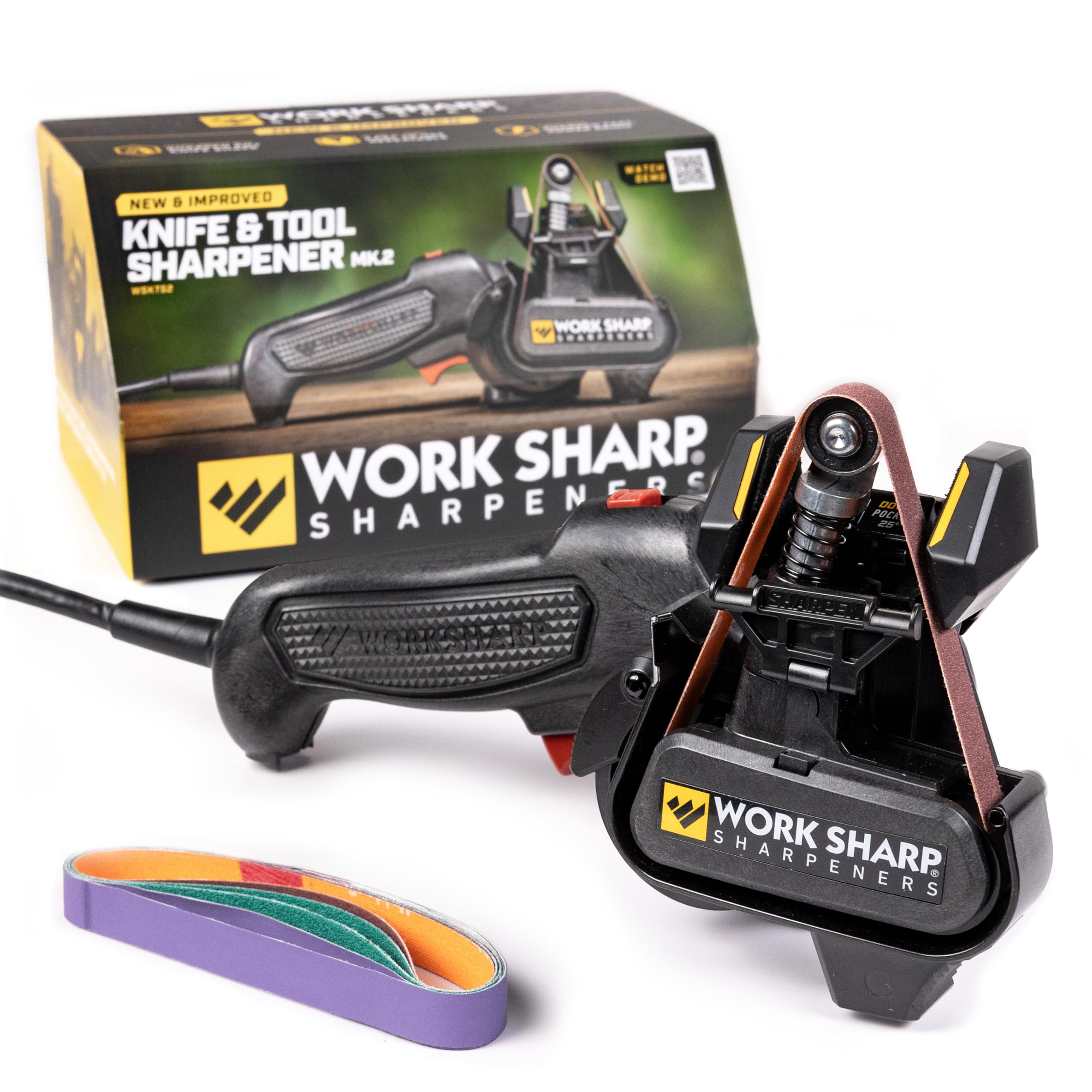
1. Work Sharp MK2 Electric Knife Sharpener & Replacement Belts
Our pick — over 4.5★ from 350+ verified ratings; the strongest balance of quality and price.
The countertop sharpener that turns a drawer of dull knives into paper-slicers.
This is the one to buy if you want your kitchen knives sharp without learning a whole craft. The MK2 runs a two-speed motor — a slower setting and a faster one — so you can pick control for thin blades or more power for heavier sharpening jobs like lawn mower blades and axes. What makes it beginner-proof is the edge guide: it supports the blade all the way to the tip, so you do not have to hold a steady angle by hand. The MK2 restores a dull kitchen knife with less fuss than any other machine here.
The Work Sharp performs like a commercial machine in daily use — it restores an edge fast, and the learning curve is genuinely short. On the buyers’ side, performance is what wins people over, and effectiveness and ease of use are the qualities that come up again and again. It sharpens faster and cleaner than the old pull-through sharpeners most homes still keep in a drawer. Indoor utility runs from standard kitchen knives to serrated blades to scissors and garden tools, with replacement belts included to keep you going. The whole unit measures 7.02″L x 2.26″W x 1.27″H and weighs 1.12 ounces, so it stows in a drawer — versus the BUCKTOOL grinder below at 13.39″L x 12.99″W x 15.35″H, which is a 1.9x larger footprint you give up for stationary power. It carries a 3-year warranty and is designed, engineered, and calibrated in Oregon.
The catch is that you are trading raw grinding power for convenience. Where the BUCKTOOL and KFMK machines below will hog off metal for reshaping a broken tip, this one is built for maintaining a good edge rather than rebuilding a damaged one. And unlike a full metalworking grinder, it is not meant for heavy shop tasks or reshaping thick tools.
What earns the top spot
- Two-speed motor lets you pick slow control or faster aggressive passes for heavier jobs
- Edge guide supports the blade all the way to the tip, so you do not fight your own hand
- Handles kitchen, serrated, pocket knives, scissors, and garden tools on one machine
- 3-year warranty with belts included
Where it draws the line
- Built to maintain a sharp edge, not to grind down damaged or chipped blades
- Compact bench machine, so it is not intended for heavy shop sanding or stock removal
Reach for this if: you want the simplest route to genuinely sharp kitchen and pocket knives without learning to hold an angle by hand.
Think twice if: your real job is reshaping chipped blades or grinding metal — a stationary grinder below serves you better.
2. BUCKTOOL Low Speed Belt Grinder Combo for Metal, 1×30″ Belt, 6″ Grinder
A slow-spinning benchtop workhorse that grinds steel without scorching the edge.
A slow belt is the right choice for thin, heat-sensitive kitchen blades. The Bucktool pairs a 1×30 inch belt with a 6-inch grinder wheel, driven by a 1/3 HP direct-drive motor that runs at 1790 RPM. At 1790 RPM the belt moves slowly enough that heat dissipates instead of building at the edge, which is what preserves a blade’s temper. A 1-year owner described the machine as still running with no vibration and parts that are replaceable, which speaks to the build. The angle guide fits 10º-45º, giving you an adjustable reference for repeatable bevels.
What buyers keep coming back to is sharpening performance — it just does metal right. Build quality and value for money round out the praise. A 120 grit fine belt comes with it, suited to prepping and scuffing work. The belt change system uses a quick-release so swapping grits is fast, and the vacuum port actually pulls dust away as advertised. Belt tracking runs true, which is the detail most cheap grinders get wrong. It measures 13.39″L x 12.99″W x 15.35″H — the footprint of a genuine bench machine, versus the compact Work Sharp MK2 above, so plan bench space for it.
Honesty check: speed and noise both draw divided opinions. Some owners find the pace perfect for controlled sharpening, while others wish it ran faster, and some find it quiet while others notice the noise under load. It is a low-speed grinder by design, so if you picture blazing fast stock removal you will be working against the machine’s whole reason for existing. A few owners have noted it can bog down briefly after sitting unused for days.
The case for it: a 1×30 low-speed grinder that keeps steel cool while it cuts — smooth, powerful, and priced like an entry-level machine with a pro feel.
The best fit: anyone who wants to shape and sharpen knives and tools by belt without cooking the steel, and who has real bench space for it.
Reconsider if: you need high-speed stock removal — the 1790 RPM pace is deliberate and slow on purpose.
3. Work Sharp Ken Onion Knife Sharpener Tool
Built with Ken Onion for people who want a mirror-polished edge, not just a working one.
The Ken Onion Edition is the step up for blade enthusiasts who want precision and consistency, not just sharp. It uses flexible abrasive belts, precision sharpening guides, and electronic speed control — meaning you dial the belt speed to the steel instead of taking what the motor gives you. The stainless steel body and the partner design work with knife-maker Ken Onion point at a tool built for people who care about edge geometry. It sharpens any knife you own, done in a guided way that produces the same result every time.
Sharpness is what people rave about, and adjustability is the second thing they lean on — the angle guide lets you set it and trust it. Buyers report finishing a whole kitchen knife set in under an hour, restoring dull EDC pocket knives in minutes, and even handling longer, oddly shaped blades and hard D2 steel to better-than-factory sharpness. The electronic speed control and guided belt system make it forgiving for someone who struggled with flat sharpening stones. Kit includes everything you need to get started, and it carries the same 3-year Work Sharp warranty.
Why enthusiasts gravitate here: electronic speed control plus precision guides put consistent, repeatable edges within reach of a home user.
Be ready for: instructions and belt options draw divided feedback, and some find the D2 steel and larger blade work needs slower passes to keep control.
Ideal for: the knife collector or outdoor enthusiast who wants pro-grade, repeatable results on a wide range of blades.
Hold off if: you want the absolute simplest machine for a couple of cheap kitchen knives — the MK2 above is friendlier.
4. KFMK Variable Speed 1″ x 30″ Belt & 6″ Disc Sander Combo
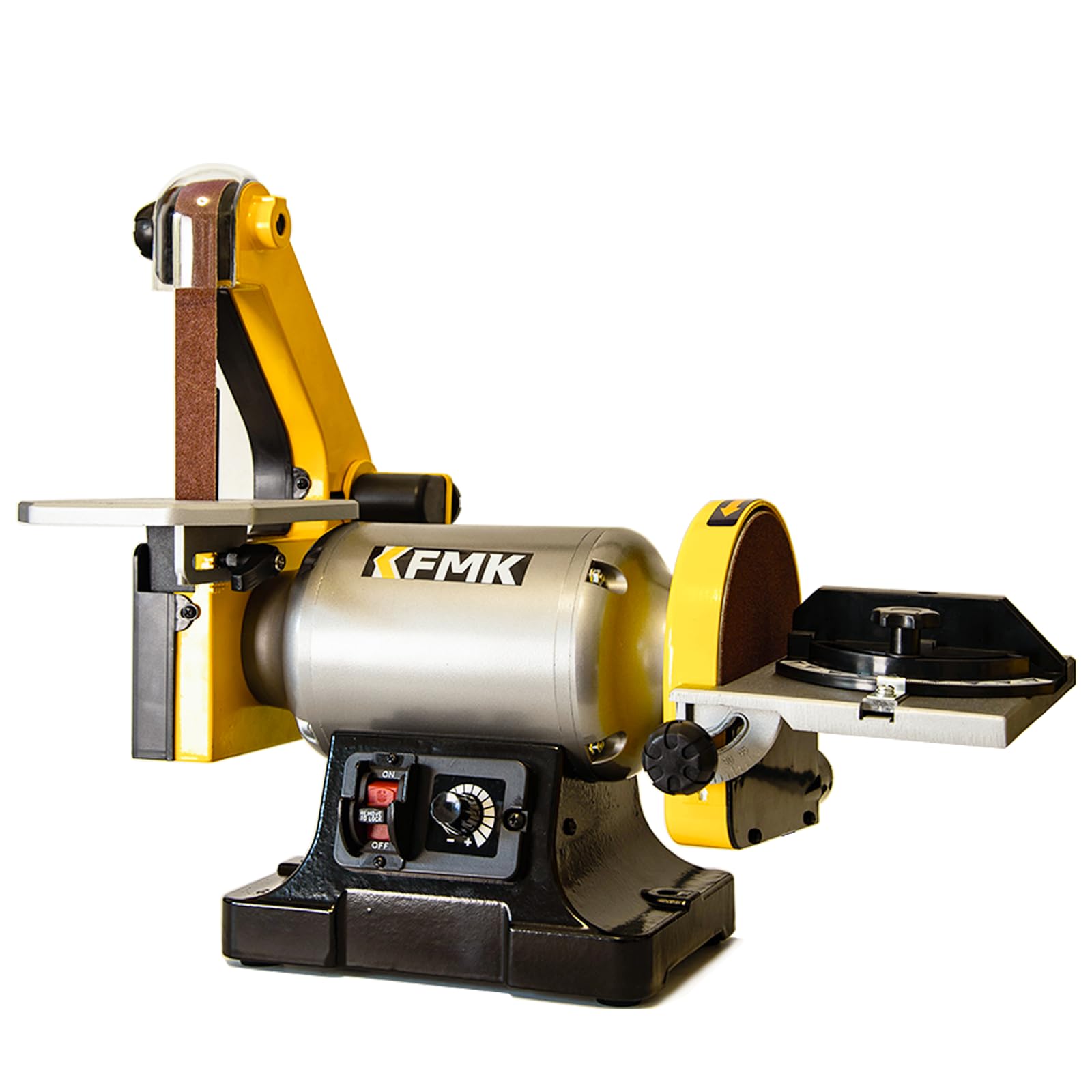
One machine that grinds, bevels, and squares — with adjustable speed for every material.
This combo hands you two tools in one footprint. The 1×30 inch belt is for edge work and contouring; the 6-inch disc gives you a flat, stable surface for squaring and finishing. A 3/4 HP direct-drive motor delivers steady torque, and the direct-drive build means less maintenance than belt-driven units. Variable speed spans 2000-3400 RPM on the disc side and 1909-3248 SFPM on the belt — SFPM being the actual surface speed of the belt. So you can set it slow for heat-sensitive steel and precise sharpening, or fast for aggressive removal.
What owners value most is functionality — it does the job and does not hog the bench. Quality and value come in close behind. The 80 grit coarse belt handles reshaping, and both belt and disc sides have solid aluminum work tables, with a miter gauge on the disc table for accurate angle work. The removable belt cover opens the door to round-corner and contour sanding. It ships with the belt disc sander and its work tables, and it runs on corded power.
Here is the honest footwork. Speed is a matter of taste — some owners find the variable-speed range gives them exactly the control they want, and others adjust the belt-speed expectations to taste. A few noted the belt rest table grooves arrived uneven and needed a quick fix. One owner reported the delivered motor spec read differently from the listing, worth checking against your workload before you commit.
Verdict in one line: buy this if you want a belt and a disc on one bench and you value being able to slow the speed for sharpening without a second machine.
Best for: knife makers and DIYers who want both belt and disc grinding with adjustable speed on a single base.
Not for you if: you only ever sharpen kitchen knives — the combo is more machine than a countertop blade user needs.
5. GOLDSAND Belt Sander Professional with Vertical and Horizontal Support
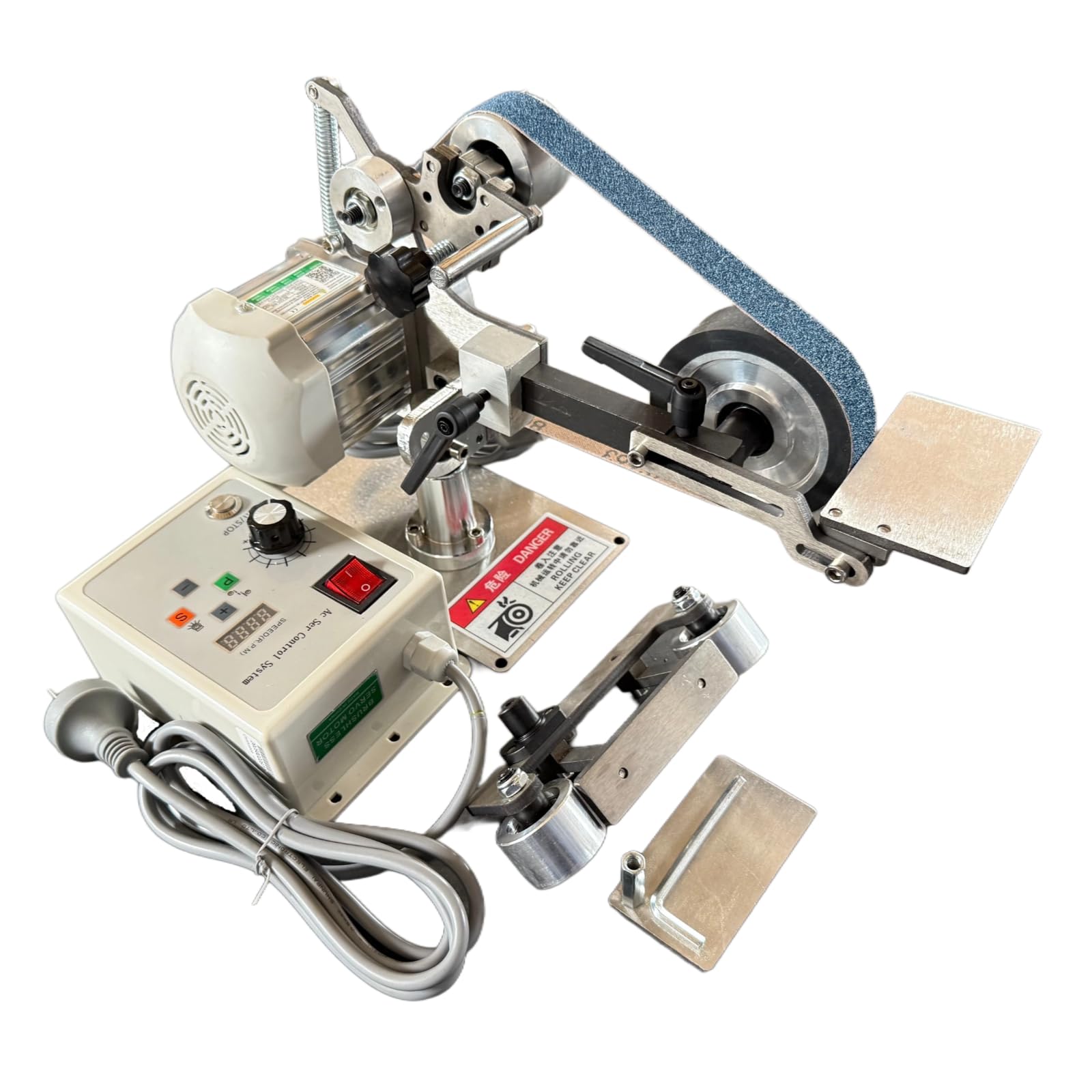
Runs the belt forward or reverse with one button — the move that keeps a clean edge.
Reversing a belt changes how it hits an edge, and on a blade sharpener that is a genuine upgrade. This GOLDSAND runs its 1×30 inch belt forward or in reverse with a push, which lets you sharpen edge-leading on one pass and edge-trailing on the next. The motor is a 550W pure copper unit at 5500 RPM with stepless speed regulation, so you can dial from aggressive grinding down to a delicate fine finish. It throws 3 grit belts — 100, 180, and 240 — so you get the whole progression from coarse to polish in the box. It is rated to 6000 RPM maximum with 3 amps at 110 volts, and it weighs 17.4 pounds.
The machine switches between vertical and horizontal positions, with a detachable workbench so you can set the working angle to suit the task. The steel frame reduces vibration, which matters when you are holding a blade steady against a moving belt. What it delivers best is performance — owners describe it as fast and capable — with adjustability like the reverse button pushing it forward. The reversible belt gets specific praise for letting you sharpen the way you want.
Why it earns a slot
- Push-button reverse and stepless variable speed in one machine
- Three grit belts included at 100, 180, and 240 for a full sharpening progression
- Vertical and horizontal operation with a detachable workbench
- Steel frame that cuts down on vibration
Know before you buy
- Belt tracking draws mixed reports — some owners had to dial it in, and reverse tracking can need a tweak
- Notably heavier than a compact countertop sharpener at 17.4 pounds
The sharpener to pick: if you want reverse-belt sharpening and stepless speed control in a compact bench unit, this one earns its space.
Look elsewhere if: you want a grab-and-go sharpener for occasional kitchen knives — its weight and adjustable frame belong on a dedicated bench.
6. BUCKTOOL Dual Speed Belt Disc Sander for Metal, 1×42″ Belt, 8″ Disc

A metalworking-grade grinder built to survive real shop work, not just weekend touch-ups.
If you need a machine that grinds hard and lasts, this is the level up. It pairs a 1×42 inch belt (that is 42 inches around, a longer belt that runs cooler) with a large 8-inch disc, driven by a 4.8A 3/4 HP brushless induction motor. That brushless motor is the key difference from the smaller BUCKTOOL 1×30 above — it runs at two speeds, 1750 and 3450 RPM, without the yearly belt changes a belt-driven motor needs, and it is designed for metalworking with metal work tables, base, belt frame, and dust ports throughout.
Owners single out quality control and reliability as the strongest parts of ownership, with build quality close behind. It assembles easily — two work tables and you are ready — and the two-speed switch responds instantly, with enough power to grind steel in roughly fifteen minutes. The disc table adjusts from 0-45 degrees for angled work, and the hook-and-loop disc mount means no glue when you swap an 80 grit disc. What catches the eye is how confidently it grinds steel and takes the load. Custom knife makers and fabricators treat this as a serious tool, including one car builder who keeps it next to a pricier machine and still calls it dependable. It measures 20.2″L x 17.72″W x 20.2″H — a full bench footprint.
Adjustability is the one mixed note — belt tracking and the disc table both benefit from careful setup from the start. A few owners wish the disc safety guard were steel rather than plastic, and durability over many years is still an open question given how new some units are. Treat the disc-table adjustment as a setup step, not a flaw.
Worth knowing: this is the machine for knife makers and fabricators who grind hard and often and want a brushless motor they never have to belt-service.
Made for: the metalworker or knife maker who needs two grinding speeds and a large work table in a tool that holds up.
skip it if: you only sharpen a handful of kitchen knives a year — its size and power are overkill for that job.
7. VEVOR Belt Grinder Sander, 30 x 1-Inch Variable Speed Belt Polisher with VFD

A heavy steel 1×30 that brings a professional VFD to a hobbyist budget.
Heft and a variable frequency drive define this machine. VEVOR’s grinder runs a 550W pure copper motor at up to 5000 RPM, with a belt line speed of 26m/min and a VFD (variable frequency drive, the electronic box that lets you dial belt speed smoothly instead of in steps). That gives you stepless speed control — slow and fine for a delicate edge, fast and aggressive for removing stock. It sets up into circular or flat grinding modes and switches between vertical and horizontal positions, with a detachable workbench and a reinforced steel body. It weighs 17.4 pounds and ships with a circular grinding wheel, a flat grinding rack, an M6 Allen wrench, and three sanding belts in 100/180/240 grit.
Where it wins hearts is value for money — quality and money-well-spent lead the feedback, with functionality right behind. Owners highlight how well it handles smaller, detailed tasks, and the adjustable-speed feature keeps coming up. The three included belts let you move from coarse grinding to a finer pass without shopping separately. For the price of a serious bench tool, it does the bulk of what far pricier grinders do.
The honest snags: assembly directions draw split reactions, some find them clear and others find them thin; belt tracking occasionally needs a manual tweak; and a handful of units have arrived damaged or needed small fixes like reaming tight platen bearings. A few describe the wheels or belt path needing a slight adjustment to run true. None of it is fatal — most owners get it running well and stay happy.
Straight read: the best bang-for-your-bench grinder here if you can set it up carefully and want pro-grade speed control on a smaller budget.
Grab it if: you want VFD speed control and real grinding power without paying premium prices, and you are comfortable with a little setup tinkering.
Better to pass if: you want zero assembly fuss or need factory-perfect belt tracking the moment it lands.
8. KFMK 1×30 Variable Speed Belt Sander with KSAG-5 & Forward/Reverse
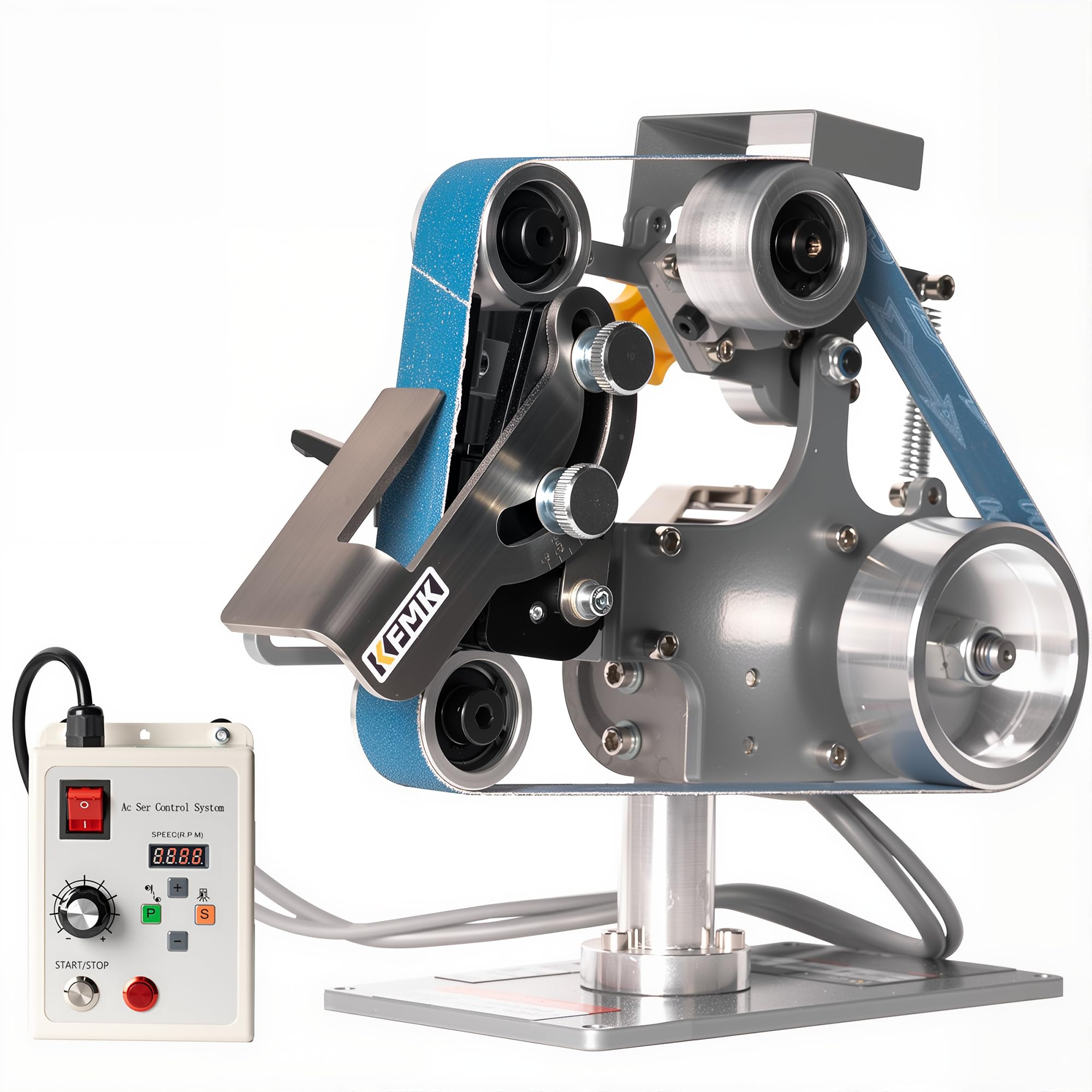
Ships with a dedicated angle guide, so bevel grinding stops being guesswork.
The headline here is the included KSAG-5 Angle Guide, a bracket that holds your knife at a fixed, repeatable angle so your bevels come out even instead of wavy. Combined with a professional VFD for smooth belt speed and forward/reverse belt direction, this is a knife-making machine first. It runs a 5-amp motor at up to 5000 RPM on 120 volts, built from welded steel throughout the frame for rigidity and reduced vibration. The reversible belt improves visibility and reduces burr formation as you grind a bevel. It includes a contact wheel, a flat platten, the KSAG-5 angle guide, and a work rest for horizontal or vertical sanding.
Owners who have handled the KSAG-5 guide specifically praise its construction — it holds angle reliably across edge-leading and edge-trailing passes and works on several 1×30 grinders, not just this one. The feedback on the guide calls it solid, well-designed, and easy to adjust, with angles set between 10 and 45 degrees. The core machine combines flat and hollow grinding, contour shaping, and tool making in one unit, and the all-steel build is what keeps the belt tracking stable under load.
The honest note on this one: the guide can need a small modification — some owners relieved one edge to clear wider bevels, and a couple wish it came in a 2-inch version for larger machines. The angle guide is the star component, and if you want it as a stand-alone accessory for a grinder you already own, it earns its place. As a complete package it is the pick for anyone whose focus is clean, repeatable bevels.
Clear-eyed take: the machine-plus-guide bundle for bevel work, with forward/reverse and VFD control in a welded-steel frame.
Right for: knife makers and serious sharpening hobbyists chasing repeatable bevels and burr control.
Not the one if: you just want to freshen up a kitchen knife — the dedicated bevel focus is more than a casual user needs.
9. JAYEUW 1″ x 30″ Belt Sander Bench Grinder with 60/800 Grits Belts

An all-steel grinder that runs a coarse belt and a fine belt — a whole shop in one body.
Built from stainless steel and aluminum alloy with a galvanized finish, this bench grinder is meant for durability. It runs a 550W DC brushless motor at 5000 RPM on 110 volts with a line speed of 30m/s and a 762mm x 25mm belt (roughly 30 x 1 inch), covered by a fixed-angle worktable you can set at any angle for sharpening and cutting. It supports forward and reverse rotation, and the body turns 90 degrees so you can work horizontally or flat. It arrives with a 60 grit belt and an 800 grit belt — coarse cutting on one end, fine finishing on the other — plus a motor driver, wheels, two worktables, and a protective baffle. At 19.8 pounds it is the heaviest unit on this list.
Owners describe it as well-made and powerful, with the machined metal parts earning specific praise, and it holds up well specifically for knife sharpening. What owners value most is the quality of construction, followed by raw performance. It runs surface-conditioning and grinding belts well for its size, and the forward-and-reverse capability is a plus for controlling your edge direction. Some owners have used the fixed-angle worktable as an impromptu angle guide to keep their bevels consistent.
Two things to weigh. Belt tracking is the recurring tune-up — some find it finicky, especially in reverse, and a simple strip of tape on the tracking wheel is the common fix. And the 100dB sound-pressure level means it is loud; ear protection is a sensible habit. One owner described a unit that would not hold track and returned it, so inspect the tracking on arrival.
Bottom line: the all-steel, metal-parts build is the draw here, and the 60 and 800 grit belts give you cutting and finishing in one purchase.
Choose this: if you want a heavily built steel grinder with two grits included and you are willing to spend a moment dialing in belt tracking.
Look outside it if: you want silent operation or a light countertop machine — this one is loud and heavy by design.
Understanding the Specs
RPM and Belt Line Speed
RPM is how fast the motor spins; belt line speed (measured in SFPM or meters per minute) is how fast the belt itself moves under your blade. The two are related but not the same, and belt line speed is the number that decides how much heat reaches your edge. Run a belt too fast on thin kitchen steel and the edge can lose its temper; run it slow and controlled and the steel stays cool. That is why low-speed machines like a 1790 RPM grinder are prized for sharpening — the pace is deliberate, not underpowered.
Belt Grit and What It Does
Grit is the abrasive rating of the belt: lower numbers like 60 and 100 cut fast and leave a rougher scratch pattern, while higher numbers like 240 and 800 refine and polish. Sharpening is a progression — start coarse to set the bevel or remove damage, then step up through finer grits to finish. A machine that includes 100/180/240 gives you that whole path; one that includes only a single grit means buying more belts to complete the job. Always match the grit to the task, not to a fixed habit.
FAQ
Will a belt sander ruin my kitchen knives?
What is the difference between RPM and belt speed?
What grit should I start with to sharpen a knife?
Do I need an angle guide to sharpen on a belt?
Is a 1×30 belt big enough or do I need 1×42?
Can I sharpen serrated and scissors on a belt sander?
How do I keep my belt from overheating the knife blade?
Do these belt sanders need special belts or can I use standard ones?
How long do the abrasive belts last?
Can a belt sander sharpen a knife faster than a stone?
Final Thoughts: The Verdict
For most people, the belt sander knife sharpener winner is the Work Sharp MK2 because it delivers a genuinely sharp edge with the least learning curve — two-speed control, an edge guide that supports the blade to the tip, and belts included, all in a unit small enough for a drawer. If you want serious grinding power and a stationary bench machine, reach for the BUCKTOOL 1×30 Low Speed Belt Grinder, which keeps steel cool while it cuts. And for knife makers chasing repeatable bevels, the KFMK 1×30 with the KSAG-5 angle guide is the one to set up on a dedicated bench. One practical note: start with the finer grits on a knife that is only lightly dull, and let the belt do the cutting. Pick the machine whose belt speed and belt size match the knives you actually sharpen.
How We Picked
We do not accept paid placement. Every pick is matched to a real buyer and a real use-case; we do not hands-on test units.
Sources & Methodology
Specifications: manufacturer listings and product documentation. Review insights: verified customer reviews, as of September 2026. Pricing: not shown on this page (it changes often); check the current price via the retailer link.
As an Amazon Associate, KitchPrep earns from qualifying purchases. This does not affect which products we feature.
Related Guides
