
Specs are compiled from manufacturer listings and verified buyer reviews and can change over time — please confirm the key details on the product page before buying.
You face two very different problems: keeping a classic muscle car from overheating at a stoplight, or pushing a wall of air across a warehouse floor. Both use a belt-driven fan — a motor spins a belt that spins the blades — but the right pick depends on whether your project has four wheels or four walls. This guide separates the engine-bay cooling fans from the industrial air movers so you know exactly which one belongs in your garage or under your hood.
I’m Mohammad Maruf — the founder and writer behind KitchPrep. This guide is built by comparing the manufacturers’ published specifications and the patterns across verified customer reviews, so you get each pick’s real strengths and trade-offs instead of marketing spin.
To cool a big-block V8 or a 20-by-30-foot shop, the right belt-driven fan depends on blade diameter, airflow in CFM (cubic feet per minute — the volume of air moved each minute), and how much noise you can tolerate.
Our Picks at a Glance

How To Choose The Best Belt-Driven Fan
Belt-driven fans split into two families that barely overlap. Automotive flex fans bolt to your water pump and tuck behind the radiator, while industrial drum fans sit on the floor and roll where you need them. Matching the fan to the setting is the first and most important decision you will make.
Know your space: engine bay or open floor
Under the hood, you are fighting idle overheating with a fan that pulls air through a radiator shroud. In a shop or barn, you are moving air across a large open area, often without ducting. A 17-inch flex fan that solves a Mustang’s traffic jam problem will not cool a 40-foot warehouse, and a 42-inch drum fan will not fit behind your radiator. Decide which job you are solving before you compare prices.
Blade design matters more than you think
Automotive flex fans use stainless steel blades that flatten out at higher engine RPM. That flattening reduces engine drag — the resistance the fan creates as it spins — which frees up horsepower and improves fuel economy. In the industrial world, blades stay rigid and are often aluminum, and the fan relies on sheer size plus a belt drive to move huge volumes of air quietly.
Motor power and speed options
For drum fans, the motor does the heavy lifting. A thermally protected motor shuts itself off before overheating, which matters when a fan runs all day in a workshop. Multiple speeds give you control between a gentle breeze and full hurricane mode. Two speeds is common; some buyers wish they had a third, slower setting for draft-free nights or smaller rooms.
Quick Comparison
| Model | Best For | Airflow (CFM) | Blade Size | Type | Amazon |
|---|---|---|---|---|---|
| Flex-A-Lite 17″ Flex Fan★ Best Overall | Classic cars & muscle cars | — | 17 inches | Engine Cooling | Amazon |
| Flex-A-Lite 16″ Flex Fan | Small-block engines | — | 16 inches | Engine Cooling | Amazon |
| K Tool International 42″ Drum Fan | Shops & warehouses | 14,800 CFM | 42 inches | Industrial Drum | Amazon |
| Maxx Air 60″ Drum Fan | Hangars & large industrial spaces | 19,000 CFM | 60 inches | Industrial Drum | Amazon |
In‑Depth Reviews
1. Flex-A-Lite 6-Blade Belt Driven Flex Fan, 17 inches, Silver
Our pick — over 4.5★ from 80+ verified ratings; the strongest balance of quality and price.
The classic-car cure for idle overheating, with blades that flatten to save engine power at speed.
If your vintage muscle car creeps past the safe zone every time you sit in traffic, this 17-inch flex fan is the fix owners lean on. The stainless steel blades pull serious air at idle — buyers report the temperature staying pinned at 180 at idle on a 1968 Mustang running a fan shroud and a 1 1/2 inch spacer. One owner paired it with an aluminum radiator on a 1976 Corvette and saw the car run 20 degrees cooler.
The clever part is what happens when you hit the highway. The blade design comes from the 1962 Flex Fan concept, and the steel blades flatten out at higher engine RPM. That flattening cuts engine drag, which means less parasitic loss and better fuel economy instead of the fan fighting the engine at speed. The silver coating is built to shrug off the harsh engine-compartment environment without losing its luster.
This is the crowd favorite — 4.6 stars across 80+ owners who consistently praise the cooling performance and build quality. The review pages sum it up: owners call it great quality and note it pulls a lot of air. Most installs are straight bolt-on with a spacer, and the main recurring note is simply to double-check your blade clearance.
Owners mention: “With this new fan the temperature stays 180 at idle.” That single line explains why this is the pick for anyone fighting heat-soak at stoplights in a classic car, truck, SUV, or muscle car.
Why owners choose it
- Fixes idle overheating — temperature holds at 180 at idle with a shroud
- Flattening blades reduce engine drag at highway RPM
- Cooling performance is the top praise, with 7 owners calling it out
Install notes
- Usually needs a 1 1/2 to 2 inch spacer for proper fit
- Best results come with a fan shroud in place
Reach for it if: you own a classic car or muscle car that runs hot at idle and you want a proven, quality fix.
Look elsewhere if: your project lacks the clearance for a spacer and shroud setup, since fit matters here.
2. Flex-A-Lite 6-Blade Belt Driven Flex Fan, 16 inches, Silver
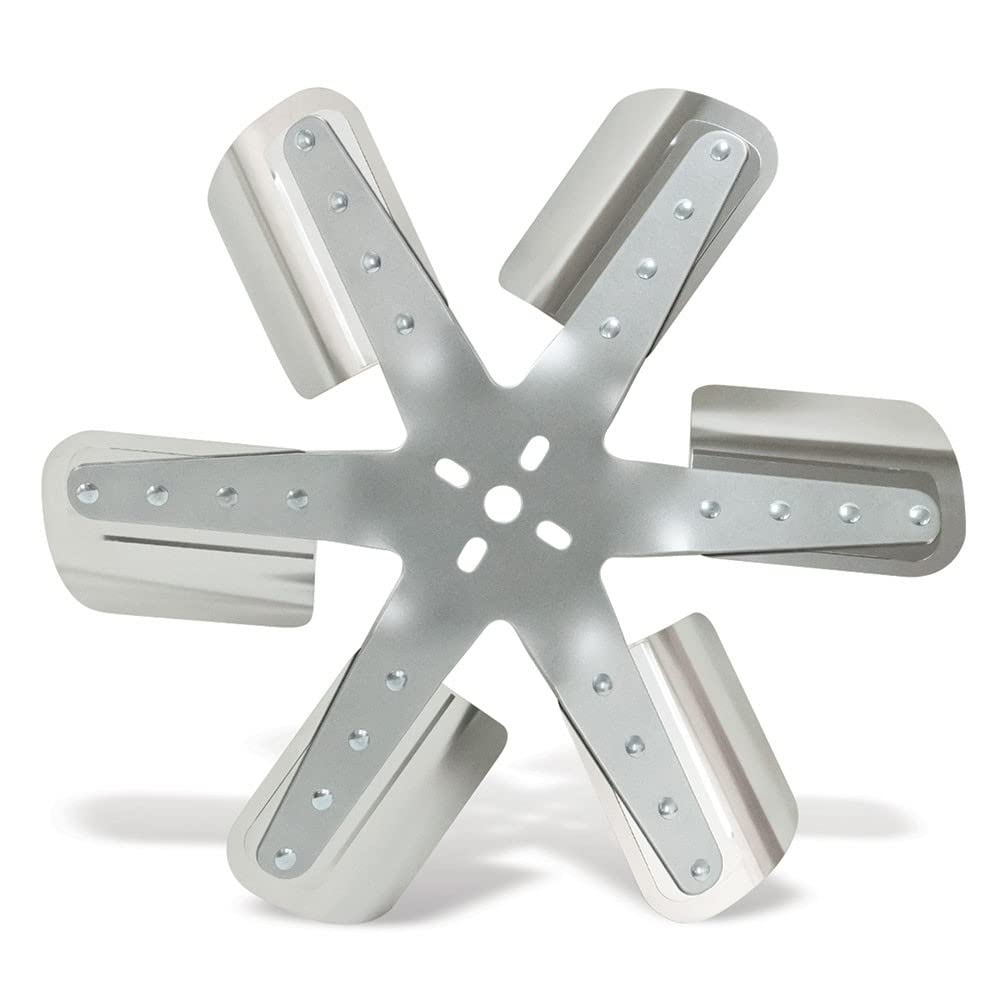
A 16-inch sibling that fits small-block Fords and cools them by a solid ten percent on the road.
For tighter engine bays where a 17-inch fan simply will not clear, this 16-inch version from Flex-A-Lite is the natural next step down. It shares the same 6-blade, belt-driven flex design, so you still get stainless steel blades that flatten at higher RPM to cut engine drag. Customers note it drops on-road and in-town temperatures by 10 percent or more, offering meaningful relief for a daily driver running hot.
Appearance gets real attention here — the silver finish and painted detailing earn genuine compliments, with several owners noting it looks nice on the engine and adds a nice touch to a detailed bay. It fits a 302 small-block cleanly, per multiple verified installs, and pulls a lot of air once it is spinning. Quality is the single most-discussed aspect, with 10 owners praising the build.
The honest trade-off is that you are giving up an inch of diameter compared to the 17-inch model above, so this is the pick for clearance-constrained swaps rather than maximum airflow. If your engine bay has room for the larger fan, the 17-incher moves more air; if it does not, this 16-inch unit is the smarter fit.
Between the two Flex-A-Lite fans, the choice is pure clearance math — 17 inches when it fits, 16 inches when you need that extra inch of breathing room around the water pump.
Fit-first flex fan: Ideal for small-block engines and detailed engine bays where an inch of clearance makes the difference; the 10-degree-plus drop reviewers point out comes without sacrificing looks.
3. K Tool International 42″ Belt Drive Drum Fan
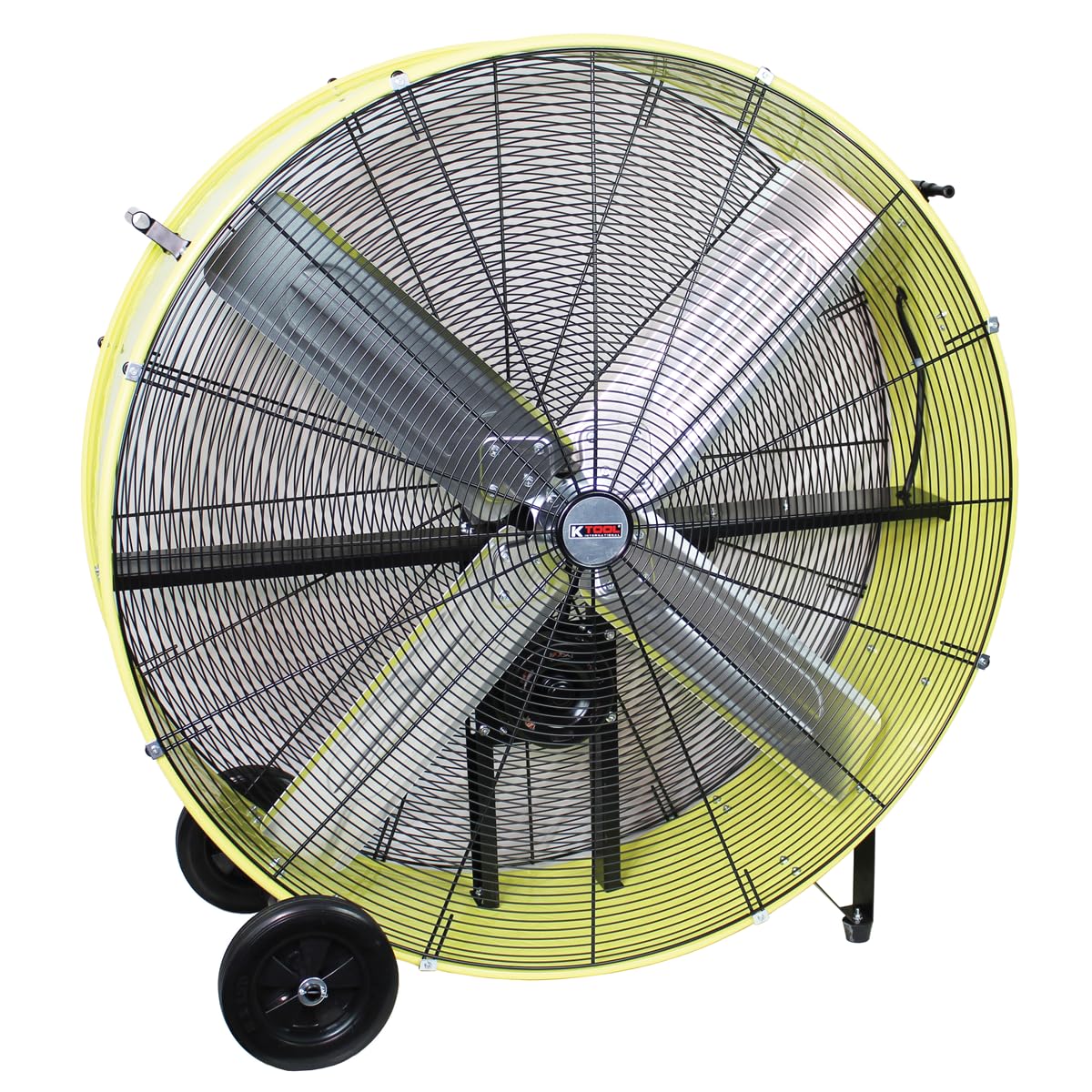
A 42-inch yellow giant that blankets a 20-by-30-foot porch with high-velocity air on two speeds.
This industrial air mover suits spaces that eat smaller fans alive. The 42-inch blade pushes up to 14,800 CFM — a 28% gap behind the 60-inch Maxx Air above it at 19,000 CFM — but in a far more approachable footprint and price tier. Owners say it covers a 20×30 ft porch while staying relatively quiet for its size.
It is built for rough environments: a sturdy 4-blade aluminum design in a yellow powder-coated finish, riding on 8-inch rubber wheels with a 6-foot power cord. A cut-off protection feature and cUL (Canadian UL) listing signal safety in demanding settings like warehouses, mechanic shops, gyms, greenhouses, and barns. It runs on standard 120V/60Hz power, so no special outlet is needed.
The recurring trade-off is pure scale. Owners who bought it for home use found it too big for the house and parked it in the garage. The other honest gripe in the review pages is a reliability question — one reviewer noted the motor dying within the first hour — though most shoppers say solid, powerful performance with employees loving them in shop settings.
If you need less machine, the 42-inch size is the meaningful middle ground between a residential floor fan and the 60-inch hangar-class unit — but be honest about your space before committing.
Where it shines
- 14,800 CFM covers a 20×30 ft porch or large shop bay
- 8-inch rubber wheels make it easy to roll and reposition
- Relatively quiet for moving this much air
Who should think twice
- Far too large for ordinary home use — owners store it in the garage
- Two speeds leave some wanting a slower third option
Best for: large garages, workshops, and porches where you need serious airflow and don’t mind a big machine.
Not for: personal bedroom cooling or tight spaces where a 42-inch drum simply overwhelms the room.
4. Maxx Air 60 Inch High Velocity Industrial Belt Drive Drum Fan

A 60-inch, 130-pound hangar-class air mover that runs 24/7 in aircraft facilities.
For a whole aircraft hangar or massive warehouse bay, this 60-inch drum fan is the serious answer. Its 3/4 HP (horsepower) thermally protected PSC motor — a motor type that runs efficiently and stays protected from overheating — spins the belt drive to push 19,000 CFM, the highest airflow here by a 28% margin over the 42-inch K Tool at 14,800 CFM. Owners run it around the clock in aircraft hangars and report it really moves a great deal of air.
The build is genuinely industrial. A rugged 22-gauge steel powder-coated housing protects dual ball bearings and reinforced steel motor mounts, and the whole 130-pound unit rolls on wheels with convenient handles for portability. The belt drive is the star here — it creates ultra-quiet operation compared to direct-drive fans, plus increased motor longevity. Owners confirm it moves lots of air without a bunch of noise and rolls around easily.
The honest catch is that this is a specialized tool. At roughly twice the physical scale of the 42-inch model, buyers report it is too large to return via a standard van, and the belt needs periodic replacement over years of service. One owner wisely observed that the smaller cousin costs a lot less and is almost as good — a fair warning that this fan is only worth it if you genuinely need 19,000 CFM of slow, steady, wide airflow.
This is the pick for the buyer with a genuinely huge space and the budget to match — not for a home garage where a 42-inch unit covers the same ground for far less money.
The hangar-class choice: 19,000 CFM airflow, near-silent belt drive, and a 130-pound build that says commercial duty — justified only when your space is truly vast.
The honest trade-off: Massive size complicates returns and transport; an occasional unit arrives with internal bolt contact that needs a quick fix.
Understanding the Specs
CFM (Cubic Feet per Minute)
CFM is the airflow volume a fan pushes each minute — the higher the number, the more air moves. A 14,800 CFM drum fan can blanket a 20×30-foot porch; a 19,000 CFM unit handles a hangar. For automotive flex fans, CFM is rarely listed because the engine’s RPM drives the fan speed — what matters is blade diameter and whether it pulls enough air at idle.
Flex-Fan Blade Flattening
Automotive flex fans use stainless steel blades that literally flatten out at higher engine RPM. This reduces engine drag — the resistance the spinning fan creates — which frees up horsepower and improves fuel economy. At idle, the blades keep their pitch and pull maximum air to fight overheating in traffic.
Belt Drive vs. Direct Drive
A belt-drive fan separates the motor from the blade, spinning the blade through a belt. This isolates motor vibration and lets the motor run at its most efficient speed, which produces quieter operation and longer motor life — the reason industrial drum fans favor this design despite needing periodic belt replacement.
FAQ
What is the difference between a belt-driven fan and a direct-drive fan?
Will a Flex-A-Lite flex fan fit my classic car?
How does a flex fan improve fuel economy?
What size drum fan do I need for my garage or shop?
Can I use an industrial drum fan indoors?
Do I need a special electrical outlet for these drum fans?
Will a 16-inch flex fan cool as well as a 17-inch model?
How do I stop my car from overheating at idle?
Final Thoughts: The Verdict
For most buyers, the belt-driven fan winner is the Flex-A-Lite 17-inch Flex Fan because it directly solves the classic-car problem of overheating at idle with a proven design owners swear by. If you need to cool a large shop or porch, grab the K Tool 42-inch Drum Fan with its 14,800 CFM output. And for genuinely vast industrial spaces, the Maxx Air 60-inch is the one to reach for when you need 19,000 CFM of quiet, steady airflow that runs around the clock.
How We Picked
We do not accept paid placement. Every pick is matched to a real buyer and a real use-case; we do not hands-on test units.
Sources & Methodology
Specifications: manufacturer listings and product documentation. Review insights: verified customer reviews, as of September 2026. Pricing: not shown on this page (it changes often); check the current price via the retailer link.
As an Amazon Associate, KitchPrep earns from qualifying purchases. This does not affect which products we feature.
Related Guides
