
Specs are compiled from manufacturer listings and verified buyer reviews and can change over time — please confirm the key details on the product page before buying.
If your child’s books are piling up on the floor because there is no wall left to spare, a behind door bookcase is the fix — it turns the dead strip of wall hidden behind a door into real, usable shelving. The catch most buyers hit is depth: the shelf has to be shallow enough that the door still swings closed and clears the baseboard (the trim board running along the bottom of the wall), and it has to be anchored well enough that a toddler tugging on it does not pull it down. This guide covers what matters — shelf spacing, depth, and anchor hardware — so you pick right the first time.
I’m Mohammad Maruf — the founder and writer behind KitchPrep. This guide is built by comparing the manufacturers’ published specifications and the patterns across verified customer reviews, so you get each pick’s real strengths and trade-offs instead of marketing spin.
You will see how slim the profile needs to be for a door to clear it, what the guardrails really do, and why some shelves hold thirty books while others manage a handful. Everything below is sorted by who each pick suits, so you can match one to your wall.
Our Picks at a Glance
How To Choose The Best Behind Door Bookcase
Shopping for a behind door bookcase is different from buying a normal freestanding shelf. Here you are working with a fixed, awkward strip of wall, a swinging door, and usually a baseboard running along the bottom. Get one measurement wrong and the door will not close. Get the anchoring wrong and the whole thing becomes a tipping hazard the moment a toddler grabs a shelf. So the choice depends on three things: how deep the shelf is, how it handles your baseboard, and how securely it attaches to the wall.
Depth decides whether the door still closes
The single most important number is depth — how far the shelf sticks out from the wall toward the room. A behind door bookcase lives in the gap between the wall and the door swing, so a deeper shelf simply will not clear. Narrow profiles around 3.9 to 4.7 inches tend to sit flush enough that most interior doors swing past without scraping, and the deeper options in this category can start to intrude on the door travel. Measure the gap between your wall and the door when it is fully open, then compare that to the shelf depth in the specs.
Why the baseboard cutout saves your install
Most walls have a baseboard — that raised trim strip running along the floor line. If a wall-mounted shelf is flat all the way down, it hits the trim and refuses to sit flush against the wall, leaving a gap that looks unfinished and, worse, lets the shelf wobble. A baseboard cutout (a notch or reserved space at the bottom of the back panel) lets the shelf slide down over the trim so the back sits right against the wall. This is why you will see the cutout called out as a selling point on several of these picks.
Guardrails and anchor hardware are the safety story
Two features keep books and toddlers safe. First, front guardrails — the thin rails or rebar running across the front of each shelf — stop books from sliding out when the door bumps the shelf or when a child grabs one. Second, the anchor: a wall-mounted shelf should fasten into studs or proper wall anchors, not rely on lightweight sticky pads. Several reviews in this category mention upgrading the included hardware, which is the smart move for anything a child will pull on.
Quick Comparison
| Model | Best For | Shelf Tiers | Depth | Install Type | Amazon |
|---|---|---|---|---|---|
| FOTOSOK 4-Tier Kids Bookshelf★ Best Overall | Small nurseries behind the door | 4-Tier | 4.72 inches | Wall Mount | Amazon |
| Wood 6-Tier Wall Mounted Kids BookshelfBest Value | Tight spots for thin paperbacks | 6-Tier | 12.3 cm | Wall-mounted | Amazon |
| UTEX Wall Kids Bookshelf 4-Shelf | Face-forward display reading corners | 4-Shelf | 5.9 inches | Wall Mount | Amazon |
| UTEX 4-Tier House-Shaped Bookcase | Rooms that need a decorative touch | 4-Tier | 5.79 inches | Freestanding | Amazon |
| Heehee Solid Wood Bookshelf | Adults wanting real wood storage | 6-Tier | 3.93 inches | Wall-mounted | Amazon |
| FerniTry Behind Door Bookcase 5-Tier | Maximizing tall narrow walls | 5-Tier | 3.94 inches | Wall Mount | Amazon |
In‑Depth Reviews
1. FOTOSOK Kids Bookshelf, 4-Tier Wall Mount Book Shelf
Our pick — over 4.5★ from 450+ verified ratings; the strongest balance of quality and price.
The shelf that turns a dead wall behind the playroom door into a tidy little library.
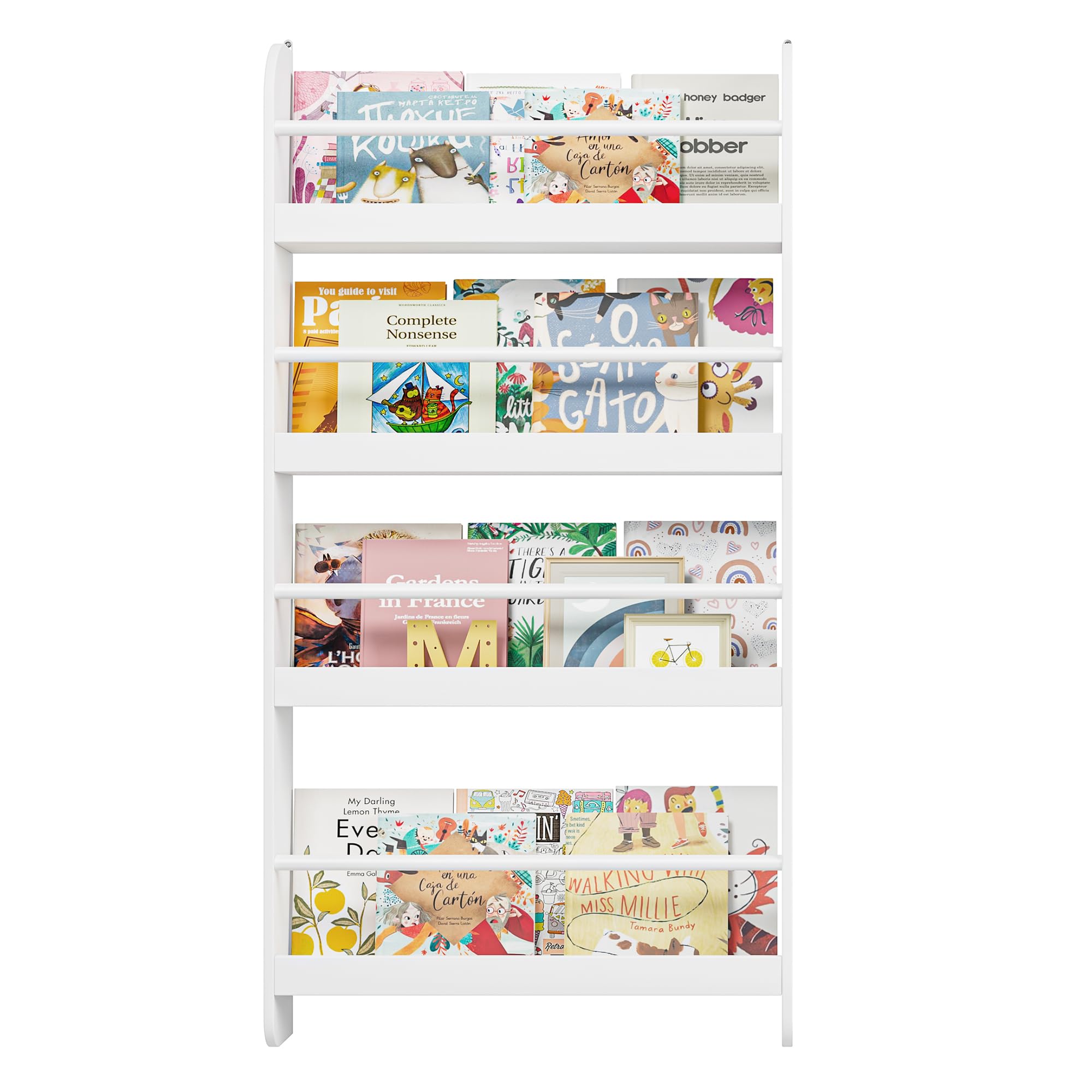
This is the easiest of the whole group to assemble, and that is not a small thing when you are bolting furniture to a wall with a toddler in the room. The 110cm (43.9in) height is pitched so a child can grab books without help — owners describe the numbered parts and pre-drilled holes lining up so cleanly that a solo build wraps up in roughly 45 minutes, with the wall mounting adding another 20 to 30. It sits 4.72 inches off the wall and spans 22.4 inches wide, which keeps it inside the strip of wall a door panel actually covers.
The storage claim lands around 22 kids’ books, and buyers echo it in plain terms — “It holds so many books! Easy to build and fits perfectly behind our playroom door. Love it so much!” Where this really separates itself is the anti-tip hardware. Four anti-toppling anchors come in the box, and the corners are polished smooth, so a nursery install feels considered rather than improvised. That matters because the behind-door spot is exactly where a climbing toddler will reach.
Be clear-eyed about the build, though. The feedback on sturdiness and material quality is genuinely split — plenty of owners find it solid, while others flag the MDF and say it chips if you are rough with it. The shelf heights also run short, so oversized picture books need the wide lower levels rather than the top. Treat it as a tidy children’s shelf, not a load-bearing unit, and it does its job well.
What earns it the top spot
- Easiest assembly in the group — pre-drilled holes and numbered parts, with a solo build landing near 45 minutes
- Four anti-toppling anchors included, matched with polished corners and smooth edges
- 43.9in height puts books within easy reach for young readers
- 4.72-inch profile clears a door swing in a narrow nursery
Where it asks for care
- Sturdiness and material feedback is mixed — the MDF build wants gentle handling
- Short shelf gaps mean tall picture books only fit on the lower levels
- Some owners swap the included anchors for heavier wall screws
Reach for this if: you want the simplest behind-door install for a nursery or playroom and value the anti-tip anchors.
Think twice if: your collection is mostly large hardcovers that need deep, wide gaps.
2. Wood 6-Tier Wall Mounted Kids Bookshelf – Floating Book Shelf
Six slim tiers of solid pine — plenty of shelves, but built for thin books only.
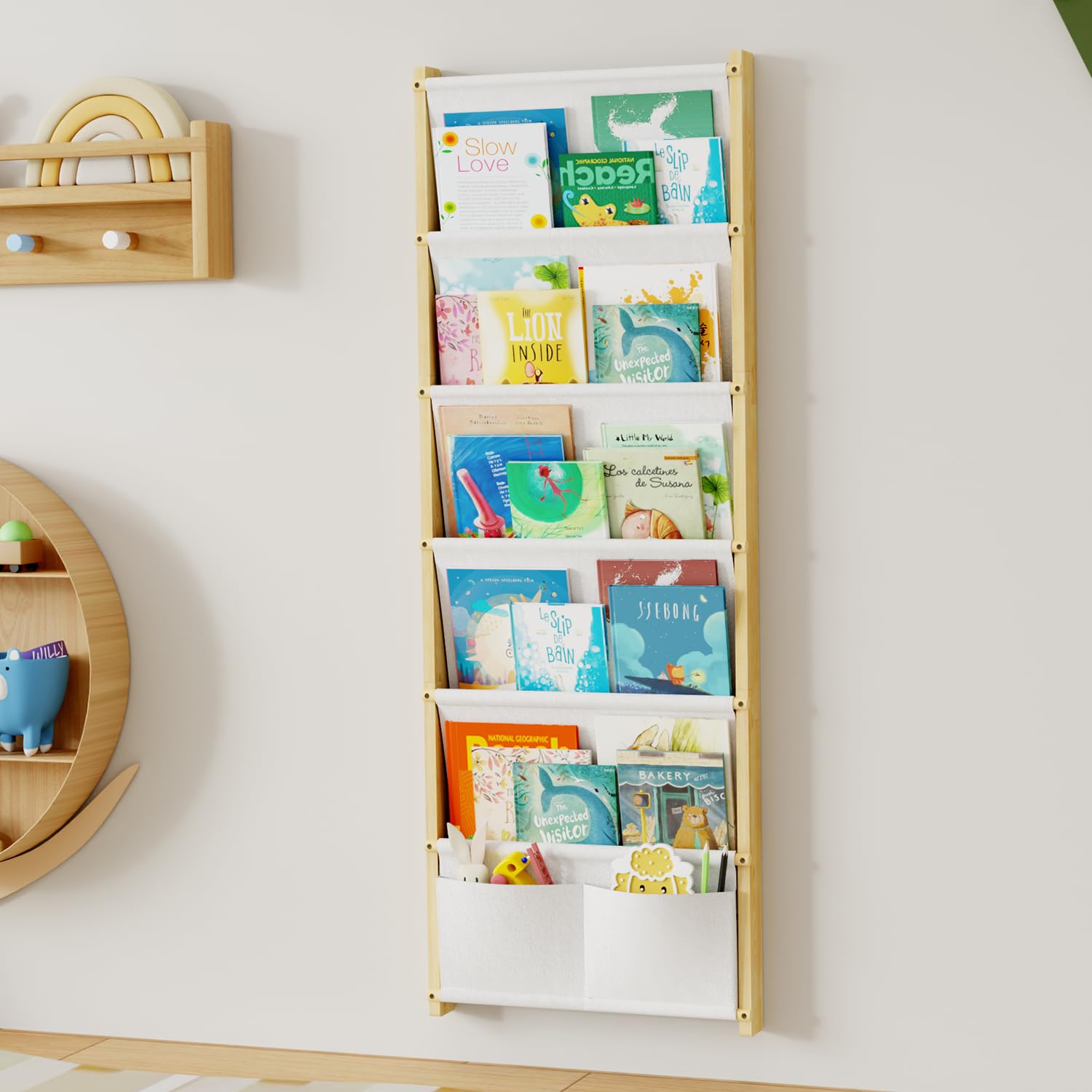
Where the FOTOSOK runs short on shelf count, this one stacks six tiers of natural pine into a footprint that barely protrudes. It is made from solid pine wood rather than melamine splicing board, which is what owners notice first — the finish is polished, the surface is smooth, and the maker states it is free of harmful odors. It mounts flush and stays slim, which is exactly the profile you want squeezing into the gap behind a door.
Set your expectations on capacity, because this is the one spec that dominates the feedback. Each of the six sections holds roughly 2-3 thin children’s books, and thick picture books eat a whole slot on their own. As one buyer put it, “Such a good bookcase to snug right before our door. Recommend if you’re tight on space however doesn’t hold too much.” The pocket design suits thin paperbacks and early readers — not board books or big hardcovers.
The other thing to know is the install. It goes up around a beam easily enough on its own, but the pouches sit low-profile, so anything chunky simply will not slide in. If your shelf is bursting with fat picture books, this six-tier format will frustrate you fast. If your collection is thin and plentiful, it is a smart budget way to get a lot of display surface.
Material you can feel: Solid pine with a hand-polished finish, so there are no sharp edges for little hands to catch.
The honest catch: Six pockets sound generous until you realize each one swallows only 2-3 skinny books — thin paperbacks are this shelf’s whole world.
Best for: thin paperback collections that need lots of separated slots on a tight wall.
Look elsewhere if: board books, thick hardcovers, or anything oversized is your child’s staple.
3. UTEX Wall Kids Bookshelf, Book Shelf for Kids Rooms Behind Door

A face-forward Montessori display that shows off covers and swallows a small library.
The standout here is the format: books sit face-forward on four shelves, so a child sees the cover art and actually picks something up rather than staring at a wall of spines. It is built around Montessori principles, with an anti-toppling device and fixed wall points keeping it steady. The manufacturer lists capacity up to 114 books, and it fits neatly behind a bedroom door, in a nursery, or against a toy room wall.
Quality is the thing people rave about — the feedback leads on it, then capacity, then size — and the surface is smooth and wear-resistant thanks to the finished artificial wood. Owners also like that several books fit front-to-back per shelf with enough height to get picture books in and out cleanly. It carries Greenguard certification for ASTM, TSCA and CPSIA standards and uses FSC-certified wood.
Two honest trade-offs round it out. Assembly draws a genuinely mixed reaction — some find it a breeze, others hit quirks with cross-piece screws and end up buying their own wall anchors to fasten it into studs. And it is deep at 5.9 inches and tall at 57.5 inches, so measure the door swing carefully. The narrow footprint and big capacity still make it the workhorse of the group.
The case for it: Face-forward 4-shelf display with room for up to 114 books, built with FSC-certified wood and Greenguard certification.
Worth knowing: It is a tall, deep unit, so check that your door clears 5.9 inches of depth — and budget for your own anchors if you want it rock solid.
Choose this when: you want maximal book capacity on a narrow wall and love the face-forward Montessori look.
skip it if: your install spot is shallow or you prefer a quick, no-fuss assembly.
4. UTEX Kids Bookshelf, 4-Tier House-Shaped Bookcase with Guardrails

A house-shaped slim tower that looks like decor and stores like a proper shelf.
If you want the shelf to be a feature rather than a fixture, this house-shaped 4-tier tower is the pick. It is deliberately skinny — 5.79 inches deep and 23.62 inches wide — so it slides into the tight strip beside or behind a door and hugs the wall, helped along by a reserved baseboard cutout (a notch cut into the back panel) that lets the back panel sit flush over the trim. The kid-friendly 51.3-inch height lets a child reach most of the shelves on their own.
What wins people over here is the look, followed closely by the build quality. Smooth rounded edges keep the profile soft for little hands, top and bottom stoppers hold books in place, and the anti-toppling device secures it to the wall. One buyer summed it up: “Great quality! Not super hard to put together! Great size. Can fit plenty of books. Super cute.” The 30-minute solo build is a recurring note too, which makes it a quick win for a weekend nursery setup.
The one real constraint is shelf spacing. The gaps are tuned for shorter toddler books, so taller picture books are limited to the top shelf and may not fit as your child’s books grow. And while tight to the wall it is steadfast, the freestanding nature means the wall anchor is doing real work — fasten it properly, because a climbing toddler will test it.
what separates it
- House-shaped design turns the shelf into decor that draws compliments
- 5.79-inch slim depth and baseboard cutout let it sit flush in narrow spots
- Rounded edges, top and bottom stoppers, and an anti-toppling device
- FSC-certified wood and a 51.3-inch height kids can reach
The trade-offs
- Shelf gaps suit short toddler books; tall picture books only fit on the top shelf
- Sturdiness feedback is mixed once it is up — the wall anchor is doing the heavy lifting
Made for: parents who want a behind-door shelf that doubles as room decor with a soft, kid-safe finish.
Not the one for: a collection heavy on oversized picture books that need deep, tall shelf gaps.
5. Heehee Solid Wood Bookshelf Bookcase Organizer

Hand-sanded pine with no paint and no glue — real wood, and it shows.
This is the one to pick if you want to feel the material every time you touch it. It is built from high-quality pine with no glue and no paint, hand-sanded so each piece is smooth with no flaws or burrs, and finished in its original wood color. Six layers, each a slightly different height, tested to hold around 100 books — and the pieces are slim at just 3.93 inches deep across a 31.5-inch width, so it tucks against the wall without stealing your door swing.
Owners describe it exactly the way the maker pitches it. “Bookshelf fits perfectly behind door and great storage. The pieces are smooth to the touch with rounded corners. Love it and no splinters during assembly. They even include gloves if you decide to stain it!” That stain-friendly raw finish is a genuine perk — you can leave the pale wood alone or finish it to match your room. The bottom is cut to clear the skirting, and two no-punch nails come with it so you can fix it without drilling if your wall allows.
Here is the part they do not tell you: the included sticky anchors have a reputation for letting go and taking paint with them. Buy your own wall screws or corner brackets and fasten this into studs. A few owners also found the baseboard notch a touch short for tall trim and had to trim it. Do those two prep steps and it is a lovely, durable piece of real wood that works as well for adult books and sketchbooks as it does for a child’s shelf.
Why it commands its price: Genuine hand-sanded pine, no paint or glue, built to hold around 100 books across six varied-height tiers.
Do this first: Swap the included sticky anchors for your own screws or brackets — that is the one upgrade owners keep recommending.
Ideal for: buyers who want real, unpainted wood and a shelf that ages well and suits adults as much as kids.
Look past it if: you want a set-and-forget install — this one rewards a few minutes with proper wall screws.
6. FerniTry Behind Door Bookcase, Wooden 5-Tier White
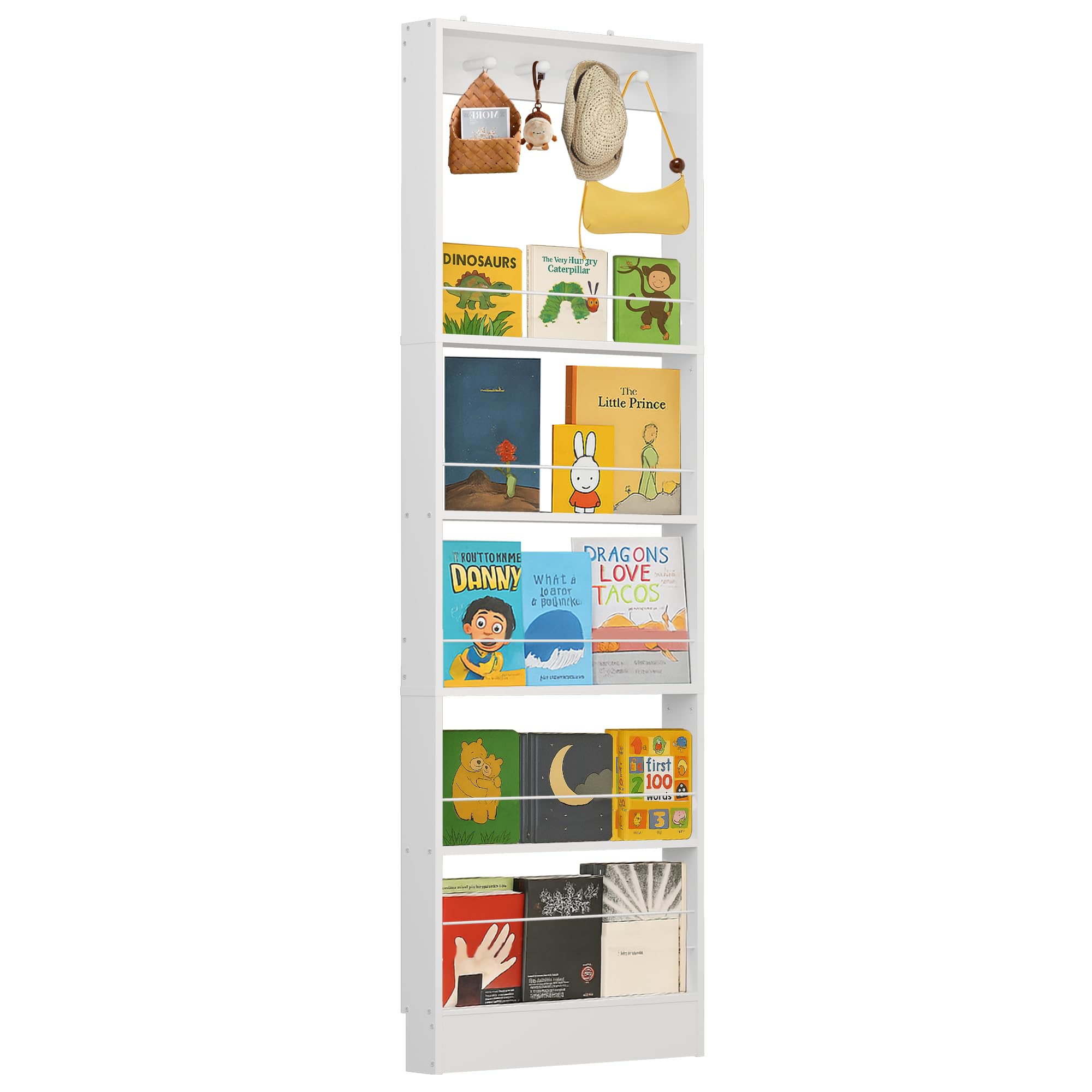
A tall, skinny tower that stretches your storage floor-to-near-ceiling behind the door.
This is the tallest of the bunch at 71.65 inches, and the slimmest at 3.94 inches — a combination built for squeezing maximum storage into a narrow wall. Five tiers run floor to ceiling, and the maker includes four large wooden hooks plus a blank DIY area so the unit works as much as an entryway organizer as a book display. The forward-facing design keeps book covers visible, so nobody has to dig through a drawer hunting for a title.
It is made from high-quality MDF (a dense engineered wood) with a smooth pure-white laminated finish, and each shelf carries a high-quality rebar running across it to stop items slipping off — the single detail owners keep flagging as the feature that makes it practical. One buyer wrote: “This behind the door shelf is perfect for maximizing storage in a small space. It was easy to assemble, feels well-made, and fits perfectly in the area I needed it for.” The reserve space at the bottom lets it sit flush over the skirting board.
The shallow shelves are a double-edged detail. They hold books and small baskets well, but anything deep or tall can slide since there is no lip on every shelf, and the included tool has a reputation for giving out mid-build. Swap in your own driver from the start, keep the load light on the top tiers, and this becomes the practical catch-all for a narrow entryway or a kid’s room.
Where it shines
- 71.65-inch height stacks five tiers into a very narrow wall
- 3.94-inch depth and a skirting cutout for a flush, space-saving fit
- Four wooden hooks and a DIY area add flexible storage
- Rebar across each shelf keeps items from falling off
Where to be careful
- Shallow shelves without a full lip let some taller items slide
- The included assembly tool has a reputation for breaking — bring your own
Pick this if: you need a tall, narrow unit that doubles as a book display and a catch-all organizer with hooks.
Pass if: you plan to store deep or heavy items — the shallow shelves favor light loads.
Understanding the Specs
Shelf depth and the baseboard cutout
Depth is how far the shelf reaches out from the wall — the number that decides whether your door still closes. A shallow unit around four inches tucks neatly into the gap behind a door, while a deeper shelf needs more swing clearance. The baseboard cutout is the companion feature: a notch or reserved space at the bottom that lets the back panel slip over the floor trim so the shelf sits flush instead of leaning away from the wall. If a shelf has neither a cutout nor a shallow depth, expect to measure twice before you drill.
Guardrails and the anti-tip anchor
Guardrails are the thin rails or rebar running across the front of each shelf — they catch books before they slide out when the door bumps the unit or a child grabs one. The anchor is the other half of the safety story: a wall-mounted behind door bookcase should fasten into a stud or a real wall anchor, not a sticky pad. Across this category, the recurring advice is to use the included hardware as a starting point and upgrade to screws or brackets that bite into wood when you can.
FAQ
How deep can a behind door bookcase be before the door scrapes it?
Will a behind door bookcase hold thick picture books or only thin ones?
Do I need to anchor a wall-mounted kids bookshelf into a stud?
What is a baseboard cutout and why does it matter for a behind door shelf?
Can a behind door bookcase fit a small nursery or playroom?
What is the difference between a face-forward and a traditional spine-out bookshelf?
How much weight can a behind door bookcase realistically hold?
Are the included wall anchors and assembly tools good enough?
Can I mount a solid wood behind door bookshelf without drilling into the wall?
Which pick is best for an adult collection of magazines and journals?
Final Thoughts: The Verdict
The best behind door bookcase for most homes is the FOTOSOK 4-Tier Kids Bookshelf: easiest assembly in the group, four anti-toppling anchors, and a 4.72-inch profile that clears a nursery or playroom door.
For maximum display and capacity on a narrow wall, the UTEX Wall Kids Bookshelf holds up to 114 books face-forward across four shelves. For unpainted solid pine that suits kids and adults, the Heehee Solid Wood Bookshelf is the pick — bring your own wall screws. For a tall, narrow tower that doubles as a catch-all with hooks, the FerniTry Behind Door Bookcase is the one.
How We Picked
We do not accept paid placement. Every pick is matched to a real buyer and a real use-case; we do not hands-on test units.
Sources & Methodology
Specifications: manufacturer listings and product documentation. Review insights: verified customer reviews, as of September 2026. Pricing: not shown on this page (it changes often); check the current price via the retailer link.
As an Amazon Associate, KitchPrep earns from qualifying purchases. This does not affect which products we feature.
Related Guides
