
Specs are compiled from manufacturer listings and verified buyer reviews and can change over time — please confirm the key details on the product page before buying.
Choosing your first machine is a gamble between a frustrating toy and a solid tool you’ll keep for years. The real dividing line is feed quality, threading ease, and room to grow beyond your first project. This guide finds machines that teach you to sew, not fight you.
I’m Mohammad Maruf — the founder and writer behind KitchPrep. This guide is built by comparing the manufacturers’ published specifications and the patterns across verified customer reviews, so you get each pick’s real strengths and trade-offs instead of marketing spin.
By the time you finish, you’ll know exactly which beginner sewing machine fits your space, your budget, and the projects you actually want to make.
Our Picks at a Glance

How To Choose The Best Beginner Sewing Machine
Before comparing stitch counts or brand names, focus on three things: smooth fabric feeding, simple threading, and a solid feel on your table.
Feed Dogs and Fabric Handling
The feed dogs are the little metal teeth under the presser foot that pull your fabric through. A multi-piece feed dog system moves layers evenly, keeping seams straight and preventing puckering. This matters most when you move from thin cotton to knits or layered material.
Threading and Bobbin Setup
A needle threader and drop-in bobbin save beginners the most headaches. A top drop-in bobbin is a clear plastic window you set the thread in, instead of wrestling with a hidden side-loading case. An automatic needle threader pushes thread through the eye for you—a sanity saver for imperfect eyesight.
Quick Comparison
| Model | Best For | Stitches | Weight | Max Speed | Amazon |
|---|---|---|---|---|---|
| Janome JW8100★ Best Overall | All-around growth | 100 | 12 lbs | — | Amazon |
| Dechow Beginner KitBest Value | Kids & travel | 14 | 5.3 lbs | 2 speeds | Amazon |
| Stoigeld SM-725Best Starter Kit | Complete starter kit | 12 | 5 lbs | 2 speeds | Amazon |
| StitchMaster Pro | Portable, dual power | 14 | 5.5 lbs | 2 speeds | Amazon |
| Brother XM3700 | Light household use | 37 | 12.5 lbs | — | Amazon |
| Brother SM1704 | Travel & carry case | 17 | — | — | Amazon |
| Janome 2212 | Simple, sturdy learning | 12 | 14 lbs | — | Amazon |
| SINGER 4411 | Thick fabrics & speed | 11 | 14 lbs | 1,100 st/min | Amazon |
| SewLaVie 1130 | Quilting & computerization | 300 | 12.1 lbs | — | Amazon |
In‑Depth Reviews
1. Janome JW8100 Computerized Sewing Machine
Our pick — over 4.5★ from 950+ verified ratings; the strongest balance of quality and price.
The one machine that lets a beginner grow into quilting without needing an upgrade.
This Janome offers 100 built-in stitches and 7 one-step buttonholes, handling everything from your first skirt to quilting rows. The computerized brain means you pick a stitch on the LCD screen and press a button, rather than guessing which dial does what—an approach that keeps early projects from turning into tangles.
The 7-piece feed dog system is the quiet hero here, moving cotton, knits, and layered materials evenly to prevent the shifting and puckering that spoils beginner seams. An extension table and even-feed foot arrive in the box, so you don’t need extra purchases to try patchwork. At 12 pounds, it’s no featherweight, but the trade-off is a metal body that stays put while you sew.
Buyers report this machine just keeps running, with one long-term owner summing it up: “I love this machine. I have had it for a few years now and it’s still chugging along.” The self-threading feature (which guides the thread through the needle eye for you) and jam-proof drop-in bobbin (a bobbin that drops into a slot and rarely tangles) remove the two biggest beginner frustrations. The start/stop button and speed control slider let you sew without touching the foot pedal, so you can keep both hands on the fabric. A few owners note the built-in light could be brighter—work near a window if you can.
Why it earns the top spot
- Feed quality that prevents fabric shifting and puckering
- Quilting extras (extension table & feet) included in the box
- Self-threading and jam-proof bobbin for easy setup
- Quiet enough for classes and late-night sewing
What to know before buying
- The work light is dimmer than some owners hoped
- At 12 lbs, it’s not the easiest to haul to a class
Your best match if: you want one machine that handles clothes today and quilts next year without another purchase.
Think twice if: you only need a tiny machine for occasional repairs and have very limited storage space.
2. Dechow Sewing Machine for Beginners with Extension Table
A featherlight 5.1-pound starter that slips into a bag and follows you to class.
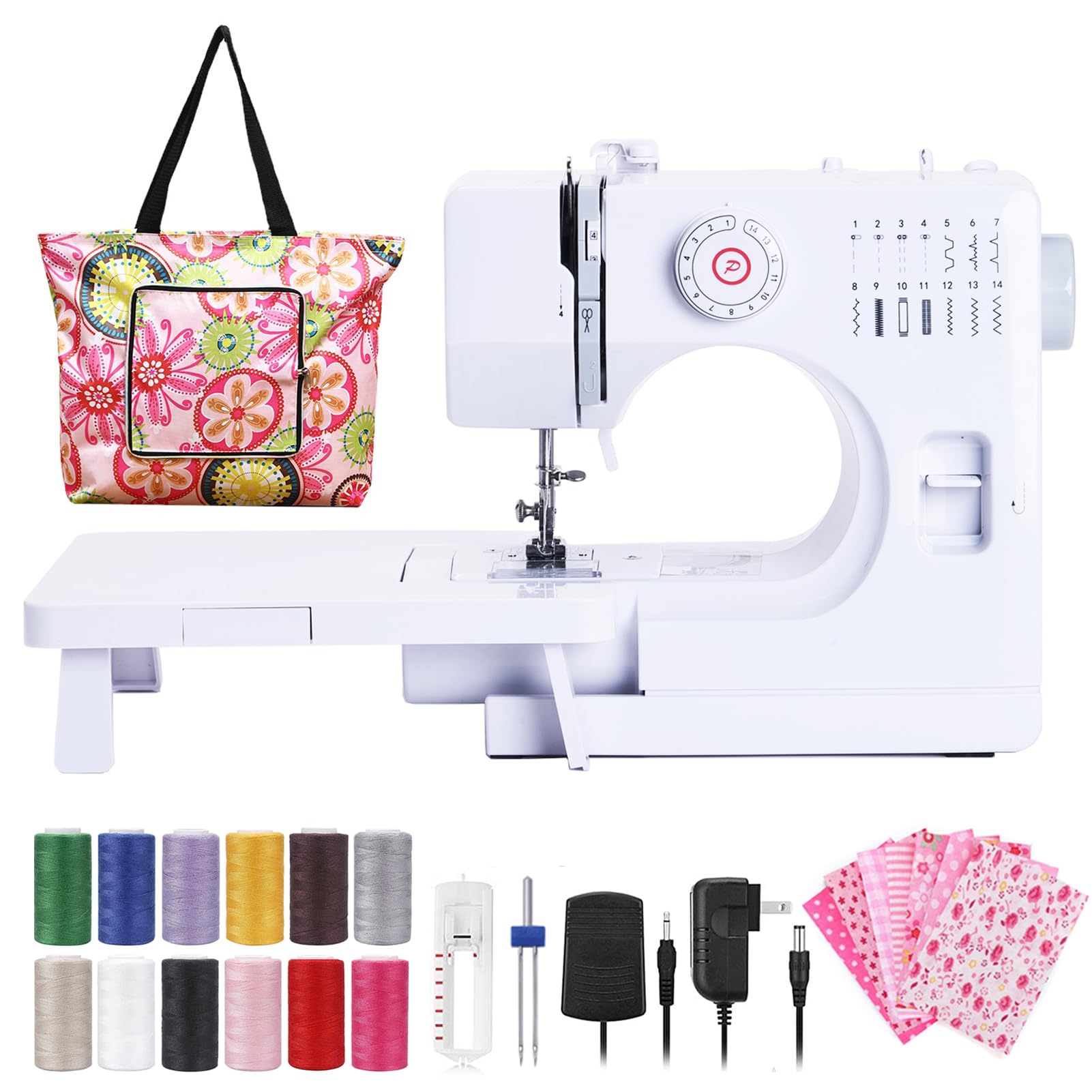
For the beginner who wants to learn anywhere, this Dechow set is the most portable full kit here. It weighs just 5.1 pounds (the listing rounds it to 5.3 lbs), and the included foldable storage bag means you can carry the machine, fabric, and 12 thread colors in one trip. The new-generation motor gives it greater piercing power than its size suggests, so it can handle denim and stretch knits despite being tiny.
The 14 built-in stitches cover basic, decorative, and stretch options, and the reverse sewing function secures the start and end of your seams for a professional finish. It’s noticeably trimmer than the Stoigeld’s footprint—10.8″D x 4.7″W x 10.2″H—so it earns its keep on a dorm desk or in an RV. Setup can confuse at first, so the maker suggests watching the guidance video before your first stitch.
Owners describe it as “great for a first time sewer,” and families report granddaughters loving it within minutes. The speed is beginner-friendly and noise stays minimal, though it’s not built for fancy decorative work. Thread can arrive tangled in the kit, so give it a check before you start.
Why beginners like it
- Everything needed is in one package, including a carry bag
- At 5.1 lbs, it’s easy for a child or traveller to manage
- Reverse sewing locks seams for durable results
Before you commit
- Setup has a learning curve—watch the video first
- Some kits arrive with tangled thread
Reach for this if: you want an affordable, portable set that a child or grandchild can grow into.
Look elsewhere if: you plan on heavy quilting or constant professional-level use.
3. Stoigeld Sewing Machine for Beginners with 20Pcs Fabric & 32Pcs Threads Kit
The rare starter box that includes the fabric and thread to practice on immediately.
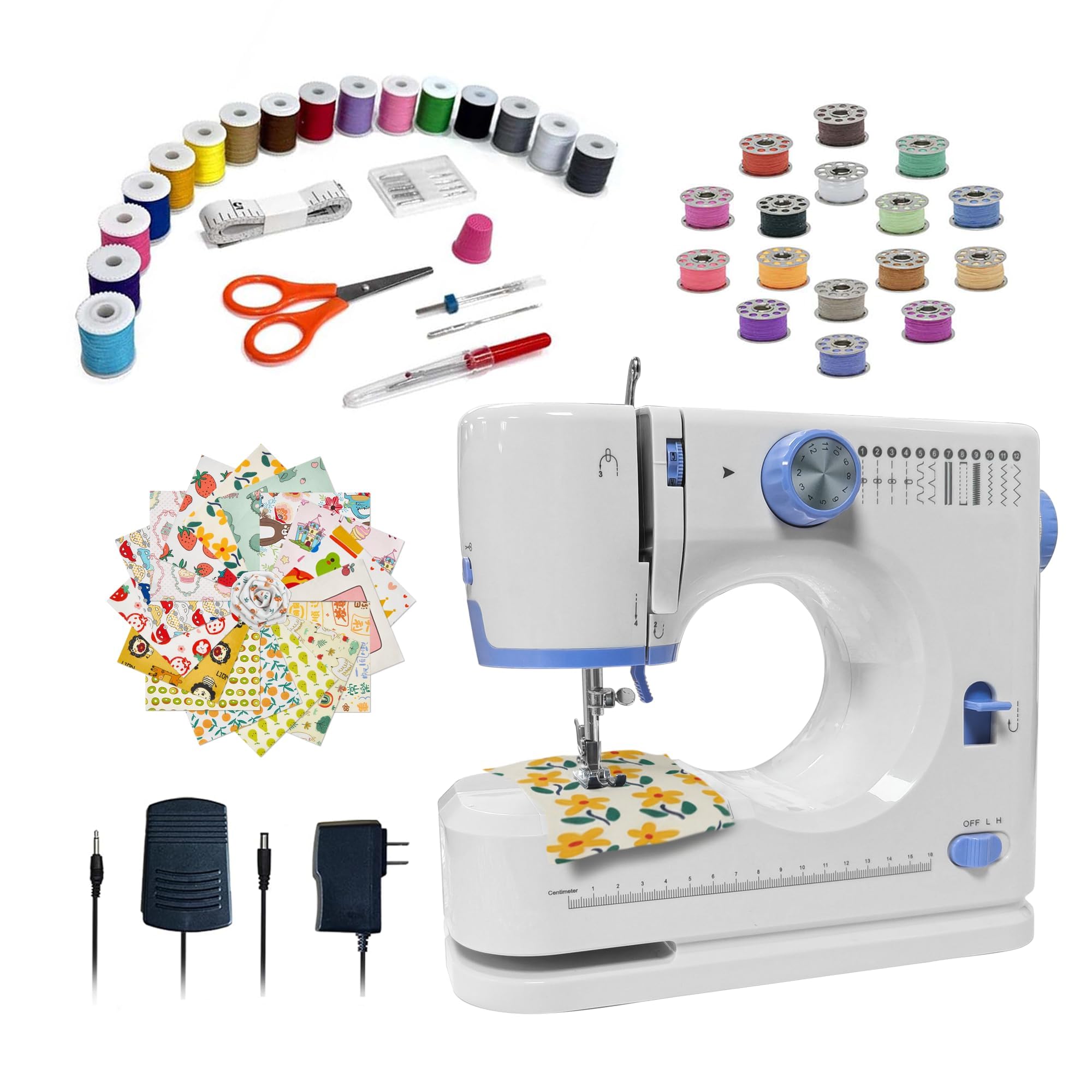
This Stoigeld arrives with 32 pieces of sewing thread and 20 fabric pieces, so you can make your first stitches the same day it lands on your kitchen table. It’s a compact 5 pounds with 12 built-in stitches, a 4-step buttonhole, and a reverse function—enough range for home mending, DIY, and school teaching. The two-speed control is a real teaching aid, letting you crawl before you walk.
Be honest with yourself about what you’ll sew, because this is a light-fabric machine. It’s designed for thin cotton and linen up to 4-6 layers, and thick denim only to 2-4 layers; the maker is upfront that it’s not for commercial or industrial work. Unlike the Janome JW8100 above with its 100 stitches and 5.5 lb weight difference—the Stoigeld is truly entry-level, priced and built for learning the basics.
Owners mention the included threader tool makes this easy to thread, and the setup is simple enough for a complete first-timer. The main critique is that the setup video could be clearer, so you may rely on the printed manual instead. It’s ideal for simple fixes and cross-stitch, not for heavy canvas bags.
Kit completeness: This is the only pick here that hands you fabric, thread, needles, and a threader in one box—no extra shopping required.
Honest limit: Light fabrics only; treat thick denim as out of bounds to avoid jamming.
4. StitchMaster Pro Sewing Machine by Lastempa
A 4.4-pound studio you can run on battery power when there’s no outlet nearby.
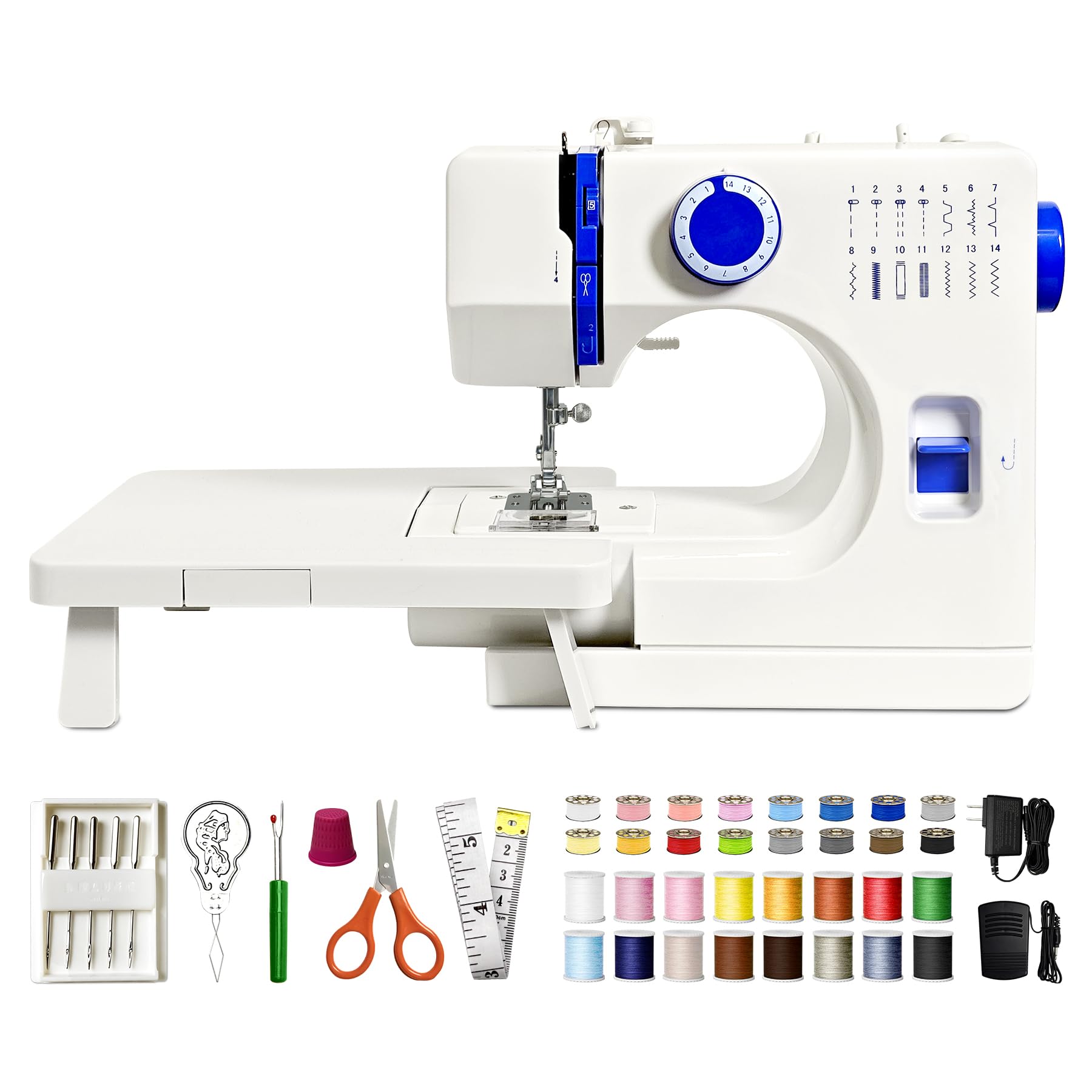
For sewing in a dorm, at a craft fair, or anywhere without a wall plug, this StitchMaster Pro is the flexibility champion. It’s the only machine here with dual power—an AC/DC adapter plus battery option—so you’re not tethered to a socket. The built-in carry handle and 4.4-pound weight make it genuinely hand-portable, a trait that separates it from the 12-pound Janome JW8100, which you’ll likely need two hands to lug.
Color-coded threading guides and auto tension adjustment remove the guesswork, and the two control modes mean you can use the foot pedal for a traditional feel or the one-touch button if you’re a young crafter. The 14 stitches include straight, zigzag, and blindstitch, with low-speed precision for silk and high-speed for canvas. A 10-foot power cord gives you workspace flexibility when you do plug in.
Owners find it beginner-friendly and note the machine doesn’t jam, though the experience isn’t universal—a few report the thread jamming and quality concerns. The included kit is generous: 12 thread spools, 6 needles, scissors, measuring tape, and a seam ripper. A 2-year warranty and US-based support back it up.
Its a neat extra: Battery operation means you can sew truly anywhere, which no other pick here offers.
Fair warning: Quality feedback is split; some owners love it, others hit jamming—keep expectations realistic for the weight class.
5. Brother XM3700 Sewing Machine

A reliable workhorse for mending that handles surprise heavy jobs without complaint.
Brother’s XM3700 is the machine people reach for when they “always need a sewing machine” for everyday repairs. The 37 built-in stitches include a one-step auto-size buttonhole, and the free arm slides off to sew cuffs and sleeves with ease. The automatic needle threader and jam-resistant drop-in top bobbin make it one of the easiest machines here to get running.
Owners have put this machine through surprising punishment—handling heavy camo canvas and webbing, and even surviving 30,000 masks in a single year. The 5 included sewing feet (zigzag, zipper, blind stitch, buttonhole, and button sewing) plus a 3-piece needle set and twin needle mean you’re covered for most projects from the start. At 12.5 pounds, it’s a full-size machine that one-hand lifts when you need to move it.
The directions are clear and the stitch presets work instantly, making it a strong teaching machine. The notable caveat: some customers note durability issues, with machines breaking after a few uses, and the self-threading feature gets mixed feedback. Brother’s “At Your Side” support offers free technical help for the life of the machine, which is a real safety net.
Why it works
- 5 presser feet and a twin needle included
- Free arm for sleeves and cylindrical projects
- Free lifetime technical support from Brother
Consider this
- Occasional durability complaints exist
- Self-threading gets mixed reactions from owners
Best for: the home mender who wants a dependable machine with strong brand support.
Not ideal for: someone who wants a compact, travel-friendly footprint.
6. Brother SM1704 17-Stitch Free Arm Sewing Machine
The no-frills machine that fits in a carry-on and still delivers solid daily stitching.
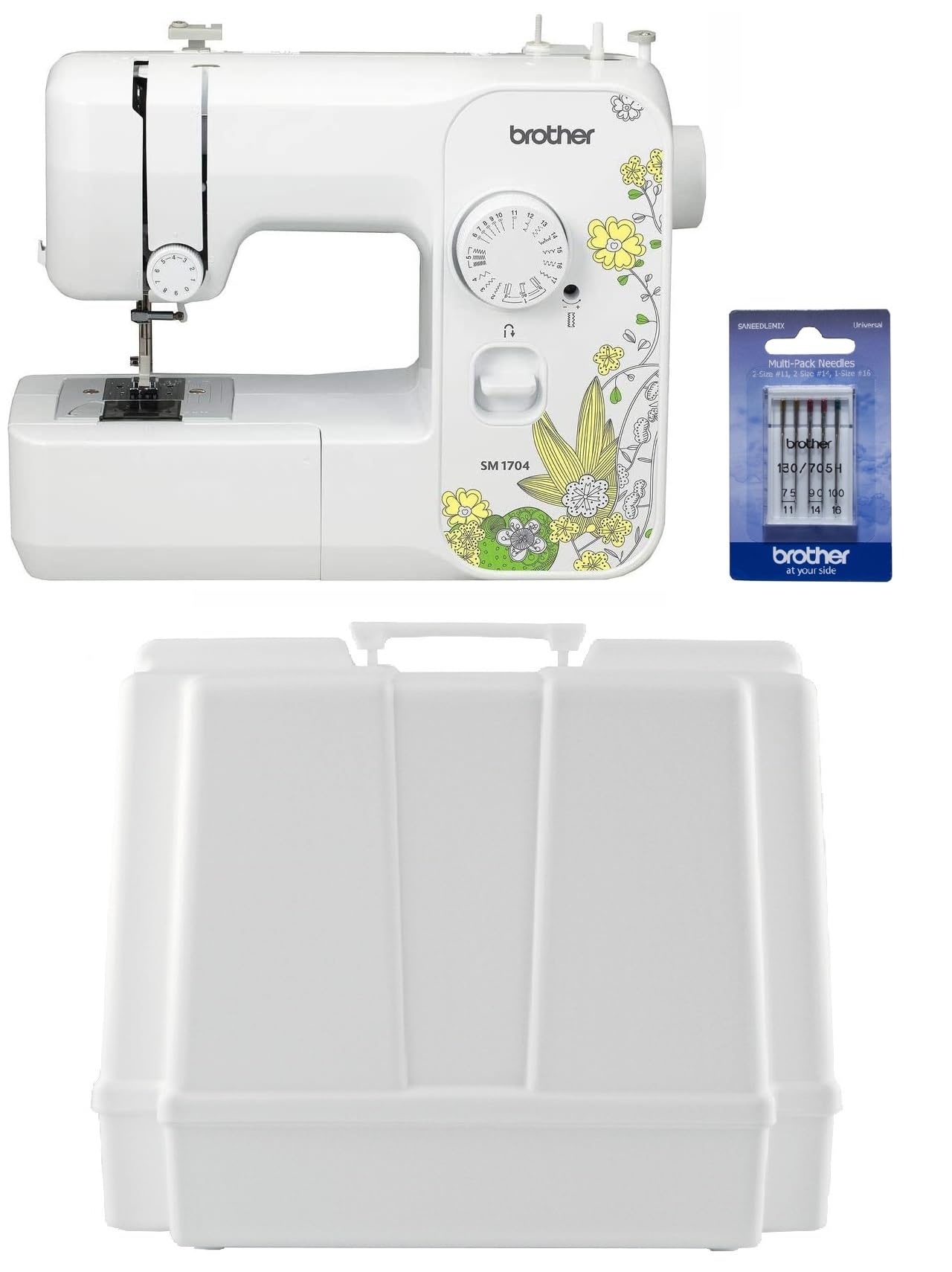
If your sewing happens on the go, this Brother SM1704 is built for it—reviewers point out it fits in a carry-on size bag for air travel, protected by the included hard plastic case with comfortable handle and metal latches. The 17 unique stitches cover blind, stretch, buttonholes, and zipper insertion, which is genuinely all most beginners need for alterations and light projects. The free arm is there when you need to sew a sleeve or a baby sock.
It’s a basic machine without bells and whistles, and that’s exactly the appeal for many. Reviewers call it quiet, lightweight, and easy to thread, with a drop-in bobbin that simplifies loading. They also note it handles bag linings and light alterations beautifully, and that a previous Brother machine lasted 30+ years. The recurring advice: keep it to light and medium fabrics, not thick denim.
The stitch dial is the one temperamental spot—it can stick or not click smoothly when you switch stitches, though it works fine once set. It comes with a 5-piece needle assortment and a 25-year limited manufacturer warranty, which signals real confidence in the build. A solid, honest pick for the basics.
What owners love
- Hard case with metal latches is travel-ready
- Quiet and lightweight for a full-featured machine
- 25-year limited warranty from Brother
Keep in mind
- Stitch dial can feel stiff or stick when switching
- Not meant for thick or heavy fabrics
Choose this when: you need a machine you can pack for a flight or tuck into a small closet.
skip it if: you plan to sew through denim or multiple heavy layers regularly.
7. Janome 2212 Sewing Machine with Bonus Bundle

A tank-like mechanical Janome that sews through tough layers where fancier machines stall.
Some beginners want simplicity and raw strength over stitch libraries, and that’s exactly what the Janome 2212 delivers. Reviewers call it a “tank,” praising its ability to handle thick, multi-layer materials like military gear and backpacks—jobs that leave other machines tangled. It’s a mechanical machine with dial pattern selection, zig-zag width adjustment, and stitch length control, which means you learn the fundamentals without a screen doing the thinking for you.
The 12 built-in stitches and four-step buttonhole cover daily needs, and the free arm with drop feed makes it versatile for sleeves and cuffs. At 14 pounds, it has the heft of a serious tool, and the quality is evident in its metal construction. Owners say the stitch quality rivals machines costing several times more, and that it sews leather, curtains, and costumes without thread breaks.
The included bonus bundle adds bobbins, needles, and a metal buttonhole foot, so you’re set up immediately. The trade-off: it’s a mechanical machine, so you won’t find the 100 stitches of the JW8100 or the computerized convenience of an LCD screen, and the manual notes a needle threader is not included. Reliability gets mixed feedback, though most find it user-friendly with a clear manual. Durability is where this machine shines for the long haul.
Why it stands out
- Handles thick and multi-layer fabric like a workhorse
- Stitch quality praised as rivaling far more expensive machines
- Bonus bundle includes bobbins and a metal buttonhole foot
Know the limits
- No needle threader—you’ll thread manually
- Some plastic parts despite the metal build
A great fit for: the beginner who wants to learn on a sturdy mechanical machine that won’t quit on tough jobs.
A poor fit for: anyone who wants a big stitch library or computerized features.
8. SINGER 4411 High Speed Heavy Duty Sewing Machine (Pink)
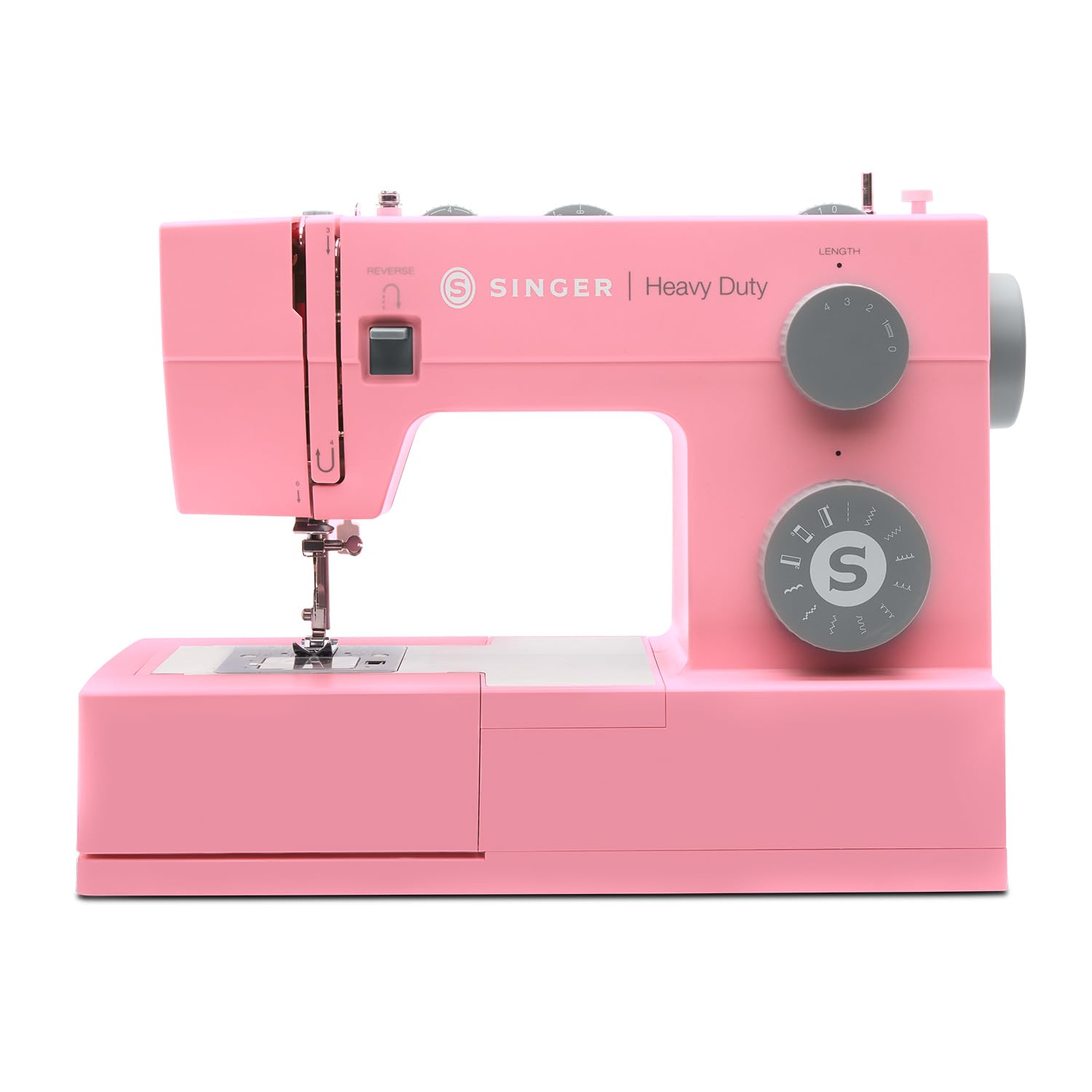
A motor with 60% more power that blazes through denim at 1,100 stitches per minute.
This special edition pink SINGER is for the beginner who already knows they’ll be sewing thick fabrics. The high-performance motor delivers 60% more power than standard models, letting you push through denim, canvas, and leather without the machine straining. At 1,100 stitches per minute, it’s the fastest machine here—a real advantage when you have a stack of projects and limited time. The 11 built-in stitches expand to 69 stitch applications, covering essential, decorative, and stretch options.
Unlike the computerized Janome JW8100, this is a mechanical machine where you dial in your stitch, which keeps controls simple and direct. Owners love that it sews through multiple layers and denim with ease, and the pink color earns genuine affection—one owner calls it “pretty in pink” sewing. The bonus accessory kit adds 4 presser feet, a quilting guide, bobbins, spool caps, screwdrivers, a seam ripper, and a soft cover, so you can start right away.
At 14 pounds with a metal frame, it’s built to stay stable during high-speed work. The main caveats: there’s no automatic needle threader, and the English manual can be hard to find for some—one owner bought a copy separately. It also lacks a hard case, so you’ll want to store it under a cover. Reliability and value get mixed feedback, but for speed and power on tough materials, few beginners’ machines compete.
Why it powers ahead
- 60% stronger motor for denim, canvas, and leather
- Fastest sewing speed here at 1,100 stitches/minute
- Bonus accessory kit valued at included
Watch for this
- No automatic needle threader
- English manual can be hard to source
Grab this if: you know you’ll sew denim and canvas and want speed plus power in a fun color.
Pass if: you prefer a computerized machine with a threader and slower, gentler pace.
9. SewLaVie 1130 Computerized Sewing and Quilting Machine
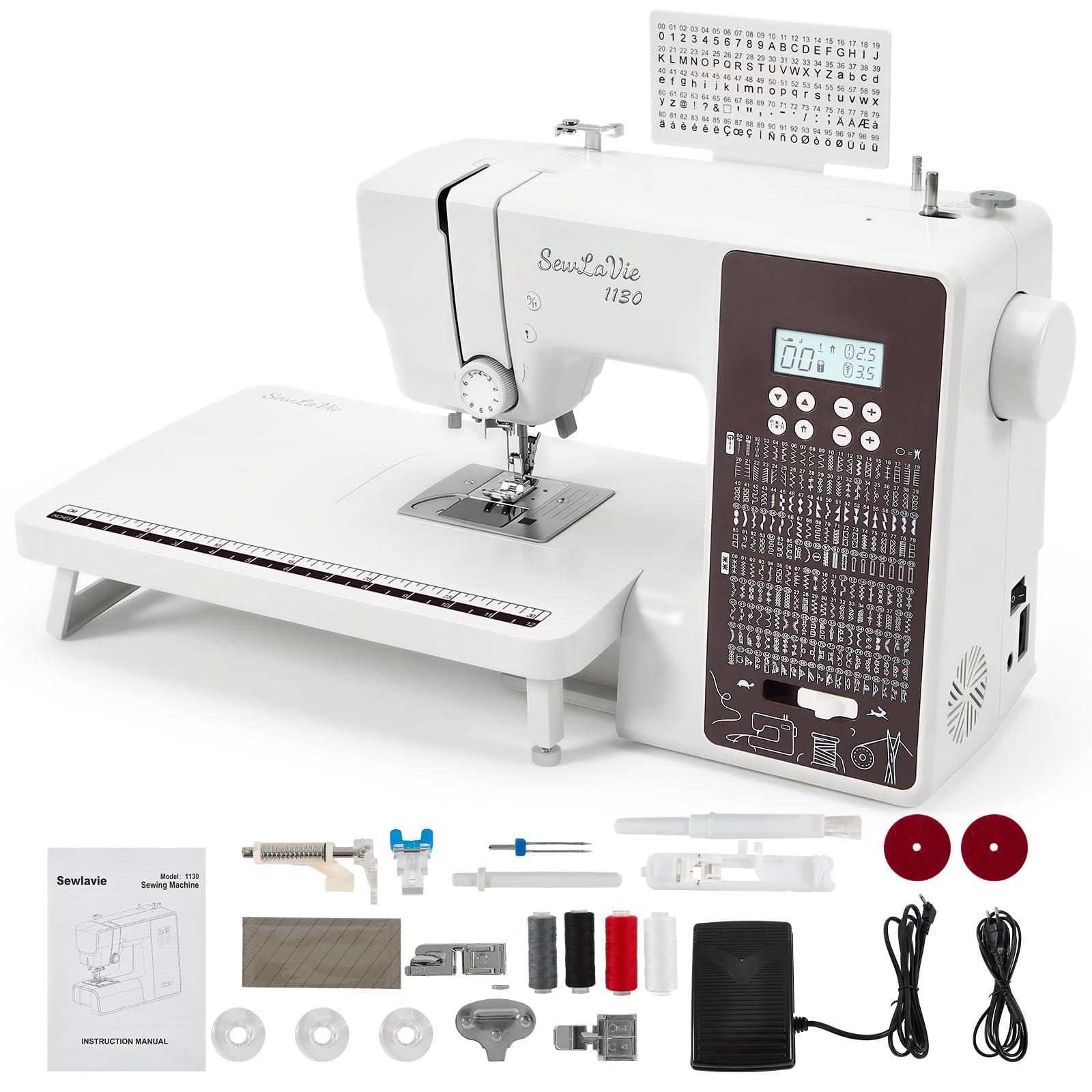
A 300-stitch library with a 7-point feed system that powers through 9 layers of denim.
For the beginner who secretly dreams of quilting, this SewLaVie is a revelation. The 300 built-in stitches include 143 utility patterns, 57 twin-needle setups, and 100 alphanumeric fonts—so you can even sew letters onto labels. The 1-step auto-size buttonhole and LCD screen make stitch selection intuitive, and the speed control slider lets you sew at your own pace without a foot pedal. The start/stop button and needle up/down position give you precision for pivoting corners.
The sturdy motor and 7-point feed dog system (the teeth that grip and move fabric under the needle) handle up to 9 layers of denim smoothly, a capability that outpaces many standard machines and puts it in the same league as the Janome JW8100 for quilting. The detachable wide extension table and drop feed mechanism (which lowers the teeth for free-motion work) let you try free-motion quilting at home. Built-in LED lighting illuminates your workspace, and the auto-stop mechanism protects the motor if the machine jams.
A built-in needle threader saves time, and the top drop-in bobbin with automatic winder keeps tension consistent. The package includes a wide table, presser foot set, maintenance tools, needles, bobbins, foot controller, and power cord, all organized in a built-in storage box. Owners are delighted, calling it “solidly built” and easy to learn, with one naming theirs “Bertha.” At 12.1 pounds, it’s a substantial machine with a metal frame and ABS casing.
What makes it special
- 100 alphanumeric fonts for personalized stitching
- Feeds up to 9 layers of denim with the 7-point system
- Auto-stop protection extends motor life
Consider this
- Auto needle threading can be tricky to master
- So feature-rich that beginners may feel overwhelmed at first
Your machine if: you want quilting capability and a huge stitch library from day one.
pass on it if: a simple mechanical machine with 12 stitches is all you truly need.
Understanding the Specs
Mechanical vs. Computerized
A mechanical machine uses dials and levers to select stitches—simple, sturdy, and easy to repair. A computerized machine uses buttons and an LCD screen, offering more stitches and features like a start/stop button and speed slider. For learning the fundamentals, mechanical is forgiving; for versatility, computerized gives you more room to grow without buying a new machine later.
Drop-in Bobbin and Needle Threader
A drop-in bobbin loads from the top through a clear window, so you can see when thread runs low—much easier than a side-loading case. An automatic needle threader pushes the thread through the needle eye for you. These two features save more beginner frustration than any other spec, so they’re worth prioritizing if you want a smooth first experience.
Free Arm and Feed Dogs
A free arm is the narrow section you expose by removing the accessory tray, letting you slide cuffs and sleeves over it for circular sewing. Feed dogs are the metal teeth that pull fabric through; a multi-point system feeds layers evenly and prevents puckering. Both matter more than stitch count for getting clean results on real garments.
Stitch Count and Speed
Stitch count ranges from 11 to 300 here, but beginners rarely use more than a dozen. Focus on having straight, zigzag, blind hem, and a buttonhole. Speed matters if you sew heavy fabrics—the SINGER’s 1,100 stitches per minute is a genuine advantage for volume work. For learning, lower speeds with a slider or two-speed control build confidence without runaway seams.
FAQ
What’s the difference between a mechanical and computerized beginner sewing machine?
How many stitches do I really need as a beginner?
What does a free arm do and why should I care?
Is a lightweight machine better for a beginner?
Can a beginner machine sew through denim or multiple layers?
What is a drop-in bobbin and why is it easier?
How much space do I need for a sewing machine?
What accessories come with beginner sewing machines?
What does a 25-year warranty on the Brother SM1704 actually cover?
Should I buy a cheaper machine first to see if I like sewing?
Final Thoughts: The Verdict
For most beginners, the beginner sewing machine winner is the Janome JW8100 because its 100 stitches, 7-piece feed dog system, and included quilting extras let you learn today and tackle quilts tomorrow without a second purchase. If you want a portable, budget-friendly kit for a child or for travel, the Dechow is the one to reach for. And for sewing denim and canvas at high speed, the SINGER 4411 delivers the power you need.
How We Picked
We do not accept paid placement. Every pick is matched to a real buyer and a real use-case; we do not hands-on test units.
Sources & Methodology
Specifications: manufacturer listings and product documentation. Review insights: verified customer reviews, as of September 2026. Pricing: not shown on this page (it changes often); check the current price via the retailer link.
As an Amazon Associate, KitchPrep earns from qualifying purchases. This does not affect which products we feature.
Related Guides
