
Specs are compiled from manufacturer listings and verified buyer reviews and can change over time — please confirm the key details on the product page before buying.
The picks below are all semi-automatic machines with a real portafilter, meaning you load ground coffee yourself instead of pressing one button on a sealed pod. That is the whole point: you control the shot, and you learn the craft as you go.
I’m Mohammad Maruf — the founder and writer behind KitchPrep. This guide is built by comparing the manufacturers’ published specifications and the patterns across verified customer reviews, so you get each pick’s real strengths and trade-offs instead of marketing spin.
Every machine here was chosen for one reason: it makes the learning curve survivable. You will see which models hide their weak spots behind a plastic tamper, which ones put a pressure gauge right in front of you, and which warm up fast enough for a weekday morning. The goal is simple — pick a beginner espresso machine you will still enjoy using after the novelty wears off, not one gathering dust in six weeks.
Our Picks at a Glance
How To Choose The Best Beginner Espresso Machine
Buying your first espresso machine is really a decision about how much control you want to take on. A semi-automatic machine hands you the grind, the dose, and the tamp — and hands you back the results. That trade is worth it, but only if the machine makes the rest easy while you learn.
Pump pressure and the 9-bar reality
Almost every machine on this list advertises 20 bar of pump pressure. That number describes what the pump can produce at the inlet, not what reaches your coffee. Espresso extracts best when the water hits the puck near 9 bar, so a machine that lets you watch or tune that pressure is genuinely easier to dial in. The XIXUBX includes a visible pressure gauge so you can see extraction in real time. The HIBREW H10B adds an adjustable pre-infusion stage, which wets the grounds evenly before full pressure arrives and cuts down on channeling — the spurting that leaves half your puck dry and your shot sour.
Portafilter size sets your upgrade ceiling
The portafilter is the handled basket you lock into the machine. A 51mm portafilter is the smaller standard and limits you to 51mm baskets and dosing rings. A 58mm portafilter matches the size used in many commercial machines, so aftermarket baskets, tampers, and puck screens are plentiful. The CASABREWS Ultra and the Gevi both use a 58mm portafilter and ship with several baskets. If you already own an espresso grinder and plan to chase better crema, that larger size gives you more room to grow.
Temperature control is what separates good shots from bitter ones
Coffee oils extract in a narrow temperature window — too cool and the shot tastes sour and thin, too hot and it turns bitter and ashy. A PID controller holds that temperature by constantly measuring and adjusting; simpler machines cycle a heater on and off. The AMZCHEF Compact uses a PID system to hold water temperature within a very tight range. The SHARDOR 20 Bar with LCD and the Gevi both let you pick among multiple temperature settings instead. Either way, look for a machine that keeps temperature steady rather than one that simply heats fast once.
Quick Comparison
| Model | Best For | Portafilter | Water Tank | Weight | Amazon |
|---|---|---|---|---|---|
| AMZCHEF Compact EM3131★ Best Overall | First-timers who want café crema fast | — | 50 oz | 8.2 lb | Amazon |
| 20 Bar Semi-Automatic (Havato CM8054H)Best for Grounds or Capsules | Grounds-or-capsule flexibility | 51mm | 45 oz | 17 lb | Amazon |
| AMZCHEF Matte SilverEasiest Touchscreen Start | Touchscreen simplicity for novices | — | 41 oz / 1.2 L | 8.5 lb | Amazon |
| SHARDOR Touchscreen | Small kitchens that need a slim footprint | — | 45 oz | 8.5 lb | Amazon |
| XIXUBX Stainless | Watching pressure while you learn | 51mm | 42 oz | 8.2 lb | Amazon |
| SHARDOR EM3209 | Double shots in one pull | — | — | 3.8 lb | Amazon |
| HIBREW H10B | Dialing in exact temperature and volume | 51mm | 44 oz | 9.6 lb | Amazon |
| Gevi ECMC0-SS0A1 | 58mm portafilter on a mid-range budget | 58mm | 74 oz / 2.2 L | 13.7 lb | Amazon |
| CASABREWS Ultra | Latte art and back-to-back drinks | 58mm | 73 oz | 13.6 lb | Amazon |
| De’Longhi Dedica Duo | Hot and iced drinks in a slim body | — | 35 oz | 9.6 lb | Amazon |
| De’Longhi Classic Signature | Brand-name reliability on a compact body | — | — | 9 lb | Amazon |
In‑Depth Reviews
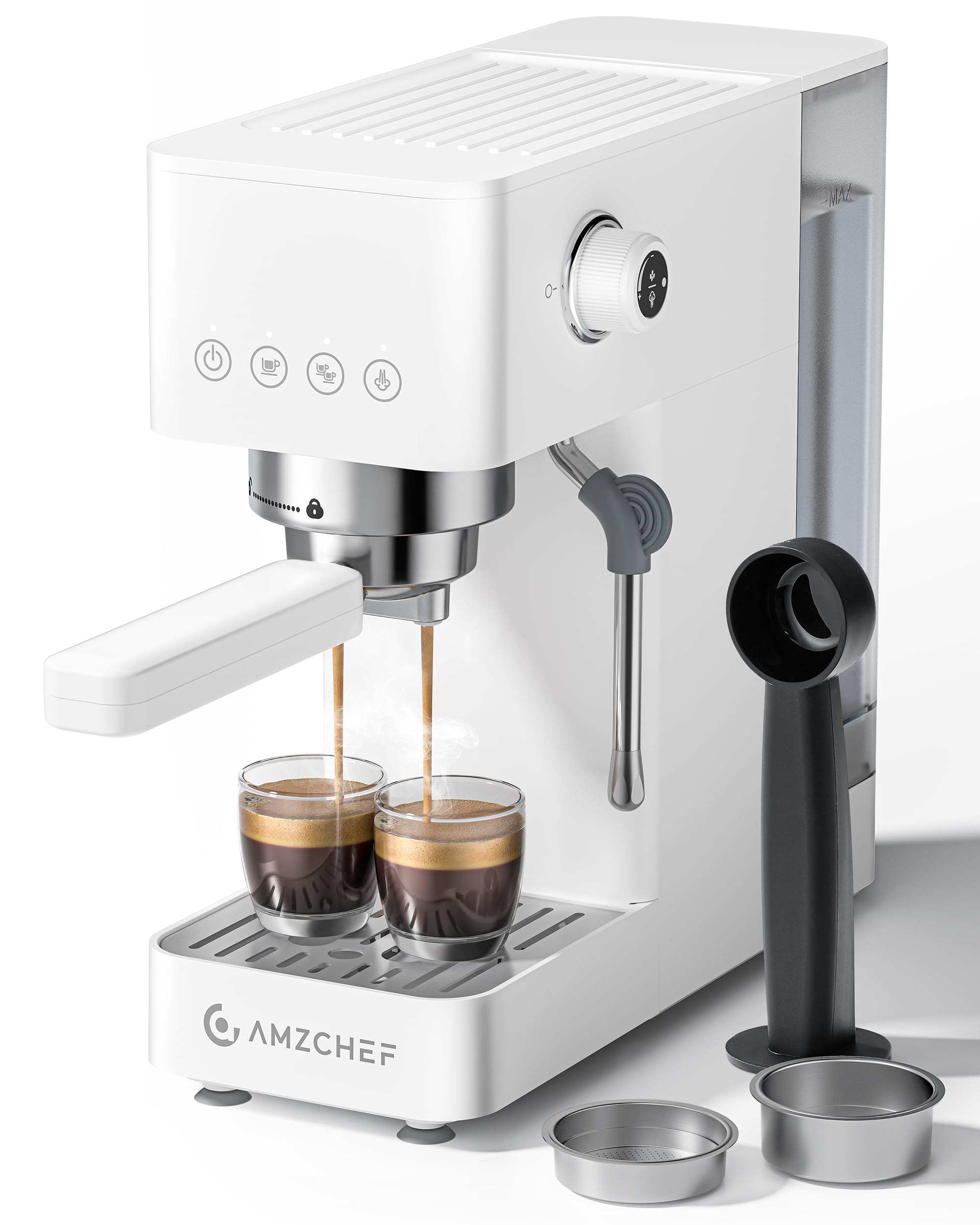
1. AMZCHEF Compact Espresso Machine 20 Bar, Americano, Latte & Cappuccino
Our pick — over 4.5★ from 350+ verified ratings; the strongest balance of quality and price.
The countertop starter that heats in thirty seconds and holds its temperature while you learn.
What earns this machine the top slot is not a flashy feature — it is the fact that it removes the two biggest beginner failure points at once. A PID controller constantly measures and corrects water temperature to within roughly two degrees, so your first shot and your fifth shot taste the same instead of swinging sour then bitter. The 1350W heating system finishes preheating in 30 seconds, which means a weekday espresso does not require planning your morning around the machine.
Owners consistently point to build quality and value first, with quick heat-up, rich crema, and bright flavor close behind. The compact footprint and clean white look come up often too, and the appliance is light enough at 8.2 pounds to move out of the way when the counter gets crowded. The removable 50 oz tank reduces how often you refill, and the parts break down quickly for cleaning — a detail that matters more than most buyers expect once the honeymoon phase ends.
Milk is where this machine gets tricky. Foam quality splits opinion, and one verified buyer in Spanish noted the machine worked well but took a little over a month to arrive — a shipping story rather than a machine story, though worth knowing before you order. The steam wand rotates a full 360 degrees, so you can position the pitcher under it from any angle. Expect to practice on your first few pitchers; textured microfoam is a technique, not a button.
What buyers keep praising
- PID temperature control holding water within roughly two degrees of target for repeatable shots
- 30-second preheat from a 1350W heating system
- Light 8.2 pounds for easy repositioning on a crowded counter
- Removable 50 oz tank and quick-disassembly parts for simple cleanup
Where it asks more of you
- Foam texture is the most divided point — plan on a few practice pitchers
- Single and double shot buttons work best once you settle on a consistent grind
Reach for this if: you want the steadiest temperature and the fastest heat-up in the mid-range, and you mostly drink straight espresso with the occasional cappuccino.
Look elsewhere if: milk drinks are your daily ritual and you want a wand that forgives a sloppy technique.
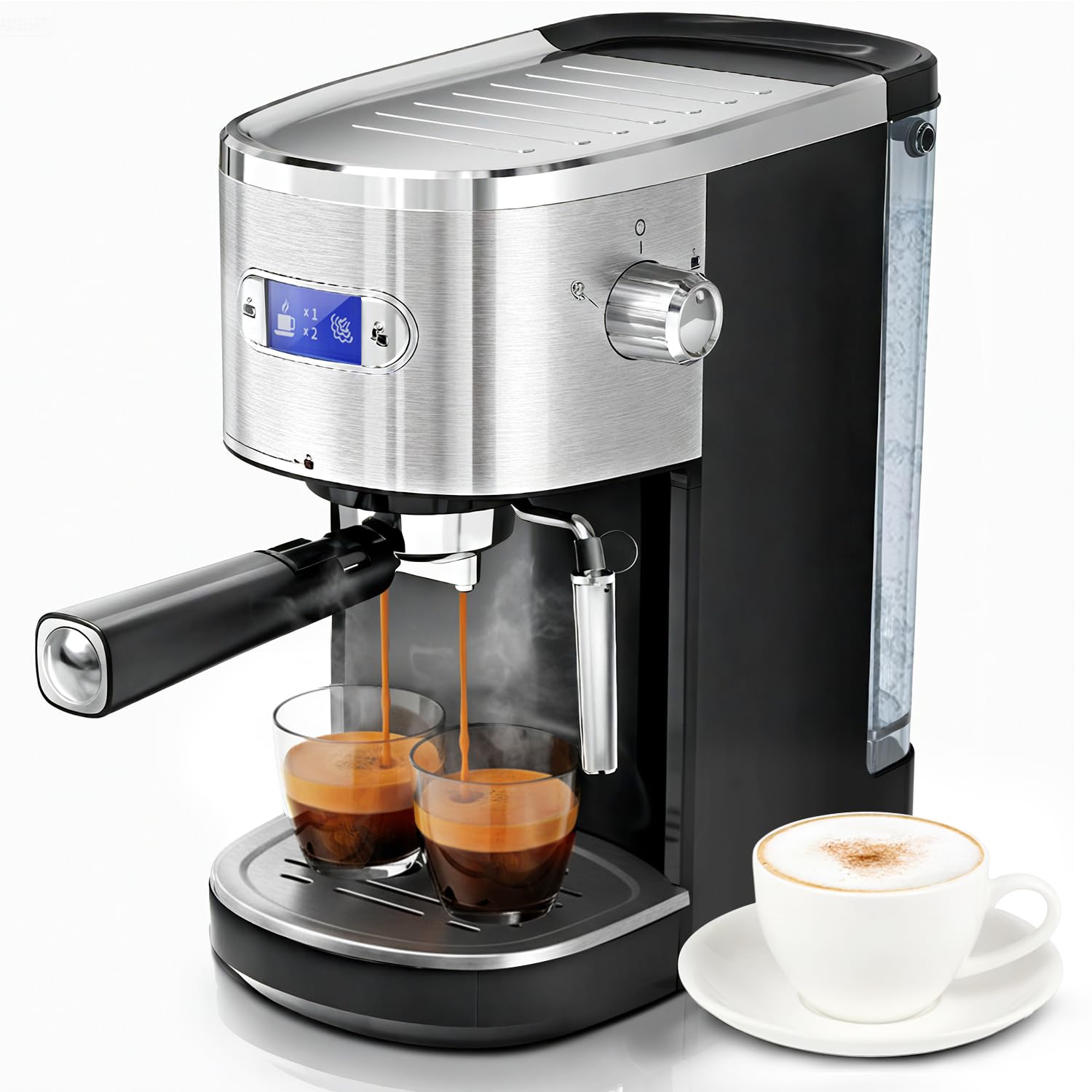
2. 20 Bar Espresso Machine Semi-Automatic, Professional Coffee Maker with Milk Frother Steam Wand & 45OZ Removable Water Tank
A heavyweight stainless build that brews loose grounds or capsules from the same portafilter.
Here is the honest trade-off before anything else: this machine weighs 17 pounds, roughly twice the heft of the AMZCHEF Compact at 8.2 pounds. That mass comes from stainless steel rather than plastic, and it is why the body feels planted when you lock the portafilter in place. It is also noticeably taller and deeper than the AMZCHEF — 11.42 inches deep by 7.09 wide by 11.97 high — so measure your counter clearance before you commit.
The flexibility is the real draw. A 3-in-1 filter holder lets you brew a single or double shot from loose grounds or drop in a capsule when you are running late. The blue LCD panel shows live brewing data and the tactile knob lets you pick shots without scrolling menus. Performance is what owners talk about most, followed closely by espresso quality and ease of use, with several noting the 20-bar pump produces visible crema and the steam wand turns out dense, velvety froth.
The part nobody mentions in the listing: the bundled tamper is a light plastic piece and the portafilter basket fits loosely. Buyers report that pairing this machine with a proper 51mm tamper and a heavier basket transforms the results. Warm-up runs around 45 seconds rather than the 30-second class of the AMZCHEF above. Reliability and cleaning both draw mixed notes, so treat descaling as a schedule rather than an afterthought.
Where the money goes: a stainless-steel body, a dual-input filter holder, and a real LCD panel — the physical hardware is the strongest part of the package. Pricing language from owners lands on the same note: it delivers coffee-shop-style drinks without the outlay of a high-end machine.
Buy it if: you want one machine that handles loose coffee on weekends and capsules on rushed weekdays, and you do not mind adding a 51mm tamper.
Think twice if: you need something light enough to tuck into a cabinet — at 17 pounds this one stays put.
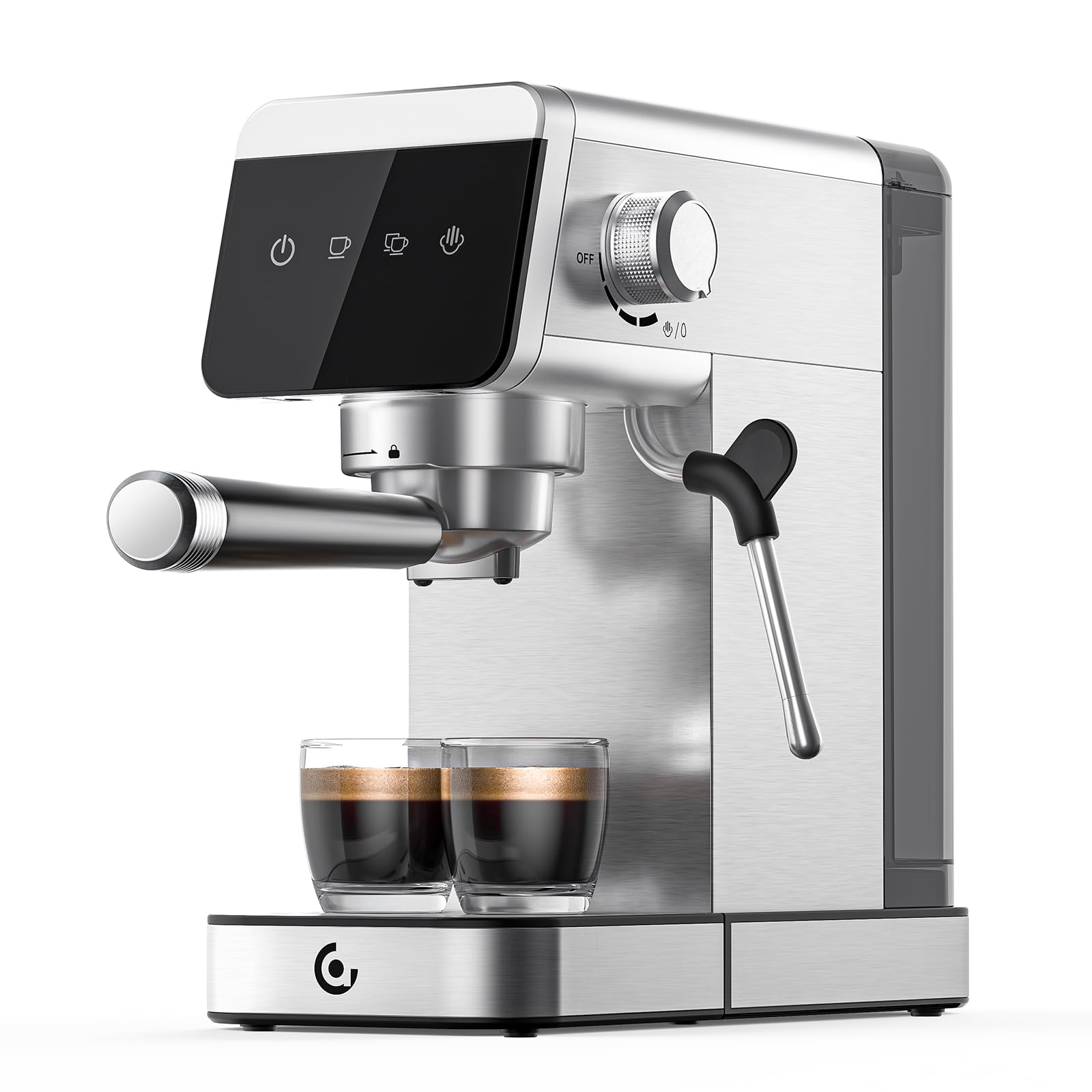
3. AMZCHEF 20 Bar Compact Home Espresso Coffee Machine, Matte Silver
Tap once for a shot, hold for five seconds to save the strength you love.
If the idea of learning a control panel puts you off, this is the one that gets out of your way. The LED touch panel pulls a single or double shot with one tap, and holding an icon for five seconds saves your preferred extraction length as a preset. That memory is the feature that separates a machine you keep using from one you stop fiddling with, because you stop having to think about it at 7 a.m.
The 1350W heating system reaches preheat in 30 to 40 seconds, and the Italian-made 20-bar pump is tuned to pull a thick golden crema without you needing to nail the grind on day one. The 41 oz detachable tank refills in seconds. Owners who moved up from pricier machines report this one matching them on froth and flow.
The integrated 8mm one-piece steam wand is the quiet hero — milk has nowhere to build up inside it, so a single wipe clears it. The honest limit is on you, not the machine: milk texturing still takes practice, and the packaging leans on you learning by doing rather than following a complicated guide. The kit arrives complete with portafilter, tamper with measuring spoon, and both filter baskets, so there is nothing extra to buy before your first shot.
The beginner math: saving a custom shot length means your best cup is the default press, not a sequence you have to remember. That is a genuinely different experience from machines that reset every time you switch off.
The honest limit: froth quality improves the more pitchers you steam, so budget a week of practice before judging the wand.
The right fit: anyone who wants the machine to remember their settings and does not want to read a manual twice.
Not the fit: you want dials and gauges to tune every variable by hand.
4. SHARDOR Espresso Machine 20 Bar, Professional Espresso Machine with Milk Frother and Touchscreen
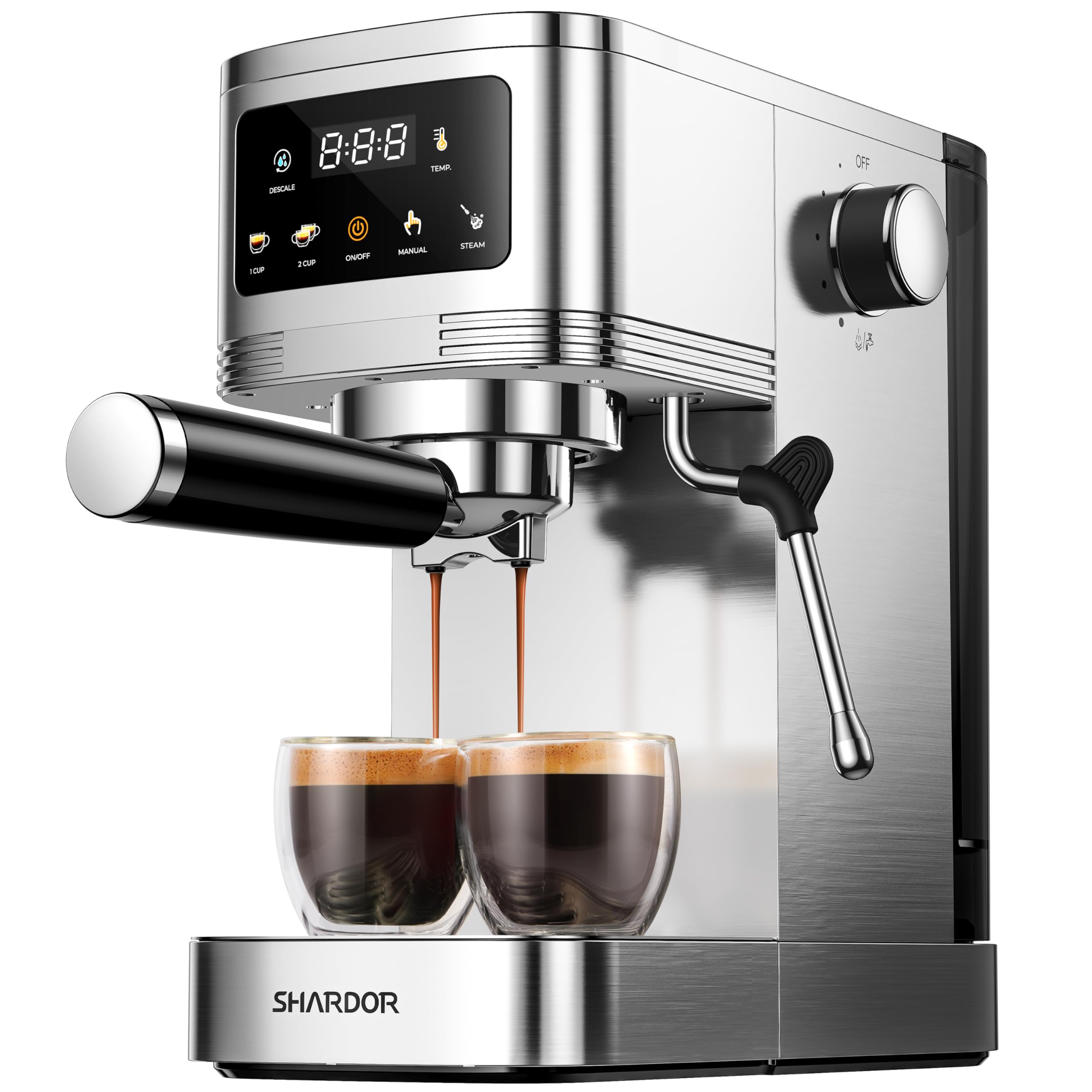
The slim tower with a touchscreen that covers almost everything a beginner needs.
At 8.14 inches deep and 5.12 inches wide, this is the narrowest body on the list — built for the countertop corner that nothing else fits. The 20-bar pump pairs with a 1350W motor, and the touchscreen handles single or double cups, a manual mode for custom strength, one-touch descaling, temperature control, and one-touch steam, all from the same panel. Auto shutoff kicks in after 15 minutes idle, which is the sort of detail that quietly prevents accidents rather than advertising itself.
NTC precision temperature control gives you three settings, so you can nudge extraction warmer for a lighter roast or cooler for a dark one. Owners rate quality and value highest, then ease of use and espresso quality, with several noting rich crema and a quiet warm-up under a minute. The 45 oz removable tank and easy-to-clean drip tray mean maintenance does not spiral into a project.
The split point is temperature — some find the default not hot enough for their taste, so lean on the three settings rather than the factory default. A few buyers also flag the bundled tamper and portafilter as the weakest links, with one recommending a bottomless portafilter swap for noticeably better extraction. Neither is a defect; both are upgrades most espresso owners make eventually anyway.
Strengths worth the counter space
- Three NTC temperature settings to match your roast
- 45 oz removable tank plus one-touch descaling
- 15-minute auto shutoff for confidence
- Fully manual mode when you want to experiment
Room to improve
- Stock temperature leans cool for some palates — adjust the setting up
- Included tamper and portafilter are the parts to upgrade first
Pick this if: your counter is short on space but you still want temperature control, descaling alerts, and a genuine manual mode.
Skip only if: you expect the bundled accessories to be pro-grade — they are the first thing you will replace.
5. XIXUBX Espresso Machine with Milk Frother for Cappuccino & Latte, Sliver
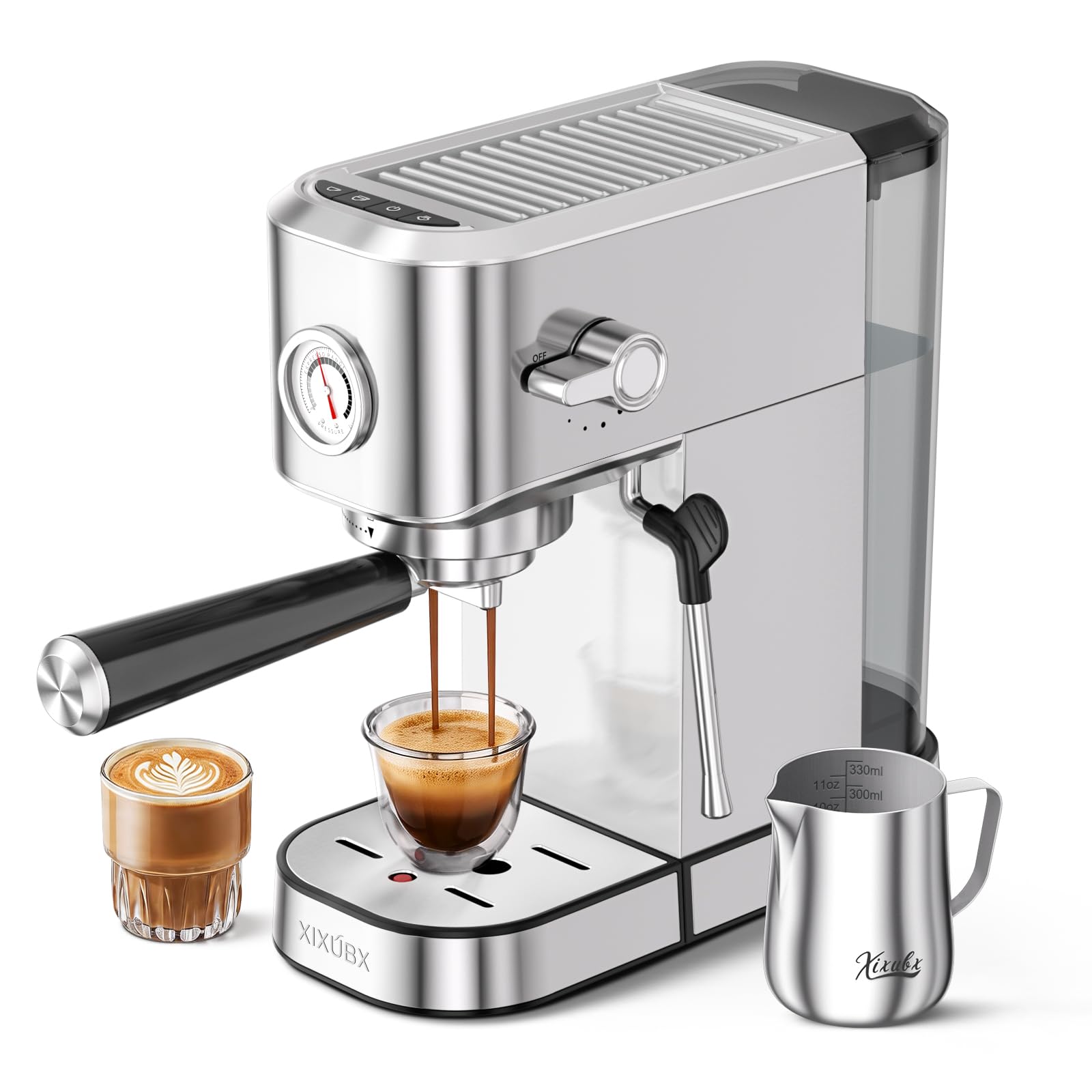
A pressure gauge on the front means you can see the extraction instead of guessing at it.
The gauge is the whole reason to consider this one. Watching the needle rise tells you in real time whether your grind is choking the flow or running too fast — the single hardest thing for a beginner to diagnose blind. That feedback loop shortens the learning curve more than any preset button can. The 20-bar pump and instant heating system keep things moving, and the tank holds 42 oz, enough for at least 10 cups on a single fill.
Owners mention tight, consistent shots that hold up against pricier Italian machines. The 360-degree rotating steam wand produces dense, silky microfoam, and because it detaches, cleaning it after each use is a rinse rather than a chore. The package includes a stainless steel milk frothing pitcher, a 51mm portafilter, two 51mm cup filters, and a tamper with spoon, so you are brewing the day it lands.
Two practical notes worth knowing. Customers note that the machine benefits from priming — running water through the inlet before the first pump so it does not spin on air. And a handful of buyers swap the stock portafilters for stainless steel basket upgrades, which tells you the machine responds well to modest improvements. The manufacturer backs it with a one-year warranty and step-by-step video tutorials.
What the gauge changes: instead of tasting a bad shot and not knowing why, you see the flow stall or race and correct the grind on the spot. That is the fastest way a beginner gets better.
What to prep for: prime the water inlet before your first brew, and expect to consider a basket upgrade down the line.
Choose this if: you learn best from feedback and want to understand what you are doing wrong while it is still happening.
Pass on it if: you would rather the machine hide the details and just hand you a cup.
6. SHARDOR 20 Bar Espresso Machine for Home with LCD Display and Steam Wand

A double shot in a single cup with a warming tray that keeps the heat where it belongs.
Drinking espresso in one cup rather than splitting a double into two is a small thing that changes your whole routine — no wasted half-shot sitting on the counter going cold. The stainless steel filter baskets give you one or two shots, and the 1350W thermoblock brings the machine to ready in about 30 seconds. The integrated cup warming tray is the detail that quietly improves the result, since a cold mug pulls heat out of the espresso the moment it lands.
Owners rank value for money and brew quality highest, with the 20-bar pump producing a thick crema. The LCD panel and simple button controls keep things approachable, and the compact stainless body looks tidy on a counter without dominating it.
Heat is the dividing line here, and one specific real-world gripe is worth passing along: the steam pipe handle can get extremely hot, so grip it with a cloth or use the wand quickly. That is a handling note, not a flaw — but it is the sort of thing you will appreciate knowing beforehand. Owners who have run this machine for months report it staying consistent with regular descaling every 30 days using a diluted white vinegar solution. Skip that schedule and mineral buildup is the real risk, not the machine itself.
Why beginners stick with it
- Double shot into one cup removes the split-shot guesswork
- About 30 seconds to ready from a 1350W thermoblock
- Cup warming tray keeps the first sip as hot as the last
- Long-term reviewers point out consistency with routine descaling
Keep in mind
- The steam pipe handle runs hot — handle it immediately and carefully
- Descaling every 30 days is a real requirement, not a suggestion
Right for you if: you drink doubles alone and want a compact body that stays consistent month after month.
Wrong for you if: you will not keep up with a monthly descaling routine — the machine rewards the discipline.
7. HIBREW H10B Programmable Espresso Machine with LED Display & Pressure Gauge
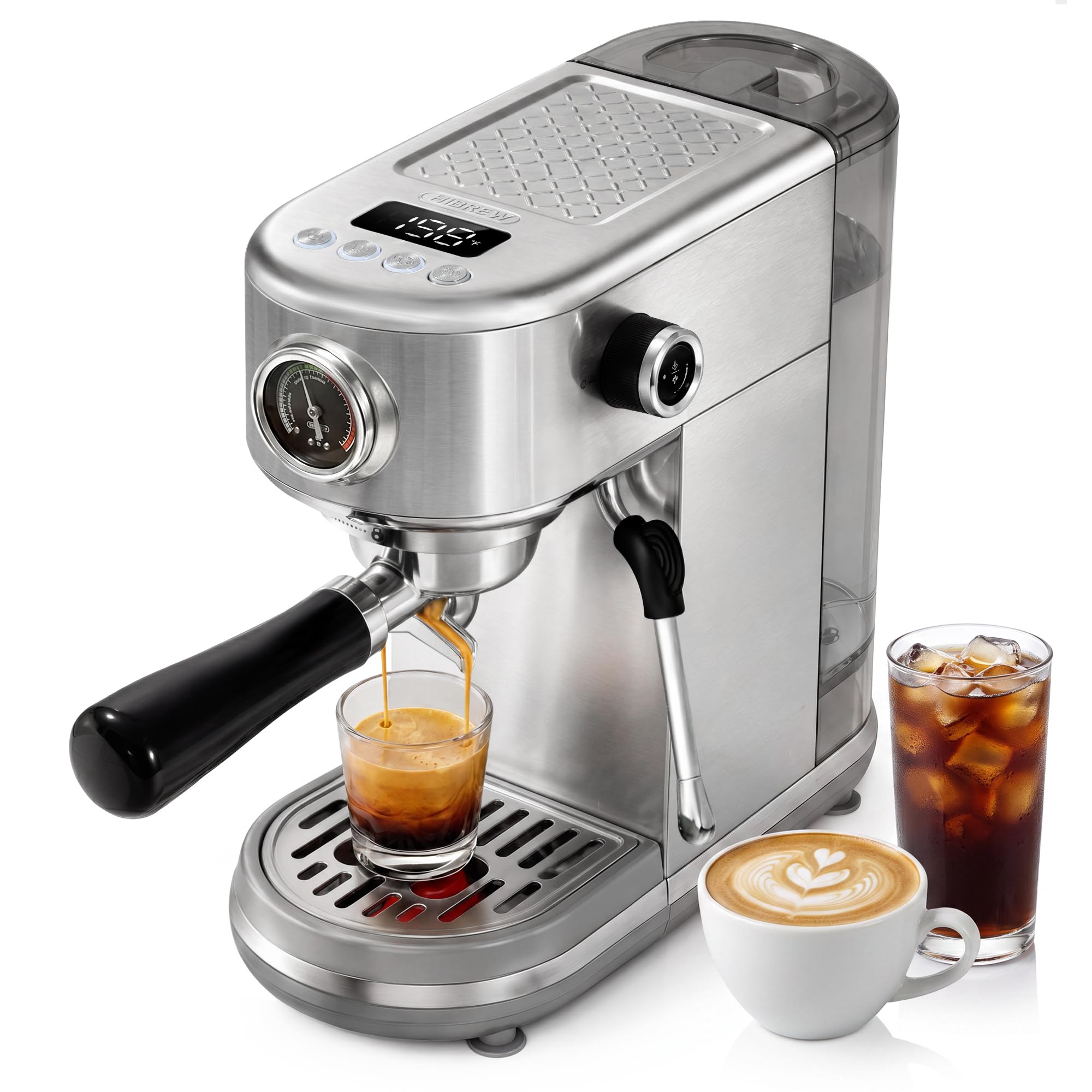
The programmable pick that lets you dial in temperature, shot volume, and pre-infusion yourself.
You can set the extraction temperature anywhere from 194°F to 204°F, the window where coffee oils release properly. That is a real dial on the machine, not a marketing claim. Pair it with a 20-bar pump, an NTC sensor (a temperature sensor), and adjustable pre-infusion — the stage that wets the grounds evenly before full pressure arrives and prevents channeling — and you have a machine that teaches you what each variable does.
Owners praise coffee quality, reliability, and ease of use most, along with the compact stainless body that fits small kitchens. The LED panel shows preset temperature on standby and switches to a live extraction timer mid-brew, so you always know what is happening. The 51mm portafilter holds around 14 grams of coffee, and a pressurized filter basket in the box means regular pre-ground coffee still produces a thick crema. Warm-up runs roughly 25 seconds to reach brew temperature.
The honest caveat: some espresso knowledge genuinely helps. Users who grind their own beans and weigh their dose get noticeably better shots than those throwing in scoop after scoop of pre-ground. That is true of every machine on this list, but it shows up faster here because the machine gives you more to adjust. One practical quirk — there is no three-way solenoid, so the portafilter drips a little after a shot. A drip, not a defect.
What you are paying for: a fingertip thermometer and timer for every shot, plus pre-infusion control that most machines this price leave out entirely.
What to know going in: the machine gives you enough rope to hang a bad shot — consistency in your dose and grind matters more than the spec sheet here.
For you if: you want to grow into your machine rather than outgrow it, and you enjoy adjusting temperature and volume shot by shot.
Not for you if: you want one button and zero decisions — this one hands you the dials.
8. Gevi 58mm Commercial Espresso Machine | PID & NTC Temp Control with Steam Wand
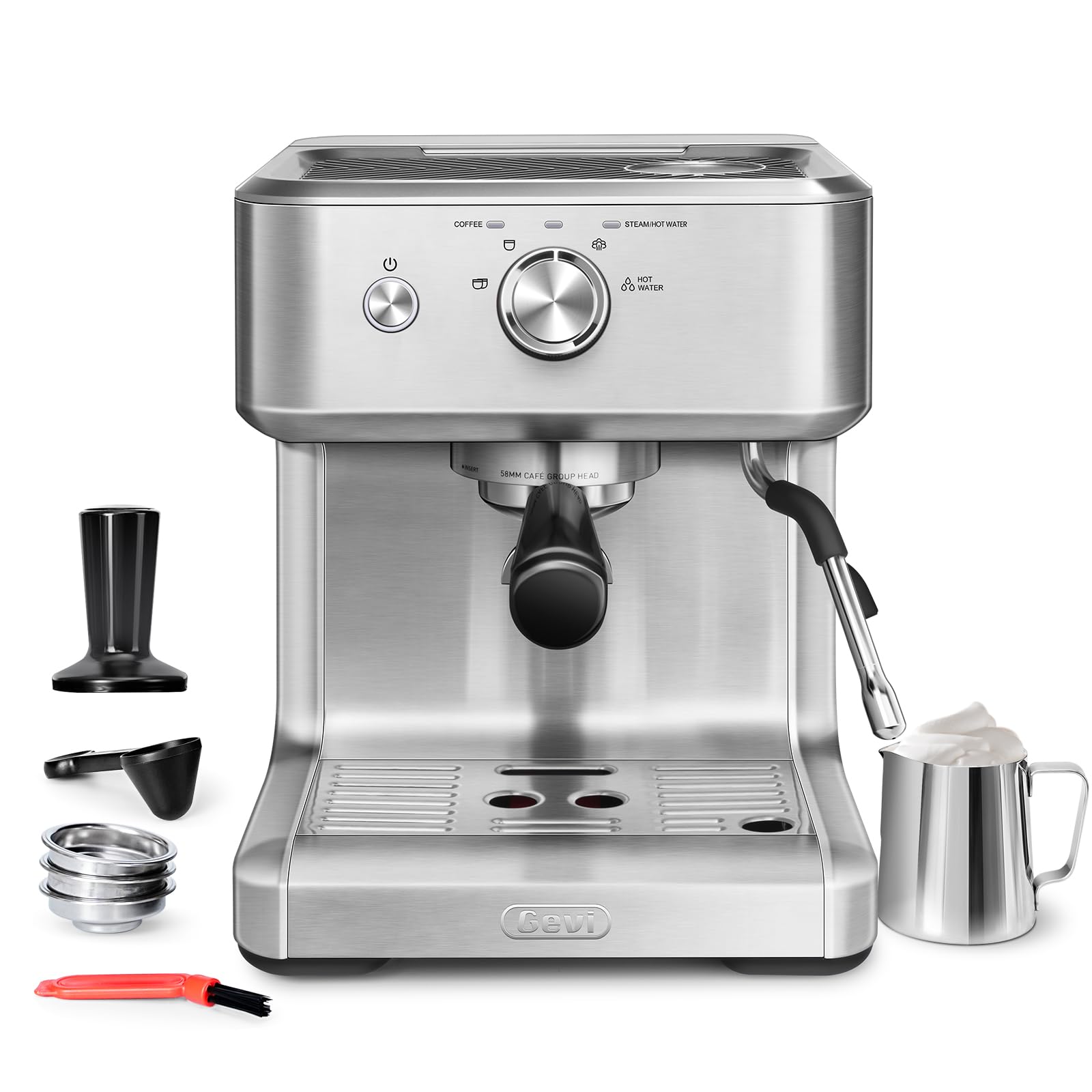
A commercial-size 58mm portafilter and dual temperature control in a compact stainless body.
This is the machine to pick if you already own an espresso grinder and want a launchpad rather than a stopgap. The 58mm portafilter matches the size used on many commercial machines, so baskets, tampers, and dosing tools are easy to find and swap. It ships with single-wall and dual-wall baskets in one-cup and two-cup sizes plus a tamper and milk pitcher, so you can start pressurized and move to a single-wall basket as your technique tightens.
PID and NTC dual temperature control holds the water between 194°F and 204°F — you get four temperature settings to pick from and four adjustable shot volumes from a single dial, no menu diving needed. The 74 oz tank is the largest on this list, which means far fewer refills during a morning of back-to-back drinks. Owners describe a machine that heats quickly, dispenses consistent shots at pre-set volumes, and cleans easily, with a body that is mostly stainless steel apart from the water holder and catcher.
Where it pushes back is noise — the steam wand runs loud enough to draw comment, and cleaning the shower screen after each shot takes more effort than the swipe-and-go machines above. Give the portafilter space when you knock out the puck. It is a fair trade for the 58mm ecosystem, because the accessories you buy for this machine carry over to most serious setups you might upgrade into later.
Why the ecosystem matters
- 58mm portafilter opens up a wide range of aftermarket baskets and puck screens
- Four temperature settings and four shot volumes on one dial
- 74 oz tank for long brewing sessions without a refill
- Ships with both single-wall and dual-wall baskets to grow into
Trade-offs to accept
- Steam wand is noticeably loud during milk prep
- Shower screen cleaning takes more attention than simpler designs
Made for: the buyer who already grinds their own beans and wants commercial-size hardware without a commercial-size outlay.
Not made for: someone who wants a near-silent steam wand — this one announces itself.
9. CASABREWS Ultra Espresso Machine, Barista Espresso Maker with Steam Wand
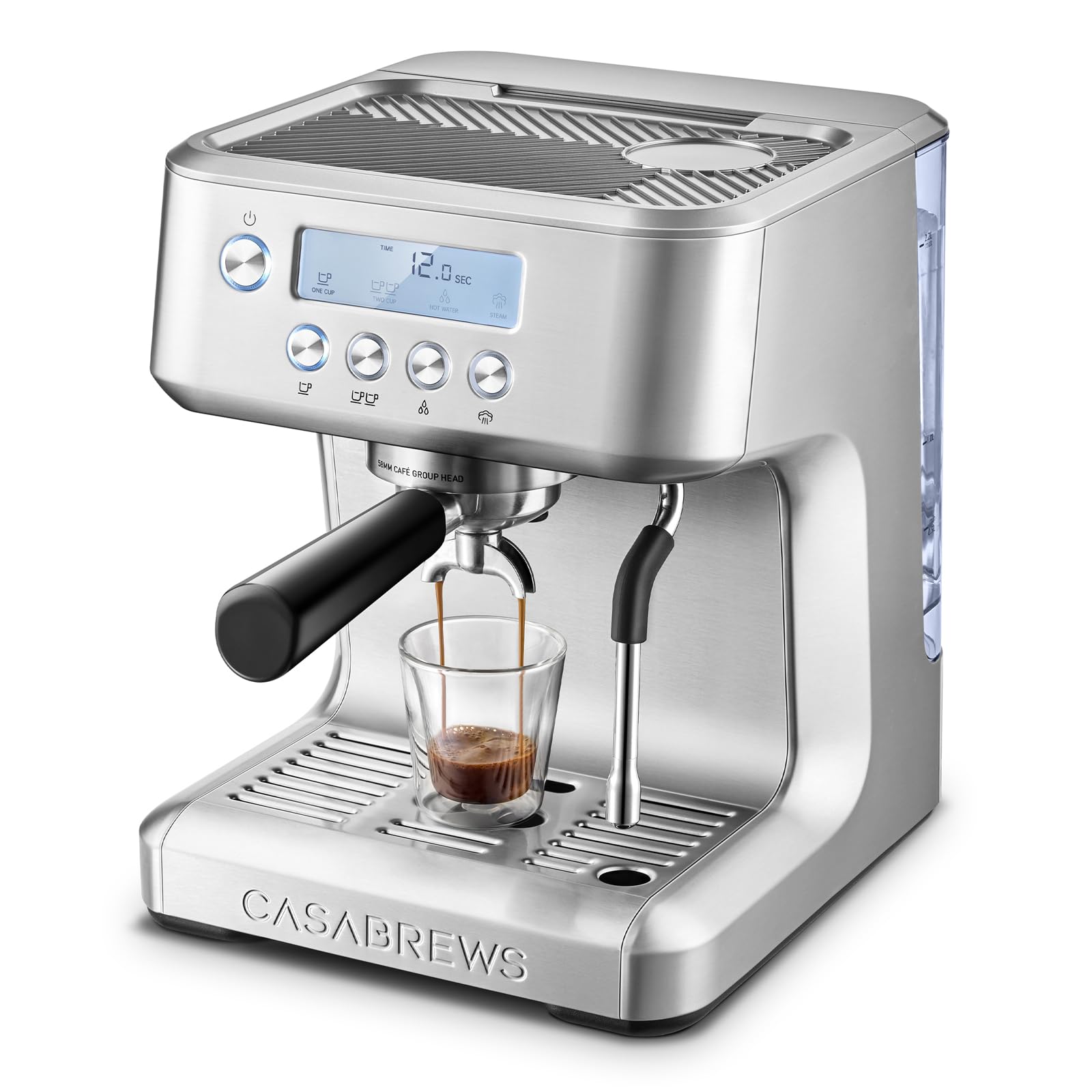
Two hundred and fifty-four owners do not agree on much, but they agree this machine pulls quality shots.
If lattes and cappuccinos are the reason you are buying, start here. The 20-bar Italian pump pairs with a 1350W heating system, and the steam wand produces the kind of microfoam that holds a pattern rather than collapsing into bubbles. You get four brewing temperature settings to match your beans, plus a 58mm portafilter and a full barista kit including single-wall and dual-wall baskets in one- and two-cup sizes, a tamper with spoon, a milk pitcher, and a cleaning needle. The 73 oz removable tank is enormous — nearly double the 42 oz tank on the XIXUBX — so you are not refilling mid-session.
Shoppers say excellent shots after dialing in their grind, plus good lattes and fast heating. Setup is short, the semi-automatic controls cover steam, hot water, and pre-programmed shots, and the brushed stainless finish holds up to daily wiping. Cleanup runs a couple of minutes, helped by the large drip tray.
The candid part: the included portafilter and baskets are the lightest-feeling parts of an otherwise solid machine, and some owners upgrade to a bottomless portafilter and a heavier basket for thicker crema. Heating speed and noise draw mixed comments — the steam function is not quiet, and a few users find the wand fussy with their milk. Neither stops anyone from recommending it. The recurring advice is simple: budget for a basket upgrade, and taste the difference.
The strongest case: a 73 oz tank, four temperature settings, and a 58mm portafilter on a machine that owners describe as delivering café-quality lattes at home. For a milk-drink household, that combination covers a lot of ground.
The honest asterisk: the bundled portafilter and baskets are the weak link — set aside a little budget to replace them and the crema noticeably improves.
Best matched to: a household that drinks milk-based coffee daily and wants a big tank, adjustable temperature, and a wand that can hold latte art.
Less suited to: buyers who refuse to upgrade any stock accessories — the stock baskets are the first thing to go.
10. De’Longhi Dedica Duo Compact Espresso Machine – Cold Brew Coffee Maker with Milk Frother Wand
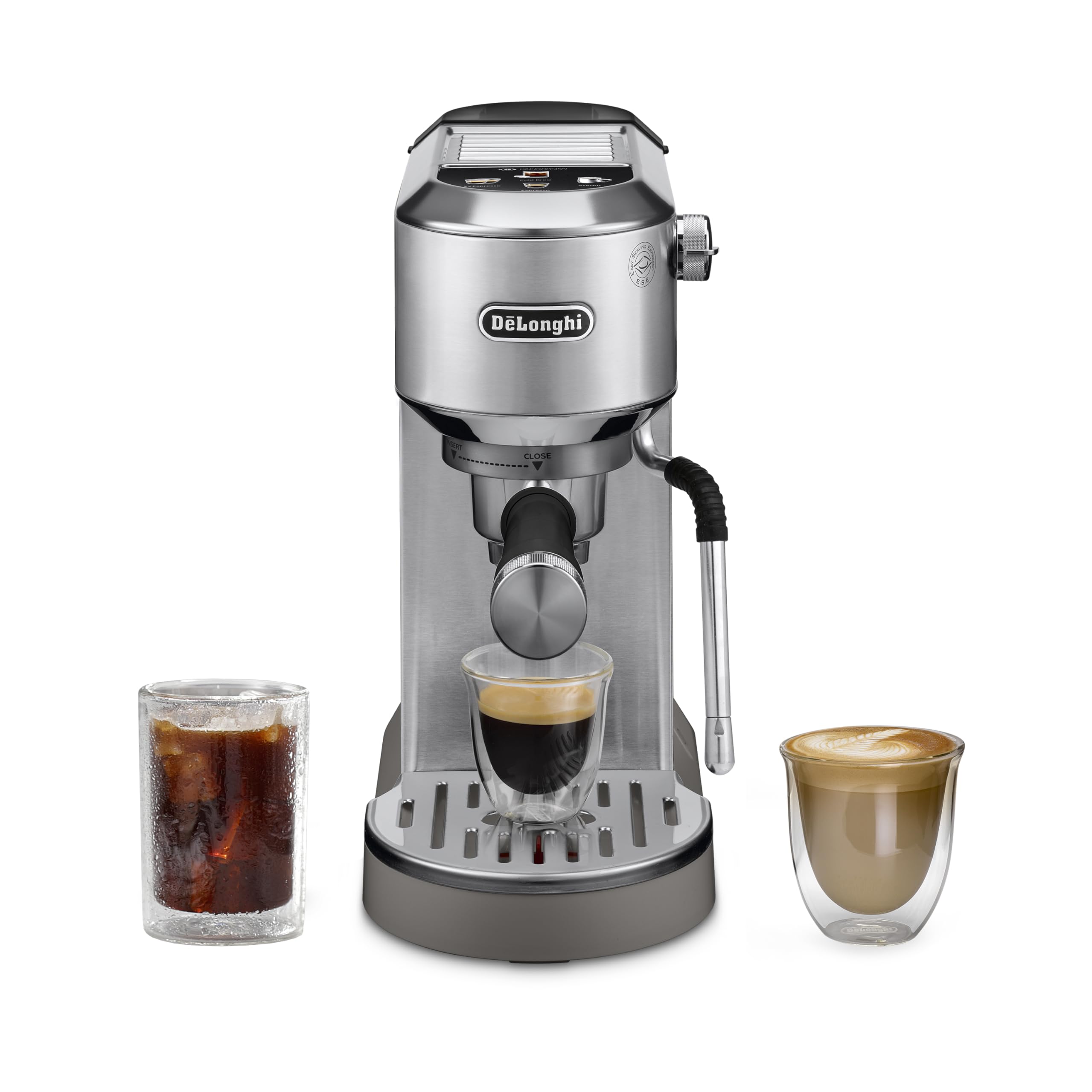
The one machine here that brews cold brew and iced espresso as naturally as hot shots.
Three presets — Espresso, Double Espresso, and Cold Brew — mean you can make iced lattes and espresso martinis without changing your routine. That is unusual for a beginner machine, most of which handle hot coffee only. The professional pump uses low-pressure pre-infusion followed by consistent 9-bar extraction, with an auto-stop function that ends the shot for you rather than asking you to time it. The full-color digital touch display makes the presets easy to follow.
Thermoblock technology warms the machine fast and holds a stable temperature, and the My LatteArt steam wand streams both dairy and plant-based milk into microfoam — it is cool to the touch and wipes clean easily. Buyers report compact, quiet operation and good results for the price, and the 5.9-inch-wide stainless body fits a tight kitchen corner. It ships with a professional tamper, a measuring scoop, a filter, a cleaning needle, and a water hardness test.
Be clear-eyed about what you are buying. This is a 3.7-star machine, and the most common complaint is practical: the steam wand is loud enough that a buyer mentioned reaching for earplugs, you cannot steam milk and pull a shot at the same time, and many mugs need the drip tray removed to fit underneath. The steam function occasionally restarts. For a patient drinker who wants flexibility over raw power, it is easy to live with. For someone who wants a fast morning espresso, this is a compromise. Note also that a number of reviews concern used or refurbished units — buying from a seller who stocks new units avoids that entirely.
what separates it: a built-in Cold Brew preset on a compact stainless machine is genuinely rare at this level, and it is what makes an iced-coffee drinker want this model specifically.
Where it stumbles: loud steaming, one function at a time, and cautious mug clearance add up to a machine that asks for a little patience.
For the iced crowd: if cold brew and iced lattes are what you actually drink, no other machine here does both so easily.
For the hot-shot crowd: if a silent, one-handed morning espresso matters most, look at the machines above instead.
11. De’Longhi Classic Signature Espresso Machine, Adjustable Milk Frother
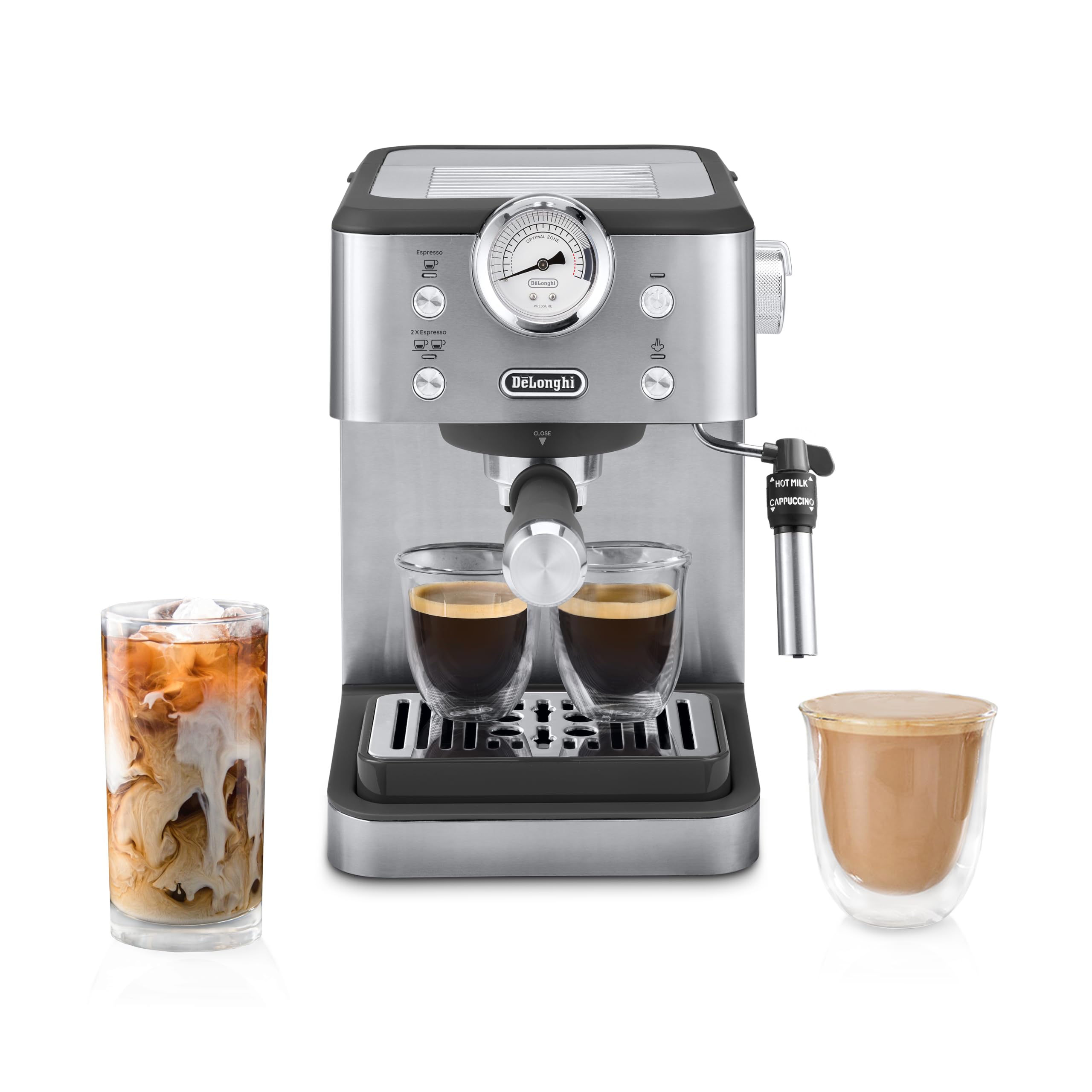
Fifteen bars, two frother settings, and the familiarity of a household espresso name.
Do not be thrown by the 15-bar figure — it is lower than the 20-bar machines above, and that is not a downgrade for extraction. What matters is steady pressure at the puck, and De’Longhi pairs the pump with Thermoblock heating for fast, stable temperature. The adjustable steam wand has two settings, moving between silky steamed milk and richer, denser microfoam for latte art, and the single and double espresso presets can be customized so the machine pours the dose you prefer automatically.
Owners mention rich espresso with solid crema, a portafilter that locks simply, and parts that clean easily. The frother works well on milk and alternatives, and the customizable shot buttons mean you do not have to hold anything or watch a timer. There is also a helpful video channel from the brand covering everyday use, which shortens the learning phase.
The recurring caveat is heat. Some users find the brewing temperature runs cooler than they would like, so lean into the preset customization and preheat your cup. The other note that surfaces is the portafilter interior being plastic rather than stainless — the sort of detail that matters to anyone planning to upgrade baskets later. Neither point undermines day-to-day use, but both are worth knowing before you buy.
What you get for the name
- Customizable single and double espresso presets pour automatically
- Two steam-wand settings for silky milk or denser microfoam
- Compact stainless body fits small kitchens
- Easy-clean parts and brand support videos for new owners
Points to weigh
- Some users find brew temperature runs cooler than expected
- Portafilter interior is plastic, not stainless, if you plan to upgrade baskets
Consider this if: brand familiarity and a simple, automatic pour matter more than tinkering with every variable.
Move along if: you want the higher-pressure pump and fully metal portafilter of the machines above.
Understanding the Specs
Pump Pressure vs. Extraction Pressure
The bar rating on the box describes how hard the pump can push water, not what reaches your coffee. Most machines here advertise 20 bar, while the De’Longhi Classic Signature runs a 15-bar Italian pump and the Dedica Duo extracts at a consistent 9 bar. The number that actually determines flavor is the pressure at the puck — the compacted disc of coffee inside your portafilter. That is why a machine with a visible pressure gauge, like the XIXUBX, is so useful early on: you see the needle climb and can tell whether your grind is restricting flow or letting water rush straight through. Too fast and the shot tastes thin and sour. Too slow and it turns bitter. Watching that needle teaches you faster than reading about it.
Temperature Stability and Why PID Matters
A PID controller is a small computer that measures water temperature continuously and adjusts the heater to keep it on target. An NTC sensor does the same measuring job. Without one, a machine cycles its heater on and off and drifts across a wider temperature range, so your first shot and your third taste noticeably different. The AMZCHEF Compact uses PID control to hold within roughly two degrees, while the Gevi uses PID and NTC dual control to stay between 194°F and 204°F and the HIBREW H10B lets you pick anywhere in that same window yourself. If you want consistent espresso without constant correction, temperature control is worth more than a higher bar number.
FAQ
Do I need a burr grinder to start witha beginner espresso machine?
Can I use pre-ground coffee in these machines or do I need to grind my own?
What is the difference between a 51mm and a 58mm portafilter?
How often do I need to descale an espresso machine?
Why does my espresso come out sour or bitter?
Is a 20 bar pump better than a 15 bar pump?
Do I need a steam wand to make lattes and cappuccinos?
Can these machines make cold brew or iced coffee?
What size water tank do I need for a beginner machine?
How long does a beginner espresso machine take to warm up?
Final Thoughts: The Verdict
The honest rule for a first espresso machine is that the steadiest temperature and the fastest heat-up beat a bigger number on the box every time. That is why the AMZCHEF Compact Espresso Machine takes the top spot — its PID controller holds water within roughly two degrees, it heats in 30 seconds, and its 8.2-pound body fits tight counters. It is also the pick that quietly sidesteps the strongest complaint across this category, since quality is what owners single out. If you want the widest upgrade path, the Gevi 58mm Espresso Machine gives you commercial-size hardware and a 74 oz tank. And when cold brew and iced lattes are the drinks you actually reach for, the De’Longhi Dedica Duo handles both without changing your morning rhythm. Given how many units this category moves, buying the pick that matches your drink rather than the most advertised spec is the smartest move you can make.
How We Picked
We do not accept paid placement. Every pick is matched to a real buyer and a real use-case; we do not hands-on test units.
Sources & Methodology
Specifications: manufacturer listings and product documentation. Review insights: verified customer reviews, as of September 2026. Pricing: not shown on this page (it changes often); check the current price via the retailer link.
As an Amazon Associate, KitchPrep earns from qualifying purchases. This does not affect which products we feature.
Related Guides
