
Specs are compiled from manufacturer listings and verified buyer reviews and can change over time — please confirm the key details on the product page before buying.
If you are reading this, you probably woke up with bites on your arm — or you found one of the little rust-colored insects crawling along your bed frame, and now you cannot sleep. The short answer: liquid concentrates and ready-to-spray formulas with residual action are the ones that finish the job, because they kill the bugs that walk across treated wood next week, not just the ones you see today. Traps and single cans do not end an infestation on their own, no matter what the label promises.
I’m Mohammad Maruf — the founder and writer behind KitchPrep. This guide is built by comparing the manufacturers’ published specifications and the patterns across verified customer reviews, so you get each pick’s real strengths and trade-offs instead of marketing spin.
Bed bugs are hard to kill partly because they hide in seams and cracks you never think to check — and partly because many of them are now resistant to the older pesticides. This walkthrough covers the best Bed Bug Treatment Products so you can choose one that matches the size of your problem.
Our Picks at a Glance


How To Choose The Best Bed Bug Treatment Products
Before you buy anything, take ten minutes to measure how bad the problem is. A single bug on a hotel suitcase is a completely different job from a bedroom where you found them in the bed frame seams, the headboard, and the baseboards. That one fact — where you have seen them and how long the biting has gone on — decides which type of product actually works.
First, count the surfaces you need to treat
One can of ready-to-spray aerosol covers roughly one bedroom’s worth of mattress, box spring, frame, and baseboards, while a gallon of liquid covers a whole apartment. If you have more than one bedroom or a couch to treat, a gallon-sized bottle is the version that will not run out halfway through. Crossfire’s 13-ounce concentrate makes a full gallon once you mix it, which is why it stretches so far.
Second, decide if you need egg kill or adult kill
Adults you can see; eggs you cannot. A product that only kills the adults you spray will be followed by a fresh round of bites in about a week when the eggs hatch. Formulas that kill eggs on contact — Harris’s 5-minute spray, Crossfire’s concentrate, and EcoVenger’s botanical blend among them — cut the whole cycle off at the source, and that is why they are worth seeking out.
Third, know your drying time and re-entry window
Even the better formulas take a day or two to dry fully. One reviewer noted that a mattress treated with Crossfire took two days before it was dry enough to sleep on. Plan to treat in the morning, open windows, and sleep in another room the first night. Products with a mild or no odor still need airflow — the smell being subtle does not mean the residue has dried.
Quick Comparison
| Model | Best For | Form | Coverage | Residual | Amazon |
|---|---|---|---|---|---|
| Crossfire Liquid Concentrate 13 oz★ Best Overall | Whole-home DIY treatment | Liquid concentrate | Makes 1 gallon | Non-repellent, long-lasting | Amazon |
| JT Eaton Bed Bug, Tick & Mosquito KillerBest for Gear | Treating clothing and gear | Water-based spray | 128 fl oz | Lasts through at least 10 washings | Amazon |
| Harris 5 Minute Kill Time SprayFastest Knockdown | Fast knockdown, small rooms | Ready-to-spray aerosol | 32 fl oz | Up to 30 days | Amazon |
| Bedlam Plus Insecticide 17 oz | Resistant bed bugs, small spots | Aerosol | 17 fl oz | Residual control after dry | Amazon |
| Crossfire Aerosol 17 oz | Targeted cracks and mattresses | Aerosol | 17 fl oz | Kills all life stages | Amazon |
| Bedlam Bed Bugs Spray (2 Spray Cans) | Multi-surface treatment | Aerosol 2-pack | 34 oz total | Residual on water-safe surfaces | Amazon |
| Ortho Home Defense Max 3-Step System | Detect, treat, confirm | Traps + spray + powder | 1 gal + 12 oz powder | Long-lasting powder in cracks | Amazon |
| Harris Toughest Bed Bug Killer Gallon | Long-term prevention | Liquid spray | 128 fl oz | Up to 16 weeks | Amazon |
| EcoVenger Bed Bug Killer with Remote Sprayer 1Gal | Pet- and child-friendly homes | Botanical liquid | 1 gal | 14-day dry residual | Amazon |
In‑Depth Reviews
1. Crossfire Liquid Concentrate 13 oz – Long-Lasting Bed Bug Control, Kils Bed Bugs and Their Eggs, pyrethroid-Resistant.
Our pick — over 4.5★ from 800+ verified ratings; the strongest balance of quality and price.
The concentrate that turns 13 ounces into a full gallon of bed bug killer
For a whole-home DIY job, this is the bottle most pest-control techs would quietly buy for themselves. The 13-fluid-ounce concentrate mixes up to a full gallon, and it is built to be non-repellent — meaning bed bugs do not sense it and avoid the treated strip of floorboard the way they dodge some sprays. They walk straight across the residue and pick it up on their bodies. It is also approved for direct application onto mattresses, which is where a lot of infestations center. For comparison, Harris’s ready-to-spray 32-ounce bottle is already mixed and covers one room the moment it arrives — the exact opposite of the mix-it-yourself approach. The formulas target very different kinds of users.
What wins people over here is the effectiveness, and it is a deserved reputation. Buyers report dead bugs within an hour of application, and one detailed writeup describes eliminating a mild infestation in a mother’s three-bedroom home by drenching the mattress and box spring, spraying carpets, curtains, baseboards, and outlets, then retreating at the 10-day mark. The whole job took two days to dry. The same buyer notes this is the difference between a DIY fix and a five-hundred-to-a-thousand-dollar professional visit, which is why they call it a lifesaver. As they put it: “Anything else is burning your money.” The non-repellent, non-staining formula also means you are not scrubbing residue off furniture or worrying that visible streaks will tip off a landlord.
The honest catch is that you must mix it correctly. The instructions say whole bottle to the gallon mark with distilled water — no more, no less — and one buyer found that mixing wrong killed their results on the first round. Mix it too weak and it can fail outright. Mix it too strong and the drying time stretches out. And like any serious residual formula, it takes a full day or two to dry before the room is safe to sleep in. If you are treating one small bedroom once, the pre-mixed 32-ounce Harris bottle is the lower-effort option. If you suspect the bugs have spread beyond a single room, this is the one to reach for.
Why this earns the top slot
- One bottle mixes up to a full gallon of spray
- Non-repellent so bed bugs walk into it instead of around it
- Approved for direct application onto mattresses
- Kills adults and eggs, and targets pyrethroid-resistant strains
- Non-staining on surfaces
What to keep in mind
- Requires correct dilution — wrong mix wastes a treatment
- Takes up to two days to fully dry after spraying
- Some buyers find the upfront cost steep for a single-room job
Buy it if: you are treating more than one room, or you have already tried a store-bought spray and the bites kept coming.
skip it if: you only need to treat one small bedroom once — a pre-mixed 32-ounce bottle will do the same job with less setup.
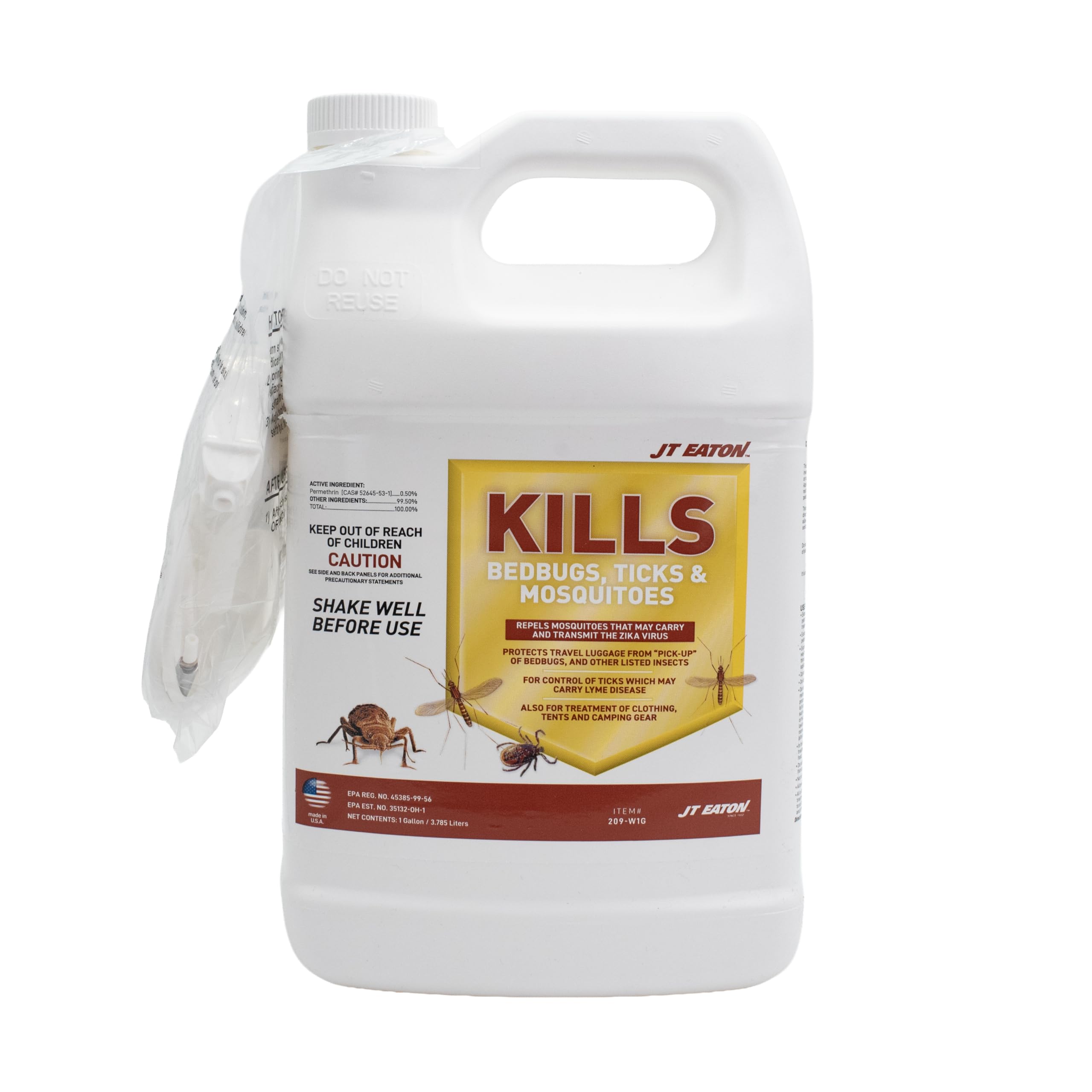
2. JT Eaton Bed Bug, Tick & Mosquito Killer Water-Based Spray, Gallon
The gallon that treats mattresses, camping gear, and hiking clothes with one bottle
If your infestation started after a trip or a camping weekend, this is the one to buy first. JT Eaton’s gallon treats three pests — bed bugs, ticks, and mosquitoes — and the water-based formula is designed for mattresses, tents, clothing, and camping gear, not just the floor. It comes with sprayer attachments, so you do not need to buy a separate pump. And because it is a 128-fluid-ounce gallon versus the 13-ounce Crossfire bottle above, it simply lasts longer on the shelf between treatments. The 7-pound jug is a serious piece of hardware to pick up, though, so if storage space is tight, the smaller Crossfire bottle will sit more easily in a cabinet.
The thing buyers rave about most is how many different pests it handles. Hunters treat their woods clothing with it and find ticks crawling onto them for 15 to 20 seconds before frantically trying to escape. Some buyers who spend all day in the field report that it has replaced their old tick spray entirely and works just as well. Pet owners use it on dog t-shirts and report it holds up for about six weeks between reapplications. Mattress and curtain treatments work too. And it is safe once dry, with no skin reactions compared to topical flea treatments — though one buyer mentioned the same non-selective formula that kills bed bugs also kills bees and pollinators, so avoid flowers and hives.
Two things to plan for. First, the odor. The water base has no pesticide smell at the start, but some users find a light chemical scent comes through as the bottle empties. Second, watch which pets are in the home: owners mention it is safe for dogs but should be kept away from cats. It also does not kill fleas, despite the name on the box. Those are real limits — but for treating clothing, gear, and a mattress in one pass, nothing in this list does more jobs at once.
Treats every pest in one bottle: Bed bugs, ticks, and mosquitoes are all listed on the label, so a single gallon handles both the bedroom and the camping gear.
Where the trade-off sits: the light chemical smell that appears near the end of the bottle is the honest gripe, plus the cat-safety limit noted by users.
Land on this one if: your infestation came home from a trip or a campsite, or you want a single bottle that doubles as a clothing and gear treatment.
Roll past it if: you have a cat in the house — customers note the formula is safe around dogs but not cats.
3. Harris 5 Minute Kill Time Bed Bug Killer Spray, Odorless and Non Staining Formula with Residual Protection (32oz)
Five minutes from spray to dead — the fastest kill time on this list
When you can see the bugs and you want them dead before you go to bed, the label number that matters here is the 5-minute kill time. It is the fastest figure on this list. Harris’s formula is EPA-registered for indoor use (Reg. No. 1021-2793-3) and kills at all life stages including eggs — which means the ones you do not see die too. That last part is why this is a mid-pack pick that beats a lot of pricier labels on paper. Up to 30 days of residual protection keeps working after the surface dries, so a bug that walks across your baseboard two weeks from now still drops. Mix that with the 32-fluid-ounce bottle and you have about one full bedroom’s worth of coverage — mattress, box spring, frame, baseboards — in a single session. The 2.2-pound aerosol is light enough to hold one-handed while you reach under a bed frame.
What made it popular is the combination of speed and quiet. The odorless formula is a big deal for anyone with kids or allergies in the house, and it is non-staining, so fabric and mattress covers come through clean. Reviewers point out it killed bugs that another brand missed, and one long writeup describes using it alongside diatomaceous earth for a two-step approach. The customer consensus is that the spray does what the label promises without leaving you worried about chemical fumes in the bedroom.
Where it gets tested is the front-end cost. There is also a known shipping risk — some buyers have received bottles that leaked through the plastic wrap in transit, though the spray inside was still usable. Packing a leaky product is annoying; the formula itself is very much not the problem. If you want the fastest single-room fix with no mixing, this is the one.
Why it works fast
- Kills bed bugs at every life stage, including eggs, within 5 minutes of contact
- Odorless and non-staining on mattresses, furniture, and fabrics
- Up to 30 days of residual protection after drying
- Light 2.2-pound aerosol, easy to aim under a frame
What to anticipate
- 32-ounce bottle covers about one room — large apartments will need more
- Some units arrive with a leak during shipping
- Front-end cost is higher than a gallon of JT Eaton
Choose this when: you want the fastest kill in the list, in one pre-mixed bottle, in a single bedroom with no mixing.
Look further when: you are treating a whole apartment — a concentrate gallon will stretch noticeably further for the same money.
4. Bedlam Plus Insecticide 17 oz – for Resistant Bed Bugs, Kills Bed Bugs Quickly, with USA Supply Protective Gloves | USA Supply Pest Identification Card

The aerosol pest-control pros buy for themselves — with gloves in the box
If you have already sprayed something and the bugs just kept walking, this is the one to try next. Bedlam Plus is formulated specifically for pyrethroid-resistant bed bugs, the ones that have survived older pesticides. It is sold in a 17-fluid-ounce aerosol with a slightly sweet scent and comes with USA Supply protective gloves and a pest identification card — so you are not guessing whether the bug on your pillowcase needs this product or something else. One buyer who works for a pest control company says they bought it themselves for their own apartment after developing an infestation, which tells you a lot about where this formula sits inside the industry. They also note the cost gap between this DIY route and a professional service is significant.
What earns the confidence of professionals is the product format as much as the chemical. Shoppers say it works well on spiders and ants too, which makes it a general-purpose aerosol rather than a one-trick bed bug product. One reviewer describes spraying suitcases after a trip and items that cannot go into hot water. Others confirm it as a fast elimination tool for a known bed bug problem. The can is one of the smaller sizes in this list at 17 fluid ounces, so expect roughly one bedroom’s worth of coverage per can — the Crossfire Aerosol below offers the same 17-ounce size, so choose between them on formula alone rather than on volume.
The one recurring snag is a missing component. Some buyers have received their order without the included protective gloves, which is annoying when you bought the bundle specifically for that item. The chemical itself is not the problem — it is the packaging inconsistency. If you need the gloves, spot-check the box when it arrives. And this is a concentrated aerosol for targeted spray, not a fogger, so plan to apply it to seams, cracks, and edges rather than misting the whole room.
The professional angle: it is built to kill bed bug strains that have already survived other pesticides, which is exactly the scenario most DIY buyers run into after a failed first attempt.
The one thing that can go wrong: the gloves have shipped missing on some orders, so verify the box contents on delivery if that is why you picked this bundle.
This is for you if: a store-brand spray already failed and you suspect the bugs in your home are resistant to standard treatments.
Consider the Crossfire Aerosol instead if: you want a larger residual control window after drying.
5. Crossfire Aerosol – Kills pyrethroid-Resistant Bed Bug strains at All Life Stages, Ideal Bed Bug Solution with USA Supply Gloves | USA Supply Pest Identification Card

The no-mix aerosol version of the Crossfire concentrate, aimed at seams and cracks
Crossfire makes two versions, and this is the one for tight spots. The 17-fluid-ounce aerosol can carries the same non-repellent, non-staining, kills-eggs formula as the 13-ounce concentrate at the top of this list — but it comes pre-loaded. It targets pyrethroid-resistant bed bugs at all life stages, and it is approved for direct application onto mattresses. It ships with a pair of USA Supply gloves and a pest identification card. If you have a known bed bug hotspot — a headboard seam, a baseboard crack, the piping on a couch — the straw-style nozzle gets the spray right into the gap, whereas the concentrate requires you to mix and then choose your sprayer separately. That convenience matters when you are doing two or three follow-up treatments over a month.
What stands out from the owner reports is the recovery time. Buyers describe stopping bites after a single treatment, finding dead bugs the next morning, and settling into a biweekly retreat schedule that keeps the room clear. One detailed account of a three-month battle describes going through diatomaceous earth, Cimexa, steaming, and Temprid with no success — then treating the entire house with the Crossfire aerosol, including baseboards, crown molding, couches, and beds, plus hot-washing the bedding. That buyer concluded that most of the earlier steps were a waste and now treats every two weeks. The can covers roughly one primary bedroom, so a whole-home treatment means buying more than one.
The real cost of this pick is the discipline it demands. Because the can is small, you have to be strategic — aim at the seams, the cracks, the mattress piping, and the corners where bugs cluster near the food source. Buyers who tried to spray the whole house with a single can run out before they have finished the job. There is also a mild smell reported by some users, so open a window and wear the included gloves and a mask. If you own a small number of rooms and want to hit specific spots, this is a smart aerosol add-on. If your entire apartment is infested, the concentrate is the better value.
Why buyers stick with this one
- Ready-to-spray aerosol — no dilution step, no separate sprayer
- Non-repellent and non-staining, approved for mattresses
- Kills adults, nymphs, and eggs
- Ships with USA Supply gloves
The honest limits
- 17-ounce can covers roughly one room
- Whole-home jobs need multiple cans, which adds up
- Some users notice a mild residual smell while spraying
Reach for this if: you already know where the bugs are hiding and want an aerosol that aims into cracks, seams, and mattress piping without any mixing.
Choose the Crossfire Concentrate instead if: you are treating a full apartment and want the stretch of a bottle that mixes up to a gallon.
6. Bedlam Bed Bugs Spray (2 Spray Cans)

Two cans of the same formula pest-control companies load into their own trucks
This is the multi-room version — two cans of Bedlam, the water-based aerosol pest-control companies actually use. It kills on contact and keeps working afterward on water-safe surfaces, so treated baseboards continue to stop bugs for days after you spray them. Two cans of 17 ounces each gives you 34 ounces total, which is more coverage in the box than single-can competitors at the same tier. What it treats is broad: bed bugs, adult lice and nymphs, ticks, fleas, and dust mites are all listed. The formula is non-irritating and can be used on bedding and fabric, and it will not stain water-safe surfaces — which matters when your bedroom is not your house and you cannot afford to ruin the furniture.
What buyers consistently describe is a residual game, not an instant-kill game. Bedlam spreads through contaminated bugs — a bug that walks across a treated surface carries the pesticide back to wherever the colony is hiding. That is why the recommended schedule is a reapplication roughly every three weeks, for three to five treatments total. One user laid out a five-stage approach — encasements, diatomaceous earth in the cracks, a 30-minute hot dryer cycle for bedding, leg coasters under the furniture, and Bedlam as the spray layer — and reported that the residual rather than the immediate knockdown did the real work. A separate writeup used Bedlam, Bedlam Plus, and diatomaceous earth together and reported seeing dying bugs and reapplying after 10 days.
The negative side of that residual design is that you will not see a dramatic pile of dead bugs an hour after spraying. Some buyers feel let down because the kill is slow, and the mixed user sentiment on value reflects that gap between expectation and reality. The other thing to expect is coverage math: one can does a queen mattress and box spring plus a bed frame, a dresser, a nightstand, and a small bedroom floor, so two cans comfortably covers a full bedroom or two smaller spaces. If you want to see bugs die on contact, pick the Harris 5-minute spray above instead.
Why two cans before one: the 2-pack gives you 34 total ounces of the same formula at a lower per-can price, and the residual design rewards treating the same room on a 3-week cadence — you don’t want to run out mid-cycle.
The bedtime reality: this is not a knock-down-and-watch spray. It works through contamination over weeks, so the visible kill is slow even when the treatment is working.
Worth picking up if: you are treating a full bedroom or two, can commit to reapplying every three weeks, and want the same formula the pros load into their trucks.
Walk past if: you need visible dead bugs on the mattress to feel confident the product is working.
7. Ortho Home Defense Max 3-Step Bed Bug Solution System, Bed Bug Treatment System, Includes Traps, Spray and Powder, Treat Rooms, Beds, Cracks and Crevices
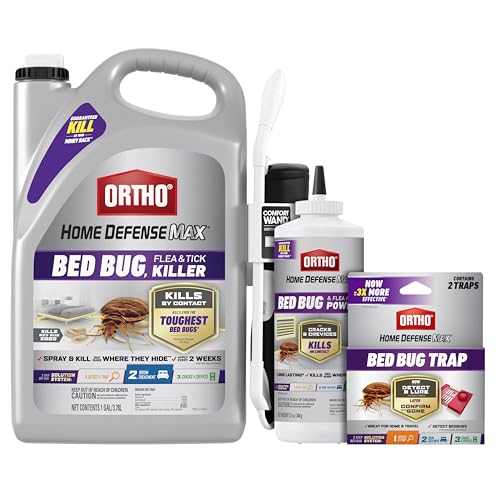
Traps to find them, spray to kill them, powder to finish the ones you can’t reach
The reason this one earns its slot has nothing to do with formula strength — it is the sequence. Ortho packages two bed bug traps, a one-gallon container of bed bug, flea and tick killer, and a 12-ounce container of bed bug and flea killer powder. Step 1 uses the traps to confirm you actually have bed bugs, or to confirm they are gone after treatment. Step 2 sprays surfaces where you can see the infestation — rooms, baseboards, bed frames, mattresses. Step 3 dusts the hollow places you cannot spray — the crack behind a wall outlet, the inside of a wood furniture joint. Powder gets into gaps that spray never reaches, and for bed bugs, those gaps are where the problem lives.
What surprises buyers is how far a single kit stretches. One person reported covering two bedrooms, a living room, a bathroom, a hallway, all the baseboards, two large dressers inside and out, an entire mattress, a bed frame, and a loveseat with the kit. That is a whole small apartment’s worth of treatment surfaces. Others compare the result favorably to a professional service — one buyer’s friend who works for a pest control company says this is the closest thing you can buy without hiring anyone.
The trade-off with any all-in-one kit is that each component is smaller than a dedicated purchase. The gallon of spray is smaller than the 128-fluid-ounce JT Eaton gallon above, and the powder is a 12-ounce container. If your infestation is confined to one room, the kit is a great single-stop option. If it has spread through a house, you will be buying refills of the spray and the powder before the job is done, and each component on its own costs more than buying in bulk. Plan the surface count before you start.
What the 3-step approach gets right
- Traps confirm the infestation before you spend money on treatment
- Spray covers visible surfaces; powder reaches the hollow crevices
- The kit has treated a whole small apartment in one order
- Nozzle is designed to aim into tight gaps
Where it falls short of bulk buying
- Each component is smaller than the dedicated size — refills come sooner
- Cadence matters: several sprays per week for a while, not a single pass
- For a whole house you will likely buy more of the gallon and additional powder
The right pick when: you are not sure you have bed bugs yet, or you want traps, spray, and powder in one order without shopping around.
Look elsewhere if: your house is fully infested — you will burn through the smaller components fast and spend more on refills.
8. Harris Toughest Bed Bug Killer, Liquid Spray with Odorless and Non-Staining Extended Residual Kill Formula (Gallon)

A gallon designed to keep killing bed bugs for up to 16 weeks after it dries
The headline here is the residual window — up to 16 weeks of continued control after application, the longest stretch on this list by a wide margin. Up to 16 weeks is four months of protection from a single treatment pass. That is the reason to buy this gallon rather than one of the shorter-residual aerosols above: if your problem is recurring — a shared-wall apartment, a room you rent out — this is the one that keeps working between tenants. Harris is America’s oldest EPA-registered pest brand, on the label since 1922, and the gallon format covers baseboards, cracks, and crevices throughout a home. The formula includes deltamethrin or a pyrethroid-based active ingredient and is EPA-registered for indoor use under Reg. No. 1021-2597-3. It kills bed bugs, eggs, and the pyrethroid-resistant strains that survive the older-generation sprays.
What owners write about most is how immediately it goes to work — kill-on-contact behavior and burst eggs are the phrases that show up again and again in the writeups. There are also buyers who combine it with an encasement, a dust, and a dryer cycle and report being bite-free after a single pass. No single spray ends an infestation. Multiple applications, consistency, and coverage of every baseboard and seam in the room will do more work than any one bottle of anything.
The recurring complaint is the sprayer itself. The 16-ounce spray head has a reputation among buyers for being awkward — one buyer described a handle that was defective from the start, leaked, and often refused to spray. Others note the formula is powerful enough that it is hard to breathe during application, so plan for ventilation and a mask. A few buyers report it needs three to four applications before the room is fully clear. If you already own a pump sprayer, the refill cost on this gallon is the better option; if you need everything in the box, expect to spend some time with the sprayer design.
The strongest case for the gallon
- Up to 16 weeks of residual protection — four months between treatments
- Kills adults, eggs, and pyrethroid-resistant strains
- EPA registered for indoor use, Reg. No. 1021-2597-3
- 128-fluid-ounce gallon treats whole-home baseboards, cracks, and crevices
The parts to plan around
- The included sprayer handle is prone to leaks and clogs
- Must be applied with a mask and ventilation
- Some users need three to four applications before the room clears
The pick for: shared-wall apartments, rental units, or anyone who wants the longest possible protection window between treatments.
Know before you buy: the built-in sprayer is the recurring weak point — if you already own a pump sprayer, use that instead and treat the gallon as a refill.
9. EcoVenger (Formerly EcoRaider) Bed Bug Killer with Remote Sprayer 1Gal – Kills 100% All Stages on Contact- Kills Resistant Bugs- Kills Eggs- 14 Day Residual Protection- Non-toxic- Child & Pet Friendly
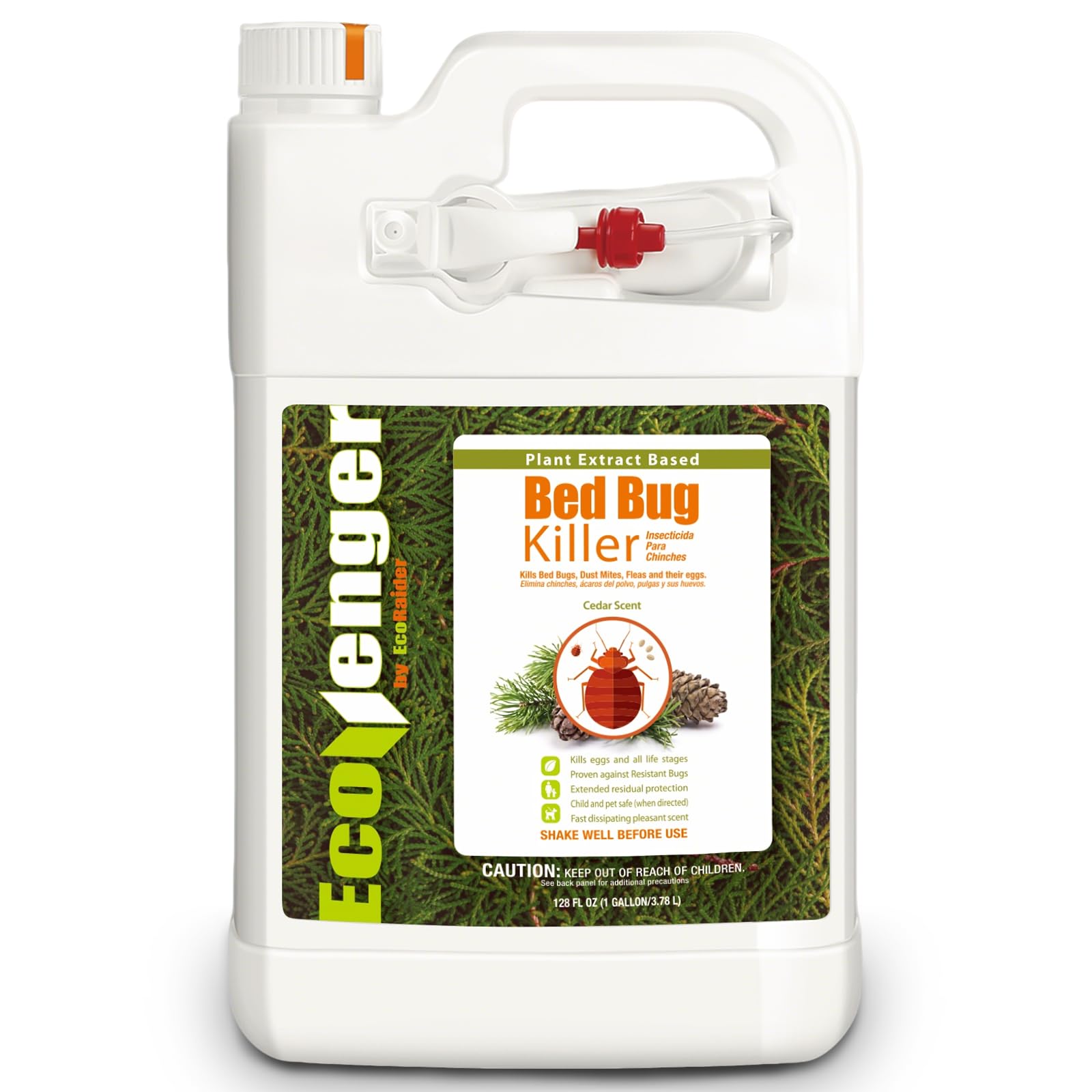
A botanical formula for the homes where you cannot risk residue on the mattress
When you have young children or pets and you need to spray the mattress directly, this is the safest option on the list. EcoVenger’s formula is botanical — geraniol, cedarwood oil, sodium lauryl sulfate, glyceryl dicaprylate, silica hydrate, glyceryl monooleate, and water. It is certified USDA BioBased and labelled dermatologically safe for kids and pets. It kills adults and nymphs on contact, is proven against pyrethroid-resistant bed bugs, and destroys bed bug eggs. It also comes with a remote sprayer attachment so you can treat the underside of a mattress without crouching. A published university study ranked it the #1 natural product against bed bugs among 12 tested, and its residual keeps killing for two weeks after it dries.
What makes this product the right pick for sensitive households is not just the ingredient list — it is what the users did with it. Owners spray it directly onto the mattress, a pillow topper, a box spring, and even inside wall outlets without any reported harm to their cats. Buyers who had a professional pest control service fail after three sprays report eliminating bed bugs with this product by spraying their room and house twice weekly for four weeks. Another buyer resolved months of issues within two weeks. It kills more slowly than the synthetic residuals above — closer to a two-week session than a one-hour knockdown — but you can spray it where kids sleep.
The one real gap is with the sprayer accessory. EcoVenger ships with a remote sprayer, but reports of it arriving without that sprayer are common — one buyer described five separate attempts, even a drop-ship direct from the manufacturer, and still receiving the gallon without the sprayer. The product itself works; the packaging problem is separate and worth checking on arrival. Some buyers also find the botanical scent pleasant while others find it strong, so plan a well-ventilated room and one day’s dry time before sleeping in the treated space. It is not the fastest or cheapest option here, but it is the one to pick when the priority is safe for family rather than fastest kill.
Built for sensitive homes: a certified USDA BioBased formula ranked the top natural option among 12 tested in a university study, with a botanical blend of geraniol and cedarwood oil.
The bundle catch: the remote sprayer attachment is the recurring missing item, so verify the box before you plan your first treatment around it.
This is your pick if: kids or pets share the room and you want to spray the mattress directly without a synthetic pesticide residue on the surface they sleep on.
Better alternative if: you want the fastest single-room knockdown — the Harris 5-minute spray will kill visibly faster.
Understanding the Specs
Concentrate vs. ready-to-spray
A concentrate is a small bottle of highly concentrated liquid that you mix with water before spraying — usually a full bottle per gallon of water. It costs less per treated square foot because you are paying for the chemical, not the water or the bottle. A ready-to-spray aerosol or bottle is pre-mixed: you open it and spray. The trade-off is convenience versus coverage. Crossfire Concentrate’s 13-ounce bottle mixes up to a gallon, while Harris’s 32-ounce ready-to-spray bottle is a single-room tool. Neither is better — the concentrate is cheaper for multiple rooms, and the pre-mixed aerosol is easier for one small bedroom treated on a weekend.
Residual protection and reapplication windows
Residual protection means the pesticide keeps killing bugs after it has dried onto the surface. It lasts different lengths depending on the formula: Harris Toughest advertises up to 16 weeks, Harris 5-Minute advertises up to 30 days, and EcoVenger’s botanical formula provides two weeks of dry residual. Bed bug eggs hatch on a schedule, so a residual that outlasts the hatch cycle will catch the new generation as it walks onto the treated surface. That is why the residual number matters more than the immediate knockdown number — a fast kill that stops working next week will be followed by fresh bites, while a slower formula with a long residual often ends the whole cycle in fewer treatments.
FAQ
How do I know if I actually have bed bugs or something else?
Can I spray the mattress directly with these products?
How long does a treatment keep working after it dries?
Why do bed bugs survive some sprays but not others?
How many treatments will I actually need before the bugs are gone?
Do I need to treat the whole house or just the bedroom where I saw them?
Are these treatments safe around pets and kids?
What is the difference between a pyrethroid and a botanical formula?
Can I keep sleeping in the treated room?
Will these products stain my mattress, curtains, or bedding?
Final Thoughts: The Verdict
For most people, the bed bug treatment products winner is the Crossfire Liquid Concentrate because the 13-fluid-ounce bottle mixes up to a full gallon, is approved for direct application onto mattresses, and is formulated to kill the pyrethroid-resistant strains that survive most over-the-counter sprays — which is exactly the problem most people run into after a failed first attempt. It is the bottle that a pest-control tech would buy for their own apartment, and the buyer reviews back that up.
If your infestation is small and you want a dead bug in five minutes, grab the Harris 5-Minute Spray — no mixing, no waiting, no lingering smell. And for the homes with young kids or pets where the mattress has to be sprayed directly, the EcoVenger Gallon is the one to reach for — a botanical formula with a two-week dry residual is the closest thing to a safe-for-family option in this lineup, and the one bottle that can be sprayed on a bed without a second thought.
One last nudge from a real-world buyer’s perspective: treat more than you think you need to. The team that finishes a bed bug job is almost never the one-bottle, one-room solution — it is the household that sprays every baseboard, washes every piece of bedding on high heat, retreated on schedule, and left the room empty until the surface dried. Whatever you buy from this list, that routine is what makes it work.
How We Picked
We do not accept paid placement. Every pick is matched to a real buyer and a real use-case; we do not hands-on test units.
Sources & Methodology
Specifications: manufacturer listings and product documentation. Review insights: verified customer reviews, as of September 2026. Pricing: not shown on this page (it changes often); check the current price via the retailer link.
As an Amazon Associate, KitchPrep earns from qualifying purchases. This does not affect which products we feature.
Related Guides
