
Specs are compiled from manufacturer listings and verified buyer reviews and can change over time — please confirm the key details on the product page before buying.
You want to hang a shelf, mount a TV, or set a grab bar, and one wrong hole means patching drywall or hitting a live wire. The fix is simpler than most people expect: pick the scanner that matches your wall, not the one with the longest feature list. A magnetic finder that snaps onto the screws already in your studs is unbeatable on standard drywall, while a multi-sensor electronic scanner earns its keep on tile, plaster, and double-layer walls. That single distinction decides which tool you should actually buy.
I’m Mohammad Maruf — the founder and writer behind KitchPrep. This guide is built by comparing the manufacturers’ published specifications and the patterns across verified customer reviews, so you get each pick’s real strengths and trade-offs instead of marketing spin.
Every pick below is a real wall stud detector, sorted by what it genuinely does best, from a pocket magnet that never needs batteries to a deep-scan unit that reads through porcelain tile. What separates a great nail and stud locator from a frustrating one depends on three things: how many sensors it has, how deep it can scan, and whether it warns you about live wiring before the drill bit goes in.
Our Picks at a Glance

How To Choose The Best Beam Finder Tool
Two tools get called the same name, and they do opposite jobs. A magnetic finder holds itself onto the screws buried in a stud, so you feel exactly where the framing runs. An electronic scanner sends a signal into the wall and paints the stud across a display. Buy the wrong type for your wall and you will fight it all afternoon.
Magnetic or electronic, pick by wall type
On plain drywall over wood studs, a magnetic finder is nearly impossible to beat. It never needs a battery, it never needs calibrating, and it cannot drift out of tune. It works by grabbing the drywall screws that hold the sheet to the framing. The catch: it only sees metal, so it cannot tell you anything about wiring or pipes.
Electronic scanners shine when the wall hides its structure. Tile, plaster, and layers of drywall over a gap are where a sensor array earns its price. These units send a signal through the surface and light up the stud width on a display. The trade-off is battery dependency and the need to calibrate against a clean patch of wall first.
Scan depth and what it buys you
Depth is measured in inches, and it means how far the signal reaches before it fades. A basic scan reads a standard wall. A deep scan mode reaches further, which matters when you are over tile, a double layer of drywall, or a surface covering that eats the signal. Match the depth to your worst wall, not your easiest one.
Live-wire warning: the safety feature to check first
An electrical warning light tells you when a hot wire is running behind the surface before you drill. Most electronic units carry it and it stays active while you scan. Magnetic finders do not have it, since they only track metal screws. If you plan to mount anything near switches, outlets, or a kitchen wall, that alert earns its place.
Quick Comparison
| Model | Best For | Detection Type | Max Scan Depth | Power Source | Amazon |
|---|---|---|---|---|---|
| Franklin Sensors ProSensor 710+★ Best Overall | All-round accuracy | 13-sensor electronic | Up to 1.6 in | Battery (2 AA) | Amazon |
| SUNTUTUFY 5-in-1 Wall Scanner (Carrot)Budget Champion | Budget starter scanner | Smart sensor electronic | Wire warning up to 2 in | Battery powered | Amazon |
| CH Hanson 03040 Magnetic (2-Pack)Pocket Favorite | Battery-free pocket carry | Magnetic | Metal fasteners only | Hand powered | Amazon |
| Klein Tools MSF1002 Magnetic (2-Pack) | Compact level + magnet | Magnetic + bubble vial | Metal fasteners only | Manual | Amazon |
| USTUDCHY 5-in-1 Wall Scanner | Five-mode flexibility | Smart chip electronic | AC scan up to 2 in | Battery powered | Amazon |
| FNIRSI WD-01 | Rechargeable versatility | 6-in-1 electronic | Ferrous metal up to 4.7 in | Rechargeable lithium | Amazon |
| Zircon StudSensor A100 | Everyday stud edges | Two-mode electronic | DeepScan up to 1 1/2 in | Battery (9V alkaline) | Amazon |
| Zircon MultiScanner A200 | Stud plus metal detection | Three-mode electronic | DeepScan up to 1 1/2 in | Battery (9V alkaline) | Amazon |
| Franklin Sensors ProSensor MAX | Deep scan through tile | 13-sensor electronic | Up to 2.5 in | Battery powered | Amazon |
In‑Depth Reviews
1. Franklin Sensors ProSensor 710+ Stud Finder, 13-Sensor Wall Scanner
Our pick — over 4.5★ from 10,500+ verified ratings; the strongest balance of quality and price.
Thirteen sensors, one button, and a row of lights that draws the stud for you.
The Franklin ProSensor 710+ runs on a simple idea: more sensors means fewer guesses. Where common electronic finders pack one or two sensors, this one carries 13. That wide array is why it can show you the full width of a stud instead of just its edge, and why the middle light flashes green when you are sitting dead center over the framing. You press and hold one button to scan, and the unit needs no calibration at all. That matters because the usual cause of a bad electronic reading is starting the scan over a stud or forgetting to recalibrate on a clean patch.
Depth reaches up to 1.6 in, so it handles standard drywall and wood or metal studs alike. There is a built-in bubble level for keeping your marks level and an integrated ruler for spacing. Professional and DIY buyers alike lean on it — A contractor working behind a fiberglass shower surround reported six of seven drill attempts hit stud.. The limitation to know up front: it finds framing, not hazards, so it will not flag wiring or pipes the way a wire-warning scanner does.
Weighing 6.4 ounces and needing two AA batteries, it is a handheld tool you can work overhead without tiring. It is not compatible with rechargeable batteries, so keep alkalines on hand. On the recurring gripe: some owners feel it asks a lot for what a cheaper unit might do. The honest read is that the 13-sensor array is the reason the readings hold up where cheap models scatter.
Where it earns its keep
- 13 sensors show full stud width, not just one edge
- No calibration step — press and hold from anywhere
- Deep scan to 1.6 in for wood and metal studs
- Built-in bubble level and integrated ruler for straight marks
What to keep in mind
- No wiring or pipe detection
- Requires batteries, and rechargeables are not compatible
- Some buyers find the cost hard to justify
Made for: anyone who wants one tool that reads cleanly on standard drywall and thick walls without fiddling.
Look elsewhere if: you need live-wire alerts, since this finds framing only.
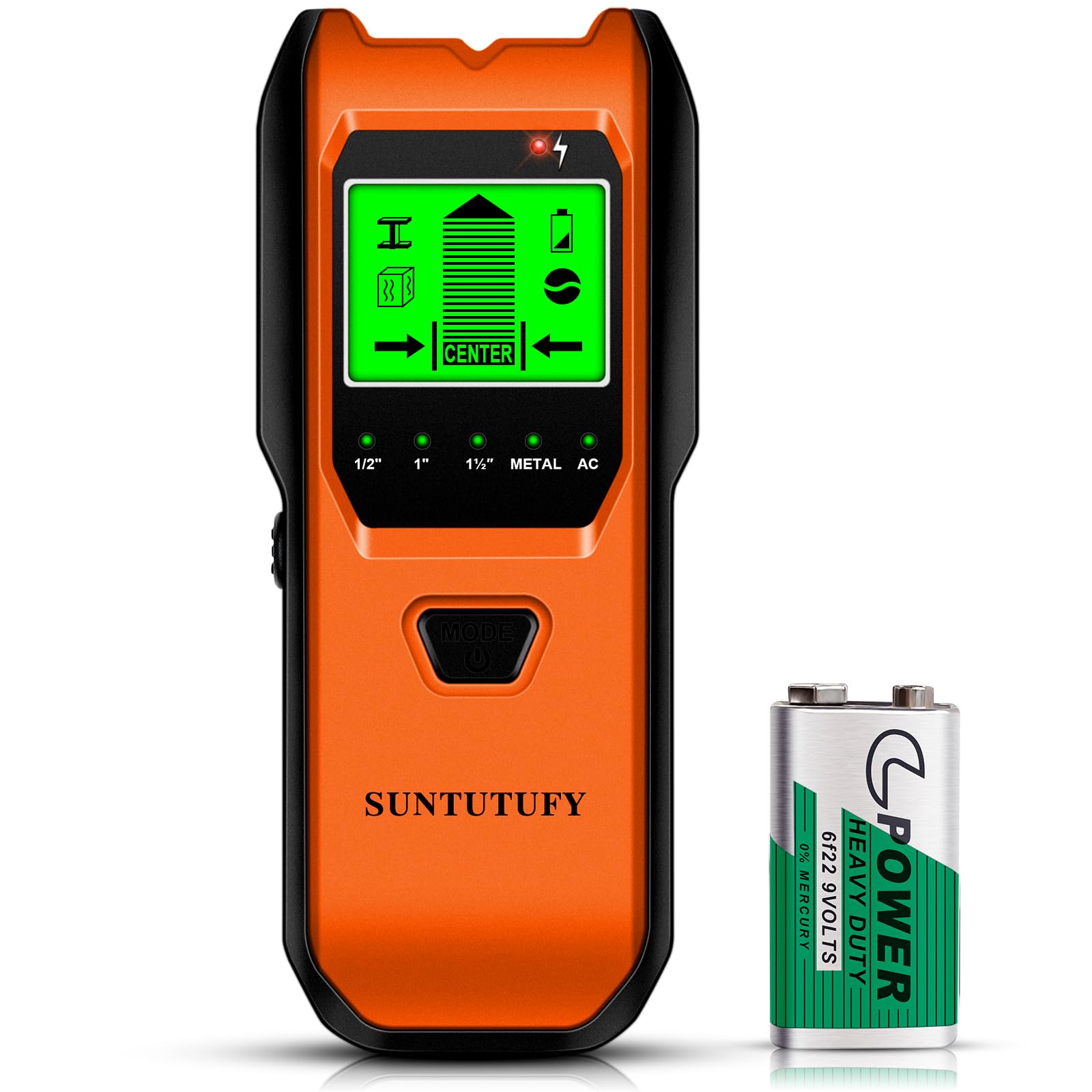
2. Stud Finder Wall Scanner – 5 in 1 Electronic Stud Detector (Carrot)
A backlit screen and a wire alarm for buyers who want electronic scanning without the premium tag.
This entry-level scanner takes the electronic route and does it on a small budget. It uses upgraded sensor chips to read studs, metal, pipes, and live AC wires through walls, floors, and ceilings. Automatic calibration runs before you start, which cuts down on the false readings that trip up cheaper units. A backlit LCD shows the target location even in a dim basement or closet, and a beep sounds as you close in on an edge or center.
The wire warning is the feature to note here. It stays active while you scan in Stud Scan and Metal Scan modes and reaches up to 2 in deep, so you get a warning before a bit meets a live line. Owners mounting shelves and TVs report it reads both stud sides and center cleanly and holds up on fresh construction. One buyer hanging a TV through 3/4 in Sheetrock said it found the studs perfectly and the batteries have not needed a change since.
At 9.5 ounces it is roughly five times the weight of the CH Hanson magnetic set further down, so it is a tool you hold rather than carry in a pocket. There is a split of opinion on how reliable every single stud reading is, which is worth knowing if you mount heavy items.
Buyers report: the rear sensor reads both edges and the center of most studs, and the wire alert is the reassurance buyers mention most often.
Honest caveat: stud ID draws mixed views, so double-check before drilling anything heavy.
Right for you if: you want electronic detection and live-wire cover on a tight budget.
Think twice if: you weigh your tools by the ounce for pocket carry.
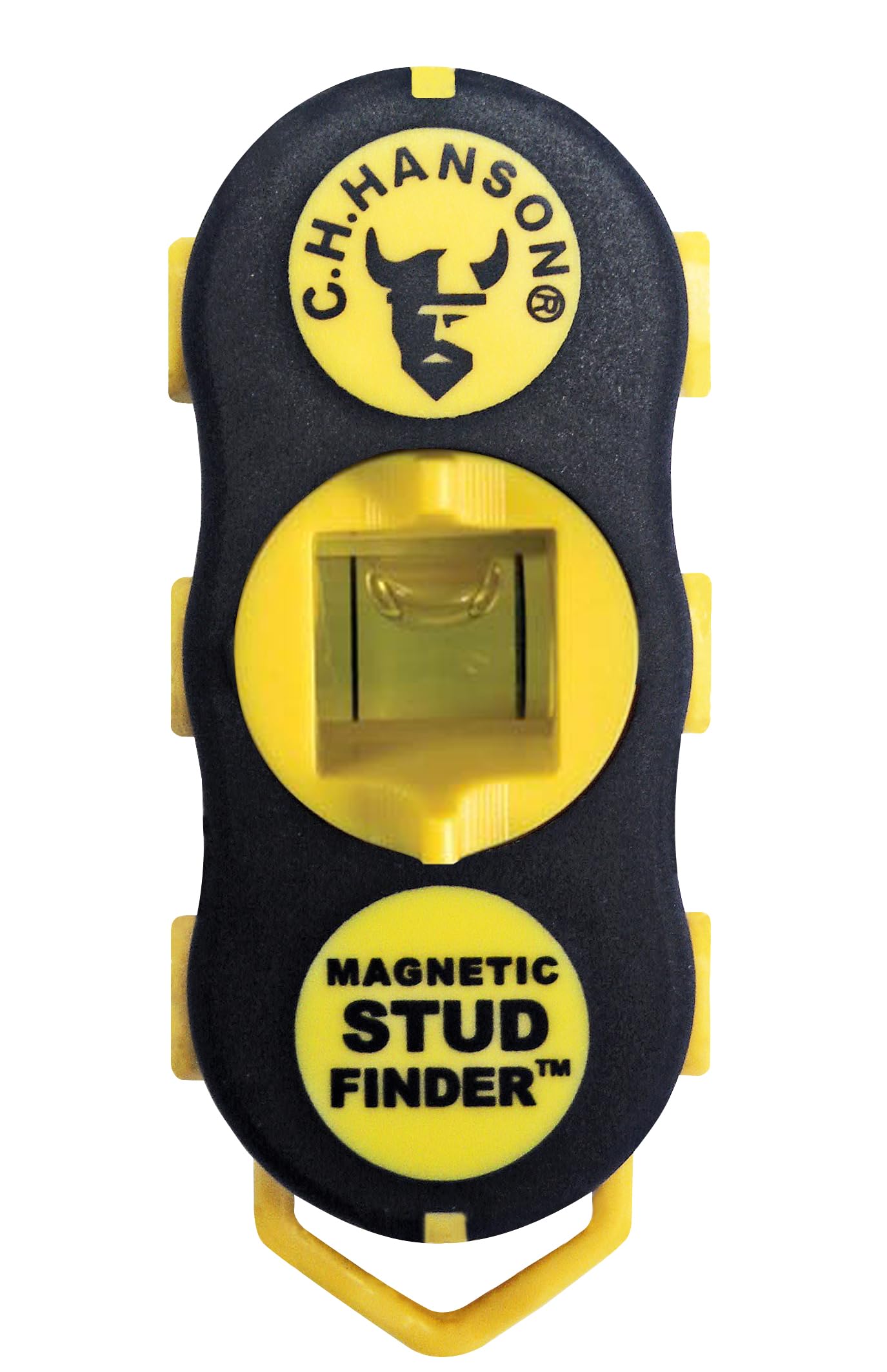
3. CH Hanson 03040 Magnetic Stud Finder Pack of 2
It clings to the screws already hiding inside your walls, so the stud finds you.
If your walls are drywall over wood, this hand-powered magnet removes every source of electronic error at once. There is no chip, no calibration, no dead battery mid-job. You slide it across the wall and it stays put the instant it grabs a drywall screw, which tells you exactly where the framing runs. The pack of two means one can live in a pocket while the other stays in the toolbox, which is a favorite move on job sites where crews want a quick read on any wall.
The magic here is the magnet strength. Owners mention it grabs drywall screws firmly and picks up the nails holding lath to studs through plaster, where electronic finders struggle. One reviewer noted it retired every battery-powered finder in the house. On drywall it works better than on most other surfaces, and there is a bubble level to help keep your marks square.
What it cannot do is see depth or hazard. It reads metal fasteners only, so it will not tell you about a pipe or a live wire, and it will not find a stud that has no metal screw near the surface. That is the fit question, not a flaw: on lath-and-plaster walls (thin wood strips over plaster, where no screws sit near the surface), an electronic scanner will out-read it. For standard drywall, though, it is the fastest tool in this guide.
Best for: drywall-over-wood homes and anyone who never wants to change a battery.
Not the tool for: tile, plaster, or any wall where you need pipe and wire clues.
4. Klein Tools MSF1002 Magnetic Stud Finder and Level, 2-Pack
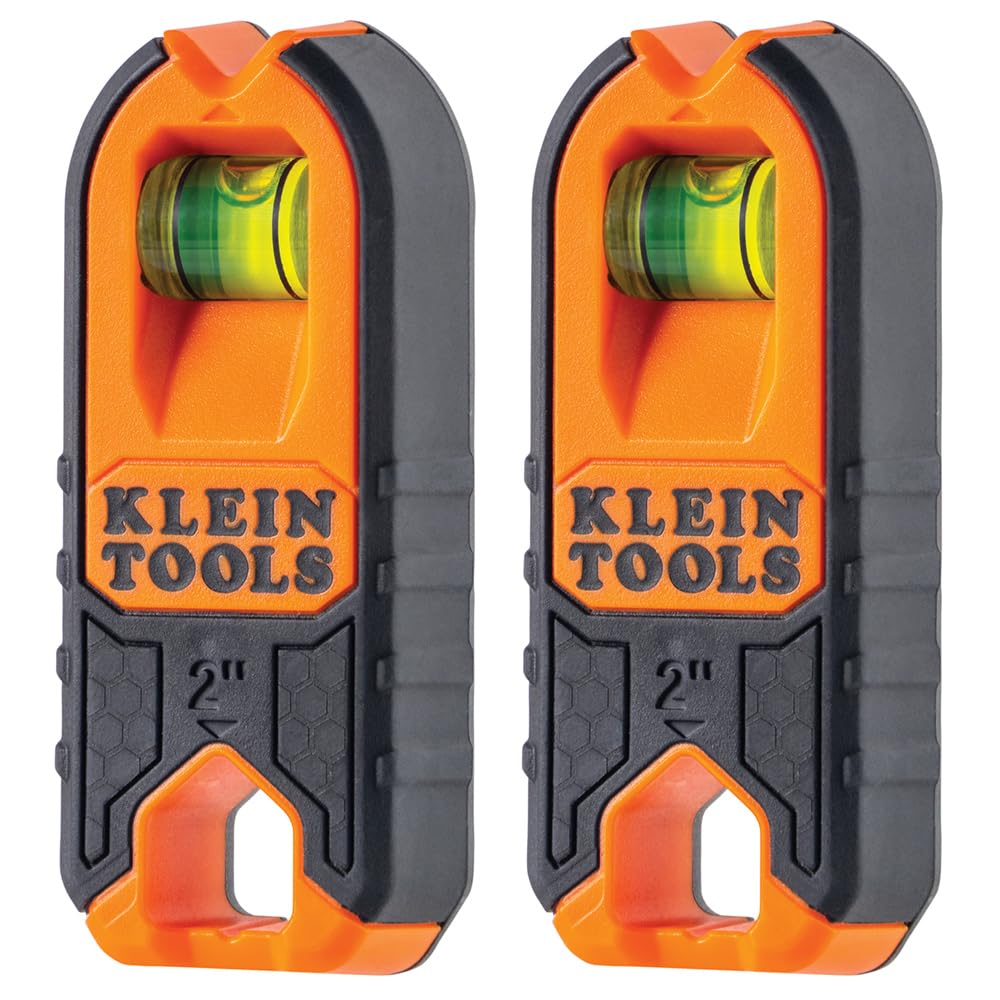
A rare-earth magnet small enough to sit on the wall while you mark the spot.
Klein Tools takes the magnetic concept and adds two niceties that matter in the field: a rare-earth magnet (a strong permanent magnet) for a firm grab, and a protective felt pad on the back so the tool does not scuff your drywall or plaster as you slide it. The center notch and bottom opening let you pencil straight through the finder onto the exact fastener spot. Two in the pack means you can leave one on a stud as a reference point while you work around it.
The bubble vial is the small feature that earns its place. Owners describe lining it up to point straight up and following the vial to track the stud’s vertical run, which turns a single point into a full line. The compact build is a talking point too. At 1.12 ounces it sits in a pocket or apron without any weight to it, and it never needs a battery because it is manually operated.
The same magnetic limit applies: it catches the N52 magnet against metal fasteners, so it detects metal studs and the screws in wooden studs, but it will not read pipes or wiring. It works on drywall and was described as untested on plaster, so plaster walls are a question mark. For a small, battery-free finder that stays put and includes a level, it punches above its tiny size.
The small features add up: felt backing protects the paint, and the center notch lines your mark up with the fastener for a straight drill.
Pick this if: you want a featherweight magnetic finder with a level and paint-safe backing.
Pass if: you need wiring or pipe alerts, or you are working lath-and-plaster.
5. USTUDCHY 5 in 1 Electronic Stud Finder Wall Scanner (Peacock Blue)

Five scan modes and an anti-slip handle for buyers who work across several wall types.
The USTUDCHY scanner spreads its bets across five modes. There are three stud-scan depths — 0.5, 1, and 1.5 in — so you match the mode to the wall thickness rather than forcing one setting on everything. A Metal Scan mode shows whether wood or metal sits behind the surface, and it can locate wood by catching the nails holding it. An AC scan reads unshielded 80 to 240 voltage lines. The large backlit LCD shows a signal bar that tracks the distance and direction as you approach a target, with a beep landing the exact spot.
The wire safety angle is the practical win. The warning indicator stays on through StudScan, DeepScan, and MetalScan modes and reaches up to 2 in, so you get a heads-up before drilling into a live line.
The ergonomic anti-slip handle gives you a firm grip while you scan overhead. The honest hitch: a few buyers found the manual’s wording fumbles the word calibrate when it means operate, so plan on following the picture guide instead. On textured walls it can throw the occasional false reading. For the range of modes you get at this tier, it covers more ground than the single-purpose magnetic finders above.
Value read: five modes plus a backlit screen and wire warning make it a do-everything starter for a new homeowner.
One wrinkle: the instructions use calibrate loosely, and textured surfaces can read slightly off.
Suits: DIYers who want depth selection and metal detection in one affordable unit.
skip it if: you want a one-button tool with zero setup reading required.
6. FNIRSI WD-01 6 in 1 Rechargeable Stud Finder Wall Scanner

Six scan modes, a built-in positioning hole, and no more hunting for spare batteries.
The FNIRSI WD-01 is the one pick here that runs on a rechargeable lithium battery instead of disposables, which removes one recurring annoyance from every job. Its six detection modes cover the widest list in this round-up. Exact scan mode finds wood and metal stud centers up to 0.75 in deep, while Depth scan mode reaches 1.5 in. Non-ferrous metal scan picks up copper to 3.9 in, ferrous metal scan finds iron to 4.7 in, AC scan reads live unshielded wires to 2 in, and a copper wire scan reaches 1.6 in. That ferrous 4.7 in figure is the deepest metal reach in this article.
The newly designed positioning hole is the feature worth noting. Once the tool locates an edge or center, the hole gives you a spot to mark without bridging or hesitation, which speeds up hanging and mounting. A digital LCD pairs with an audio alarm to pinpoint the target, and the auto-calibration works anywhere on the wall to find stud centers in a single step. On drywall over plasterboard it marks the start and end of studs cleanly, and the live-wire alert fires fast.
Now the trade-off a buyer should weigh honestly. This is the one pick where reliability draws open disagreement across the whole rating pool — it reads well for many, and a minority find it inconsistent, especially on plaster-and-lath walls, where the edge finder struggles and live-wire alert can be over-sensitive. If your walls are plain drywall, it does the job. If they are lath and plaster, this is the wrong tool for the reading you need.
What stands out
- Rechargeable lithium battery, no disposable swaps
- Six modes including ferrous metal to 4.7 in and AC wire to 2 in
- Positioning hole for fast, accurate marking
- Auto-calibration in one step anywhere on the wall
Where it wobbles
- Reliability draws mixed feedback across reviews
- Edge finding and wire alert struggle on plaster-and-lath walls
- Not the tool for the most demanding wall types
For drywall jobs: it delivers six modes and rechargeable convenience in one unit.
Skip if: your home is lath and plaster, where the readings turn inconsistent.
7. Zircon® StudSensor™ A100 Stud Finder w/Live Wire Detection
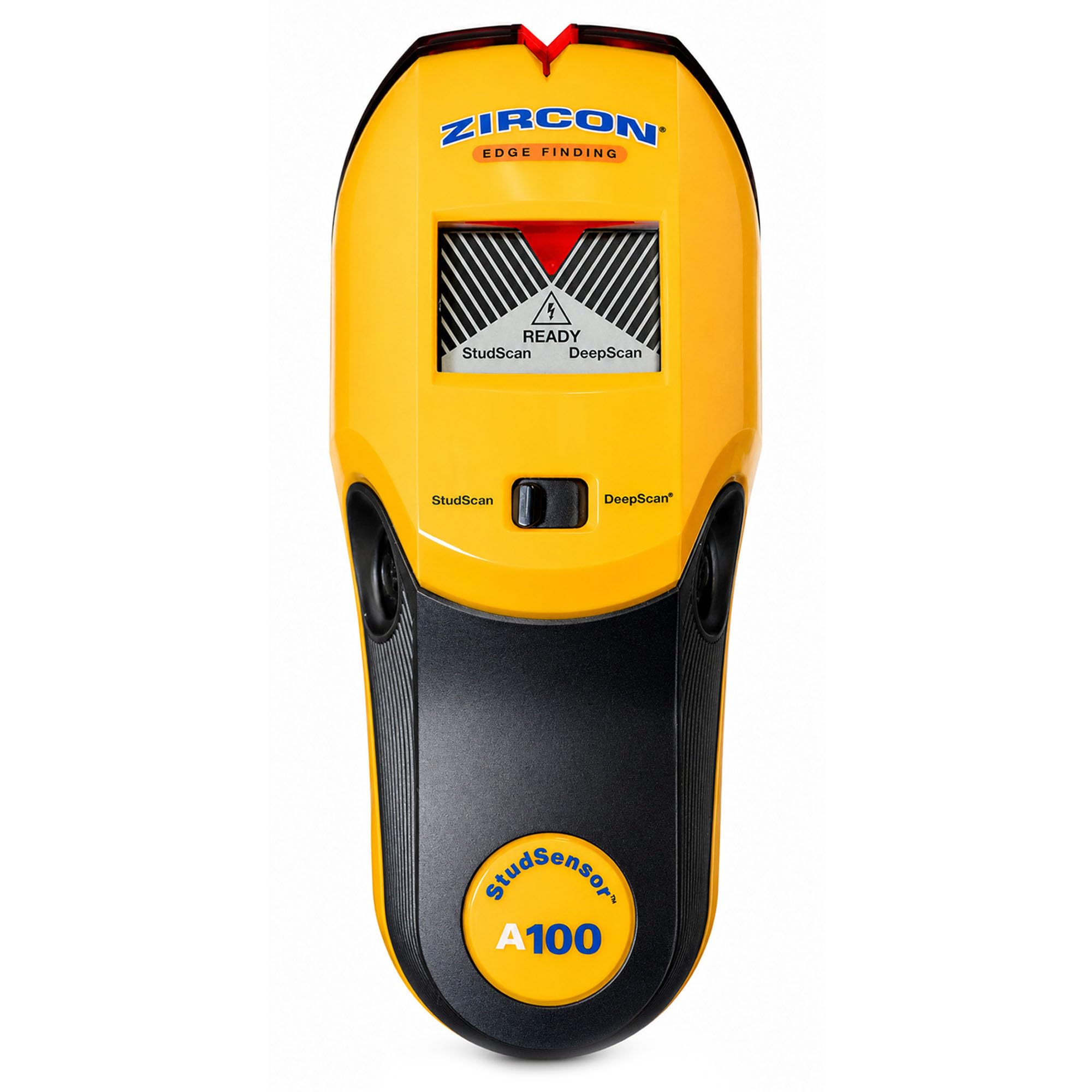
Two modes, a pointer light, and a wire alert for straightforward wall reads.
Zircon built its name on the electronic stud sensor, and the A100 keeps the formula lean. It runs on just two scanning modes. StudScan finds stud edges up to 3/4 in deep for standard walls, while DeepScan reaches up to 1 1/2 in for thicker surfaces. A SpotLite Pointer shines a light onto the exact spot while a V marker groove guides your pencil line, so you mark the edge cleanly on the first pass. Calibration is quick: press and hold the power button flat against the wall, wait for the short beep, then slide slowly.
Wire warning runs continuously during scanning and reaches up to 2 in, alerting you to hot, unshielded wiring before you drill. That is the safety feature most buyers want on this type of tool, and it stays on while you scan for studs and metal. Owners describe it as comfortable to hold and easy to use, and One buyer mentioned it read through a layer of bathroom tile.. A low-battery indicator tells you when power is too weak for a reliable scan so you can swap in a 9V alkaline before readings drift.
The honest side: this is a value-priced tool and, on very specific walls, it can be finicky. One owner found it misread on mobile home walls but read fine on a standard home, a reminder that unusual wall construction is the fit question, not a knock on the tool. For ordinary drywall in a normal house, it does the everyday job reliably.
Where it lands: a simple two-mode scanner for standard drywall jobs, with wire warning as the headline safety feature.
Note: mobile home and unusual wall builds can trip it up, so test on a scrap patch first.
Good match for: standard homes and buyers who want a recognizable brand at an accessible tier.
Reconsider if: you live in a mobile home or a build with unusual stud spacing.
8. Zircon® MultiScanner™ A200 Stud Finder with Metal & Live Wire Detection

A three-mode scanner that reads stud centers, metal, and wire in one pass.
The MultiScanner A200 steps up from the A100 with a third mode and center-finding. StudScan reads wood or metal stud edges and centers up to 3/4 in deep, DeepScan reaches up to 1 1/2 in for thicker walls, and Metal Scan locates metal behind the surface before you drill. The LCD, audio tone, and SpotLite Pointer combine to make marking easy, and center detection is what buyers who need to align a mount care about most. It also carries an IP54 rating, meaning it is sealed against dust and splashes rather than rated for submersion.
Build quality is the strongest part of its story, and it shows in use. Customers note solid construction, a clear display, and intuitive controls, with edge detection described as consistent during renovation work. One owner noted it caught two studs just an inch apart, a tight read cheaper finders struggle to separate. Deep scan mode handles thick or multi-layer drywall, and it runs on a 9V alkaline battery with a low-battery indicator so you know when to swap it.
Two things to plan around. Accuracy and value draw mixed views, so treat repeated passes as part of the routine rather than a fault on the first try. A few note occasional false readings that clear with another sweep, and it wants a strong battery to scan at its best. If you want a stud finder that also identifies metal pipes in the same pass, it earns its place among the more capable tools here.
What wins people over: the build quality and clear display, backed by metal scan and wire warning working together in one pass.
Plan for: an occasional false reading that clears on a second pass, and a fresh 9V battery.
Choose it for: renovation work where you want center detection plus metal pipe and wire checks.
Look past it if: you want calibration-free scanning with no repeated passes.
9. Franklin Sensors ProSensor MAX 13-Sensor Stud Finder, 2.5-in Deep Detection
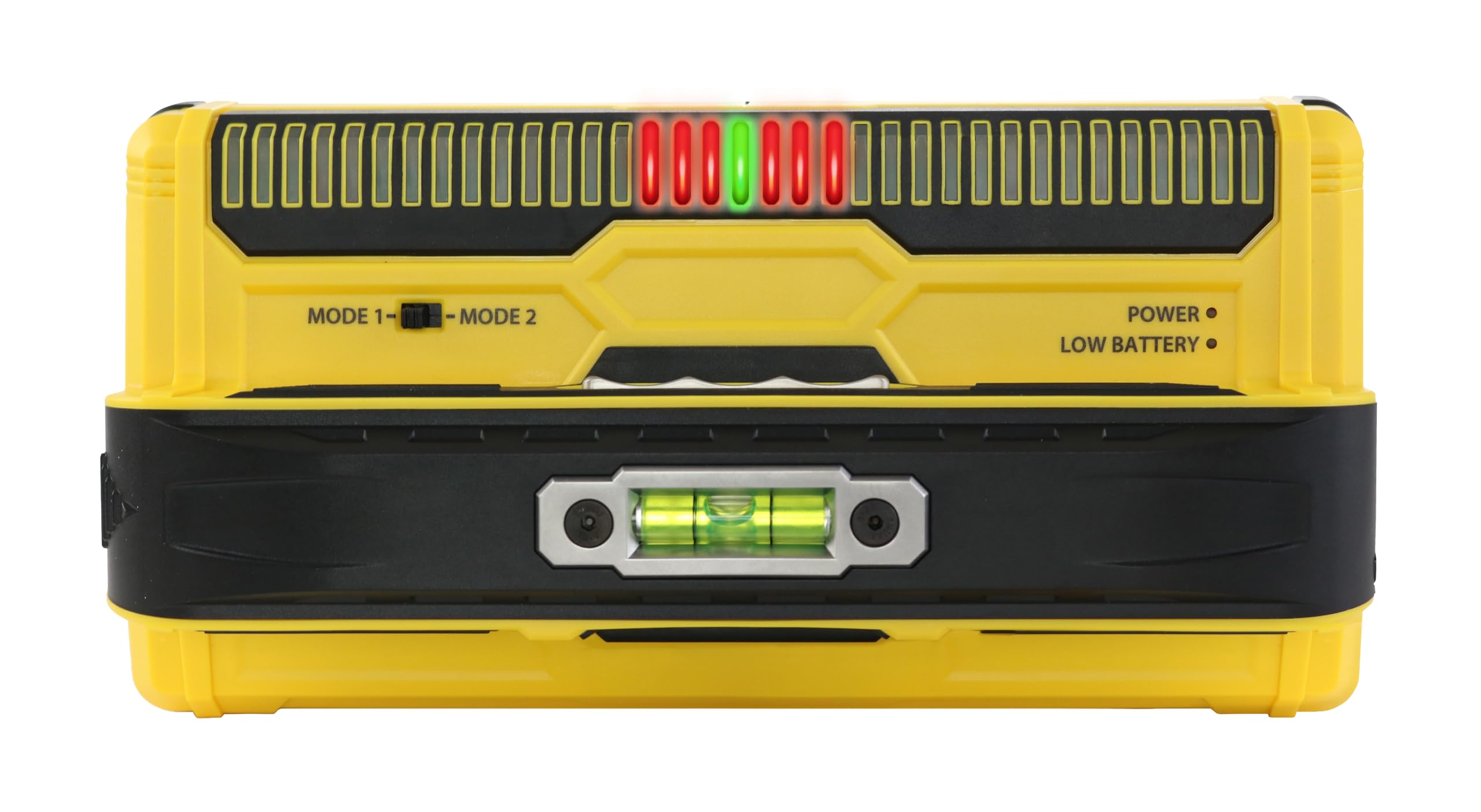
The deep-scan specialist that reads through two layers of drywall and porcelain tile.
Where the 710+ caps out at 1.6 in, the ProSensor MAX reaches 2.5 in — the deepest detection depth in this article. That extra reach is the whole point: it is built to scan through two or more layers of drywall, plaster, OSB, plywood, MDF, and large tile. It carries 13 larger sensors and shows the full width of a stud on its precision LED display, with the middle light turning green over stud centers and single or double studs shown clearly. Two modes let you use it as a normal finder for drywall, then switch to deep scanning for thick or tough walls.
The deep-scan ability is what owners rave about. Reviewers point out it reads through OSB, old plaster, tile, and blue board with little doubt about what is behind the surface. No calibration is needed — press and hold to scan anywhere, even over a stud. It runs on AA batteries, which owners note last well, and the larger frame is easy to grip and steady while you work overhead.
The trade to weigh honestly: size and value both draw mixed views. The larger body is a real change from a pocket magnet, so it is a bench tool rather than a belt tool. And like the other Franklin here, it finds framing, not hazards — it cannot separate a stud from a pipe or wiring behind plaster, so treat it as a locator rather than a safety scan. For the deepest, most reliable read on tough walls, nothing else here reaches 2.5 in.
The deep-scan advantage
- 2.5 in max depth, the deepest in this round-up
- Reads through two layers of drywall, plaster, OSB, plywood, MDF, and large tile
- 13 larger sensors show full stud width with a green center light
- No calibration, starts scanning anywhere including over a stud
The size and scope
- Larger body, not a pocket carry
- Some find the value hard to justify
- Finds framing only, with no pipe or wiring separation
Built for: tile, plaster, and double-layer walls where every other finder comes up short.
Not for: anyone who wants a palm-sized tool, or needs live-wire and pipe detection.
Understanding the Specs
Sensor count
This is the number of detectors packed into the scanning head, and it decides how much of the stud you see at once. A one or two sensor unit reads a single point, so you edge along the wall hunting for the framing. The 13-sensor Franklin units read a wide strip instead, which is why they can show the full width of a stud and mark its center in one pass. More sensors means fewer false starts, though it also means a larger, pricier tool.
Scan depth in inches
Depth is how far the signal reaches into the wall before it fades, and it sets the wall types a finder can handle. A basic scan covers standard drywall, while a deep scan reaches further and works through tile or a double layer of drywall. Depth is usually given as a single maximum number, so compare that number across tools to see which reach matters for your worst wall surface.
FAQ
Is a magnetic or electronic stud finder better?
How deep can a stud finder scan through a wall?
Will a stud finder detect electrical wires behind drywall?
How do I calibrate an electronic stud finder?
Can a magnetic stud finder work on plaster walls?
Why does my stud finder give false readings?
Do I need rechargeable batteries for a stud finder?
Can a stud finder detect metal pipes as well as studs?
How much weight can I hang once I find a stud?
Does a higher sensor count mean a better stud finder?
Final Thoughts: The Verdict
For the majority of shoppers, the beam finder tool winner is the Franklin Sensors ProSensor 710+ because its 13-sensor array shows the full stud width and the green center light lets you mark without guessing. If you want the deepest read through tile and double-layer walls, grab the Franklin Sensors ProSensor MAX with its 2.5 in reach. And for the simplest possible job on standard drywall, the CH Hanson 03040 Magnetic Stud Finder never needs a battery and finds the stud the instant it touches.
How We Picked
We do not accept paid placement. Every pick is matched to a real buyer and a real use-case; we do not hands-on test units.
Sources & Methodology
Specifications: manufacturer listings and product documentation. Review insights: verified customer reviews, as of September 2026. Pricing: not shown on this page (it changes often); check the current price via the retailer link.
As an Amazon Associate, KitchPrep earns from qualifying purchases. This does not affect which products we feature.
Related Guides
