
Specs are compiled from manufacturer listings and verified buyer reviews and can change over time — please confirm the key details on the product page before buying.
A storm knocks out your electricity, and your primary sump pump goes silent right when the water is rising fastest. That is the exact moment a battery powered sump pump backup earns its keep, automatically taking over so your basement stays dry without you lifting a finger. This guide breaks down the best systems by how much water they move, how long they run on a charge, and how easy they are to install, so you can pick the right safety net for your home.
I’m Mohammad Maruf — the founder and writer behind KitchPrep. This guide is built by comparing the manufacturers’ published specifications and the patterns across verified customer reviews, so you get each pick’s real strengths and trade-offs instead of marketing spin.
When the power goes out during a storm, your basement’s safety depends on a battery powered sump pump backup. You can choose a complete combo unit that replaces your whole setup, or a simple add-on that works with your existing pump.
Our Picks at a Glance


How To Choose The Best Battery Powered Sump Pump Backup
Your primary pump handles the daily work, but the backup only matters during a power outage. So your buying decision depends on three questions: how much water can it move, how long will the battery last, and will it fit in your sump pit. Answer those three and you have the right system.
Measure your water inflow first
The single most important spec is the flow rate, measured in gallons per minute (GPM) or gallons per hour (GPH). A backup pump that moves water slower than your pit fills is useless. Compare the backup’s GPM rating to your primary pump’s rating and to how fast water actually enters your pit during a heavy storm.
Decide between a combo system and an add-on
If your existing primary pump is old or you are building from scratch, a preassembled combo system that includes both the AC primary and the DC backup is the simplest route. If your primary pump is fairly new and working well, a dedicated backup pump that sits beside it in the pit is the more budget-friendly route. Both approaches need you to buy a deep-cycle battery separately, so factor that extra cost into your plan.
Quick Comparison
| Model | Best For | Flow Rate | Type | Weight | Amazon |
|---|---|---|---|---|---|
| Wayne WSS30VN Combo★ Best Overall | Whole-system replacement | 85 GPM | 1/2 HP AC + 12V DC | 44 lbs | Amazon |
| Superior Pump 92900Budget Champion | Budget add-on backup | 23 GPM | 12V DC only | 12.5 lbs | Amazon |
| OLTEANP 2500W InverterMost Versatile | Powering multiple devices | — | 2500W Inverter/Charger | — | Amazon |
| Basement Watchdog BWSP | Compact pits & monitoring | 8.33 GPM | 12V DC backup | 12 lbs | Amazon |
| PumpSpy BU-2000 | Two pumps at once | — | 2000W Inverter/Charger | 10.5 lbs | Amazon |
| Wayne ESP25n | Heavy water flow backup | 45 GPM | 12V DC backup | 13.5 lbs | Amazon |
| Liberty Pumps 441 | Simple reliable add-on | — | 12V DC backup | 13 lbs | Amazon |
| Zoeller Aquanot 508 | Zoeller primary owners | 40 GPM | 12V DC backup | 10.5 lbs | Amazon |
| Basement Watchdog CITS-50 | Smart monitoring combo | 73.3 GPM | 1/2 HP AC + 12V DC | 27 lbs | Amazon |
| Westinghouse WH50BBU | Stainless steel durability | 87 GPM | 1/2 HP AC + 12V DC | — | Amazon |
| Zoeller 508 ProPak | Complete pre-plumbed setup | 43 GPM | M53 AC + 12V DC | 17 lbs | Amazon |
In‑Depth Reviews
1. Wayne Preassembled Primary & Battery Backup Sump Pump Combo System
Our pick — over 4.5★ from 800+ verified ratings; the strongest balance of quality and price.
The do-everything combo that drops into your pit and out-pumps nearly every rival on this list.
This is the full package for homeowners who want one system to handle daily pumping and storm outages alike. The main pump is a 1/2 HP model that pushes 85 gallons per minute, and the 12-volt backup can evacuate up to 10,000 gallons on a single battery charge. It arrives preassembled so you can have it running in 15 minutes or less, and it fits in pits that are 16 inches in diameter or larger.
The 85 GPM spec holds up in practice, with owners reporting fast pit evacuation. Owners say the DC backup can empty an 18″x30″ sump in 30 seconds against a 7-foot head — that is the vertical height the pump has to push water. One owner ran it all day on a 100Ah AGM battery without seeing a voltage drop, and another reported whisper-quiet operation through four heavy storms. With a 4.6-star average across over 800 ratings, this is the most-proven pick in this guide.
The catch is that the battery is not included, and Wayne recommends using only sealed batteries with the built-in charger. A few owners suggest an external charger for better battery care, and the pump’s base is large enough that it barely fit an 18-inch round pit for one buyer. The premium price is justified for finished basements where flood damage is catastrophic.
Reliable all-in-one
- Preassembled drop-in design saves hours of plumbing work
- Massive 85 GPM flow handles heavy spring water with ease
- Tested to 1 million cycles for long-term reliability
Heavy install
- Battery sold separately and adds to the upfront cost
- Large base may not fit narrower 18-inch pits
- Wayne recommends sealed batteries only
Top pick: This is the best overall choice for anyone replacing an entire system and wanting proven, powerful protection.
Space tight: You just need a backup for a newer primary pump — a dedicated backup unit will cost far less.
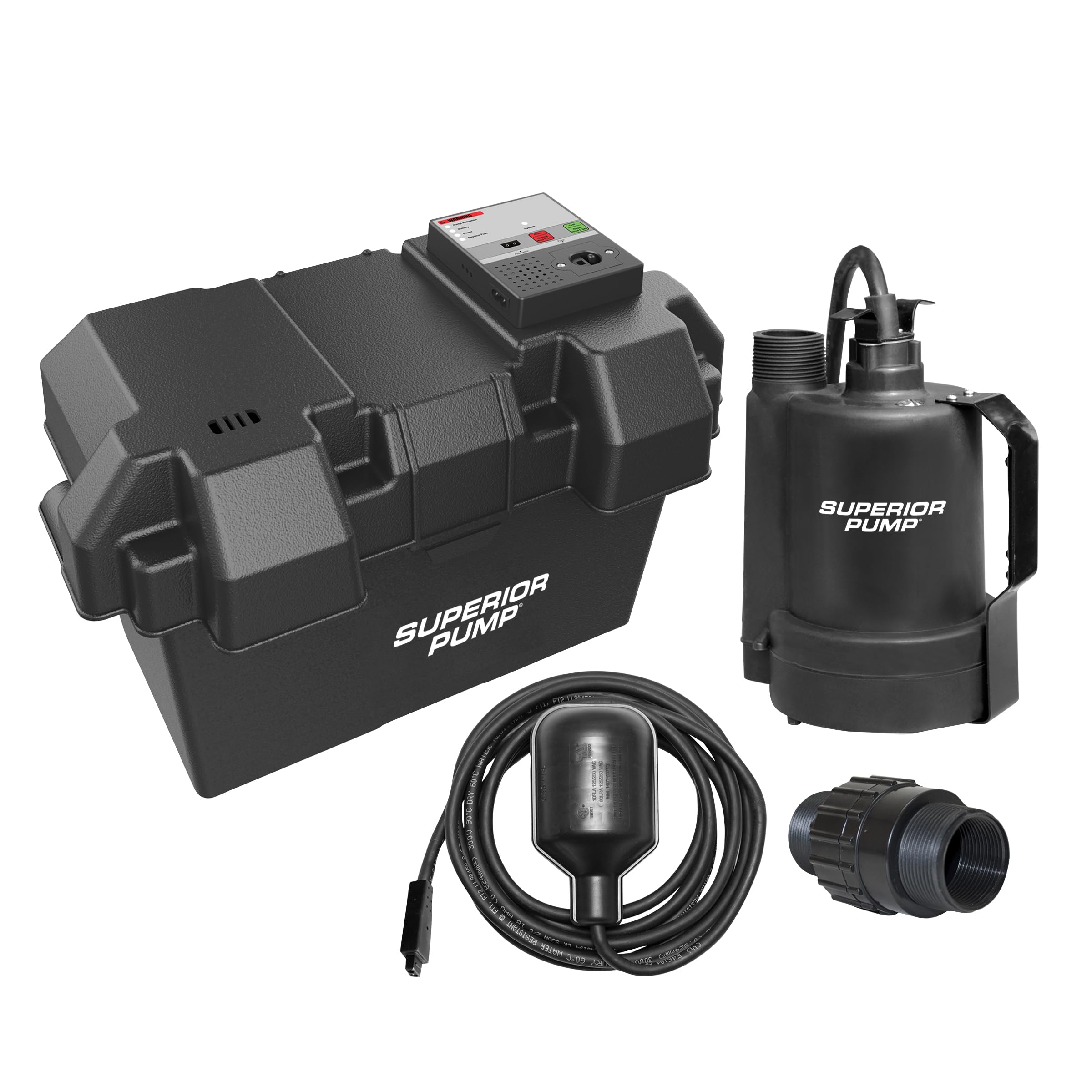
2. Superior Pump 92900 12V Battery Back Up Submersible Sump Pump
A featherlight 12-volt add-on that slips in beside your primary pump for a fraction of the cost.
If your existing AC pump is still young and healthy, this is the budget-friendly way to add outage protection. The 12-volt pump moves up to 1,380 gallons per hour and can lift water 25 feet of vertical height, which covers most residential basements. Weighing just 12.5 pounds and built from tough thermoplastic, it is far easier to handle than the 44-pound Wayne combo above — a full 31.5 pounds lighter for the same job of backup duty.
The trade-off shows up in flow rate: at 23 gallons per minute, this moves water at roughly a quarter of the Wayne combo’s 85 GPM pace. That is fine for moderate inflow, but a fast-filling pit could outpace it. Buyers report it clears a sump quickly and quietly, and one owner installed it only to have the power go out later that week — the pump worked exactly as expected and paid for itself immediately. A tethered float switch turns it on and off automatically, and the 10-foot cord gives you reach to a nearby outlet.
There are a few honest caveats. The provided check valve cracked during installation for one owner, who swapped in a sturdier aftermarket unit. The charging plug also fits loosely in its port, so it is easy to dislodge by accident. You will need to buy a compatible battery separately and budget roughly extra for a good one, and some buyers recommend a platform so the bottom-draw pump sits above the pit floor.
Budget buy: You want the lowest-cost way to add backup protection to a working primary pump without a plumber.
Power outages: Your pit fills aggressively during storms — you will want a higher-GPM backup like the Wayne ESP25n below.
3. OLTEANP 2500W Sump Pump Battery Backup System
One box that keeps your sump pump running and your furnace and router alive through an outage.
This is not a pump at all — it is an inverter system that turns a 12-volt deep-cycle battery into household power for your existing pump. Instead of a dedicated DC backup pump, the OLTEANP converts battery power to a stable pure sine wave 120-volt AC output, so any standard AC sump pump plugs straight into it. The built-in 25A smart charger tops the battery back up automatically when grid power returns, and an auto transfer switch flips you to battery the instant the lights go out.
The 2500W output is the headline here, and owners have put it to work far beyond the sump pit. Owners mention running a furnace pulling 400W and internet gear at 100W alongside the pump, and one sustained a full 2500W load before the unit shut itself down above that mark. A remote LCD panel shows battery voltage, load status, and operating mode in real time, so you always know your system’s health.
The main quirk is behavioral: if the battery fully drains, the unit stays off until you manually power it back on. Owners also note the voltage display reads about 0.1V low and the unit cuts off at 10V to protect the battery. It is compatible with LiFePO4, AGM, GEL, and flooded deep-cycle batteries, so you are not locked into one chemistry, and it comes with a 12-month warranty and 24/7 support.
Heavy duty: You want one backup power source that covers your sump pump plus essential household devices during an outage.
Quiet homes: You prefer a simple dedicated backup pump that needs no manual restart after a deep discharge.
4. Basement Watchdog Special CONNECT Battery Backup Sump Pump System

A compact backup that fits tight pits and can alert your phone when trouble starts.
This 1/4 HP backup pump is built for the awkward, narrow sump pits where bigger units will not fit. Its compact footprint measures just 9″L x 5″W x 7.63″H, yet it still moves a respectable 2,890 gallons per hour at zero lift and 1,730 GPH at a 10-foot lift. A user-friendly control panel lights up with a warning and literally describes what to do, so maintenance does not require a manual.
Owners love the long service life here. Customers note previous units lasting 8 to 10 years before needing replacement, and several note the diagnostic LED lights make it easy to spot issues like a tripped breaker. The pump uses a copper-wound motor and thermoplastic housing, and a sensor monitors battery fluid levels to remind you when the battery needs distilled water — typically every six months.
The standout feature is the WiFi capability, but it requires a separately purchased CONNECT module for real-time alerts via text or the Basement Watchdog app. Owners note the alerts are one-way only, so you can see a problem but not control the pump remotely. The battery is sold separately, and buyers recommend budgeting for replacement every 3-4 years since an older battery can fail during a long 24-hour outage.
Tech lovers: Homeowners with tight sump pits who want smart monitoring and a track record of decade-long service.
Simple needs: Anyone who expects WiFi alerts from the start — that module is an extra purchase.
5. PumpSpy 2000W Sump Pump Battery Backup System

An American-tested inverter that can drive two sump pumps at once without breaking a sweat.
This inverter system handles the demanding job of powering two primary sump pumps simultaneously, as long as their combined current draw stays under 16.6 amps. Like the OLTEANP, it converts a 12-volt deep-cycle battery into a pure sine wave 120-volt AC output, keeping sensitive pump electronics running cleanly. A smart trickle charge keeps the battery topped off and ready, and an intelligent cooling feature protects the unit during long runs.
Buyers consistently praise its American-made build quality. It is tested and packaged in Kalamazoo, Michigan, and comes with everything you need for installation — including screws for wood and concrete plus a concrete bit, a thoughtful touch owners mention. Two grounded outlets and a USB charge port mean you can also power lights and phones during an outage.
Owners with two sump pumps call it a storm-season life-saver. One buyer called it a “life-saver,” and another confirmed flawless performance during a real outage. The honest caveat is that the battery is sold separately and is required for operation — one frustrated owner missed that detail and bought it without a battery. At 10.5 pounds and 17.5 x 6.75 x 4 inches, it mounts on a wall or sits flat wherever you have room.
Smart homes: You have two sump pumps or want a backup power source that also runs essential electronics during an outage.
Offline use: The battery is an extra purchase many first-time buyers overlook, so read the box carefully before checkout.
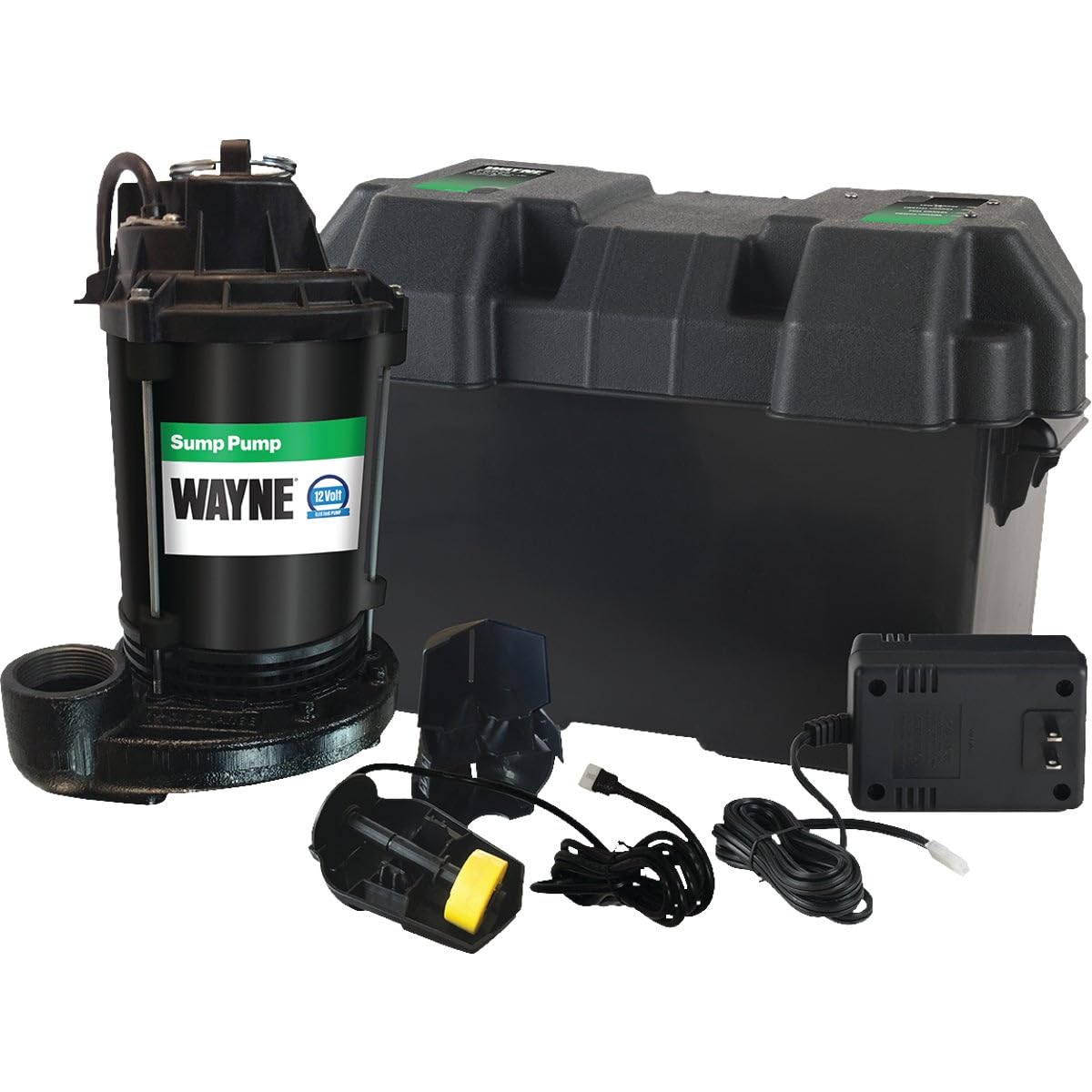
6. WAYNE ESP25n 12 Volt Battery Back Up Sump Pump
A dedicated backup with serious muscle that has saved basements through multiple floods.
This is the dedicated backup pump for homeowners who want serious flow without buying a whole new primary system. The 12-volt pump moves up to 2,700 gallons per hour — nearly double the Superior Pump’s output — and can evacuate 10,000 gallons on a single battery charge. Its cast-iron base and epoxy-coated steel housing give it a durability edge over all-plastic rivals, and it fits in pits 14 inches in diameter or larger.
Reviewers point out the backup kept pace with heavy inflow even with the primary unplugged. Owners describe this backup keeping up with heavy inflow even when the primary pump was unplugged, and one replaced their previous Wayne ESP25 after 9 years of service. The protective battery case includes an LED display and an audible alarm so you know immediately if something is wrong, and a test switch lets you verify the system works before a storm hits.
Shoppers say roughly 20-30 minutes for setup using the included Y-joint and check valve, and several note the total cost with a 100Ah AGM battery ran about half what a plumber quoted for a comparable install. The recurring caveat is the battery box lid does not snap shut securely, and Wayne’s charger lacks surge and overcharge protection, so buyers recommend avoiding unsealed or lithium-ion batteries. The battery itself is sold separately, and a compatible 75AH unit is required for operation.
Standard choice: Ideal for homes with heavy water inflow that need a reliable backup that can actually keep pace.
Long outages: Battery life runs shorter under extreme flow, and the loose battery box lid is a minor annoyance worth knowing about.
7. Liberty Pumps 441 Battery Back-Up Emergency Sump Pump System

A set-and-forget backup that sat idle for 21 months, then ran 2.5 hours straight when called on.
Liberty Pumps has a reputation for building dependable sump equipment, and this 12-volt backup system lives up to it. The package includes the submersible pump, control panel, battery box, and a 12-volt charger — everything except the battery itself. An automatic, mercury-free float switch starts the pump when water rises, and the control panel keeps you informed of system status.
Owners are surprised by its flow, which nearly matched a 120-volt primary in one test. One buyer paired it with an Interstate 27M battery and reported the pumping speed came very close to their Zoeller 120-volt primary pump. Another described the unit sitting idle for 21 months, then working flawlessly through heavy rain for 2.5 hours to prevent a basement flood — the kind of reliability story that sells itself.
The honest downsides are mostly about fit and finish. The pump feels light and flimsy to some owners, and one received a unit with a damaged controller housing in shipping. Installing it in an 18-inch basin is tight, and since it comes without a support bracket, you may need to build a PVC stand to mount it above the primary pump. A loud audible alarm alerts you when the pump runs, though a silent mode is available.
Small spaces: You want a proven, straightforward backup from a respected pump brand without paying combo-system prices.
Big basements: Your pit is very narrow or you want a pre-built mounting bracket included in the box.
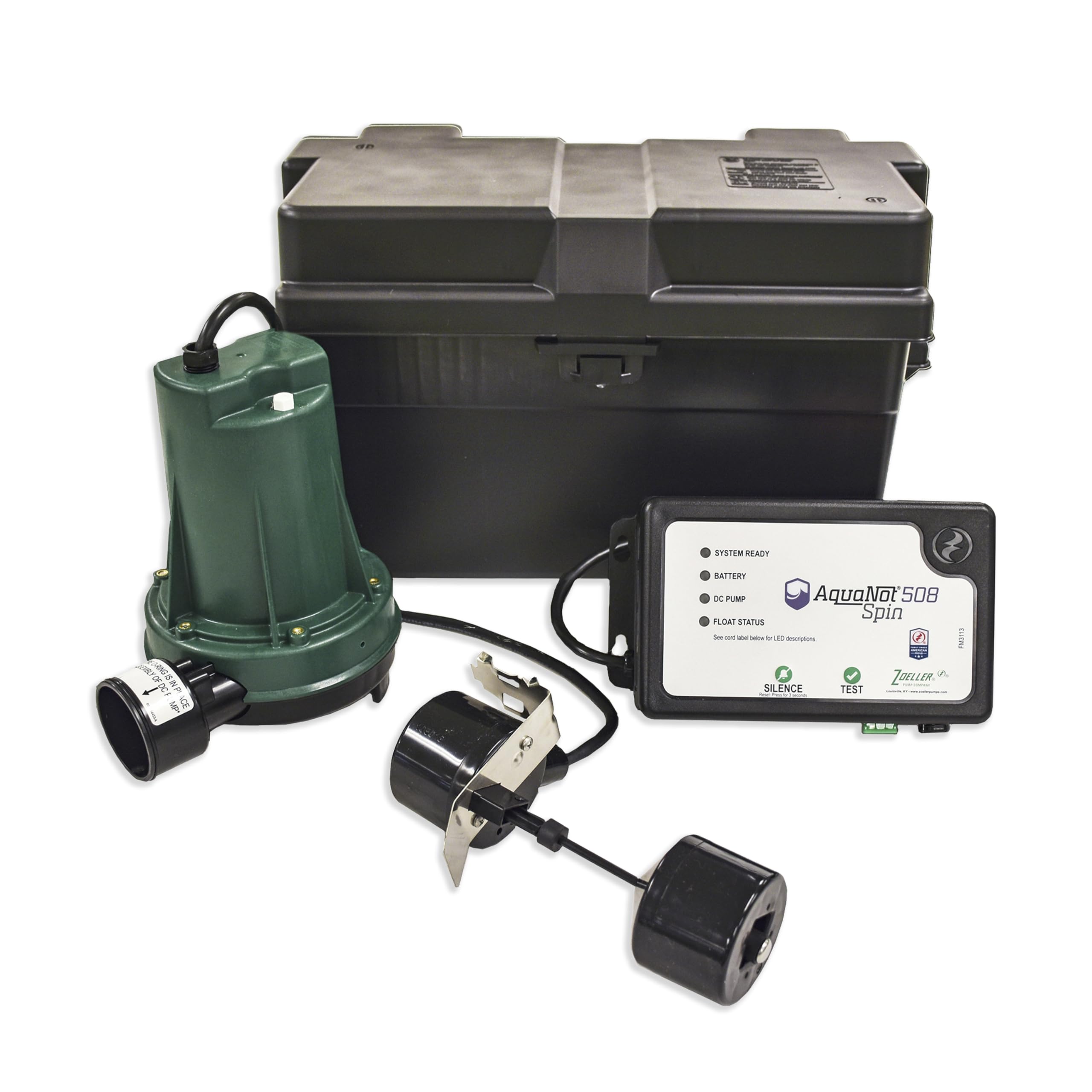
8. Zoeller 508-0005 Aquanot 508 Battery Back-Up System
Zoeller’s hand-built American backup that integrates smoothly with its famous M53 primary pumps.
Zoeller is a name plumbers trust, and this 12-volt backup pump shows why. It is hand-built and 100% tested in the USA, with a noncorrosive pump construction, aluminum seal pocket, and cooling plate for long service life. The 0.33 HP pump moves 40 gallons per minute, and an integrated check valve plus quick-disconnect discharge simplify both installation and maintenance.
Owners who pair this with a Zoeller M53 primary pump praise how well the two work together. The intelligent design fits a standard 18-inch sump well without overcrowding the primary pump, and the pre-drilled relief hole and built-in flapper valve save buyers from buying extra parts. An aluminum control box with LCD display, described as resembling a car amplifier, mounts on the wall and gives clear status readouts.
Buyers report this unit outperforms the Basement Watchdog units they replaced, which suffered control errors and overcharging issues. The warranty is a differentiator: it extends from 12 months to 36 months when you purchase an Aquanot battery — but only when used as a backup to a primary dewatering system. The instructions are notoriously vague, though owners say the support hotline is genuinely helpful. A Trojan deep-cycle battery is recommended and typically lasts 3-4 years.
Quiet zones: You already own a Zoeller primary pump and want a matching backup that integrates cleanly.
Budget buyers: The full 36-month warranty only applies if you buy the Zoeller Aquanot battery alongside it.
9. Basement Watchdog Combo Preassembled Primary & Battery Backup System (CITS-50)

A pre-plumbed combo with a half-horsepower primary that empties your pit and watches itself 24/7.
This is the big brother of the Basement Watchdog BWSP, bundling a 1/2 HP copper-wound primary pump with a battery backup in one preassembled, pre-plumbed package. The primary moves 73 gallons per minute at zero lift — 4,400 gallons per hour — while the backup adds 48 GPM (2,890 GPH). A monitoring controller checks pump, power, and battery conditions around the clock, sounding an alarm and describing the fix when something goes wrong.
The smart features are the big draw. With a separately purchased CONNECT module, you get real-time alerts via text, email, push notification, or the free Basement Watchdog app. Owners mention the AGM battery lasting up to a week during power loss, and one described the backup keeping their basement dry for 5 days while they swapped out their old primary. The system accepts both maintenance-free AGM and wet-cell batteries, and you can connect two in parallel to double your runtime.
At 27 pounds, this is a heavy unit, and the permanently attached floats and multiple cords make it awkward to install through a tight sump lid. One owner found the 1/2 HP motor overpowered for a 14-foot lift, emptying the sump in 5 seconds and blowing fittings. The backup pump itself is plastic while the primary uses cast iron, and a small number of customers note the main pump failing within months, though the vast majority describe it as a reliable workhorse that runs for a decade or more.
All-in-one: Tech-minded homeowners who want smartphone alerts and a complete, pre-plumbed combo that installs quickly.
DIY novices: Your sump pit has a tight lid — the large footprint and permanent floats make fitting a challenge.
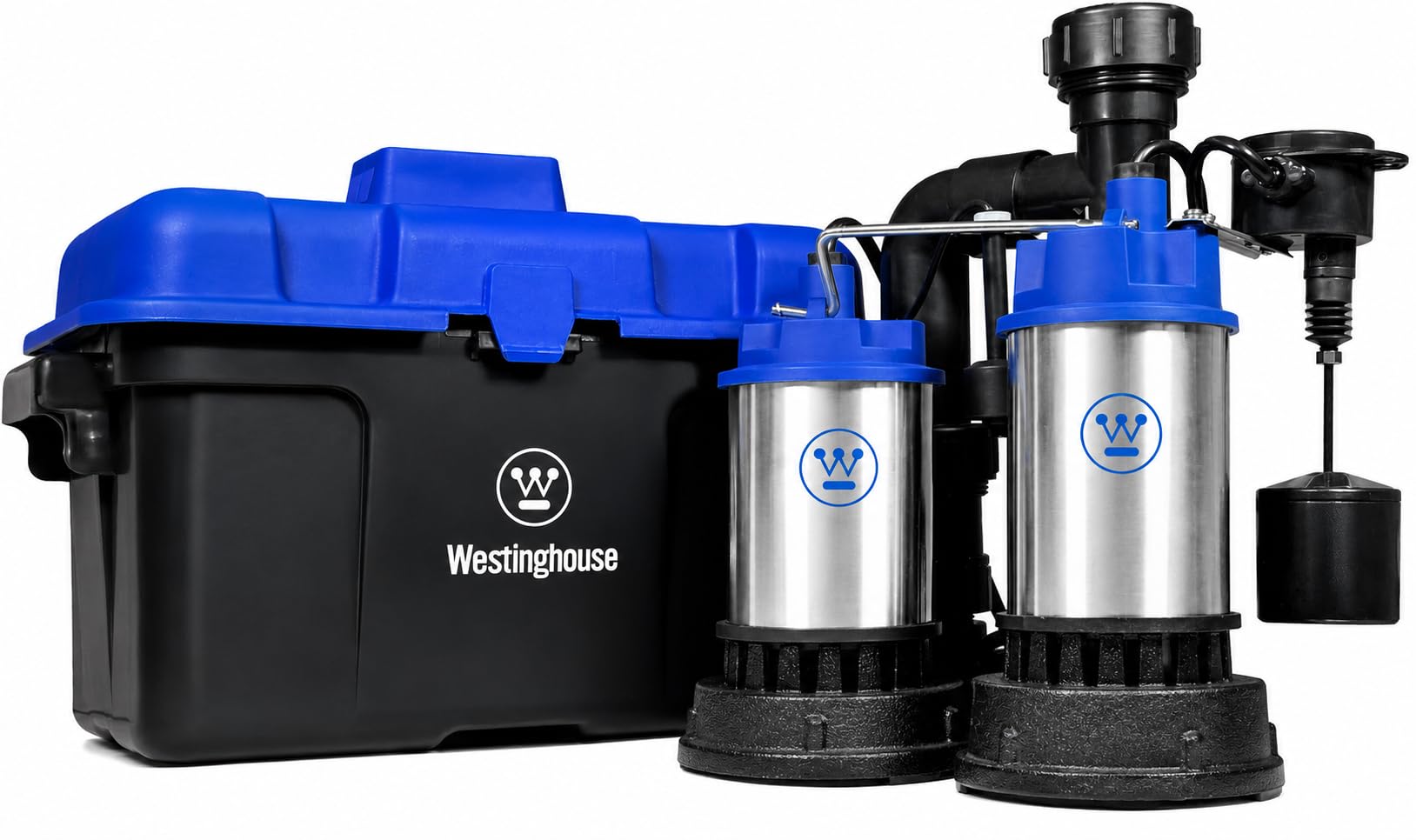
10. Westinghouse WH50BBU 1/2 HP Primary & Battery Backup Sump Pump System
The highest-flow pump here at 87 GPM, wrapped in corrosion-resistant stainless steel.
Westinghouse enters the battery backup market with the most powerful flow rate on this list. The 1/2 HP primary pump moves up to 87 gallons per minute — edging out even the Wayne combo’s 85 GPM — while a high-flow DC backup pump activates instantly during power loss. Both pumps feature corrosion-resistant stainless steel housings, a genuine upgrade over plastic-bodied rivals for homes in humid or mineral-heavy water conditions.
Owners consistently describe the build as heavy, solid metal rather than cheap flimsy plastic. One reviewer noted the pump emptying a large pit completely in about 10 seconds, and several praised it as quieter than their previous unit. The energy-efficient PSC motor includes thermal overload protection, lubricated ball bearings, and a sealed shaft, while the top suction design helps prevent airlock and reduces debris buildup.
The package includes the primary pump and switch, backup pump and switch, battery controller, charger, and box — everything except the battery. With a maximum lifting height of 30 feet, this system handles even deep discharges where other pumps struggle. The only recurring complaint is the short cable on the charger adapter, and a few buyers wish Westinghouse offered a bundled discount when buying a compatible battery at the same time. The system is designed for tight sump pits with a compact, space-saving footprint.
Long-term use: You want the highest flow rate available plus stainless steel durability in a dual-pump system.
Cramped pits: The short charger cable may require a nearby outlet or an extension cord for installation.
11. Zoeller 508-0006 AquaNot Spin 508 ProPak
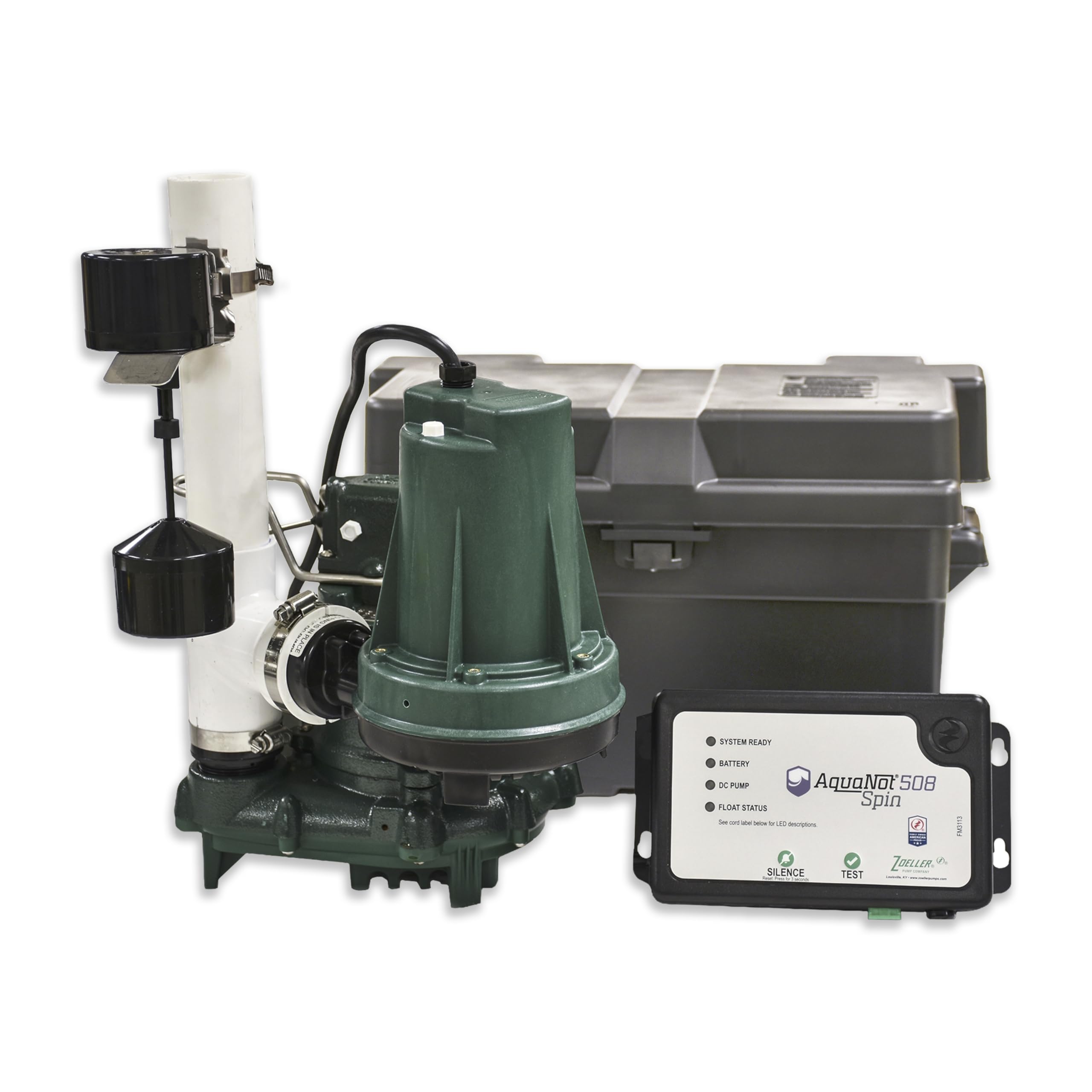
A factory-tested, pre-plumbed system with a 3/10 HP primary and a backup rated for days of duty.
This is the turnkey solution for buyers who want one box that contains everything. The ProPak bundles the 3/10 HP M53 primary pump, the AquaNot Spin 508 controller, a 12-volt DC backup pump, check valve, float switch, and pre-plumbed 1-1/2 inch Schedule-40 PVC discharge piping. It is 100% factory tested, so the hardest part of your install is just lowering it into the pit.
The backup’s endurance is the headline spec: on a fully charged battery, it delivers up to 5.5 hours of continuous pumping, or over 48 hours at a 10% duty cycle — the on-and-off rhythm of a typical sump. The controller continually tests itself and alerts you to power outages, high-water conditions, switch obstructions, and pump faults, taking the guesswork out of knowing when the battery needs replacing.
Reviewers point out flawless operation through multiple power failures, with one noting three separate outages with no problems at all. The DC backup pump swivels for easy adjustment, and buyers describe the whole system as very quiet compared to previous pumps. The 3-year limited warranty adds confidence, though a small number of owners received units with defective check valves or base seals — the kind of quality-control issue that is frustrating but not universal. You will need a deep-cycle battery, 1.5-inch pipe, glue, and a cutter to complete the install.
Tech savvy: Perfect for homeowners who want a complete Zoeller system with minimal assembly and a strong warranty.
Simple users: A rare defective unit slips through, so inspect the check valve and base seal carefully on arrival.
Understanding the Specs
Gallons Per Minute (GPM)
This measures how much water the pump can move in one minute. It is the single most important number because it tells you whether the backup can keep up with water entering your pit. A higher GPM means the pump empties the pit faster, which matters most during heavy rain when water pours in quickly. Compare the backup’s GPM to your primary pump’s rating to make sure the backup is not dramatically weaker.
12V Deep-Cycle Battery
Battery backup sump pumps run on 12-volt DC power stored in a deep-cycle battery, which is designed to be drained and recharged repeatedly. The battery is almost always sold separately, so budget for it. Battery capacity, measured in amp-hours (Ah), determines how long the pump runs during an outage. A larger battery like a 100Ah unit gives you more runtime than a smaller 75Ah one. You will also need to choose between AGM and wet-cell batteries, and some brands recommend sealed types only.
FAQ
Is a battery backup sump pump worth the money?
How long will a battery backup sump pump run during an outage?
Do I need a battery backup if I have a generator?
What kind of battery do I need for my backup sump pump?
Why is the battery not included with most backup sump pumps?
How often should I test my battery backup sump pump?
What is the difference between a backup pump and a combo system?
Can a battery backup pump handle heavy water flow?
Will a battery backup pump fit in my existing sump pit?
Can I use a battery backup system to power other devices during an outage?
Final Thoughts: The Verdict
If you want one dependable pick, the battery powered sump pump backup winner is the Wayne Preassembled Combo System because it pairs the raw power of a 1/2 HP primary pump with a backup that has proven itself across over 800 owner ratings. If you already have a healthy primary pump and want smart alerts, the Basement Watchdog BWSP brings WiFi capability and a compact footprint to the job. And for the strongest flow rate on this list wrapped in stainless steel, the Westinghouse WH50BBU is the premium pick that empties even the most demanding pits with ease.
How We Picked
We do not accept paid placement. Every pick is matched to a real buyer and a real use-case; we do not hands-on test units.
Sources & Methodology
Specifications: manufacturer listings and product documentation. Review insights: verified customer reviews, as of September 2026. Pricing: not shown on this page (it changes often); check the current price via the retailer link.
As an Amazon Associate, KitchPrep earns from qualifying purchases. This does not affect which products we feature.
Related Guides
