
Specs are compiled from manufacturer listings and verified buyer reviews and can change over time — please confirm the key details on the product page before buying.
If you have ever held a hot iron in one hand and a wire in the other while hunting for an outlet, you already know why a battery powered soldering iron changes the job. No cord dragging across the workbench, no extension lead stretched into the truck bed, no waiting for a butane torch to warm up. The right one heats in seconds, holds a steady tip temperature, and runs off a battery you may already own.
I’m Mohammad Maruf — the founder and writer behind KitchPrep. This guide is built by comparing the manufacturers’ published specifications and the patterns across verified customer reviews, so you get each pick’s real strengths and trade-offs instead of marketing spin.
Some of these tools run on a power-tool battery you already keep charged, while others carry their own built-in cell and charge over USB-C. Heat-up time, tip temperature range, and whether you already own the right batteries are the three specs that narrow this category fastest.
Our Picks at a Glance

How To Choose The Best Battery Powered Soldering Iron
The single biggest fork in this category is the power source. A platform tool runs on a battery you already own from your drill or impact driver, so the iron itself is often the cheaper part of the deal. A self-contained iron carries its own cell and charges over a cable, so it works even if your bench shares no battery system. Decide which camp you are in first, and everything else gets simpler.
Heat-up time and the wait you actually feel
Heat-up is measured in seconds, and it is the number you feel every time you pick the tool up. An iron that reaches working temperature in 8 seconds lets you fix one joint and walk away; one that takes a minute and a half makes you stand there holding it. For a single repair, either works. For a full afternoon of wiring, the fast one keeps you in rhythm instead of waiting between joints.
Tip temperature and what it can actually melt
Temperature range tells you how much metal you can heat. Delicate circuit-board pads want a lower, steadier setting so you do not lift a trace, while thicker stranded wire soaks up heat and needs the top of the range. A wide adjustable span, from around 212°F up past 840°F, covers both ends of that job. Some irons hold their heat better than others, and a tip that cools the moment it touches a big wire is the most common frustration in this category.
if you need a battery that is always topped up
A platform iron drains whatever pack you clip in, so a mid-size battery may only last a session or a couple of hours depending on the load. A built-in cell gives you a fixed, predictable runtime and charges from any USB-C source, which suits field work where no outlet waits at the end. Either way, consider how you will keep it charged — that plan matters more than any single spec on the box.
Quick Comparison
| Model | Best For | Power Source | Heat-Up | Temperature Range | Amazon |
|---|---|---|---|---|---|
| Milwaukee 2488-20 M12★ Best Overall | Tight spaces and ladder work | M12 battery (tool only) | Under 18 seconds | — | Amazon |
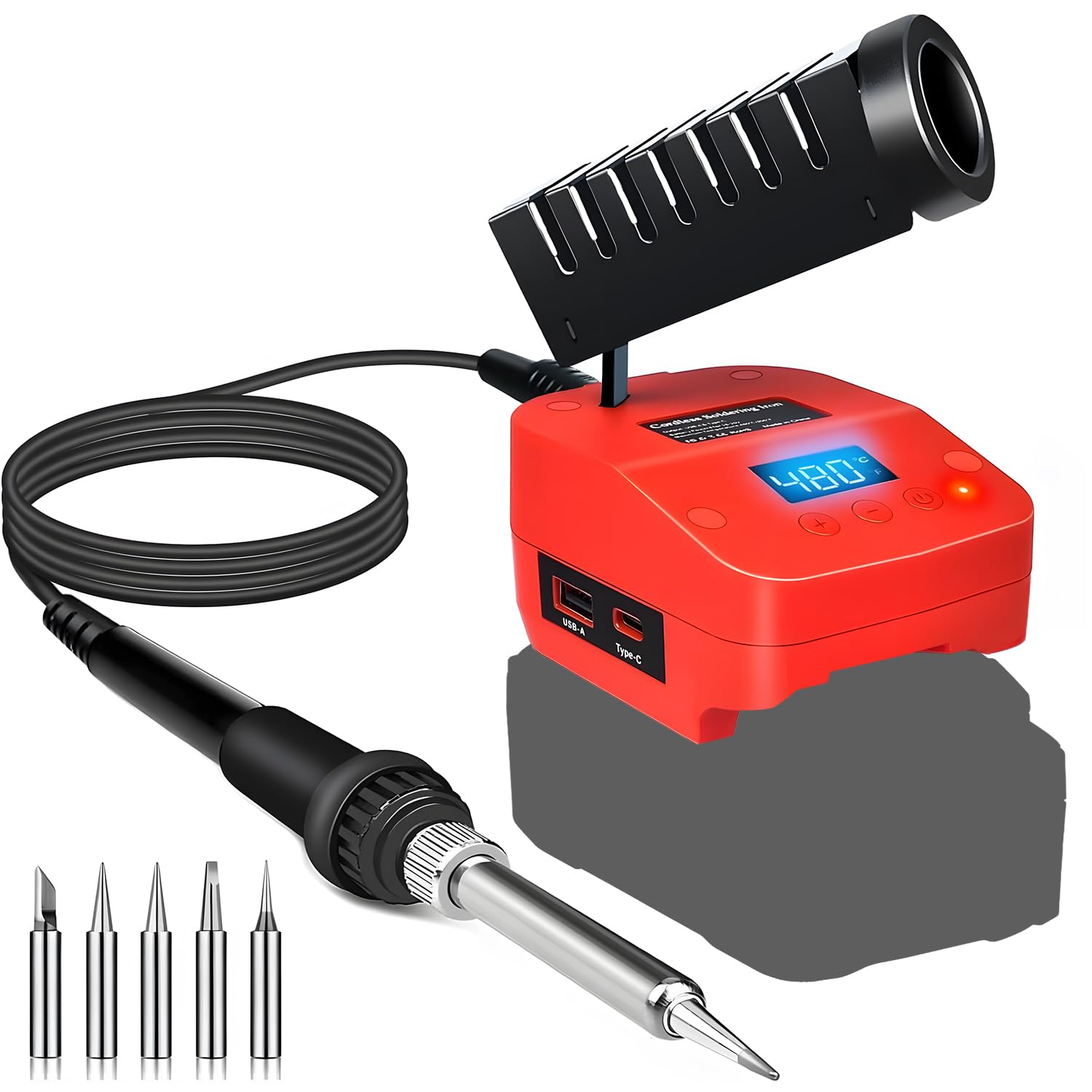
| Cordless Soldering Iron Station for Craftsman V20Best Value | Owners of Craftsman V20 packs | Craftsman V20 (no battery) | 8 seconds to 350°C | 180°C–480°C | Amazon |
| BK210 Cordless Soldering Iron Kit | Electronics and jewelry repair | Built-in 3200mAh | 8 seconds | 356°F–842°F | Amazon |
| QSDXNYDC Station for Milwaukee M18 | M18 owners, shop and field use | Milwaukee M18 (no battery) | 8 seconds to 350°C | 180°C–480°C | Amazon |
| Hakko FX-901/P | Small wires and quick PCB jobs | 4xAA batteries | 30 seconds | — | Amazon |
| RYOBI ONE+ 18V Topper | 12V automotive and remote jobs | RYOBI 18V (tool only) | Under 90 seconds | 400°F–900°F | Amazon |
| FNIRSI HS-03 Kit | Fine PCB work and gaming mods | Built-in 2600mAh | 3 seconds | 212°F–842°F | Amazon |
In‑Depth Reviews
1. Milwaukee 2488-20 M12 Cordless Soldering Iron (Tool Only) New
Our pick — over 4.5★ from 600+ verified ratings; the strongest balance of quality and price.
The one you grab when the joint sits where no cord can follow.
Pick this up if you already run Milwaukee M12 batteries, because the iron itself is sold as a bare tool — no pack, no charger, just the head and handle. It reaches working temperature in under 18 seconds, so a single repair is a one-hand job rather than a two-minute wait. The pivoting head lets you angle the tip into corners a straight barrel simply will not reach, and the whole thing weighs 0.35 kg, light enough to hold overhead on a ladder without your wrist complaining.
You can see what you are heating even in a dark engine bay or under a dash, thanks to the angled head and a work light aimed at the tip. A four-level battery indicator tells you where you stand before you start. It carries a 12-volt input and runs on any M12 pack, so the packs you already charge for your drill cover this too. Buyers report exactly this pattern — “perfectly compatible with Craftsman v20 batteries and it functions as intended” is a line from a similar platform tool, and the same plug-and-play expectation holds here for the M12 line.
The honest catch is durability at the tip. Some owners mention the tip melting through extended use, and a long-term user counted a failure after roughly eight hours spread across about 25 sessions. That is a real trade-off to weigh if you solder daily for hours, though the heating speed and ease of use are what most people rave about — they are the two things this iron is known for. Treat it as a fast, convenient field tool and it delivers; treat it as a bench station and you may want a spare tip on hand.
Why it earns the top spot
- Under 18 seconds to working temperature — barely a pause between joints.
- Pivoting head and tip-mounted work light reach into tight, dark spaces.
- Runs on any M12 battery you already own, with a four-level charge readout.
What to weigh before buying
- Bare tool — no battery or charger in the box, so factor in what you already have.
- Tip life is the recurring gripe; heavy daily use may want spares.
Made for: M12 owners who want a cordless iron that heats in under 18 seconds and reaches spots a corded unit cannot.
Think twice if: you solder for hours at a stretch and want a tool that will not need a fresh tip.
2. Cordless Soldering Iron Station for Craftsman V20 20V Battery (No Battery)
If Craftsman V20 packs already fill your garage, this is the easiest add-on you will make.
The headline number here is 60 watts of power reaching 350°C in 8 seconds, and that speed is the reason it earns a spot near the top. It slots onto Craftsman V20 batteries — the CMCB204, CMCB202, CMCB206, CMCB209, CMCB201 and CMCB205 among them — and the batteries and charger are not included, so it suits someone who already owns the platform. The temperature dials in from 180°C to 480°C, and you can flip between Celsius and Fahrenheit in a second with a double-click.
What owners value most is simply that it works. It handles both soldering and desoldering, and the portability lets you take it outdoors where no outlet waits — one Craftsman owner put it plainly: “perfectly compatible with craftsman v20 batteries and it functions as intended.” A hobbyist who ran it alongside other irons called it extremely handy when you already have a stack of batteries for your tools. The stand slips into a socket on the battery adapter for stability and pulls free for storage, and a memory function keeps your last temperature so you are not dialing it back in every time.
The design detail worth knowing about is the connector. A proprietary battery connector cord links the iron to the adapter, and the recurring concern is that this cord is the weak point and is not replaceable on its own. That is a genuine limitation to size against the price, not a reason to skip it — for everyday DIY repairs it does the job, and the Craftsman compatibility is the whole point. One buyer comparing it to the branded alternative noted it comes in at close cost with USB-A and USB-C outlets on board for charging your phone in a pinch.
The quick-repair angle: You get heat fast — 8 seconds to 350°C — and a 180°C–480°C range covers everything from a loose wire to a board-level joint. The auto-off at 30 minutes and drop to 100°C add a safety net if you set it down mid-job.
Reach for this if: you are invested in Craftsman V20 batteries and want a fast, inexpensive iron that shares your existing packs.
Look elsewhere if: you want a user-replaceable connector cord, since this one is fixed.
3. BK210 Cordless Soldering Iron Kit, Portable Rechargeable Soldering Pen with C210 Tip
A self-contained pen that hangs a full hour of soldering off a USB-C charge.
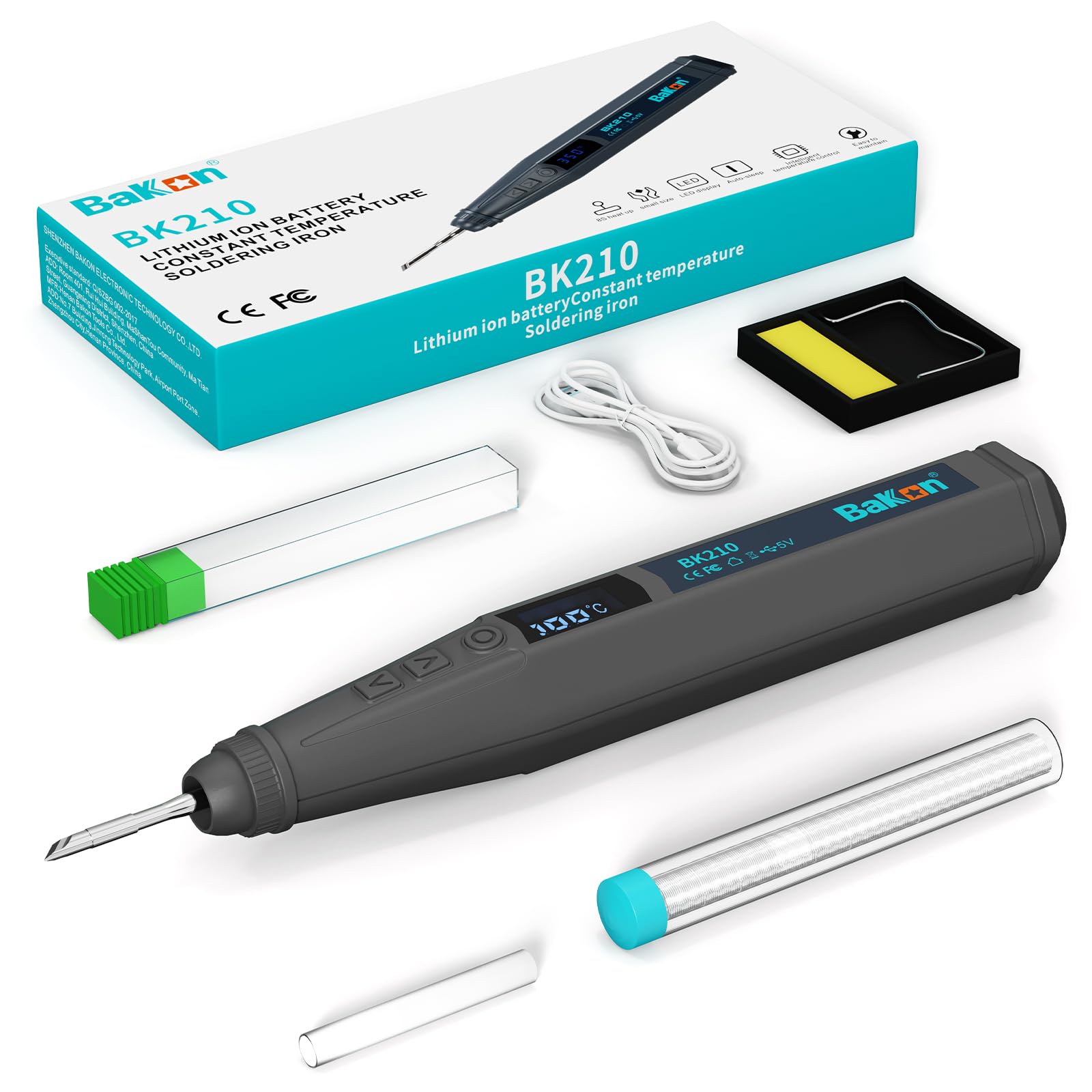
For electronics and jewelry work, you need fine control rather than brute heat — that is what this pick delivers. The built-in 3200mAh battery delivers up to 60 minutes at 840°F on 12W of output in wireless mode, and when you want to keep going you can switch to 16W over USB-C and run it from a charger or power bank. A C210 tip reaches working temperature in just 8 seconds, and you can dial anywhere from 356°F to 842°F so delicate pads and small wires each get the right setting. Real-time temperature monitoring shows on the LED display.
What wins people over is the quality of the build and how well it simply functions — it is the kind of kit that arrives with everything you need for a small project at home. The package includes the pen, a C210 tip, lead-free solder wire, a heat-resistant stand and sponge, a tip protection tube, and a USB-C cable, so there is nothing extra to buy before your first job. The body is hexagonal with a matte finish for a grip that does not slip, it weighs 115 grams, and after 10 minutes of inactivity it drops into hibernation to protect both the tip and your fingers. There is a child lock as well.
Two honest notes before you buy. The heat control draws the most mixed feedback of anything about this iron, so expect to fine-tune your settings rather than set it once and forget it, and battery life is the other area where expectations vary. At only 12W in wireless mode it is not built for thick cable or heavy lugs — it is built for circuit boards, jewelry, and small gauge work. One quirk owners mention is that the slender C210 tip does not fit standard stands, though the included stand handles it fine.
The case for the BK210
- 8-second heat-up with a 356°F–842°F range for precision work.
- 60 minutes of wireless runtime from a 3200mAh cell, plus USB-C corded mode.
- Full kit included — solder, stand, sponge, tip tube, and cable.
Where it falls short
- 12W wireless output is not meant for thick cable or large lugs.
- Temperature control takes some adjustment to dial in.
Suits: hobbyists and repair techs working on boards, jewelry, and fine wire who want a complete cordless kit in one box.
Not for: anyone expecting a single setting to handle every job without tweaking.
4. QSDXNYDC Cordless Soldering Iron Station Compatible with Milwaukee M18 18V Battery

Mount an M18 pack and this iron heats to 350°C in 8 seconds, cord-free.
For anyone running Milwaukee M18 batteries, this is the fastest way to turn a pack you already own into a soldering station. It is powered by 60 watts and reaches 350°C in 8 seconds, with a 180°C–480°C working range you set with the +/− buttons. The battery list covers the 48-11-1811, 48-11-1815, 48-11-1820, 48-11-1822, 48-11-1828, 48-11-1840, 48-11-1841 and 48-11-1850 packs — no battery or charger included, so it is built for the M18 owner. It weighs 0.42 kg and runs on 18 volts of DC.
Owners describe a tool that keeps going. One report said an hour of work on a 5Ah battery left it still showing full, which speaks to how little this iron draws for its heat. It handles small-to-medium jobs with room to spare — one owner soldered 15 connections and stayed above half charge. The same design adds a memory function so your last temperature returns, a low-battery reminder, and protection against input overvoltage, output short circuit, and output overcurrent. It powers down automatically every 30 minutes in case you forget, and the heat-insulated, antislip handle stays comfortable through a long session. It also carries USB and Type-C ports at 5V 2A for charging a phone or tablet in an emergency.
The trade-off to know about is finish, not function. A couple of owners note the looks are less refined than the big-name brands, but the same buyers call it a great value that does exactly what it should. The auto-off at 30 minutes can also catch you mid-job if you leave it idle, so pace the work or expect to switch it back on. It cools down slowly and carries a calibration option for keeping the tip true.
Why M18 owners gravitate here: an 8-second heat-up, a wide 180°C–480°C range, and a runtime that barely dents a 5Ah pack make it an easy choice for field and shop repairs alike.
Best fit: Milwaukee M18 owners who want cordless soldering without buying a new battery system.
Second thoughts if: you care about a polished name-brand finish, since the casing here is more utilitarian.
5. Hakko Soldering Iron, Battery, Cordless, 6W FX-901/P

Runs on four AA batteries and lives in a glovebox for the job you did not plan.
Here is an iron that needs no platform and no charging cable — just four AA batteries, which makes it the simplest thing in this roundup to keep ready. It reaches temperature in around 30 seconds, weighs 179 grams with the batteries loaded, and stands upright on its own for safe parking between joints. The handle is chunky and the weight shifts toward it for stability, and the fine tip suits small wires up to 16AWG and circuit-board work. Use NiMH rechargeable cells and customers note roughly two hours of even heat; alkalis give you around 75 minutes but with a hotter-then-colder swing.
The reason to buy this one is convenience and portability, especially in tight spots like working inside a car. It heats quickly, holds enough energy for multiple joints on 14 and 16AWG wire, and the solid build feels like a tool meant to last. A user who replaced a dead soldering station with two of these called it safe to lay down anywhere and easy on batteries. The one thing everyone agrees on is what it cannot do: it is not built to solder 12AWG or thick cable, and the tip cools fast after each joint on heavier work, so you reheat between connections.
Where it asks for patience is heat capacity. This is a 6-watt iron, and if you push it into repeated heavy joints the tip temperature drops off. A veteran solderer with decades of experience found it fine for surface-mount work but not for thicker gauge, and another noted that wet sponges pull the tip down fast — a dry cloth works far better. Tips are the T11 style and come in chisel and pencil profiles, which can be hard to track down locally. No temperature control and no battery meter, so it rewards the kind of user who just wants small, quick joints done and does not mind swapping cells.
The right user: someone who wants a grab-and-go iron for small wires and quick board work, kept loaded with batteries and forgotten until needed.
Pass on it if: you routinely solder 12AWG or heavy cable, where this iron runs out of heat.
6. RYOBI ONE+ 18V Cordless 120-Watt Soldering Iron Topper (Tool Only)

A 900-degree dial and a three-foot reach turn your 18V pack into a bench iron.
What sets this one apart is the top of its temperature range: a control dial that runs from 400 degrees up to 900 degrees, higher than anything else in this roundup. It warns up in under 90 seconds and gives you a three-foot reach that lets you bring the tip to the terminal instead of dragging the work to an outlet. The head is pencil style with a ceramic element, the handle is ABS plastic, and it weighs 1.4 pounds. It is a bare tool, so your RYOBI ONE+ 18V battery and charger are sold separately. Tip changes are tool-free.
Portability and control are the two things that make owners happy. A pinball-machine repair owner used it daily for remote and workshop jobs, praising that it handled every task and reached its full 900°F. An automotive owner found it ideal for 12V work, with no cord snagging and a quick reheat between joints. The onboard iron holder keeps the hot head parked safely, a three-color LED shows heating, ready, and cooling states, and an auto shutoff kicks in after about 20 minutes of inactivity. One owner with a 4 amp-hour pack liked being able to dial the heat to whatever the job demanded.
The main line-item to accept with a battery topper is the battery cost. If you leave it running all day, a larger pack is the practical answer, and that is an extra expense if your largest RYOBI battery is a small one. One colorblind owner noted the red and green indicators are hard to tell apart, and there is no on/off toggle — you remove the battery to be sure it is off. Durability gets some mixed feedback, but for a tool at this price that runs off packs you already own, that is a fair trade for the reach and range it brings.
What makes it stand out
- 400°F–900°F dial — the widest range in this lineup.
- 3-foot reach to get to hard-to-access terminals.
- Onboard iron holder and tool-free tip changes.
What to plan for
- Bare tool — no battery or charger, so a long session needs a big pack.
- No on/off toggle; you pull the battery to shut it down.
Ideal for: RYOBI ONE+ owners who need the highest heat and the longest reach for remote and automotive work.
Reconsider if: you want a simple on/off switch rather than removing the battery to shut it off.
7. FNIRSI HS-03 Cordless Soldering Iron Kit, 2600mAh Battery, 3s Fast Heating
Three seconds from cold to working heat, with a knob built for quick jumps.
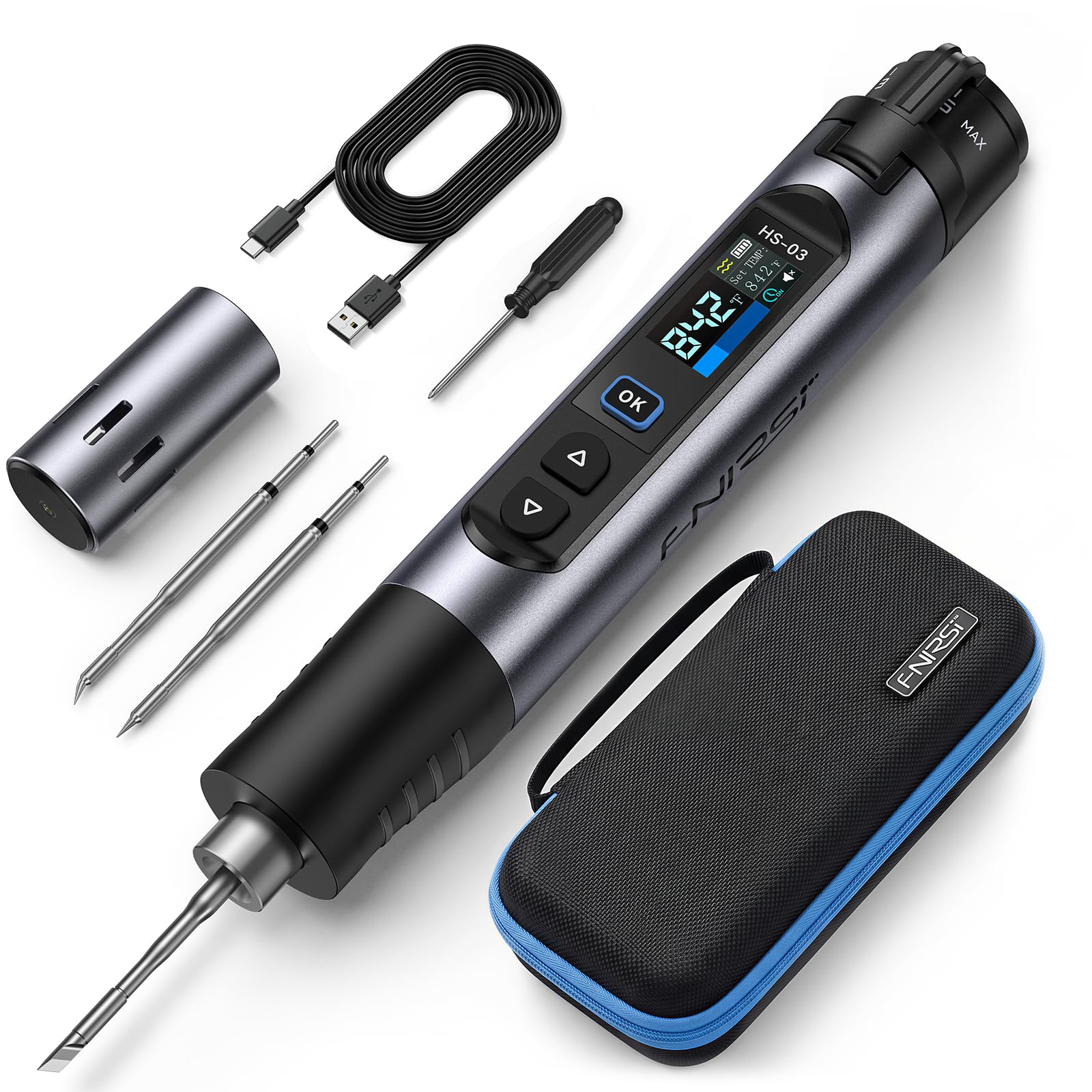
For sheer speed, this is the fastest iron here — 3-second heating puts it ahead of the BK210’s 8 seconds and well clear of the RYOBI’s under-90-second warm-up. A 2600mAh battery runs it cordless, or you plug in over Type-C to solder while charging and keep the work going without a break. The control scheme is flexible: a knob for 5-level quick temperature jumps and buttons for 1-to-50-degree fine-tuning, across a 212°F–842°F span. A 0.96″ IPS color screen shows the setting at a glance, with adjustable brightness that works from a bright lab to a dark garage.
The details are what owners keep returning to. The tip cap doubles as a heat shield so you can set a hot iron down safely, the tips swap without tools in seconds — a K-Tip for joints, an I-Tip for precision, and an IS-Tip for tight spaces — and an adjustable sleep and standby setting keeps it mission-ready. A left/right hand mode gives both lefties and righties a clear view of the screen, and the silicone handle stays comfortable and cool. The kit arrives in a zippered case with three tipped probes and its own storage, and it includes a screwdriver, tips, a storage bag, and a USB cable.
The pattern in the reviews is that it excels at fine work and stops short of heavy cable. It handles light electronics and 12AWG stranded wire with ease, but owners are clear that it is not for thick cable — this is a fine-work tool. The other thing to know is charge time: a full charge is slow, though the battery then holds well and can run straight from a power source even without the battery installed, which is a handy fallback. For PCB repair, modding, and delicate builds, it hits its marks.
Go for it if: you want the fastest heat-up in this lineup and a screen-driven, ambidextrous kit for PCBs, mods, and fine electronics.
Not the one if: you need to melt solder onto heavy-gauge cable, where it is out of its depth.
Understanding the Specs
Heat-up time in seconds
This is how long the tip takes to reach working temperature — the 8-second irons here feel instant, while the 90-second ones make you wait between jobs. In practice, a fast heat-up keeps you in rhythm during a multi-joint repair and a slow one is merely a nuisance. If you are fixing one connection, either works; if you are working down a board, speed matters. That is why heat-up is the number most buyers in this category check first.
Temperature range and wattage
Temperature range is what a tip can actually heat, measured here from 180°C up to 900°F depending on the tool. Higher watts generally mean more reserve to hold temperature when a big wire soaks up heat. A wide adjustable range lets you drop low for delicate pads and climb high for heavier joints. Look for the span, not a single figure, since the low end protects circuit boards and the high end handles thick wire.
Platform battery versus built-in cell
A tool-only iron runs on a battery you already own from your power tools, so the iron costs less but you need the right pack and charger. A built-in cell charges over USB-C and works no matter what battery system you use. Platform tools give you swap-in power; built-in cells give you predictable runtime. Pick based on which batteries already sit on your shelf.
Tip style and tip changes
The tip shape decides what the iron can reach. A fine conical or pencil tip lands on tiny board pads; a larger chisel or screwdriver tip moves more heat for wire work. Tool-free changes let you swap profiles in seconds without hunting for a wrench. Irons that accept a few tip options, like the K, I, and IS styles, adapt to more jobs than a single fixed tip ever will.
FAQ
Will a battery powered soldering iron get hot enough to solder thick wire?
How long does a battery powered soldering iron run on one charge?
Can I use my existing power tool batteries with a cordless soldering iron?
Is a cordless soldering iron as good as a corded one?
What temperature setting should I use for circuit board work?
Do these soldering irons come with a battery and charger?
How fast do these irons heat up before I can start soldering?
Can I run a rechargeable soldering iron while it charges?
What should I look for if I mostly solder small electronics and jewelry?
Is a soldering station better than a soldering pen?
Final Thoughts: The Verdict
The best battery powered soldering iron for most people is the Milwaukee 2488-20 M12, because it heats in under 18 seconds, its pivoting head reaches into tight spots, and it runs on the M12 batteries you already own — the combination that tops this list. If you are in the Milwaukee M18 system and want a fast, well-reviewed alternative, the QSDXNYDC M18 station heats to 350°C in 8 seconds and barely dents a 5Ah pack. For fine electronics and jewelry work on a self-contained charge, the BK210 kit brings a 3200mAh cell and everything you need in one box. The one nudge worth taking: if you already have the right batteries on your shelf, a bare platform tool saves you the cost of a second power system — and since most of these irons are bought that way, matching your battery first is the smartest move you can make.
How We Picked
We do not accept paid placement. Every pick is matched to a real buyer and a real use-case; we do not hands-on test units.
Sources & Methodology
Specifications: manufacturer listings and product documentation. Review insights: verified customer reviews, as of September 2026. Pricing: not shown on this page (it changes often); check the current price via the retailer link.
As an Amazon Associate, KitchPrep earns from qualifying purchases. This does not affect which products we feature.
Related Guides
