
Specs are compiled from manufacturer listings and verified buyer reviews and can change over time — please confirm the key details on the product page before buying.
If you have ever dragged an extension cord across a freshly sanded tabletop, you already know why a battery powered sander solves a real problem. A cord hits the wood, it snags on sawhorses, and it limits how far you can walk from an outlet. The picks below fix that — but only if the tool runs long enough on a charge to finish the job you started. That runtime question is the single biggest difference between a sander you love and one that sits on a shelf.
I’m Mohammad Maruf — the founder and writer behind KitchPrep. This guide is built by comparing the manufacturers’ published specifications and the patterns across verified customer reviews, so you get each pick’s real strengths and trade-offs instead of marketing spin.
The reviews below compare orbit rate, runtime, and dust collection on each of the nine sanders. Runtime per charge is the spec that decides whether a cordless sander finishes the job.
Our Picks at a Glance


How To Choose The Best Battery Powered Sander
Match the sander to the work you do most: flat panels, drywall patches, or tight trim. A palm sander that fits your hand and your existing battery packs gets used far more than a heavier machine that stays in its case.
Check The Pad Size And Shape First
A 5-inch round pad handles broad tabletops, cabinet doors, and plywood sheets. A detail file sander with a narrow belt reaches into tight corners and doorframe edges where a round pad simply will not fit. If your projects are mostly flat stock, a 5-inch random orbit model is the natural pick. If you carve, repair trim, or sand in odd spots, a detail tool earns its place.
Match The Battery To What You Already Own
Several of these sanders ship as bare tools, meaning the battery and charger are not included. That is not a fault — it is a way to reuse packs you have from the same brand’s drill or impact driver. Once you own one battery line, each additional bare tool costs only the tool itself. Buying outside your battery line means paying for a second charger and packs for a tool you use a few times a year.
Think About Dust Before You Buy
Sanding throws fine dust that settles on every surface in the room. A sander with a locking collection bag or a vacuum hose port keeps your workshop cleaner and your lungs happier. It also matters how the bag attaches. A bag that clicks or locks into place stays put; one that simply slides on can pop off when you catch an edge.
Quick Comparison
| Model | Best For | Pad / Belt Size | Max Speed | Battery Included | Amazon |
|---|---|---|---|---|---|
| RYOBI RROS18-0 Eccentric Sander★ Best Overall | Furniture restoration | 125 mm round | 20000 osc/min | No | Amazon |
| RYOBI ONE+ PCL401B Sheet SanderBest Value | Wall patching before paint | 1/4 sheet | 14000 rpm | No | Amazon |
| AVID POWER 20V Random Orbital SanderComplete Kit | One-hand weekend projects | 5 inch round | 11000 rpm | Yes | Amazon |
| WEN 20437 Detail File Sander | Trim and tight corners | 1/2 x 18 inch belt | 1600 rpm | Yes | Amazon |
| SKIL PWRCore 20 SR660302 | Daily repaint work | 5 inch round | 11000 rpm | Yes | Amazon |
| Metabo HPT SV1813DAQ4 | Long finish-carpentry sessions | 5 inch round | 11000 rpm | No | Amazon |
| FLEX FX3411-Z 24V Sander | Aggressive material removal | 5 inch round | 13000 rpm | No | Amazon |
| BOSCH GEX18V-5N | Long furniture sessions | 5 inch round | 10000 rpm | No | Amazon |
| DEWALT DCW210P1 | Full workshop kit | 5 inch round | 12000 rpm | Yes | Amazon |
In‑Depth Reviews
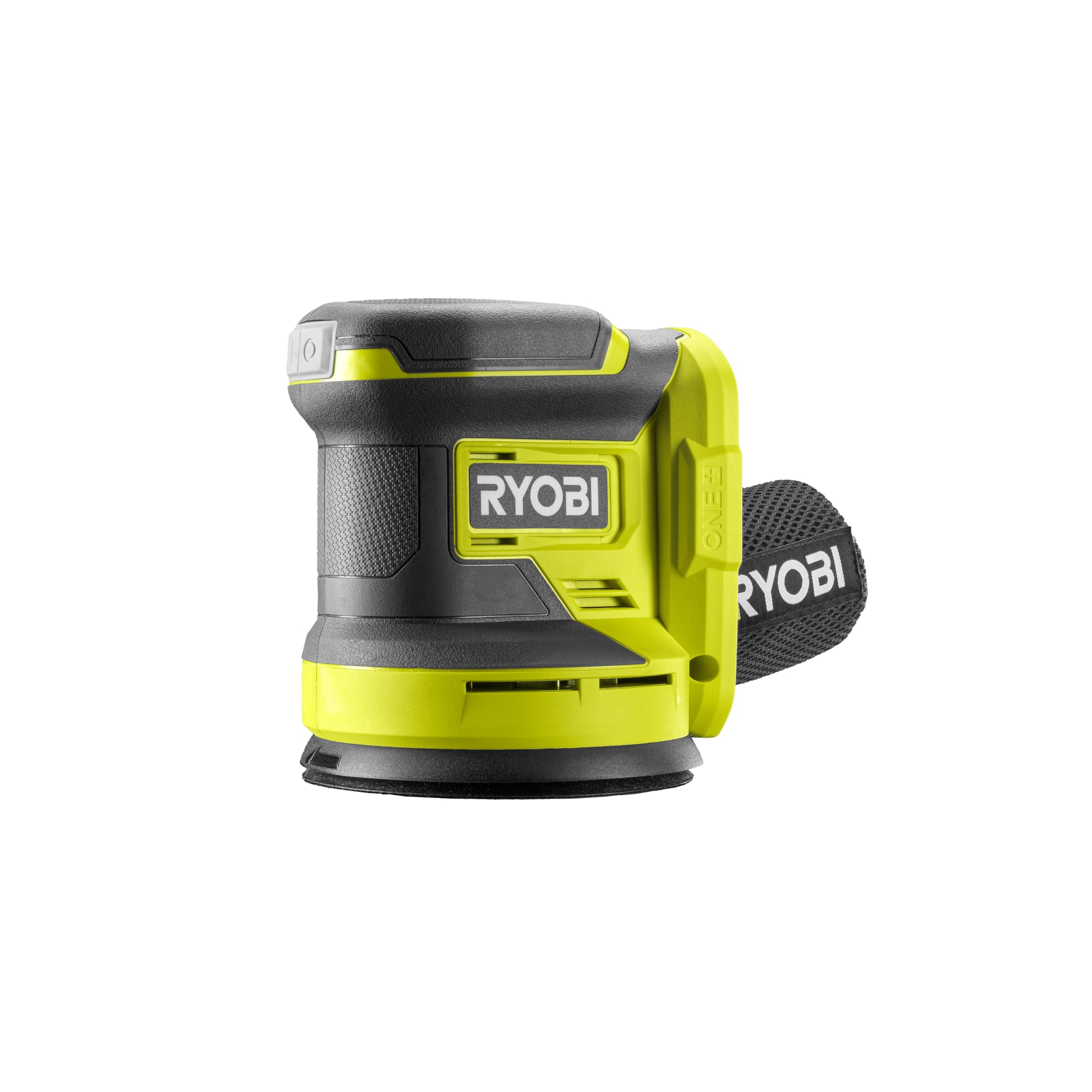
1. RYOBI 18V ONE+ Eccentric Sander (RROS18-0)
Our pick — over 4.5★ from 800+ verified ratings; the strongest balance of quality and price.
The stripped-paint machine that turns furniture rescue into an afternoon job, not a weekend.
The number that sets this Ryobi apart is its 20000 osc/min orbit rate — that is oscillations per minute, the speed at which the sanding pad scrubs in tiny circles. More orbits per minute means faster material removal. For anyone stripping varnish off a dresser or smoothing a refinished table, that speed is the difference between a satisfying afternoon and a slow chore. Its 125 mm pad, about five inches across, is a standard size, so replacement abrasive sheets are easy to find anywhere.
The rest of the package is built around control. A Gripzone-coated handle — that is a textured rubber layer that keeps your palm from sliding — cuts down the tingling buzz that long sanding sessions can leave in your hands. Changing sheets is tool-free thanks to the Velcro backing. A dust collector bag catches the debris as you go, and the sealed switch keeps fine dust out of the on/off mechanism, which is what usually kills a sander early.
You’ll need to swap batteries often on big jobs. Buyers report the sander runs only a short time before you must change the battery numerous times on a large project. That’s the trade-off of cordless sanding in general: sanding large surfaces eats power quickly. It ships as a bare tool with three sanding sheets and no battery, so it only makes sense if you already own Ryobi 18V ONE+ packs (the brand’s battery system that also powers their drills, trimmers, and many other tools).
Where It Wins
- Fast 20000 osc/min orbit rate for stripping and smoothing
- Standard 125 mm pad means widely available abrasives
- Tool-free Velcro sheet changes and an effective dust bag
- Shares the broad 18V ONE+ battery system
What To Expect
- Battery drains fast on large sanding jobs
- Ships without a battery or charger
- Bigger and heavier than a palm sander
- No variable speed adjustment
Grab this one if: you already own Ryobi 18V batteries and do furniture refinishing, paint stripping, or deck work.
Look past it if: you need a palm-sized tool for quick touch-ups, or you don’t own Ryobi batteries yet.
2. RYOBI ONE+ 18V Cordless 1/4 Sheet Sander (PCL401B)
A palm-sized patcher that makes drywall cracks vanish before the paint roller comes out.
This straightforward sheet sander hits 14000 rpm — revolutions per minute — which is the fastest of any model here. That plainly beats the AVID POWER’s 11000 rpm and outpaces the DEWALT’s 12000 rpm tops. For patching nail holes and smoothing drywall repairs, it gets the surface flat faster than you would expect from a tool this light. Its quarter-sheet paper format and a redesigned clamp system make paper swaps quick, and it runs on the same 18V ONE+ batteries as the rest of Ryobi’s line.
The basics are done well. It is at 3.2 pounds, lighter than the AVID POWER’s 3.3 pounds, so one-handed work above your head is manageable. What buyers praise most is simply the quality of the build — it holds up on repeated projects, and that reliability is what keeps people coming back to the line. On-board dust collection and vacuum compatibility round out a tool that seems bigger than its price suggests.
Be realistic about power. Several owners find the battery drains quickly, and the dust collector slides on without a locking mechanism, so it can fall off if you knock it. The real break point is the battery: with a small pack you get roughly half an hour of sanding, while a 4Ah pack stretches that to hours. If you have Ryobi batteries, this is a strong, low-cost entry point.
Best if you need a finishing tool: you want rapid material removal in a palm-sized, lightweight package for wall patches, trim, and small refinishing work.
Not ideal if: you do heavy sanding on large surfaces, or you don’t already own Ryobi 18V batteries and would need to buy into another charger system.
Reach for this if: you need a fast, budget-friendly sheet sander for patching drywall and small finish jobs.
skip it if: you don’t own Ryobi 18V batteries or need the material removal of a random orbit sander on bigger surfaces.
3. AVID POWER 20V Cordless Random Orbital Sander
The box that has everything: sander, battery, charger, and thirty sheets of paper.
Buying this sander means you can start your first project the day it arrives, because nothing else is required. You get the tool, a 20V 2.0A lithium-ion battery, a charger, a dust bag, and thirty sandpaper sheets in 60, 80, and 120 grits. Six variable speeds let you dial the tool from 7,000 RPM for delicate work up to 11,000 RPM for aggressive removal, so one tool covers rough sanding and fine finishing without swapping machines.
Owners consistently rate the quality and the real-world performance here very highly, particularly the six-speed dial, and the grip earns praise too. A rubber over-mold on the handle, which is a soft textured layer, provides comfort for longer sessions and helps you steer one-handed around shelves and trim. A dust-resistant switch cover keeps debris out of the on/off mechanism, and a hook-and-loop pad makes paper changes a snap. Eight vacuum holes at the base pull dust into a removable bag.
The trade-offs are typical. It is a touch heavier than some alternatives and can feel harder to manage at the top speed, and owners note the battery life is more modest than the sander’s power. Batteries are good for intermittent use and long stretches between sessions, but if you plan to run the tool for continuous hours, expect to keep a spare pack charged. The one-hand grip and balanced weight help offset that.
The case for it: the six-speed control and included 60, 80, and 120 grit papers make it a complete starter kit for weekend woodworkers.
Its main limit: it is slightly heavier than some competitors, so heavy continuous sanding may tire your arm, and the battery drains faster than on premium models.
This is your pick if: you want a ready-to-run kit with battery, charger, and an assortment of sandpaper for occasional projects.
Consider skipping if: you need a sander for all-day continuous sanding and want longer battery life between charges.
4. WEN Cordless Detail File Sander (20437)

A narrow-belt problem-solver that fits wherever a round pad refuses to go.
This is not a general-purpose sander, and that is the whole point. Instead of a spinning disc, it runs a 1/2-by-18-inch abrasive belt at a variable 1000 to 1600 feet per minute. That narrow belt slides into door frame edges, teak slats, and carved details where a five-inch round pad would chew up the surrounding surface. The head pivots up to 55 degrees, letting you angle the belt to the shape in front of you. An auto-tracking system keeps the belt centered with no tensioning to fuss over.
Owners prize the quality and the functionality most, and the tight-space reach keeps coming up. The tool is compact enough to run one-handed, and the small contact area is what lets you sand right up to an edge without rounding it over. Belt changes are tool-free, so you’re back to sanding in seconds. Battery life is sufficient for trimming jobs, and the fast charger means you’re not waiting long. A very useful tool for precise detail work, and best reserved for those jobs rather than bulk removal.
Be honest about what it is not. This is a detail sander, so removing large amounts of material is slower than with a random orbit model. Its 2.0Ah battery is modest and is best for intermittent use rather than hours of continuous work. It earns its place for the tricky cuts and trim work, not as your only sander.
Why It Earns A Spot
- Narrow 1/2-by-18-inch belt reaches tight edges and trim
- Head pivots up to 55 degrees for angled work
- Auto-tracking belt needs no tensioning or adjustment
- Tool-free belt changes keep you moving
Its Fastest Route To Trouble
- Only suitable for detail work, not bulk removal
- 2.0Ah battery is modest for long sessions
- Charging issues reported after several months of use
- Included sandpaper of low quality
Ideal for the precise jobs: spot sanding, rust removal, and finishing tight trim that a round pad can’t reach.
Pass on it if: you need to strip a large flat surface or run continuous hours of sanding.
5. SKIL PWRCore 20 Brushless Random Orbital Sander (SR660302)

The kit that revives a dead battery in the time it takes to clear your workbench.
The defining feature here is the PWRJump charger, which charges the battery in just 5 minutes, or to 100% in 30 minutes. That quick top-up changes how you work, because a short break is enough to get you back to sanding. You can also charge the battery from your car, which owners appreciate for mobile repairs away from an outlet. The brushless motor delivers up to 11,000 RPM with variable speed control, so you match the pace to the surface.
An efficient brushless motor — meaning it uses electronics instead of carbon brushes that wear down — runs cooler and lasts longer than a traditional motor. The microfiltration dust canister creates a clean working environment, and the dust-sealed on/off switch extends tool life in gritty conditions. Hook-and-loop paper changes keep the project moving. Owners using it almost daily describe long runs and easy handling, with the battery lasting into the ninety-minute range on the lowest speed and closer to an hour at full speed. The included battery even has a USB port for charging a phone on the job site.
There is one durability note worth knowing. A few owners mention the hook-and-loop pad can work loose from the sanding head over time. It is a fixable part, but it is the kind of thing to keep an eye on. Otherwise, this is a complete kit with battery, charger, and sandpaper, and its charge speed stands out among the picks here.
The main draw is the charge speed: a 5-minute top-up and a full charge in 30 minutes means the tool is rarely down for long.
One long-term watch item: the hook-and-loop pad can loosen from the head with heavy use, so check it periodically.
Match this to your shop if: you want minimal downtime and a complete kit that charges fast enough to keep you working.
Look elsewhere if: you rarely sand and don’t want to invest in a dedicated charging system.
6. Metabo HPT Cordless Random Orbital Sander (SV1813DAQ4)

Barely any buzz in the hand, and at 2.6 pounds it stays comfortable through long finish work.
Weight is the first thing you notice. At 2.6 pounds this is the lightest sander in the roundup, beating both the FLEX’s 3 pounds and the BOSCH’s 2.4-pound class. Paired with six speed settings and an electric brake that stops the pad quickly when you let go, it gives you fine control for finish carpentry, remodeling, and flooring work. Run it on the low 7,000 OPM setting for delicate trim, or dial it up for faster stock removal. It is part of the MultiVolt system, so you can go lightweight with an 18V pack or run longer with the 18V/36V battery for up to 8.0Ah per charge.
What keeps owners impressed is how smoothly it performs. Low vibration and a well-balanced body make it easy to guide, and the one-handed dust bag catches nearly all the sawdust without fuss. It uses the same batteries as Metabo HPT’s drills and impact drivers, so if you’re already in that system, the tool alone is all you need. A dust port and collection adapters are included, letting you hook up a vacuum instead of the bag.
Two things to weigh. It ships without a battery or charger, so it only makes sense if you’re in the Metabo HPT ecosystem. And a heavy 8Ah pack makes the tool tip toward the battery side — a natural physics thing, not a flaw. For pure comfort on long sessions, this is about as good as it gets in cordless sanding.
Standout Qualities
- Lightest at 2.6 pounds for less fatigue
- Six-speed control with a quick-stopping electric brake
- Very low vibration for precise finish work
- Backed by Metabo HPT’s 5-year tool warranty
Where It Falls Short
- Battery and charger not included
- Dust bag closure is fiddly to operate
- Heavy 8Ah packs tip the tool sideways
- Slower top speed than the fastest models here
Your tool if: you’re already in the Metabo HPT system and want the lightest, smoothest handling for finish work.
Not your tool if: you don’t own Metabo HPT batteries or want everything in one box.
7. FLEX 24V Brushless Cordless Random Orbital Sander (FX3411-Z)

Turbo mode’s 13,000 OPM chews through material faster than anything else on this list.
For raw removal speed, this is the tool to beat. Turbo mode reaches 13,000 OPM, the highest of any sander here, and it plainly outpaces the DEWALT’s 12,000 rpm top. Push the trigger and material disappears. That power comes from the FLEX 24V system, with a sensor-free brushless motor that runs cooler and more efficiently than a brushed equivalent. In Speed 3 with a 3.5Ah stacked battery you’re looking at up to 30 minutes of runtime, and the low-profile body keeps the tool close to the workpiece for control.
Owners rate the performance and the raw power here at the very top of the list. The pad brake adds endurance for long jobs, and the dust- and water-resistant switch keeps the tool working in dusty shops. A dust bag and ports mean you can run it bagged or hooked to a vacuum. Comfort is a genuine advantage too — a few owners who own several big brands say it feels more comfortable than the alternatives. Register the tool within 30 days and you get FLEX’s limited lifetime warranty.
The honest catch is battery life, which owners describe as mixed. Thirty-minute runs mean bigger jobs need a spare pack on standby, which is normal for a high-output motor. And like most FLEX tools, it ships as a bare tool with no battery or charger. If you’re already in the 24V system and want maximum power, this is the aggressive option.
The raw-power pick: 13,000 OPM in Turbo mode makes it the fastest for stripping paint and hogging off material.
Budget for the batteries: up to 30 minutes of runtime per charge means a larger job will need a second pack.
Choose this for maximum bite: you want the fastest removal of material for heavy sanding, and you’re invested in FLEX 24V batteries.
Not for you if: you sand in short bursts or want a battery and charger included.
8. BOSCH GEX18V-5N 18V Brushless Random Orbit Sander

Handles like a palm sander but removes stock like a corded machine.
Bosch built this one around your hand. Its compact palm-grip shape and vibration-dampening element cut the fatigue that comes from holding a sander flat against a panel. Soft-start technology eases the tool into the workpiece so it doesn’t jerk on startup, and constant speed keeps the disc spinning steadily under load. A hook-and-loop backing pad conforms to contours, and the dust port takes either the included bag or a vacuum hose. The 18V brushless motor pulls stock removal close to what a corded sander manages.
The thing everyone agrees on is the build quality. Owners point to the balance, the cast zinc dust chute, and the intuitive push-button switch, and many describe finishing projects faster than before. Running a 4Ah pack let one woodworker sand both faces of a full 4×8 plywood sheet with 40-grit paper and still have a bar left. It holds speed smoothly even when you press into the grain, and the vibration damping keeps your hand fresh.
Two real notes. The battery sits centered on the disc, so you pull up slightly to keep the pad flat — some find that tiring on long jobs. And power is strong but not limitless compared to the fastest tools here. It ships as a bare tool, so it’s best for owners already in Bosch’s 18V lineup. For a smooth, well-balanced all-rounder, it’s hard to argue with.
What Buyers Value
- Compact palm grip with vibration damping for less fatigue
- Soft-start and constant speed for controlled sanding
- Quiet operation for a cordless sander
- Choice of dust bag or vacuum hose connection
Trade-Offs To Know
- Battery placement can tire your hand on long sessions
- Bare tool with no battery or charger
- Power slightly less than the highest-output models
- Top speed of 10200 rpm is modest
A strong fit if: you own Bosch 18V batteries and want a well-built, low-vibration all-rounder for furniture and trim.
Think twice if: you want maximum removal speed or a ready-to-run kit with battery and charger.
9. DEWALT 20V MAX Random Orbital Sander Kit (DCW210P1)
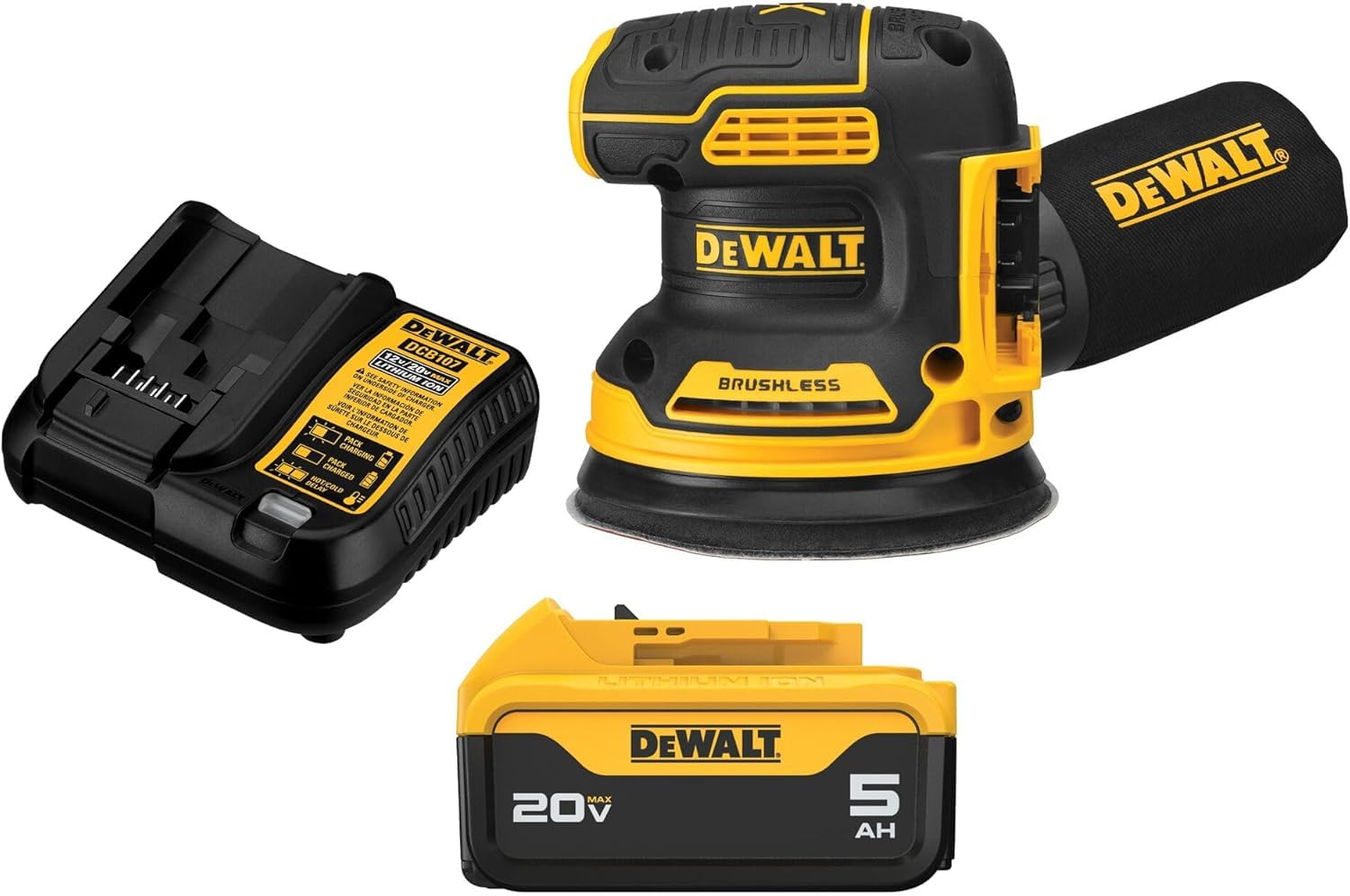
A complete kit built to run all day on a brushless motor and a big battery.
This is the full-package sander: the tool, a 5.0Ah lithium-ion battery, a charger, and a dust bag all in one box. The brushless motor runs efficiently and the variable-speed control spans 8,000 to 12,000 OPM, giving you the whole range from delicate finish work to faster removal. That 12,000 rpm top speed sits between the SKIL and BOSCH, right in the middle of the pack. A low-profile body lets you get close to the work surface for precision, and the eight-hole hook-and-loop pad takes standard paper.
Owners overwhelmingly praise the raw performance, and the combination of power and portability is the recurring theme. The 5.0Ah battery lasts through long sessions, and the rubber-overmold grip adds comfort. The spring-loaded dust canister snaps on and stays put while it collects. One owner found the tool stops instantly when switched off — unlike older models that spin down for ten to fifteen seconds — and that instant stop makes controlled sanding much easier. It is a heavy-duty kit from a brand known for its carpentry tools, and the emphasis here is on getting the job done without stopping.
The main practical limit is access. The battery and dust canister both protrude, so getting into tight corners is harder than with a lower-profile tool, and the sander is a touch noisier than a corded model. It’s also the most expensive sander in this group, so the value rests on the included 5.0Ah battery and charger. If you’re already in the DeWalt 20V lineup, this kit slots right in.
Built for endurance: the 5.0Ah battery and brushless motor give you long runtimes for big projects, and the kit includes everything you need.
One access caveat: the protruding battery and canister make cornering tricky, and it’s the top-priced option here.
This is the one for: carpenters and serious hobbyists who want a complete, powerful kit and long battery life from the start.
It’s not the cheapest route if: you want to reuse existing batteries or need a low-profile tool for tight spaces.
Understanding the Specs
Orbit Rate (OPM / RPM)
Orbits per minute, or OPM, measures how fast the sanding pad scrubs in small circles. A higher number removes material faster. The FLEX tops out at 13,000 OPM in Turbo mode, the RYOBI eccentric sander runs at 20000 osc/min, and the sheet-sander models spin at 14000 rpm. Lower numbers like the Metabo HPT’s 7,000-to-11,000 OPM range suit lighter finish work. Match the speed to the job: fast for stripping, slower for a smooth final pass.
Battery Amperage (Ah)
Amperage capacity, written in Ah, is the size of the power tank. A bigger number means a longer run between charges. The DEWALT kit ships with a 5.0Ah battery, while the AVID POWER and WEN use 2.0Ah packs. Sanding is a power-hungry job, so a larger battery means fewer interruptions. If you own batteries from the same brand, you can often drop a bigger pack into a bare tool for longer sessions without buying new equipment.
FAQ
What does it mean when a sander is sold as a bare tool?
Will a battery powered sander run long enough for a whole furniture project?
Can I hook these sanders up to a shop vacuum instead of the dust bag?
Why do owners complain about the dust bag falling off some sanders?
Is a random orbital sander or a sheet sander better for sanding drywall patches?
What tasks is a detail file sander like the WEN 20437 made for?
Do I need a brushless motor in a cordless sander?
Can I use a bigger battery to get longer runtime from a bare-tool sander?
Are cordless sanders as powerful as corded models?
What is the advantage of a variable speed control on these sanders?
Final Thoughts: The Verdict
For most people, the battery powered sander winner is the RYOBI RROS18-0. Its 20000 osc/min orbit rate (the speed at which the sanding pad moves in tiny circles) strips and smooths furniture faster than anything else in its class, and it fits the huge Ryobi 18V ONE+ battery line. If you want a complete kit with battery, charger, and sandpaper ready to go, grab the DEWALT DCW210P1. And for sanding tight trim and door frames where a round pad won’t reach, the WEN 20437 Detail File Sander is the one to reach for.
How We Picked
We do not accept paid placement. Every pick is matched to a real buyer and a real use-case; we do not hands-on test units.
Sources & Methodology
Specifications: manufacturer listings and product documentation. Review insights: verified customer reviews, as of September 2026. Pricing: not shown on this page (it changes often); check the current price via the retailer link.
As an Amazon Associate, KitchPrep earns from qualifying purchases. This does not affect which products we feature.
Related Guides
