
Specs are compiled from manufacturer listings and verified buyer reviews and can change over time — please confirm the key details on the product page before buying.
Hauling a compressor, hoses, and extension cords up a ladder onto a sloped roof is the part of the job everyone hates. A battery powered roofing nailer eliminates that entire tangle, letting you work with just the tool and a coil of nails in hand. The real question is which cordless model can sink a nail cleanly through shingles all day without jamming or running out of juice — and that’s what this guide breaks down for you.
I’m Mohammad Maruf — the founder and writer behind KitchPrep. This guide is built by comparing the manufacturers’ published specifications and the patterns across verified customer reviews, so you get each pick’s real strengths and trade-offs instead of marketing spin.
Here are the four cordless options worth your time, from the crowd-favorite DeWalt to the air-spring Metabo, so you can find the best battery powered roofing nailer for your next shingle job.
Our Picks at a Glance

How To Choose The Best Battery Powered Roofing Nailer
You want a roofing nailer that drives nails hard, lasts through a full roof on one charge, and won’t jam when you’re perched halfway up. A pneumatic nailer needs an air compressor, but these battery models use either a flywheel or an air spring to deliver the same force without a hose. Your choice depends on which drive type fits how you work.
Match the nail coil to the tool
Roofing nails come in coils, and the angle of that coil has to match your gun. A 15-degree coil and a 16-degree coil are not interchangeable, so check the magazine angle before you buy a box of nails. These tools also have a length limit, usually up to 1-3/4 inches, which covers standard shingle work.
Decide how many nails you need per charge
Battery capacity decides how long you work before swapping packs. A compact 2.0Ah battery might drive a few hundred nails, while a larger pack can last a full day on smaller jobs. If you are re-roofing a whole house, plan on having at least two batteries so one can charge while the other is in the gun.
Look for depth adjustment and firing modes
A tool-free depth dial lets you set how deep each nail sinks without carrying a separate wrench. Firing modes matter too: sequential mode drives one nail per trigger pull for precise placement, while bump mode lets you hold the trigger and bounce the nose along for speed on open field shingles.
Quick Comparison
| Model | Best For | Weight | Nail Length | Drive Type | Amazon |
|---|---|---|---|---|---|
| DeWalt DCN45RNB★ Best Overall | Full roof jobs | 6.7 pounds | Up to 1.5 inches | Flywheel | Amazon |
| CORDLESS ROOFING NAILER (DeWalt) | Repairs & small jobs | About 9 lbs with battery | — | Flywheel | Amazon |
| Metabo HPT NV1845DA | Pneumatic-like power | 8.6 pounds | Up to 1-3/4 inches | Air Spring | Amazon |
| Milwaukee 2909-20 | Deep control & balance | — | Up to 1-3/4 inches | — | Amazon |
In-Depth Reviews
1. DeWalt 20V MAX 15 Degree Coil Battery Powered Roofing Nailer
Our pick — 4.5★ from 600+ verified ratings; the strongest balance of quality and price.
The 6.7-pound cordless that takes over when a compressor job turns into a full 15-square roof.
At just 6.7 pounds, this DeWalt is the lightest nailer here — 28% lighter than the Metabo HPT at 8.6 pounds — and that weight saving shows up at the end of a long day on a slope. It runs on the 20V MAX battery system (the battery is sold separately since this is a bare tool), and a small 20V pack lasted a full day on one reported repair job. The brushless motor is the reason: it sips power while delivering consistent driving force.
The bump mode is what makes it fast — you hold the trigger and bounce the nose along the shingles to fire rapidly, which is exactly what you want on open field areas. Buyers report running it for a complete 15-square roofing job without any compressor backup, with just a couple of easy-to-clear jams along the way. The tool-free nail tray slides out and adjusts by hand to fit the full range of coil roofing nails, so switching nail sizes mid-job takes seconds, not a trip to the truck for a wrench.
The honest trade-off is the flywheel design: it is heavier up top than an air tool and the depth adjuster sometimes needs to be backed all the way out to hit the right depth. Review pages report the odd jam with off-brand nails, but DeWalt-brand and BHTOP coils feed cleanly. One buyer’s verdict after a full all-day run: “not even one jam after using all day.”
The full-day finisher: This is the tool owners reach for when they abandon the compressor mid-job — it drives nails hard and fast enough to complete an entire roof, not just patch a leak.
Plan for spare packs: The bare-tool format means you supply your own 20V batteries, and serious all-day work will need more than one.
For the pro or ambitious DIYer: who is already inside the DeWalt 20V battery family and wants a nailer that handles whole roofs without a hose.
Think twice if: you own no DeWalt batteries — the bare-tool price adds up once you factor in buying your first 20V pack and charger.
2. DEWALT CORDLESS ROOFING NAILER

The cordless that makes a small repair job feel almost too easy to call work.
This is the same DCN45RNB model family as the Best Overall pick, sold as a multi-colored unit from Stanley Black and Decker, and it shares the cordless convenience that owners rave about. Its defining quality is how it transforms small jobs — the thing everyone praises most is that it simply works, with 25 owners highlighting its functionality. That makes sense for a tool whose whole pitch is replacing the compressor-and-hose hassle.
A roofing company owner calls it “a great value for the money” and “very durable,” reaching for it specifically on small repair jobs rather than full tear-offs. The weight is where opinions split: it feels solid and sturdy in hand, but it tips the scale at an exact 9 pounds with a 20V battery attached. That is noticeably heavier than the 6.7-pound Best Overall pick above, so it suits shorter bursts of work more than marathon runs.
If you are patching a few shingles, replacing a valley, or doing touch-up work around a chimney, this tool saves you from dragging the air compressor out of the garage entirely. The speed is not the fastest on the market, and a rare owner found it less durable than expected, so treat it as the repair specialist it is rather than a nonstop production gun.
Why owners reach for it
- Cordless freedom means no compressor, extension cord, or air hose on the roof — owners say that alone is worth it
- Runs on the common 20V platform you likely already own for other tools
Who should pause
- At roughly 9 pounds with a battery, it is on the heavier side for a full-day roof
- Speed is a step behind the fastest cordless guns, so production roofers may feel held back
Best for the homeowner: with a leak or a few blown-off shingles who wants a one-handed fix without renting a compressor.
Not the pick if: you are tearing off and re-decking entire roofs weekly and need maximum speed and minimal fatigue.
3. Metabo HPT 18V MultiVolt Brushless Coil Roofing Nailer NV1845DA

The first air-spring coil roofing nailer that delivers pneumatic force with zero hoses attached.
You get pneumatic-like force without a compressor from the Metabo HPT, their first air spring coil roofing nailer. Instead of a spinning flywheel, an internal air spring compresses and releases to slam the nail home, mimicking a pneumatic gun. Buyers who switched from an air compressor report they “couldn’t tell the difference in power/effectiveness.” It weighs 8.6 pounds, heavier than the DeWalt, but that heft delivers serious driving force.
The kit is genuinely complete: it arrives with an 18V 2.0Ah battery, a charger, a vinyl siding adapter, a wrench, a carry bag, and safety glasses. That included battery drives up to 500 nails per charge, and it accepts 16-degree wire coil nails from 7/8-inch up to 1-3/4 inches at.120-inch diameter — the broadest nail range in this lineup. The side-loading magazine makes reloading fast, and a dust and tar resistant mechanism is designed to keep roofing debris out of the driver blade.
Quality control is the honest concern here. One owner’s unit had the battery fall out and shut off repeatedly — a frustrating experience that stands in contrast to the many owners who love the tool. A first-time nailer buyer called it “great value,” and it won a 2025 Pro Tools Innovation Award. If you get a good unit, the lifetime tool body warranty (with 2 years on the battery and 1 year on the charger) backs it up.
The pneumatic feel, minus the hose
- Air spring drive matches the power of a compressor-fed nailer
- Complete kit with battery, charger, and vinyl siding adapter included
The catch to weigh
- At 8.6 pounds it is the heaviest pick here, tiring on long overhead stretches
- An occasional unit arrives with battery or firing issues — buy where returns are easy
Reach for the Metabo if: you are used to pneumatic power and refuse to give up that driving force when you cut the cord.
Look elsewhere if: weight is your top concern — at 8.6 pounds, this one asks more of your arms than the DeWalt.
4. Milwaukee M18 FUEL Coil Roofing Nailer 2909-20
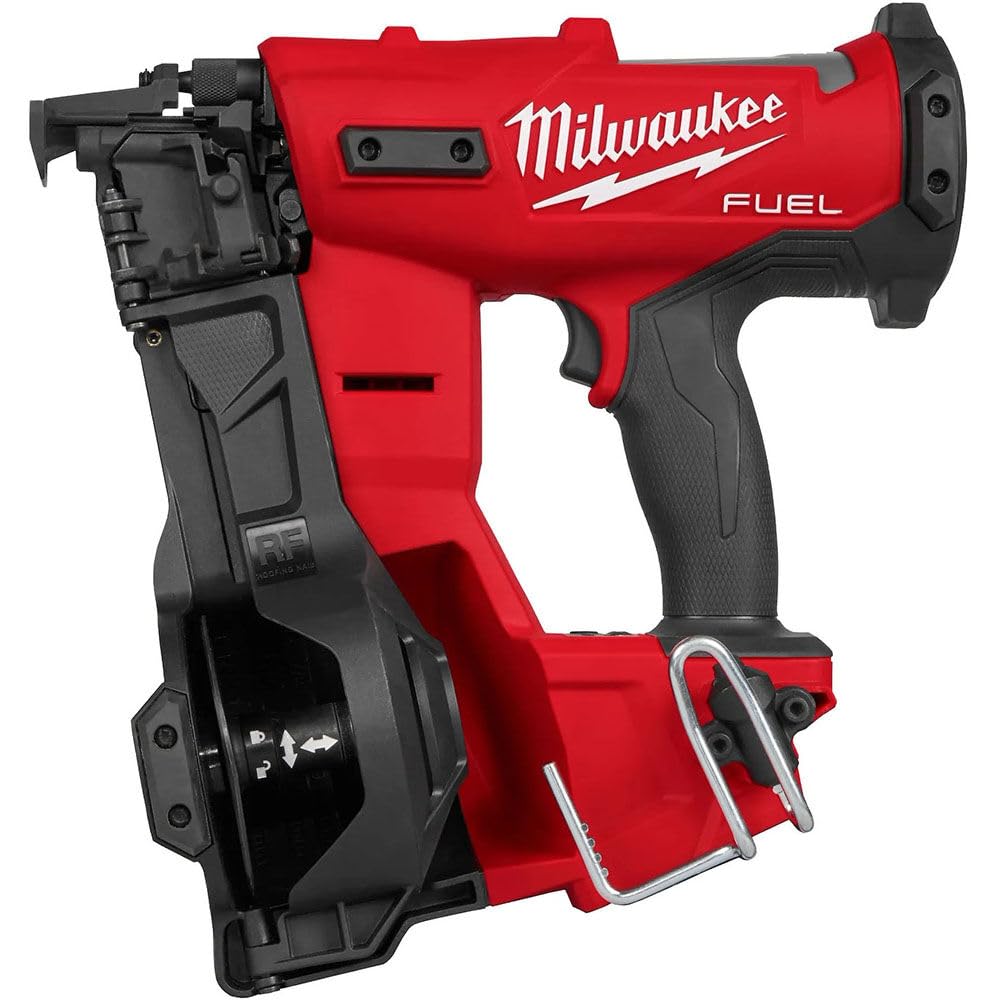
A M18 FUEL nailer with balance so good it refuses to slide down the roof when you set it down.
The Milwaukee M18 FUEL runs on the M18 FUEL battery system, so you can ditch the compressor and hose entirely. Its balanced design keeps it steady on a sloped roof without sliding when you set it down, a relief when grabbing the next shingle bundle. It takes 15-degree coil roofing nails and holds up to 120 in the magazine, cutting reload stops between courses.
The tool-free depth adjustment dial is the control freak’s friend: spin it to set exactly how deep each nail sinks, no wrench required. It drives roofing nails up to 1-3/4 inches with force rated for various roofing materials, and the sequential trigger mode gives you one-nail-per-pull precision for tricky spots like valleys and flashings. One owner called it “the best tool I’ve ever purchased,” noting excellent battery life and fast loading over a 9-hour workday.
The standout praise is how consistent the nail drives are — a full day of work produced just two misfires, one of which the owner admitted was their own error while learning the auto mode. The flip side is that a rare unit struggles to set nails fully, leaving them proud enough that you would need a hammer to finish them. It is the most expensive pick here, so it is for the pro who wants the M18 platform’s reliability and a tool that keeps pace all day.
Built for balance and control: the depth dial and sequential firing mode make precise shingle work feel deliberate, not rushed.
The premium cost is real: this is the top-tier price in the lineup, justified mainly if you already live in the M18 battery ecosystem.
Choose the Milwaukee for: long production days where consistent nail depth and reliable battery life matter more than the upfront cost.
skip it if: you do not already own M18 batteries — the bare-tool price plus new packs makes it the most expensive route into cordless roofing.
Understanding the Specs
Drive Type: Flywheel vs Air Spring
The drive type is the engine of a cordless nailer. A flywheel system spins a heavy wheel to strike the nail, a proven and consistent method used by the DeWalt. An air spring compresses air and releases it like a pneumatic gun, giving the Metabo its compressor-like feel. Neither is inherently superior; pick the proven workhorse or the newer pneumatic mimic based on your preference.
Coil Angle Compatibility
Roofing nails are glued into coils, and the angle of that coil has to match your magazine. A 15-degree coil (like the Milwaukee) and a 16-degree coil (like the Metabo) look similar but will not cross-feed. Always match the nail coil angle to your specific nailer model, and stay within the listed nail length range — typically up to 1-3/4 inches — so the driver can seat the nail fully.
FAQ
How many nails can a battery powered roofing nailer drive per charge?
Will a cordless roofing nailer really replace my pneumatic nailer?
What is the difference between bump mode and sequential firing?
What length roofing nails can these tools drive?
How heavy is a battery powered roofing nailer and will it tire me out?
Do these nailers jam often, and are jams hard to clear?
Is the depth of the nail adjustable on cordless roofing nailers?
Can I use a battery powered roofing nailer for vinyl siding too?
Final Thoughts: The Verdict
For most roofers, the battery powered roofing nailer to buy is the DeWalt 20V MAX: at 6.7 pounds it stays light for all-day use, its bump mode keeps production moving, and shoppers say finishing entire roofs on one charge. If you want pneumatic-level force without a compressor, choose the Metabo HPT for its air-spring drive. For precise control on tricky sections, the Milwaukee M18 FUEL with its tool-free depth dial is your best pick.
How We Picked
We do not accept paid placement. Every pick is matched to a real buyer and a real use-case; we do not hands-on test units.
Sources & Methodology
Specifications: manufacturer listings and product documentation. Review insights: verified customer reviews, as of September 2026. Pricing: not shown on this page (it changes often); check the current price via the retailer link.
As an Amazon Associate, KitchPrep earns from qualifying purchases. This does not affect which products we feature.
Related Guides
