
Specs are compiled from manufacturer listings and verified buyer reviews and can change over time — please confirm the key details on the product page before buying.
Dragging a cord across a finished floor or running an extension reel out to a half-built deck is exactly why cordless miter saws changed trim work. The short answer: pick a saw that runs on the battery platform you already own, because the blade is only 7-1/4 inches or 10 inches wide on most of these tools and the battery is what decides whether you finish the job today. This guide sorts the real differences between them — blade size, cut capacity, weight, and how many cuts each one delivers before it needs a fresh pack.
I’m Mohammad Maruf — the founder and writer behind KitchPrep. This guide is built by comparing the manufacturers’ published specifications and the patterns across verified customer reviews, so you get each pick’s real strengths and trade-offs instead of marketing spin.
You will see which saws handle nested crown and baseboard standing up, which ones stay light enough to carry one-handed, and which run all day on a single charge. Every pick below is a cordless saw, and the right one for you usually depends on the batteries already sitting in your garage. Here is how to sort the battery powered miter saw options before you commit to a platform.
Our Picks at a Glance


How To Choose The Best Battery Powered Miter Saw
Choosing a cordless miter saw is mostly a battery decision wrapped around a blade decision. Get those two right and almost everything else — accuracy, dust, portability — falls into place. Here is what actually matters when you compare these tools.
Match the saw to the battery you already own
A miter saw body is cheap compared to a stack of batteries and chargers, so the platform you are already invested in usually decides the brand. A DEWALT 20V MAX pack will not run a Ryobi ONE+ tool, and Bosch CORE18V packs are their own system. If you own several tools on one platform, buy the saw that shares those packs and you skip the re-buy entirely. If you are starting fresh, look at how many other tools that platform covers, because a saw is rarely the last cordless tool you buy.
Blade size and crosscut capacity decide what you can cut
Blade diameter sets the ceiling on what passes under the blade. A 7-1/4 inch blade handles standard dimensional lumber and most trim, while a 10 inch or 12 inch blade opens up wider stock and deeper vertical cuts. Crosscut capacity tells you the widest board you can slice in a single pass — a sliding saw extends the blade forward so it reaches wider material than a fixed-head saw of the same blade size. If your work is baseboard, crown, and framing, a compact sliding saw covers it. If you are cutting wide shelving or deck boards, step up in blade size.
Single-bevel or dual-bevel, and which angles you tilt
A single-bevel saw tilts the head one direction only, so you flip the workpiece to cut the opposite bevel. A dual-bevel saw tilts both left and right, which saves the flip on crown and complex joints. For cutting baseboard flat and simple miters, single-bevel is plenty. For crown molding and picture frames where you are chasing a mirrored angle, dual-bevel removes a whole step. Bevel detents at common angles make those setups faster and repeatable.
Quick Comparison
| Model | Best For | Blade | Weight | Cutting Angle | Amazon |
|---|---|---|---|---|---|
| DEWALT 20V MAX 7-1/4-Inch (DCS361M1)★ Best Overall | All-rounder for trim and framing | 7.25 inches | 16 ounces | 48 degrees | Amazon |
| CRAFTSMAN V20 Sliding 7-1/4 inch (CMCS714M1)Best Value | DIY baseboard and trim on a budget | 4 inches | 21.8 pounds | 90 degrees | Amazon |
| Ryobi ONE+ 7-1/4 in. Miter Saw P551 (Tool Only)Compact Pick | Ryobi owners with batteries already | 7.25 inches | 17.4 pounds | 45 degrees | Amazon |
| RYOBI ONE+ 18V Sliding Compound 7-1/4 in. | Long runtime and wide sliding cuts | 7.25 inches | 30.2 pounds | 45 degrees | Amazon |
| BOSCH GCM18V-07SN PROFACTOR 18V | Compact jobsite trim and finish work | 4 inches | 26 pounds | 45 degrees | Amazon |
| DEWALT 20V MAX XR 10 in. Double Bevel (DCS714B) | Big capacity crosscuts and base molding | 10 inches | 34 pounds | 22.5 degrees | Amazon |
| BOSCH GCM18V-07SN14 PROFACTOR Kit | Going cordless from scratch with a big pack | 4 inches | 11.8 kg | 45 degrees | Amazon |
| MILWAUKEE M18 FUEL 10 in. Dual Bevel (2734-21HD) | Heavy framing and deck building | 10 inches | 45 pounds | 90 degrees | Amazon |
| FLEX 24V 12-Inch Dual Bevel Kit (FX7141A-1J) | Large stock and one-pass 12 inch cuts | 12 inches | 53.6 pounds | 47 degrees | Amazon |
| Makita XSL06PT 18V x2 LXT 10″ (5.0Ah) | Stationary shop and jobsite accuracy | 10 inches | 80.5 pounds | 90 degrees | Amazon |
| Festool KAPEX KSC 60 EB 5.0 I-Plus | Finish carpentry and fine trim | — | 59.6 pounds | 47 degrees | Amazon |
In‑Depth Reviews
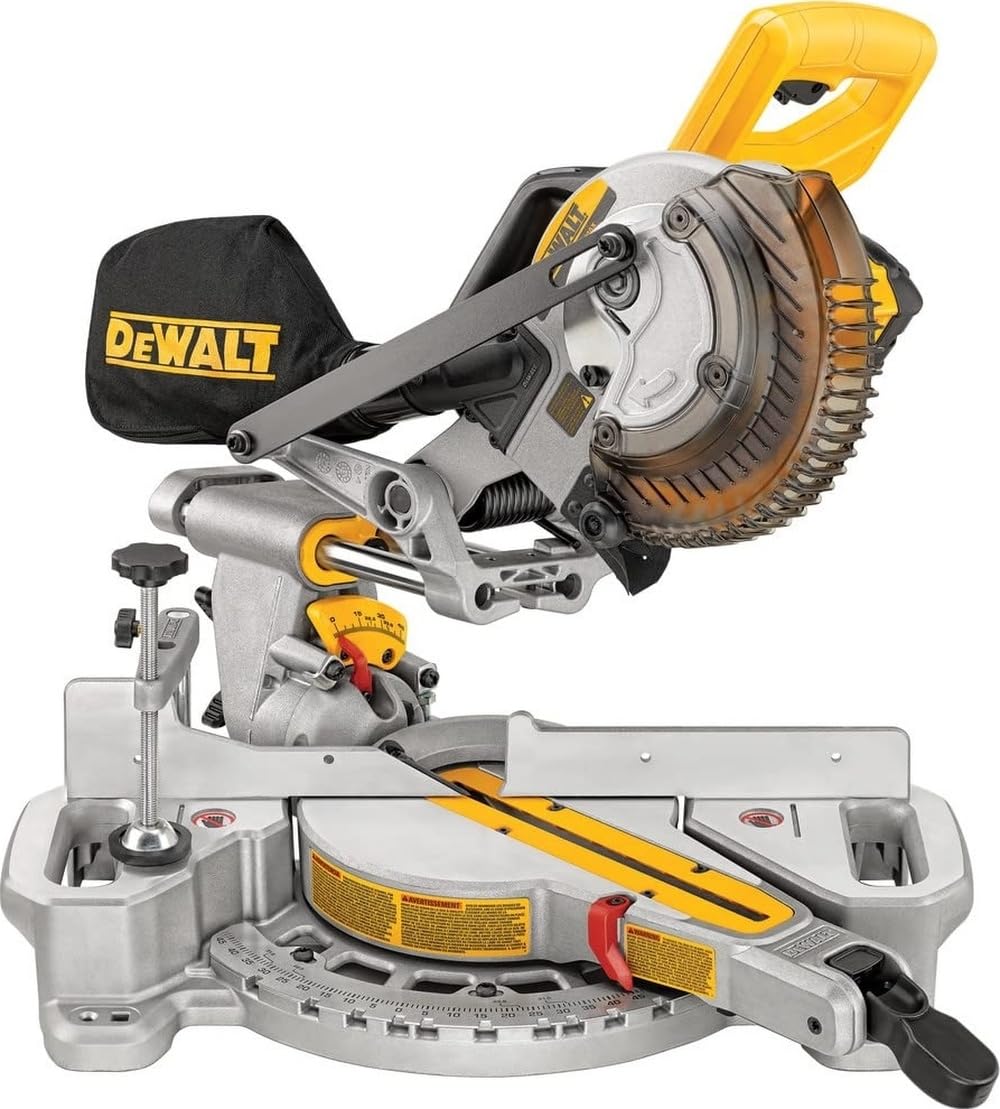
1. DEWALT 20V MAX* 7-1/4-Inch Miter Saw, Cordless (DCS361M1)
Our pick — over 4.5★ from 800+ verified ratings; the strongest balance of quality and price.
The trim saw that keeps cutting long after the corded one would need an outlet.
This is the pick for the trim carpenter or remodeler who already owns DEWALT 20V batteries and wants a saw that feels like a corded tool until the battery pack runs down. The headline number is runtime: the included DCB204 20V MAX battery delivers on average 183 cuts of 2×4 pine or 275 cuts of 3-1/4 inch pine baseboard on one pack. That is a full trim job in a single charge, no extension cord in sight. It cups 3-5/8 inch nested crown and 3-1/2 inch base vertically, so you can stand baseboard up and cut it without laying it flat.
What buyers gravitate to most is how compact and light it feels in hand — it is the smallest and most carriable of the DEWALT saws here, with a machined base fence and an adjustable stainless steel miter detent plate carrying 11 positive stops for repeatable angles. The cut line cross-cut positioning system gives you adjustment-free cut line indication, so you see exactly where the carbide blade meets the wood before you pull the trigger. A cam lock miter handle locks in angles fast, and the oversized bevel scale makes bevel tweaks readable at a glance.
The honest catch is depth: this saw cuts to roughly 2-3/4 to 3 inches of vertical capacity, so thicker stock has to lie flat. And you will want the bigger 4Ah and up packs, not the smallest 20V batteries, because it pulls real current under load. It also ships with a working carbide blade but plenty of owners swap to a finer-tooth blade for finish work.
Where it pulls ahead
- 183 cuts of 2×4 pine or 275 cuts of 3-1/4 inch pine baseboard per charge
- 11 positive miter detents plus a cam lock handle for fast, repeatable angles
- Adjustment-free cut line indication for straighter crosscuts
Worth knowing first
- Vertical cut tops out around 2-3/4 to 3 inches, so thick stock lays flat
- Wants 4Ah and larger packs — small batteries sag under load
- Stock blade is fine, but a finer-tooth blade cuts cleaner trim
Best for: trim carpenters and remodelers already on the DEWALT 20V platform who need cordless freedom on every cut.
Skip if: you need deeper vertical cuts than this saw’s roughly 3-inch capacity allows.
2. CRAFTSMAN V20 Cordless Sliding Miter Saw, 7-1/4 inch, Single Bevel (CMCS714M1)
A sliding head and a big battery in the box, sized for the weekend remodel.
Where the DEWALT above cuts deeper into pro-grade build and pricier batteries, the CRAFTSMAN takes a different path: an entry-level saw that ships with everything you need to start cutting today. The included CMCB204 V20 4.0Ah lithium-ion battery and fast charger mean no separate battery purchase, and the slide capability adds capacity the fixed-head saws cannot match. It crosscuts 8 inches at 90 degrees and 5-1/2 inches at 45 degrees, cut through the sliding head reaching forward into wider boards. The 3,800 RPM motor is built for 2x dimensional lumber, hardwoods, baseboard and trim.
Strip cutting to a single charge tells the story best: this saw makes up to 585 cuts in 3-1/4 inch MDF baseboard on a full pack. What wins people over is the outright cutting performance — it powers through 2x4s without stalling, and the LED cut line positioning system throws a clean shadow across the work so your mark lines up. Nine casted miter detent stops click into common angles, and a lightweight design with side carry handles makes it easy to haul from room to room.
The real-world limits show up in thicker material and at 45 degrees. The motor can graze wood on cuts of 3 inches and up, such as 3.25 inch baseboards, and the hold-down clamp sits in the path of 45 degree cuts and takes a screwdriver to reposition. It is a genuinely great tool for a homeowner or solo remodeler, but daily commercial duty is a stretch.
The sliding advantage: 8-inch crosscut at 90 degrees and 5-1/2-inch at 45 degrees opens up baseboard and crown the fixed-head CRAFTSMAN-class saws cannot reach in one pass.
Where it keeps pace: The 4.0Ah battery and charger are included, so a first-time cordless buyer is cutting on day one rather than waiting on a separate purchase.
Reach for this if: you are a homeowner or solo remodeler who wants a sliding saw, a battery, and a charger in one box.
Think twice if: you plan to run it daily on a crew, where the motor strain on 3-inch-plus cuts becomes a constant nuisance.
3. Ryobi 18-Volt ONE+ 7-1/4 in. Cordless Miter Saw – P551 (Tool Only)
The bare tool Ryobi owners pick up when they already have the batteries.
For a garage full of Ryobi ONE+ 18V tools, this saw slides straight into the collection without another charger on the shelf. It runs a 7.25 inch carbide-tipped blade, which is a full size larger than the 4-inch blade on the CRAFTSMAN, so it grips more wood per cut. At 17.4 pounds it is one of the lighter saws in this lineup — the DEWALT weighs 16 ounces and the CRAFTSMAN tips 21.8 pounds, so this lands squarely in the carryable middle. Its 45 degree cutting angle covers the standard miter cuts on trim and framing.
What earns it a spot is straight functionality at a tool-only price. What wins people over is the weight and easy handling — it delivers clean, accurate cuts and stays simple to carry between small jobs around the house. Buyers report knocking out a full porch railing with 24 struts and 6 rails cut clean on this head, once the blade strike point is learned. The battery power keeps it handy for the quick trim cut you would otherwise drag a cord for.
Two things to square away before you buy. It is a bare tool, so no battery or charger comes in the box. And blade changes can fight you: the included allen wrench has a known habit of stripping the nut when loosening it, so have a flat wrench system ready if you swap blades often. Set your expectations to small trim and light framing tasks and it does exactly what a compact Ryobi saw should.
The weight story: At 17.4 pounds it stays manageable for one-handed trips between rooms, which is exactly what an 18V trim saw should do.
Check the box: It ships tool-only, so factor in that you need ONE+ batteries already on hand.
Pick this if: you are already deep into the Ryobi ONE+ 18V platform and want a lightweight saw without buying another battery setup.
Look elsewhere if: you need a saw that comes ready to run from the start or you swap blades constantly.
4. RYOBI ONE+ 18V Cordless 7-1/4 in. Sliding Compound Miter Saw

The sliding Ryobi that cuts 2×10 in one pass and runs the whole workday.
Take the tool-only P551 above, add a sliding head, and you get this one — and the runtime leap is the reason trim carpenters reach for it. It delivers up to 800 cuts per charge, and the sliding carriage gives it a top-tier 2×10 crosscut capacity, so a deck board or stair stringer passes under the blade in one pass. That is a genuine jump over the fixed-head Ryobi, whose 45 degree cutting angle and non-sliding design limit it to narrower stock. It runs on the same ONE+ 18V batteries that fit over 260 other ONE+ tools, so it slots into any Ryobi shelf.
What wins people over is the cut quality and range — it handles 90 percent of a homeowner’s mitering needs and cuts 5-1/4 inch base cleanly while still taking bigger stock when asked. The full-house remodel crowd swears by the accuracy after the repetitive cuts overlap in tight corners. Swap the stock blade for a 60-tooth for cabinet-grade crosscuts and it holds its own against bigger saws.
The trade-off is weight and setup. At 30.2 pounds it is noticeably heavier than the compact P551, and it needs a blade swap to cut finish-grade stock cleanly. It ships as a bare-tool PBT01B with a 30-day limited warranty, so your ONE+ batteries are the real power source — plan on buying the pack separately if you are starting fresh.
Why it earns its place
- Up to 800 cuts per charge and 2×10 crosscut capacity in one pass
- Shares every ONE+ 18V battery across 260-plus tools
- Sliding head handles wide stock the fixed-head models cannot
The honest limits
- Heavier than the compact Ryobi at 30.2 pounds
- Stock blade needs upgrading for clean finish cuts
- Bare tool with a 30-day limited warranty only
Built for: Ryobi owners who want sliding capacity and all-day runtime without adding another charging standard.
Not the one if: you need a light one-hand carry or you are starting with no ONE+ batteries at all.
5. BOSCH GCM18V-07SN PROFACTOR 18V 7-1/4 In. Single-Bevel Slide Miter Saw (Bare Tool)

A pro-capacity trim saw that stores under the workbench between jobs.
Finish carpenters building picture frames and running crown molding are the target here. The Bosch GCM18V-07SN is a brushless sliding saw that delivers 3-3/4 inch nested crown cutting and 8-1/4 inch crosscuts, with 45 degrees left against the fence. It weighs only 26 pounds as a bare tool and carries a built-in handle, so it moves room to room without a cart. Where the Ryobi P551 tops out at 7-1/4 inches of blade, this one uses the tall fence and precisely centered sliding bars to cut taller material cleanly.
What wins people over is the accuracy. The Bosch brushes up against heavier 12 inch compound saws in cut quality while staying far more portable, and it stores neatly under a workbench between jobs. The BITURBO brushless motor and drive train pull extra power when paired with CORE18V high-power batteries, and the bevel detents and easy-to-read scale make common angles a one-click setup. Dust extraction is ready from the start with a bag included or a vacuum hookup.
Two honest caveats. It is a bare tool — the batteries and charger are separate. And the most common gripe is the vertical cut limit of about 3-1/2 inches, which means tall stock needs to lay flat, plus a few buyers wish there were a built-in light or laser guide. Neither is a dealbreaker for trim, but both matter if you cut thick stock standing up.
Pro capacity in a trim body: 3-3/4 inch nested crown and 8-1/4 inch crosscuts put it closer to a mid-size saw’s reach than a compact head can get.
Worth noting: No built-in light or laser guide, and the 3-1/2 inch vertical limit pushes tall material to lay flat.
An easy yes for: finish carpenters cutting crown and frames who value a light sliding saw with pro-grade capacity.
A pass if: you rely on a laser guide for lining up cuts, since this one does not have one.
6. DEWALT 20V MAX XR 10 in. Double Bevel Fixed Miter Saw (Tool Only) (DCS714B)
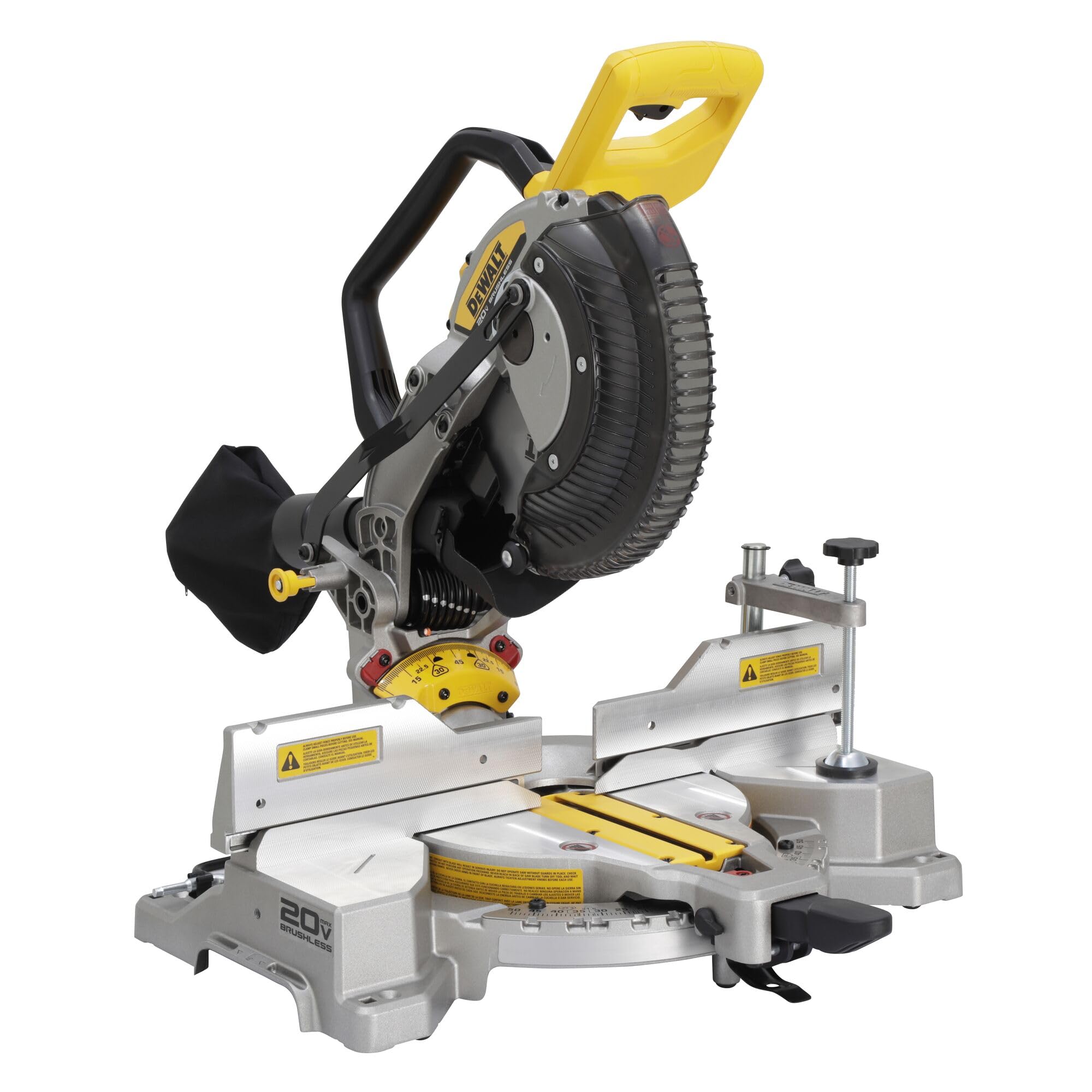
The stair-step up to a 10-inch blade when 7-1/4 just is not enough.
If your work has outgrown the 7-1/4 inch trim saws, this is where DEWALT’s line opens up. It is a 10 inch blade — meaningfully more cut width than the 7.25 inch blade on the DCS361M1 in the top spot — with a large cut capacity that handles 6 inches horizontally, 5-1/4 inch baseboard vertically and 5-1/4 inch crown nested. The 3-1/4 inch MDF base molding cut count is 434 per charge, and 2×4 SPF drops to 311 per charge, so the 10 inch head pays for itself in throughput on wide stock.
The distinguishing feature is the dual-bevel, double-angle range — the DEWALT’s 22.5 degree bevel pawls let you set 22.5 or 33.9 degree bevels fast, which saves the workpiece flip on crown and compound cuts. The cutline blade positioning system gives you adjustment-free cut line indication, and a bevel gear transmission keeps the power where it should be. Dust collection captures up to 97% of dust during use, and the 34-pound head has a carry handle for the walk between cuts.
Two things to plan around. It is a bare tool, so you supply the batteries — but it is compatible with DEWALT 20V MAX and FLEXVOLT packs both. And at 34 pounds of tool weight, it is not the one-hand carry a compact trim saw is, so the portability it offers is more of a jobsite-scale thing.
Where it stands out
- 10-inch blade cuts 6 inches horizontally and 5-1/4 inch baseboard vertically
- 434 cuts in 3-1/4 inch MDF base molding and 311 cuts in 2×4 SPF per charge
- Dual-bevel and bevel pawls at 22.5 and 33.9 degrees for compound cuts
Before you commit
- Tool-only — no battery or charger in the box
- 34 pounds of tool-only weight makes it a two-hand carry
- Fixed head, so wide slides are not part of this saw’s design
Best match for: DEWALT 20V owners who have moved past trim into wider base molding and framing capacity.
Consider another route if: you want a sliding head for the widest cuts or want the saw to arrive with batteries included.
7. BOSCH GCM18V-07SN14 PROFACTOR 18V 7-1/4 In. Single-Bevel Slide Miter Saw Kit with CORE18V 8 Ah Battery

The same accurate Bosch head, packing a big 8.0 Ah battery and charger.
Here is the bundle version of the Bosch in the five-spot: identical 7-1/4 inch slide miter saw head, but with a CORE18V 8.0 Ah PROFACTOR battery and an 18V charger in the box. The 8.0 Ah pack is the headline — it delivers 2x the runtime of the GBA18V40 battery, so one pack covers long trim and flooring days. Where the bare-tool version makes you supply your own cell, this one arrives ready to cut.
The head stays the same pro-capacity tool: 3-3/4 inch nested crown, 8-1/4 inch crosscuts, 26 pounds as a bare tool, precisely centered sliding bars, and BITURBO brushless power that open up with the CORE18V high-power cells. What wins people over is how it performs on flooring, accent walls, and small crown — the sliding mechanism lets you push the head back against a wall and still make the cut. Finish carpenters swap the stock blade for a Diablo on composite jobs, but the included carbide blade cuts standard trim fine for most work.
The real-world limit is that a single 8.0 Ah pack is not two packs. Heavy all-day flooring and decking work will want a second or a bigger head, and a few owners mention that stepping up to a dual-bevel saw opens doors this single-bevel head cannot. It is still a superb trim saw — just not the one for wide crosscuts in one pass.
The kit value: The included 8.0 Ah CORE18V battery delivers 2x the runtime of the GBA18V40, so one pack covers a full trim day.
The honest scope: A single battery means heavy day-long flooring work will want a spare, and this head stays single-bevel only.
Pick this for: going cordless from scratch on the Bosch 18V platform with enough battery to work a full day.
Keep looking if: you cut wide shelving and deck material and need a dual-bevel head or a bigger blade diameter.
8. MILWAUKEE ELECTRIC TOOL 2734-21HD M18 FUEL Dual Bevel Sliding Compound Miter Saw, 10″
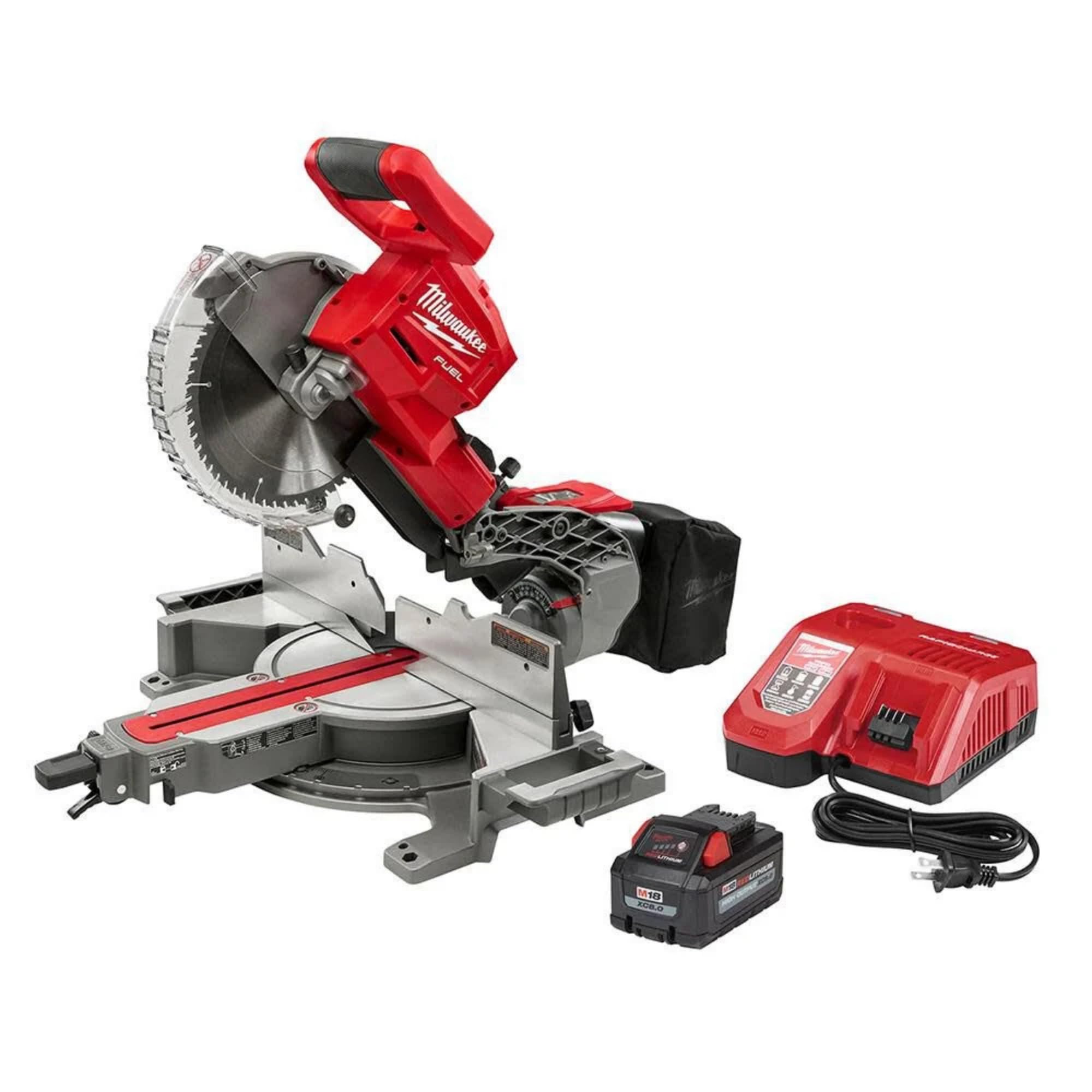
The 10-inch Milwaukee that cuts framing lumber all day on one pack.
When a corded jobsite saw feels like a burden, this M18 FUEL sliding dual-bevel is the answer for framing, decking, and heavy trim. It runs a 10 inch blade with 90 degree cutting capability and side carrying handles for hauling between stations. The runtime is the star: it runs a long time on a single charge, and commercial contractors keep it on the truck for every job. Customers note running all day on one battery and still cutting on the blade that came in the box.
what separates it is the M18 FUEL build and Milwaukee’s cordless ecosystem — this saw shares the batteries and chargers used across their other M18 tools. And the durability is real: one owner is still making money with theirs three years later and calls it a quality, lightweight tool for its class. It delivers smooth sliders, generous crosscut capacity, and the dual-bevel tilt that keeps compound cuts out of a flip. The FUEL platform and heavy-duty housing are built for daily use, not weekend trim.
The one honest note is value. Milwaukee cordless tools carry a premium, and several owners flag that the pricing runs high here compared to other options. The dust collection while running a shop vac also leaves room for improvement — a fair trade for the motor size and durability. If you are a working pro on the M18 system, the price is the cost of the runtime and the build; if you cut occasionally, a lighter cordless saw covers your needs.
The daily-driver case: M18 FUEL power plus 10-inch dual-bevel sliding capacity, built for framing and repeated jobsite use.
What to expect: Milwaukee tools carry a premium price, and the shop-vac dust collection is the weakest link.
Built for: professional contractors already on the M18 platform doing framing, decking, and heavy trim every day.
Not for: occasional home users, who will not get value out of the pro-grade build and battery premium.
9. FLEX 24V Brushless Cordless 12-Inch Dual Bevel Sliding Miter Saw Kit (FX7141A-1J)
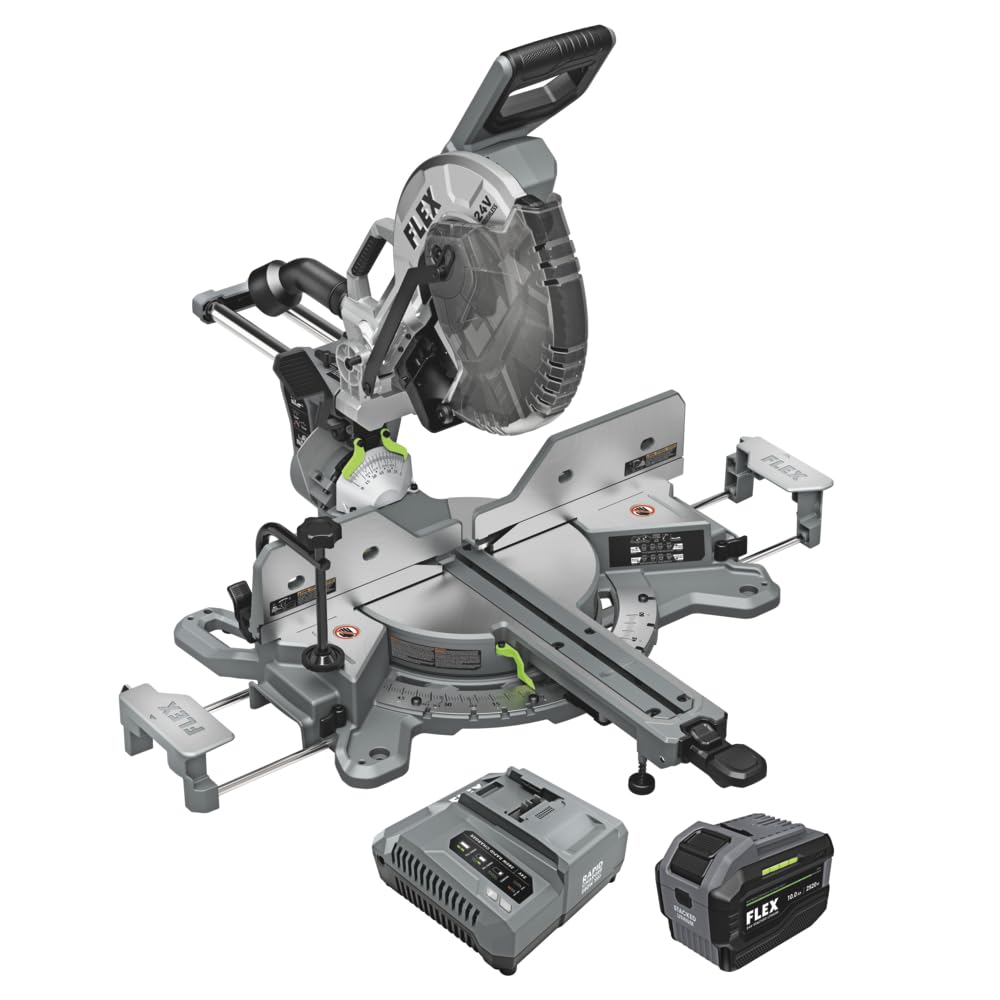
The 12-inch cordless that swallows wide stock in a single pass.
If you routinely cut 12-inch-wide boards, deck railings, and heavy shelving, blade diameter is the whole argument, and this FLEX gives you 12 inches of it. The kit ships with a 10.0Ah Stacked Lithium battery that delivers up to 630 crosscuts in 3-1/4 inch MDF on a single charge, plus the 280W Rapid Charger and a 60-tooth carbide blade. It cuts up to 12 inches in one pass, so wide stock clears the blade without needing to flip and reset. Table extensions on both sides support longer material while you cut.
The FLEX Stacked Lithium advantage is what makes the runtime claims possible — the company states 200% more power, 300% longer runtime, and 100% faster charging versus its baseline, and the 10.0Ah cell fits every FLEX 24V tool and charger. What wins people over is the setup: smooth, accurate cuts from the start with no calibration needed, and buyers call it the best miter saw they have run. The patented FASTSHIFT bevel lever sets 0, 22.5, 33.9, 45, and 47 degree bevels left and right, and the LED shadow light aligns the blade edge to the cut line.
The trade-offs are real. It is loud, heavy at 53.6 pounds, and the blade light auto-shuts off when you need it most. Dust collection with a vacuum is weak — a bag with a 2-1/4 inch adapter works better. And FLEX charges a premium for the kit; a few reviewers point out a corded adapter option is available separately for extended runtime, though it is sold on its own.
Where it takes the lead
- 12-inch blade cuts wide stock in one pass with table extensions to support long material
- 630 crosscuts in 3-1/4 inch MDF on the included 10.0Ah Stacked Lithium battery
- Patented FASTSHIFT lever sets bevels to 0, 22.5, 33.9, 45, and 47 degrees both directions
Straight talk
- Loud and heavy at 53.6 pounds
- Dust collection with a vacuum underperforms — the bag works better
- LED shadow light auto-shuts off when you still want it on
Worth it for: anyone cutting wide boards and needing 12 inches in a single pass on a large-stock jobsite.
Look past it if: you cut trim and baseboard only, where a compact saw is lighter and quieter.
10. Makita XSL06PT 18V x2 LXT 10″ Dual-Bevel Sliding Compound Miter Saw with Laser Kit (5.0Ah)

A 10-inch shop saw that cuts cordless and settles onto a miter station.
This sliding 10-inch Makita is built for the user who has a fixed miter station and wants the accuracy of a corded saw without the cord. It runs on two 18V LXT 5.0Ah batteries and the x2 LXT system pushes 4,400 RPM from a brushless motor, delivering up to 334 cuts per charge in 2×4 SPF and up to 192 cuts per charge in 2×12 SPF. The automatic speed change technology adjusts torque mid-cut, so thick stock does not bog the head down.
What wins people over is the machine-like accuracy. The head cuts perfectly square, glides with zero deflection on its slide bars, and holds its calibration across repeated jobs. It handles 3/4 inch walnut easily and cuts 5-1/4 inch base cleanly. Build quality is what owners keep coming back to — Makita’s reputation and the brushless motor keeping it cooler and more efficient for longer life. The extendable supports, slow-start, and easy safety switch all add up to a saw that feels made for a bench, and a laser helps line up cuts (though many prefer the blade itself).
The weight is the honest catch. At 80.5 pounds it is the heaviest saw here — putting it above even the FLEX at 53.6 — so it is genuinely a station saw, not a carry-to-the-ladder one. Some shoppers say it is slightly underpowered on very thick stock as the battery drains, and the dust port wants a shop vac to be effective. For everything but the widest mobile cuts, that trade is worth it.
The accuracy argument: Zero-deflection sliding, perfectly square cuts, and calibration that holds make this a genuine bench saw with cordless freedom.
The weight caveat: At 80.5 pounds it is a station tool — transport is a two-person job and mobile jobsite use is not its strength.
Ideal for: the home shop or fixed jobsite station where a 10-inch sliding saw stays in one spot and cuts often.
A different saw if: you need a saw you can carry room to room, since the 80.5 pound weight rules out easy transport.
11. Festool Cordless Sliding Compound Miter Saw KAPEX KSC 60 EB 5.0 I-Plus

A finish carpenter’s saw built around precision, not brute cut count.
For the cabinet installer and finish carpenter chasing perfect miters, this Festool KAPEX KSC 60 is the tool. The twin-column guide with two bearings keeps the blade tracking smoothly and precisely, which is what separates a fine-cut saw from a framing head. It handles miter angles up to 60 degrees on each side and bevels up to 46 degrees right and 47 degrees left, covering the full range a finish carpenter needs. The dual battery system powers a brushless EC-TEC motor for maximum power with the low weight and compact design Festool aim for.
What wins people over is the cut-per-charge number. Even on this saw with fewer reviews, the pattern is clear: it fires off a surprising number of cuts per charge, and finish users say they need spare batteries as backup rather than as a requirement. It works beautifully with a dust extractor, and the elevation feet, chip collection bag, and LED spotlight are all packaged in. The universal saw blade W 36 and variable speed let you adjustto the material, so you can tune the cut to softwood, hardwood, or trim without swapping the head.
Two honest things to weigh. It is the priciest saw in this group, and buyers openly say the price is high — that is a real consideration if you cut infrequently. And at 59.6 pounds with a bare-tool capacity note, this is a station or shop saw rather than a carry-on tool. It arrives as a full kit with an angle transfer device, so setup is quick, but plan for a dedicated spot for it.
Precision first: The twin-column, two-bearing guide keeps the blade tracking true, and 60 degree miter each side plus 46 right and 47 left bevel covers every finish-carpentry angle.
The cost of fine: The saw commands a premium price, and at 59.6 pounds it belongs at a fixed station rather than a carry-around jobsite.
Choose this if: you install cabinets and trim for a living and need repeatable fine-grade miters more than raw blade width.
Think again if: you are a homeowner who cuts a few boards a year, since the price premium delivers precision you may rarely push to its limit.
Understanding the Specs
Blade diameter and what it open up
Blade length is the diameter of the cutting disc, and it caps the height and width of stock a saw can pass. A 7-1/4 inch blade handles baseboard, crown, and framing lumber laid flat. A 10 inch blade opens up wider crosscuts and taller vertical material, and a 12 inch blade takes the widest boards in a single pass. Pick the blade size around the widest board you cut most often, not the one-off job; a bigger blade adds weight and price you may never use.
Battery voltage, amp-hours, and runtime
Battery voltage is the power class of the pack, and amp-hours (Ah) is how much energy it stores — think of voltage as pressure and amp-hours as tank size. Higher Ah packs give you more cuts per charge, which is exactly why a saw that cuts 183 times on one pack and another that cuts 585 times on a different pack feel completely different over a workday. Stick to the platform you already own, because swapping brands means buying batteries and chargers all over again.
Bevel angle and crosscut capacity
Bevel angle is how far the saw head tilts sideways to cut an angled edge, letting a miter joint close into a clean corner. A single-bevel saw tilts one way only, so you flip the board to cut the other side. A dual-bevel saw tilts left and right without flipping, which matters on crown and compound cuts. Crosscut capacity is the widest board you can slice without moving the material — sliding saws reach wider boards than fixed-head saws of the same blade size.
Weight and carry handles
A saw’s weight decides whether it moves with you or sits in one spot. A compact 7-1/4 inch head stays light enough for one-handed trips between rooms, which is what makes a cordless saw so useful for trim. A 10 inch or 12 inch head runs heavier and usually lives on a stand or bench. Look for a built-in carry handle and side grab points, because a heavy saw is only portable if you can actually pick it up and move it safely.
FAQ
Will a 7-1/4 inch cordless miter saw cut baseboard and crown molding?
How many cuts can a cordless miter saw make on one battery charge?
Do I need a sliding miter saw or a fixed-head one?
Single-bevel or dual-bevel — which should I buy?
Can a cordless miter saw replace my corded saw on the jobsite?
Do I need to buy batteries separately for a bare-tool miter saw?
Which battery platform should I pick first?
What is crosscut capacity and why does it matter?
How long does a cordless miter saw last?
Is a cordless miter saw safe to use indoors without a cord?
Final Thoughts: The Verdict
For most people buying a battery powered miter saw, the DEWALT 20V MAX 7-1/4-Inch Miter Saw (DCS361M1) is the one that gets the job done — a proven trim head with a 183-cut runtime on one pack and the largest following of any saw in this group at 4.8 stars across 800-plus ratings, backed by the DEWALT 20V battery platform. If you want sliding capacity and the longest runtime per charge, the RYOBI ONE+ 18V Sliding Compound Miter Saw delivers up to 800 cuts and a 2×10 crosscut. And for daily pro framing on an ecosystem you already trust, the MILWAUKEE M18 FUEL Dual Bevel 2734-21HD is the one to reach for when the work does not stop.
How We Picked
We do not accept paid placement. Every pick is matched to a real buyer and a real use-case; we do not hands-on test units.
Sources & Methodology
Specifications: manufacturer listings and product documentation. Review insights: verified customer reviews, as of September 2026. Pricing: not shown on this page (it changes often); check the current price via the retailer link.
As an Amazon Associate, KitchPrep earns from qualifying purchases. This does not affect which products we feature.
Related Guides
