
Specs are compiled from manufacturer listings and verified buyer reviews and can change over time — please confirm the key details on the product page before buying.
When the lights go out, your first instinct might be to drag out a gas generator. But the modern answer is a battery powered generator — a silent, fume-free box of stored electricity that you charge from a wall outlet or solar panels and draw from whenever you need it. This guide breaks down the best battery powered generator picks by capacity, output, and real owner experience, so you can match the right one to your home, RV, or campsite without wading through spec-sheet jargon.
I’m Mohammad Maruf — the founder and writer behind KitchPrep. This guide is built by comparing the manufacturers’ published specifications and the patterns across verified customer reviews, so you get each pick’s real strengths and trade-offs instead of marketing spin.
When the power goes out or you head off-grid, the battery powered generator you choose hinges on three things: how much it holds (capacity), how much it can run at once (output), and how quickly it recharges.
Our Picks at a Glance


How To Choose The Best Battery Powered Generator
Buying a battery powered generator is a multi-year decision, so the goal is to match the unit’s capacity and output to the appliances you actually plan to run. Start by listing what you want to power, then work backward to the spec that matters: watt-hours.
Capacity: The Watt-Hour Question
Capacity is measured in watt-hours (Wh) — the total amount of electricity the unit can store. A 512Wh unit can run a 50W laptop for roughly ten hours, while a 2048Wh unit can keep a fridge going for a day or more. Think of it as the size of the fuel tank; bigger gets you more runtime, but also more weight and cost.
Output: Continuous vs. Surge
Output is the rate at which the unit can deliver power, measured in watts (W). Continuous output is what it can sustain, while surge (or peak) output is the brief burst needed to start motors. A fridge might draw 150W running but need 600W to kick on — so surge rating matters for anything with a compressor.
The Battery Chemistry: LiFePO4
Nearly all modern picks use lithium iron phosphate (LiFePO4) cells, a chemistry built for longevity. These batteries handle thousands of charge cycles — often 3,500 to 6,000 — before degrading, which translates to a decade or more of regular use. Older chemistries degraded faster, which is why LiFePO4 has become the default for serious buyers.
Quick Comparison
| Model | Best For | Capacity | AC Output | Weight | Amazon |
|---|---|---|---|---|---|
| BLUETTI AC200L★ Best Overall | Whole-home backup | 2048Wh | 2400W | 61.4 lbs | Amazon |
| DABBSSON 2000LBest Value | Value 2kWh | 2048Wh | 2200W | 41 lbs | Amazon |
| EF ECOFLOW DELTA 3 PlusTop Performer | Compact mid-size | 1024Wh | 1800W | 27 lbs | Amazon |
| Jackery Explorer 500 v2 | Light camping | 512Wh | 500W | 19.3 lbs | Amazon |
| AFERIY P210 | Many devices at once | 2048Wh | 2400W | 54 lbs | Amazon |
| DJI Power 2000 | Tool-site power | 2048Wh | 3000W | 47.9 lbs* | Amazon |
| EF ECOFLOW DELTA 3 Max | High-output backup | 2048Wh | 2400W | — | Amazon |
| Jackery Explorer 2000 v2 | Lightest 2kWh | 2042Wh | 2200W | 39.5 lbs | Amazon |
| Anker SOLIX C2000 Gen 2 | Long fridge runtime | 2,048Wh | 2,400W | 41.7 lb | Amazon |
| BLUETTI Elite 200 V2 | Longest lifespan | 2073.6Wh | 2600W | 53.4 lbs | Amazon |
| Anker SOLIX F3800 | Whole-home + EV | 3,840Wh | 6,000W | 132.3 lbs | Amazon |
*Weight converted from the listed 21.72 kg specification.
In‑Depth Reviews
1. BLUETTI AC200L Portable Power Station
Our pick — over 4.5★ from 500+ verified ratings; the strongest balance of quality and price.
The expandable heavy hitter that runs a motorhome’s worth of gear from one quiet box.
The AC200L leads this list because it pairs 2400W of continuous output with 2048Wh of capacity and then lets you grow beyond that. You can bolt on extra battery packs — two B300K units add 2764Wh each — to reach a maximum of 8192Wh, which is enough to scale from a weekend campsite to a multi-day home backup. It also includes a 30A RV port, so you can plug it straight into a camper’s electrical system.
What wins people over is the charging speed and sheer versatility. At up to 2400W AC input, it refills from 0% to 80% in just 45 minutes, and up to 1200W of solar input tops it off in 1.7 to 2.2 hours. Buyers report it handles a 1500W kettle and a 12000 BTU air conditioner on solar power, and one long-term owner describes “2-year use” with Bluetooth app monitoring and optional Wi-Fi. At 61.4 pounds, it’s roughly three times heavier than the 19.3-pound Jackery Explorer 500 v2, so moving it between rooms is a two-person job.
Reliability is the other headline — dozens of owners praise its build and steady performance, with one noting it “runs everything in their motorhome.” The crowd favorite among serious buyers holds a 4.8-star score across 500+ ratings, and the LiFePO4 battery (a lithium-iron-phosphate chemistry known for long life) is rated for 3000+ charge cycles, meaning it should serve you for years of regular use. If you want one unit that can grow with you instead of being replaced, this is the one.
What owners love
- 2400W output handles high-draw appliances like kettles and AC units
- Expandable to 8192Wh for serious off-grid or backup use
- 0–80% recharge in 45 minutes at max AC input
- 61.4 lbs makes it a carry-with-care unit, not a grab-and-go
- Optional Wi-Fi raises a privacy consideration some owners flag
The decision: Reach for the AC200L if you want a central power hub for home backup or RV living.
Think twice if: You need something to toss in a car trunk daily — this one stays put.
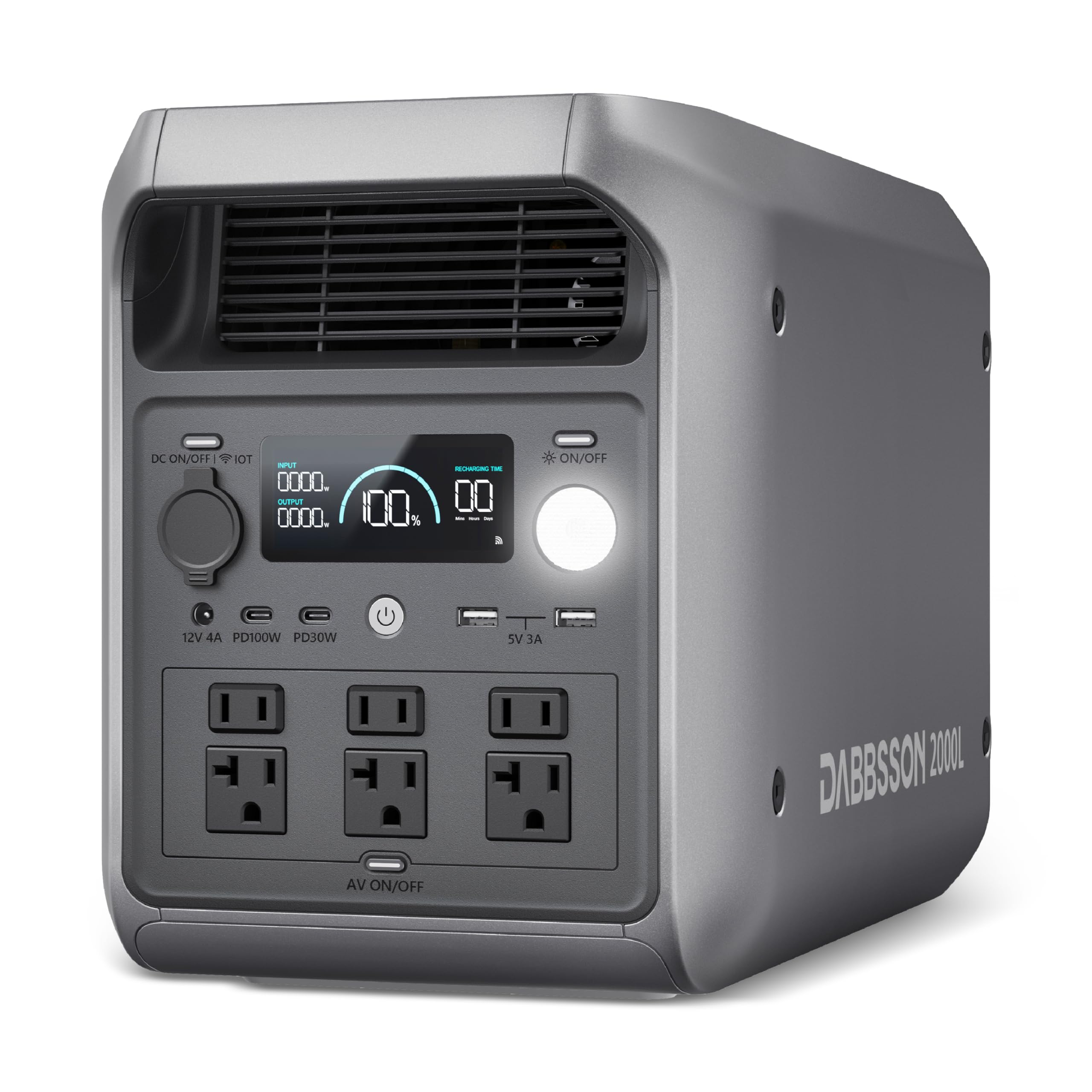
2. DABBSSON Portable Power Station 2000L
A 2kWh-class station that undercuts the big names while matching their runtime.
The DABBSSON 2000L delivers the same 2048Wh capacity as the pricier BLUETTI AC200L above, but does it in a lighter, more affordable package. At 41 pounds, it’s over 20 pounds easier to haul than the AC200L’s 61.4 pounds, which matters if you’re moving it between the garage and the campsite regularly. It still produces a strong 2200W continuous output with a 3300W surge boost, so it can start motor-driven appliances like refrigerators and power tools.
Owners consistently call out the value — the review pages sum it up as the best price-to-performance in the 2kWh class. The semi-solid LiFePO4 cells are rated for 4000+ deep cycles to 80% capacity, which the maker says translates to over 10 years of daily use. A 1-hour full AC recharge is genuinely fast for this size, and the 6 AC outlets let you power a mini fridge, coffee maker, and e-bike at the same time, as one owner reported doing.
The plastic shell feels less premium than metal-clad rivals. One owner helping family through blackouts in Cuba called it “silent” and easy to use but noted the housing “feels flimsy.” If you’d rather save the budget for solar panels than pay for a brand name, this is your pick.
Why it earns its spot
- 1-hour AC recharge on a 2048Wh battery
- 41 lbs with a 3300W surge for motor-starting appliances
- 5-year warranty (3 years standard + 2-year extended)
The honest limits
- Plastic housing feels less sturdy than metal rivals
- Fans can get audible under heavy load
Your pick if: You want full 2kWh capacity without the premium markup.
Look elsewhere if: Industrial build quality matters more to you than the price.
3. EF ECOFLOW DELTA 3 Plus
A compact mid-size unit that recharges as fast as units twice its size.
The DELTA 3 Plus proves you don’t need 2kWh to get serious power. It packs 1024Wh of capacity with 1800W of continuous output — enough to run a space heater on high, as one owner did during a test — while staying a manageable 27 pounds. That makes it the balance for anyone who wants real appliance power without the 60-pound commitment of the bigger BLUETTI AC200L.
Charging speed is the defining trait here. With 1500W AC input, it hits 80% in 40 minutes, and you can refill it from solar (80% in 1 hour), your car’s alternator, or the EcoFlow smart generator. The X-Boost mode pushes past 2200W for resistive appliances, and the two MPPT solar inputs accept up to 1000W — a spec that owners specifically praise. The 10ms UPS switch-over is fast enough to protect a NAS or server from data loss during outages.
The LFP battery is rated for 4000 cycles to 80%, and the IP65-rated battery pack shrugs off splash, dust, and oil. One owner reported running a fridge off it for an estimated 12.5 hours, while another called it “very quietly… light weight and easy to move.” It can expand up to 5kWh by adding other EcoFlow battery packs, so there’s a growth path if your needs change.
The fast-fill compact: If recharging speed matters more than raw capacity, this beats everything near its size.
The catch: 1024Wh is half the runtime of a 2048Wh unit for the same fridge load.
4. Anker SOLIX C2000 Gen 2
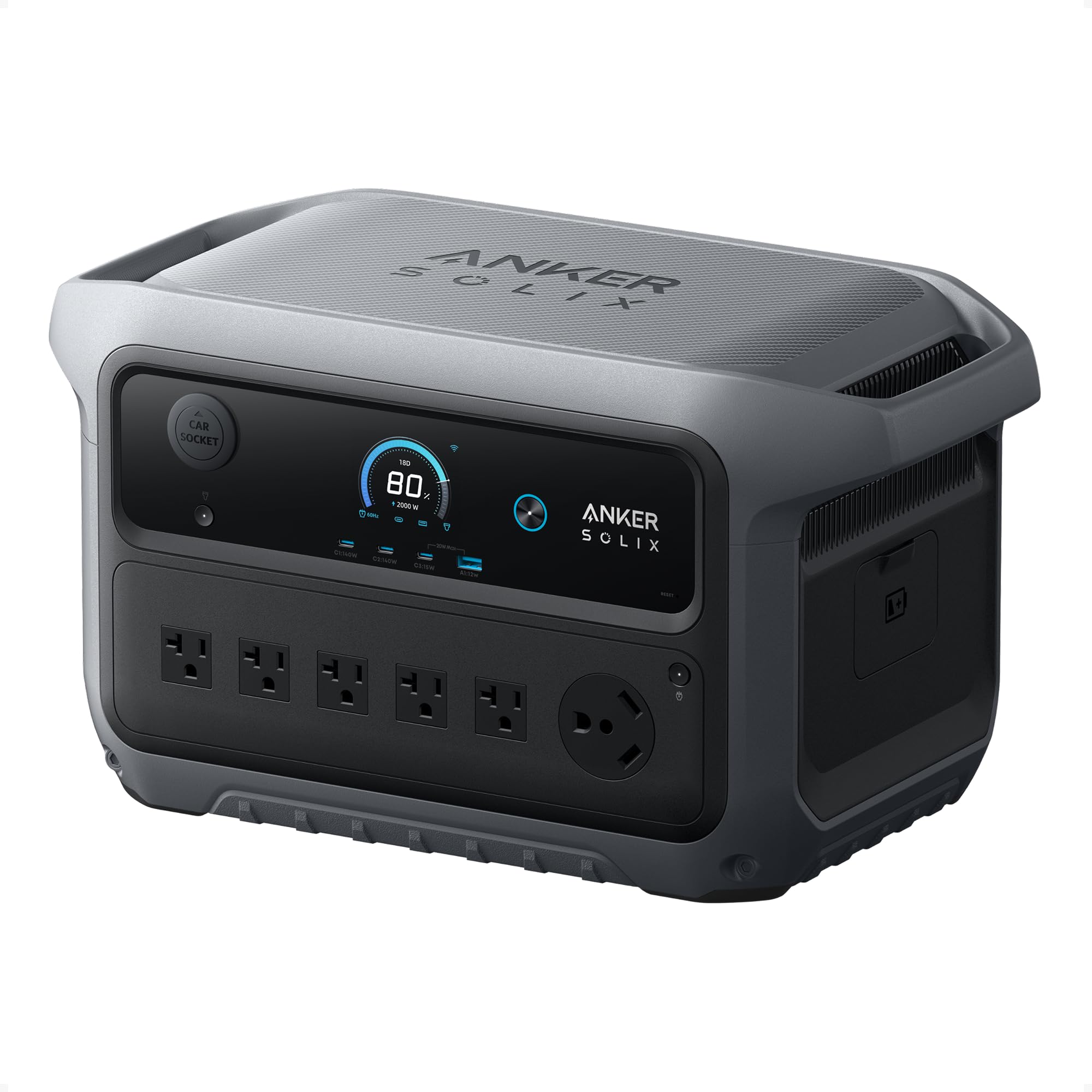
The efficiency king that sips just 9W on standby and runs a fridge for 32 hours.
The SOLIX C2000 Gen 2 turns a familiar 2,048Wh capacity into genuinely longer runtime through smart efficiency. It draws only 9W on standby, which is why the maker says it can run a dual-door fridge for up to 32 hours on a charge — and add the optional expansion battery to reach 4kWh and stretch that to 64 hours. For outage prep, that’s a real difference from units that waste power just sitting idle.
Output is equally strong: 2,400W rated with a 4,000W peak, which the maker says runs most window and RV air conditioners. One owner used it to run a miter saw, drill, and charge tool batteries without issue, while another noted RV fridge, fans, and pumps ran for three days with 27% charge left. Recharging is fast too — a full 100% in 58 minutes via AC, or 100% in 3 hours from your car with the 800W alternator charging.
The build is notably light for the class at 41.7 lb, which owners call “compact for 2000Wh.” It won’t run a large air conditioner for long, and the app’s runtime estimates can be inaccurate for cycling appliances. For most home-backup and camper needs, though, it’s a near-perfect fit.
Where it shines
- 9W standby draw stretches every watt further
- 4,000W peak output starts most AC units
- 58-minute full recharge from AC
Where it gives ground
- Large AC units drain it faster than smaller rivals
- App runtime estimates can mislead for cycling loads
Best suited for: Home-backup buyers who want maximum fridge runtime per watt stored.
Not your first choice if: You plan to power heavy AC for hours at a time.
5. BLUETTI Elite 200 V2

The longest-lived battery here, rated for 6000+ cycles and a 17-year lifespan.
The Elite 200 V2 leans into longevity with an automotive-grade LiFePO4 battery rated for over 6,000 cycles — the maker claims a 17-year lifespan of everyday use. For buyers who want to buy once and never think about it again, that’s the strongest durability story on this list. It pairs that with 2600W of continuous AC output and a 3900W power-lifting burst for starting high-draw appliances like refrigerators, hair dryers, and coffee makers.
Efficiency is the second headline. Standby consumption drops to just 10W, which the maker says is lower than most rivals, and owners mention 95%+ AC efficiency. One owner ran an induction stove, air fryer, pressure cooker, dishwasher, office computers, fridge, freezer, and 3D printer simultaneously from a single unit. At 53.4 pounds it’s lighter than the AC200L’s 61.4 pounds, and the dual handles make it easier to carry for its size.
Charging is flexible with three app-controlled modes: Turbo hits 0–80% in 1 hour at 1800W AC, Standard takes 1.6 hours, and Silent uses just 800W for a 3-hour fill at 16–30dB. The 10W idle draw means less wasted energy when it’s parked. It’s not expandable like the AC200L, and the 60V solar input limit restricts some panel configurations.
The longevity story
- 6000+ cycles and a 17-year rated lifespan
- 10W standby draw for less waste
- 2600W continuous with 3900W lifting power
The trade-offs
- No expansion battery option
- 60V solar limit restricts some panel configurations
Choose it for: A decade-plus daily workhorse that outlasts every other battery here.
skip it if: You need to grow capacity over time — this one is fixed.
6. DJI Power 2000
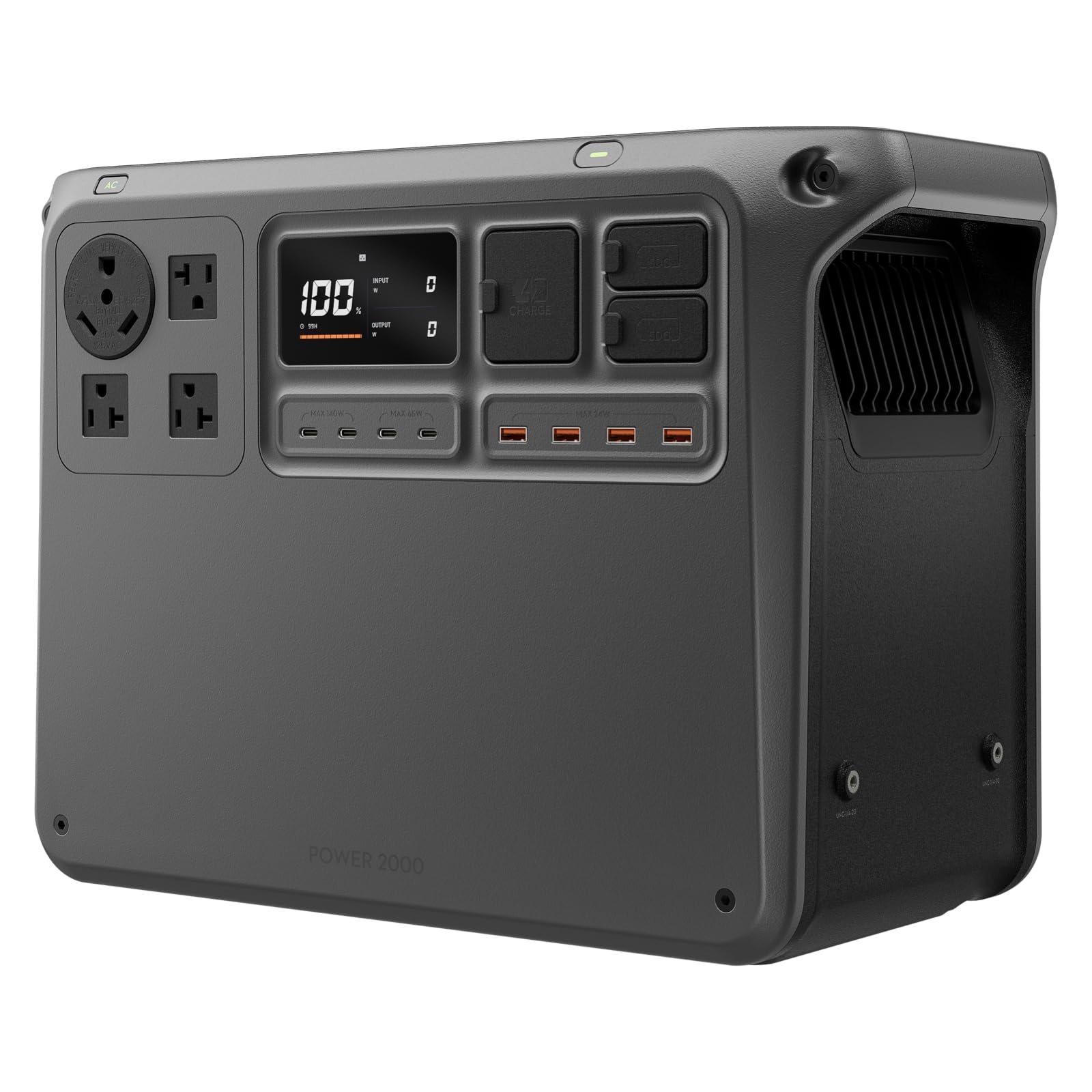
The tool-site monster that replaces gas generators for serious jobs.
The DJI Power 2000 is the unit to grab when you’re running power tools or electric winches, not just phones and fridges. Its 2048Wh LFP battery feeds a 3000W continuous output with a 4000W peak — enough that one owner replaced three Honda EU3000 gas generators with these units. The same owner reported running high-power tools, an electric winch with a 4500W peak in-rush, and a Starlink, 75-inch TV, and Traeger grill simultaneously.
It refills to 80% in just 55 minutes via AC, and the 15 ports — including two USB-C at 140W each — can charge a whole crew of four or five people’s phones, lights, and laptops at once. The 10ms UPS switch time means it protects sensitive gear during outages, and at 30dB it’s quiet enough for nighttime RV use. It can also expand to 22.5kWh for multi-day home backup.
It requires the DJI app, uses proprietary SDC connectors for expansion, and lacks a built-in MPPT solar controller. It requires the DJI app, uses proprietary SDC connectors for expansion, and there’s no built-in MPPT solar controller — you need a separate adapter for panels. As a standalone powerhouse, though, it’s exceptional.
The gas-killer: For tradespeople and off-grid work, this replaces a fuel generator without the fumes or maintenance.
The reality check: Expansion accessories have been hard to source, so buy it as a complete unit.
7. EF ECOFLOW DELTA 3 Max
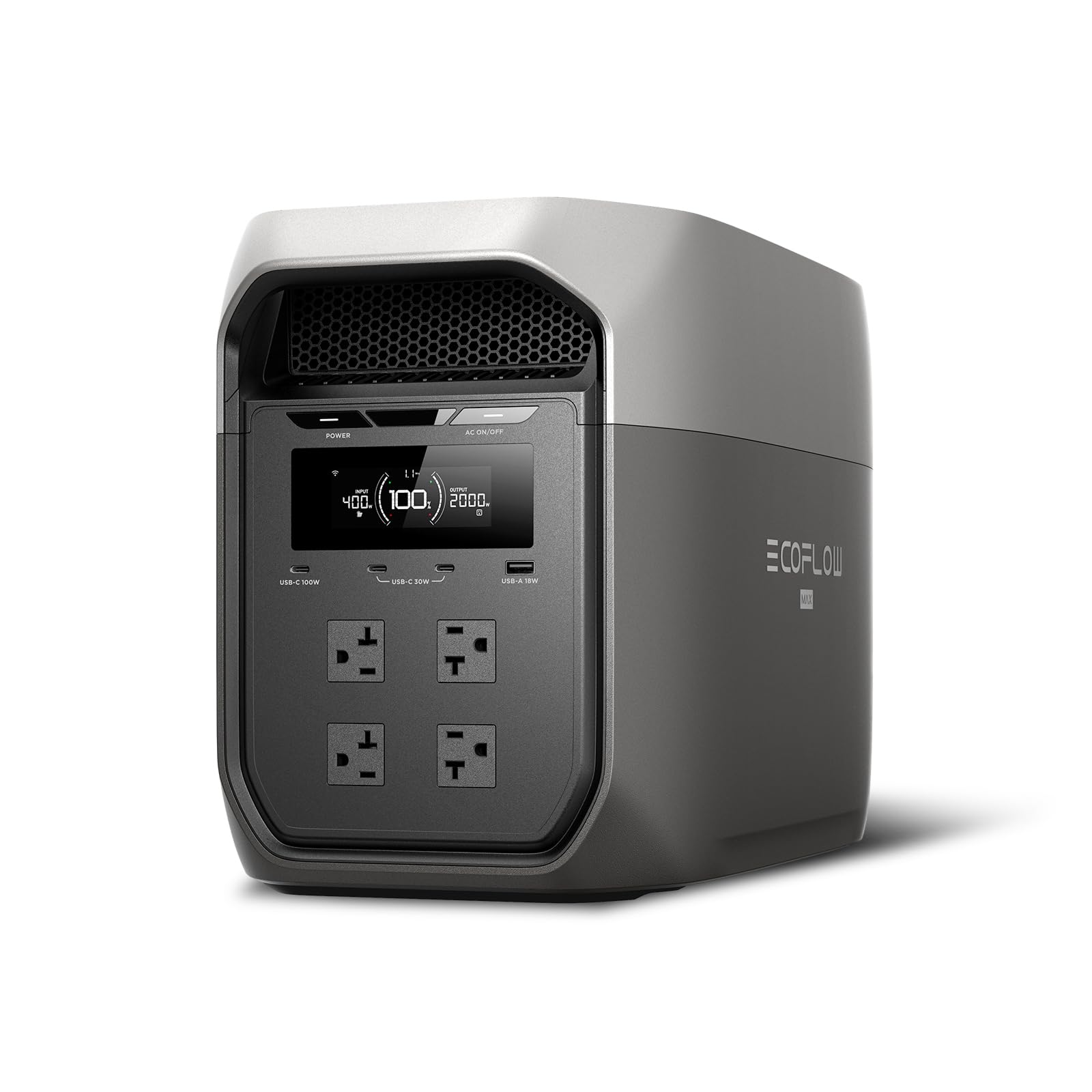
A full 2048Wh station with a 3400W X-Boost for powering 99% of appliances.
The DELTA 3 Max takes EcoFlow’s proven platform and scales it up. It delivers 2048Wh of capacity with a continuous 2400W output — and its X-Boost mode pushes that to 3400W for starting high-demand appliances like fridges, microwaves, and power tools. The maker says that covers 99% of household appliances, which makes it a strong whole-home-backup candidate at a mid-tier price.
Charging from 0–80% takes just 1.13 hours thanks to X-Stream technology, and the 10ms transfer time keeps computers and other sensitive electronics safe during outages. Owners repeatedly describe it as “super fast” to charge with battery life that “lasts forever,” and several use it as a dedicated backup for parents or frequent-outage areas. The app adds smart scheduling to shift charging to off-peak hours and track usage.
It’s built for a decade of daily use with a LiFePO4 battery and comes with a 5-year service plan. Some owners note it’s heavy, but that’s the price of 2kWh capacity. If you want one unit that anchors both home backup and RV trips without overspending, this delivers.
The strengths
- 3400W X-Boost starts almost any appliance
- 0–80% charge in 1.13 hours
- App control for off-peak charging schedules
The considerations
- Weight is substantial for frequent carrying
- 5-year warranty, not the longest on this list
Grab this for: Reliable home backup and RV power at a price that won’t hurt.
Pass on it if: You need the longest warranty or lightest carry in the 2kWh class.
8. Jackery Explorer 2000 v2

The lightest full-size 2kWh station, using EV-grade Cell-to-Body construction.
The Explorer 2000 v2 tackles the biggest complaint about 2kWh power stations — their bulk. At just 39.5 pounds, the maker says it’s 41% lighter and 34% smaller than typical 2kWh LiFePO4 units, using the same Cell-to-Body technology found in EVs to pack the cells efficiently. That makes it the best pick if you need real capacity but still want to load it into a car or camper without a hernia.
Performance holds up at 2042Wh capacity with 2200W AC output across three ports. A 100W USB-C PD port fast-charges laptops without an adapter, and the 20ms UPS switch keeps essentials running through outages — it’s UL1778 test certified for Uninterruptible Power Systems. Customers note it keeping fridges and freezers running for up to 3 days on a charge, and one remote worker in Belize relied on it to keep Wi-Fi running through rainy days.
Charging is flexible: 0–80% in 66 minutes via AC, a full charge in 102 minutes via the app’s Emergency Super Charging mode, or 6 hours from 400W of solar. Silent Charging mode runs at under 30dB for nighttime use. Minor gripes include a finicky Bluetooth connection and solar ports that flex when plugged, but core performance is solid.
The appeal
- 39.5 lbs is the lightest full 2kWh here
- UL1778-certified UPS for outage protection
- Runs fridges up to 3 days per owner reports
The quirks
- Bluetooth connection can be unreliable
- Solar barrel ports flex inward when plugged
Ideal for: Campers and RV owners who want 2kWh power without the usual weight penalty.
Reconsider if: You plan heavy daily solar hookups — the ports warrant gentle handling.
9. Jackery Explorer 500 v2 + 100W Solar Panel

The lightweight solar starter kit that keeps a campsite powered for days.
The Explorer 500 v2 earns its place for a very different buyer: the weekend camper who wants a self-contained solar setup, not a home backup powerhouse. Its 512Wh capacity and 500W rated output (1000W surge) run laptops, mini-fridges, cameras, and phones — and the included 100W SolarSaga panel makes it ready to recharge off-grid from day one. The full kit ships with both the station and panel, so there’s nothing else to buy.
Owners put the solar pairing through real-world tests. One RV dry-camper reported 18 days of flawless use with the 100W panel, charging from 83% to 100% in about 2 hours in sunny Arizona, and overnighting two iPads, two phones, one computer, and a jetpack while staying at 75–80% by morning. The LiFePO4 battery is rated for 6,000 charge cycles — which the maker says delivers over a decade of use — and the 14 lb weight (for the station itself) makes it one of the lightest in its class.
Its limits are equally clear. The older model’s max AC charge is slow at 89W, and capacity fits a fridge plus one or two laptop charges, not a whole home. But as buyers put it, this is a “good starter unit” that many keep even after upgrading — it’s small enough to stay as a portable backup. For entry-level solar without commitment, it’s the pick.
The strengths
- Includes the 100W solar panel for off-grid use
- 6000-cycle LiFePO4 battery for a decade of service
- 10ms UPS for quiet home backup
The limits
- 89W max AC charge is slow by modern standards
- 512Wh suits a fridge plus a few laptop charges, not whole-home loads
Your move: Pick this for a light, complete solar kit that’s perfect for car camping.
Not for: Whole-home backup — step up to a 2kWh unit for that.
10. AFERIY P210 Solar Generator

A 16-port powerhouse that runs two greenhouse fans and everything else at once.
The AFERIY P210 is built for the person who charges everything, all at once. Its 16 ports include 6 AC outlets at 2400W, 2 USB-A, 4 USB-C (with 100W on one), 2 DC5521 ports, a car outlet, and an XT60 connector — enough to run a small kitchen or workshop setup simultaneously. One owner used it to run two fans in a greenhouse, while another reported running a 12000 BTU AC easily.
The 2048Wh LiFePO4 battery is rated for 3500+ cycles, and the maker backs it with a 7-year extended warranty — longer than most rivals. Pure sine wave AC output (both input and output) means clean power that protects sensitive electronics from damage. A 10ms server-level UPS response keeps critical equipment online through outages, and at under 30dB full load (16dB normal), it’s quiet enough for bedroom use at night.
Owners praise the build quality and design, with the app for monitoring getting its own kudos. The solar charging, however, is the weak spot — several owners found MPPT solar input caps lower than expected, around 350W regardless of panel count on one setup. If you’re mostly AC-charging and want max ports for the money, it’s a strong value; if solar is your primary input, check the limitation first.
What stands out
- 16 ports power a whole crew at once
- 7-year warranty is among the longest here
- 16dB normal-load operation is genuinely quiet
What to watch
- Solar input capped well below spec in owner tests
- 54 lbs demands care when moving
Made for: Power users who need many simultaneous device connections.
Think twice if: Solar recharging speed is your priority.
11. Anker SOLIX F3800

The 6,000W dual-voltage titan that can power a whole home or charge an EV.
The SOLIX F3800 is the endgame for battery powered generators. Its 3,840Wh battery feeds a 6,000W AC output at both 120V and 240V — meaning it can run a dryer, well pump, or even charge your EV directly through the NEMA 14-50 port. One owner used it to replace a gas generator at their transfer switch, keeping a fridge, lights, hot water inducer, and radon motor running through a 6-hour outage while solar input helped.
Capacity is expandable up to 26.9kWh with six extra battery packs, and the maker says you can reach 53.8kWh with a second F3800 and 12 packs for two weeks of power. It charges at up to 2,400W from solar. The EV-class LFP batteries and smart temperature system are rated for a 10-year lifespan with a 5-year warranty, and the Anker app gives full Wi-Fi/Bluetooth remote control.
At 132.3 pounds and a premium price, it’s a stationary investment rather than a portable unit. At 132.3 pounds, it’s not portable in any practical sense — it’s a stationary home appliance. Owners also note solar charging has quirks, with one finding a 400W panel maxed at 218W in full Texas sun, and MPPT tune for Anker’s own panels. If you want whole-home backup that doubles as an EV charger, nothing else here matches it.
The capabilities
- 6,000W output at 120V/240V runs whole-home loads
- NEMA 14-50 port charges an EV directly
- Expands to 26.9kWh for multi-day backup
The realities
- 132.3 lbs — it stays where you put it
- Solar performance trails spec with non-Anker panels
Invest here if: You want a permanent home-backup system that can also charge your EV.
Look elsewhere if: You need something you can move between locations.
Understanding the Specs
Watt-Hours (Wh): The Fuel Tank
Watt-hours tell you how much electricity the unit can store and deliver over time. A 2048Wh unit can run a 500W appliance for roughly four hours, while a 512Wh unit would manage about one hour at the same load. Bigger capacity means longer runtime, but it also means more weight — the 2048Wh units here range from 39.5 to 132.3 pounds.
Output Watts: The Flow Rate
Output watts determine which appliances the unit can power at any moment. A 500W unit handles laptops and small fridges, while a 2400W unit can run kettles, microwaves, and most power tools. Surge rating matters even more — refrigerators and AC compressors need a brief spike of power to start, often 2-3 times their running draw.
LiFePO4: The Long-Life Chemistry
Lithium iron phosphate (LiFePO4) batteries are the industry standard for serious power stations because they handle far more charge cycles than older lithium-ion cells. Most units here are rated for 3,500 to 6,000 cycles to 80% capacity — that translates to a decade or more of daily use before meaningful degradation.
Solar Input: The Off-Grid Refill
Solar input rating tells you how fast you can recharge from panels. Inputs range from 100W on the Jackery 500 to 2400W on the Anker F3800. Higher input means fewer panels needed for fast fills, but check the voltage limits — some units cap solar input well below their stated spec, as owners of the AFERIY P210 found.
FAQ
How long can a battery powered generator run a refrigerator?
What’s the difference between watts and watt-hours?
Can I run a 120V air conditioner off a battery generator?
How long does a LiFePO4 battery actually last?
Can I charge my EV with a battery powered generator?
What’s the difference between AC output and surge output?
How do I recharge a battery powered generator with solar panels?
Is a 2048Wh battery generator enough for whole-home backup?
Can a battery generator power tools like a saw or drill?
What’s the best battery generator for camping?
Final Thoughts: The Verdict
For the majority of shoppers, the battery powered generator winner is the BLUETTI AC200L because it combines 2400W output, 2048Wh capacity, and expansion to 8192Wh — making it the only pick that grows from a weekend unit into a whole-home backup without being replaced. If you want the lightest full-size carry, the Jackery Explorer 2000 v2 at 39.5 lbs is the one to reach for. And for entry-level solar without commitment, the Jackery Explorer 500 v2 with its 100W panel is the smart starting point. Each of these is rated 4.4 stars or higher across hundreds of owners, so whichever matches your load — from a weekend campsite to a whole house — you’re buying proven performance, not marketing promise.
How We Picked
We do not accept paid placement. Every pick is matched to a real buyer and a real use-case; we do not hands-on test units.
Sources & Methodology
Specifications: manufacturer listings and product documentation. Review insights: verified customer reviews, as of September 2026. Pricing: not shown on this page (it changes often); check the current price via the retailer link.
As an Amazon Associate, KitchPrep earns from qualifying purchases. This does not affect which products we feature.
Related Guides
