
Specs are compiled from manufacturer listings and verified buyer reviews and can change over time — please confirm the key details on the product page before buying.
Hauling a compressor, extension cords, and an air hose up a ladder is the worst part of any roofing job. A battery powered coil nailer ends that chore — you carry one tool, load a coil of nails, and fire away right on the shingles. This guide compares four cordless coil nailers across speed, runtime, and weight so you can pick the one that matches how you actually work.
I’m Mohammad Maruf — the founder and writer behind KitchPrep. This guide is built by comparing the manufacturers’ published specifications and the patterns across verified customer reviews, so you get each pick’s real strengths and trade-offs instead of marketing spin.
Whether you are tearing off an old roof or fixing a small leak, the right battery powered coil nailer saves you hours of setup time and keeps you moving safely across the roof deck.
Our Picks at a Glance

How To Choose The Best Battery Powered Coil Nailer
Buying a cordless coil nailer means trading the compressor setup for battery life and raw driving force. The real question is whether the tool can keep up with the pace of a full roof without running out of power or jamming mid-course.
Match the nail angle to the coil
Roofing nails come in wire coils, and the angle of that coil has to match the magazine on your gun. A 15-degree tool (often called round head) takes a different coil than a 16-degree version, so check the rating before buying nails in bulk. Getting this wrong means the coil simply will not feed.
Think about length and depth
Standard shingle work usually needs a nail long enough to bite through the shingle and into the deck. Many cordless models handle up to 1-3/4-inch nails, which covers most residential roofs. A tool-free depth dial then lets you set how deep the nail sits so you avoid over-driving into the shingle.
Quick Comparison
| Model | Best For | Weight | Max Nail Length | Drive System | Amazon |
|---|---|---|---|---|---|
| DeWalt 20V MAX Coil Nailer★ Best Overall | Full roof jobs | 6.7 pounds | — | Brushless motor | Amazon |
| CORDLESS ROOFING NAILER | Repairs and small jobs | 9 pounds with battery | — | Battery | Amazon |
| Metabo HPT NV1845DA Kit | Air-spring power | 8.6 pounds | 1-3/4 inches | Air spring + brushless | Amazon |
| Milwaukee M18 FUEL 2909-20 | Sequential control | — | 1-3/4 inches | M18 FUEL brushless | Amazon |
In-Depth Reviews
1. DeWalt 20V MAX 15 Degree Coil Battery Powered Roofing Nailer
Our pick — 4.5★ from 600+ verified ratings; the strongest balance of quality and price.
A cordless workhorse that nails a full 15-square roof without a compressor.
Its brushless motor delivers longer runtime and less wear than brushed alternatives. Buyers report finishing a full 15-square roofing job on one charge, a task they’d planned for a compressor.
Speed comes from bump mode, which lets you fire nails as fast as you can tap the tool down, a big productivity boost on a flat roof deck. The tool-free nail tray slides to adjust for different roofing nail sizes without needing a wrench, and the crowd favorite rating of 4.5 stars across 600+ owners confirms this is a dependable choice. At 6.7 pounds it is lighter than the Metabo HPT above, which makes a difference when you are carrying it up a ladder.
Owners mention a couple of jams during heavy use, but they clear easily and the tool keeps going. Those who shoot 1.5-inch nails say the power adjuster needs to be backed all the way out for full drive depth. It is a bare tool, so you need your own 20V battery.
What wins people over
- Brushless motor delivers dependable runtime for all-day jobs
- Bump mode speeds up production roofing work
- Tool-free tray adjusts to the full range of roofing nails
- Customers note coils load fast and fire without constant jams
What to plan around
- Sold as bare tool only, so a 20V battery is on you
- The motor is powerful and the tool is heavy, but battery drain is real
Who it fits: roofers already in the DeWalt 20V ecosystem who want proven speed and runtime on full jobs.
Reach for it when: you need bump-mode production speed and own spare batteries for a long day on the roof.
2. CORDLESS ROOFING NAILER

A cordless pick for small repairs that skips the compressor hassle.
Functionality is the reason owners pick this one — it is the aspect mentioned most in reviews, and it works great on smaller repair jobs and DIY shingle fixes. Buyers skip the air setup entirely, finding a cordless gun does the same work without the compressor.
Know that this is a heavier option. One owner measured it at an exact 9 pounds with a 20V battery, and the weight shows up as a mixed point in review patterns alongside durability. A roofing company owner calls it a great value that is durable and works well for small repairs, while a separate review warns that it is not the fastest tool on the market.
For small repairs, cordless convenience outweighs the extra weight. The trade-off is clear: this gun is built around ease of use on modest roofs rather than marathon production speed.
Where it fits: small repairs and spot fixes where setting up an air compressor is overkill and the reduced noise alone is worth it.
The honest limit: at 9 pounds with a battery, it is on the heavy side, and durability opinions are genuinely mixed among owners.
3. Metabo HPT Roofing Nailer, 18V MultiVolt Brushless, Coil Kit, NV1845DA

The first air-spring coil nailer delivering pneumatic force with no hoses.
Metabo HPT calls this the first air-spring coil roofing nailer, meaning it uses a sealed air spring instead of a gas canister to deliver power similar to a pneumatic tool — no gas, no hose, no compressor. The brushless motor works with the air spring to drive nails up to 1-3/4 inches, and a bonus vinyl siding adapter keeps you from over-driving nails into siding.
On a single charge with the included compact 18V 2.0Ah battery, the maker claims it drives 500 nails, and a first-time nailer owner confirms the normal-sized battery handled a full small roofing job without a mid-job recharge. The side-loading magazine makes refilling fast. It weighs 8.6 pounds, which is noticeably heavier than the DeWalt at 6.7 pounds, and one experienced user admits they could not tell the difference in power versus the pneumatic nailer they used before.
The recurring owner complaint is battery retention — reports of the battery falling out and the tool shutting off after minutes of non-use. It also carries a lifetime warranty on the tool body, a 2-year battery warranty, and a 1-year charger warranty. This one arrives as a complete kit with the battery, charger, and bag included.
Why owners go cordless
- Air-spring drive feels as powerful as a pneumatic gun
- Complete kit includes battery, charger, and vinyl siding adapter
- Side-loading magazine speeds up nail refills
- Drives up to 1-3/4-inch nails
The catch to weigh
- Battery retention and shut-off behavior worry some owners
- Heavier than the DeWalt at 8.6 pounds vs 6.7 pounds
Best for: buyers who want pneumatic-level power and a full kit from the start, especially new cordless converts.
Think twice if: you demand flawless battery retention and already own a lighter cordless option.
4. Milwaukee Electric – M18 Fuel Coil Roofing Nailer
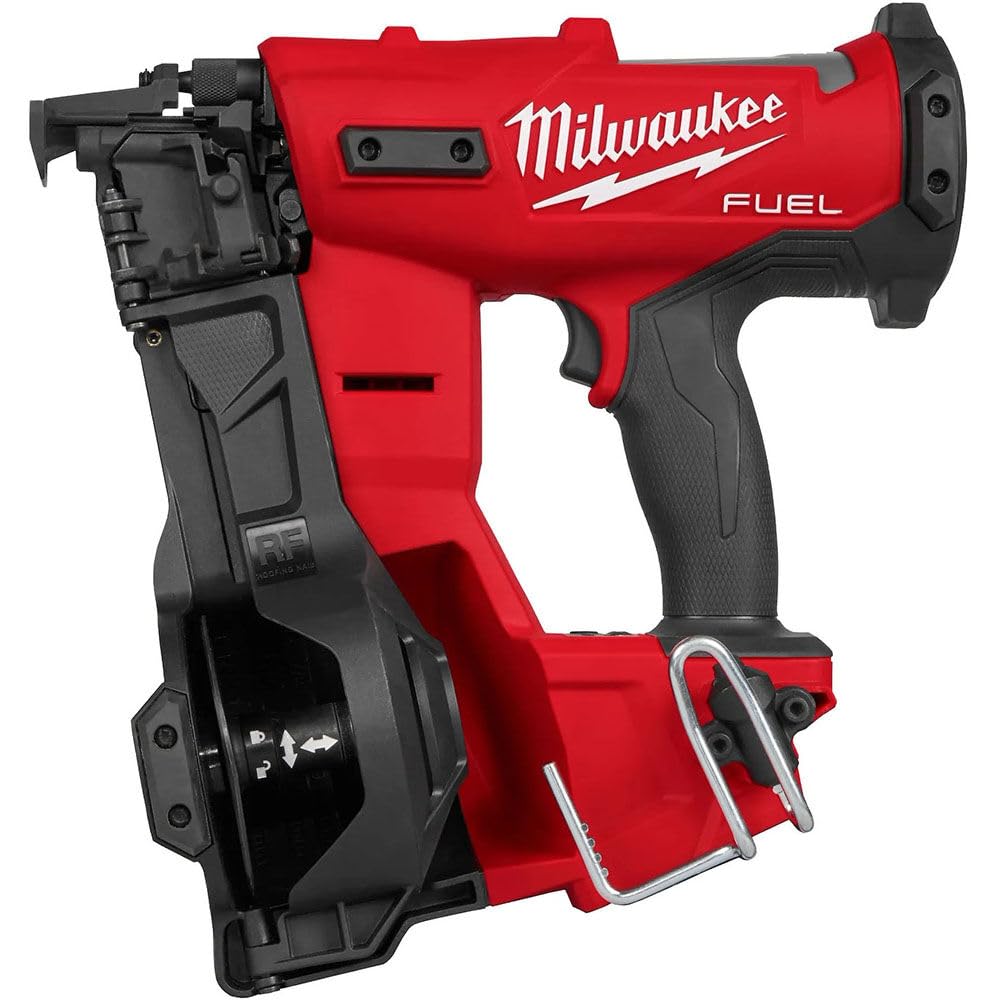
An M18 Fuel option with a grip that stays put on sloped roofs.
Milwaukee’s cordless design eliminates the compressor and hoses entirely, and owners describe it as the best tool they have ever purchased, with excellent battery life and fast loading. The stand-out physical trait is balance — reviewers point out it does not slide down the roof when set down, a small but vital safety detail on a slope.
Sequential firing mode gives you controlled, one-nail-at-a-time placement, which is ideal for accurate shingle installation, while auto mode fires fast for production stretches. The tool-free depth adjustment dial lets you set nail depth without digging for a wrench. It drives roofing nails up to 1-3/4 inches and the magazine holds up to 120 nails, so you spend more time nailing and less time reloading.
The magazine accepts 15-degree coil roofing nails. One owner reports a nail not seating fully and needing a hammer to finish the drive, so depth setting matters on this unit. Over a 9-hour workday, another buyer counted just two misfires, one of which was their own fault while learning auto mode.
Standout trait: the balanced, non-slip design that owners say stays put when resting on a sloped roof.
Who this is not for: anyone who skips depth-setup and expects perfect seating on the first trigger pull every time.
Understanding the Specs
Drive System and Power
A coil nailer needs force to sink a nail through shingle and deck, and cordless models generate that force in different ways. Brushless motors use electricity more efficiently, which means longer runtime per charge. A step up is an air-spring system, which uses a sealed air chamber to mimic the punch of a pneumatic gun without needing a compressor. More driving power lets you handle longer nails and denser materials.
Nail Angle and Magazine Design
Roofing nails come wound in coils rated by angle, commonly 15 or 16 degrees. The angle must match your tool’s magazine or the nails will not feed. The magazine itself holds the coil, and higher capacity means fewer reloads. A side-loading magazine or tool-free tray makes refills faster.
Firing Modes and Depth
Bump mode fires nails as fast as you tap the tool down, which is the productivity choice for flat, open roof sections. Sequential mode fires one nail per trigger pull for controlled placement on edges and repairs. A depth adjustment dial, tool-free or not, sets how deep each nail sits so you do not over-drive into the shingle.
Battery and Runtime
Runtime depends on the battery capacity and the motor’s efficiency. Compact batteries handle small repair jobs, while full-size packs last for long stretches on production roofs. Some tools ship as bare units and others include a battery and charger, so check before you order. Weight also matters because you will hold this tool at arm’s length all day.
FAQ
What is the difference between a 15-degree and 16-degree coil nailer?
Will a battery powered coil nailer drive nails as well as a pneumatic one?
How many nails can I drive on a single battery charge?
How heavy is a battery powered coil nailer?
What length of nails can a cordless coil nailer handle?
Does a battery powered coil nailer work for vinyl siding?
What is the difference between bump mode and sequential mode?
Is a battery powered coil nailer worth the price?
Final Thoughts: The Verdict
If you want one dependable pick, the battery powered coil nailer winner is the DeWalt 20V MAX Coil Nailer because its brushless motor and bump mode carried owners through full roofing jobs without a compressor. If you want air-spring power with a complete kit, grab the Metabo HPT NV1845DA. For controlled sequential placement and a balanced grip on slopes, the Milwaukee M18 FUEL 2909-20 is the one to reach for.
How We Picked
We do not accept paid placement. Every pick is matched to a real buyer and a real use-case; we do not hands-on test units.
Sources & Methodology
Specifications: manufacturer listings and product documentation. Review insights: verified customer reviews, as of September 2026. Pricing: not shown on this page (it changes often); check the current price via the retailer link.
As an Amazon Associate, KitchPrep earns from qualifying purchases. This does not affect which products we feature.
Related Guides
