
Specs are compiled from manufacturer listings and verified buyer reviews and can change over time — please confirm the key details on the product page before buying.
A closed bedroom or packed classroom can feel stuffy with no obvious cause. That heavy-headed, foggy feeling usually has a number behind it: the CO2 level in the air. A battery powered CO2 detector shows that number on a screen, so you know when to crack a window instead of guessing. The hard part is picking one that reads true, runs on its own batteries, and stays quiet at 3 a.m.
I’m Mohammad Maruf — the founder and writer behind KitchPrep. This guide is built by comparing the manufacturers’ published specifications and the patterns across verified customer reviews, so you get each pick’s real strengths and trade-offs instead of marketing spin.
Here is what separates a trustworthy battery powered co2 detector from a gadget that just blinks.
Our Picks at a Glance

How To Choose The Best Battery Powered CO2 Detector
Your readings are only as trustworthy as the sensor inside. Almost every serious CO2 meter uses an NDIR sensor (non-dispersive infrared — it shines an infrared light through a tiny air chamber and measures how much of that light the carbon dioxide absorbs). Skip the sensor type and you end up with a meter that jumps around and never settles.
Sensor type is the whole ballgame
An NDIR sensor holds its calibration and stays stable for years, which is why every serious pick on this list uses one. A “photoacoustic” sensor is a different design that some premium models swap in for extra stability. Both read true — what you want to avoid is anything that measures “air quality” broadly without a real CO2 cell. Watch the accuracy figure: a tight tolerance like ±50 ppm means the reading you see is close to the real concentration.
Battery life changes everything about how you use it
How you plan to use the meter decides your battery type. Rechargeable lithium units run for a day or two between charges, so you can carry them room to room easily. E-ink or low-power models stretch to months or even years on a single set of batteries, but they update more slowly. Decide if you need a grab-and-go handheld or a set-and-leave-it monitor, because those are different machines.
Display and alarm design decide whether you keep using it
A color-coded screen (green for clear air, yellow for caution, red for high CO2) makes the reading instant, but the alarm behavior is what people live with day to day. Some units let you silence or lower the beep, while others lock the threshold. If this meter sits in a bedroom, check that the alarm is adjustable before you buy.
Quick Comparison
| Model | Best For | CO2 Range | Sensor | Power | Amazon |
|---|---|---|---|---|---|
| Portable CO2 Meter Handheld (Gain Express A017755)★ Best Overall | Handheld building surveys | 0~9999ppm | NDIR | Battery (included) or 9V adaptor | Amazon |
| INKBIRDPLUS PTH-10CBest Value | Everyday portable checks | 400~5000ppm | NDIR | 1000mAh lithium, about 72 hrs | Amazon |
| KETOTEK E0172Best Sensor Tech | Wall or desk in living spaces | 400-5000PPM | Swiss Sensirion photoacoustic | USB or battery | Amazon |
| INKBIRD IAM-O2 | Sealed homes and tight rooms | 0-9999ppm | Swedish CO2 sensor | 1 lithium ion (included) | Amazon |
| SwitchBot Meter Pro CO2 | Set-and-forget rooms | 400-9000ppm | Swiss-made NDIR | Built-in battery, up to 12 months | Amazon |
| LifeBasis 11-in-1 | All-in-one air overview | CO2 among 11 indexes | NDIR infrared | 2500mAh, up to 11-12 hours | Amazon |
| Forensics AB841 | Classrooms and grow rooms | Detects as low as 1ppm | NDIR | Li-Ion, up to 8 hours, USB | Amazon |
| TEKCOPLUS COTK-57 | Ventilation and exhaust checks | 0~9999ppm | NDIR | Battery powered | Amazon |
| INKBIRD IAM-T1 | Long-term always-on monitoring | 400-9000ppm (Senseair) | Swedish Senseair NDIR | 2 AA batteries, up to 4 years | Amazon |
In‑Depth Reviews
1. Portable CO2 Meter Handheld CO2 Detector Monitor (Gain Express A017755)
Our pick — over 4★ from 250+ verified ratings; the strongest balance of quality and price.
The rugged handheld that reads corn bins, classrooms, and bedrooms with equal ease
This is the do-it-all workhorse — a handheld meter that measures CO2 from 0 up to 9999ppm, which means it covers everything from fresh outdoor air to a genuinely bad room. It also tracks temperature, humidity, dew point, and wet bulb, so one device answers several questions at once. The accuracy is tight where it counts most: ±50ppm or ±5% of the reading from 0 to 2000ppm, widening to ±10% above that.
What wins people over is how it handles real use. In one review, a sealed-house test dropped from 1600ppm to a healthy 600-800ppm once windows opened — exactly the before-and-after you buy a meter for. Owners who have bought several over the years call them “workhorses” that “always work,” with a battery that “lasts forever.” That durability comes from a design that runs on four included batteries or an optional 9V adaptor, and it cuts battery power automatically when the adaptor is connected, so you never drain both at once. It reads in about 30 seconds — slower than the KETOTEK’s six-second USB refresh at a desk, but far faster than a plug-in wall unit you have to leave in place.
The honest catch is the interface. The buttons are over-debounced and the menu is confusing enough that you will want the manual handy at first. Settings like the default 1000ppm alarm are strict for everyday living, and it tops out with an RS232 connection rather than phone logging. It is a lab-style instrument dressed like a consumer gadget, which is exactly why it earns the top spot — this meter holds 4.4 stars, and its track record is why it leads.
What earns the top spot
- Widest range here — 0 to 9999ppm covers any room
- Reads CO2, temp, humidity, dew point, and wet bulb
- Batteries included plus automatic cutoff when the adaptor powers it
- 30-second CO2 read; multiple owners keep buying replacements over years
Where it asks patience
- Confusing menu and touchy buttons need the manual
- Default 1000ppm alarm is stricter than many rooms need
- No phone logging — data stays on the screen
Buy this one if: you want one handheld meter for homes, classrooms, grain bins, or building walkthroughs and you do not mind a learning curve.
Think twice if: you want a screen you can glance at from across the room without touching a single button.
2. INKBIRDPLUS Portable CO2 Detector, Mini Indoor CO2 Monitor (PTH-10C)
Pocket-sized, color-coded, and ready to roam from desk to car to classroom
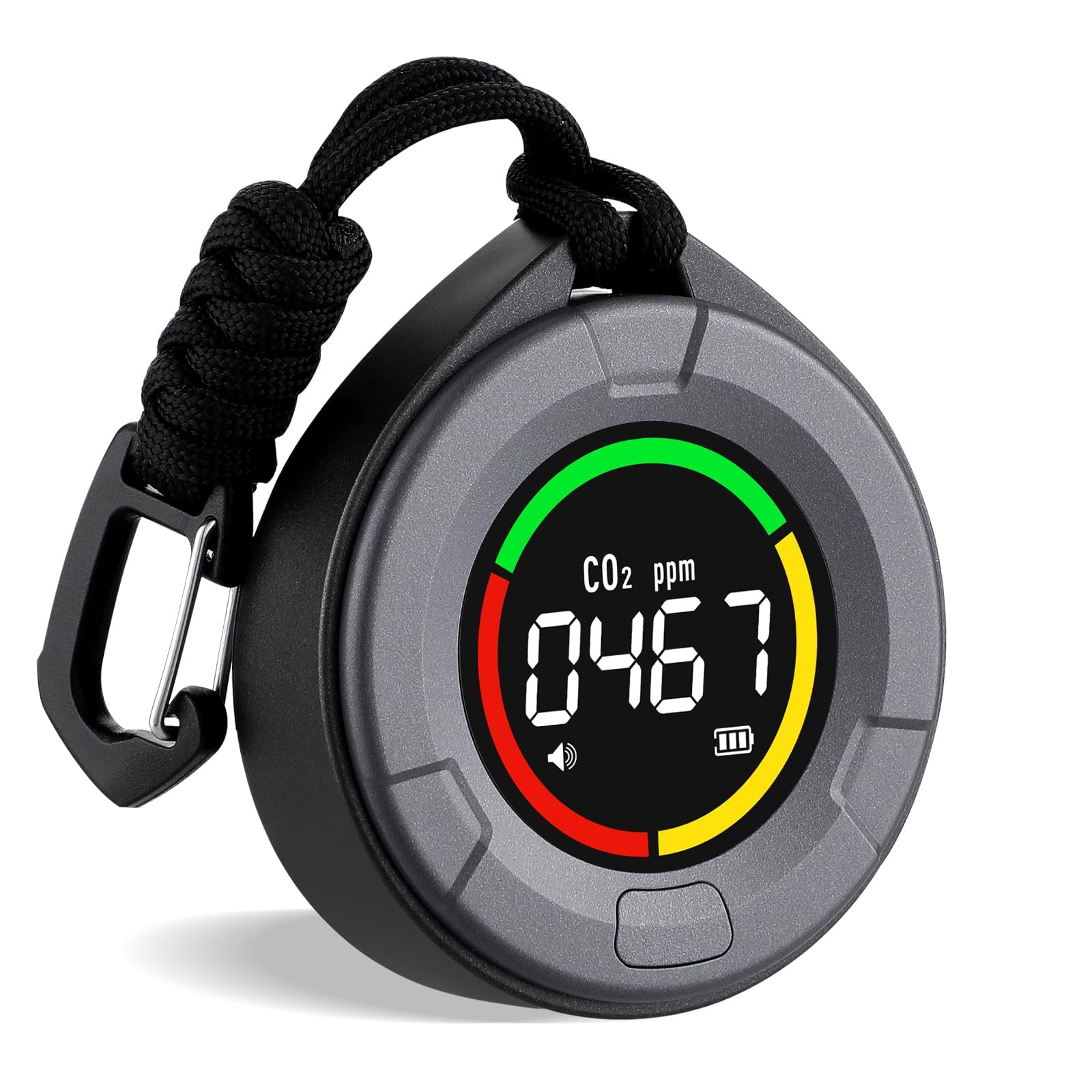
The PTH-10C is the pick for anyone who wants a budget-friendly meter they can throw in a bag. It runs on an NDIR (infrared) sensor, the same principle the pricier meters rely on, and it shows the reading on a full-color LCD that owner feedback repeatedly highlights as bright and readable in direct sunlight. The color coding is instant: green for 400 to 699ppm, yellow for 700 to 1499ppm, and red for 1499 to 5000ppm.
The lanyard and small size make carrying it genuinely convenient, and the built-in 1000mAh lithium battery recharges in about 3 hours and runs about 72 hours per charge. It ducks into an energy-saving ECO mode after 5 minutes of no input, which is what stretches that battery across several days. Accuracy sits at the top of what owners care about most, with the NDIR cell described as accurate and stable against pricier units. The alarm threshold is customizable above 1500ppm, so you are not stuck with a canned limit.
The trade-off is the alarm itself. The low-battery alert can fire loudly in the middle of the night with no obvious way to silence it, which is a real annoyance if this lives in a bedroom. The color bands also lean cautious — some owners feel the red zone starts earlier than the science requires, so do not panic when it flashes. Calibrate it outdoors before you trust the numbers, a step the instructions call for. For the price, the accuracy and portability combo is hard to argue with.
What stands out: The 1000mAh battery and roughly 72 hours of runtime mean you charge it a couple of times a week at most, and the ECO mode keeps it sipping power.
The bedroom caveat: The night alarm and low-battery beep have no easy mute, so it is better suited to a desk or bag than a nightstand.
Reach for this if: you want a portable, color-coded meter on a budget and plan to calibrate it outdoors for an accurate baseline.
Look elsewhere if: you need a silent bedroom companion that never beeps without your say-so.
3. KETOTEK CO2 Monitor Indoor Air Quality Meter (E0172)
A Swiss photoacoustic sensor built to out-read ordinary NDIR meters
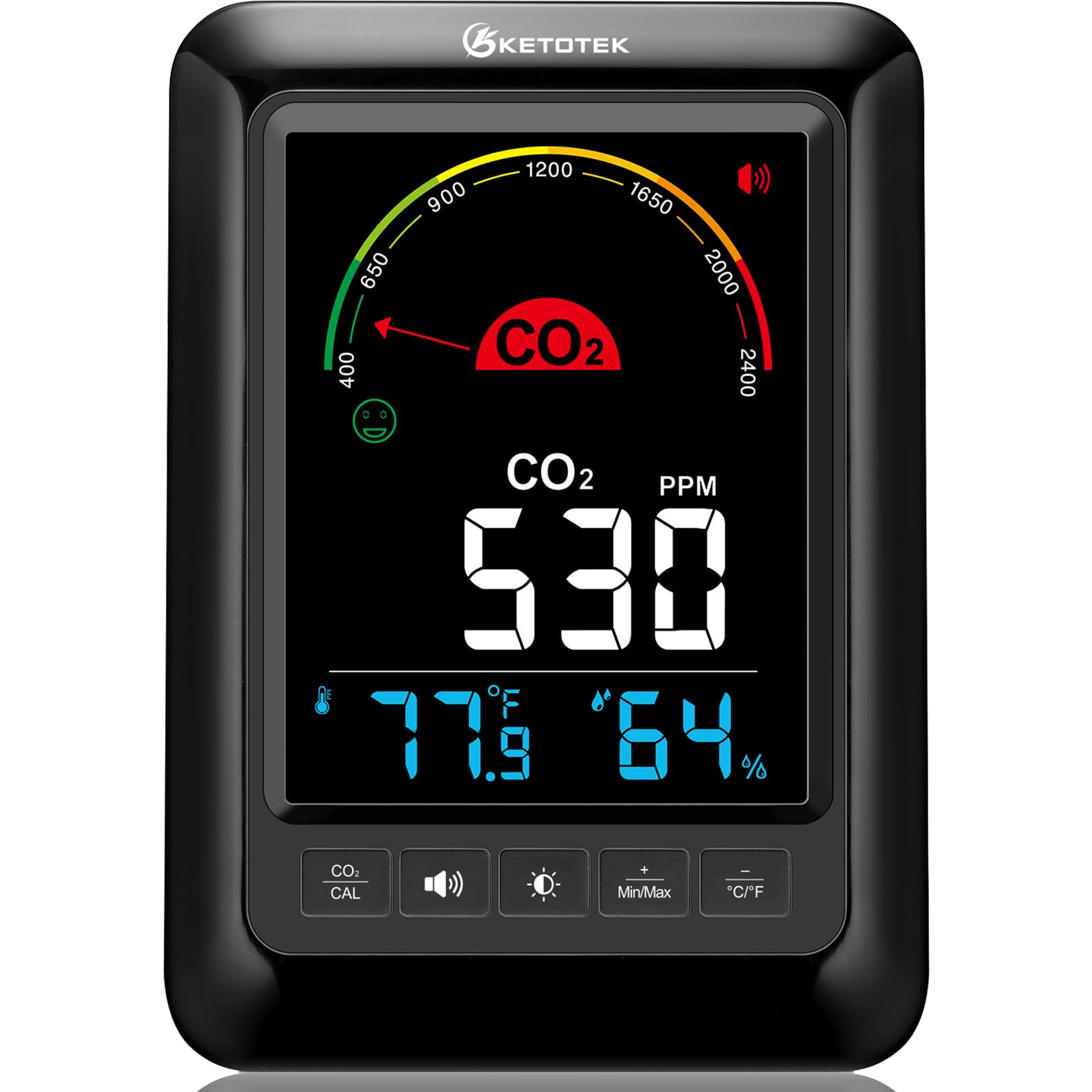
KETOTEK went a step beyond the pack here. This meter uses a Swiss Sensirion industrial-grade photoacoustic sensor (a design that measures gas by the tiny sound waves it produces when it absorbs light), and the maker states it compensates for the limits of NDIR technology with an accuracy of ±50 ppm. That is the tightest tolerance on this list, and it is why this unit earns the sensor-tech nod over the Gain Express handheld, which widens to ±10% of the reading above 2000ppm.
It measures CO2 from 400 to 5000PPM, plus temperature from 14.2°F to 140°F and humidity from 20% to 95%. The extra-large viewing-angle VA display shows the CO2 concentration, temperature, humidity, a comfort indicator, the CO2 level, a ventilation prompt, and a low-battery alert all at once, and the screen brightness adjusts. There are six CO2 concentration levels with a voice reminder, and the sound can be turned off when you want quiet.
It runs on USB mains power, updating CO2 every 6 seconds, or on battery when you want it free of a cable — though in battery mode you press the CO2 button to trigger a manual read. One owner used it in a basement with gas appliances, calibrated it, watched it read 400ppm at the start and max out at 5000ppm overnight twice while a standalone CO detector read zero, and called it a potential life saver. The recurring gripe is trust and build: a few owners say the housing feels flimsy, there is no clear baseline calibration from the start, and readings wander. Give it a good calibration and it holds up.
The real edge: That ±50 ppm accuracy from a Swiss photoacoustic sensor is the tightest figure in this lineup — meaningful when you care about the exact number, not just a color.
Know before you buy: On battery it only reads when you press the button, and it needs a solid calibration to settle — so treat it as a desk or wall unit first, a handheld second.
Best for: fixed placement on a desk or wall where you want the most accurate sensor, dual USB-or-battery power, and a big easy-to-read screen.
Pass if: you need a cable-free meter that continuously logs without pressing a button.
4. INKBIRD Indoor Air Quality Monitor Ndir CO2 Detector (IAM-O2)
Three to six months per charge — the answer for tightly sealed, stuffy rooms
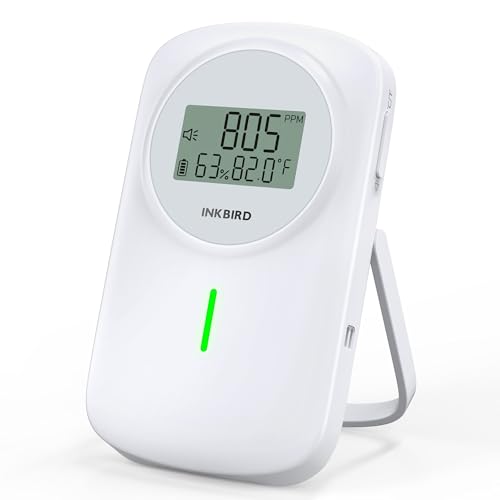
This is the meter you leave on a shelf and forget about, and that is its whole appeal. A Swedish CO2 sensor measures concentrations from 0 to 9999ppm, and low-power circuitry delivers the spec that matters most for a set-and-leave-it unit: 3 to 6 months of use on a single charge, with no need to keep it tethered to an outlet. Temperature accuracy runs to ±0.2°C and humidity to ±1.8%RH.
The real-world reports back the design. Owners of tightly sealed spray-foamed homes describe it as invaluable for knowing when CO2 climbs and ventilation is needed. A mushroom grower uses it to tune airflow, and an exercise-room user was startled by how fast CO2 rose during a workout. Accuracy is what people notice most, with one owner finding it matched a detector costing far more. It also reads temperature and humidity, and the green/yellow/red indicator lights make the level obvious at a glance.
Two things to plan around. The internal battery charges full in about 30 minutes and drains to roughly half over a month, so top it up on a schedule. And the display is bright enough that sleeping next to it needs a little electrical tape over the light. Set both expectations and it quietly does exactly what it promises.
The defining spec: 3 to 6 months per charge at a 0-9999ppm range is the balance between a grab-and-go handheld and a years-long e-ink meter.
Plan for this: The screen light is bright in a dark room, and the battery wants a top-up about monthly — small habits, not dealbreakers.
Who it suits: anyone in a well-sealed modern home, barndominium, or grow space who wants accurate CO2 plus temperature and humidity with minimal fuss.
Not for you if: you want a screen you can read in a pitch-black bedroom without taping over a light.
5. SwitchBot CO2 Detector, Air Quality Monitor Indoor (Meter Pro CO2)

A big, glanceable board that displays five readings and lasts up to a year
The defining feature here is the screen. A 92-millimeter display shows CO2, temperature, humidity, time, date, and a comfort level all at once, which turns air quality into something the whole household can read from across the room. Inside, a Swiss-made NDIR sensor measures CO2 every second with ±50 ppm accuracy across a 400 to 9000 ppm range, and a built-in battery runs up to 12 months with low-battery warnings.
Setup is genuinely simple, and the screen quality is what owners single out — one van-lifer mounted it on the wall and described the large display as readable from anywhere in the vehicle. Alerts come three ways: sound, a visual screen cue, and app notifications through the SwitchBot app, with customizable triggers for CO2, temperature, and humidity. Wall-mount holes and an adjustable bracket make placement flexible. It is also a Home Assistant-friendly sensor, which matters if you already run a smart-home setup.
The catch lives in the smart features. The app notifications and remote monitoring need the SwitchBot Hub, which is a separate purchase. Bluetooth connectivity is decent but not flawless, and a few owners note CO2 readings can pause for long stretches when the unit is plugged in rather than on battery — so if you want live readings, run it on battery. Readings also refresh slowly for some, moving every ten minutes rather than by the minute.
The headline: A 92mm screen, 1-second sampling, and up to 12 months per battery — that combination is the best all-around display package in this lineup.
The asterisk: App alerts and remote checks require the SwitchBot Hub, and readings can stall when it is plugged in — keep it on battery for live data.
Choose this: if you want a large, glanceable wall or desk board that tracks CO2, temperature, humidity, time, and date, and can sit untouched for up to a year.
skip it if: you expect remote app alerts without buying a separate hub.
6. LifeBasis Air Quality Monitor Indoor, 11-in-1 Air Quality Detector

One screen, eleven readings — the closest thing to a full air-health dashboard
If you want more than CO2, this is the most feature-dense meter here. It monitors eleven indexes in real time: AQI, CO2, PM1.0, PM2.5, PM10, particles, HCHO (formaldehyde), TVOC (total volatile organic compounds), temperature, and humidity, with dual visual and audible alerts. The CO2 reading comes from an NDIR infrared sensor, backed up by laser particle, semiconductor, photoelectric, and temperature-and-humidity sensors.
The color system is genuinely useful: each gas icon shifts through Good (green), Moderate Pollution (yellow), Poor (orange), and Abnormal (red), and when a level exceeds normal, the device emits a ticking alert, flashes its indicator light, and tints the interface. A 2500mAh battery with a Type-C charging port delivers up to 11-12 hours of continuous use, and the adjustable screen brightness keeps it readable. Owners find it easy to check at a glance and convenient to carry from room to room.
Here is what to understand before you buy. The accuracy of the whole bundle is mixed — a small number of owners found readings out of step with reference equipment, and one hit a glitch that a support replacement fixed. The CO2 and particle numbers are the reliable ones; treat the fuller gas list as directional rather than lab-grade. For a broad, all-in-one overview of a room’s air, that trade is a fair one, and customer service has a track record of making things right.
Why it earns a spot: Eleven indexes on one screen, plus a rechargeable 2500mAh battery and Type-C charging, makes it the best breadth-for-the-money option for a household overview.
Fair warning: The all-in-one approach spreads accuracy thinner than a dedicated CO2 meter — rely on the CO2 and particle readings and view the rest as directional.
A good fit for: families who want one glanceable device covering CO2, particles, chemicals, temperature, and humidity, and who value a support team that stands behind it.
Look elsewhere if: you need lab-grade precision on a single gas rather than a broad picture.
7. Basic CO2 Meter by Forensics (AB841)
A stripped-down, ten-year-sensor meter built for classrooms and grow rooms
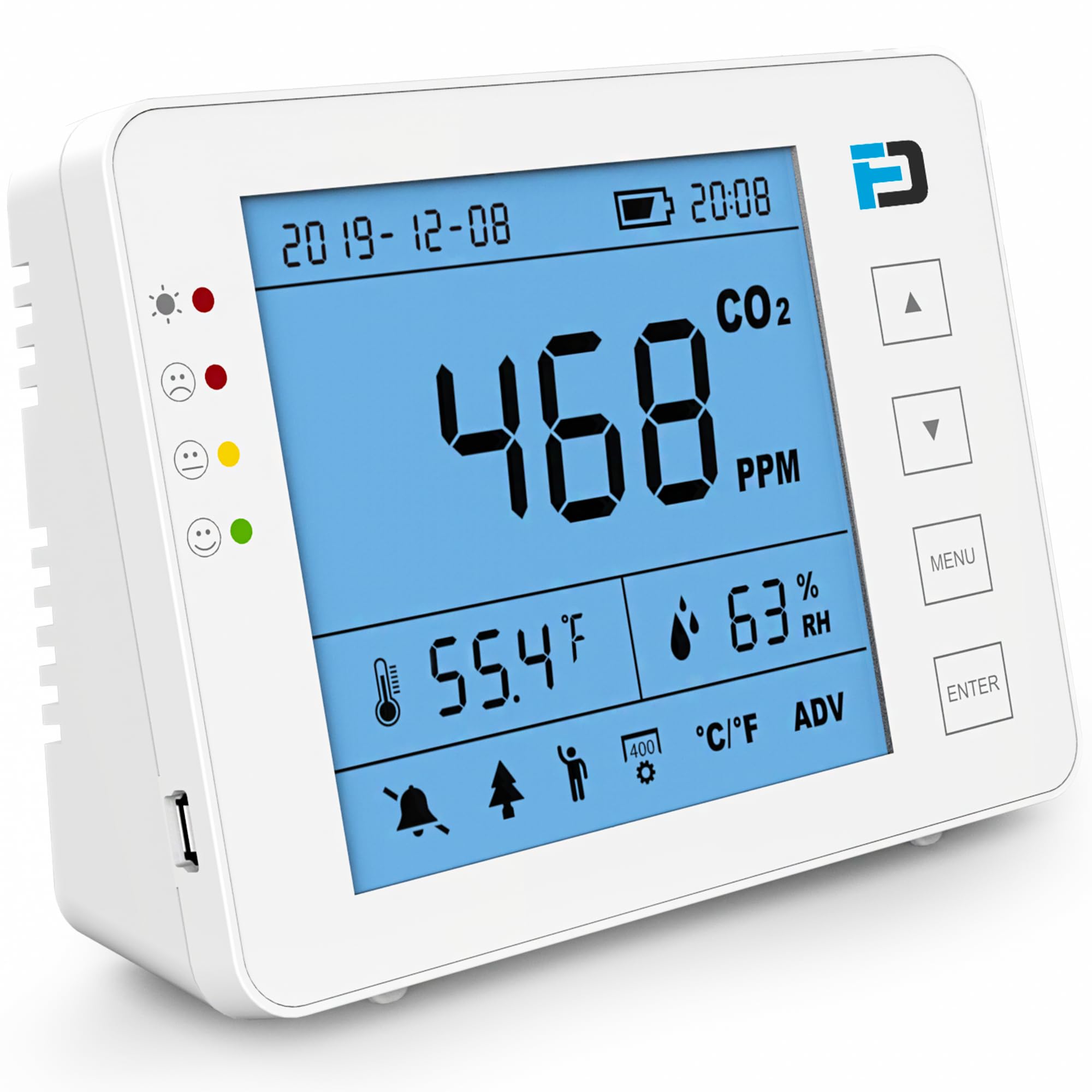
The AB841 is deliberately simple. Its NDIR sensor detects CO2 as low as 1ppm, and the sensor is rated for a 10-year life — far beyond the disposable handhelds that need replacing. A Li-Ion battery runs up to 8 hours on a USB recharge, and it also runs on direct USB power if you want it plugged in for a full school day. It stands stably on a table or mounts on the wall.
The accuracy holds at ±5%, the response time is 20 seconds, and the use-case list is broad: grow rooms, incubators, beer brewing, hydroponics, homes, cars, classrooms, offices, and gyms. One office user with no window used it to prove that a closed door sent CO2 unhealthy within an hour while an open door reset it in about ten minutes. A batch of owners who thought their unit was dead found it simply needs wall charging rather than a computer USB port — a quirk, not a failure.
The honest limitation is readability and the alarm. The screen is only clear from one to two feet in good light, and the backlight will not stay on, which is why portability suffers here. Worse for some, the alarm cannot be disabled — the maximum threshold is 1100ppm, so it can fire repeatedly at night and annoy anyone in earshot. Owners otherwise praise its solid build and accurate readings for the money, but set your expectations around that beeping before you commit.
The dependable core
- Detects CO2 as low as 1ppm with a 10-year sensor life
- Up to 8 hours on Li-Ion, or runs on direct USB power
- ±5% accuracy with a 20-second response time
- Great for grow rooms, hydronics, classrooms, and offices
The real irritations
- Screen readable only from 1-2 feet in good light; backlight will not stay on
- Alarm cannot be disabled — max threshold is 1100ppm
- Only charges while powered on, even when plugged in
Made for: classrooms, grow rooms, and anyone who wants a simple, long-lived, accurate CO2 meter that just works.
Reconsider if: you need a bright always-on display or a silent alarm you can fully control.
8. TEKCOPLUS CO2 Meter Portable Detector (COTK-57)

A yellow, backlit workhorse for spotting stuffy rooms and car-exhaust leaks
This meter covers a lot of ground for the money. Its sensitive chip reads CO2 from 0 to 9999ppm with ±50ppm or ±5% accuracy from 0 to 2000ppm, plus temperature from 14°F to 140°F and humidity from 0.1% to 99.9%RH. The large backlit LCD shows CO2, temperature, and humidity together, and audible and visual alarms fire when you cross your chosen threshold so you can act fast.
The build is a sturdy ABS housing that samples the air about once a second, though the sensor needs roughly 30 seconds to fully stabilize — worth knowing so you do not overreact to the first number. Owners have used it for everything from detecting car-exhaust leaks to checking building ventilation; in a car with recirculated air, readings blew past 1500ppm within minutes. A plastic carrying case is included. It is the same wide-range, wide-application playbook as the Gain Express, but with a friendlier interface for casual use.
The catch is reliability. Most units work from the start, but some arrive faulty — that is the mixed pattern here. There is also a bigger gotcha waiting for data nerds: the serial connection is not standard, so it will not pair with common USB/UART adapters and needs a proprietary adapter plus Windows-only software. Use it as a standalone meter with its own screen and it does the basic job cleanly.
Where it shines: A 0 to 9999ppm range, backlit three-value display, and audible alarms make it a capable, budget-friendly sanity checker for home and vehicle ventilation.
The catch: The serial port is proprietary and Windows-only, and a portion of units arrive dead — buy from a seller with easy returns.
Right for you if: you want a wide-range handheld with a backlit screen and alarms for quick ventilation and exhaust checks.
Think twice if: you plan to export data to a computer — the connection is proprietary.
9. INKBIRD Portable CO2 Detector with Bluetooth (IAM-T1)

Four years on a pair of AA batteries, with an e-ink screen you can read at any angle
No meter on this list touches the IAM-T1’s stamina. It runs up to 4 years on the included AA batteries when you pick the 10-minute sampling interval, with selectable intervals of 1, 2, 5, and 10 minutes. The low-power electronic ink display is why: it holds an image without drawing power, and it stays readable from any viewing angle, unlike the backlit LCD meters that wash out or need a light source.
The sensing side is equally serious. A Swedish Senseair NDIR sensor delivers ±30ppm ±3% accuracy, with ±75ppm at the 1500-2500ppm edge of the range where things get most concerning. Bluetooth 5.0 connects to the INKBIRD app for real-time CO2, temperature, humidity, and even air pressure, and all usage data stays as local data on your phone rather than being uploaded to a cloud server — a deliberate privacy choice for anyone wary of smart devices. Owners verify its accuracy against other meters and call the e-ink screen gorgeous and easy to read.
The trade-offs center on connectivity and the app. There is no Wi-Fi, so monitoring is Bluetooth-only and range-limited, and the app has quirks — it re-downloads data and its graphs default awkwardly. The humidity sensor tends to read about 10% high until you apply a +10% offset in the app, and the unit wants periodic calibration to stay sharp. The e-ink screen also has no backlight, so it needs ambient light to read in a dark room.
Why the battery king wins
- Up to 4 years on two AA batteries at a 10-minute sample interval
- Swedish Senseair sensor with tight ±30ppm ±3% accuracy
- E-ink screen readable at any angle, and data stays local, not cloud-uploaded
What nags a little
- Bluetooth only — no Wi-Fi, so monitoring is range-limited
- Humidity reads about 10% high until you offset it, and it needs periodic calibration
- No screen backlight, so it needs room light to read
The pick for: long-term whole-room monitoring where you want to set it, forget it, and let the Bluetooth app handle history and trends.
Not the one if: you need Wi-Fi remote access or a screen that lights up in the dark.
Understanding the Specs
NDIR vs Photoacoustic Sensors
NDIR stands for non-dispersive infrared — a light is passed through the air sample and the amount absorbed tells the meter how much CO2 is present. It is the workhorse sensor in most meters here and holds calibration well. A photoacoustic sensor, like the Swiss Sensirion unit in the KETOTEK, instead listens for tiny pressure waves the gas creates when it absorbs light. Photoacoustic designs tend to be very stable, which is why they often carry tighter accuracy figures — KETOTEK lists ±50 ppm.
Battery Runtime
Runtime splits into two families. Rechargeable lithium meters run a day or two per charge and update fast, which suits carrying room to room. E-ink and low-power meters sample less often — from every minute up to every ten — and in exchange can reach months or, in the INKBIRD IAM-T1’s case, up to four years on a set of AA batteries. Slower sampling means slower updates, so match the interval to how closely you need to watch the number.
FAQ
What does NDIR mean on a CO2 detector?
Is a CO2 detector the same as a carbon monoxide alarm?
How often do I need to calibrate a battery CO2 meter?
What CO2 level is considered too high indoors?
Do battery CO2 detectors run continuously?
Can a CO2 meter help me decide when to open a window?
What is the difference between an NDIR and a photoacoustic sensor?
Will a CO2 meter work inside a car?
How long do the batteries last on a battery CO2 detector?
Do these CO2 meters need a subscription or hub to work?
Final Thoughts: The Verdict
For most rooms, the Portable CO2 Meter Handheld (Gain Express A017755) is the pick to start with, because it covers a full 0~9999ppm range, tracks temperature and humidity too, and has a multi-year track record that owners keep coming back to. If you want the tightest sensor accuracy in a fixed spot, the KETOTEK E0172 and its ±50 ppm Swiss photoacoustic sensor is the one to reach for. And if you simply want to mount it and forget it for up to four years, the INKBIRD IAM-T1 outlasts everything else here on a pair of AA batteries. Whichever you choose, the number on the screen turns a vague stuffy feeling into a clear decision.
How We Picked
We do not accept paid placement. Every pick is matched to a real buyer and a real use-case; we do not hands-on test units.
Sources & Methodology
Specifications: manufacturer listings and product documentation. Review insights: verified customer reviews, as of September 2026. Pricing: not shown on this page (it changes often); check the current price via the retailer link.
As an Amazon Associate, KitchPrep earns from qualifying purchases. This does not affect which products we feature.
Related Guides
