
Specs are compiled from manufacturer listings and verified buyer reviews and can change over time — please confirm the key details on the product page before buying.
Boondocking in summer heat or winter chill used to mean a noisy generator or no comfort at all. A battery-powered AC and heater changes that by running straight off your 12V house bank, so you can sleep cool in the desert or stay warm in the mountains without plugging into anything. The catch is that these units vary wildly in how much battery they drain, how loud they run, and whether the heat is a true heat pump or just a small supplement.
I’m Mohammad Maruf — the founder and writer behind KitchPrep. This guide is built by comparing the manufacturers’ published specifications and the patterns across verified customer reviews, so you get each pick’s real strengths and trade-offs instead of marketing spin.
Here is how to pick the right battery powered ac and heater for your rig, based on BTU output, power draw, and real owner experiences.
Our Picks at a Glance
How To Choose The Best Battery Powered AC and Heater
Picking the right unit starts with understanding that not all “battery powered” ACs are the same. Some are rooftop units that bolt onto a 14″ x 14″ cutout, while others are portable boxes you vent through a window. Your vehicle’s roof space and your battery capacity decide which one will actually work for you.
Cooling and Heating Power (BTU)
BTU, or British thermal units, measures how much heat the unit can move. A higher cooling BTU means faster, stronger cooling in a larger space. For heating, pay attention to whether the unit uses a PTC heater or a heat pump. A PTC heater is a supplemental warmth source for mild conditions, while a heat pump reverses the compressor to provide real heat efficiently.
Battery Draw and Runtime
The biggest mistake buyers make is ignoring amp draw. A unit that pulls 40 amps at 12V will drain a 100Ah battery in about two hours. Look for units with inverter compressors and Eco modes, which can cut power use dramatically during nighttime operation, often dropping to around 350W. Match the unit’s draw to your battery bank size before you buy.
Installation and Fit
Rooftop units need a specific roof cutout, usually 14″ x 14″, and must be compatible with your roof thickness. Low-profile units reduce wind drag and are easier to lift. Portable units skip the roof work but need a vent hose and a place to exhaust hot air, which makes them less practical inside a vehicle.
Quick Comparison
| Model | Best For | Cooling Power | Heating Power | Noise Level | Amazon |
|---|---|---|---|---|---|
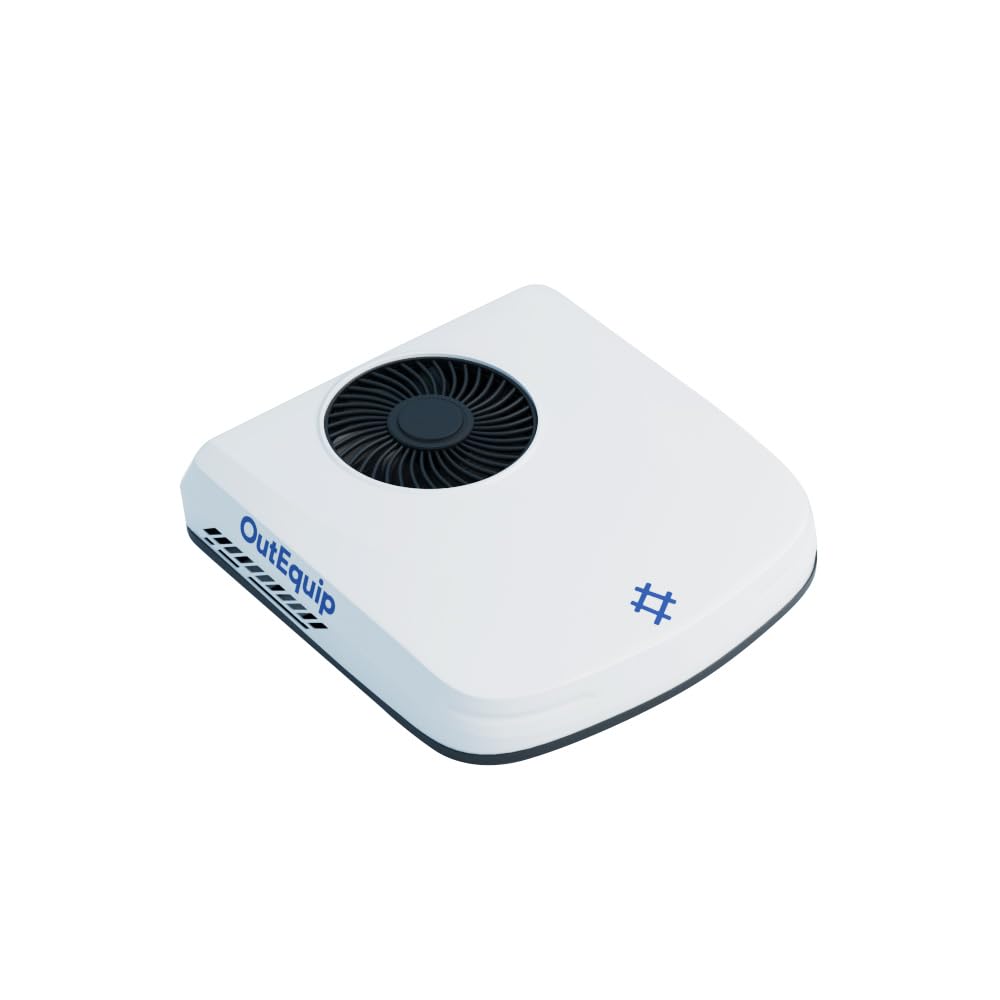
| Outequip 10K BTU★ Best Overall | Off-grid campers wanting quiet comfort | 10,000 BTU | 4,500 BTU PTC | 40 dB | Amazon |
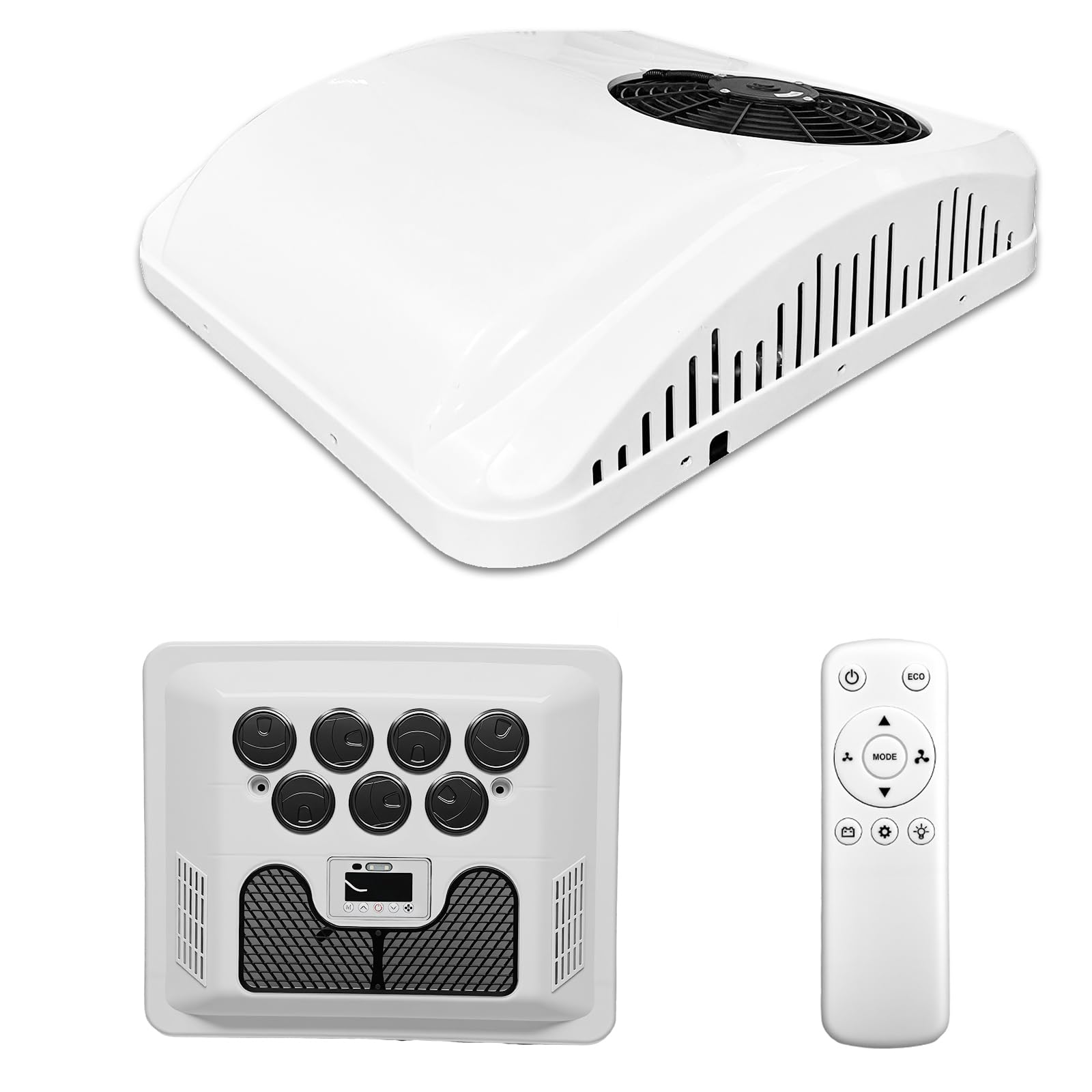
| Treeligo 11K BTUBudget Champion | Budget DIY installs | 11,000 BTU | 11,000 BTU | Below 45 dB | Amazon |
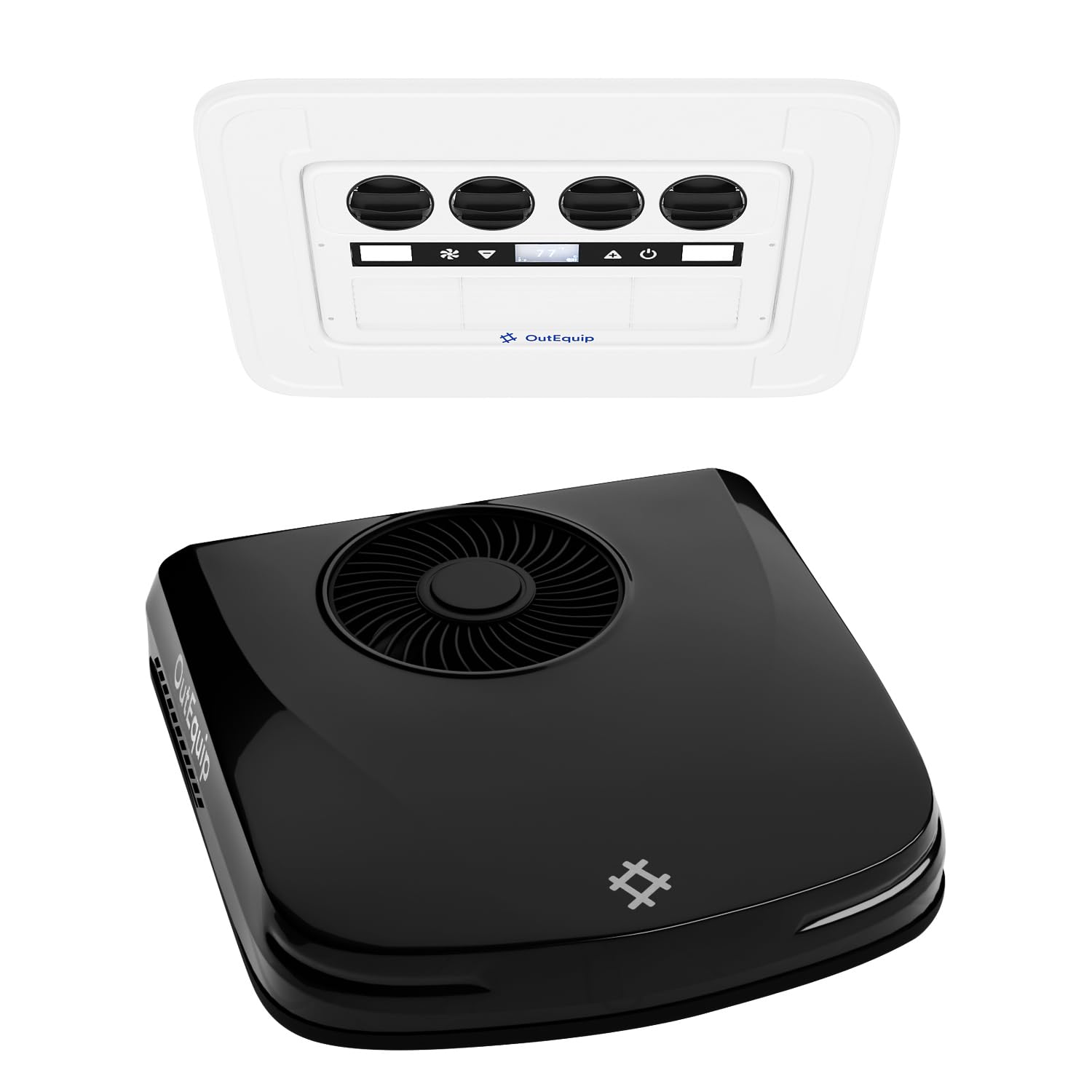
| Outequip Black 10K BTUPremium Pick | Vans needing sleek low profile | 10,000 BTU | PTC Heater | Quiet | Amazon |
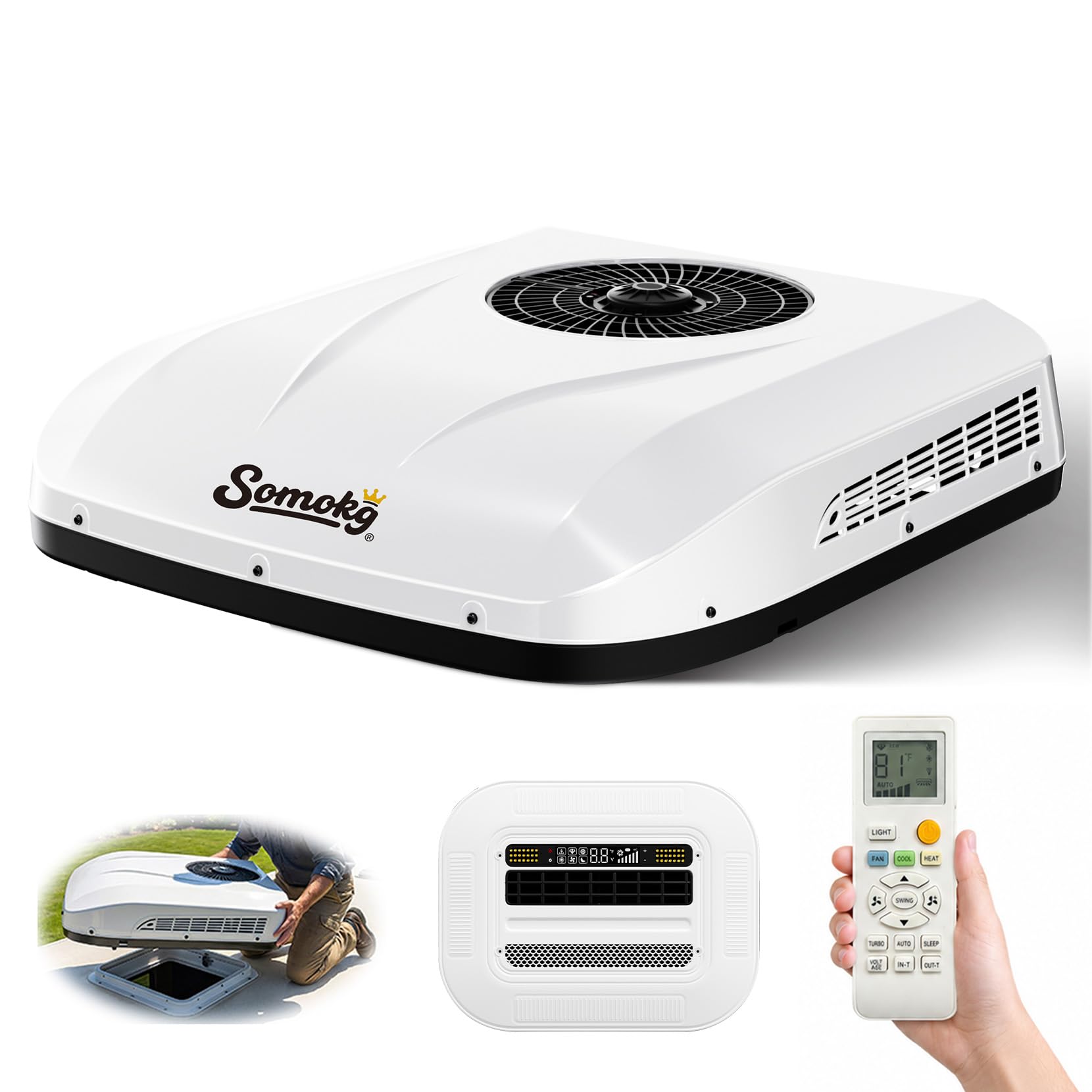
| Somokg 11K BTU | Quiet, low-profile builds | 11,000 BTU | 4,500 BTU | 35 dB | Amazon |
| Gidrox 10K BTU | App-controlled cooling | 10,000 BTU | — | 40 dB | Amazon |
| Cybertake S2 Pro | Tents and small cabins | 5,100 BTU | 6,100 BTU | 40 dB | Amazon |
| Gidrox 12K BTU | Year-round heat pump needs | 12,000 BTU | 9,000 BTU | 40 dB | Amazon |
| EcoFlow WAVE 3 | Portable plug-and-play setups | 6,100 BTU | 6,800 BTU | 44 dB | Amazon |
In‑Depth Reviews
1. Outequip 10,000 BTU 12V RV Air Conditioner
Our pick — over 4.5★ from 100+ verified ratings; the strongest balance of quality and price.
A 10,000 BTU rooftop unit that cools a cabin in 15 minutes and runs at a quiet 40 dB.
You get rapid cooling that drops the cabin temperature within 15 minutes, powered by a 10,000 BTU compressor. The 4,500 BTU PTC heater is the honest trade-off here: it adds warm air for mild nights in small spaces, but the data is clear that it is not a primary heat source for extreme cold. Owners run it directly on 12V DC power, which means no generator and no inverter in the chain. The consensus is that it uses roughly 250 watts an hour, which is remarkably low for this class of cooling.
Build quality addresses the outdoors directly: a UV-stabilized ABS shell, an EPDM foam gasket for sealing, and a zinc-coated condenser to fight corrosion. The brushless copper motor fans keep noise down, and the spring-supported mounts isolate vibration so you can actually sleep under it. Control comes from a remote with eco, sleep, and turbo modes, plus temperature monitoring, so you can dial in a personalized environment without leaving your bunk.
You get a dependable cooling and heating unit for off-grid trips, and Owners consistently call it a standout for boondocking, citing reliable off-grid cooling.. Owners highlight the easy install with the improved bracket and square gasket, the lack of interior drips even in humid Southern heat, and the ability to cool on low at 96°F outside. The 6 AWG wire and stainless bolts show attention to the install details that matter. As buyers report, it is a “12V/24V/48V DC heat pump AC; efficient inverter tech, off-grid ready with 500W solar; 43 lbs, 6″ tall, 40 dB.”
Why it wins owners over
- Remarkably quiet at 40 dB with brushless copper fans
- Ultra-low power draw of about 250W per hour
- Runs on 12V, 24V, or 48V DC for solar setups
- Low-profile 6-inch tall design fits tight roofs
Honest limitations
- 4,500 BTU heater is supplemental, not for freezing temps
- Install can be frustrating if connectors are fragile
- Heavy at 43 lbs, needs a helper to lift
Reach for it if: you want the best-documented balance of quiet cooling, low amp draw, and off-grid solar compatibility.
Think twice if: you need serious winter heating, since the PTC warmth is only for mild conditions.
2. Treeligo 11,000 BTU 12V DC Rooftop AC
The most affordable 11,000 BTU dual-function rooftop unit, but you gamble on durability.
This is the budget route to full 11,000 BTU cooling and 11,000 BTU heating, which is a rare and genuinely useful combo. The operating power ranges from 330W to 1000W depending on mode, and the inverter compressor adjusts output to match the load. It runs directly on a 12V system, so it pairs with a 12V 300Ah battery bank and solar without needing a generator. The digital display and 3 fan speeds make temperature monitoring straightforward.
Installation is simplified by the factory pre-charge: it ships with R134a refrigerant and POE 68 refrigeration oil ready to go. The minimum roof opening needed is 12.60″ (L) x 10.24″ (W), which is smaller than the standard 14″ x 14″ cutout on many RVs. At 50 pounds, it is heavier than the Outequip at 50 lbs vs 43 lbs, but the compact footprint saves roof space. Noise stays below 45 decibels thanks to frequency conversion technology and a low-noise internal structure.
The review pattern here is the reason it is not ranked higher. Owners mention it cools a 5th wheel bedroom quickly even in 100°F heat and runs well on solar. But there are also verified accounts of the unit failing after 2 months in an RV with solar, where the fan stops but the compressor keeps running, with no airflow and no response from the seller. As customers note, it “failed after 2 months in RV with solar… no response from seller/company after multiple contacts.” That durability and support risk is real, so treat this as a value gamble.
Where it wins: you get the best BTU-to-price ratio for a unit that both cools and heats on 12V DC, so you save on energy costs while staying comfortable.
Where it stings: durability reports and unresponsive support make it a riskier long-term bet.
3. Outequip Black 10,000 BTU Low Profile DC AC
A low-profile black rooftop unit offering up to 10 hours of quiet cooling on a 600Ah battery bank.
This is the premium take on the Outequip platform, and the headline is runtime. Powered directly by your 12V system, it delivers up to 8 hours of cooling on a standard 480Ah house bank, stretching to 10 hours on a 600Ah system when parked. That is enough for a full night’s sleep without worrying about the batteries. The 10,000 BTU cooling still drops the cabin in about 15 minutes, and the PTC heater handles mild Southern California nights well, according to owners.
The build is tailored for harsh conditions: UV-resistant ABS housing, a zinc-coated condenser, and an EPDM foam gasket for sealing. Dual brushless copper motor fans and anti-vibration mounting keep it exceptionally quiet, with one owner noting they can hold a conversation or sleep without any compressor noise. The black housing is a visual upgrade over the white model, sitting below roof rack height for a low profile. Control comes from a remote, a digital temperature display, and Eco, Sleep, and Turbo modes.
What wins people over is the overall quality and the low power draw of about 650 watts maximum. Owners have installed it on a 2020 Ford Transit and a 2025 Ram Promaster 3500 with straightforward results. The recurring note is that daytime cooling in direct sun is slower than night cooling, which is a fair expectation for 10,000 BTU. Support gets high marks, with one professional installer specifically praising the build quality.
Standout trait: the 8-10 hour runtime on a 480-600Ah bank makes it the best overnight off-grid choice here.
Fair caveat: real-world daytime cooling in direct sun is slower, so insulated window covers help.
4. Somokg 11,000 BTU 12V RV Air Conditioner
The quietest rooftop unit at 35 dB, with a soft start that cuts surge by 70%.
At 35 dB, this is 14% quieter than the 40 dB Outequip unit, making it the lowest-noise option in this lineup for peaceful downtime. It delivers 11,000 BTU of rapid cooling and 4,500 BTU of supplemental heating, so it is 10% stronger on cooling than the 10,000 BTU models above. The integrated soft start is a standout feature, reducing startup surge by 70% to protect your battery bank and extend the unit’s life. Reviewers point out it runs 12 hours of cooling in Eco Mode with a 400Ah battery.
The design is genuinely low-profile at just 6.1″ tall and 43 pounds, which reduces wind drag on the highway. It fits standard 14″ x 14″ roof openings and works with roof thicknesses from 1.5″ to 3.9″. The 360° adjustable vents provide gentle, even airflow without direct blowing, and the digital LED display includes a built-in reading light. Control comes from a full-function remote with Cool, Eco, Sleep, and Fan modes across 6 adjustable speeds.
The strongest owner feedback centers on functionality and how well it performs for the value. Shoppers say the installation is straightforward, though a few needed custom duct extensions for thicker RV roofs. The manufacturer’s customer service gets repeated praise for fast responses and easy part replacement when issues arise.
What owners praise most
- Library-quiet 35 dB operation with a stable scroll compressor
- Soft start cuts surge by 70% for longer battery life
- Ultra-slim 6.1″ height reduces wind drag
- Responsive manufacturer support for part replacement
Watch out for
- Compressor may need a 300Ah battery to start reliably
- Thick roofs may require custom duct extension
- Occasional part failures reported, though support resolves them
Pick this if: quiet operation and battery protection matter more than anything else.
Look elsewhere if: you have a small battery bank, since it may not start below 300Ah.
5. Gidrox 10,000 BTU 12V DC RV AC
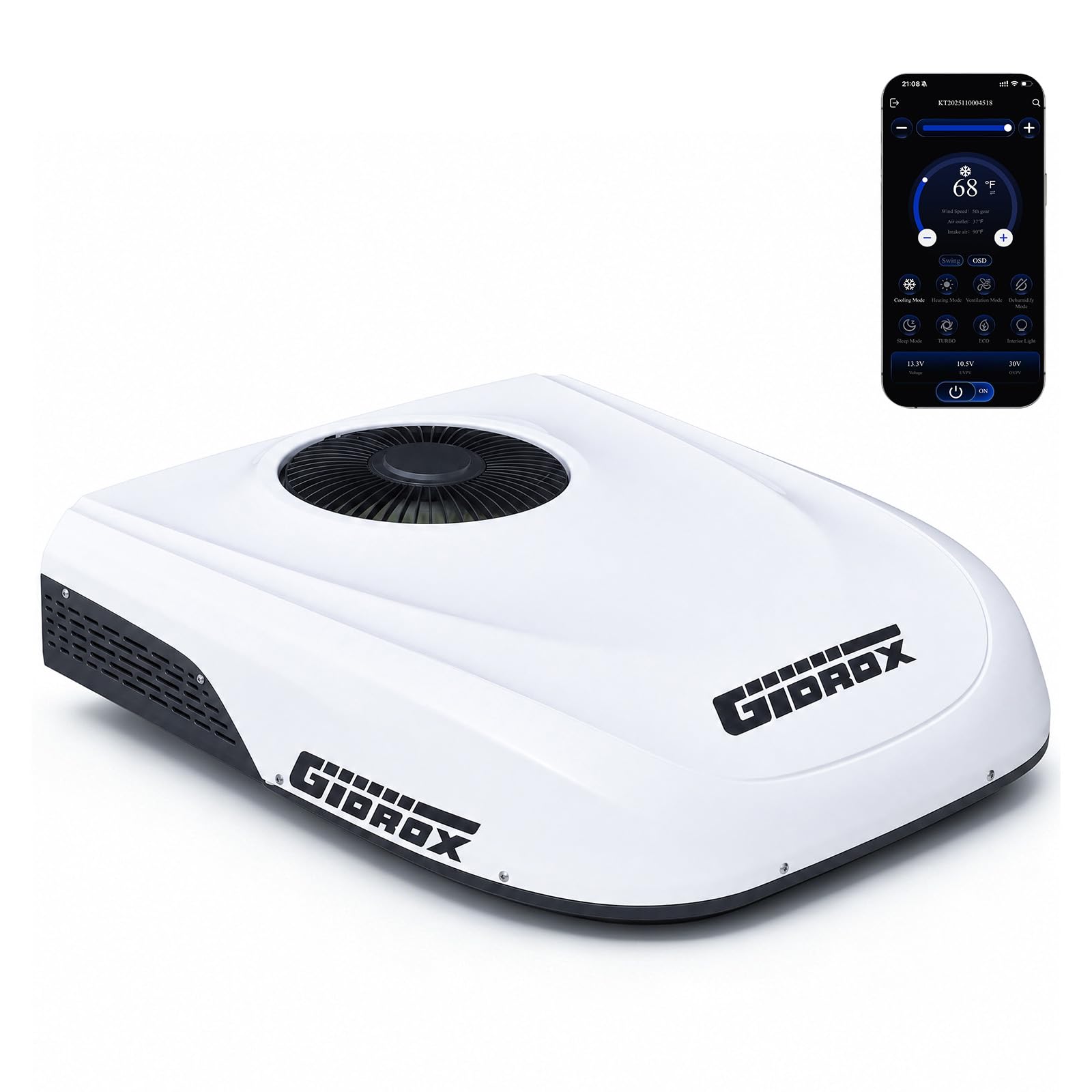
A 10,000 BTU cooling-only unit with app control and a 350W eco mode.
This unit is for the cooling-focused buyer who wants modern controls. It delivers 10,000 BTU of cooling that can chill your space within 3 minutes using inverter technology. The tested average power consumption is only about 350W during nighttime operation in 30°C ambient, which supports all-night use with a 400Ah battery. The brushless fan and sound-insulation design keep it at a library-quiet 40 dB in Sleep mode.
The smart control suite is the differentiator here: a smartphone APP via Bluetooth, an infrared remote, and physical buttons on the unit. You can set temperature, program timers, switch between °C/°F, and the unit automatically adjusts power based on the temperature difference. The included HEPA filter is a nice touch for allergen-sensitive campers. At 59 pounds packed, it is the heaviest of the rooftop options, but you get a 19.7 ft power cable and all mounting hardware for a 14″x14″ cutout.
Owner-reported power draws are detailed and informative: 250W in dehumidifier mode, 350W in eco, 420W in normal cooling, and 650-700W in turbo with the compressor on. One owner ran it all week on 800W solar and a 600Ah battery bank. The realistic caveats are the fixed 79°F eco mode that you cannot change without exiting eco, and the lack of battery cutoff settings. It is note this is a cooling-only unit, so pair it with a separate heater for winter.
Best for: tech-savvy campers who want app-based temperature control and clear power draw data.
Keep in mind: there is no heating function, so it only solves half of the year-round equation.
6. Gidrox 12,000 BTU 12V DC RV AC with Heat Pump
The most powerful rooftop unit with 12,000 BTU cooling and a 9,000 BTU heat pump.
This is the big brother to the Gidrox 10K, and it brings the most cooling power of any rooftop unit here at 12,000 BTU. The integrated heat pump delivers 9,000 BTU of heating, saving about 65% energy versus standard electric heaters, and the cooling efficiency rating reaches up to 12.3 EER. That makes it the genuine year-round solution in this group, handling both summer heat and winter cold from the same rooftop unit.
It shares the smart control DNA of its sibling: app control via Bluetooth, infrared remote, and physical buttons, with temperature programming, timers, and °C/°F switching. The 350W average nighttime power draw in 30°C ambient supports all-night use with a 400Ah battery, just like the 10K model. Buyers report a 10-hour runtime on a 400Ah battery versus only 6 hours with their old unit, holding 70°F inside when it was 80°F outside. The included HEPA filter and 19.7 ft power cable round out the package.
The honest assessment is more complicated. While the heat pump is efficient, there are verified reports of the heater not working on some units, and the 12K cooling performance is described by one owner as similar to a good 8K window unit rather than a full 12K. The app has reliability issues with Bluetooth dropping, and the remote limits temperature adjustment to 63°F while the app goes to 61°F. It is quiet and efficient at 250-800W, but it may not be enough as the sole cooling source on very hot days.
Why it rates the top spot for power: the 9,000 BTU heat pump is the most capable heater on a rooftop unit here.
Why it is not for everyone: mixed reliability reports on the heater and app make it a quality gamble.
7. Cybertake S2 Pro Portable Camping AC
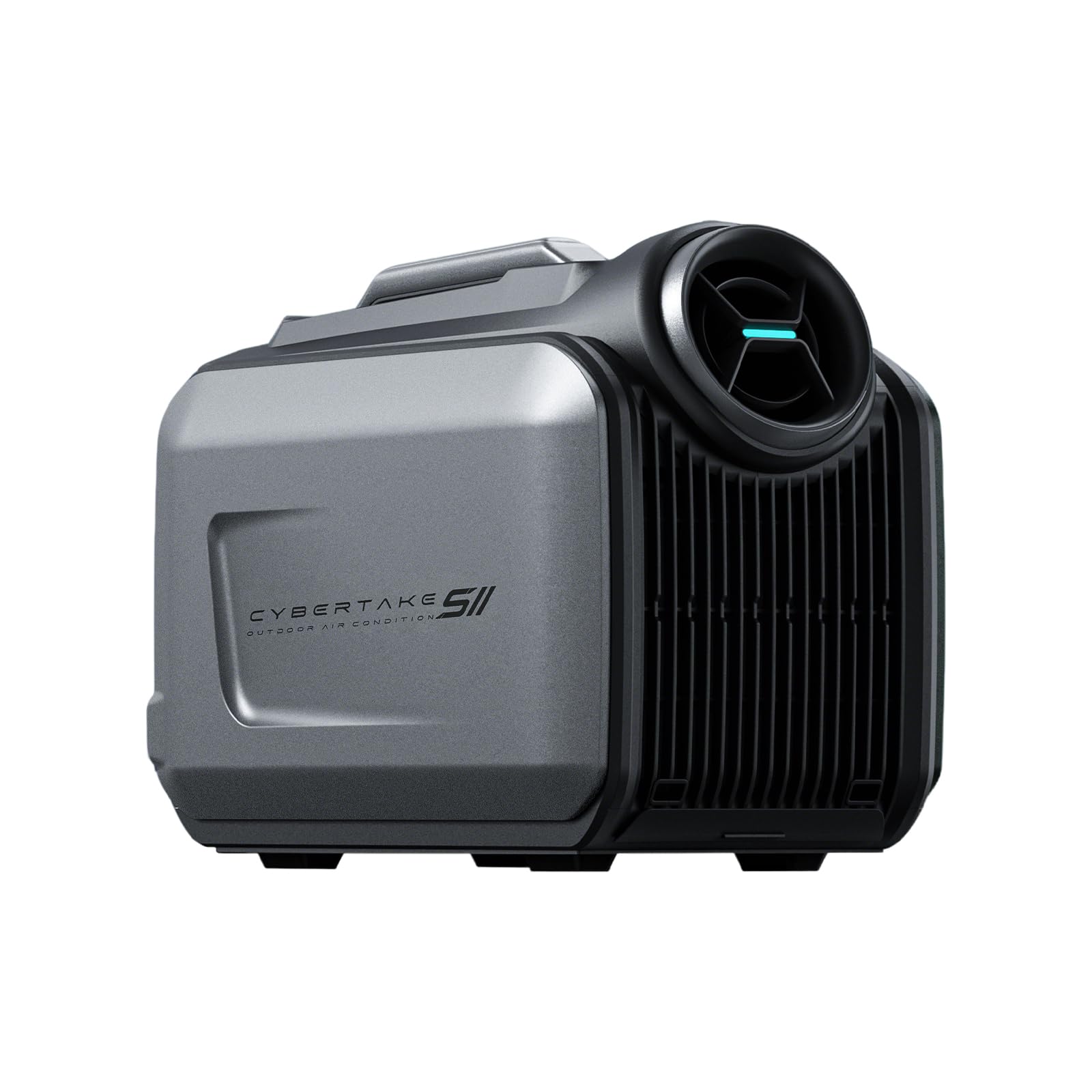
A portable unit that cools and heats up to 130 sq ft with 30-second setup and 3-way power.
If you do not want to cut a hole in your roof, this portable unit is the alternative. It delivers 5,100 BTU of cooling and 6,100 BTU of heating, conditioning spaces up to 130 sq ft. The clever part is the 3-way power: it runs from a wall outlet (100-240V), from a car or RV (12V/24V), or from a portable power station (DC 48V). In Eco+ mode, it uses as little as 1kWh per 8 hours, which is the standout efficiency figure here. Setup takes 30 seconds with all hoses and adapters included.
The IPX4 water-resistant shell handles splashes and rain, and the waterproof silicone buttons keep working in wet conditions. It operates at a whisper-quiet 40 dB, quieter than a dishwasher. You get 4 modes (Cool, Heat, Dehumidify, Eco+), 3 fan speeds, precise temperature control from 60°F to 90°F, and a 0-12 hour timer. The operating ambient range is 41°F to 113°F, so it is designed for real outdoor conditions.
Owner feedback is genuinely split on this one. On the positive side, performance earns the most mentions, with buyers reporting it keeps a truck cap dry overnight and cools a tent down to the low 80s in full sun. Power consumption gets repeated praise, with one owner confirming the 1kWh per 8-hour claim. On the negative side, some report the unit is inefficient when used inside a vehicle, draining a 2000Wh station in under 3 hours, and the app has connectivity issues. The separate remote and separate 12V-48V boost converter are extra costs to plan for.
Why it wins over rooftop units
- Installation-free setup in 30 seconds with included hoses
- Three power sources: wall, vehicle, or power station
- IPX4 water-resistant shell for outdoor use
- Eco+ mode uses as little as 1kWh per 8 hours
Why it may not fit you
- Not efficient for cooling inside an SUV or vehicle interior
- App and remote must be purchased separately or may not pair
- 5,100 BTU is limited for larger spaces
Choose this for: tents, truck caps, and cabins where no roof modification is possible.
skip it if: you expect it to cool the inside of a vehicle efficiently, where it falls short.
8. EcoFlow WAVE 3 Portable AC with Battery
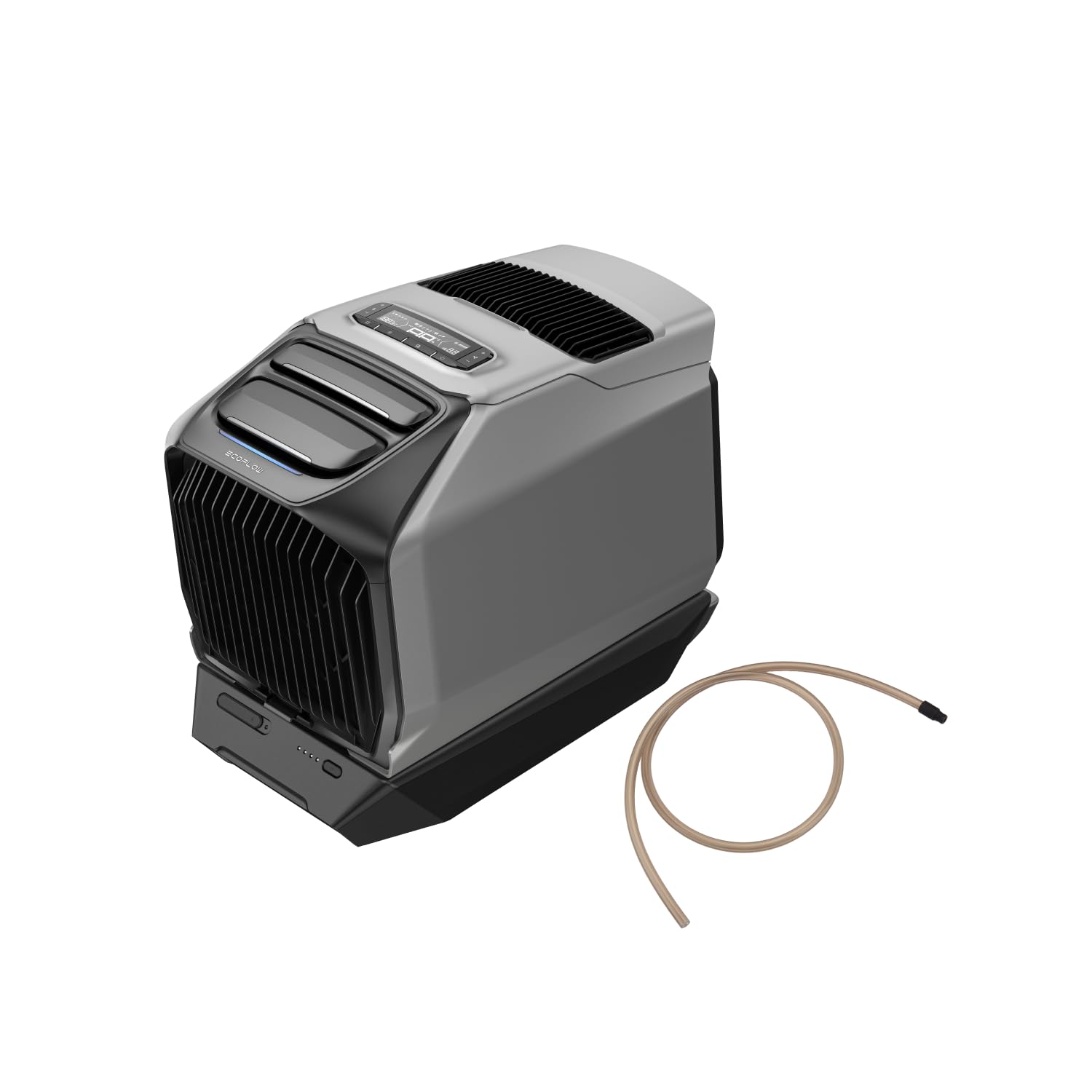
The only unit with a built-in 1024Wh battery for 8 hours of cordless cooling and heating.
This is the premium portable option, and its defining feature is the built-in 1024Wh LFP battery that delivers 8 hours of cordless operation. That means no wiring, no roof cutout, and no external battery bank required. The 1800W cooling power drops the temperature 15°F within 15 minutes, while the 2000W real heating boosts the temperature 17°F at the vents in the same time frame. It cools 120-180 sq ft spaces, making it suitable for RVs, tents, and truck caps.
The battery recharges in 75 minutes via 1000W ultra-fast charging from AC, the EcoFlow Alternator Charger, car, or solar. Sleep mode runs at 44 dB for undisturbed rest, and the PetCare feature auto-activates cooling if the cabin overheats while you are away. The R290 refrigerant reduces CO2 emissions, and the compact 20″ luggage size with an ergonomic handle makes it easy to move around. Real-time power monitoring comes through the app.
The review data reveals a real split between performance and reliability. Cooling performance gets the most positive mentions, with owners confirming it drops temperatures by 10 to 15 degrees, even in a tent in full sun, from 93°F down to 80-84°F. But reliability is the most-discussed aspect overall, with reports of units tripping breakers after one use and water leaking even on level ground. The value-per-dollar is also questioned, with some calling it not worth the premium price. The built-in battery and brand ecosystem are compelling, but you are paying for that convenience.
What stands out: the only true all-in-one with a built-in battery, recharges in 75 minutes, and cools quickly.
What holds it back: mixed reliability reports on breakers and leaks make the high price harder to justify.
Understanding the Specs
BTU and What It Means for You
BTU, or British thermal units, is the standard measure of heating and cooling power. A higher cooling BTU means the unit can remove heat from a larger space faster. For example, a 10,000 BTU unit is better suited to a small camper or van bedroom, while a 12,000 BTU unit can handle a larger RV living area. For heating, a true heat pump with a high BTU rating, like the Gidrox 12K’s 9,000 BTU, provides real warmth, whereas a PTC heater is a supplemental source for mild conditions only.
Amp Draw and Battery Math
Your battery bank size determines how long you can run the AC. A unit pulling 40 amps at 12V drains a 100Ah battery in about two hours. Look for Eco modes and inverter compressors, which can drop power draw to around 350W during nighttime operation. For an all-night run, you generally want a 400Ah battery bank. Always check the unit’s rated wattage and match it to your battery capacity before purchasing.
FAQ
Will a battery powered AC and heater work with my existing solar setup?
How big of a battery bank do I need for overnight cooling?
What is the difference between a PTC heater and a heat pump?
Can I install a rooftop unit myself?
How loud are these units while I sleep?
Will a 10,000 BTU unit cool a large RV?
Do portable units like the Cybertake need a vent hose?
What is the difference between rooftop and portable battery powered AC units?
Final Thoughts: The Verdict
For most buyers, the battery powered ac and heater winner is the Outequip 10K because it delivers quiet, efficient cooling on 12V DC with proven owner satisfaction. If you want the most powerful heat pump in a rooftop unit, grab the Gidrox 12K. And for a no-install tent and cabin solution, the Cybertake S2 Pro is the one to reach for.
How We Picked
We do not accept paid placement. Every pick is matched to a real buyer and a real use-case; we do not hands-on test units.
Sources & Methodology
Specifications: manufacturer listings and product documentation. Review insights: verified customer reviews, as of September 2026. Pricing: not shown on this page (it changes often); check the current price via the retailer link.
As an Amazon Associate, KitchPrep earns from qualifying purchases. This does not affect which products we feature.
Related Guides
