
Specs are compiled from manufacturer listings and verified buyer reviews and can change over time — please confirm the key details on the product page before buying.
The real problem isn’t a lack of batteries — it’s that you can’t tell the good ones from the dead ones without burning your tongue on a 9-volt. A battery organizer and tester solves both halves of that equation in one box: a dedicated home for every size you own, plus a built-in checker that tells you in seconds which cells are still worth keeping. This guide walks you through the nine best options, sorted by what each one does best, so you can match a case to your actual battery hoard.
I’m Mohammad Maruf — the founder and writer behind KitchPrep. This guide is built by comparing the manufacturers’ published specifications and the patterns across verified customer reviews, so you get each pick’s real strengths and trade-offs instead of marketing spin.
You’ll see which cases store the most, which testers read true, and which organizers survive daily drawer life, all to help you find the right battery organizer and tester for your home.
Our Picks at a Glance

How To Choose The Best Battery Organizer and Tester
You’ll pick the right case by matching three things: how many batteries you own, which sizes you use most, and whether it lives in a drawer or travels with you. Match those needs to the specs below, and you’ll avoid both the too-small case and the oversized one that swallows your shelf.
Capacity vs. Your Real Battery Collection
Capacity numbers like 58, 180, or 285 slots sound impressive, but they only help if the slots match your sizes. A case packed with AAA slots does you no good if your home runs on C and D cells for flashlights and toys. Count your batteries by size before you buy, then check the per-size breakdown in the specs — most cases list exactly how many AA, AAA, 9V, C, D, and coin cells they hold.
The Tester: Your Dead-Battery Detective
The whole point of a combined organizer and tester is avoiding the frustration of installing a dead cell. Most included testers are small, battery-powered checkers that measure AA and AAA, with some also reading 9V and lithium cells. If you stock 18650s or button cells, confirm the tester handles them before committing — many cases only test the two most common cylindrical sizes.
Build and Portability
A full case of batteries is heavy, so the material and closure matter. Hard plastic shells with latches survive drops but can crack, while EVA and fabric bags with zippers are lighter and often water-resistant but less rigid. If the case lives in a drawer, a slim double-sided design fits best; if you’re hauling it to a campsite or job site, a strong handle and secure latch are non-negotiable.
Quick Comparison
| Model | Best For | Total Capacity | Weight | Closure | Amazon |
|---|---|---|---|---|---|
| Ontel Battery Daddy★ Best Overall | Massive home storage | 180 | 1.24 kg | Locking Lid | Amazon |
| Comecase Hard CaseBest Value | Briefcase-style travel | 148 | 454 g | Zipper | Amazon |
| KIWIFOTOS 58 SlotsRugged Pick | Waterproof outdoor use | 58 | 0.36 kg | Sealed Lid | Amazon |
| Luxtude Small Case | Tight drawers and RVs | 61 | — | Zipper | Amazon |
| Bee Neat Organizer | Wall-mounted workshops | 117 | 16 ounces | Lift-Off Lid | Amazon |
| PAIYULE 220+ Case | Garage bulk storage | 220+ | 0.55 kg | Zipper | Amazon |
| Tenergy Large Case | Balanced all-rounder | 120 | 0.51 kg | Button | Amazon |
| Aptbyte 269 Case | Rigid plastic durability | 269 | 1.33 kg | Latches | Amazon |
| YCTYIYAO 285 Case | Maximum size variety | 285+ | 1.63 kg | 4 Buttons | Amazon |
In-Depth Reviews
1. Ontel Battery Daddy Organizer Storage Case & Tester
Our pick — over 4.5★ from 83,500+ verified ratings; the strongest balance of quality and price.
The crowd favorite that swallows 180 cells and shows them all through a clear lid.
The Battery Daddy earns its “best overall” spot by being the most-loved option in this category — it’s a 4.8-star pick with over 80,000 owners weighing in. Its double-sided design stores up to 180 batteries across six sizes: 76 AA, 72 AAA, 8 9-volt, 10 C, 12 coin cell, and 8 D. That’s the sort of capacity that ends a junk-drawer problem for good, and the clear ‘Easy View’ cover means you spot the size you need without opening a thing.
What wins people over is the included tester, which checks whether single-use or rechargeable batteries are still good by aligning the positive and negative ends on the indicator. The build is sturdy with secure latches and a built-in carrying handle, and buyers consistently praise how it stands upright on a shelf or fits a cabinet. It weighs 1.24 kg empty, and it is 3.4x heavier than the compact KIWIFOTOS case below — a fair trade for 3.1x the capacity, 180 slots vs 58.
The honest trade-off: because batteries rest in fixed rows, rotating stock so you always use the oldest first means physically moving every battery forward, as owners put it: “if you want to rotate your batteries so you are always using the latest, you have to move all the batteries forward.” Some also find the latches very secure to the point of being stiff to open. If you want first-in-first-out rotation, that’s a real chore; if you just want tidy storage, this is the one.
Why it wins
- Massive 180-battery capacity across six sizes
- Clear lid shows everything at a glance
- Integrated tester checks single-use and rechargeable cells
- Sturdy snap-lock latches and carry handle
Watch out for
- Stock rotation means moving batteries forward by hand
- Secure latches can feel stiff to open at first
- At 1.24 kg it’s heavy before you add a single battery
Grab it for: the household that buys batteries in bulk and wants one place for every size, with a checker to sort the dead from the living.
Think twice if: you need true first-in-first-out rotation — this case demands manual reshuffling to use the oldest cells first.
2. Comecase Battery Organizer Storage Box with Tester
A briefcase-style hard case that packs 148 batteries into a zippered, carry-friendly shell.
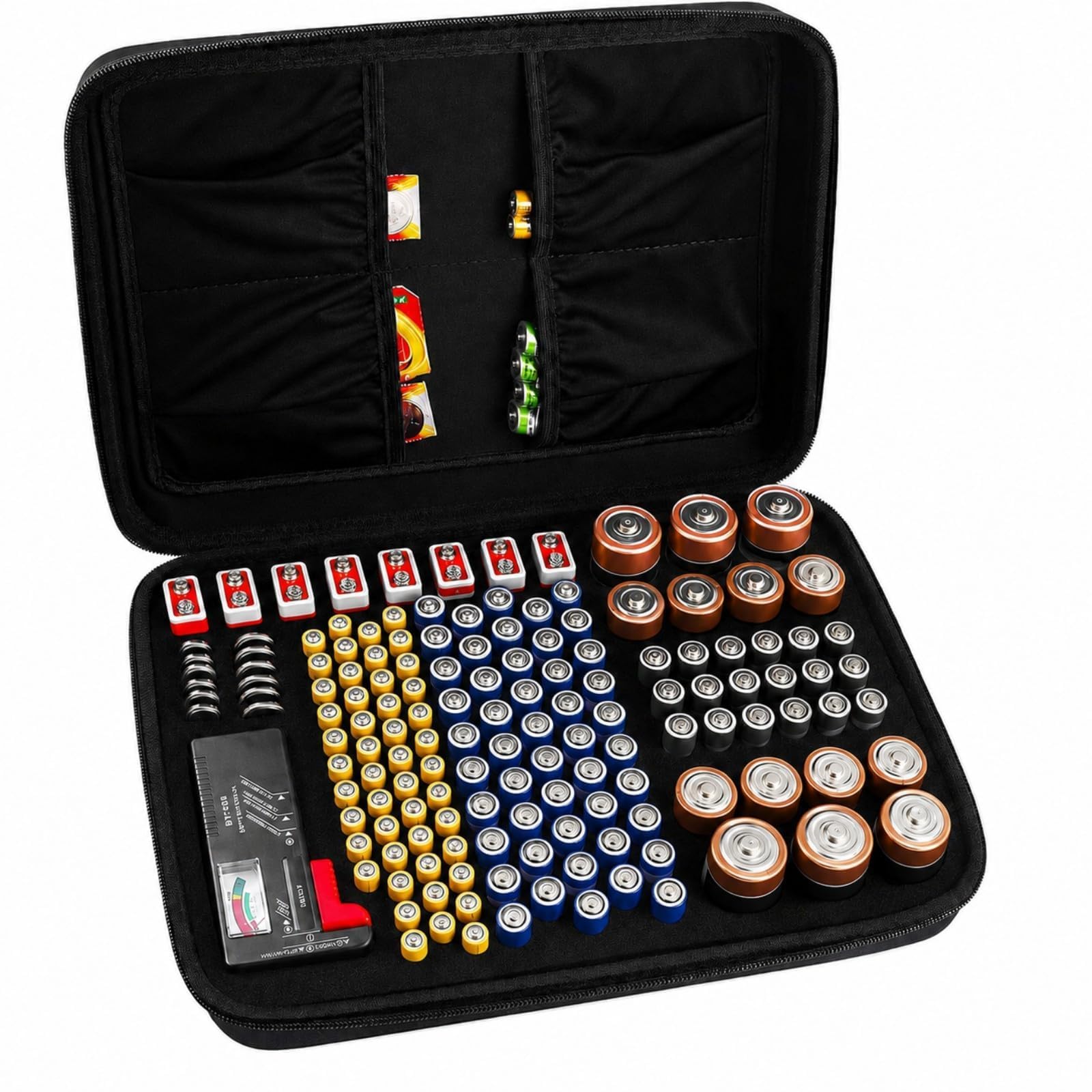
The Comecase takes the “best value” label because it delivers near-top-tier capacity in a lighter, softer package at an entry-level price. It’s built from EVA (a firm, slightly flexible foam-like plastic), measures 9″ x 13.08″ x 3.5″, and weighs just 454 g — notably lighter than the Ontel’s 1.24 kg while still holding 148 batteries. There are 142 compartments inside, plus a built-in tester and a strong top handle.
The layout gets consistent praise for keeping things “ever-ready”: AA, AAA, C, D, and 9V batteries fit snugly and won’t fall out, with 48 AA slots and extra room for AAA. The hard case stacks well and holds its form even when full, and the tester earns frequent mention as a lifesaver for checking charge before use. There are also useful top pockets for flat items and slits for button cells.
Two quirks show up in the feedback. First, the pre-cut foam inserts must be removed manually — buyers report it takes about 15 minutes of pushing them out. Second, there’s a strong chemical smell from the new foam initially. Neither is a dealbreaker, and most owners say the foam removal is a minor hassle for a case that otherwise performs flawlessly.
What owners love
- Lighter than plastic rivals at 454 g
- Holds 148 batteries across all common sizes
- Hard shell keeps its shape under weight
- Sturdy zipper and strong carry handle
Setup notes
- Pre-cut foam needs manual removal, about 15 minutes
- New case has a chemical smell that fades
- Heavy once fully loaded despite light empty weight
Reach for this if: you want near-Battery-Daddy capacity in a lighter, zippered case that travels well and stacks neatly.
Look elsewhere if: you’re not willing to spend a few minutes popping out the pre-cut foam before first use.
3. KIWIFOTOS 58 Slots Battery Case with Tester
The featherweight hard case that seals out water and takes a beating on the trail.
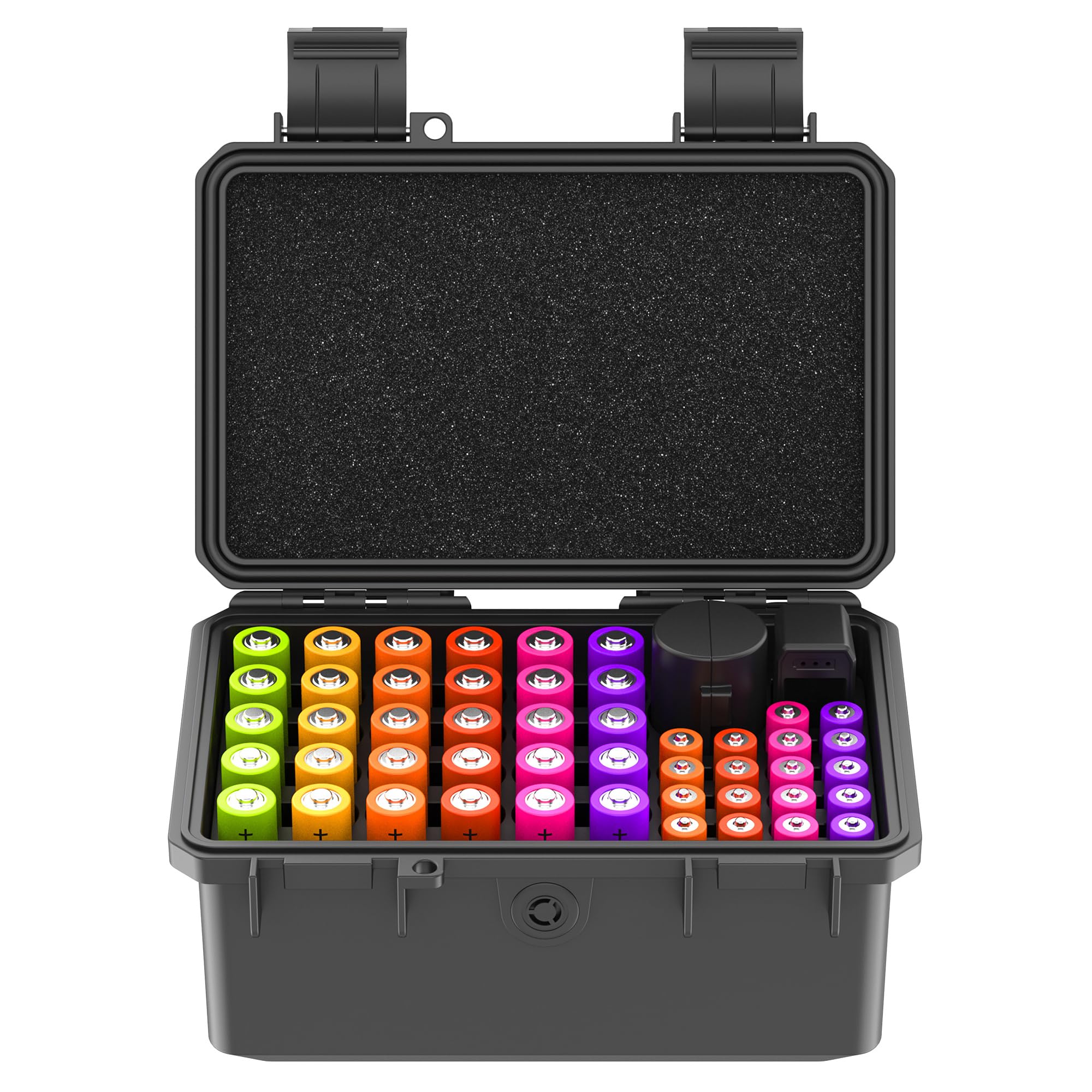
The KIWIFOTOS is the outdoor specialist of this list, rated IP67 — meaning fully dust-tight and protected against immersion in water up to a meter. That’s the spec that matters if your batteries ride in a kayak, a fishing box, or a hiking pack. It holds 58 batteries: 30 AA, 18 AAA, and 10 coin cells, with a detachable coin holder that fits the common CR2016, CR2025, CR2032, and CR2450 button cells.
At just 0.36 kg, this is the lightest case here — 3.4x lighter than the Ontel’s 1.24 kg, though it also holds 3.1x fewer cells (58 vs 180). The high-impact plastic shell and silicone sealing ring keep contents dry and quiet, with thick EVA sponge pads that damp vibration. The built-in tester works for AA and AAA batteries, which is a practical match for the sizes this case prioritizes.
Owners praise the build as “great quality” that “seals tight,” and the detachable inner compartment is a clever bonus — remove it and the case becomes a storage box for a small flashlight, first aid supplies, GPS, or camera batteries. The neutral trade-off: it’s less travel-friendly than slim caddies when empty, and the tester is handy but not lab-precise. This is a niche pick for people who need rugged protection more than maximum capacity.
Built for the outdoors: the IP67 seal and shock-resistant shell make this the case to trust in wet, bumpy environments where a zippered bag would fail.
Capacity reality check: 58 slots is modest — this suits a focused AA/AAA/coin-cell kit, not a whole-household battery hoard.
4. Luxtude Small Battery Organizer Storage Case with Tester
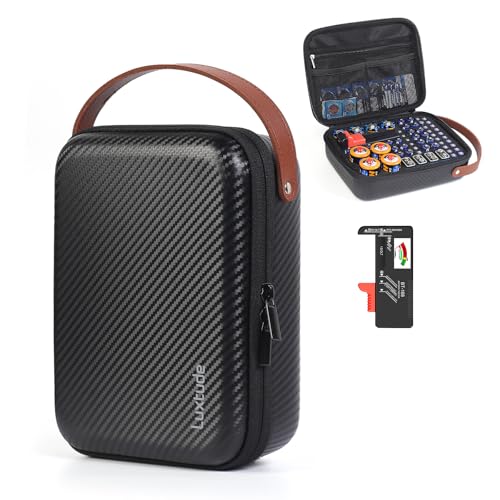
A tidy 61-slot tote sized for kitchen drawers and RV glove boxes.
If the 180-cell behemoths feel like overkill, the Luxtude is the answer for tight spaces. It holds 61 batteries across AA, AAA, 9V, C, and D in a frame measuring just 9.0 x 7.2 x 2.8 inches — small enough that owners say it “fits in my drawer perfectly.” The hard shell protects against impacts and drops, and the free battery tester lets you check remaining power so you never install a dud.
The recurring praise centers on the compact footprint and quality build. Buyers describe it as a perfect solution for an RV when they already have a large case at home, and one even tucks battery chargers inside alongside the cells. The interior is pre-cut for various battery sizes, which makes sorting simple and keeps everything from rattling around.
The trade-off is clear: 61 slots is on the smaller end, and this case won’t tame a serious bulk-buyer’s collection. But for a secondary case in a camper, a workshop bench, or a drawer that’s already crowded, the size is the feature, not the flaw. Owners call it well-made and a purchase they’d gladly repeat.
The space-saver’s choice: a small, sturdy, pre-cut case that slips into a drawer or RV cabinet without swallowing the whole shelf.
Keep expectations sized: 61 slots fits everyday household needs, not warehouse packs — treat it as the secondary or travel companion case.
5. Bee Neat Battery Organizer w/Tester

The slanted-slot organizer that mounts on a wall and keeps batteries upright on a door.
Most cases sit in a drawer, but the Bee Neat is built to hang. It holds up to 117 batteries — 54 AA, 36 AAA, 5 9-volt, 10 C, 4 D, and up to 8 button cells — in slanted slots designed to keep cells secure even when the organizer is mounted on a door or wall. Included hardware makes mounting easy, and the angled slots keep batteries upright and visible at a glance.
The removable battery tester is powered by the battery itself, which owners find easy to use for quickly eliminating dead cells. The design has been on the market for years, and long-term owners mention it stays simple and durable through years of daily use. The most common home for this case is a workshop bench or garage wall, where the visual layout makes restocking obvious.
The honest gripes: the plastic feels cheaper than the hard-shell rivals, and the coin battery tray is fiddly to sort and remove. A few owners also note there’s no D battery storage despite the capacity list, so confirm the size breakdown matches your needs. For a mounted, always-visible setup, this is the most practical option in the lineup.
What stands out
- Wall-mount hardware included — rare in this category
- Slanted slots keep batteries upright when hung
- Removable tester is easy to use
- Proven design with years of owner satisfaction
Consider first
- Plastic body feels less premium than hard shells
- Coin battery tray is fiddly to sort
- Some owners find D-cell storage missing
Best for: workbench and garage setups where hanging the organizer keeps every battery visible and within reach.
skip it if: you prize a premium feel or need dependable D-cell storage — the plastic build and size gaps may disappoint.
6. PAIYULE Battery Organizer Storage Case Box
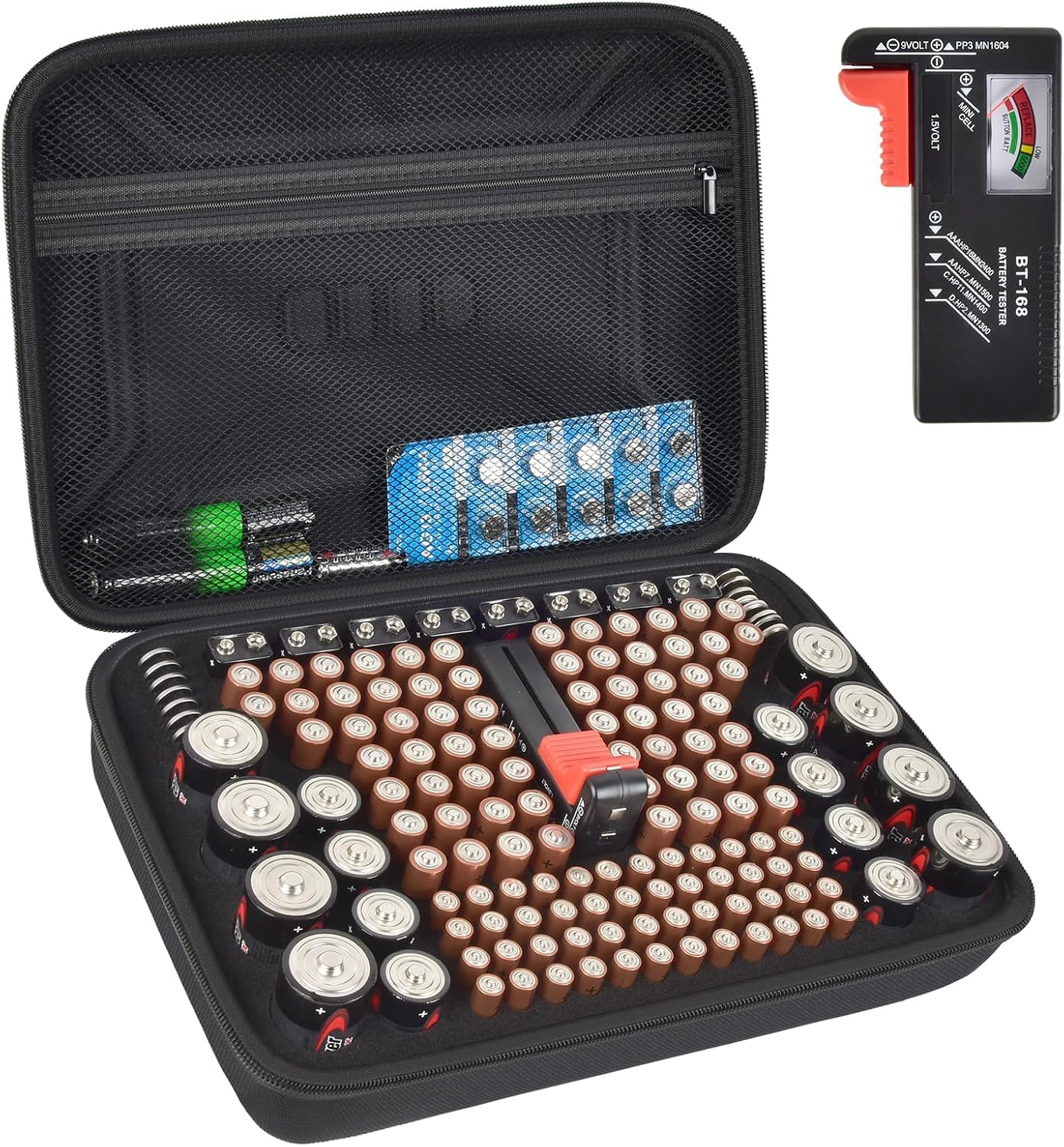
A zippered hard-EVA case that packs 220+ cells and a tester into a 360-degree zipper shell.
The PAIYULE is built for the garage or kitchen organizer who buys in serious volume. It fits 220+ batteries with a clear per-size plan — 8 AAAA, 51 AAA, 48 AA, 8 D, 8 C, 8 9V, 14 lithium 3V (CR2032, CR2016, CR1632, CR2025), plus 1.5V button cells. The external case measures 13.98″ x 9.45″ x 3.46″, and the hard EVA material brings water resistance and shockproofing in a lighter package than rigid plastic.
The defining feature is the detachable insert foam with well-cut holes that hold each battery snugly, preventing friction and short circuits between cells. The BT168 checker is included, and a mesh pocket with zipper stores accessories so nothing rolls loose. The 360-degree zipper opens smoothly, and the strong top handle makes it easy to carry on the road.
Owners are effusive, with one declaring it the “#1 case will never have to buy another one again” after plastic cases “all broke easily.” Another notes it’s “pretty compact for the amount of the batteries it holds.” The practical trade-off is that a fully loaded case becomes heavy despite the light 0.55 kg empty weight, so plan for how you’ll haul it once it’s full.
Why it earns a spot
- 220+ capacity with a slot for every common size
- Water-resistant, shockproof EVA shell
- 360-degree zipper opens from any angle
- Detachable foam prevents battery-to-battery contact
Keep in mind
- Fully loaded, the case gets heavy despite light empty weight
- Foam insert must be carefully aligned for snug fit
- Mesh pocket adds bulk to the profile
Choose this for: a garage or utility room where you stock deep and want one zippered case that holds nearly everything.
Pass if: you need rigid plastic protection — the EVA shell is tough but not as impact-rigid as latched plastic cases.
7. Tenergy Large Battery Organizer Storage Case

The well-rounded 120-slot case that hits the balance between size and portability.
Tenergy’s case earns the “balanced” label because it splits the difference: 120 batteries isn’t overwhelming, but it’s plenty for most homes. The layout holds 48 AA, 48 AAA, 8 C, 8 D, and 8 9V batteries in foam slots that keep contacts from touching. At 11.5″ x 9.6″ x 3.5″ and 0.51 kg, it fits drawers and toolbox compartments without dominating them.
The included tester handles alkaline, NiMH, and NiCd batteries, letting you check how much power remains after long storage. Six extra pockets in the lid store loose items like shrink-wrapped batteries and button cells on hanger cards. The PET (a tough, recyclable plastic) shell is impact-resistant, and the button closure keeps everything sealed.
Owners call it “well made” and appreciate having the tester on hand, with one noting the extra lid pockets are a thoughtful touch. The build quality and sturdiness get consistent praise, and the case holds its form even when loaded with heavy C and D cells.
The all-arounder: moderate capacity, solid PET build, and a multi-chemistry tester make this the easiest recommendation for a typical household.
Not the biggest: at 120 slots it falls mid-pack here — serious bulk buyers may outgrow it quickly.
8. Aptbyte Battery Organizer Storage Case with Tester
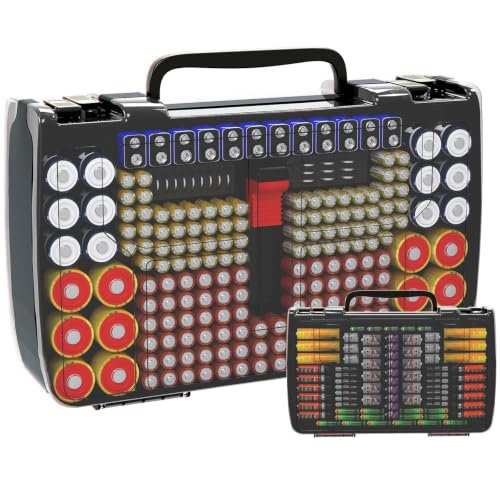
The 269-slot case that ditches foam for rigid plastic compartments built to last.
The Aptbyte stands apart with its “pro-grade rigid plastic slots” instead of foam inserts. That’s a meaningful difference for anyone tired of foam that tears or crumbles over time — these custom-molded compartments click each battery securely into place and are engineered for lifetime durability in workshops and garages. It holds up to 269 batteries including AA, AAA, 9V, C, D, 18650, and button cells.
The double-sided, slim design fits standard kitchen drawers or mounts on a wall, with upright storage for the cells you grab most. A high-precision BT-168 tester checks power levels in seconds, which owners value for emergency readiness — you’ll know your flashlights and radios are truly ready before a storm. Four high-tension latches and a reinforced handle keep the 1.33 kg case secure when full.
Feedback highlights how it “keeps all batteries organized and easy to get to” and eliminates duplicate purchases. The catch: button cell slots are flawed — owners found the 2032 spots either too tight (risking sparks) or too loose, with a workaround of bagging 2032s and storing them in 9V slots instead. Handle it with care when full; some owners note you must hold the bottom to avoid handle breakage and spills.
What’s different
- Rigid plastic slots — no foam to degrade
- 269-battery capacity includes 18650 cells
- BT-168 tester for quick power checks
- Fits drawers or mounts on walls
Reality check
- Button cell slots are poorly sized — use the bag workaround
- Handle needs support from the bottom when full
- Heavy at 1.33 kg empty
Pick this for: durability-focused buyers who want foam-free, rigid compartments and a case that can handle 18650s alongside standard cells.
Skip if: you store lots of 2032 button cells — the flawed slots and required workaround are an unnecessary hassle.
9. YCTYIYAO Battery Organizer Storage Holder Box with Tester
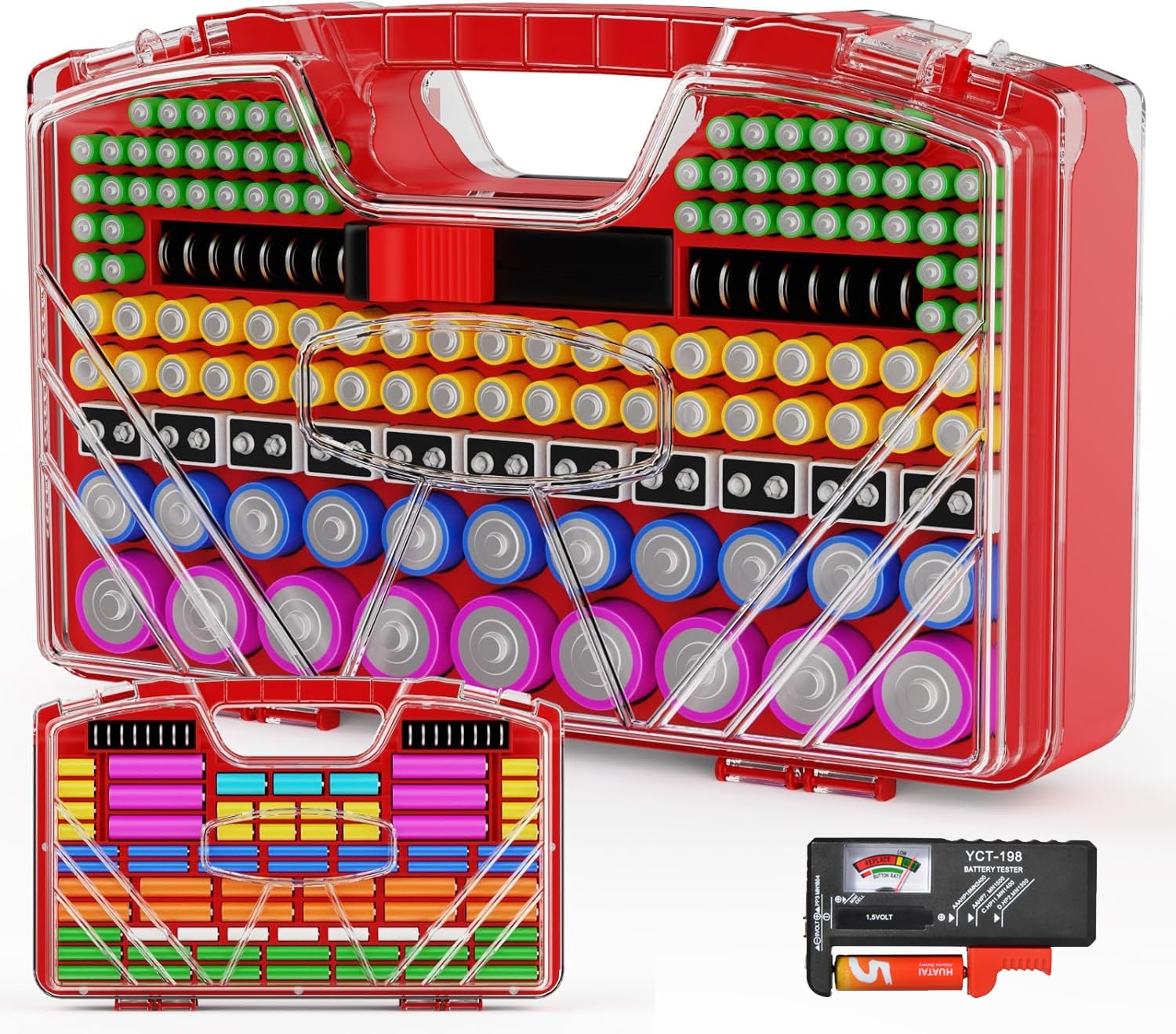
The 285-slot double-sided box with a spot for virtually every battery chemistry you own.
This is the capacity king of the list, holding 285+ batteries across an extraordinary range of sizes — including AAAA, 23A, CR123A, CR3, 18650, LR44, and 50+ button cells on each side. The front face stores 56 AAA, 38 AA, 9 D, 11 C, and 11 9V batteries upright, while the back holds 12 AA, 16 AAA, 14 AAAA, 7 23A, 16 CLR44, 6 CR3, 3 CR123A, and 6 18650 horizontally. Every hole is marked with the battery model name, so there’s zero guesswork.
The detachable sponge system is the clever part: four independent, tear-resistant foam slots can be removed to transform the case into a super-large compartment for 50-100+ button batteries. The ABS (a tough, rigid plastic) shell adds triple protection — water resistance, flame retardancy, and impact resistance — and a 4-button closure keeps batteries from rolling out even when you’re on the move. The included BT-168 tester checks remaining power to help you sort and classify cells.
Owners appreciate the flip-to-open design on both sides, the spot for flat disc batteries, and the sturdy overall construction at a reasonable price. The recurring note is that it becomes very heavy when filled — one owner admits it’s “portable but when filled becomes very heavy.” If you want more room for D-cells specifically, this case’s 9-slot D allocation might feel tight; but for sheer size variety, nothing here matches it.
Why it’s the max pick
- 285+ capacity with the widest size variety on this list
- Detachable foam creates a massive button-cell compartment
- Every slot labeled with the battery model name
- Flame-retardant, water-resistant ABS shell
Be ready for
- Gets very heavy when fully loaded
- D-cell storage capped at 9 slots
- Larger footprint needs a bigger shelf or drawer
Choose for: the collector or photographer with 18650s, CR123As, and dozens of button cells who wants one labeled case for every chemistry.
Reconsider if: your collection is mostly D-cells or you need a case that stays light-weight when packed — this one is for stationary, shelf-based storage.
Understanding the Specs
Capacity and Slot Layout
The headline number — 58, 120, 180, or 285 — tells you the total cells a case holds, but the breakdown matters more. Check how many slots go to the sizes you actually use. A case with generous AAA slots won’t help if your home runs on C and D cells for flashlights and toys. Count your batteries by size before you buy, and match that to the per-size chart in the specs.
Tester Coverage
Most included testers are small, battery-powered checkers that read AA and AAA cells, with some also handling 9V and lithium. The tester’s range should match your battery mix — if you stock 18650s or button cells, confirm the checker reads them before committing. A tester that only covers the two most common sizes still solves the biggest household problem: installing a dead AA and wondering why the remote won’t work.
Build Material and Closure
A full case of batteries is heavy, so material and closure type decide how it survives daily life. Hard plastic with latches offers the most drop protection but can crack under impact. EVA and fabric bags with zippers are lighter and often water-resistant but less rigid. Think about where the case lives — a drawer favors slim double-sided designs, while a workshop wall favors mountable options with secure closures.
Weight and Portability
Empty weight ranges from 0.36 kg for compact cases to 1.63 kg for the capacity monsters — and every one of them gets heavier once filled. If you’re hauling batteries to a campsite or job site, a strong handle and lighter shell matter. If the case sits on a shelf, weight barely matters; capacity and build quality should drive your choice instead.
FAQ
Will a battery organizer prevent batteries from draining each other?
Do the included battery testers work on all battery sizes?
How many batteries do I actually need to store?
Can I mount a battery organizer on my wall?
Are foam inserts in battery cases durable?
What is the difference between EVA and plastic battery cases?
Will my rechargeable batteries fit in these organizers?
How do I test a battery with a built-in tester?
Why do some battery cases feel heavier than others when empty?
Can these organizers store lithium coin cell batteries safely?
Final Thoughts: The Verdict
For most households, the winner is the Ontel Battery Daddy because it pairs a massive 180-battery capacity with an integrated tester, all in a clear-lid case that makes finding the right size easy. If you want a lighter, zippered briefcase-style case that still holds 148 batteries, grab the Comecase. And for the collector with 18650s, CR123As, and dozens of button cells, the YCTYIYAO is the one to reach for — it’s the only case here with a labeled slot for virtually every chemistry you own.
How We Picked
We do not accept paid placement. Every pick is matched to a real buyer and a real use-case; we do not hands-on test units.
Sources & Methodology
Specifications: manufacturer listings and product documentation. Review insights: verified customer reviews, as of September 2026. Pricing: not shown on this page (it changes often); check the current price via the retailer link.
As an Amazon Associate, KitchPrep earns from qualifying purchases. This does not affect which products we feature.
Related Guides
