
Specs are compiled from manufacturer listings and verified buyer reviews and can change over time — please confirm the key details on the product page before buying.
Dragging an extension cord around a workshop or fighting a dust cloud in a tight corner is the fastest way to kill a project’s momentum. A battery operated sander cuts both problems loose, letting you work anywhere from a fence line to a finished piece of furniture without hunting for an outlet. The real question is which one keeps its power up and its vibration down long enough to finish the job.
I’m Mohammad Maruf — the founder and writer behind KitchPrep. This guide is built by comparing the manufacturers’ published specifications and the patterns across verified customer reviews, so you get each pick’s real strengths and trade-offs instead of marketing spin.
These nine cordless sanders span random orbit, detail, and mouse styles, so you can match the right balance of speed, runtime, and control to your next project. battery operated sander choices come down to orbital speed, battery platform, and dust collection. This guide breaks down the best battery operated sanders to help you pick the one that fits your hand and your workload.
Our Picks at a Glance


How To Choose The Best Battery Operated Sander
Buying a cordless sander is really a bet on a battery platform as much as on a tool. If you already own drills or impact drivers from a brand like RYOBI, Bosch, or CRAFTSMAN, sticking with that same battery family means you only buy the bare tool and share batteries across everything. That single decision shapes your cost, your runtime, and how heavy the sander feels in your hand.
Orbital speed and sanding pattern
Random orbit sanders spin a round pad in a random pattern, which leaves a swirl-free finish and removes material fast. The key number is RPM, and it varies wildly: budget cordless models hum along at 3,500 rpm, while premium ones like the Bosch and RYOBI push to 10,000 rpm and the FLEX rockets to 13,000. Variable speed helps you dial it down for delicate work or crank it up for paint removal, so check if the trigger offers adjustability.
Runtime and battery size
A 2.0Ah battery in a sander is a different story than a 4.0Ah or larger pack. Owners consistently report that smaller packs drain fast under load — the RYOBI burns through batteries “fairly quick,” and the 2,000mAh packs on the Vkndoynt only promise about 40 minutes of runtime. If you have big panels or multiple coats to strip, buy a kit with a higher-capacity battery or plan to own a spare.
Dust collection is a health feature
Fine sawdust is more than a cleanup hassle — it hangs in the air you breathe. Look for sanders that route dust into a bag, a canister, or a vacuum hose port. Several picks offer a 1-1/4 inch vacuum connection so you can hook up a shop vac and keep the work surface nearly dust-free. A dust-sealed switch also matters, because grit sneaks into trigger mechanisms and kills tools early.
Quick Comparison
| Model | Best For | Speed (RPM) | Weight | Battery | Amazon |
|---|---|---|---|---|---|
| BOSCH GEX18V-5N★ Best Overall | Pro-grade stock removal | 10,000 | 2.4 lbs | 18V Lithium-Ion | Amazon |
| FLEX FX3411-ZSpeed King | Aggressive speed | 13,000 | 3 lbs | 24V Lithium | Amazon |
| SKIL SR660302Fast-Charge Pick | Fast charging kit | 11,000 | 5.3 lbs | 20V 2.0Ah included | Amazon |
| ONEAND RROS18-0 | Swirl-free finishing | 5 A draw | 2.7 lbs | 18V Lithium-Ion | Amazon |
| CRAFTSMAN CMCW221B | Tight spaces & detail | 12,000 | 2.6 lbs | 20V MAX Lithium | Amazon |
| AVID POWER ACOS326 | Value & variable speed | 7,000–11,000 | 3.3 lbs | 20V 2.0Ah included | Amazon |
| RYOBI PCL406B | RYOBI battery owners | 10,000 | 2.6 lbs | 18V ONE+ (sold sep.) | Amazon |
| BLACK+DECKER BDCMS20B | Corners & small jobs | Oscillating | 2.1 lbs | 20V MAX (sold sep.) | Amazon |
| Vkndoynt DX-A04 | Budget & portability | 3,500 | 1.8 lbs | 2× 2000mAh included | Amazon |
In‑Depth Reviews
1. BOSCH GEX18V-5N 18V Brushless 5 Inch Cordless Random Orbit Sander
Our pick — over 4.5★ from 550+ verified ratings; the strongest balance of quality and price.
The cordless that erases the corded-sander excuse with a brushless motor and a 5-inch orbit.
For heavy sanding jobs where speed and smoothness matter more than portability, the Bosch GEX18V-5N earns its spot with a 5-inch pad spinning at a full 10,000 rpm — the same top speed as the RYOBI but with a brushless motor (a motor with no carbon brushes to wear out, so it runs cooler and longer). The ergonomic palm grip and vibration-dampening element (a built-in buffer that soaks up shake before it reaches your hand) make extended sessions genuinely comfortable, and owners call it “really an excellent sander” for good reason. Its compact shape sits close to the workpiece, which helps you keep control in tight spots where a bulky tool would wobble.
Dust management is a headline feature here. You can snap on the included dust bag or attach a vacuum hose through the vac hose interface, and the cast zinc dust chute helps dissipate heat while it collects. Soft-start technology (which eases the pad into motion instead of jerking it) and constant speed (a feature that holds steady power under load) mean the tool behaves predictably even when you lean on it. That 5 A draw — 2.5 times the 2 A of the budget Vkndoynt — is why buyers report a 4Ah battery lasts about 30 minutes sanding both sides of a 4×8 plywood sheet at speed 5.
The catch is that battery placement splits opinion. The battery mounts centered on the disc area rather than in the handle, so some owners say you have to pull up to keep the pad flat, which adds fatigue on long jobs. The tool is bare — no battery or charger included — and at 2.4 pounds it’s not the featherweight of the category, but it’s a fair trade for the power. If you already own Bosch 18V packs, this is the closest a battery sander gets to corded-level material removal, backed by a five year limited warranty.
Why owners rave
- Strong material removal at 10,000 rpm, less than a corded unit but impressive for cordless
- Top-notch dust collection with bag or vacuum hose options
- Comfortable palm grip and low vibration for long sessions
- 5-year limited warranty adds confidence
What to know
- Battery placement centered on the disc can speed up fatigue
- Bare tool — you must own Bosch 18V batteries and charger
- No visible charge indicator on the tool itself
Grab it if: you need cordless power that rivals a corded unit and already own Bosch 18V batteries.
Look elsewhere if: you’re starting from zero batteries and don’t want to invest in the Bosch platform.
2. FLEX 24V Brushless Cordless 5-Inch 13,000 OPM Random Orbital Sander
A class-leading 13,000 OPM turbo mode that chews through material and still feels smooth.
The FLEX FX3411-Z is the speed demon of this lineup, hitting 13,000 OPM (orbits per minute — how fast the pad moves in its random pattern) in its turbo mode. The sensor-free brushless motor (a design with no sensors to fail, reducing friction and boosting efficiency) keeps the tool running cool, and owners mention “little vibration” even during heavy use. For stripping paint or leveling rough wood, this is the one that gets it done fastest.
Run time is a genuine strength. The manufacturer claims up to 30 minutes of runtime in Speed 3 on a 3.5 Ah Stacked Lithium battery, and owners describe the battery as “amazing” and recharging “incredibly fast.” The THERMA-TECH heat management (a cooling system that wraps battery cells to keep them from overheating) contributes to that 25% longer runtime claim. The low-profile design with a pad brake (a mechanism that stops the pad quickly) offers control, and the dust and water-resistant switch adds durability. A limited lifetime warranty is available if you register within 30 days of purchase.
The honest trade-off is weight and platform commitment. At 3 pounds, it’s heavier than the budget Vkndoynt at 1.8 pounds, and owners admit it gets “a little heavy and clunky with the battery on.” This is a bare tool — FLEX 24V batteries and charger sold separately — so you’re buying into a premium ecosystem. But for sanding heavy jobs where speed and smoothness matter more than portability, this is the standout. The one recurring note is that dust collection is good, not perfect, so plan on a vacuum hookup for the messiest work.
Turbo advantage: FLEX’s 13,000 OPM is the highest speed here, delivering fast material removal that outpaces the 10,000 rpm Bosch.
Platform caution: You’ll need to invest in FLEX 24V batteries to use it, and the added weight with a battery attached is noticeable.
Reach for this if: you want the fastest orbital action available for aggressive stripping and own or are ready to buy FLEX 24V gear.
Think twice if: you want an all-in-one kit with battery included, or if weight is your top priority.
3. SKIL PWRCore 20 Brushless 20V 5-Inch Random Orbital Sander
A brushless 11,000 rpm sander that recharges from dead in five minutes flat.
If you hate waiting for a recharge, the SKIL SR660302 bundles everything you need in one box: a 2.0Ah Lithium battery, a PWRJump charger, three pieces of sanding paper, and a battery jacket. Most cordless sanders make you wait 30 minutes or more for a recharge; SKIL’s PWRJump technology (a fast-charging feature that tops up the battery in just 5 minutes) gets you back to work almost immediately, or a full 100% charge in 30 minutes. The digital brushless motor delivers up to 11,000 rpm with variable speed control, so you can dial it down for fine finishing or crank it up for material removal.
Battery life here is the headline. Customers note the battery lasts up to 90 minutes at speed 1 and closer to 60 minutes at speed 6, with one surfboard repairer noting they run it down and recharge from their vehicle for mobile work. Another owner claims about 2 hours of runtime at speeds 5-6 with a 25-minute recharge. The 20V battery also has a USB port via PWR Assist, letting you charge your phone from the pack when you’re off-grid. The microfiltration dust canister keeps the work area clean, and the dust-sealed on/off switch is designed to extend tool life.
Everything comes in at 5.3 pounds, which makes this the heaviest pick in the lineup — you’ll feel it on overhead sanding. And while the Velcro pad (a hook-and-loop backing that holds sandpaper) works well, one owner had theirs detach after 4-6 hours of use due to adhesive failure, so treat the pad gently. The charger is effective but noisy. Despite those quirks, the brushless motor, variable speed, and 5-minute PWRJump recharge make this a genuinely useful kit, backed by a 5-year limited warranty.
Kit value: You get sander, battery, charger, and sandpaper in one box — the 5-minute PWRJump charge is a real productivity win.
Weight trade-off: At 5.3 pounds, it’s the heaviest here, so factor in arm fatigue for long sessions.
Choose it for: a complete kit with fast-charging convenience and long runtime for mobile or shop use.
skip it if: you need a lightweight tool for extended overhead or detail work.
4. ONEAND 18V Cordless 5 in. Random Orbit Sander

A RYOBI-compatible 5-inch orbital that delivers swirl-free finishes without a cord.
The ONEAND RROS18-0 is a smart play for anyone already invested in RYOBI’s 18V battery system (the battery platform shared across dozens of tools). It runs on that same lithium-ion system, so you can drop in your existing packs and skip the charger entirely. The 5-inch orbital pad delivers what owners describe as smooth, swirl-free sanding action on wood, drywall, and composite surfaces, with an 87-count of performance praise making it the most-discussed strength. It draws 5 A of current, matching the BOSCH’s amperage for consistent power delivery.
The ergonomics earn their keep. Weighing 2.7 pounds, it’s heavy enough to sit firmly on the workpiece for even sanding but not so heavy that it gets awkward — as reviewers point out, “the tool is heavy enough to put firmly on work piece but not so heavy as to be awkward.” The dust collector is a recurring positive, though a minority of owners find it adequate rather than excellent. The included sanding disc gets the job done quickly, and the tool’s compact 4″ x 4″ x 6″ footprint helps in tight spaces.
The battery life is the honest trade-off here. Shoppers say it can drain two big batteries in under 20 minutes under heavy load, so if you have large projects, budget for higher-capacity packs. There’s also no battery included — it’s tool only. The variable speed control and let-the-tool-do-the-work design means you shouldn’t lean on it hard, or it won’t perform as designed. For finishing work and RYOBI platform loyalty, this is a strong, affordable companion.
Owner favorite
- Produces a smooth, swirl-free finish on multiple surfaces
- Compatible with RYOBI 18V batteries you may already own
- Weight sits firmly without being awkward
Reality check
- Battery life is mixed — heavy use can drain large packs in under 20 minutes
- Tool only, so you need your own RYOBI battery and charger
- Dust collection gets mixed reviews, and the collector attachment draws some negative feedback
Best for: RYOBI 18V owners who want a reliable, swirl-free finishing sander for furniture rehab and woodwork.
Not ideal for: marathon sanding sessions without access to spare high-capacity batteries.
5. CRAFTSMAN 20V MAX Cordless Detail Sander

A D-handle detail sander that slips into fence slats and corners other orbitals can’t reach.
Sometimes you don’t need a big 5-inch pad — you need to get between fence slats or into a corner. The CRAFTSMAN CMCW221B is a detail sander (a compact tool with a pointed, iron-shaped base for tight spots) that tops out at 12,000 OPM with a variable speed dial from 9,000 to 12,000. That range lets you adjust from gentle finishing to faster stock removal, and owners specifically praise its effectiveness in tight spaces like fence slats. Its lightweight build at 2.6 pounds (1.18 kg) makes it easy to handle one-handed, and the D-handle grip is designed for vertical sanding control.
The dust-sealed switch (a trigger protected from grit ingress to extend its life) and rapid dust collection via a bag or 1-1/4 inch vacuum connection keep the work area cleaner than you’d expect from something this small. Owners describe it as “light and easy to use” with long charge life, and the “iron” shape works great for detail work. For anyone with hand weakness, the low-vibration, lightweight design is a notable plus — it’s effective even with less raw power than bigger orbitals.
The main consideration is battery life, which is mixed — owners recommend picking up an extra battery if you have a lot to sand. It’s also a tool-only purchase, so you’ll need CRAFTSMAN 20V MAX batteries. Power is a topic of mixed feedback too, with some wanting more grunt for heavy material removal. But for its intended job — precise, small-surface sanding — this is a purpose-built winner that outperforms a full-size orbital in the spots that matter.
Detail specialist: 12,000 OPM variable speed and a D-handle make it ideal for corners, fence slats, and vertical surfaces.
Small-tool limits: Expect to carry a spare battery for longer jobs, and don’t expect heavy stock removal power.
Perfect if: your projects involve tight spaces, small items, or vertical sanding where a bigger pad won’t fit.
Pass if: you need a workhorse for large flat surfaces — that’s a random orbit sander’s job.
6. AVID POWER 20V Cordless Random Orbital Sander

A 20V sander with six speed settings and a 30-piece sandpaper kit that overdelivers for the money.
The AVID POWER ACOS326 is the value pick that refuses to feel cheap. It offers six variable speeds from 7,000 to 11,000 rpm, letting you match the exact pace to the material — slow for polishing, fast for paint removal. The 20V 2.0Ah battery and charger are included, along with 30 sandpapers across 60/80/120 grits (10 of each) and a dust collection bag, so you can start sanding straight from the start. Owners say it “feels as good and does as good of a job as the Dewalt” at a much lower cost, and one even notes it survived drops.
Comfort is a real focus here. The texturized rubber over-mold grip (a soft rubber coating on the handle that absorbs vibration) keeps your hand comfortable during long sessions, and it’s easy to operate one-handed. The dust collection routes through 8 vacuum holes at the bottom into a removable bag, with a dust-sealed on/off switch to keep grit out of the trigger. Buyers report it runs “well for long periods without vibration” and find the adjustable speed settings genuinely useful across oak, pine, and birch.
The honest downsides: it’s slightly heavy at 3.3 pounds, and at high speeds it can be hard to handle. Battery life and durability both get mixed feedback — some units have failed after a few minutes of use, and indoor dust can escape when using coarse 40-grit paper, with owners recommending a shop vac attachment. A few note the dust bin fills fast and compacts, so it needs regular emptying. For a first cordless sander or occasional DIY, the included battery, charger, and 30 discs make this a strong value proposition.
What wins people over
- Six variable speeds from 7,000 to 11,000 rpm for precise control
- Complete kit: battery, charger, and 30 sandpapers included
- Comfortable rubber grip with long-session vibration control
Keep in mind
- Slightly heavy at 3.3 pounds; high speed can be hard to control
- Dust collection is mixed — shop vac hookup recommended indoors
- Some units report durability issues after minimal use
Reach for it: if you want an affordable, ready-to-run kit for small projects, quick touch-ups, and paint removal.
Look elsewhere: if you need professional-grade durability for daily heavy sanding.
7. RYOBI 18V ONE+ 5″ Random Orbit Sander

The RYOBI ONE+ crowd favorite that spins a 5-inch pad at 10,000 rpm and hooks to your shop vac.
If you’re already in the RYOBI 18V ONE+ ecosystem (the huge battery platform that powers dozens of tools), the PCL406B is a no-brainer addition. It uses the same batteries you already own, spinning a 5-inch pad at 10,000 rpm for solid wood sanding and furniture rehab. The multiple grip zones (textured areas on the body designed for different hand positions) increase comfort during extended use, and the rocker switch with a rubber membrane (a flexible, sealed trigger cover) offers comfortable, dust-resistant operation. It’s a quality build, and owners call it a “great product/deal” that handles truck hood painting prep with ease.
Dust collection is a standout feature here. The on-board dust collection port accepts both 1-1/4 inch and 1-7/8 inch vacuum hoses, so you can hook up a small shop vac and keep the workspace nearly dust-free — several owners use this exact setup. The 2.6-pound weight makes it manageable, and the 30-day limited warranty offers basic coverage. For the weekend warrior, it’s a capable tool that gets the job done on everything from furniture to automotive prep.
The recurring theme in owner feedback is battery consumption. As one puts it, “make sure you have the larger capacity batterys for length of use as it does use up battery fairly quick” — expect about 10 minutes of runtime on a standard pack. This is a bare tool with battery and charger sold separately, so you need RYOBI packs anyway. Also, the sawdust bag fills quickly, so you’ll want to empty it often or run a shop vac. But for RYOBI loyalists, the integration and price-to-performance ratio are tough to beat.
Ecosystem win: RYOBI owners get a 10,000 rpm 5-inch sander that slots into their existing battery family and accepts their shop vac hose.
Runtime watch: Battery drains fast — invest in larger-capacity packs or a spare for anything beyond quick sanding.
Choose this: if you’re already collecting RYOBI ONE+ tools and want a cordless sander that shares your batteries.
Skip this: if you’re not in the RYOBI ecosystem and don’t want to start a new battery platform.
8. BLACK+DECKER 20V MAX Mouse Sander

A 20V mouse sander with a removable finger attachment for corners a round pad simply can’t touch.
For detail work, paint removal in tight spots, and corner sanding, the BLACK+DECKER BDCMS20B is a compact specialist. This is a mouse sander (a small, triangular-pad sander named for its shape) that weighs just 2.1 pounds, and the included detail finger attachment (a narrow, pointed accessory that clips onto the base) swaps in to reach hard-to-access spaces. The hook-and-loop system makes changing sandpaper quick and tool-free. Owners call it “lightweight, versatile and a pleasure to use” and specifically praise it for detailing work, with one saying it “eliminates the hassle of dragging extension cords around.”
The 20V MAX battery platform means if you have other BLACK+DECKER 20V tools, this bare-tool purchase slots right in. Battery life runs about 30-40 minutes of continuous use, though the battery is not included. Dust collection uses a small bag that needs emptying every 5-10 minutes during heavy work, and for vacuum users, it requires 12-hole sanding pads — which are pricier from BLACK+DECKER, though cheaper third-party options exist. Durability is mixed; a subset of owners mention units that didn’t last long, though the same number praise it for lasting through projects.
The key limitation is that this is a detail sander, not a stock remover. It’s great for paint removal and finishing on small surfaces, but it’s “not for metal” and won’t match a 5-inch orbital’s speed on large panels. For anyone with hand weakness or arthritis, the light weight and easy grip make it genuinely easier to use than bulkier tools. If you need a corner-and-edge specialist for trim, furniture, or craft projects, this fits the bill.
Detail champion: The finger attachment and 2.1-pound weight make it unbeatable for corners, edges, and small craft projects.
Expectations set: You’re buying a finisher, not a stock remover — and you’ll want a spare battery for jobs over 30 minutes.
Perfect for: furniture detailing, corner sanding, paint prep on trim, and anyone who wants a lightweight tool for small jobs.
Not for: large flat surfaces or heavy material removal, and you’ll need to buy the battery separately.
9. Vkndoynt Cordless Electric Sander with 36PCS Sandpapers
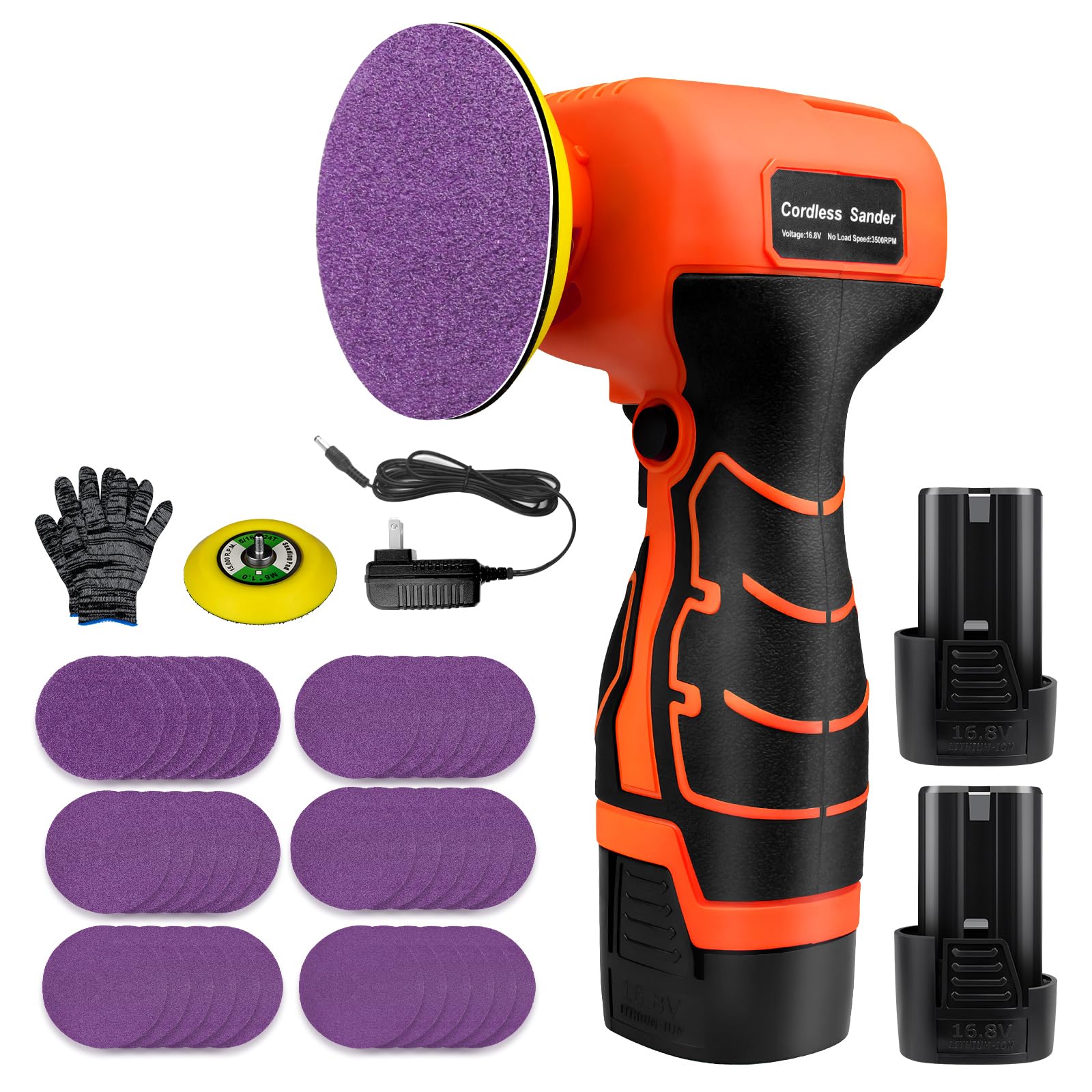
A featherweight 1.65-pound sander with two batteries and 36 sandpapers that’s easier than a plug-in.
If budget is your starting point, the Vkndoynt DX-A04 packs an awful lot into a small, light frame. At 1.65 pounds including the battery, it’s the lightest sander in this whole lineup — nearly a pound lighter than the 2.6-pound RYOBI — and owners describe it as “much more powerful and effective than I expected, and much easier than using a plug in sander.” It runs at 3,500 rpm, which is a fraction of the 10,000 rpm BOSCH top speed, but for light wood sanding, paint removal, and DIY craft projects, it gets the job done with surprising ease. The long, slim body helps you get into nooks and crannies and maneuver around corners better than a conventional palm sander.
The kit is genuinely complete: two 14.4V 2000mAh lithium-ion batteries, a fast charger, 36 sandpapers spanning P60 to P320, and even a pair of gloves. The dual batteries give you up to 40 minutes of combined runtime, and a full recharge takes about 3 hours. The three-inch backing pad and coarse-to-fine grit selection mean it’s ready for everything from rough material removal to fine finishing straight from the start. Size is the most-praised feature — its compact footprint makes it a favorite for women who craft and for finishing painted pieces like an Adirondack bench.
The trade-offs are clear if you think about it. This is a compact, low-speed sander designed for light work, not a production tool — the 3,500 rpm is a 2.9x gap slower than the 10,000 rpm RYOBI and BOSCH. Owners note the battery life is mixed, with some reporting charging issues and no charge-level indicator lights. The stability of the tool also draws some negative feedback, so it rewards a gentle touch rather than heavy pressure. But for occasional DIY, craft projects, and first-time buyers who want everything included, this is a remarkably versatile little package that overdelivers for its price tier.
Why it’s a steal
- Complete kit: 2 batteries, charger, 36 sandpapers, even gloves included
- Lightest pick at 1.65 lbs, ideal for extended use and craft work
- Gets into corners and nooks better than a plug-in model
Keep it honest
- 3,500 rpm is far slower than the 10,000 rpm premium orbitals
- Battery life is mixed, with some charging issues reported
- No charge indicator lights; stability needs a gentle hand
Best for: budget shoppers, crafters, and DIYers who want a ready-to-run lightweight sander without buying into a battery platform.
Not for: heavy material removal or full-day professional sanding sessions.
Understanding the Specs
Orbital Speed (RPM)
Revolutions per minute measures how fast the sanding pad spins. Higher numbers mean faster material removal, but they also demand more battery and can be harder to control. Random orbit sanders like the BOSCH and RYOBI hit 10,000 rpm, the SKIL and AVID POWER reach 11,000, and the FLEX tops out at 13,000 OPM. Budget models like the Vkndoynt sit at 3,500 rpm, which is fine for light work but noticeably slower for stripping heavy paint.
Battery Platform & Capacity
Your sander’s battery is the whole game. Tools like the BOSCH, RYOBI, and ONEAND run on 18V systems, while CRAFTSMAN, SKIL, AVID POWER, and BLACK+DECKER use 20V MAX. The capacity is measured in amp-hours (Ah) — a 2.0Ah pack is standard for kits, but owners consistently report faster drain under load, so higher-capacity packs like a 4Ah or 6Ah extend runtime significantly. The SKIL’s PWRJump 5-minute charge and the Vkndoynt’s spare battery are two different solutions to the same problem.
Dust Collection
Sanding creates fine dust that hangs in the air and coats your workspace. Look for sanders with a dust bag, canister, or vacuum hose port. The BOSCH and RYOBI accept standard 1-1/4 inch vacuum hoses for near-dust-free operation, while the SKIL uses a microfiltration canister. The AVID POWER routes dust through 8 vacuum holes into a removable bag. A dust-sealed switch is also worth seeking out, since grit can destroy triggers.
Weight & Ergonomics
Sanding is repetitive arm work, so weight and grip matter more than you’d think. The Vkndoynt leads at 1.65 pounds, ideal for extended use and craft projects. The BOSCH (2.4 lbs), RYOBI (2.6 lbs), and CRAFTSMAN (2.6 lbs) sit in a comfortable middle ground. The SKIL is heaviest at 5.3 pounds, which buys you more power but costs arm fatigue on overhead work. Grip design, like the BOSCH palm grip or CRAFTSMAN D-handle, affects control during vertical sanding.
FAQ
How long does a cordless sander battery last?
What is the difference between a random orbit sander and a detail sander?
What does a brushless motor do in a sander?
Should I buy a sander kit with battery or a bare tool?
Can I hook a shop vacuum to a battery sander?
What grit sandpaper should I use?
Is a cordless sander as powerful as a corded one?
How do I maintain a cordless sander?
Which battery operated sander is best for furniture rehab?
Do I need a variable speed sander?
Final Thoughts: The Verdict
For most buyers, the battery operated sander winner is the BOSCH GEX18V-5N because it combines a brushless motor, 10,000 rpm speed, and superb dust collection in a comfortable palm grip that owners consistently rate as excellent. If you want the fastest orbital action available, grab the FLEX FX3411-Z at 13,000 OPM. And for a complete, fast-charging kit from the start, the SKIL SR660302 with its 5-minute PWRJump charge is the one to reach for — especially if you need to work on the go.
How We Picked
We do not accept paid placement. Every pick is matched to a real buyer and a real use-case; we do not hands-on test units.
Sources & Methodology
Specifications: manufacturer listings and product documentation. Review insights: verified customer reviews, as of August 2026. Pricing: not shown on this page (it changes often); check the current price via the retailer link.
As an Amazon Associate, KitchPrep earns from qualifying purchases. This does not affect which products we feature.
Related Guides
