
Specs are compiled from manufacturer listings and verified buyer reviews and can change over time — please confirm the key details on the product page before buying.
If you have ever balanced on a ladder with a stiff air hose hooked to your belt, you already know the problem a cordless finish nailer solves. The right one sinks a 16-gauge nail to a set depth in hardwood trim, then fires the next without a compressor cycling behind you. The wrong one jams, misfires, or weighs enough that your forearm gives out on the third window casing. This guide walks through nine battery-powered finish nailers, explains what actually matters when you are choosing one, and tells you plainly which pick suits which job.
I’m Mohammad Maruf — the founder and writer behind KitchPrep. This guide is built by comparing the manufacturers’ published specifications and the patterns across verified customer reviews, so you get each pick’s real strengths and trade-offs instead of marketing spin.
You will see which gauges fire which nails, why the nose size decides whether you can reach a corner, and how voltage and battery platform affect your whole tool kit. The goal is simple: help you pick the battery operated finish nailer that keeps firing in tight trim work.
Our Picks at a Glance


How To Choose The Best Battery Operated Finish Nailer
A finish nailer is a precision tool, not a framing gun. It exists to sink a thin nail just below the surface of trim, casing, or baseboard so you can fill the hole and paint over it. Everything about the tool — gauge, nose shape, magazine angle, trigger mode — is aimed at that one job. Get those four things right and the rest is comfort and battery convenience.
Gauge: the nail thickness that decides your hole size
Gauge is simply how thick the nail shank is, and the numbering runs backwards — a 16-gauge nail is thinner than a 15-gauge, and an 18-gauge is thinner still. A 16-gauge nail leaves a slightly larger hole than an 18-gauge but holds heavier trim with less splitting. A 15-gauge holds the most of the three and suits crown molding that fights back. Choose the gauge by the material, not the price tier.
Nose shape and magazine angle
The nose is the contact tip pressed against the wood before firing. A micro or narrow nose improves your line of sight so you can place the nail exactly, especially on the last inch of a casing. An angled magazine tilts the nail strip so the tool body fits into a corner that a straight magazine cannot enter. Straight magazines feed some nail types more easily; angled models reach further into tight joins.
Trigger modes, depth setting, and weight
Sequential mode fires only when you press the tip down and then pull the trigger, which keeps you deliberate. Contact mode fires each time the tip bumps the surface while the trigger is held, which speeds up flat runs but demands care. Look for tool-free depth adjustment so you can countersink a nail without hunting for an Allen key. Weight matters most overhead or on a ladder — a tool that feels fine at bench height becomes a chore at arm’s length.
Quick Comparison
| Model | Best For | Gauge | Weight | Voltage | Amazon |
|---|---|---|---|---|---|
| DEWALT DCN660D1★ Best Overall | All-around trim and casing | 16 gauge | 6 pounds | 20 volts | Amazon |
| RYOBI P326 AirStrikeBest Value | Budget-friendly ONE+ owners | 16 gauge | 7.3 pounds | 18 volts | Amazon |
| Worx Nitro WX841LCompact Pick | Compact reach in tight spaces | 16 gauge | 7.5 pounds | 20 volts | Amazon |
| CRAFTSMAN CMCN616B | Long runs between charges | 16 gauge | 7.6 pounds | 20 volts | Amazon |
| Metabo HPT NT1865DAA | Lightest overhead work | 15 gauge | 5.9 pounds | 18 volts | Amazon |
| DEWALT DCN650B (15GA) | Crown molding and thick stock | 15 gauge | — | 20 volts | Amazon |
| DEWALT DCN650D1 Kit | Pro installers wanting the full kit | 15 gauge | 6 pounds | 20 volts | Amazon |
| CRAFTSMAN CMCN616C1 Kit | DIYers who want everything included | 16 gauge | 9.1 pounds | 20 volts | Amazon |
| RIDGID R09892B HyperDrive | Occasional jobs, tight budget | 16 gauge | 8.95 pounds | 18 volts | Amazon |
In‑Depth Reviews
1. DEWALT 20V MAX* XR Finish Nailer, Angled, 16GA (DCN660D1)
Our pick — over 4.5★ from 800+ verified ratings; the strongest balance of quality and price.
A 16-gauge angled trim workhorse that runs on the DEWALT 20V MAX batteries you already own.
If you already own DEWALT 20V MAX batteries, this is the pick that slots straight into your kit with nothing extra to buy. It is a 16-gauge angled finish nailer rated at 20 volts, weighs 6 pounds, and drives nails without gas, compressor, or hose. The angled magazine lets the body lean into inside corners where a straight tool would bind.
The brushless motor is the part that matters over years rather than minutes — it runs cooler and stretches each charge further than a motor with carbon brushes. A tool-free trigger switches between sequential and contact actuation, so you can bump-fire a long run of baseboard or switch to a deliberate single shot for a visible casing. Depth adjustment and jam release are also tool-free, which means clearing a stuck nail takes seconds at the ladder instead of a trip to the bench.
Against the Metabo HPT NT1865DAA and the DEWALT DCN650D1 kit, this one sits in the middle on size while staying fully battery powered. The RYOBI ONE+ 18V runs on 18 volts, while this one runs on 20 volts. The multi-functional LED lights do double duty — they light the work surface and help you read the tool’s status while working in a dim room.
What earns its keep
- Runs on batteries you may already own across the DEWALT 20V MAX line
- Tool-free trigger, depth, and jam release keep adjustments quick
- Inline magazine and 6-pound body stay maneuverable in tight orientations
- Brushless motor for longer runtime and durability
Where it asks patience
- Angled 16-gauge nails are harder to find and come in fewer varieties than straight
- Heavier than some people expect for overhead trim
- Buyers report a loud report at the trigger
- A rare unit has arrived with a cracked magazine
Best for: the DEWALT battery owner doing trim, baseboard, and window casement work who wants air-like performance without the hose.
Look elsewhere if: you need a steady supply of angled 16-gauge nails nearby and hate hunting for fasteners, or you want the lightest possible tool for all-day overhead work.
2. RYOBI ONE+ 18V 16-Gauge Cordless AirStrike Finish Nailer (Tool Only), P326, Green
A bare 16-gauge AirStrike nailer for RYOBI ONE+ owners who already have the batteries and charger.
This is the one to look at if you are already deep into the RYOBI ONE+ 18V battery platform and do not want to buy another charger. It runs on 18 volts, weighs 7.3 pounds, and ships as a bare tool — no battery, no charger, because you already have them. The AirStrike technology replaces the compressor, the hose, and the gas cartridges with an onboard air pump, which is the tidy part of the design.
The nose is listed as 78% smaller than the earlier RYOBI P325, and that smaller nose is what gets you into tight spots with a clean line of sight. An adjustment dial regulates the air pressure speed so you can dial the drive in for softer stock or push it harder for dense trim. What wins people over is the overall build quality at a lower price than the two DEWALT models here.
The honest catch is weight and bulk. At 7.3 pounds it lands heavier than the DEWALT DCN660D1 at 6 pounds and the Metabo HPT NT1865DAA at 5.9 pounds, and the size can make tight corners awkward for some users. Owners also report a range of experiences with the adjustment dial — some find it easy, others find it fiddly. It is a genuine bare tool, so factor in that you supply the battery and charger yourself.
The value read: For a ONE+ household, this is the least disruptive way to add a 16-gauge nailer — no new platform, no new charger, just the tool.
The honest limit: It is the heaviest tool in the DEWALT-and-RYOBI comparison here and it arrives without any battery, so the sticker on the box is only part of the real cost.
Reach for this if: you are a RYOBI ONE+ owner who wants a 16-gauge nailer without buying into a new battery system.
Think twice if: you need the lightest tool for overhead work or want everything in the box on day one.
3. Worx Nitro 20V 16GA Finish Nailer Cordless WX841L
A compact 16-gauge shooter built to reach door trim and baseboards in tight spots.
The Worx Nitro WX841L is a 16-gauge straight finish nailer that runs on the Worx PowerShare 20V platform, and it comes as a kit — 20V 2.0Ah battery, 2A charger, belt clip, carry bag, and 200 2-inch 16-gauge finish nails. NailForce Air Impact Technology drives finish nails up to 2-1/2 inches into hardwood, firing up to 70 nails per minute in contact actuation mode. That is the headline number: 70 nails per minute.
The brushless motor is set up to deliver more power and longer runtime than a standard brushed motor, and the compact body is designed for nailing within tight spaces, door trim, and baseboards run along the floor. One owner drove 400+ nails per charge on the 2Ah battery — a mix of 1-1/4-inch and 2-inch nails. Depth adjustment stayed reliable below center even in knotted, polyurethane-coated pine.
Here is the part you should weigh carefully. This nailer sits at 7.5 pounds, which is heavier than the DEWALT DCN660D1 at 6 pounds, and the reliability reports are genuinely mixed. Some units run flawlessly from the first charge; others do not. The recurring pattern in the lower-rated reviews is a tool that fires but fails to eject the nail, with one DIYer describing planks shattering when the drive was too aggressive for vinyl flooring. If you treat the depth setting with respect and test on scrap before committing to finish stock, this is a capable and complete kit.
The standout spec: 70 nails per minute in contact mode puts it among the faster tools on this list for flat runs of baseboard and trim.
The honest catch: Reliability is the split. Some Worx Nitro owners get a flawless tool while others hit no-fire problems, so buying from a seller with a clear return path is the smart move.
Best fit for: the homeowner or trim carpenter who wants a complete 16-gauge kit on the Worx PowerShare platform and values a compact body for tight spaces.
skip it if: you want the proven day-in, day-out reliability of the top DEWALT picks and are not willing to gamble on a tool that has split reliability reports.
4. CRAFTSMAN V20 Cordless Finish Nailer, 16 Gauge, Bare Tool Only (CMCN616B)

A cordless 16-gauge that keeps firing long after you expected to swap the battery.
The headline on the CRAFTSMAN CMCN616B is stamina: the motor drives up to 375 nails per charge, and one owner reported driving 200 nails over three hours without changing the battery. It is a 16-gauge bare tool rated at 20 volts, weighs 7.6 pounds, and runs on the CRAFTSMAN V20 platform. No compressor, no hose, no gas cartridges.
What earns its keep is reliability — owners routinely note it drives nails into hardwood without protest and holds a consistent set depth. The tool-free depth setting and tool-free jam and stall release make mid-job fixes quick, and the CRAFTSMAN V20 battery is shared across their other cordless tools. The included belt hook keeps it within reach on a ladder. A VERSATRACK clip is sold separately if you want to hang it on CRAFTSMAN’s wall system.
The main friction point is weight. At 7.6 pounds, it is heavier than the DEWALT DCN660D1 at 6 pounds and the Metabo HPT at 5.9 pounds, and the reviews confirm that — some owners find it well balanced, others find it a bit heavy for extended overhead work. There are also reports of jams appearing every 20 to 30 nails on some units, and a rare dud from the start. For a tool that costs mid-range and drives 375 nails per charge, those are fair caveats rather than deal-breakers.
Where this earns trust
- Up to 375 nails per charge keeps you working instead of swapping batteries
- Tool-free depth and jam/stall settings keep you on the task
- Runs on CRAFTSMAN V20 batteries you may already have
- Belt hook keeps the tool within reach on a ladder
Points worth weighing
- 7.6 pounds makes extended overhead work tiring
- Some units report a jam every 20 to 30 nails
- Bare tool — battery and charger are sold separately
- A rare unit arrived with an internal fault and would not fire
Made for: the CRAFTSMAN V20 household that wants a no-fuss 16-gauge nailer for baseboards, trim, and plywood work with a long runtime per charge.
Not the one if: you want an all-day overhead tool or you need a complete kit with battery and charger in one box.
5. Metabo HPT 18V Brushless 15 Gauge Angled Finish Nailer, Kit, NT1865DAA

At 5.9 pounds, the lightest 15-gauge angled nailer here for overhead trim work.
If you have ever finished a day on a ladder with a heavy nailer in one hand, you know why this one leads on weight. The Metabo HPT NT1865DAA is a 15-gauge angled finish nailer rated at 18 volts, and it weighs 5.9 pounds without the battery. That is lighter than the DEWALT DCN660D1 at 6 pounds, and its narrow tip is designed for work in tight corners. The kit includes the nailer, a 2.0Ah lithium-ion battery, charger, bag, and safety glasses.
Run time is the other headline number here: the 2.0Ah battery drives up to 700 finish nails per charge. That is more per-charge output than the CRAFTSMAN CMCN616B’s 375 nails per charge, and it matters on a job where swapping batteries mid-run interrupts your pace. The air spring drive system is the underlying mechanism that replaces compressed air with a built-in spring, giving pneumatic-like feel without the compressor. Owners describe instant, no-delay recoil on the second shot.
The Angled format works especially well for crown molding, casing, and fiber cement trim — the 15-gauge shank holds denser stock with a bigger head than 16-gauge, which is the trade-off you make for extra holding power. The price of admission is the weight savings inside a 15-gauge tool: it is lighter than the RYOBI P326 at 7.3 pounds and the Worx Nitro at 7.5 pounds. There is a lifetime tool body warranty, though one owner did report the firing pin jamming within the first ten nails. Verify compatibility if you plan to run it on an adapter with your own batteries, because that adds a variable.
The weight advantage: At 5.9 pounds without battery, it is the lightest tool reviewed here and the one to reach for when the work is above shoulder height.
The 15-gauge reminder: Bigger shanks hold more, but a rare unit has arrived with a jammed firing pin, so test on scrap before a finished run.
Reach for this if: overhead trim work, crown molding, or fiber cement trim is on your list and you want the lightest 15-gauge tool with a strong runtime.
Look elsewhere if: you are locked into a 16-gauge nail stock and do not want to stock a second gauge.
6. DEWALT 20V MAX XR Lithium-Ion Cordless 15-Gauge Angled Finish Nailer (Tool Only)

A 15-gauge angled nailer with a micro nose that sets nails flush in white oak.
The DEWALT DCN650B is the 15-gauge angled counterpart to the 16-gauge pick at the top of this list, and it goes after the same job with a bigger nail. It runs on 20 volts, uses the same 20V MAX battery family, and fires 15-gauge angled finish nails for crown molding, casing, baseboards, and hardwood floor installation. The brushless motor boost runtime and durability, the micro nose sharpens your line of sight for placement, and the tool-free trigger, depth, and jam release cover the daily adjustments.
The 15-gauge format is the real differentiator. A 15-gauge nail holds more stock than a 16-gauge, which matters on crown molding or hardwood trim that wants holding power. Owners describe consistently setting nails into white oak, consuming very little power from any DEWALT battery, and having it operate fine on either a low amp-hour battery or a large one — so it is flexible if you only have a small battery on hand. The included multi-functional LED lights double as a workspace lamp and a status readout.
The two things buyers should know before committing: it is heavier and bulkier than the 16-gauge DEWALT DCN660D1, and the depth adjuster can be stiff and turn in a counterintuitive direction. There is also the tool-only packaging — no battery, no charger, no bag. If you are already in the DEWALT 20V MAX system, that is a bonus, since the batteries you own are all you need. If you are starting fresh, factor the whole platform into your decision.
The reasons it holds its spot
- 15-gauge angled nails hold heavier trim than 16-gauge
- Micro nose sharpens line of sight for precise placement
- Runs on any DEWALT 20V MAX battery you already own
- Tool-free trigger, depth, and jam release for quick adjustments
The honest caveats
- Heavier and bulkier than the 16-gauge DEWALT DCN660D1
- Depth adjuster can be stiff and turns counterintuitively
- Bare tool — no battery, charger, or bag included
Built for: the DEWALT 20V MAX owner who needs the extra holding power of 15-gauge nails for crown molding, hardwood floors, and thick casing.
Not the one if: you want a compact tool or you are not already set up on the DEWALT 20V MAX battery platform.
7. DEWALT 20V MAX Finish Nailer Kit, Angled, 15GA (DCN650D1)
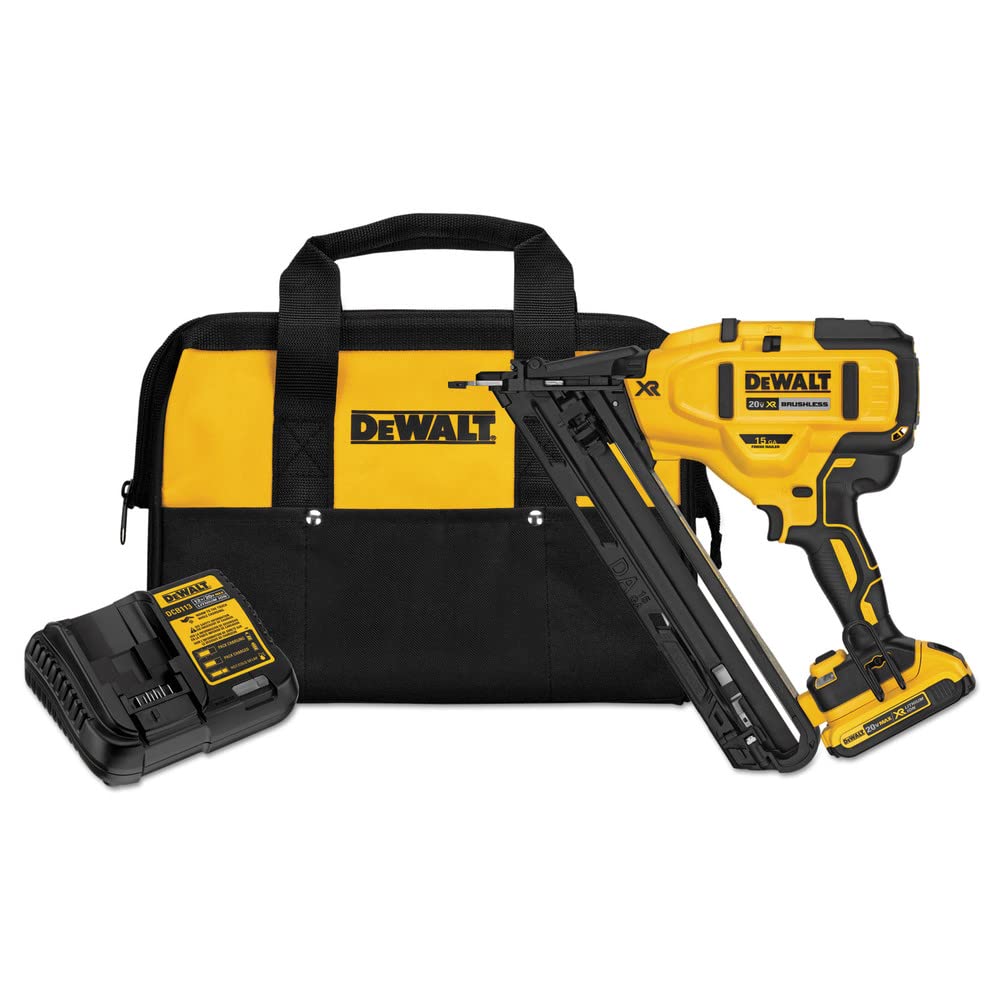
The 15-gauge DEWALT, boxed with the battery and charger so you can start working the day it lands.
This is the same 15-gauge angled DEWALT platform as the tool-only pick above, but it arrives as a complete kit: the nailer plus a 2.0Ah lithium-ion battery, charger, and kit bag. It is rated at 20 volts and weighs 6 pounds. If you are buying your first cordless finish nailer and do not already own DEWALT 20V MAX batteries, the kit is the simpler path. If you are already in the system, the bare tool is the better value.
The 15-gauge angled format is the reason to look here. It fires larger nails than a 16-gauge, so it holds crown molding and dense hardwood trim with more confidence. Owners describe setting nails through red and white oak tongue-and-groove and even hard maple with results rivaling pneumatic. The included battery is a 2.0Ah unit, which one hardwood floor installer found included but underpowered for all-day use; upgrading to a larger-capacity DEWALT battery produced much better results. The brushless motor, tool-free adjustments, and multi-functional LED lights carry over from the DEWALT design language.
Two quirks to know: the depth adjustment wheel has drawn complaints for being hard to turn, occasionally resulting in flush — rather than countersunk — nails, and the metal nose tip can dent soft wood if you press hard without a rubber tip. A battery stored in the gun can also drain over time, so pull it between jobs. Those are small habits, not flaws, but they are the little things that separate a smooth finish job from an annoying one.
Why pros pick the kit: Everything you need is in the box — the 15-gauge nailer, a 2.0Ah battery, a charger, and a bag — so nothing else has to arrive first.
The feature to plan around: The 2.0Ah battery covers light trim, but heavy all-day work wants a bigger DEWALT battery, and the depth wheel can need coaxing.
Best for: first-time cordless buyers doing crown molding, casing, and hardwood trim who want a complete 15-gauge kit with no extra purchases needed.
Think twice if: you already own DEWALT 20V MAX batteries and would rather save by buying the bare tool, or you plan heavy all-day flooring work where a larger battery is a must.
8. CRAFTSMAN V20 Cordless Finish Nailer Kit, 16GA (CMCN616C1)

A complete 16-gauge starter kit that puts nails, battery, and charger in the box.
This is the same CRAFTSMAN V20 16-gauge nailer as the bare-tool pick above, but the kit version comes with a V20 20V MAX lithium-ion battery, a charger, and two sleeves of finish nails — 100 at 2 inches and 100 at 2-1/2 inches. It weighs 9.1 pounds. That weight is the highest in the CRAFTSMAN line here, higher than the 7.6-pound bare tool, and it is the number to weigh against comfort if you plan extended overhead sessions. The 16-gauge format drives adhesive collated finish nails into hardwood and thick stair treads with consistent set depth.
The kit is designed for the person who wants everything in one box. The tool-free depth setting and tool-free jam and stall release keep adjustments fast, and the contoured over-molded handle and belt hook round out the ergonomics. Owners describe the trigger as safe with a built-in safety lock, and the bottom-load nail magazine with a slide lever is easy to load. Fast charging on the included battery is a reported plus.
What holds this pick back from the top spots is the mixed weight feedback. One long-time owner found the magazine a bit awkward to load, and the piston on a first unit eventually wore out before the second took over. But the reliability story is generally strong — users driving commercial greenhouse end walls and cabinet builds report no jams and no misfires. The included nail sleeves save you a trip on day one. If comfort matters more than kit completeness, the lighter DEWALT 15-gauge kit is the better ergonomic fit.
What you get in the box
- Nailer, V20 battery, charger, and 200 finish nails in two sizes included
- 16-gauge nails with tool-free depth and jam/stall release
- Bottom-load magazine with slide lever for easy loading
- Built-in safety lock and belt hook for safe, accessible operation
The trade-offs
- 9.1 pounds — the heaviest pick reviewed here — makes overhead work tiring
- Some owners find the magazine awkward to load
- A first piston has worn out for at least one long-term owner
Ideal for: the DIYer or casual builder who wants to unbox one item and start installing trim, baseboards, and cabinet work immediately.
Look elsewhere if: weight is a priority or you already own CRAFTSMAN V20 batteries and would rather buy the bare tool.
9. Ridgid HyperDrive 16 Gauge 18V Brushless 2-1/2 In. Straight Finish Nailer

A refurbished 18V brushless option for home projects that fire in bursts.
Starting with the important note: this Ridgid HyperDrive is a refurbished unit, which means it has been tested, cleaned, inspected, and repackaged to look and work like new, and may arrive in a generic box. It is a 16-gauge straight finish nailer that runs on 18 volts via the Ridgid battery platform and weighs 8.95 pounds — the heaviest tool in this roundup. It is the least expensive pick here, and the practical trade-off is that you buy the battery and charger separately — no combo kit is offered.
Owners describe it as a solid performer for fence boards, attic venting, and general home nailing, and it eliminates the compressor and hose for anyone tired of dragging air gear around. It is convenient one-handed on a ladder, though the 8.95-pound weight makes it heavy for a trim tool, so plan your work around shorter bursts rather than marathon overhead sessions. The brushless motor is set up for durability and runtime on the HyperDrive platform.
The 16-gauge straight format accepts 2-1/2-inch finish nails and aligns with the same fasteners used by other 16-gauge picks here. Because it is refurbished, you should confirm the included accessories in the listing before buying and inspect the unit on arrival. For a homeowner doing the occasional trim job, a refurbished Ridgid can deliver the cordless convenience at a very approachable cost — just budget for the separate battery and charger as part of your real spend.
The value case: For a homeowner firing nails on occasional projects, this refurbished 18V brushless tool gets you into cordless finish work at the lowest cost here — you just supply the battery and charger.
The trade-off: At 8.95 pounds it is the heaviest tool reviewed, and being refurbished means verifying the included accessories before you commit.
Best if: you want a low-cost entry into cordless 16-gauge finish nailing and already own or plan to buy Ridgid 18V batteries and a charger.
pass on it if: you need the lightest tool for overhead work, want a new-in-box kit, or prefer not to source the battery and charger separately.
Understanding the Specs
Gauge and nail length
Gauge is the thickness of the nail shank, and the numbers run backwards — smaller numbers mean thicker nails. A 16-gauge nail is thinner than a 15-gauge, so it leaves a smaller hole but holds less. A 15-gauge shank holds denser stock like hardwood flooring and crown molding with more confidence. Nail length is separate from gauge — most 16-gauge finish nailers in this roundup drive pills up to 2-1/2 inches, matching the M18 and V20 battery platforms used by the tools on this list.
Voltage and battery platform
The number on the side of the tool — 18 volts, 20 volts — reflects the battery family it uses, not the raw driving force. What matters more is whether you already own batteries in that platform. A DEWALT 20V MAX tool shares batteries with other DEWALT 20V MAX tools; a RYOBI ONE+ tool shares with the whole ONE+ lineup. If you are starting from zero, factor the cost of the battery and charger into your choice, since bare tools do not include them.
Actuation mode and drive depth
Actuation mode is the trigger logic that decides when the tool fires. Sequential mode fires when you press the tip against the wood and then pull the trigger, one nail at a time. Contact mode fires on each bump against the surface while the trigger is held, so you can run a line of nails quickly along a flat board. Depth adjustment sets how far the nail is driven; a good tool-free depth control lets you countersink a nail just below the surface so you can fill and paint over it.
Weight, balance, and overhead use
Weight is the spec that decides whether you enjoy using a finish nailer or dread it. A tool that feels fine at bench height becomes heavy after ten minutes overhead. In this roundup, the weights range from 5.9 pounds on the Metabo HPT NT1865DAA up to 9.1 pounds on the CRAFTSMAN CMCN616C1 kit. Balance matters as much as the number — a well-balanced heavier tool can feel more comfortable than a lighter one that sits awkwardly in the hand.
FAQ
What is the difference between a 15-gauge and a 16-gauge finish nailer?
Do I need an air compressor or gas cartridges for these nailers?
Will these nailers sink a nail into hardwood?
How many nails can these cordless finish nailers drive per battery charge?
What is the difference between sequential and contact actuation modes?
Can I use my existing batteries with these nailers?
How do I clear a jammed finish nailer?
Which gauge reaches inside corners and tight spots more easily?
Are these cordless finish nailers heavy to use overhead?
Do these kits include the battery and charger or is that separate?
Does the nailer dent soft wood or leave a mark on the surface?
Final Thoughts: The Verdict
For most buyers, the battery operated finish nailer winner is the DEWALT DCN660D1 because it combines a brushless motor, tool-free trigger and depth adjustments, and a 6-pound angled 16-gauge body that runs on the DEWALT 20V MAX batteries many contractors already own. It holds 4.7 stars across 800+ ratings, and reviewers keep returning to the same point: it sets the nail and moves on. If you want the extra holding power of 15-gauge nails, grab the DEWALT DCN650D1 kit. And for overhead trim work where weight matters most, the Metabo HPT NT1865DAA is the one to reach for.
How We Picked
We do not accept paid placement. Every pick is matched to a real buyer and a real use-case; we do not hands-on test units.
Sources & Methodology
Specifications: manufacturer listings and product documentation. Review insights: verified customer reviews, as of September 2026. Pricing: not shown on this page (it changes often); check the current price via the retailer link.
As an Amazon Associate, KitchPrep earns from qualifying purchases. This does not affect which products we feature.
Related Guides
