
Specs are compiled from manufacturer listings and verified buyer reviews and can change over time — please confirm the key details on the product page before buying.
You want a door alarm that wakes you up and that you will actually arm every night. The picks below all run on batteries alone — no wiring, no outlet, no monthly monitoring fee — so they keep working when the power cuts out. You stick one on a door or window, and the moment the two halves separate, it shrieks. That is the whole job. What separates a great one from a wasted purchase is volume, how it mounts, and whether it has a remote so you can switch it off from across the room instead of fumbling on a dark doorframe every time you let the dog out.
I’m Mohammad Maruf — the founder and writer behind KitchPrep. This guide is built by comparing the manufacturers’ published specifications and the patterns across verified customer reviews, so you get each pick’s real strengths and trade-offs instead of marketing spin.
Some alarms scream at 130dB while others chirp at 65dB, and that gap decides whether you hear it from the upstairs bedroom or not at all. Read on for the honest breakdown of the best battery operated door alarm.
Our Picks at a Glance


How To Choose The Best Battery Operated Door Alarm
Every alarm on this list runs on batteries, so the real question is not whether it works without wiring — they all do — but which one suits your door, your hearing, and how you live. Here is what separates them.
Decibels: 65dB versus 130dB is not a small difference
Volume is measured in decibels, written dB — that is the unit that tells you how loud the siren gets when it fires. A 65dB alarm is roughly the volume of a normal conversation, which is fine if the device sits a few feet from your head. A 130dB siren is closer to a jet engine at takeoff and will carry through a two-story house. If you are protecting an upstairs window or monitoring a family member who wanders, choose the louder end of the range and check that the alarm has adjustable volume so you can dial it down in daytime.
The mounting gap is the speed limit
These alarms work as a magnetic contact sensor: one half sticks to the door and the other to the frame, and when the gap between them grows past a set distance, the siren goes off. Most units trigger at roughly 0.78 inches of separation — a measurement you will see written as the maximum range. The key point is alignment. If your door has decorative trim or an uneven frame, the two halves may never sit close enough to arm properly, and that is the single biggest install complaint across this category.
Chime mode, alarm mode, and which you actually need
A chime mode plays a short ding-dong when a door opens, which is gentle enough for shop entrances and front doors during the day. Alarm mode sounds a continuous siren until you switch it off. The better units let you toggle between both, sometimes with separate volume levels for each. If you have pets or a sleeping baby, look for one with a mute or silent light mode, so the alarm can flash an LED instead of screaming.
Quick Comparison
| Model | Best For | Alarm Volume | Pack Size | Power | Amazon |
|---|---|---|---|---|---|
| TECKNET 2-in-1 Door Alarm (3 Pack)★ Best Overall | All-round home security | 65 dB | 3 alarms | Alkaline batteries | Amazon |
| TechRise 2-in-1 Alarm & Chime (3 Pack)Best Value | Pool & dementia monitoring | 100 dB | 3 alarms | Battery powered | Amazon |
| TECKNET 130dB Remote AlarmLoudest Alert | Loudest alert, remote control | 130 dB | 1 unit | 2 AAA batteries | Amazon |
| GreenCycle Door Chime | Shops & multi-door chimes | 113 dB | 1 receiver + 1 chime | 4 AAA batteries | Amazon |
| Philips Window & Door Alarm (4 Pack) | Whole-home coverage on a budget | 120 dB | 4 alarms | 4 LR44 button batteries | Amazon |
| METAK 2-Pack Remote Alarm | Remote arming across floors | 120 dB | 2 alarms + 2 remotes | 2 AAA batteries | Amazon |
| WimuPath Door Window Alarm (15 Pack) | Bulk coverage for rentals | 90 dB | 15 alarms | 2 AAA batteries | Amazon |
| Ranisny Door Window Alarm (4 Pack) | Quick temporary setups | 120 dB | 4 alarms | LR44 batteries included | Amazon |
| METAK 5-Pack Window & Door Alarm | Power-outage protection | 120 dB | 5 alarms | 2 AAA batteries | Amazon |
In‑Depth Reviews
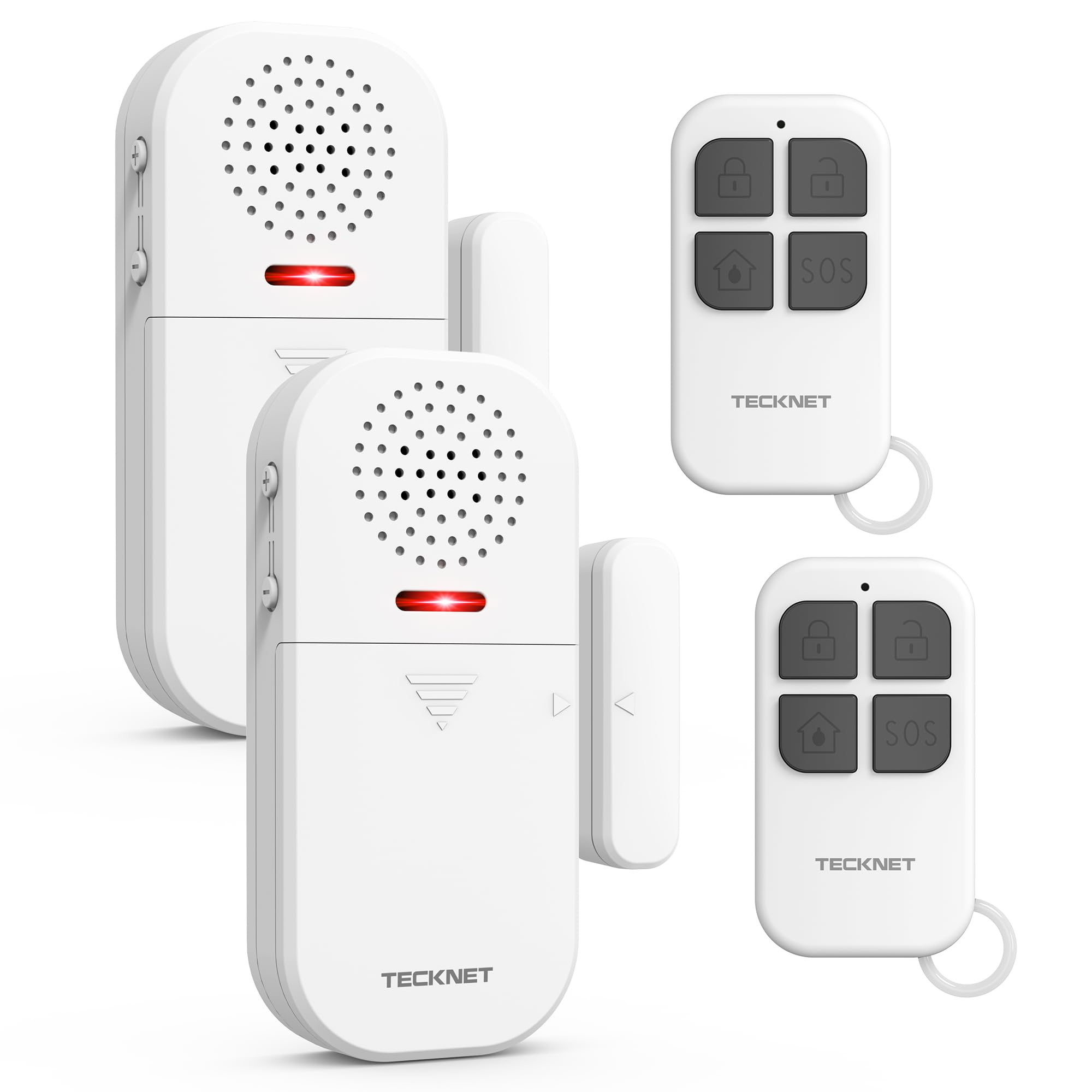
1. TECKNET Door Alarms for Kids Safety, Window Alarm Pool Alarms (3 Pack)
Our pick — over 4.5★ from 900+ verified ratings; the strongest balance of quality and price.
Three alarms, one adhesive strip each, and a siren that keeps working a year after you stick it on.
If you want one alarm to cover a front door, a back door, and a pool gate without buying three separate boxes, this TECKNET set is the one to start with. The magnetic contact sensor fires the moment the two halves drift more than 0.78 inches apart — that is the trigger distance, and it is tight enough that a door barely cracking open sets it off. Each alarm runs on alkaline batteries and needs no wiring, so the whole set installs in minutes.
What wins people over is the volume. You get three levels to choose from, and owners regularly report the loudest setting carries from a downstairs door up to a second-floor bedroom. The alarms also double as a chime, so you can use a soft ding for a shop bell during the day and switch to full siren at night. Owners also report the adhesive holding for a year or more on clean frames, with the alarms still firing after months of daily use. As owners put it: “Easy to install, good price, loud beeping, still attached and working over a year later.”
The honest trade-off is the adhesive. The included pads hold well on clean, flat surfaces, but they can loosen on rough or dusty trim, so wipe the area with rubbing alcohol before you press them on. A few owners also mention the tiny on/off switches are fiddly to read, especially for older hands. Neither issue is a deal-breaker — it is just worth knowing before you mount them.
What earns its keep
- Three levels of volume, from a gentle chime to a siren you can hear upstairs
- Triggers at just 0.78 inches of separation, so a barely-open door still fires
- Three-pack covers multiple entry points in one purchase
- 36-month warranty when you register the product
Where it asks for care
- Adhesive is the weak link — clean and dry the surface first
- Small switches can be hard to read for older users
Start here if: you want one box that covers a few doors and a pool gate, with a volume dial for day and night.
Size up instead if: you need a remote to arm it from bed — this set has no remote control.
2. TechRise 2-in-1 Alarm & Chime, Easy-to-Install Door Alarm Sensor (3 Pack)
The budget pick that earns its place by doing exactly what it promises, with three volume steps to prove it.
At 100dB, the TechRise sits right in the middle of the loudness range — clearly louder than a conversation but not the ear-splitting 130dB of the top pick. That 100dB siren fires the instant the door and sensor separate past 0.78 inches, the same trigger distance as the TECKNET set above, and the LED lights up alongside it. You get three volume steps, from low to high, plus a chime mode for daytime use.
The thing everyone raves about is how straightforward it is. Peel the double-sided adhesive, press it on, and you are done — owners use it on regular doors, patio doors, and screen doors, and several note it works fine as a doorbell substitute. The clearest praise comes from caregivers: “Easy to install and very loud!! Got them to monitor my father in-law with dementia!! He is fast and need to keep all eyes and EARS open.” That is the exact use case this alarm was built for — a chime you can hear from another room when someone slips out.
Two things to know. The adhesive holds on most surfaces but a handful of owners had to reinforce it, so a strip of heavy-duty tape or mounting putty is worth having on hand. And on an uneven sliding door with a lip, you may need to build up one side so the two halves align — one owner laid down command stickers to level the sensor. Get the alignment right and it works cleanly; rush it and you get false triggers.
The quiet win: 100dB is loud enough to wake you but gentle enough not to terrify pets, and the three volume levels let you fine-tune it for a nursery door.
Watch the alignment: unlike a flat door frame, a sliding door with a lip can stop the sensor from sitting level, which is where most setup frustration comes from.
Reach for this if: you are watching a dementia patient, a toddler, or a pool door and want loud-but-not-deafening with a simple chime option.
Look elsewhere if: you need a remote — arming and disarming here is a manual touch on the unit itself.
3. TECKNET Door Alarms for Kids Safety, 130dB Loud Adjustable Volume Window Alarm with Remote
A 130dB siren you can arm and silence from 200 feet away — no walking back to the door.
This is the loudest alarm on the list, and by a wide margin. Its 130dB siren is double the 65dB of the TECKNET three-pack at the top of this guide — a gap you will hear instantly if both are on the same wall. When the sensor and magnetic strip separate by more than 1cm, the siren fires with a flashing red LED. Five volume steps let you drop it to a gentle daytime level and crank it up at night.
The real point of difference is the remote. Its 60m (200ft) wireless range means you can arm it from indoors and disarm it without crossing the room, which solves the biggest annoyance with most door alarms — fumbling at a dark doorframe every time you want out. Owners also love the four modes: doorbell alert, anti-theft alarm, an everyday reminder for forgotten items, and an emergency call. One turned it into a backyard gate chime, and reports it held up through the garden hose, rain, and sun.
Two caveats. Because the trigger fires at 1cm of separation rather than 0.78 inches, a door with thick trim may need the two halves positioned carefully so they sit close enough — test it before you commit to the spot. And this is a single unit powered by two AAA batteries, which are not included, so budget for one alarm at a time rather than a whole house.
Why it leads on volume: at 130dB against the top pick’s 65dB, this is the one that cuts through a closed bedroom door and a running ceiling fan.
One unit, one door: no pack here — it is a single alarm, so plan a purchase per entry point you want to protect.
The pick for: anyone who wants the loudest possible warning and the convenience of a 200-foot remote to arm it from the sofa.
Think twice if: you need to cover five windows — buy a multi-pack instead of five of these.
4. GreenCycle Door Chimes when Door Opens
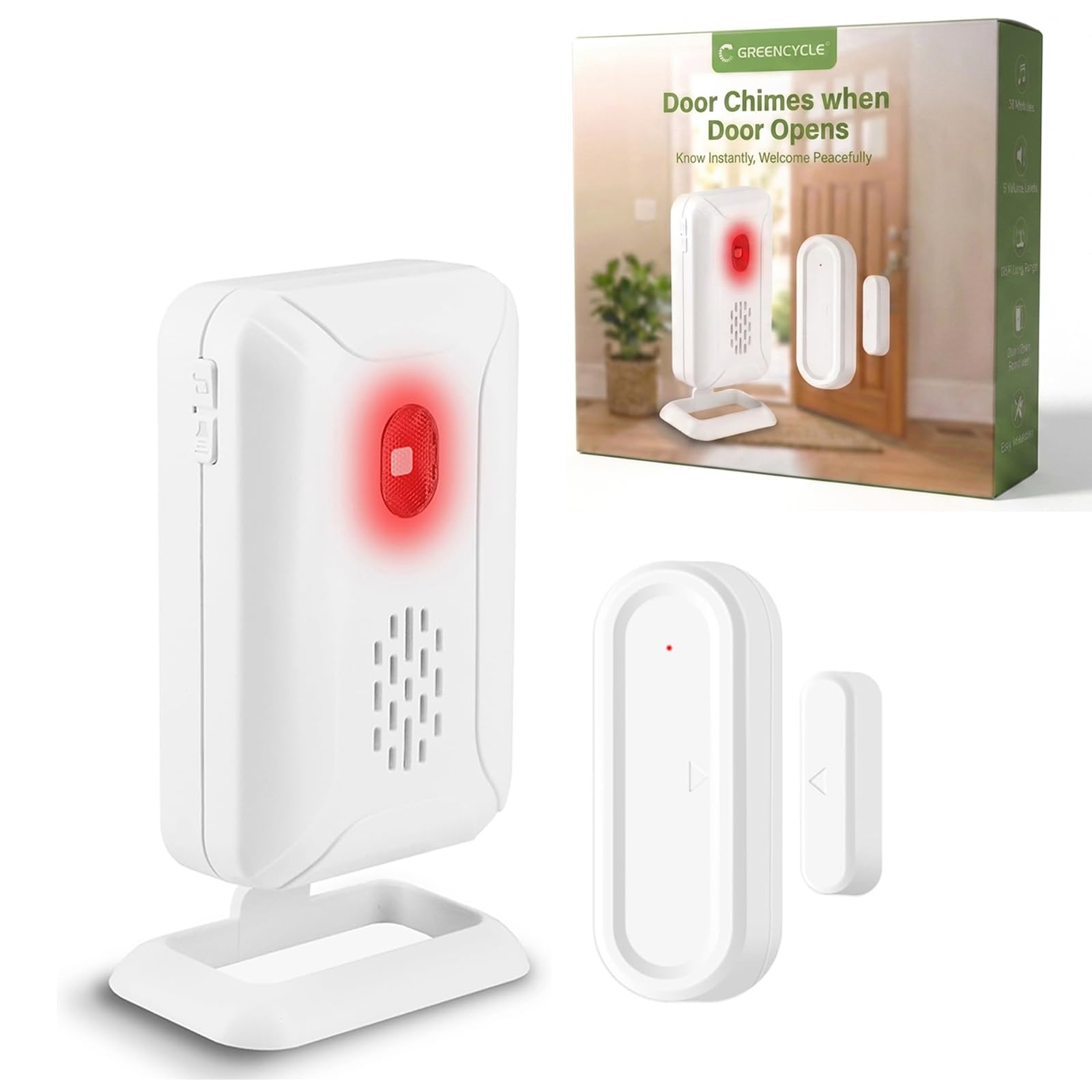
Thirty-six chimes, five modes, and a receiver that tells you which door just opened by the tune it plays.
Shopkeepers and multi-door homes get the most from this one. It pairs a wireless sensor with a tabletop receiver that plays a different chime per paired sensor, so you know by ear whether the front gate or the stockroom door just opened. You get 36 selectable chime tunes in doorbell mode, and four volume levels across its welcome, doorbell, and alarm modes. The alarm tops out at 113dB and holds for 30 seconds when the magnetic strip separates.
Range is its headline: up to 600ft between sensor and receiver in open air, and the system pairs with more sensors over time if you want to extend it. The appeal is flexibility — a gentle ding-dong during business hours, a squealy alarm at night, and a silent mode that flashes colored light for anyone hard of hearing. A renter even used it on a patio gate precisely because there is no accessible off switch for an intruder to find.
Be aware of two things before you buy. The receiver has to be plugged in to work, so it is not fully battery-powered like the sensors — one buyer was surprised there was no rechargeable option. And the alarm sounds for 30 seconds on trigger, which is loud enough that a couple of owners found it distressed their dogs.
Best for businesses: 36 chimes across multiple paired sensors mean you never have to guess which entrance just opened.
Mains-powered receiver: the sensor runs on batteries, but the tabletop unit needs an outlet — pick a spot near power.
Suits: store owners and anyone with several entrances who wants a different sound for each door and a silent light mode for quiet hours.
Skip if: you need the receiver itself to run off batteries — this one plugs into a wall.
5. Philips Personal Security Window and Door Alarm (4 Pack)
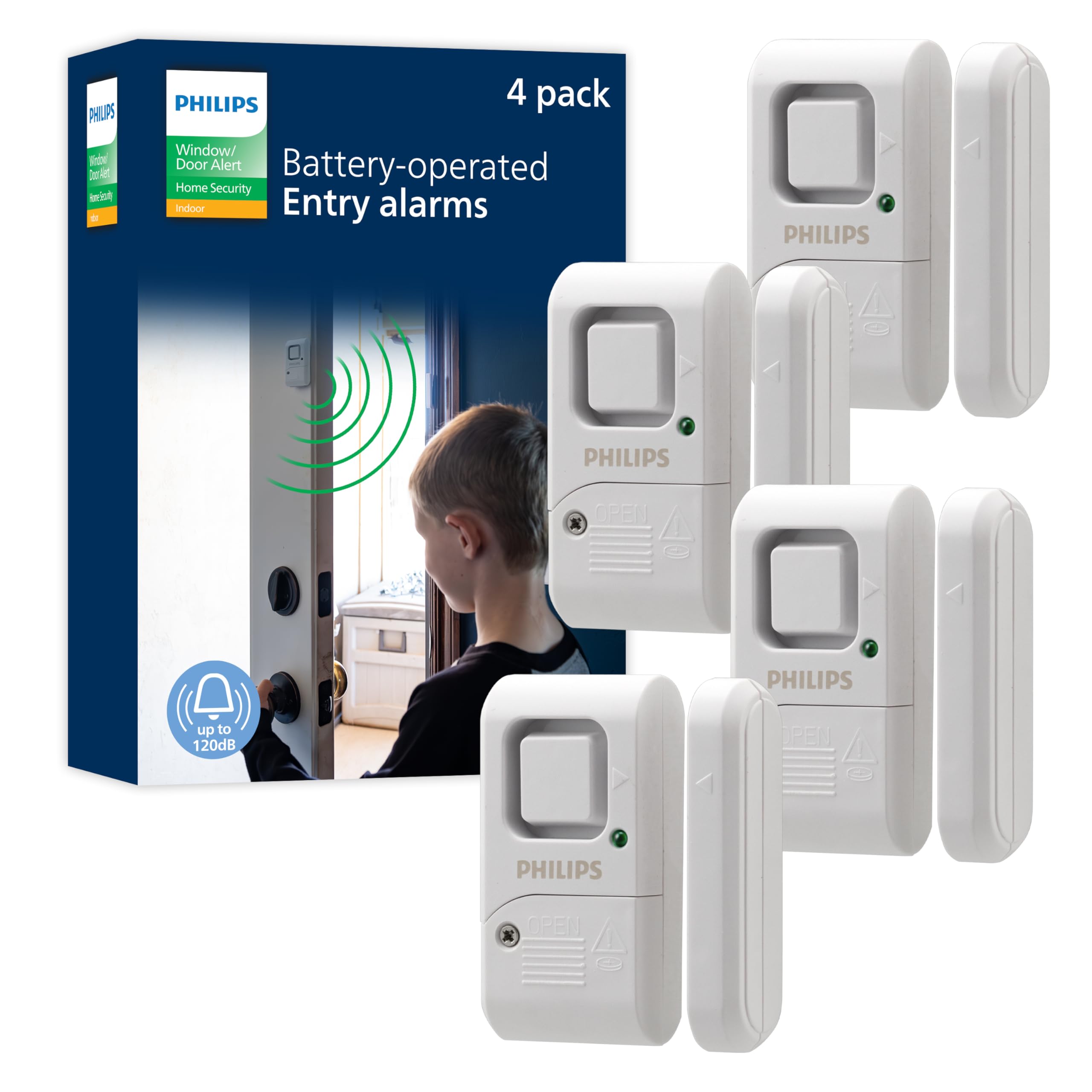
Four alarms from a name you know, each with a simple three-way switch: off, chime, or 120dB siren.
For coverage across a whole apartment, the Philips four-pack is the straightforward choice. Each unit carries a 120dB alarm driven by a magnetic sensor, and the side switch gives you three positions — off, chime, or alarm — so switching a window from friendly chime to full siren is a thumb flick, not a menu dive. It runs on four included LR44 button batteries with a battery test button and a low-battery LED indicator, so you get a warning before an alarm quietly dies.
The volume is the star here. Owners describe the 120dB siren as audible from the other side of the house and loud enough to wake them at night. Installation is genuinely tool-free: the included double-sided tape sticks the two halves straight onto a door or window frame. It is a common brand name too, which a few buyers specifically valued when they wanted something they recognized.
The one gripe worth flagging is adhesive durability. The tape works on clean, flat frames but can lift on textured or old wood, so a dab of mounting putty helps. A small number of units arrived already dead, which is why the battery test button matters — press it before you mount anything, and return the rare dud.
Four doors, one box: the multi-pack makes a whole-home setup cheap, and the chime/off/alarm switch means no complicated arming.
Button batteries included: it ships with four LR44 cells and a test button, so you can confirm each unit works before sticking it down.
Pick this if: you want a familiar brand covering four windows or doors with a dead-simple off/chime/alarm switch.
Look on if: you need a remote to arm from bed — the switch is on the unit itself.
6. METAK 2-Pack Window/Door Alarm with Remote, 90dB/120dB (2 Pack)

Two alarms, two remotes, and one of the longest control ranges you will find — 600 feet across the house.
This METAK set puts a remote in your hand for each alarm, and that 600ft range means you can arm the front door from the back bedroom without walking down the hall. Each unit runs on two AAA batteries and mounts with a magnetic sensor design and 3M adhesive, so there is no drilling. You pick your volume too — 90dB for a discreet alert or 120dB when you want full deterrence.
The reliability is what keeps people coming back. Buyers report the 3M adhesive holding for years across a whole house, and the 600ft remote makes daily arming and disarming easy. The high setting is genuinely loud; the second-highest frequency setting on a basement unit carries all the way up to the kitchen. It handles a range of doors too — front and back doors, sliding doors, and motel room doors with equal ease.
Even with 600ft of range there is a limit: the alarm has to be within reach of the remote to disarm, so mixing an alarm two floors up is fine, but hugging a radiator-blocked basement corner may test it. And like every unit on this list, the adhesive holds best on a clean, flat surface — a piece that falls off overnight usually means the surface was not prepped.
Arm it from anywhere: 600ft of remote range beats the 200ft of the loudest TECKNET pick above, and both beats no-remote units on daily convenience.
90dB or 120dB your call: the switchable volume means one unit works as a quiet reminder by day and a full alarm at night.
Ideal for: a two-story home or a rental where you want remote control over alarms on doors you cannot always reach.
Bear in mind: the batteries are not included, and the remote range is best when there is a clear line toward the alarm.
7. WimuPath Door Window Alarm, 90dB (15 Pack)

Fifteen alarms that stick a siren on every window and door in a rental for a per-unit price that is tough to top.
If you own a rental you do not always stay at, fifteen alarms in one box means you can cover every window and door without ordering again mid-job. Each unit is a 90dB magnetic switch that sits on a frame and fires when the two halves separate. Installation is peel-and-stick with no tools, and it pulls off cleanly without damaging the surface if you move it — useful in a house you are turning over between tenants.
Owners value the peel-and-stick install: fifteen alarms cover a whole house in one afternoon from one box, then pull off cleanly for repositioning. It is a common pick for portable home-inspection needs too, since you can deploy alarms room by room. The count is the whole point — a single siren on one door protects one door, and fifteen protects a building.
Two honest notes. At 90dB this is quieter than the 120dB and 130dB picks above, so it is a deterrent and alert rather than an ear-splitter. And with this much volume of product, a floor unit occasionally misbehaves — test each alarm in your hand before you mount it, so you can set aside any dud rather than discovering it after install.
Fifteen for a whole building: no other pick here covers every window and door in one box.
Modest volume: 90dB alerts and deters but will not match the 120dB-plus models for cutting through a closed door.
The one for house flippers and landlords: an entire property alarmed in an afternoon, with alarms you can pull and reuse next season.
Not for maximum noise: if you are a light sleeper far from the door, step up to a 120dB pick.
8. Ranisny Door Window Alarm with Chime, 120dB (4 Pack)

Two modes in one tiny unit — a friendly double-chime for visitors and a 120dB siren for intruders.
These Ranisny alarms give you the best of both modes in a small peel-and-stick package. Chime mode sounds twice when a door or window opens, while alarm mode keeps sounding for as long as the opening remains. The 120dB siren is loud enough to hear from another room while you sleep, and the set of four includes LR44 batteries and adhesive tape, so there is nothing else to buy to get started.
The appeal is a low-cost layer of protection you can peel and stick in an afternoon on a bedroom door, a far-off window, a garage, or a dorm room. Owners use them to keep tabs on kids and elderly relatives as much as for security, and the peel-and-stick install saves drilling into rental walls. When you move, the units come with you.
Watch the power switch and alignment. There is no bypass button, so the only way to turn one off is the side mode switch — install at adult height with the switch reachable. And the magnet has to line up with the correct three bars on the receiver’s side, not the front; a few owners found that once aligned properly, every unit worked as intended.
Four alarms, batteries included: LR44 cells ship in the box, so four doors are protected with no extra shopping trip.
Switch placement matters: with no quick-off, mount high enough that the side switch stays out of a child’s reach but easy for you.
For renters and quick jobs: four peel-and-stick alarms with batteries in the box, covering a small flat in an afternoon.
Consider the alignment: on an uneven sliding glass door, level the sensor with a sticker first so the magnet lines up correctly.
9. METAK Window & Door Alarm When Opened (5 Pack)
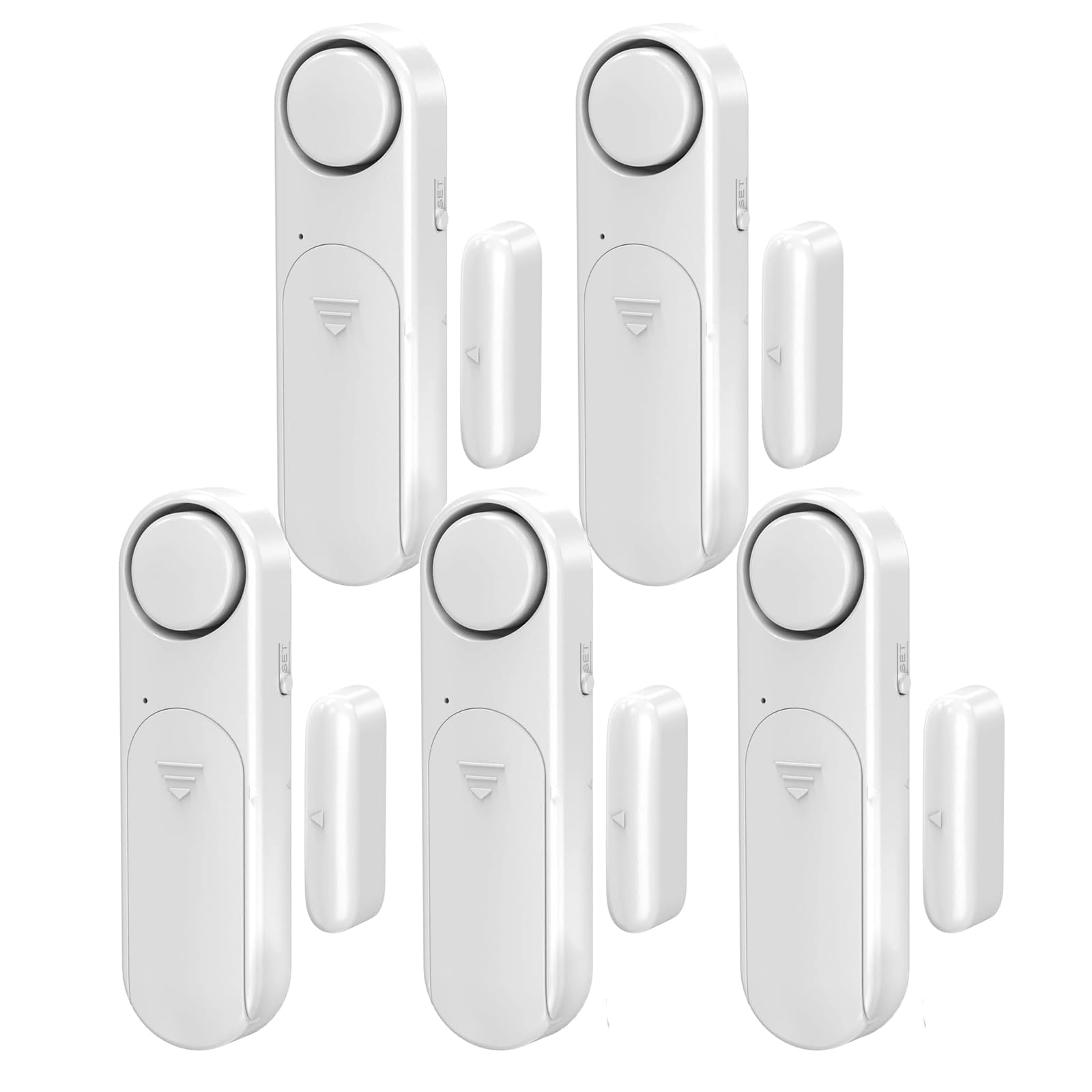
Five alarms that keep guarding the doors even when the power grid is down.
This METAK five-pack is built for anyone who wants security that does not depend on the electricity staying on. Each unit runs on two AAA batteries — no wiring, no outlet — so when the power goes out, these keep working while plug-in cameras and wired systems go dark. You get a 120dB alarm with a Set button for arming, disarming, and switching between 90dB and 120dB, plus a simple on/off switch for one-tap control.
That battery-only independence is the whole selling point, and it is exactly what owners praise: no monthly fees, and still live when the lights are out. Five alarms give you front door, back door, and windows covered from one box. A built-in LED flashes red on trigger and when the battery runs low, so you get a visual heads-up before a unit dies.
One important detail: this model, D130, does not accept a remote. A related METAK model pairs with one, but this pack is controlled entirely through the Set button on each unit, so there is no arming from across the room. If remote control is essential, pick the METAK 2-pack above instead — if you would rather buy more coverage and skip the extra hardware, this is your set.
Off-grid reliability: two AAA batteries per unit mean five alarms that never stop for a power cut.
No remote here: every unit is armed by hand at the Set button — no bedside control on this D130 model.
Best for outage-prone areas: five battery-only alarms that keep working when wired systems fail, covering a whole house in one box.
Skip if you want remote arming: the D130 has no remote — choose the METAK 2-pack for that feature.
Understanding the Specs
Audible Noise (dB)
This is how loud the siren is when it fires, measured in decibels. The number matters most when the alarm is far from where you sleep. A 65dB alarm is conversational — fine beside your bed, easy to miss across a big house. A 120dB or 130dB unit will carry through walls and wake you from another floor. If you are protecting a distant window or monitoring someone who wanders, choose the higher end and look for adjustable volume so you can lower it in the daytime.
Maximum Range (Trigger Gap)
On a magnetic contact alarm, this is the distance the two halves can separate before the siren sounds. Most units here fire at around 0.78 inches. A smaller trigger gap means the alarm reacts to a door barely cracking open, which is what you want for child-safety and anti-intrusion use. The catch is alignment: if trim or an uneven frame stops the halves sitting close enough, the alarm will not arm, so test the placement before you stick anything down.
FAQ
How loud is loud enough for a battery operated door alarm?
Will a battery door alarm work when the power goes out?
How do I install one without damaging my door?
What is the difference between chime mode and alarm mode?
Will it trigger falsely when my door has thick trim?
Do I need a remote control with a door alarm?
How long do the batteries last in these door alarms?
Can I add more sensors to one alarm system later?
Are these alarms a good fit for monitoring a family member with dementia?
Is a door alarm enough on its own for home security?
Final Thoughts: The Verdict
For most homes, the winner is the TECKNET 2-in-1 Door Alarm three-pack — it pairs three levels of adjustable volume with a trigger that fires at just 0.78 inches, and its track record of staying stuck and staying loud is why it tops this list. If you want the loudest possible siren and remote arming from the sofa, grab the TECKNET 130dB Remote Alarm, which doubles the volume of the top pick’s 65dB. And for a whole building on one order, the WimuPath 15-pack alarms every window and door without a second trip. Pick by how far you sleep from the door and if you want a remote in reach — get that right and any of these will do the job.
How We Picked
We do not accept paid placement. Every pick is matched to a real buyer and a real use-case; we do not hands-on test units.
Sources & Methodology
Specifications: manufacturer listings and product documentation. Review insights: verified customer reviews, as of September 2026. Pricing: not shown on this page (it changes often); check the current price via the retailer link.
As an Amazon Associate, KitchPrep earns from qualifying purchases. This does not affect which products we feature.
Related Guides
