
Specs are compiled from manufacturer listings and verified buyer reviews and can change over time — please confirm the key details on the product page before buying.
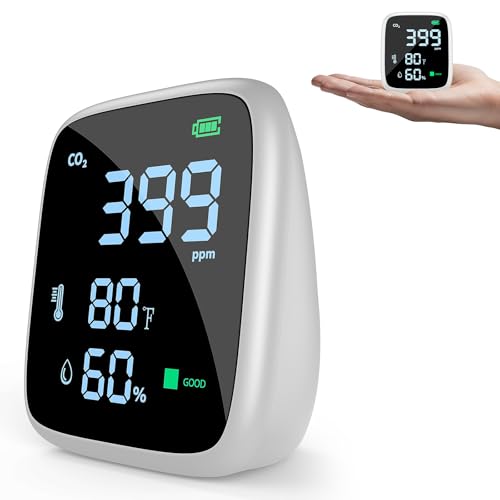
If you want the short answer: the Dienmern 5-in-1 is the best battery operated CO2 detector for most homes, because it tracks CO2, temperature, humidity and air quality on one screen and runs up to 72 hours per charge. It is the crowd favorite, holding 4.5 stars across 700+ owner reviews. Everything below explains which of the other eight meters fits your desk, your bedroom, your van, or your grow room better.
I’m Mohammad Maruf — the founder and writer behind KitchPrep. This guide is built by comparing the manufacturers’ published specifications and the patterns across verified customer reviews, so you get each pick’s real strengths and trade-offs instead of marketing spin.
A portable CO2 meter is only useful if it reads the room you are actually sitting in, so battery life, sensor type, and how loudly the alarm fires at night matter more than any spec-sheet headline. The list below covers the reliable, room-friendly battery operated co2 detector models worth your money right now.
Our Picks at a Glance


How To Choose The Best Battery Operated CO2 Detector
A battery operated CO2 detector lives or dies on two things: whether its sensor tells the truth, and whether its battery still has charge when you actually pick it up. Get those two right and the rest is preference. Get them wrong and you own a screen that shows numbers you cannot trust.
Sensor type is the whole ballgame
An NDIR sensor — short for non-dispersive infrared — shines infrared light through a small chamber and measures how much of it the CO2 absorbs. That physical measurement is why meters using it hold steady readings instead of drifting. A Swiss-made version of the same sensor is what several picks here advertise, and it is the single biggest quality marker in this category.
Battery capacity tells you how often you will hunt for a cable
Capacity is measured in mAh, or milliamp-hours — think of it as the size of the fuel tank. A 1600mAh meter and a 3000mAh meter can both claim long life, but the bigger tank, paired with ECO mode, is what pushes runtime from days into months. If your meter will sit plugged in most of the time, capacity matters less than whether the readings stay live while charging.
Alarms you can live with at 3am
Every meter here alarms somehow — color on screen, a buzzer, an app notification, or a flashing light. The practical question is whether you can silence it. A color-coded screen is easy to ignore in a dark bedroom; a repeating buzzer is not. Decide up front whether the unit will live in a room where you sleep.
Quick Comparison
| Model | Best For | Battery / Runtime | CO2 Range | Display | Amazon |
|---|---|---|---|---|---|
| Dienmern 5-in-1 DM1308B★ Best Overall | Whole-home monitoring | 1600mAh, up to 72 hours | 400–5000 ppm | LED screen, auto-dimming | Amazon |
| SwitchBot Meter Pro CO2Best for Travel | Long-haul, low-maintenance placement | Built-in, up to 12 months | 400–9000 ppm | 92mm screen with time and date | Amazon |
| Temtop C1+Longest Runtime | App-connected recording | 800mA, up to 70 days in ECO mode | Not listed | 3.3-inch LCD | Amazon |
| INKBIRDPLUS PTH-10C | Travel and bedside use | 1000mAh, about 72 hours | 400–5000 ppm | Full-color LCD | Amazon |
| INKBIRD IAM-T2 | Data logging and export | 3000mAh, 6+ months per charge | Not listed | Backlit LCD | Amazon |
| KETOTEK E0172 | Classrooms and shared rooms | Battery or USB powered | 400–5000 ppm | VA wide-angle display | Amazon |
| LifeBasis 11-in-1 | Full particle and gas sweep | 2500mAh, 11–12 hours | Not listed | Adjustable LCD | Amazon |
| Tekcoplus COTK-57 | Pro-level IAQ surveying | Battery powered | 0–9999 ppm | Backlit LCD | Amazon |
| Gain Express A017755 | Field work and grow rooms | Battery or 9V adaptor | 0–9999 ppm | Large LCD with backlight | Amazon |
In‑Depth Reviews
1. Dienmern 5-in-1 CO2 Carbon Dioxide Detector (DM1308B)
Our pick — 4.5★ from 700+ verified ratings; the strongest balance of quality and price.
One screen, four numbers, and a battery big enough to survive a whole weekend off the charger.
The number that carries this pick is 1600mAh — a battery tank roughly 60% bigger than the 1000mAh cell inside the INKBIRDPLUS PTH-10C a few picks down. In practice that means up to 72 hours of unplugged readings on a single charge, so you can move it from bedroom to kitchen to garage without trailing a cable behind you. The Swiss-made CO2 sensor reads every second across a 400–5000 ppm range, with stated accuracy of ±50 ppm, which is the same precision a serious buyer looks for on the meter’s spec label.
What earns it the top spot is the completeness of the picture. It reports CO2, air quality index, temperature and humidity all at once on a bright LED screen, and the screen brightness adjusts itself for day and night use — a genuine help in a kid’s room where the last thing you want is a glowing panel at midnight. Owners repeatedly call the four-reading layout easy for the whole household to read at a glance.
What wins people over is the display doing a lot of work without being complicated. Buyers report it arrives as a full kit: “Includes zipper case & extra 9V battery.” A hold button freezes the current reading until you clear it, which sounds trivial until you want to log a bedroom number before the meter updates. The honest catch is calibration drift — this class of meter can wander by about ±50 ppm, and one buyer in the review pool found their unit read inaccurately. That is a minority report against hundreds of satisfied owners, but run a quick outdoor baseline check when it first arrives.
What carries the day
- 1600mAh battery, up to 72 hours unplugged — the biggest tank in this lineup
- Swiss-made sensor with 400–5000 ppm range and ±50 ppm accuracy
- CO2, AQI, temperature and humidity on one auto-dimming LED screen
- Ships with a zipper case and spare 9V battery
What to know before you buy
- Readings can vary around ±50 ppm — do a baseline outdoor check on arrival
- Requires USB charging rather than standard disposable cells
- No Bluetooth app, so no long-term logging or export
The pick for you if: you want one meter to roam the whole house with CO2, AQI, temperature and humidity all visible at a glance.
Sharper tools exist if: you need app-based data logging over weeks — the INKBIRD IAM-T2 and SwitchBot handle that job instead.
2. SwitchBot CO2 Detector Meter Pro CO2
Twelve months on one charge, and a 92-millimeter screen you can read from across the van.
If the Dienmern wins on battery capacity, the SwitchBot wins on the span between charges. It pairs Swiss-made NDIR sensors with a built-in battery rated for up to 12 months of life, which changes the whole rhythm of ownership — you mount it, you forget about it. The reading range runs 400–9000 ppm with stated accuracy of about ±50 ppm plus 5% of the reading, and the sensor refreshes every 1 second.
The 92-millimeter screen shows CO2, temperature, humidity, time, date and a comfort level all at once, and it mounts on a wall via the rear holes or sits on the adjustable bracket. Van dwellers treat it as a bedside companion — the screen is legible from anywhere in a small space, and the alert system leans on sound, screen warnings and app notifications to tell you when to crack a window.
Here is the honest catch, and it is a two-parter. The app notifications require a SwitchBot Hub, so without the hub you are relying on the unit’s own screen and buzzer. Separately, readings refresh every 5 minutes on battery versus every 1 minute while plugged in, and the connected app experience has drawn mixed feedback on lags and chart glitches. Buy it for the screen and the sensor, not for a polished smart-home dashboard.
What the display does: one glance gives you CO2, temperature, humidity, time and a comfort reading — no swiping through menus in a dark kitchen.
Sizing the app: Bluetooth only, and full notifications need the SwitchBot Hub — treat the hub as an optional upgrade rather than part of the package.
Yes, if: you want a wall-mounted unit you charge once a year and never think about again.
Hold off if: you expect plug-and-play app notifications without buying into the SwitchBot Hub ecosystem.
3. Temtop C1+ CO2 Monitor with BLE App
The one built to sit on a shelf for two months and still have charge — if you can live with Bluetooth-only.
Seventy days. That is the runtime Temtop claims for the C1+ in ECO mode, running an 800mA battery through energy-saving algorithms. It is not the biggest battery in this group — the INKBIRDPLUS PTH-10C packs more into a smaller body at 4.96 ounces versus the C1+ at 4.8 ounces — but the sleep-mode engineering stretches the C1+ further than you would expect from the cell size.
The hardware is a high-precision Sensirion CO2 sensor, a 3.3-inch LCD showing CO2, temperature and humidity simultaneously, and an optional buzzer on top of the on-screen color coding. Setup is genuinely quick — one buyer put it plainly: “Works great! Set up in seconds!”
The trade-off is the connectivity. The C1+ talks only over Bluetooth, and the pairing flow has frustrated some buyers who expected the app to connect automatically. Its temperature and humidity readings and its historical data tracking both come in for criticism, so treat this as a real-time CO2 watch, not a logging device. If you want a unit that records and exports weeks of data, the INKBIRD IAM-T2 is the better fit.
The strongest case: 70 days between charges in ECO mode makes this the least demanding meter to own for a nursery or office shelf.
Where it falls short: Bluetooth-only and no usable historical data — the app shows now, not the story over time.
Pick it for: a dedicated CO2 watch in a baby room, study or classroom where you only need the live number.
Look past it for: trend logging or multi-room data capture — the Temtop C1+ rarely records anything worth reviewing.
4. KETOTEK CO2 Monitor Indoor Air Quality Meter (E0172)
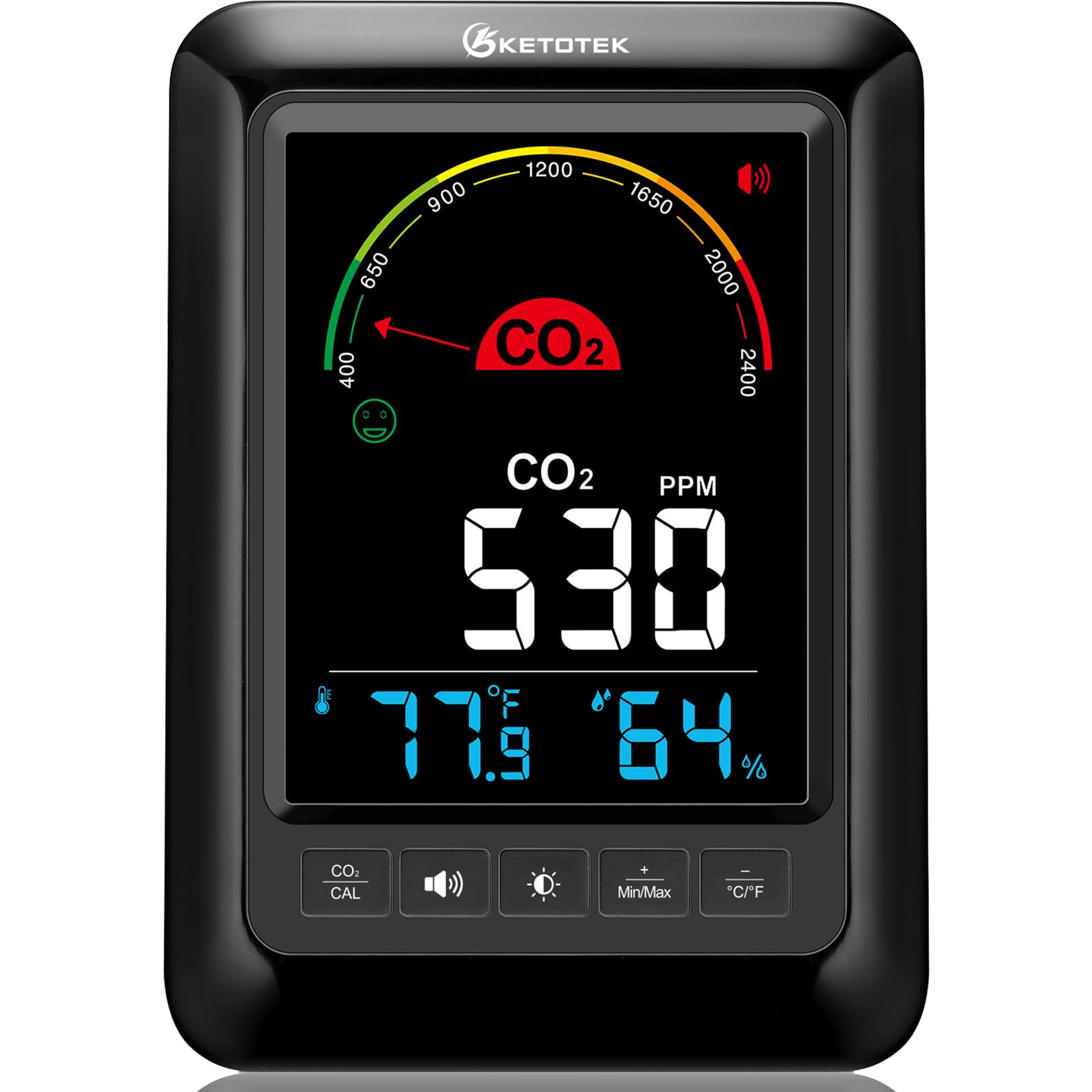
Six CO2 levels, a voice reminder you can mute, and a wide-angle screen built for a whole room to read.
The angle of the display is the giveaway here: a VA panel — a wide-viewing-angle screen type — chosen so people sitting off to the side can still read the reading. That is a classroom or waiting-room design decision, not a bedside one. The 400–5000 ppm range covers CO2, and the screen also reports temperature from 14.2°F to 140°F and humidity from 20% to 95%.
Inside sits a Swiss Sensirion industrial-grade photoacoustic sensor with ±50 ppm accuracy. The word “photoacoustic” sounds intimidating, but the practical meaning is simple: it measures CO2 by listening to the sound pressure the gas creates when it absorbs light. The maker claims this compensates for the limits of standard NDIR sensing, which is worth knowing when you compare it against the plain NDIR units above.
Frustrations show up in the review pool, and they deserve a straight mention. One buyer found the build felt cheap and saw readings fluctuate without a clear calibration baseline, calling it useful as a rough guide. Another unit failed within minutes of unboxing — a single failure, not a pattern, but return yours immediately if it misbehaves. The meter is also happiest in mains power mode, where CO2 updates every 6 seconds; battery mode drops the screen to button-press activation only.
Where it pulls ahead
- Wide-angle VA screen readable from across a room
- Six CO2 levels with a mute-able voice reminder
- Swiss Sensirion photoacoustic sensor, ±50 ppm stated accuracy
- Desktop or wall-mount, powered by USB or battery
Where it concedes
- Readings refresh every 6 seconds only on mains power; battery mode is button-press only
- No stated calibration baseline — some owners mention fluctuating numbers
- Restart resets the unit back to Celsius, a minor annoyance
A strong match for: a teacher or clinic manager who needs a screen the whole room can read and a fixed installation with USB power.
Skip if: you intend to run it purely on battery and expect constant live readings — this one prefers the mains.
5. INKBIRD IAM-T2 Smart Air Quality Monitor

More than six months per charge, and a year of data waiting in the app when you get back to it.
For anyone who wants to see the shape of their air over weeks, not just the number right now, this is the one. The 3000mAh battery takes about 6 hours to charge and then runs continuously for more than 6 months, so it disappears into the background. Bluetooth 5.0 reaches about 100 meters in open air, which is generous for a bedroom-to-kitchen hop.
On the logging side, the IAM-T2 saves 30 days of offline data on the device itself, and the app holds a full year with export support. The dual alarm system uses sound and a color indicator light — green for good air, yellow for medium, red for unhealthy — so you can read the state of the room without staring at numbers.
The honest caveat is the indicator strip itself. Multiple owners describe the green LED as far too bright for a dark bedroom, and there is no dimming option, so this meter belongs in a hallway or a study rather than on a nightstand. The other quirk is charging: several customers note the IAM-T2 is specific about which USB-A cable feeds it and rejects some high-wattage USB-C chargers — keep the included cable and you will be fine.
Where the value lands: a year of app-side data storage from a meter you charge twice in a year is real value for anyone tracking a bedroom or office over seasons.
The one concern: brightness. That indicator LED has no dimmer, and it is the recurring reason owners move this unit out of bedrooms.
Best for: a hall, hallway or living space — anywhere except the nightstand — where you want five or six months of uninterrupted CO2, temperature and humidity history.
Rule it out for: a bedroom you actually sleep in, since the front LED strip is bright with no way to dim it.
6. LifeBasis 11-in-1 Air Quality Detector

Eleven air indexes on one screen — and a reminder that monitoring more things means more chances to disagree.
If you want a single device that also reads particles, this is your pick. The LifeBasis tracks 11 indexes including AQI, CO2, PM1.0, PM2.5, PM10, HCHO and TVOC alongside temperature and humidity, using a stack of sensors — NDIR infrared for CO2 plus laser particle, semiconductor, photoelectric and temperature/humidity sensors. That is a lot of hardware for the size.
The color and sound alert system runs four grades — green for good, yellow for moderate pollution, orange for poor, red for abnormal — and when a level goes past Normal, the unit ticks audibly and the screen flashes through its color change. The 2500mAh battery charges over Type-C and delivers 11–12 hours per charge. It is the only meter here doing particle counts, so it earns its place on that alone.
The trade-off sits in the word “accuracy.” This is the busiest sensor package in the group and its readings have drawn more disagreement than any of the NDIR-only picks. One buyer saw temperature, humidity and CO2 all disagree with professional equipment until the company patched the firmware. Another found the particle channel only responded with the sample held close, suggesting the airflow design limits the particle sensor. Buy it as a broad-strokes air-watch, not a reference instrument.
What you gain
- 11 air indexes including PM1.0, PM2.5, PM10, HCHO and TVOC
- NDIR infrared CO2 sensor inside a broader sensor array
- Four-tier color and tick alerts across the readings
- Type-C charging with a 2500mAh battery, 11–12 hours runtime
What you give up
- Temperature, humidity and CO2 values have drawn repeated disagreement versus reference tools
- Particle readings are sensitive to airflow placement and how close the sample is
- Nothing like the long battery life of the INKBIRD IAM-T2 or SwitchBot
The right call if: you want a broad picture of everything floating in the air — particles included — and treat it as an early-warning panel.
Not for: the buyer who needs calibrated CO2 numbers to argue ventilation numbers with a landlord or colleague.
7. INKBIRDPLUS PTH-10C Portable CO2 Detector
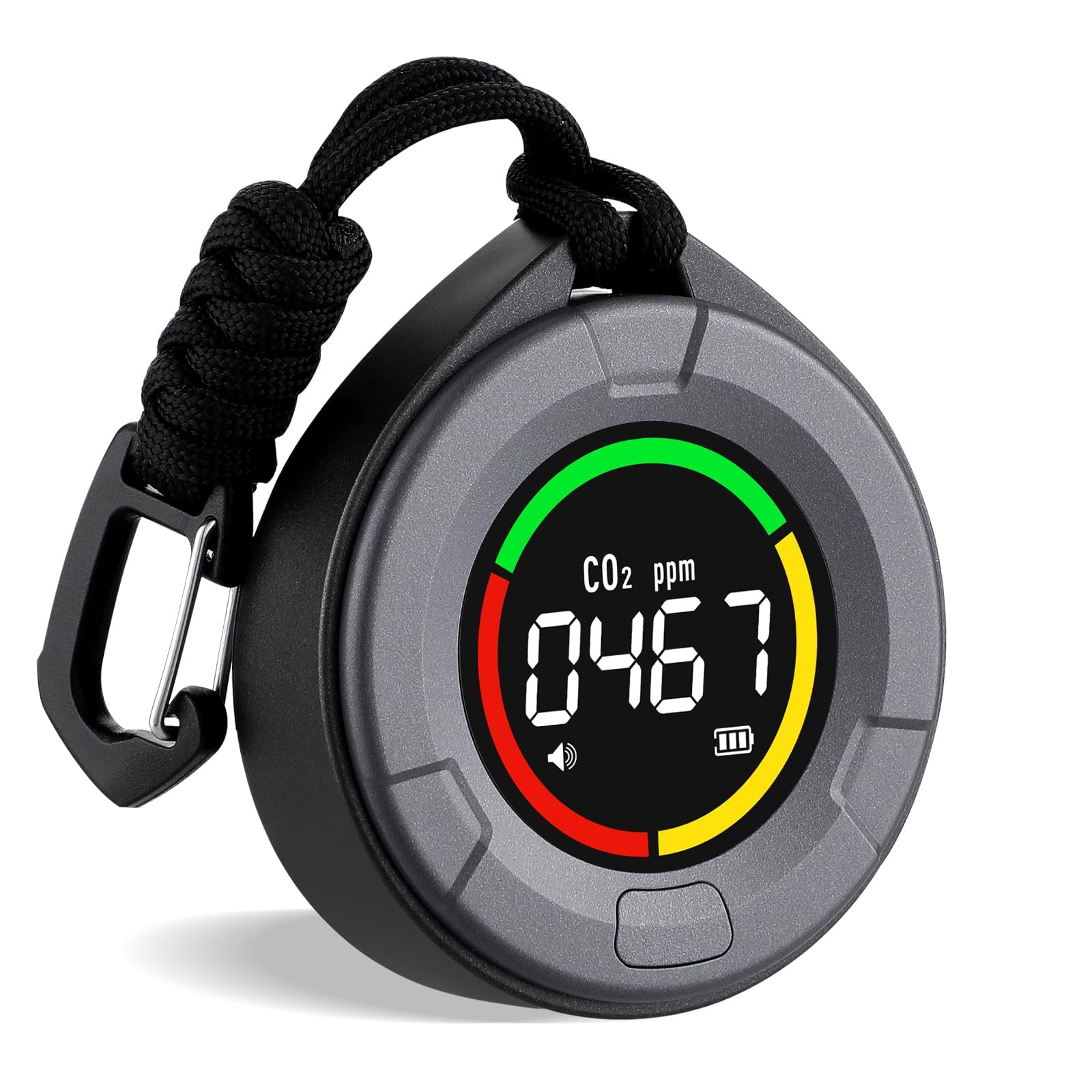
The little one that goes everywhere with you — accuracy that rivals bigger units, and one very loud alarm.
The PTH-10C earns its reputation on the sensor inside. It runs an NDIR sensor through infrared sensing, and the review consensus puts accuracy first among everything owners praise. The refillable 1000mAh battery charges in about 3 hours and then runs roughly 72 hours, and the unit weighs 4.96 ounces — light enough to disappear in a jacket pocket on a lanyard.
The guts of the interface are three colored lights — green for 400–699 ppm, yellow for 700–1499 ppm, red for 1499–5000 ppm — plus an audible alarm that fires above 1500 ppm with a customizable threshold. If you have ever wanted a CO2 meter as a pocket companion for a coffee shop trip or a gym, the PTH-10C is the one in this group built exactly for that.
That same alarm is the honest problem. The pager-style alert and the low-battery chime are loud, repeating, and not something you can silence. Sleep right next to it and you may get an unexpected wake-up. On the durability side, the review pool also contains a unit that stopped working after a couple of months, which is a genuine consideration against the Dienmern or INKBIRD IAM-T2 for longer-term reliability.
The strongest argument: a 1000mAh battery, 72-hour runtime, 4.96-ounce body and an NDIR sensor that the review pool treats as its headline strength.
The real issue: the alarm has no silence switch — treat it as a suit-your-context choice, not a bedroom model.
The one for: someone who wants a pocket CO2 detector turned on across the day and does not need to sleep beside it.
Look elsewhere if: you want a bedside unit, or you want the longer-term reliability a bigger battery unit like the Dienmern provides.
8. Tekcoplus COTK-57 CO2 Meter with Alarm

Nine thousand nine hundred ninety-nine parts per million — a working range built for closed rooms and exhaust hunting.
Where the domestic picks sit between 400 and 5000 ppm, the COTK-57 reaches all the way to 9999 ppm, and that extra headroom is what makes it useful in a grow room, a sealed basement, or a garage where you are testing a car exhaust leak. The CO2 accuracy is stated as ±50 ppm or ±5% of the reading below 2000 ppm, widening to ±10% of the reading between 2000 and 9999 ppm — you can see the precision thin out as levels climb.
The alarm is user-settable to your own threshold, which means you decide when it should start warning you. It also reads temperature from 14°F to 140°F, humidity from 0.1% to 99.9% RH, plus dew point and wet-bulb readings, so it doubles as a full environment checker inside a tent or a grow cabinet.
The honest limitation is data extraction. The meter samples roughly once per second but the sensor takes about 30 seconds to stabilize after a big swing above 5000 ppm. And if you want to log readings to a computer, the serial connection needs a proprietary adapter and Windows-only software rather than a standard USB-to-UART cable — worth knowing before you plan a long-term monitoring project. Several reviewers point out units dead on arrival, so test yours the day it lands and return it fast.
Where it earns its keep: the 9999 ppm ceiling is the highest in this lineup and the right tool for grow rooms and ventilation surveys.
Where it falls short: data logging is locked to proprietary hardware and Windows software — plan for that or plan to leave it manual.
Made for: grow-room operators, tradespeople chasing leaks, and anyone whose CO2 levels regularly blow past the domestic range.
Not worth it for: a bedside meter in a normal home — the long range and lab-style interface are more tool than most bedrooms need.
9. Gain Express A017755 Handheld CO2 Detector Monitor

A handheld workhorse with a yellow handle, a big screen, and an on-device calibration button.
The A017755 is the most “tool box” of the bunch. Its 200-gram body has a moulded handle for carrying around a site, and it reads CO2 from 0 to 9999 ppm with the same ±50 ppm or ±5% accuracy below 2000 ppm that the Tekcoplus claims. On top of CO2, temperature spans -10°C to 60°C at ±0.6°C accuracy, humidity covers 0.1% to 99.9% RH at ±3% RH, and dew point and wet-bulb readings are included. Manual calibration is available on both CO2 and humidity.
Owners treat it as a long-haul field kit. One buyer: “We’ve bought several of these over the years and they are workhorses. Alway work, battery lasts forever, accurate and consistent.” Others use it for grain bins, growing operations, and return-to-office ventilation checks where a handheld meter gets carried between rooms.
Two honest caveats. First, altitude. The spec calls for adding about 1.6% to the CO2 reading for every kPa below 101.33 kPa of pressure — which at 1000 feet works out to a 5.78% correction. Calibrating outside at assumed 400 ppm, when actual ambient is nearer 420 ppm, introduces its own error. Second, the interface is confusing from the start — a manual is worth keeping close, and the default 1000 ppm alarm is stricter than most buyers expect. It is a meter for someone who will read the manual, not for a set-and-hope buyer.
What the pros get
- Handheld handle plus dual battery or 9V adaptor power
- Full CO2, temperature, humidity, dew point and wet-bulb readings
- Manual calibration on CO2 and humidity
- Long-term durability owners describe as workhorse-grade
Where it gets fiddly
- Altitude adjustment of roughly 1.6% per kPa below 101.33 kPa is easy to forget
- Interface needs the manual and defaults to a strict 1000 ppm alarm
- No phone app or Bluetooth — logging is limited to what is on the screen
Belongs in the kit of: a farmer, grower or engineer who wants a handheld reference meter and will read the spec notes.
Not for: the home user who wants a set-and-forget bedroom display — this one rewards the person who reads the manual.
Understanding the Specs
PPM and what counts as normal
PPM stands for parts per million — a count of CO2 molecules per million molecules of air. Outdoor air sits around 400 ppm. Indoor readings often drift up to the 700–1500 ppm range in busy, closed-off rooms, and the INKBIRDPLUS PTH-10C uses a set of three lights to flag those positions — green for 400–699, yellow for 700–1499, and red for 1499–5000.
mAh and the runtime it buys
mAh (milliamp-hours) is the size of the battery tank. A 1000mAh cell, like the one in the INKBIRDPLUS PTH-10C, pairs with 72-hour runtimes; a 3000mAh cell in the INKBIRD IAM-T2 stretches past 6 months. The catch every buyer should remember: a bigger battery, without ECO mode, still drains. Sleep settings matter as much as capacity.
NDIR vs photoacoustic sensors
NDIR sensors measure how much infrared light CO2 gas absorbs. Photoacoustic sensors, like the Swiss Sensirion inside the KETOTEK E0172, measure the sound pressure CO2 generates when it absorbs light. Both are considered accurate; the practical difference is that photoacoustic designs can be less affected by the humidity swings that trip up cheaper NDIR units.
Alarm types and bedroom safety
A visual alarm — color on screen or a flashing light — is silent. An audible alarm uses a buzzer and cannot always be muted. App notifications can wake you silently but need a hub or a paired phone. Match the alarm type to the room: silent in bedrooms, audible where you need to be pulled away from something.
FAQ
How long does the battery on a portable CO2 detector actually last?
Do all these CO2 meters alarm at night?
Is NDIR better than a cheaper sensor for a home CO2 meter?
Can a CO2 meter detect a gas leak or carbon monoxide?
What does the ±50 ppm accuracy figure actually mean in real life?
Do I need a smartphone app to use a battery operated CO2 detector?
How often should a CO2 meter be calibrated?
Why does my CO2 meter jump straight to red when the room feels fine?
Can a portable CO2 detector work in a car, van or grow room?
Will a CO2 meter help me tell if my furnace is leaking exhaust?
Final Thoughts: The Verdict
For most buyers scanning the best battery operated co2 detector shortlist, the Dienmern 5-in-1 is the one to grab — 4.5 stars, a 1600mAh battery that holds up to 72 hours, and CO2, AQI, temperature and humidity all readable at a glance. If long-term data matters more than live readings, the INKBIRD IAM-T2 logs a full year and charges about twice a year; if you want something you simply mount and forget, the SwitchBot Meter Pro CO2 sits there for up to 12 months a charge. And for grow rooms and field work, the Gain Express A017755 handles 9999 ppm with a handle built to travel.
How We Picked
We do not accept paid placement. Every pick is matched to a real buyer and a real use-case; we do not hands-on test units.
Sources & Methodology
Specifications: manufacturer listings and product documentation. Review insights: verified customer reviews, as of September 2026. Pricing: not shown on this page (it changes often); check the current price via the retailer link.
As an Amazon Associate, KitchPrep earns from qualifying purchases. This does not affect which products we feature.
Related Guides
