
Specs are compiled from manufacturer listings and verified buyer reviews and can change over time — please confirm the key details on the product page before buying.
If you are cutting 2x4s in a driveway with no outlet in sight, a battery-powered saw solves your day. For most people, the DEWALT ATOMIC 4-1/2-inch kit wins because it cuts 3/4-inch OSB (oriented strand board, a common engineered wood panel), includes its own battery and charger, and fits in a tool bag you can carry with one hand. Everything below is sorted by what you actually cut, how often, and whether you already own batteries for a particular brand.
I’m Mohammad Maruf — the founder and writer behind KitchPrep. This guide is built by comparing the manufacturers’ published specifications and the patterns across verified customer reviews, so you get each pick’s real strengths and trade-offs instead of marketing spin.
Blade diameter, cutting depth, bevel range and battery platform decide whether a saw handles your job or stalls halfway. That is what separates a good battery operated circular saw from one that sits in the garage.
Our Picks at a Glance


How To Choose The Best Battery Operated Circular Saw
Three things decide whether a cordless circular saw is right for you: how deep it cuts, how far it bevels, and whose batteries you already own. Get those three right and the rest is comfort.
Blade diameter sets the ceiling on what you can cut
A 4-1/2-inch blade is a trim and framing saw. It slices 2x4s and sheet goods but runs out of depth on thicker stock. A 6-1/2-inch or 7-1/4-inch blade gives you the depth to crosscut 2x lumber in one pass. Bigger blade also means more weight in your hand all day.
Cutting depth at 90° and at 45° are two different numbers
Depth at 90° is the straight-down cut — how thick a board sits under the blade. Depth at 45° is shorter because a tilted blade has less reach. If you bevel fence pickets or notch posts, check that 45° number, not just the headline depth.
Battery platform is the decision you cannot undo
A bare tool costs less because it ships without a battery or charger. That only makes sense if you already own that brand’s batteries. If you are starting fresh, a kit with battery and charger is the honest comparison. The WORX PowerShare system lets one 20V battery run other WORX tools, which stretches the value of a single purchase.
Quick Comparison
| Model | Best For | Blade Size | Max Depth at 90° | Bevel Capacity | Amazon |
|---|---|---|---|---|---|
| DEWALT ATOMIC DCS571P1★ Best Overall | All-rounder for trim and framing | 4-1/2 in. | 2x material with 4-1/2-inch blade | 45° | Amazon |
| WORKPRO 20V 4-1/2″ MiniBest Value | Three-blade DIY kit on a budget | 4-1/2 in. | 1-11/16 in. | 0°–45° | Amazon |
| WORX WX526LBest for Fencing | Light fencing and deck work | 6-1/2 in. | 2-3/16 in. | 0°–50° | Amazon |
| CRAFTSMAN CMCS551B | Deep bevels on a 7-1/4-inch blade | 7-1/4 in. | 2×6 treated lumber | 56° | Amazon |
| Metabo HPT C3607DWAQ4 | Framing crews who cut all day | 7-1/4 in. | 5 layers of 1/2″ OSB/plywood | 53° with 0° / 45° / 53° stops | Amazon |
| Milwaukee M18 FUEL 2833-20 | M18 owners who want one saw | 6-1/2 in. | — | — | Amazon |
| DEWALT DCS590B 20V MAX XR | High-volume cutting on one charge | 7-1/4 in. | 2-9/16 in. | 2 in. at 45° | Amazon |
| Bosch GKS18V-22LN | Blade-left visibility for right-handers | 6-1/2 in. | — | 50° with detents | Amazon |
| Makita XSR01PT | Replacing a corded worm drive | 7-1/4 in. | 291 crosscuts in 2×10 per charge | — | Amazon |
In‑Depth Reviews
1. DEWALT ATOMIC 20V MAX* Circular Saw Kit, 4-1/2-Inch (DCS571P1)
Our pick — over 4.5★ from 550+ verified ratings; the strongest balance of quality and price.
The one-handed framing saw that cuts a 2×4 in a tight corner without a cord trailing behind you.
The headline spec is a 4-1/2-inch blade on a brushless motor DEWALT rates at up to 369 linear feet of 3/4-inch OSB per DCB205 charge. A brushless motor is one that runs without the carbon brushes that wear out on older tools, and that rating tells you this saw keeps cutting long past a few quick trim passes. The kit arrives complete: the saw, a wood-cutting blade, a blade change key, a dust port adaptor, a rip fence, a 20V MAX 5.0 Ah battery, a charger, and a tool bag. Nothing else to buy on day one.
What wins people over is the build quality, mentioned more than any other trait in owner feedback, followed closely by raw performance. A 40-year master carpenter summed up the feel of it: the saw is impressively powerful, best for small jobs, and rewards a gentle touch and some planning. Its 1-1/2-inch finger trigger lets your hand choke up on the tool for control, and the electronic blade brake stops the blade fast instead of letting it coast. The bevel gear design lets you cut 2x material at 90 degrees with that 4-1/2-inch blade, and a bevel lever tilts it to 45 degrees for 1x dimensional lumber. On-board blade key storage means you never hunt for the wrench mid-job.
A couple of honest limits come with a saw this compact. Its 45-degree bevel ceiling is the smallest bevel range in this lineup — the WORKPRO matches it at 45 degrees and the WORX goes to 50, so if steep angled cuts are routine, look up the list. Pushing through a 2×6 sometimes needs a second pass rather than one clean slice. It is also the heaviest tool here at 11.2 pounds, heavier than the WORX at 8.3 pounds, so all-day overhead work costs you. An occasional kit has shipped without the advertised dust catcher, though DEWALT customer service resolves that with one call.
What owners keep coming back to
- Complete kit — battery, charger, three blades’ worth of accessories and a heavy-duty carry bag included
- Brushless motor rated for up to 369 linear feet of 3/4-inch OSB on the DCB205 battery
- Electronic blade brake and a 1-1/2-inch finger trigger for safe, chokable control
- Adjustable depth and bevel, clean cuts in 2x4s and 5/8-inch cedar
Where it gives ground
- 45-degree bevel ceiling — the shallowest in this lineup
- Heaviest pick here at 11.2 pounds
- 2×6 cuts sometimes need a second pass
- Hex wrench attachment on the tool loosens over time; the guide nut can shift the guide when tightened
The short version: a fully loaded cordless kit for homeowners, remodelers and anyone tired of dragging a cord around the yard. The 4-1/2-inch blade and the included 5.0 Ah battery (amp-hour, a measure of battery capacity) cover most trim and framing work you will meet on a weekend project.
Look up the list instead if: your work is mostly steep bevels or heavy 2×6 and thicker cuts, where a 7-1/4-inch blade earns its keep.
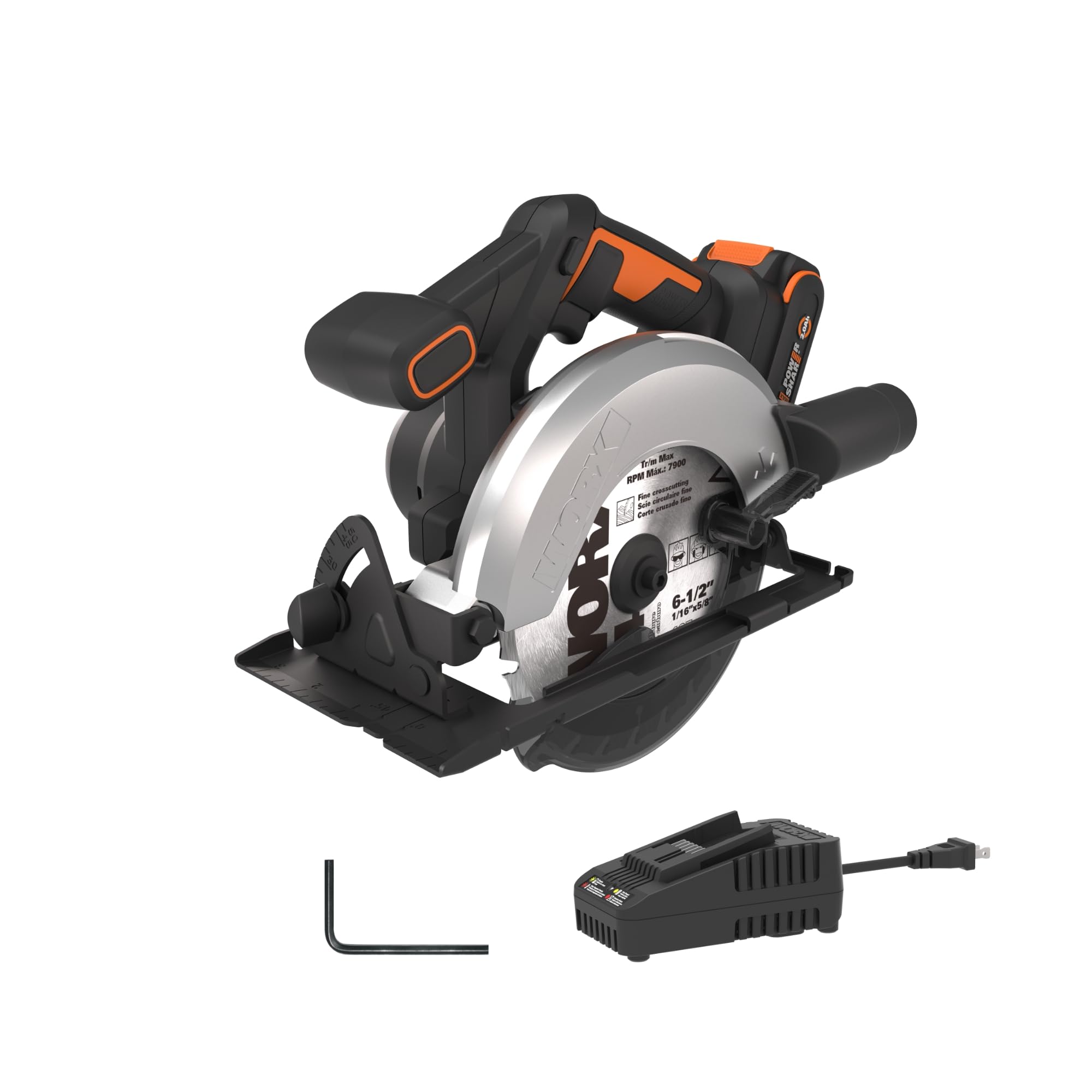
2. WORKPRO 20V 4-1/2″ Cordless Mini Circular Saw with 4.0Ah Battery
A tiny saw that brings three blades and a 4.0Ah battery — enough kit to cut wood, plastic and tile out of one box.
What you get for an entry-level outlay is unusually complete. The motor spins at 4500 RPM no-load speed (an unloaded measurement, so real cutting is slower), and the tool handles wood, tile, plastics, PVC and soft metals. Cutting depth tops out at 1-11/16 inches at 90 degrees and 1-1/8 inches at 45 degrees, with the angle freely adjustable between 0 and 45 degrees. A laser guide and parallel guide help you follow a line, and the 20-volt 4000 mAh lithium-ion battery charges back up in as little as 2 hours on the bundled 2.4A fast charger.
Portability is why this one travels. The bare tool weighs 4.36 pounds, so it drops into a storage bag and goes up a ladder without a second thought. Buyers report it takes on more than you would expect from the size: “Cut 2×6’s, 4×4’s, even pruned medium fallen tree limbs. Super handy, battery held up well. Appreciate being able to pack it all in a carry bag!” The ergonomic rubberized handle is built for one-handed work and cuts down hand fatigue, and a switch locking mechanism prevents the saw from firing up by accident.
The trade-off is scale. With 1-11/16 inches of depth at 90 degrees against the WORX WX526L’s 2-3/16 inches, this is not the saw for thick stock in a single pass — a 2×6 requires care and occasionally bogs down. There is also a compatibility quirk worth knowing. The included fast-cut blade does well, but the fine-tooth blade struggles in wood, and the saw’s own warranty support draws lukewarm feedback while the tool itself does not. Most owners simply swap in a better blade and move on. For fence-board replacement, small shelving and catio-style builds, it is a lot of capability in a light package.
The blade set is the story: you get three blades in the box: a 24T alloy blade for wood, a 60T blade for wood and plastic, and a diamond blade for tile. Also included are a hex key, parallel guide, dust extraction tube and storage bag.
Where it stops short: depth and warranty support are the two things that hold it below the bigger saws — fine for household and outdoor jobs, thin for full-scale framing.
Reach for this if you cut small and varied jobs — fence pickets, tile, PVC, quick trim — and want the blades to come with the tool rather than be bought one at a time.
Pass on it if your day is 2x6s and up: the shallow 1-11/16-inch cut at 90 degrees is the ceiling here, and you will feel it on thick lumber.
3. WORX Cordless Circular Saw, 20V 6-1/2-Inch, WX526L
Six and a half inches of blade on 8.3 pounds of saw — depth where it counts without the weight penalty.
The number that separates this from the 4-1/2-inch saws above is its blade size. At 6-1/2 inches it reaches a maximum cutting depth of 2-3/16 inches, against 1-11/16 inches on the WORKPRO — deep enough to bury the blade in a 2×6 and keep moving. The brushless motor turns up to 4,700 RPM, a TCT 24T blade is fitted from the factory, and the included 20V 2.0 Ah battery and 2A charger mean the saw runs from the moment it arrives. A 0-50 degree bevel range handles angled cuts a 45-degree tool cannot, and a built-in LED light shows you the work area in a shaded corner.
The PowerShare system is the real draw if you already own WORX tools. A single 20V battery runs across the lineup, and in practice that interchangeability is what a lot of buyers write home about. The tool cuts what a homeowner asks of it: “Did a great job cutting 2×4’s and 5” fence pickets.” The D-handle shape gives a balanced, comfortable grip, the depth adjustment is straightforward, and swapping a blade is quick. Weight settles at 8.3 pounds on the spec sheet, which is lighter than the DEWALT ATOMIC’s 11.2 pounds and makes a real difference when you are walking a fence line.
There is a catch worth naming plainly. The bundled 2.0 Ah battery is on the light side for sustained cutting — fence pickets are fine, but continuous 2×6 work drains it, and WORX itself points to adding a larger 20V battery when you need more. Stepping up to a bigger pack is a step you can take, since the platform supports it, but it is a separate decision. The machine is also built for convenience rather than heavy production: fine for DIY projects and quick cuts, less suited to framing crews running all day.
Reach for this if… you already own WORX 20V tools and the batteries interchange, or you want a genuinely light 6-1/2-inch saw for fencing and decking around the house.
Look elsewhere if… your cutting is nonstop framing on a jobsite, where the included 2.0 Ah pack and a homeowner-grade build will surface as limits.
4. CRAFTSMAN V20 RP Cordless Circular Saw, 7-1/4 inch, Bare Tool Only (CMCS551B)
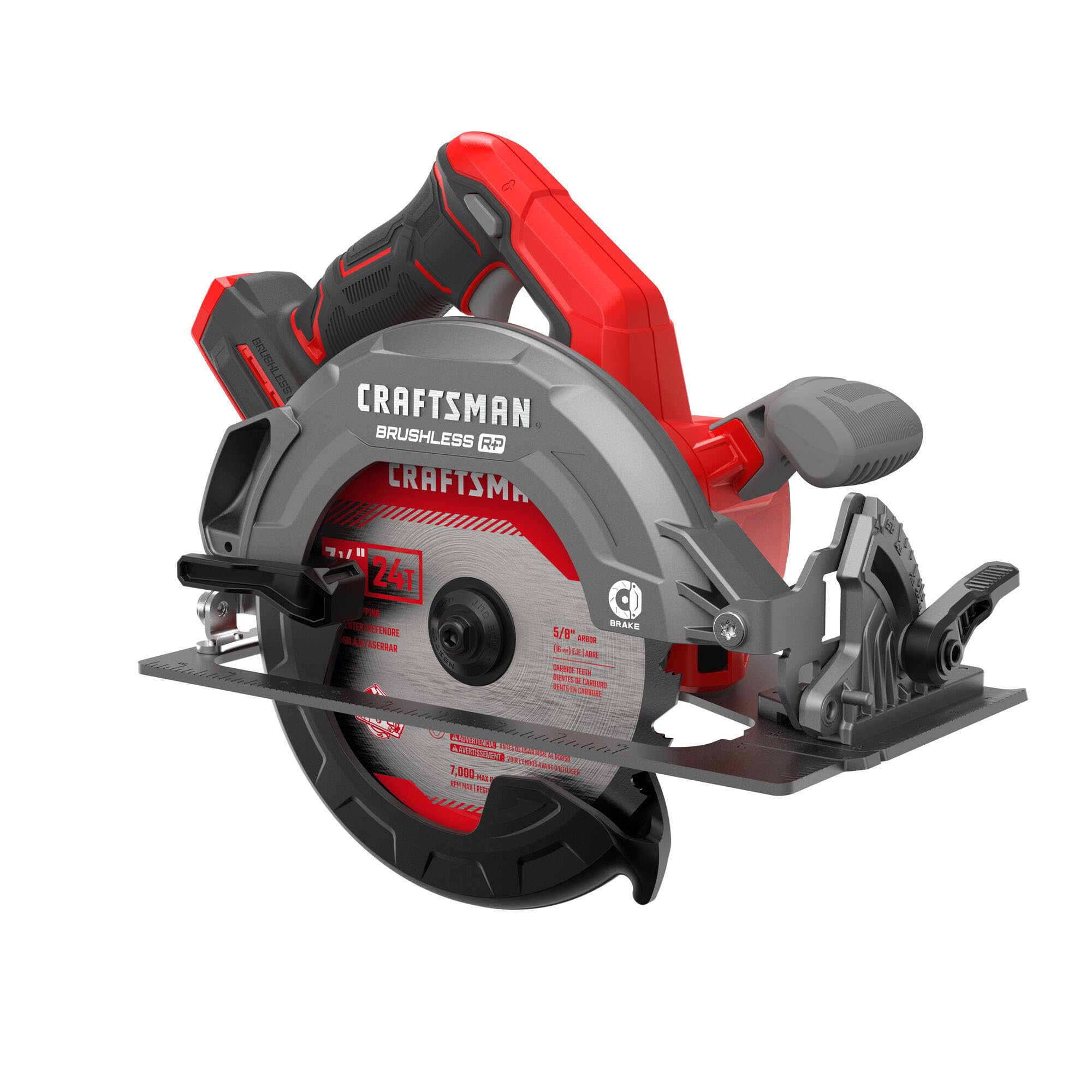
A 56-degree bevel and a big 7-1/4-inch blade for people who already carry CRAFTSMAN batteries.
Skip past the spec sheet and the standout is the bevel. This saw tilts to 56 degrees with positive stops at 22.5 and 45, giving you angled cuts no other saw in this lineup matches — the WORX tops out at 50, the Metrobo HPT at 53. Add a 7-1/4-inch blade and a brushless motor CRAFTSMAN rates at up to 75 percent more power, and you have a saw for heavier stock. A metal upper guard adds durability where a plastic cover would wear, and an LED illuminates the cutting line so you can see the work surface in low light.
Buyers with CRAFTSMAN batteries already in the shop will recognize the value here. It cuts through 2×6 treated lumber without complaint, and the metal base plate feels substantial. It is also one of the more comfortable saws in the group to hold — the balance sits well, the blade guard slides without play, and the blade brake brings it to a stop quickly. It is a bare tool, so it ships with no battery or charger; the upside is a lower entry price if you own the platform, the downside is that first-time buyers need to budget for power separately.
The elephant in the room is battery drain. Heavy torque and a big blade pull energy, and a full-size triple battery has been worked hard enough to feel hot after a few lengthy cuts of 1-inch lumber. This is a fast-cutting saw, not a marathon one, and it suits intermittent projects better than nonstop production. It is also a bare tool on a battery platform that does not cross over to other brands, so if you are starting from nothing the total outlay climbs. For crews and homeowners who already run CRAFTSMAN, that arithmetic flips in your favor.
Built for angle work: 56 degrees of bevel with 22.5 and 45 stops, plus a 7-1/4-inch blade, covers cuts that stop short on narrower saws.
The honest catch: battery life, not power, is where this one asks you to plan — keep a spare charged if a job runs long.
Reach for this if… you already own CRAFTSMAN V20 batteries and want steep bevels plus a 7-1/4-inch blade without buying into a new platform.
Think again if… you are starting fresh with no CRAFTSMAN batteries — the bare-tool price hides the cost of a battery and charger.
5. Metabo HPT 36V MultiVolt 7-1/4 Inch Rear Handle Circular Saw (C3607DWAQ4)

The lightest in its class at 8.2 pounds, and it answers every day on two 6Ah batteries.
Metabo HPT claims this saw is the lightest in its class, at 2 pounds under its competitors. The brushless motor spins to 5,100 RPM, the cutting capacity clears up to five layers of 1/2-inch OSB or plywood, and the bevel range reaches 53 degrees with stops at 0, 45 and 53. A rear handle places the motor behind your grip for balance, the blade sits on the left for a clear sight line, and the magnesium base takes job-site knocks without bending. There is also an electric brake, a rafter hook, and a clear view of the cut line.
Metabo HPT rates it at up to 500 cuts of 2×4 per charge on the 36V MultiVolt system. A homebuilder who uses it daily says it runs all day on two 6Ah batteries and keeps cutting — four sides of a PSL 6×6 without losing power. Compared with rival rear-handle saws, the balance and low weight put less strain on your arm over a long shift, and cutting that 2×10 stock that stalls a little saw goes through without drama. What you are paying for is all-day stamina in a tool light enough to keep lifting.
Making the wrong assumption here gets expensive, though. This is a bare tool — no battery or charger in the box, and at 36 volts it needs the right MultiVolt packs, not a standard 20V pack from the drawer. Angled work is capped at 53 degrees, so the steepest bevels on this list belong to the CRAFTSMAN. One genuine gripe is the safety switch, tucked just above the trigger and reportedly awkward for smaller hands. Another is poor dust direction: chips exit sideways, and without a vacuum hooked up the adapter blows them back at you. It delivers professional-class performance but it stops short of a true worm drive in raw grunt.
What this saw actually earns its keep doing: framing, ripping, rough cuts and any job where the saw leaves the ground — the 8.2-pound body and rear handle carry the load, and the up-to-500-cuts-per-charge rating backs the stamina.
Where you feel the cost: a bare-tool purchase on the 36V platform and a 53-degree bevel ceiling are the two limits to accept before buying.
The right fit for: framing crews, remodelers and builders who need a rear-handle saw that stays light through long days and cuts 2x material without stalling.
Not the fit if: you are a weekend DIYer without MultiVolt batteries already, since the bare-tool format leaves you buying power separately.
6. Milwaukee Electric – M18 Fuel 6-1/2 INCH Circular Saw Tool ONLY (2833-20)
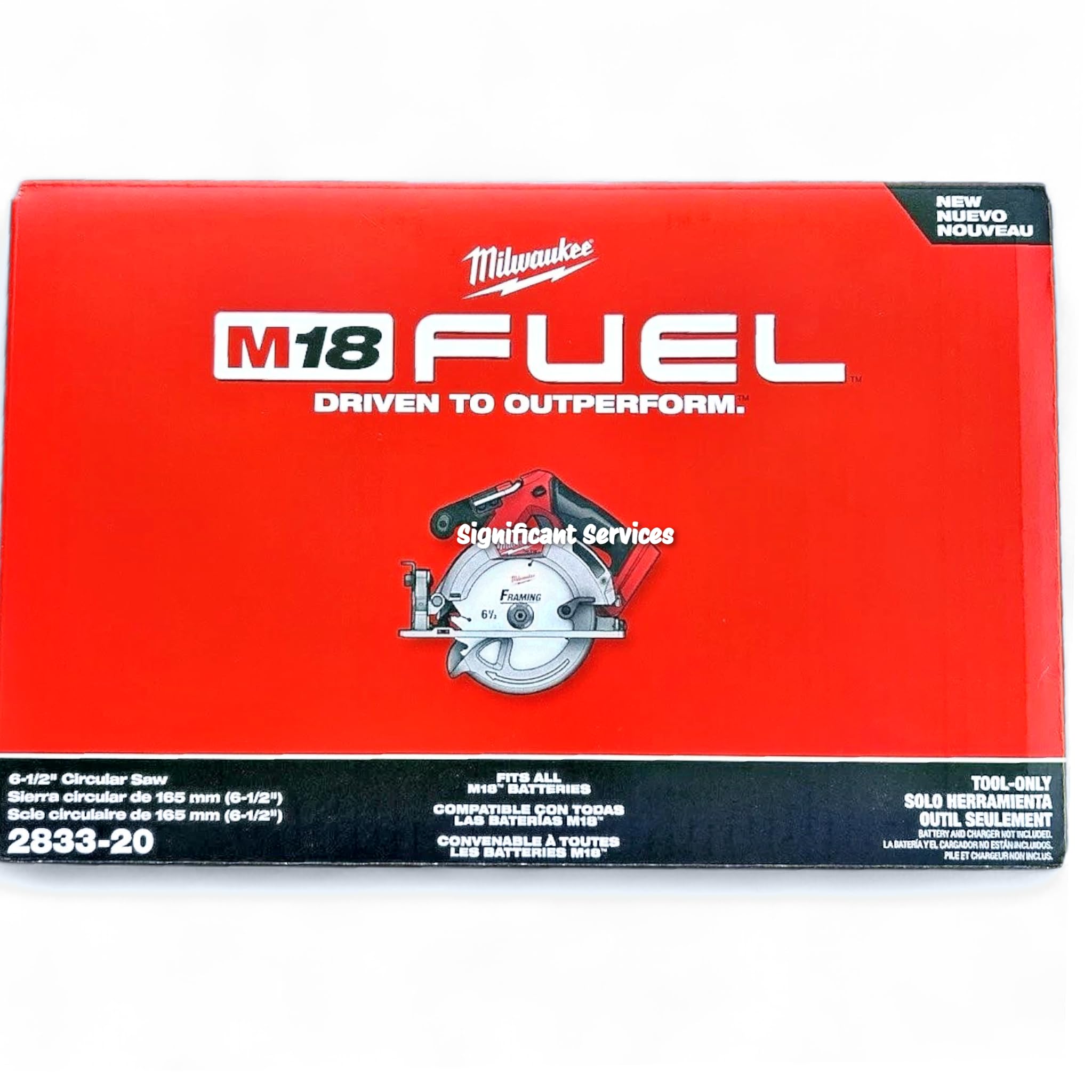
Six and a half inches of blade built for the M18 batteries already sitting in your garage.
Milwaukee’s FUEL line runs on the same M18 battery platform as the rest of its tools, and that is the whole case for this saw if you own even one M18 pack. The brushless motor delivers plenty of power and smooth cutting, with performance leading owner feedback and raw power second. A 6-1/2-inch blade keeps the tool compact at 8.4 pounds, a work light brightens the cut line, and a shop vac attachment ships in the box so you can hook up dust extraction from day one. It is a bare tool — no battery or charger included — which is why it makes sense specifically as an addition to an existing M18 setup.
Where it holds up best is the durability and feel in the hand. Users describe durable M18 Fuel performance, smooth cuts, and a tool that keeps its composure in tough conditions. The blade changes quickly, the grip sits comfortably through repeated cuts, and because it shares batteries with the rest of the platform you are not committing to a new system. For a woodworking-heavy workload this is a well-rounded addition that slots straight into the bag.
Two quirks matter. First, the side port ventilation blows sawdust out the left rear, which means right-handed users without a vacuum attached catch it in the face — a real nuisance that a dust bag or an aftermarket port cover remedies. Second, this tool ships without a blade, and the blade that some sellers include draws mixed reactions; plan on buying a good blade as part of the purchase. Battery life lived up to expectations for some owners and fell short for others, so a spare pack is cheap insurance. If you are already in the M18 ecosystem, and set up with a vacuum, none of this is a deal breaker.
Reach for this if… you already run Milwaukee M18 tools and want a compact 6-1/2-inch saw that shares the batteries you own.
Look elsewhere if… you have no M18 batteries or no vacuum on the job — the bare-tool format and the sideways dust path will both cost you extra.
7. DEWALT 20V MAX XR Brushless Cordless 7-1/4 in. Circular Saw, Tool Only (DCS590B)

DEWALT’s most powerful 20V saw, rated to make up to 368 cuts before it needs a fresh battery.
The box rating earns this pick its spot: up to 1,700 MWO (maximum watts out) from a brushless motor spinning 5,500 RPM, and up to 368 cuts per charge. Maximum depth of cut reaches 2-9/16 inches at 90 degrees and 2 inches at 45 degrees, so it takes on a wider spread of material than the smaller saws. That 2-9/16-inch figure comfortably clears the WORX’s 2-3/16-inch maximum. An automatic electric brake stops the blade from coasting after you release the trigger, which keeps a cut from drifting wide. It runs on the standard 20V MAX platform, so if you already have XR batteries you are set.
What buyers respond to is quality, rating it the most-mentioned strength of the tool by a wide margin, with its price-to-performance the second. In use the saw cuts like a hot knife through butter on 1/2-inch plywood and old pine, the deck markings are handy for setting depth, and it sits over a speed square for square 90-degree cuts. The weight-to-power balance is a deliberate design choice — 9.15 pounds — and owners appreciate that it does not feel front-heavy on long cuts. For the money, several note it is tough to top for weekend projects and home repairs.
The catches are modest but real, and two of them are DEWALT’s own choices rather than defects. There is no rip fence included, and since it ships as a bare tool you may also need to source a blade. Physical condition on arrival is the one complaint that shows up: a few saws have arrived showing scuffs and scratches despite being sold as new. That is a shipping quirk to check on delivery, not a reason to skip the tool. For a serious DIYer or a pro who already runs XR packs, this is the heavy-cutting saw to own.
What sells it: up to 368 cuts per charge, a 5,500 RPM brushless motor and 2-9/16 inches of depth at 90 degrees put this in a different class from the compact 4-1/2-inch saws.
The one gap to plan around: no rip fence in the box, and a blade you may need to buy separately.
Best for: the buyer who already owns DEWALT 20V MAX XR batteries and cuts plywood, lumber and framing stock in volume.
Not for: someone starting from zero with no XR packs and no blade on hand — the bare-tool format and missing rip fence add cost on top.
8. BOSCH GKS18V-22LN 18V Brushless Blade-Left 6-1/2 In. Circular Saw (Bare Tool)

A blade-left design that puts the cut line right in front of your eyes when you hold it in your right hand.
The defining idea behind this Bosch is where the blade sits. Blade-left means the blade is on the left side of the body when held in the right hand, so you see the cut line without leaning over the saw. It is a deliberate design for accurate work, and the blade brake and LED cut-line illumination back it up. The brushless motor runs 0-5,000 rpm, an auxiliary handle lets you run it in either hand, and depth gauges are visible from either side. At 6.1 pounds for the bare tool it is easy to maneuver on long runs. A 50-degree bevel range with detents at 0, 45 and 22-1/2 degrees handles the angles most work calls for.
What stands out in real use is how flat and controllable it feels. Owners describe it as nimble and precise, says an owner describing trimming through 1×10 stock with a 4Ah battery, while a builder using it for finish work rates it their preferred tool for trim cuts. The dust port pushes the clear majority of chips down and away instead of up into your face, and the saw balances well even with a heavier 8Ah battery. Bosch backs the tool with a five-year limited warranty, and its 18V batteries interchange with your other Bosch 18V tools.
The honest limit is that as a bare tool on an 18V Bosch platform this assumes you are already invested, or willing to be. It is also the least widely reviewed saw of this group, with a small but enthusiastic following rather than mass adoption. Buyers should read its precision-first design as being aimed at finish work rather than heavy framing where a rear handle and bigger blade pull ahead. It also ships as a bare tool with no battery or charger, so first-time buyers must add power separately.
Why it earns its place: blade-left layout plus a cut-line LED and depth gauges visible from both sides give the clearest view of the work in the lineup.
The trade-off: precision over muscle — accurate and easy to handle, but a bare tool that expects you to bring Bosch 18V batteries of your own.
Made for: finish carpenters and detail-focused workers who value a clean sight line over a rear-handle layout.
Look past it if: your heart is in heavy framing where the extra blade size and slower, torquier cuts of a 7-1/4-inch saw are the priority.
9. Makita XSR01PT 36V (18V X2) LXT® Brushless Rear Handle 7-1/4″ Circular Saw Kit (5.0Ah)

Two 18V batteries stacked into 36 volts, a 7-1/4-inch blade, and enough charge to outlast a workday.
This is the saw to reach for when your corded worm drive is finally ready to retire. Makita’s X2 LXT system pairs two 18V LXT batteries to run the tool at 36 volts, delivering more power and run time than a single 18V pack without the hassle of a cord. The electronically controlled brushless motor turns 5,100 RPM, which Makita rates at 50 percent longer run time per charge. Makita rates it at up to 558 crosscuts per charge in 2×4 SPF and 291 in 2×10 SPF on the two included 5.0 Ah batteries. Automatic Speed Change technology adjusts speed and torque during the cut, and the kit ships complete with the saw, a 7-1/4-inch 24T blade, two batteries, a charger and a wrench.
The owner consensus is unusually clear: quality is head and shoulders the trait buyers cite most. Long-time carpenters describe it as powerful enough to rip LVLs, wet pressure-treated lumber and plywood with torque to spare, and fast enough to feel like a plug-in model — but without the cord. It is a real replacement for a corded saw for many users, with the balance and handling of a rear-handle design. The trim-cut crowd also gives it a nod, and sharing two 18V LXT battery packs means the rest of your Makita tools get fed from the same source.
The trade-offs are worth thinking through before committing. Overall weight is 23.1 pounds for the kit as shipped, which is a lot to lift overhead in one hand — the reason weight is the most polarizing factor among owners. Maintenance is another: dust collection is poor, so expect to clear chips yourself. The tool is on the larger side for close-quarter work, and there is a safety button that some owners find awkward to press alongside the trigger. It is also a corded-saw replacement, not a compact trim saw, so if your work is small and fussy, look at the smaller handling-first picks. For ripping full sheets and framing lumber all day, this is the one that shows up ready.
What owners keep raving about: a 7-1/4-inch blade, 5,100 RPM and up to 291 crosscuts per charge in 2×10 lumber — enough to send corded worm drives into retirement for many users.
What to accept: the weight. At 23.1 pounds for the kit, and with dust that needs clearing yourself, this is more tool than a quick trim job needs.
Built for: carpenters and remodelers who want to leave the corded worm drive at the shop and rip framing lumber all day on battery power.
Not for: anyone whose usual cut is trim, cabinetry or quick repairs in tight spots — the bulk and heft ask more of your arm than the job requires.
Understanding the Specs
Blade diameter and what it lets you cut
Blade diameter is the size of the round cutting disc, and it sets the ceiling on depth. A 4-1/2-inch blade runs out of reach on thick lumber, while a 6-1/2-inch or 7-1/4-inch blade buries deep enough to crosscut standard 2x material. Bigger blade usually means more weight to hold, so the trade is depth against arm fatigue on long days.
Cutting depth at 90° vs at 45°
Depth at 90 degrees is the straight-down capacity; depth at 45 degrees is shorter because a tilted blade does not reach as far. If you bevel a fence picket, you need the 45-degree figure, and this is where smaller saws show their limits. A 1-11/16-inch depth at 90 degrees on the WORKPRO compares with 2-3/16 inches on the larger WORX WX526L. Check both numbers before buying for bevel-heavy work.
Bevel capacity and positive stops
Bevel capacity is how far the blade can tilt, measured in degrees from square. A 45-degree machine does the common angled cuts; 50 degrees or more opens steeper work. Positive stops lock the blade at set angles so the saw stays put when you tighten the bevel lever. The CRAFTSMAN reaches 56 degrees, the widest range here.
Battery platform and kit versus bare tool
Battery platform is the system of interchangeable batteries a tool runs on, and it decides what you can add later. A kit bundles a battery and charger; a bare tool does not, which costs less up front but only saves money if you already own packs for that brand. The WORX PowerShare system lets one 20V battery run any WORX tool, and the Makita 36V saw uses two 18V LXT packs as a pair.
FAQ
How deep can a cordless circular saw cut through a 2×4?
What does maximum cutting depth at 90° mean in plain English?
Do I need a bare tool or a kit with battery and charger?
Which battery platform should I choose for a cordless circular saw?
Is a 4-1/2 inch saw enough for framing?
What bevel angle do I actually need?
How long does a battery powered circular saw run on one charge?
Why do some cordless circular saws ship without a blade?
Can I cut tile or plastic with a cordless circular saw?
Is a rear handle saw better than a top handle one?
Final Thoughts: The Verdict
If you want one dependable pick, the battery operated circular saw winner is the DEWALT ATOMIC DCS571P1 because it arrives as a complete kit with a 5.0 Ah battery, a 4-1/2-inch blade and a brushless motor rated for up to 369 linear feet of 3/4-inch OSB per charge — enough for trim, framing and everyday cuts without a cord. If you already own Metabo HPT MultiVolt batteries and want a rear handle saw that keeps its pace through a full day, grab the Metabo HPT C3607DWAQ4. And for the largest jobs where replacements for a corded worm drive are the goal, the Makita XSR01PT is the one to reach for. If you cut mostly light fencing and trim around the house, the lean 8.3-pound WORX WX526L makes an easy partner — and the DEWALT ATOMIC kit is the one worth picking up first if you are starting from zero.
How We Picked
We do not accept paid placement. Every pick is matched to a real buyer and a real use-case; we do not hands-on test units.
Sources & Methodology
Specifications: manufacturer listings and product documentation. Review insights: verified customer reviews, as of September 2026. Pricing: not shown on this page (it changes often); check the current price via the retailer link.
As an Amazon Associate, KitchPrep earns from qualifying purchases. This does not affect which products we feature.
Related Guides
