
Specs are compiled from manufacturer listings and verified buyer reviews and can change over time — please confirm the key details on the product page before buying.
If your solar setup dies by evening, the battery is almost always the reason — not the panels. A LiFePO4 solar battery holds 4,000 to 15,000 charge cycles, versus 300 to 500 for lead-acid. Below are ten deep-cycle batteries that actually hold a charge: lithium options you can lift without help, and sealed lead-acid tanks that survive brutal temperatures. Every pick here is a true deep-cycle unit, not a car starting battery that will fail you after a season of solar cycling.
I’m Mohammad Maruf — the founder and writer behind KitchPrep. This guide is built by comparing the manufacturers’ published specifications and the patterns across verified customer reviews, so you get each pick’s real strengths and trade-offs instead of marketing spin.
This breakdown of the battery for a solar panel covers capacity, cycle life, and cold-weather cutoff so you can match a battery to your panels.
Our Picks at a Glance


How To Choose The Best Battery for a Solar Panel
Three numbers decide almost everything: amp-hours (how much energy the battery stores), depth of discharge (how far down you can safely drain it), and cycle life (how many times you can repeat that before capacity fades). Get those right and the rest is fit and weather.
Chemistry first, capacity second
Lithium iron phosphate, shortened to LiFePO4, holds far more usable energy per pound than sealed lead-acid. The weight gap is real: compare a 100Ah lithium unit at 21 pounds against a 100Ah sealed lead-acid at 28 pounds, and that difference grows painful once you are hauling the bank into a van or a boat. Lead-acid still wins on upfront simplicity, because it needs no battery management system to babysit the cells.
Match the battery to your charge controller
Your controller has to be set for your chemistry. Lead-acid batteries charge correctly when the controller is set to float around 13.8 volts and cyclic charge near 14.4 volts. Lithium packs want their own profile, and feeding them a lead-acid charge routine shortens their life. If you are switching chemistries mid-project, plan on a controller that supports both.
Cold weather and mounting position
Most lithium packs stop accepting a charge near freezing to protect their cells, while lead-acid tolerates cold charging better but loses usable capacity in the cold. A sealed lead-acid battery can also be mounted in any position and shrugs off shock and vibration, which suits boats and trailers. Check the low-temperature cutoff point before you mount anything in an unheated shed.
Quick Comparison
| Model | Best For | Capacity | Chemistry | Weight | Amazon |
|---|---|---|---|---|---|
| MARSENERGY 12V 100Ah LiFePO4★ Best Overall | Best all-round solar storage | 100Ah | LiFePO4 | 21 lb | Amazon |
| Dyness 12V 100Ah LiFePO4Harshest Climates | Harsh weather and marine | 100Ah | LiFePO4 | 25.3 lb | Amazon |
| WEIZE 12V 100Ah Deep CycleBest Backup Value | Backup power on a budget | 100Ah | Lead Acid | 60 lb | Amazon |
| yeagulch 12V 150Ah LiFePO4 | Roomier bank, tight spaces | 150Ah | LiFePO4 | 41 lb | Amazon |
| HumsiENK 12V 100Ah Bluetooth | App monitoring on a budget | 100Ah | LiFePO4 | 19.7 lb | Amazon |
| yeagulch 12V 200Ah LiFePO4 | Big bank, fewer batteries | 200Ah | LiFePO4 | 58.9 lb | Amazon |
| HumsiENK 12V 200Ah 250A BMS | High-draw appliances | 200Ah | LiFePO4 | 58.2 lb | Amazon |
| ECO-WORTHY EnergyRock 280Ah | Metal-case fire resistance | 280Ah | LiFePO4 | — | Amazon |
| Mighty Max 12V 100AH VRLA | Zero-maintenance lead-acid | 100Ah | Lead Acid | 28 lb | Amazon |
| ECO-WORTHY 12V 314Ah | Maximum stored energy | 314Ah | LiFePO4 | 60.4 lb | Amazon |
In‑Depth Reviews
1. MARSENERGY 12V 100Ah LiFePO4 Lithium Battery, BCI Group 24
Our pick — over 4.5★ from 250+ verified ratings; the strongest balance of quality and price.
The lithium pack that drops straight into your old Group 24 lead-acid box.
Cycle life is the number that separates this pack from everything lead-acid can offer. It holds 100% depth of discharge for 4500 deep cycles, 80% DOD for 8000 cycles, and 60% DOD for 15000 cycles — and a traditional lead-acid battery manages only 300 to 500 cycles. In plain terms, you buy this once and stop replacing a dying battery every few seasons. The maker rates the working life at 10 years under correct use.
You’ll notice the weight savings right away. Buyers who put it in an RV say it cut real pounds off the tongue load, and one sums it up: “Excellent product, lasted all day only used half a charge.Definitely worth the money.” A 100 amp-hour battery that runs a full day on half a charge is exactly what a solar setup needs.
Safety hardware is built in rather than bolted on. The integrated 100A battery management system watches for short circuits, over-voltage, and abnormal temperature, then cuts power and drops the battery into sleep mode until you reactivate it. The cells also carry extra low-temperature additives, so discharge continues down to -4°F while the system stops charging at 32°F to protect the cells. The 10.16 x 6.54 x 8.64 inch shell matches the BCI Group 24 standard, so it fits a Group 24 box directly and still sits fine in a larger Group 27 or 31 enclosure.
What earns the top spot
- 4500 cycles at 100% depth of discharge — versus the 300 to 500 cycles a lead-acid battery manages.
- 21 pounds, 7 pounds lighter than the 28-pound Mighty Max unit and a fraction of the 60-pound WEIZE.
- Drops straight into a BCI Group 24 box, with Group 27 and 31 also compatible.
- BMS auto-cuts power on short circuit, over-voltage, or abnormal heat.
- Backed by 5-year after-sales service.
Worth knowing before you buy
- Charging stops at 32°F, so an unheated winter shed needs a different plan.
- Waking a battery from sleep mode takes a manual reactivation step.
- Building a bigger bank calls for terminal blocks and a full charge balance.
Pick this one if: you want a drop-in lithium upgrade that fits the box you already own and outlives several lead-acid replacements.
Think twice if: your battery lives somewhere that freezes — charging shuts off at 32°F by design.
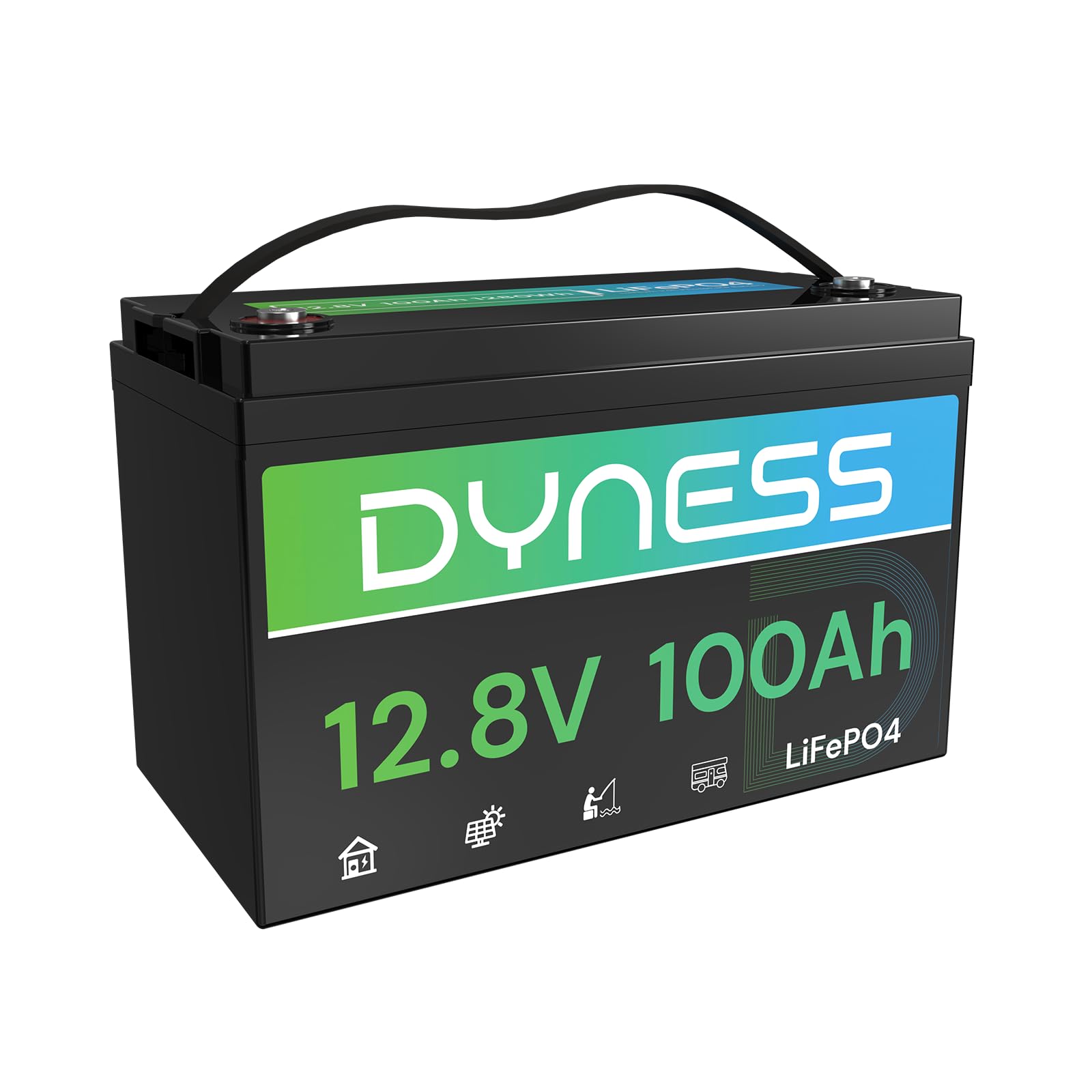
2. Dyness 12V 100Ah LiFePO4 Lithium Battery for RV, Solar System and Off-Grid
Built to shrug off rain, salt spray, and a frosty morning without flinching.
Weather protection is where this pack pulls ahead of the cheaper lithium units here. It carries an IP65 waterproof rating, which means dust cannot get in and water sprayed at it will not damage it, plus salt spray resistance for marine duty. Add dust resistance and you have a battery that lives happily in a marine bilge, a damp shed, or an open trailer — the sort of place that would wreck an unprotected pack.
The low-temperature behavior is genuinely thoughtful. Charging disconnects automatically once the battery drops below 32°F and resumes at 41°F, then cuts power entirely at -4°F to protect the cells. That two-stage approach means a cold snap slows you down rather than ruining the battery. The 100A BMS backs it with protection against overcharging, over-discharging, overcurrent, overheating, and short circuits.
Expansion is the quiet selling point. You can wire 4 in parallel and 4 in series, for a maximum of 4P4S — 16 batteries producing up to 20.48kWh of stored energy. That takes a single 100Ah brick and scales it into a home backup wall. At 25.3 pounds in a Group 31 shell measuring 13.00 x 6.77 x 8.43 inches, it stays manageable to lift, and owners swapping out old leaded banks report saving a notable amount of battery weight. The 5-year manufacturer warranty rounds it out.
Where the value sits: you pay a little more than the MARSENERK pack for IP65 sealing (protection against dust and water jets) and salt spray resistance, which is the difference between a battery that survives a boat locker and one that does not.
The straightforward catch: the same cold-weather intelligence that protects the cells also means no charging below freezing — plan around it if the bank lives outdoors in winter.
Reach for this if: your solar bank sits outdoors, on a boat, or anywhere damp, salty, or dusty.
Look elsewhere if: you need maximum capacity on a tighter budget — this is a 100Ah pack, not a big-bank solution.
3. WEIZE 12V 100Ah Deep Cycle Battery, Group Size 31
The sealed lead-acid workhorse for anyone who never wants to check a water level.
Here is the honest case for staying with lead-acid: no battery management system to configure, no app to install, no charge profile to reprogram. This is a 100 amp-hour sealed lead-acid deep cycle battery with a maintenance-free, spill-proof design that mounts in any position you like. Its 3% self-discharge rate means it holds a charge while sitting idle between sunny spells, and the 1150A maximum discharge current gives it the surge muscle to start heavy loads that would trip a smaller pack.
Owners use these in genuinely demanding setups. One runs four 100Ah units in parallel feeding a 2,000W inverter for roughly 4.8 kWh of home backup, powering 120V outlets, fans, and garage openers. Another pair has run off-grid for two years with two 150W solar panels and no issues, pushing a 700W pure sine inverter to run 120V appliances. In those reports the batteries arrived at 12.3V, with the charger set to 13.8V float and 14.4V cyclic.
The trade-off is weight, and it is substantial. At 60 pounds this is three times the heft of the 21-pound MARSENERGY lithium pack, so treat it as a permanent installation rather than something you carry. The same owners who praise its performance describe it as heavy but stationary, which is the right framing. It fits wheelchairs, scrubbers, generators, lawn and garden equipment, trolling motors, and UPS systems, and it replaces the UB121000 and Renogy 100 amp-hour units directly.
The unglamorous strength: five years of use without adding distilled water once, which matters if the battery is buried behind a panel nobody wants to open.
Factor this in: 60 pounds means you mount it once and leave it alone — this is not a portable bank.
Best matched to: stationary home backup and off-grid banks where the battery never moves.
Not the pick if: you plan to carry the battery between jobs — the 60-pound frame makes it a permanent fixture.
4. yeagulch 12V 150Ah LiFePO4 Lithium Battery, 100A BMS
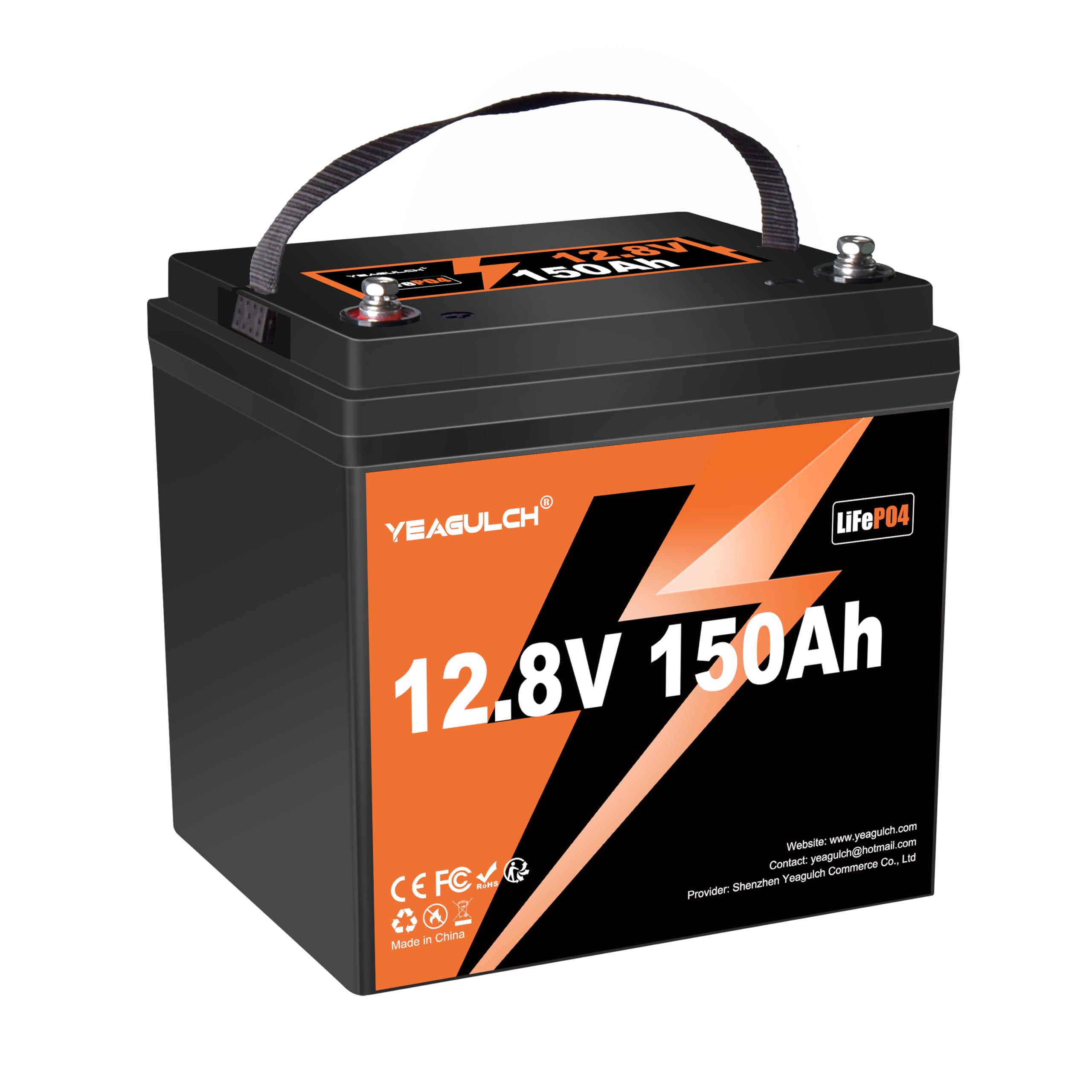
Half again the capacity of a 100Ah pack, in a shell that still fits tight corners.
The attraction here is straightforward: 150 amp-hours instead of 100, storing 1290Wh, at 41.03 pounds and just 10.01 x 7.68 x 9.84 inches. Compared with the 100Ah MARSENERGY pack at 21 pounds, you are carrying roughly double the weight for 50% more capacity — a fair trade if you want longer runtimes without wiring two batteries together. The built-in 100A BMS handles overcharge, over-discharge, short circuits, and overheating, and it can withstand 15000 cycles at 60% depth of discharge.
Temperature handling covers both extremes. Low-temperature cut-off stops charging at 32°F, and high-temperature cut-off stops it at 149°F, which is a safety edge that plain lead-acid can’t match in a hot solar enclosure. Scaling is flexible too: wire 4 in series for a 51.2V system or 4 in parallel to reach 600Ah, with a maximum 4S4P configuration. Owners running these report the battery still holding full power after six months of daily solar charging, with a full charge reached in about half a day of daylight.
One honest limitation: several owners note this generation carries no self-heating element and no Bluetooth, so you cannot track temperature or state of charge from your phone without adding a third-party monitor. Some also report it drains faster than expected under heavy cycling, so size your bank with headroom. And it is not built for starting a gasoline engine — keep it for solar storage, not for turning over an engine.
Why it lands here
- 150Ah and 1290Wh — half again the capacity of a standard 100Ah pack.
- 15000 cycles at 60% depth of discharge.
- Charging stops safely at both 32°F and 149°F.
- Scales to 600Ah in parallel or a 51.2V system in series.
Plan for these
- No Bluetooth and no self-heating element — you’ll need a third-party monitor.
- Not for starting engines, golf carts, or jacks.
- 41 pounds means this is a stationary bank, not a portable one.
Go with this when: you want more stored energy than a 100Ah pack without wiring two batteries together.
Skip if: you want phone-based monitoring built in — this one adds capacity but not Bluetooth.
5. HumsiENK 12V 100Ah LiFePO4 Lithium Battery with Bluetooth (Group 24)
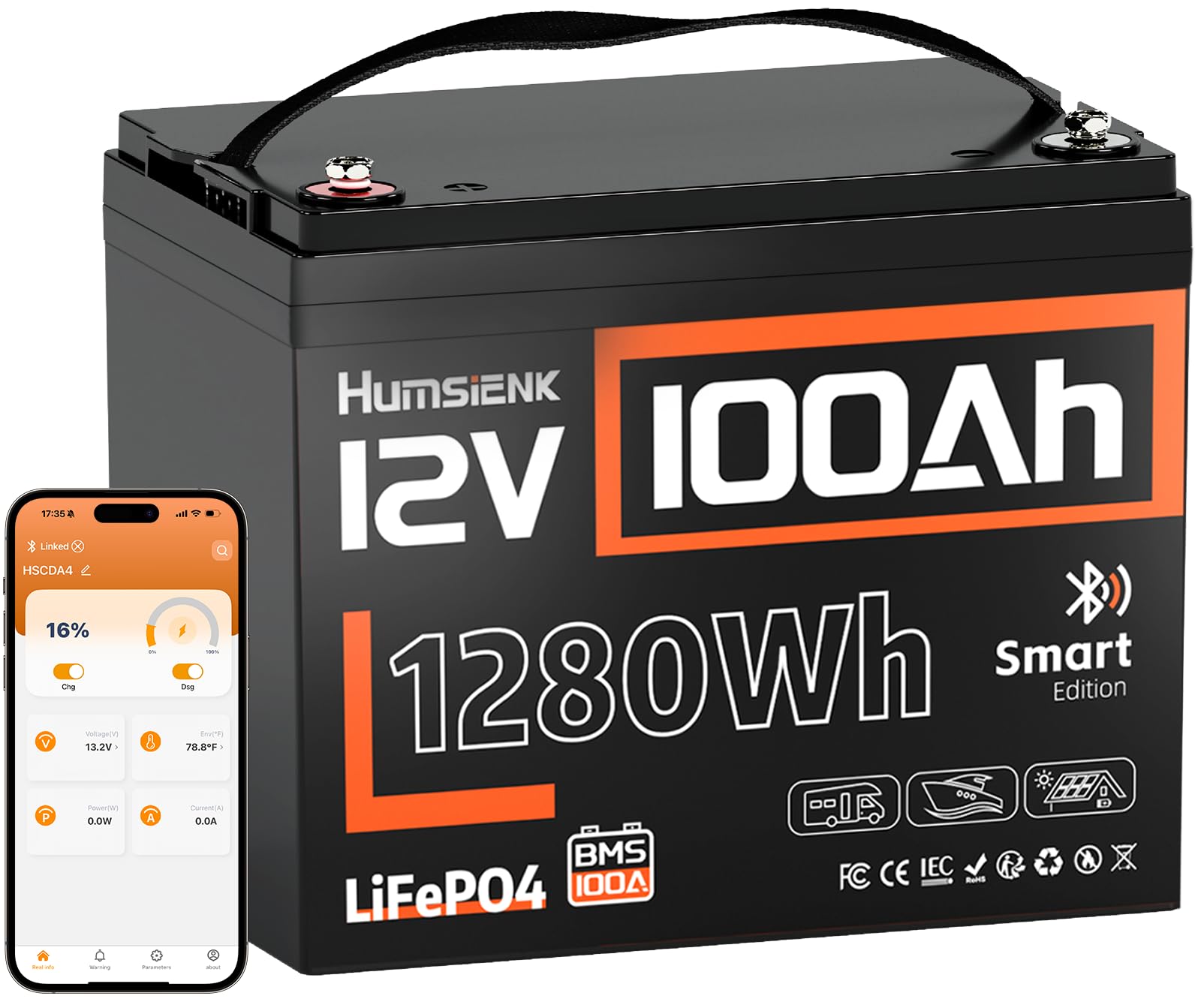
Cheap, light, and it tells your phone exactly what it’s doing.
At 19.7 pounds this is one of the lightest 100Ah packs on the list, and the Bluetooth app is what makes it feel modern. The 100A smart BMS pairs with a dedicated app for real-time monitoring of voltage, temperature, and other key parameters, catching overcharge, over-discharge, over-current, and short circuits before they become a problem. Owners driving inverters with it report it can deliver more amperage to an inverter than a lead-acid battery of similar rating.
The physical fit is the other draw. At 8.2″H x 6.6″W x 10.2″L, it is compatible with BCI Group 24 through 31 battery boxes, and compared to lead-acid, AGM, and SLA batteries it saves over 30% in space and weight. It runs across a wide temperature band from –4°F to 158°F with automatic low-temperature shutdown, holds an IP65 waterproofing rating, and supports up to 15,000 cycles with 4S4P setups up to 48V and 20.48 kWh. The maker claims a 10-year life versus lead-acid.
Three things deserve a fair mention. The battery-life aspect is genuinely mixed in owner feedback — some report steady performance, others note capacity fades faster than hoped under heavy cycling, so buy with margin. A couple of buyers report a terminal running warm or a cell balancing only to a small gap, though the seller was quick to ship replacements in those cases. And the Bluetooth range and app depth are good but basic; you get monitoring, not deep configuration. Backed by a 5-year warranty and A+ grade cells certified by FCC and CE.
The best-kept secret here: you are getting Bluetooth monitoring and IP65 sealing for less than several packs that offer neither — rare at this tier.
One thing to plan around: a few owners see capacity fade under heavy cycling, so oversize your bank if you push it hard.
For the buyer who wants: the cheapest path to Bluetooth-monitored lithium, in a Group 24 body at under 20 pounds.
Steer clear if: you need app-based deep configuration — this gives you monitoring, not tuning.
6. ECO-WORTHY EnergyRock 12V 280Ah Metal Case LiFePO4 Lithium Battery
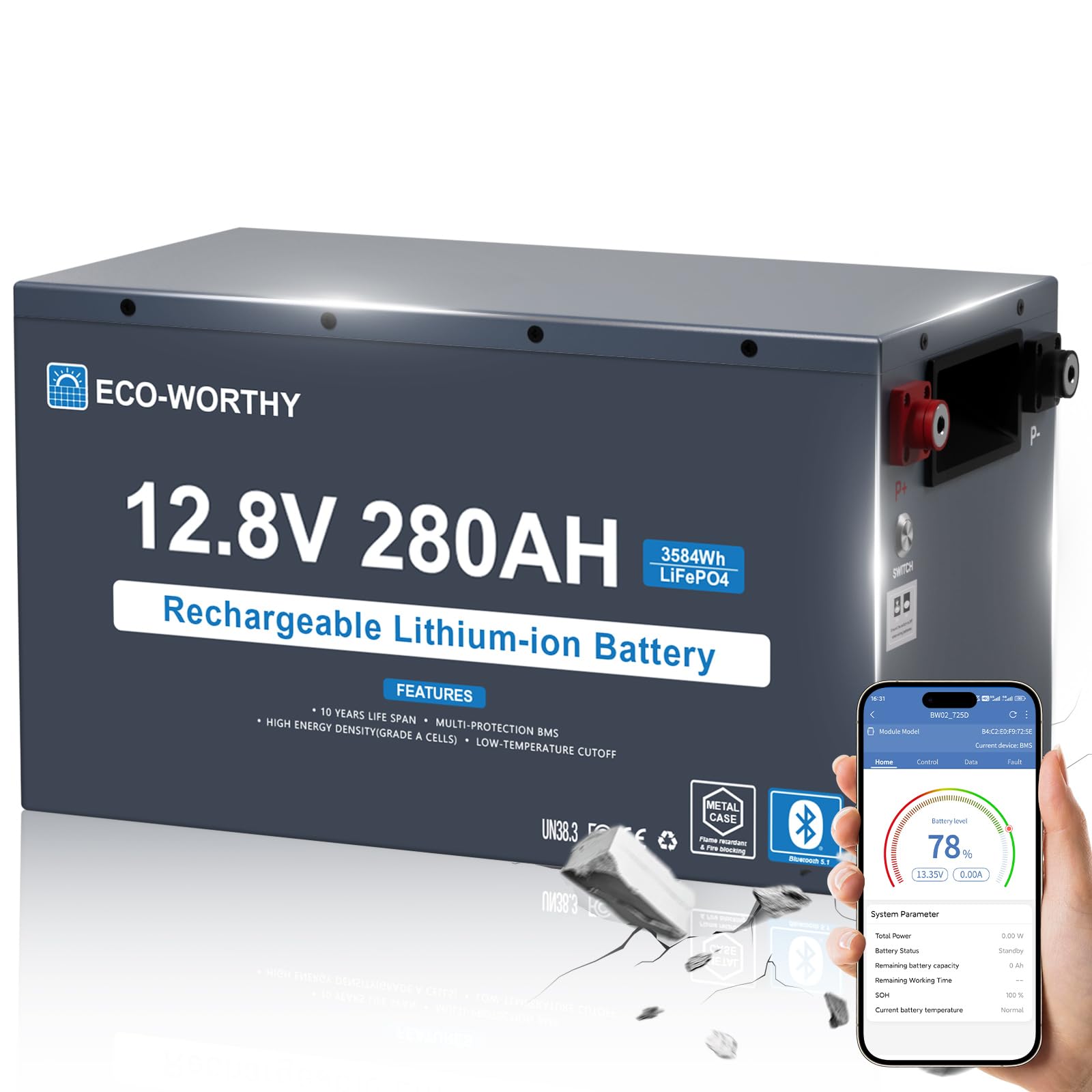
A rugged metal shell that turns a battery into furniture you can bolt down anywhere.
Most batteries on this list have a plastic case; this one has a heavy-duty metal enclosure built for heat resistance and fire protection, and it comes with 4 mounting feet so you can install it directly inside an RV or camper without buying a separate battery box. The reinforced metal case and internal cell holders resist impact and road vibration, which matters if the battery rides in a van or trailer that rattles along rough pavement. A one-touch safety switch cuts the output to prevent accidental discharge during maintenance.
Owners put real loads through it. One report has it running a 12,000 BTU portable AC plus lights for two hours and dropping to 30%, while still handling a shop vac and a table saw. A separate RV owner upgraded from 110Ah of AGM to two 280Ah units — 560Ah total — and reports the packs worked at 20°F with a low-temperature cutoff at 20°F/-7°C. The 200A BMS provides chunky continuous output, and Bluetooth monitoring pulls real-time voltage, capacity, and charge/discharge status to your phone. The max capacity is 3584Wh.
The reason to pick this over a power brick like the yeagulch 200Ah is the case. The metal housing provides structural protection a plastic shell cannot, and the front terminals plus side-post layout help avoid accidental bridging. It also runs a Grade A cell build with a 200A BMS, so you get durability alongside the rugged shell. The one thing to note: ECO-WORTHY warns the order may arrive across multiple packages at different times, so a partial delivery on day one is normal.
The standout spec: 280Ah and 3584Wh in a metal case that needs no separate battery box — the mounting feet let it live anywhere in the build.
Real-world note: shipping splits across multiple packages, so don’t be alarmed if the first box arrives alone.
Choose this when: you want a heavy-duty, mount-anywhere 280Ah bank with a metal case and a physical safety switch.
Another look if: you just need basic 100Ah storage and don’t value the rugged enclosure.
7. yeagulch 12V 200Ah LiFePO4 Lithium Battery, Built-in 200A BMS
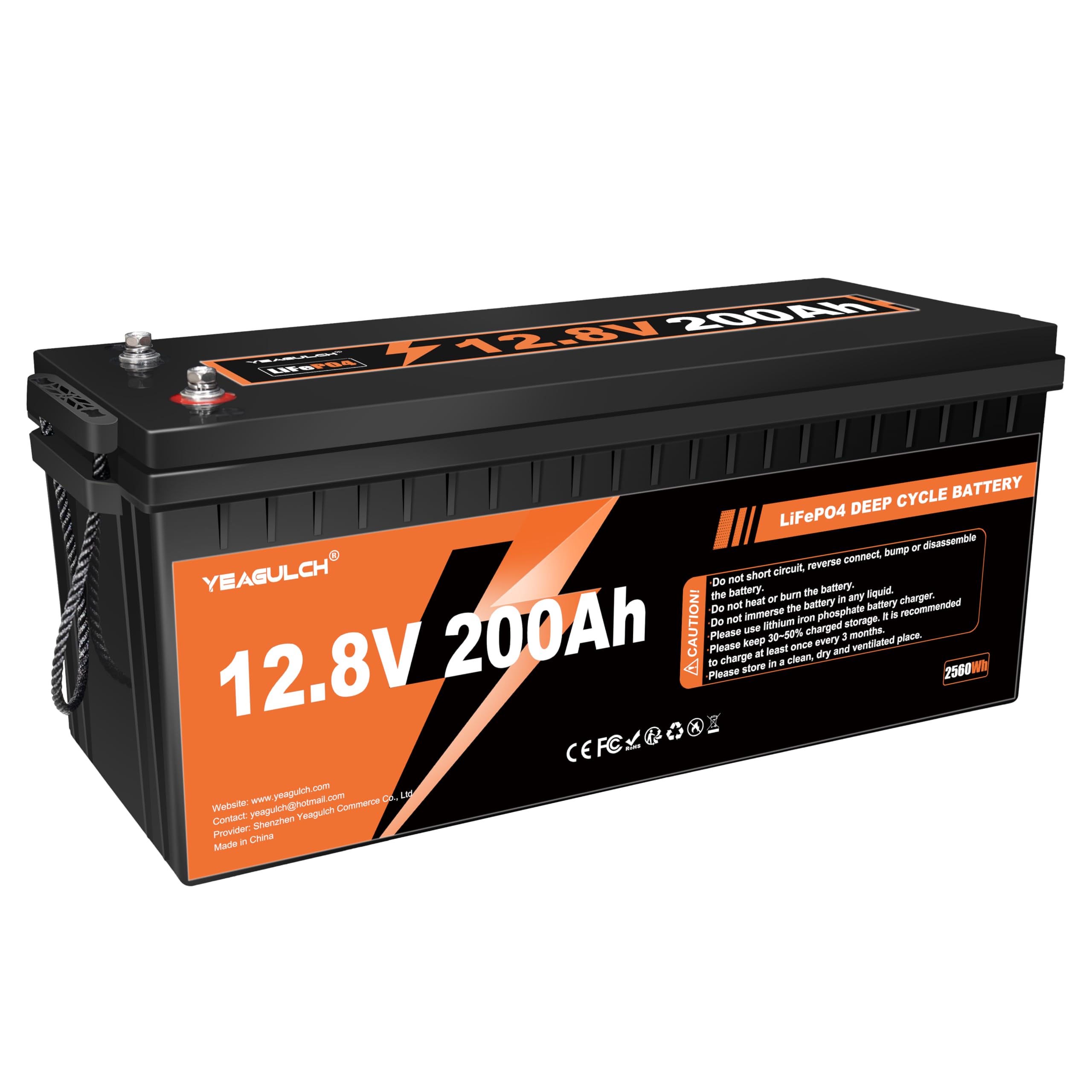
A big-capacity pack that shrugs off a hot garage and keeps the fridge cold.
Weighing about 58.86 pounds and measuring 20.08 x 8.07 x 8.46 inches, this 200Ah battery is described by its maker as roughly one-third the weight of many lead-acid batteries at the same 200Ah rating. The fixed, slim footprint makes it easy to lift and stack in solar enclosures and off-grid cabinets. Cycle life is where the lithium advantage shows: 4000 cycles at 100% depth of discharge, 6000 cycles at 80% DOD, up to 15000 cycles at 60% DOD.
Owners run serious loads on it. One report has it driving an old fridge, a security system, and a modem/router in a hot garage for nine hours. Another camper replaced a flooded lead-acid setup that lasted about half a day and got a day and a half of runtime from these, and notes the screw-style posts adapt to multiple uses. The built-in 200A BMS guards against overcharging, overdischarging, overcurrent, overheating, and short circuit, with automatic high and low temperature cut-off.
Expansion is wide. It supports up to 4 batteries in series for a max 48V system and 4 in parallel for up to 800Ah, delivering roughly 10.24kWh of usable energy in a full configuration. Keep in mind it is not meant to start a car or run a golf cart, and the maker suggests charging and discharging it at least once every six months to prevent damage from disuse. It works with 12V trolling motors up to 55-62 pounds thrust.
Strongest points
- 200Ah capacity — double a standard 100Ah pack — in a slim, stackable shell.
- 200A BMS with automatic high and low temperature cut-off.
- Scales to a 48V system in series or 800Ah in parallel.
- Owners run it through hot garages and full camping weekends without trouble.
Mind the details
- Not for car starting, engine start, or golf cart duty.
- Charging speed is mixed in owner feedback — some charge fast, others report up to 10 hours.
- At 58.86 pounds it wants a permanent mounting spot.
Best for: solar and RV banks that want 200Ah of storage out of one battery rather than two.
Don’t buy it for: engine starting — the maker specifically warns against car and golf-cart use.
8. HumsiENK 12V 200Ah LiFePO4 Lithium Battery with 250A BMS
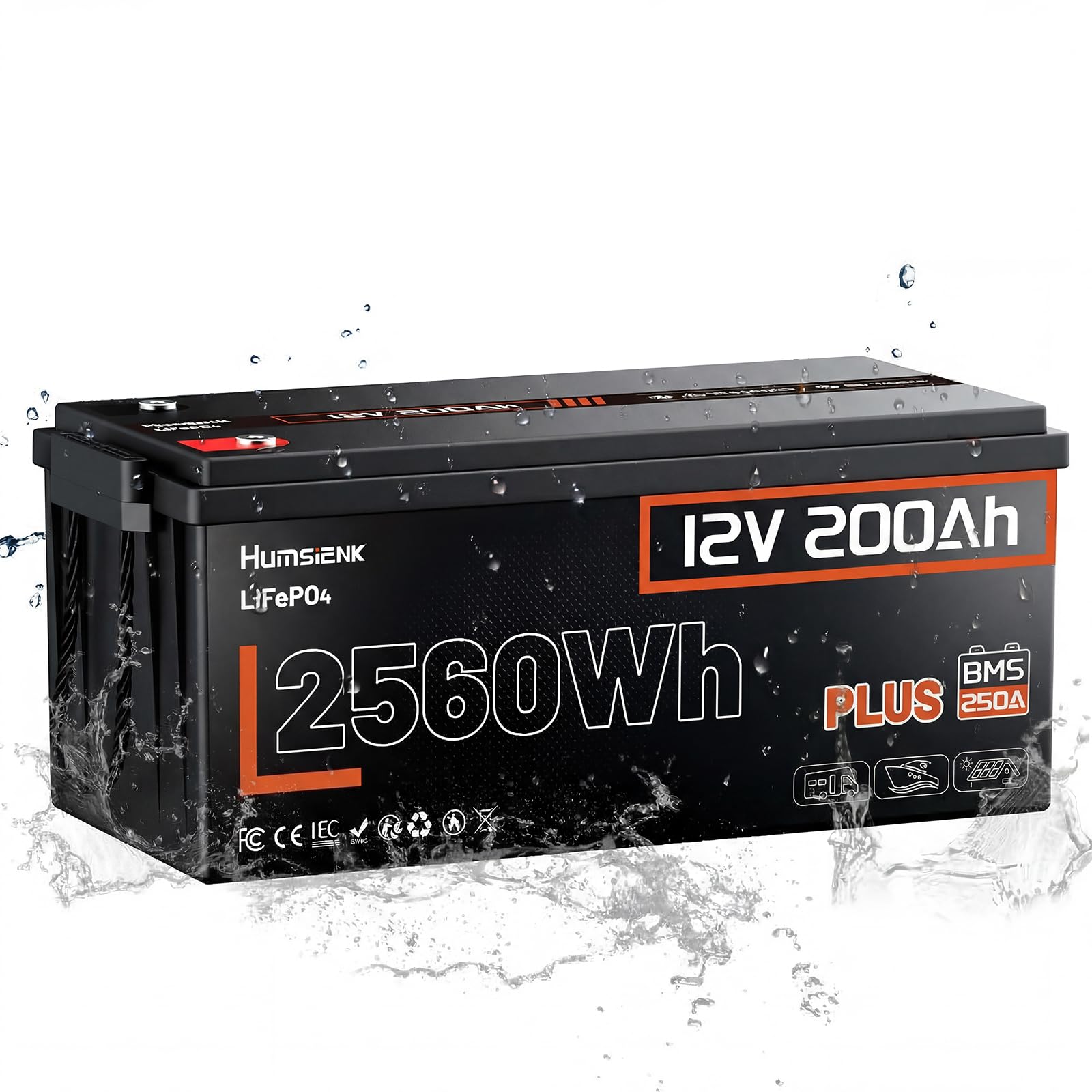
The 250A muscle that runs the AC and the fridge at the same time.
Most 200Ah packs cap their continuous output well below this one. Here the 250A, 3200W continuous output is the headline, and it is what lets high-power devices like an air conditioner and a refrigerator run simultaneously. Recharging is quick too: a full top-up takes 3.33 hours at rated current. Capacity is 2560Wh with 100% depth of discharge, and the maker claims 15,000+ deep cycles and a 10-year lifespan — supported by EV-grade A+ cells rated for 6000 to 15,000 cycles.
For solar work, this pack is designed to feed sensitive electronics cleanly. The 250A BMS prevents overcharge, over-discharge, short circuits, and overheating, and it is specifically aimed at keeping solar inverters and CCTV cameras running with stable power. Weather tolerance is wide — from -4°F to 140°F — plus an IP65 waterproof rating that covers all climates. It also scales up to 4S4P configurations reaching 40.96kWh for home energy storage.
The weight advantage is documented on the spec sheet: 58.2 pounds, which the maker states is 52% lighter than lead-acid, in dimensions of 20.53 x 9.37 x 8.69 inches. That said, the recharge time is where owners split — the maker’s 3.33-hour figure assumes a charger that can push that much current, and anyone with a smaller charge controller will wait longer. With a 5-year warranty and 24/7 support, it is the fastest-charging big-cell battery on the list when you give it the right gear.
what separates it: 250A and 3200W continuous output — enough to run an air conditioner and a refrigerator at once, which most 200Ah packs cannot.
The real caveat: that 3.33-hour recharge needs a high-output charger; a smaller controller stretches it out considerably.
The pick for: off-grid setups pushing air conditioning and heavy appliances simultaneously.
Look past it if: your charger can’t deliver high current — you won’t hit the listed recharge speed.
9. Mighty Max Battery 12V 100AH Deep Cycle VRLA

The no-fuss sealed lead battery for a shed nobody wants to open.
This ML100-12 is a 12V 100AH Group 27 sealed lead-acid rechargeable battery that is UL Certified and completely maintenance free — no water to add, no acid to check. That is the whole pitch for a lot of buyers: set it and walk away. It has a spill-proof construction, a high discharge rate for its class, and a wide operating temperature range, and it can be mounted in any position, resisting shocks and vibration. Its dimensions are 12.09 inches x 6.65 inches x 8.48 inches, and the listing includes the battery and screws only, so plan on wire and mounting hardware separately.
Owners get useful, repeatable results from it. One runs a 44-pound-thrust trolling motor on it for 8+ hours across a 1700-acre lake, landing back with about 35% charge remaining, and reports the previous battery managed only 4 to 6 hours by comparison — with one caveat the same owner notes: longevity is still untested. Another has run it off-grid for years and reports a fridge, computers, ten LEDs, an AC fan, and a 52-inch TV powered for five days straight with no sun, then nearly two weeks through storms. The wide temperature tolerance and spill-proof build suit solar setups that live outside year round.
The one thing to consider honestly: this is the heaviest battery on the list at 28 pounds, and the maker offers a one-year warranty — the shortest here. In return, it needs no BMS, no app, and no special charger routine. It just takes a charge and holds it.
Why it earns a place
- UL Certified, sealed, spill-proof, and completely maintenance free.
- Mounts in any position and resists shock and vibration.
- Owners run fridges, AC fans, and TVs off-grid for days at a time.
- No BMS or charge-profile programming required.
Weigh these up
- 28 pounds makes it the heaviest option here.
- Battery life is mixed in owner feedback — one long-term owner still calls longevity untested.
- One-year warranty, the shortest on the list.
- Battery and screws only; no wire harness or mounting accessories.
Suits: a simple, fixed solar install where maintenance-free and sealed matter more than cycle count.
Better to look on if: you want many thousands of cycles — lithium outlasts this by a wide margin.
10. ECO-WORTHY 12V 314Ah LiFePO4 Lithium Battery with SOC LEDs
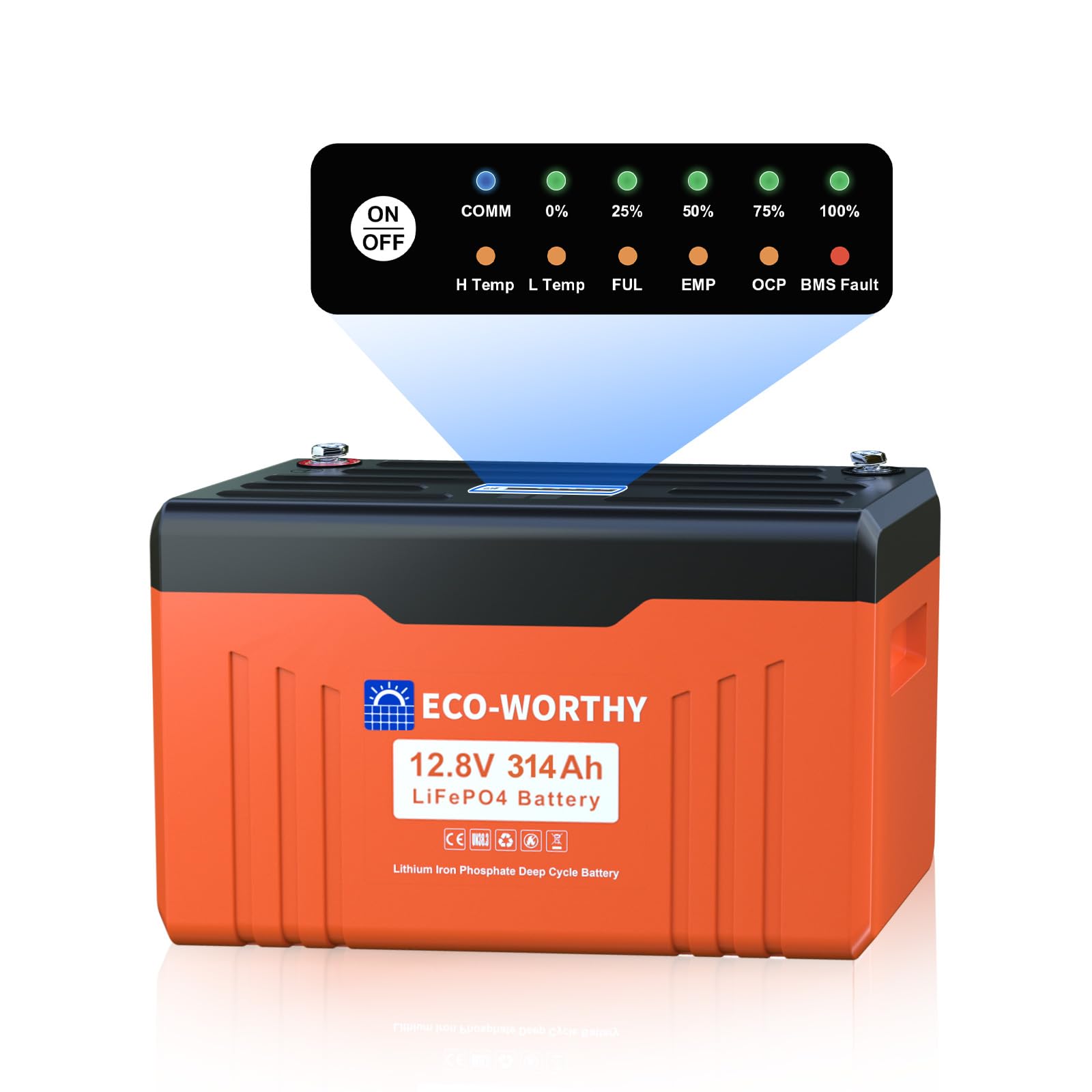
The biggest tank on the list — one battery storing over four thousand watt-hours.
If capacity is your single metric, nothing here matches it: 314Ah and 4019.2Wh in one unit, expandable up to 32.15kWh through 4P2S or 2P4S configurations. That is the difference between running a fridge and a 15,000 BTU RV air conditioner off one battery versus wiring a whole bank together. The 200A BMS handles high and low voltage, overload, and high and low temperature protection, and low-temperature protection cuts charging below -7°C (19.4°F).
The user-facing extras are what make it livable. An intelligent LED display shows battery level and status so you can read capacity and health at a glance without opening an app, and Bluetooth lets you monitor remotely through the ECO-WORTHY App. A built-in buzzer alerts you to battery faults. It uses Grade A cells the maker rates at more than 3 times the lifespan of lead-acid, and the 60.4-pound build measures 16.3 x 8.46 x 10.24 inches.
Owners run it hard. One report has it powering a truck camper with room to spare and a fire-resistant case. Another replaced two 100Ah gel batteries with it and reports going about a week without sun versus needing daily sun before, and holding up through heavy rain. There is one honest wrinkle to expect: capacity is mixed in owner feedback — some report excellent high charge capacity, while a few note it will not charge past 292.5 Ah, and one owner reports the Bluetooth voltage reading scaling incorrectly. The maker’s 3-year warranty applies.
The headline number: 4019.2Wh from a single case, with a built-in buzzer and SOC LEDs that make troubleshooting fast and app-free.
Be aware: a few owners mention the pack not charging all the way to its rated 314Ah, so give heavy off-grid weeks some margin.
Made for: serious off-grid draws like a 15,000 BTU RV air conditioner where you want maximum watt-hours per battery.
Less ideal if: you need a short warranty cycle — this ships with 3 years rather than the 5 several rivals carry.
Understanding the Specs
Amp-Hours and Depth of Discharge
Amp-hours (often written Ah) is the battery’s storage size — a 100Ah pack holds roughly twice the energy of a 50Ah one at the same voltage. Depth of discharge, or DOD, is how far you routinely drain it: pulling a battery down to 100% DOD uses every drop, while 60% DOD leaves 40% in reserve and extends the cycle count substantially. That is why several lithium packs here quote different cycle counts at 100%, 80%, and 60% DOD. Lead-acid suffers far more from deep drains, which is part of why its cycle count sits in the hundreds rather than the thousands.
BMS and Low-Temperature Cutoff
A battery management system, or BMS, is the electronic watchdog inside a lithium pack. It monitors voltage, current, and temperature and cuts the circuit if anything runs abnormal, protecting both the battery and your wiring. The number before the letters — 100A, 200A, 250A — is the maximum current it will pass, so a 250A BMS feeds far bigger loads than a 100A one. Low-temperature cutoff is a separate job: it stops charging below a set temperature so the cells are not damaged in the cold, usually around 32°F, though some packs here continue discharging well below that.
FAQ
Can I replace my lead-acid solar battery with a lithium one without changing anything else?
Does a 100Ah battery actually run my fridge overnight?
Why do lithium solar batteries stop charging in cold weather?
How many batteries can I wire together for more capacity?
Is lithium or lead-acid better for off-grid solar storage?
Do I need a special charger for a LiFePO4 solar battery?
What does the amp number in 100A BMS mean for my solar setup?
Can I mount a solar battery on its side or in a tight cabinet?
How long will a solar battery last before it needs replacing?
Why is my solar battery not charging to its full rated capacity?
Final Thoughts: The Verdict
For most buyers, the battery for a solar panel winner is the MARSENERGY 12V 100Ah LiFePO4 because it pairs 4,500 deep cycles at full depth of discharge with a 21-pound body that drops into the Group 24 box you probably already own. If harsh weather or marine duty is your reality, grab the Dyness 12V 100Ah and its IP65 sealing. And if you want a no-maintenance lead-acid bank for a fixed shed install, the Mighty Max 12V 100AH is the one to reach for. The bottom line: match your chemistry to your controller, size your amp-hours to your overnight load, and check the low-temperature cutoff before you mount anything outdoors.
How We Picked
We do not accept paid placement. Every pick is matched to a real buyer and a real use-case; we do not hands-on test units.
Sources & Methodology
Specifications: manufacturer listings and product documentation. Review insights: verified customer reviews, as of September 2026. Pricing: not shown on this page (it changes often); check the current price via the retailer link.
As an Amazon Associate, KitchPrep earns from qualifying purchases. This does not affect which products we feature.
Related Guides
