
Specs are compiled from manufacturer listings and verified buyer reviews and can change over time — please confirm the key details on the product page before buying.
When the grid drops, the real question is simple: what will still keep your fridge cold and your router blinking? The right battery backup depends on what you need to keep alive — a laptop and a modem, a full refrigerator, or a whole room of essentials. This guide breaks down eleven units worth owning, from compact UPS boxes that cover a home office to large power stations that can run a fridge for days. Each pick is matched to a specific job: desk gear, fridge backup, or whole-home power.
I’m Mohammad Maruf — the founder and writer behind KitchPrep. This guide is built by comparing the manufacturers’ published specifications and the patterns across verified customer reviews, so you get each pick’s real strengths and trade-offs instead of marketing spin.
When the power goes out, the unit you own decides whether your fridge, router, or phone keeps running. Below you’ll find how battery chemistry and runtime really work, a side-by-side table, and full reviews of every unit. This guide to the battery for a power outage covers what each unit actually delivers when the lights go out.
Our Picks at a Glance



How To Choose The Best Battery for a Power Outage
Buying backup power is not about picking the biggest watt-hour number on the box. It is about matching capacity and output to the appliances you need running when the power dies. A small desk UPS (uninterruptible power supply) bridges brief outages for computers, while a large portable power station runs a fridge for hours or days.
Capacity: Watt-Hours Tell You How Long, Watts Tell You What
Capacity, measured in watt-hours (Wh), is your run-time fuel tank. Output, measured in watts (W), is how much a device can pull at once. A 2,048Wh unit can run a low-draw fridge far longer than a 153.6Wh unit, but both can power a laptop. List what you must keep running, then match watt-hours to runtime and rated watts to the largest load.
Battery Chemistry: Why LiFePO4 Changes Everything
LiFePO4 (lithium iron phosphate) is the rechargeable battery type most modern backup units use. It handles deep discharge well and holds up across thousands of charge cycles. Older sealed lead-acid UPS batteries are heavier and need replacing more often, which is why so many picks here lean on lithium.
Switchover Speed and Sine Wave Output
UPS switchover time is how long the unit takes to jump to battery when mains power fails. Faster is better for sensitive electronics. Pure sine wave output means the power behaves like normal wall current, which matters for computers and audio gear that can misbehave on a rough waveform.
Quick Comparison
| Model | Best For | Capacity | Rated Output | Weight | Amazon |
|---|---|---|---|---|---|
| Anker SOLIX C2000 Gen 2★ Best Overall | Whole-home and RV backup | 2,048Wh | 2,400W | 18.9 kg | Amazon |
| GOLDENMATE 1000VA/600WBest Value | Desk and office gear | 153.6Wh | 600W | 4.8 kg | Amazon |
| CyberPower CP1500PFCLCDTop Performer | High-end PCs and workstations | — | 1,000W | 24.9 lb | Amazon |
| BLUETTI Elite 100 V2 | Camping and quick home backup | 1,024Wh | 1,800W | 25 lb | Amazon |
| DJI Power 2000 | RV and outdoor work | 2,048Wh | 3,000W | 21.72 kg | Amazon |
| Jackery Explorer 2000 v2 | Home backup and camping | 2,042Wh | 2,200W | 39.5 lb | Amazon |
| EF ECOFLOW DELTA 3 Max | Fast-recharge home backup | 2,048Wh | 3,400W X-Boost | — | Amazon |
| BLUETTI Elite 300 | RV travel and outage backup | 3,014Wh | 2,400W | 58 lb | Amazon |
| Anker SOLIX F3000 | Whole-home generator backup | 3,072Wh | — | 91.5 lb | Amazon |
| Jackery HomePower 3000 | Multi-day home essentials | 3,072Wh | 3,600W | 59.5 lb | Amazon |
| EF ECOFLOW DELTA Pro | Heavy-duty whole-home backup | 3,600Wh | 3,600W | 99 lb | Amazon |
In‑Depth Reviews
1. Anker SOLIX C2000 Gen 2 Portable Power Station, 2,048Wh, 2,400W, Camping
Our pick — over 4.5★ from 650+ verified ratings; the strongest balance of quality and price.
A 2,048Wh station that sips power idle and refills in under an hour
If you want one box that can carry a fridge through a long blackout, the Anker SOLIX C2000 Gen 2 is the crowd favorite — 4.7 stars across 600+ ratings. It holds 2,048Wh of LiFePO4 capacity and puts out 2,400W rated power, with a 4,000W peak for the brief jolt a motor or compressor demands on startup. That is enough to run a dual-door fridge, and Anker rates the unit to hold that load for up to 32 hours before you add anything.
Here is the number that changes daily life: it stands by at just 9W, so a charged unit is not slowly bleeding itself dry while you wait for a storm. Add a matching expansion battery and capacity climbs to 4kWh, which doubles dual-door fridge runtime to 64 hours. Recharging is where this pick separates itself from the pack — AC plus solar gets it from empty to full in 58 minutes.
Against the GOLDENMATE below, the gap is huge. This Anker carries 2,048Wh versus the GOLDENMATE’s 153.6Wh, and pushes 2,400W rated against 600W — the little desktop UPS is a trim tab, this is a power plant. The trade-off is weight, and buyers feel it: at 18.9 kg the station is 3.9 times the GOLDENMATE’s 4.8 kg, and weight is the one spec owners flag as mixed. It ships with plastic and metal construction, an AC charging cable, and a hidden point note — it is 25% lighter and 29% smaller than similar stations in its class.
What owners rave about
- Battery life is the runaway favorite here — owners run TVs, fridges, and WiFi past 10 hours on a charge
- Full recharge in 58 minutes means you are never waiting long to be ready again
- Compact enough to slide under a counter or TV stand for storage
Where it asks patience
- 18.9 kg is real weight; plan a cart if you move it often
- With AC input connected, output is capped lower than the rated 2,400W, which matters if you are running a big load while charging
Reach for this if: you want one station that can run the fridge, the router, and a few lights for a full day and refill in under an hour.
Look elsewhere if: you need to carry it up stairs regularly — consider a lighter unit like the BLUETTI Elite 100 V2 instead.
2. GOLDENMATE 1000VA/600W Lithium UPS Battery Backup & Surge Protector, White
A desk-side UPS that keeps your office alive without lead-acid bulk
For a home office or a small AV rack, you do not need a 2,000Wh power station — you need something that sits quietly under a desk and jumps in the instant the lights flicker. The GOLDENMATE 1000VA/600W is exactly that, and it runs on LiFePO4 (lithium iron phosphate) instead of the heavy lead-acid cells older UPS units use. That chemistry change is the whole story: GOLDENMATE rates the battery for 5000+ charge cycles and a service life of over 10 years.
It packs eight NEMA 5-15P outlets (the standard three-prong household shape) with surge protection, plus a low-noise cooling fan that runs under 50 dB and only spins up during heavy battery use. The 1000VA/600W pure sine wave output (power that behaves like normal wall current) keeps computers, workstations, and network gear fed cleanly. A color LCD shows real-time battery and load conditions, and a buzzer-mute switch lets you silence the battery-mode alarm with a single tap.
It is the featherweight of the group: 4.8 kg, versus the 18.9 kg Anker above — a station you can actually move one-handed. Buyers report it powers a 185W A/V load for about three hours on its 600W rating across six months of outages. The honest catch is this is a small-battery device with a non-replaceable 10-year battery, so it is built for desk gear, not for a fridge or a room of appliances.
Where it wins: a plug-and-play tower that protects a computer or AV setup with pure sine wave output and 5.45A draw on a standard 120V household circuit.
Where it stops: the 153.6Wh battery gives you minutes to hours, not days — keep it on protective duty, not as your whole-home plan.
Built for: desk-bound workstations, NAS drives, and audio gear that need a clean, quiet ride through short outages.
Not the one for: running a refrigerator or heavy appliances — it tops out at 600W rated, so keep loads light.
3. CyberPower CP1500PFCLCD PFC Sinewave UPS Battery Backup and Surge Protector
The desk-mounted tank for gamers and workstation builders running big PCs
If your desktop costs more than most furniture in the room, a proper UPS is cheap insurance. The CyberPower CP1500PFCLCD is rated 1500VA/1000W with pure sine wave output — the right waveform for Active PFC power supplies, which is what modern high-end gaming and workstation builds use. Run an 800W load and the unit delivers roughly 10 minutes of backup to shut down cleanly. That short window is the entire point: it is not for running a fridge, it is for letting a PC land safely.
The outlet count is generous — 12 NEMA 5-15R total, split into six battery-backup plus surge outlets and six surge-only outlets. A tiltable color LCD displays load and battery status, and there are two USB charge ports (one Type-A, one Type-C) for phones and tablets. Automatic Voltage Regulation (AVR) corrects minor sag and swell without draining the battery, so flickers and brownouts do not eat into your runtime.
What wins people over is baseline quality — this is the most-owned unit in this whole roundup, and the trust shows. Real-world endurance is documented too: one buyer replaced aging APC units after years of random shutdowns and reports this one works flawlessly on PFC power supplies, with an accurate watt readout. The recurring honest gripe is runtime at high load — one owner running a heavy PC at two-thirds of the rated wattage measured only around two minutes of runtime instead of the displayed estimate.
The protection argument: 3-year warranty including the battery, plus a connected equipment guarantee and free PowerPanel management software.
The honest limit: at high loads you get minutes, not hours — plan an automatic shutdown if you run a heavy tower.
Reach for this if: you own a PFC-powered gaming PC or workstation and want clean sine wave backup without hunting for exotic replacements.
skip it if: you actually need hours of runtime for a refrigerator or room of appliances — that is the job of a power station, not a tower UPS.
4. BLUETTI Elite 100 V2 Portable Power Station for Camping 1024Wh 1800W
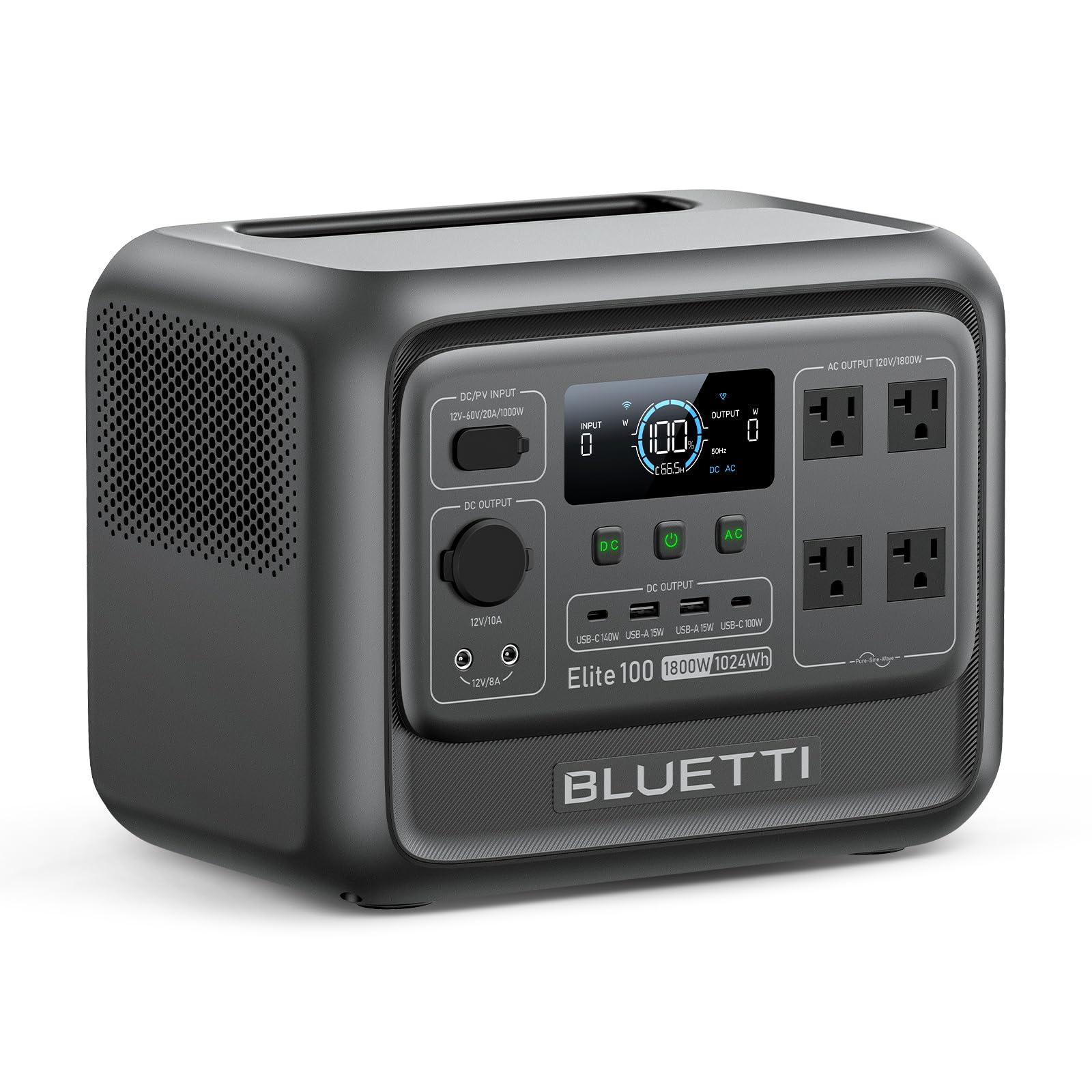
A grab-one-handed station that fills itself in about 70 minutes
If you camp or travel on weekends, you want a station you can lift one-handed and carry to the car without a second thought. The BLUETTI Elite 100 V2 is that unit: at 25 lb with a hidden handle and a 17L footprint, it’s 35% smaller and 30% lighter than typical 1kWh stations, so it fits a car trunk. It still packs 1,024Wh of LiFePO4 (a battery chemistry that lasts longer and is safer than standard lithium-ion) and 1,800W rated output. Eleven ports let you charge phones, laptops, and small appliances at once.
Speed is the headline here. With 1200W TurboBoost AC charging or up to 1000W solar input, the Elite 100 V2 refills from empty in about 70 minutes. In silent mode it runs at just 30dB — quieter than most conversation — which matters when you are sleeping near it. It also carries 10ms UPS switchover, so it can double as a router and PC backup at home between trips.
Owners lean on the capacity hard: the reported experience is powering a refrigerator for up to 48 hours during outages, and buyers describe it as easy to carry even for older users. The one honest limitation to plan around is the same place every station loses ground — the app and idle draw. Run it as a dedicated backup and it shines; treat it as a permanent AC wall-source and you will notice the drain between power events.
Best for: travelers and tent campers who want a genuinely portable 1kWh station that recharges fast and runs quiet overnight.
Wrong fit if: you need to run a full refrigerator-freezer plus appliances for days — step up to a 2kWh class unit like the Jackery Explorer 2000 v2.
5. DJI Power 2000 Portable Power Station, 2048Wh LFP Battery
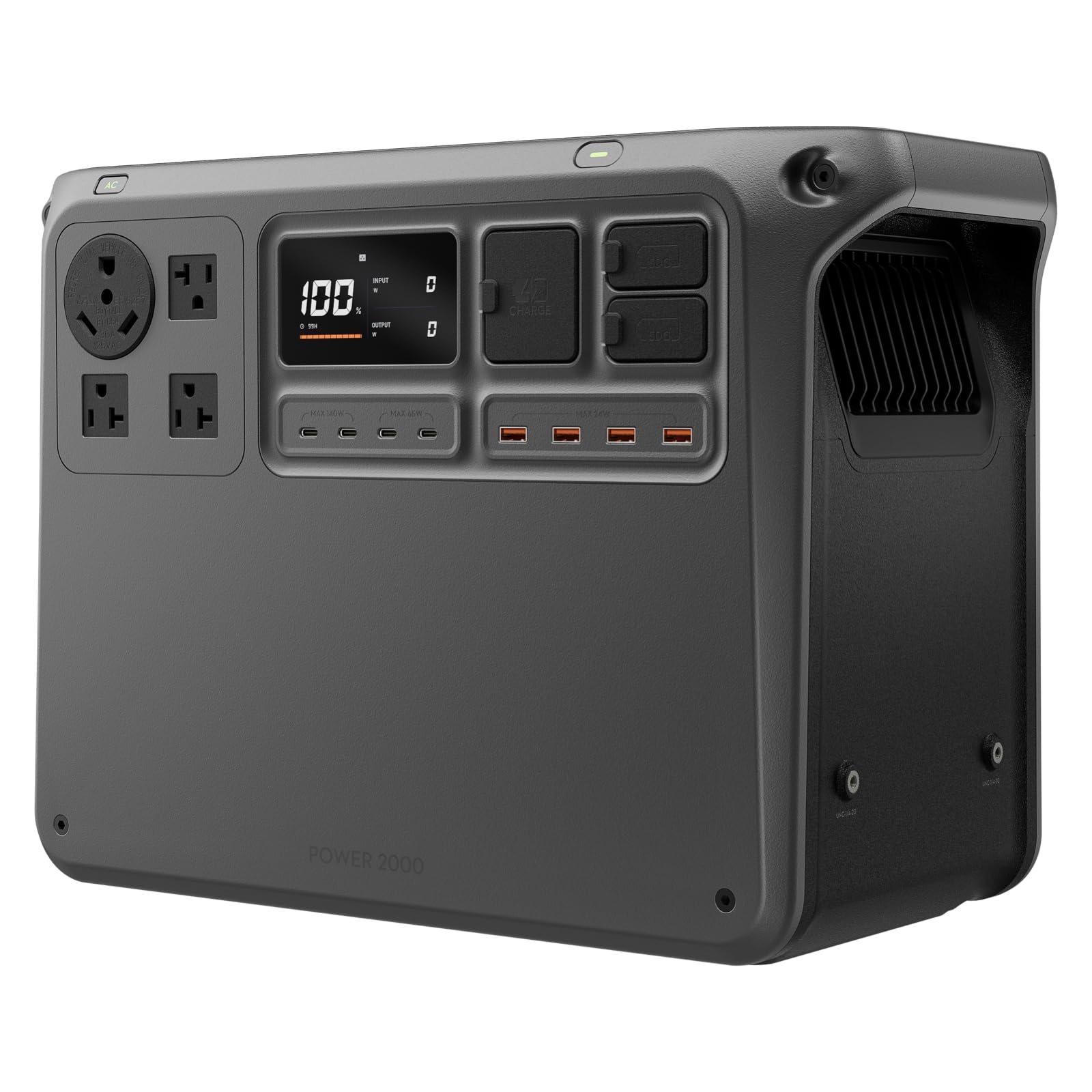
Built to run kettles and drills, not just laptops and lamps
Most power stations cosplay as backup for small devices. The DJI Power 2000 aims higher — it claims to run 99% of appliances, from kettles and cookers to electric saws and impact drills, with a 2,048Wh LFP (lithium iron phosphate) battery and 3,000W rated output. DJI rates the recharge at 80% in just 55 minutes, so a last-minute storm prep does not leave you waiting around. Fifteen ports, including dual full SDC ports (DJI’s high-power DC connector), let four or five people charge at once — a fit for RV trips and camp weekends.
Quiet matters at night: DJI rates the unit at 30dB, the kind of low hum that fades out of mind. Safety hardware is serious too — a smart BMS (battery management system that watches cell health), sub-nano coating, and flame-retardant housing are designed for wet or rugged outdoor use. A 10ms UPS switchover (about twice as fast as the DJI Power 1000) keeps gear alive through brief outages, and the DJI Home app monitors status wirelessly without the dongle older models needed.
Owners mention that build quality and output are the strong suits. The honest trade-off is accessories: customers note the DJI solar and car charging peripherals have been back-ordered, and the unit needs a separate compatible adapter for solar or car charging since the built-in MPPT (a controller that boost solar panel power) and car modules are not included. If you plan to plug straight into a solar panel, check that path carefully before buying.
Why it earns a spot: 2048Wh LFP capacity with 3,000W rated output and a 4,500W peak for high-draw tools and appliances.
Where it asks planning: you must add a compatible adapter and own the right expansion hardware before solar or car charging will work.
Made for: RVers, DIYers, and crews who need kettle-and-drill power in a compact, quiet station.
Think twice if: you want to expand fast with first-party accessories — plan for third-party adapters or long waits.
6. Jackery Explorer 2000 v2 Portable Power Station, 2042Wh, 2200W AC Output

The 2kWh station you can actually pick up and carry to the campsite
Two-kilowatt-hour stations have a reputation for being heavy bricks. The Jackery Explorer 2000 v2 sidesteps that with CTB (Cell-to-Body) technology borrowed from EVs — the same structural idea that lets electric cars pack cells tightly into the frame. The result is 2,042Wh of LiFePO4 capacity and 2,200W rated AC output in a unit that Jackery rates 41% lighter and 34% smaller than typical 2kWh stations, at 39.5 lb total. It carries three AC ports and a USB-C PD 100W port that fast-charges laptops and phones without needing an adapter.
Recharge speed is genuinely quick — 0 to 80% in 66 minutes on AC, full recharge in 102 minutes with the app’s Emergency Super Charging mode, and solar down to six hours with 400W panels. A silent charging mode refills the unit in five hours at just 30dB, which is quiet enough to sit beside a bed. The 20ms UPS switchover keeps essentials running through hurricanes and outages, and the unit is UL1778 test certified for uninterruptible power systems.
What buyers really appreciate is the reputation for performance and charging speed — powering fridges, fans, and phones through outages in about ten-hour stretches per full charge. The honest catch is a small software wrinkle: one owner found the unit needs software v1.1 to stop solar charging from pulsing on and off, and Jackery pushed that update without making much noise about it. Buyers also flag that the Bluetooth connection is not always persistent, which means the app can drop and need reconnecting.
The portability win: at 39.5 lb, this is one of the lightest 2kWh stations you can carry one-handed to a campsite or up a short flight of stairs.
The software note: confirm your unit is on v1.1 or later before relying on solar input in a pinch.
Best for: campers and home-backup owners who want 2kWh capacity without a 60-pound lift each time.
Look at the F3000 instead if: you plan to run a whole home off grid with dual solar inputs and a generator pass-through.
7. EF ECOFLOW DELTA 3 Max Portable Power Station, 2048Wh LFP Battery, 2400W
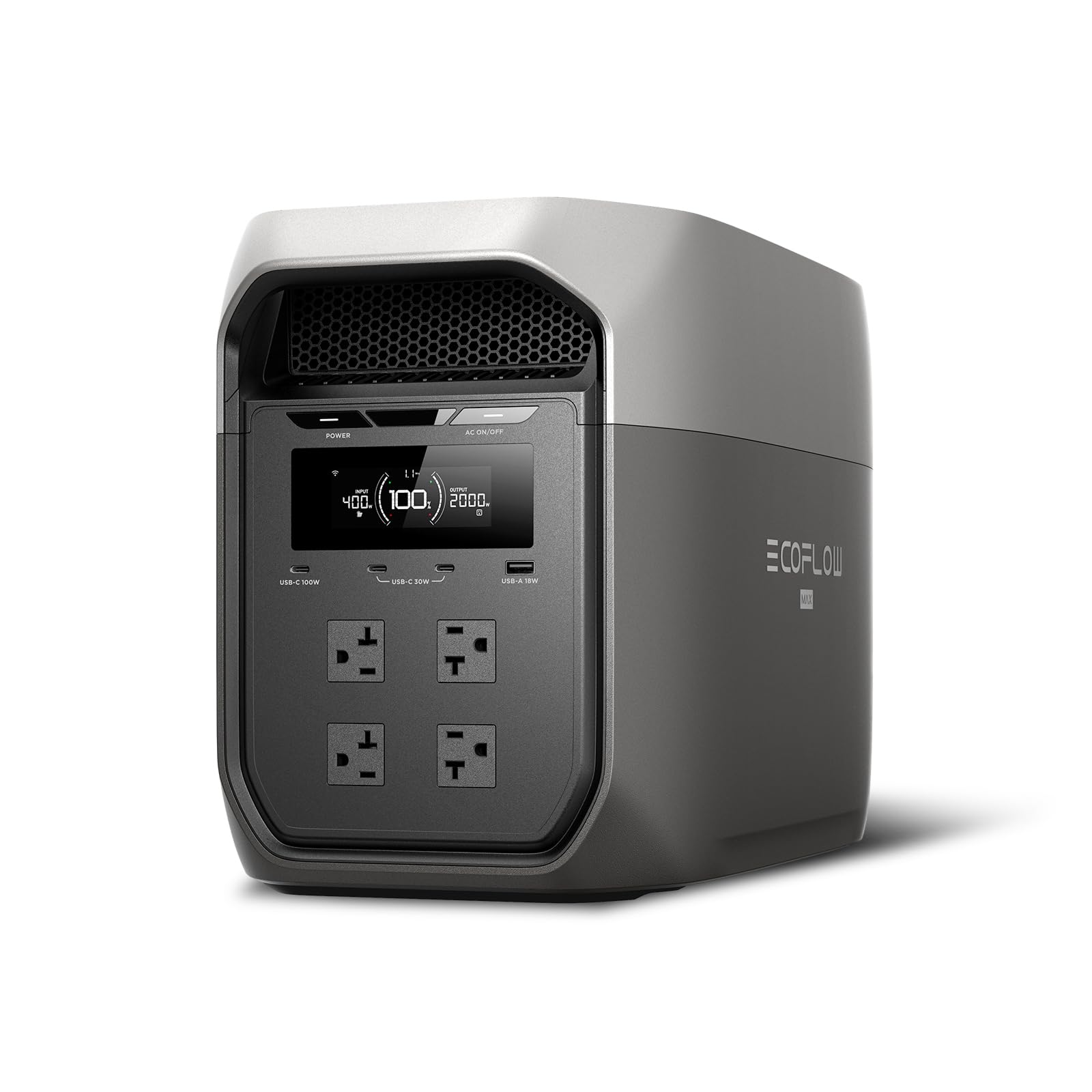
Charges 0-80% in just over an hour, then quietly powers the whole house
What separates the DELTA 3 Max from the pack is recharge speed. EcoFlow’s X-Stream technology takes the 2,048Wh LFP battery from empty to 80% in 1.13 hours, meaning you can plug in while a storm warning is on the radio and be mostly full by the time it lands. On the output side, X-Boost mode pushes continuous power up to 3,400W, enough to run fridges, microwaves, and power tools that would trip a lesser unit. EcoFlow counts that as 99% of household appliances covered.
The 10ms transfer time keeps sensitive equipment — computers, medical devices — alive through the switchover. Complementing the speed is silence: the unit is built for quiet operation so it can run overnight without being a nuisance. The LiFePO4 battery is rated for daily use across a long lifespan, and EcoFlow backs the DELTA 3 Max with a five-year service period. App control lets you set charge priorities, schedule charging, and monitor usage from your phone.
Owners consistently point to value and charge speed as the reasons this pick works. One buyer sums it up: charging to full is super efficient, and the battery keeps devices running for a long stretch. The honest adjustment to make is on the app side — the interface packs a lot into two home screens, and several buyers describe the modes as confusing at first. Firmware updates also come down over Wi-Fi rather than Bluetooth, so you need Wi-Fi access to keep it current.
The reasons to pick this
- 0-80% in 1.13 hours makes last-minute storm prep genuinely practical
- 3,400W X-Boost output handles high-draw appliances a 2,200W unit cannot touch
- Five-year service window from EcoFlow is the longest in this review
The honest trade-offs
- The app’s mode layout takes a session or two to learn
- Firmware updates need Wi-Fi, not just Bluetooth
Pick this if: recharge speed and high-wattage output are top of your list, and you want an app that grows with your setup.
Not the fit if: you want a plug-and-forget unit with zero app learning curve — the Jackery Explorer 2000 v2 is simpler.
8. BLUETTI Elite 300 Portable Power Station for RV & Home Backup 3014.4Wh
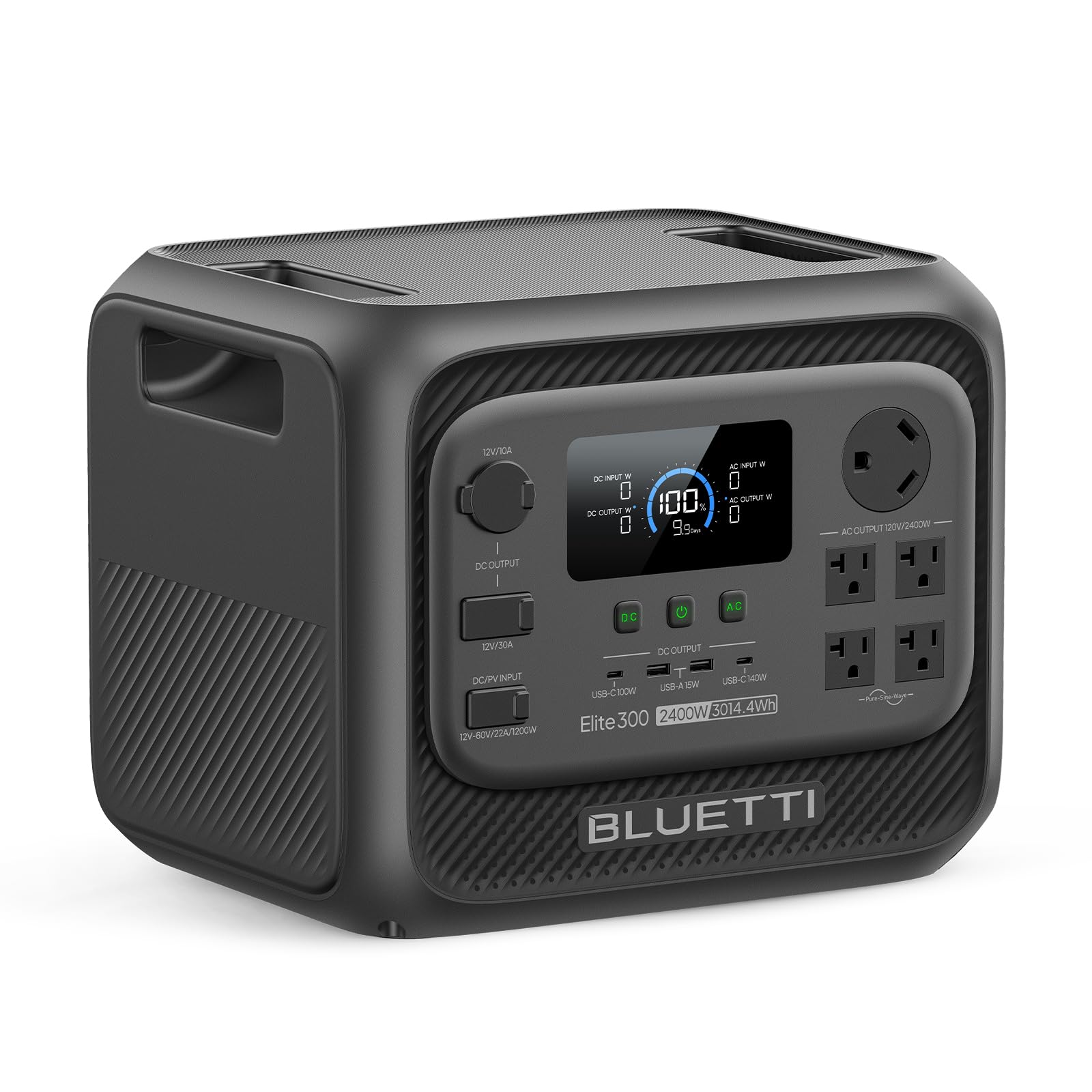
A 3kWh station that tucks into a closet but powers an RV or a whole room
Full 3,014Wh capacity in a package BLUETTI says is nearly 59% smaller than traditional large power stations — that is the pitch, and Frost & Sullivan recognized it as the world’s smallest 3kWh portable power station. The compact size is what makes it livable in a small apartment or camper; you can actually store it, not just own it. Output is 2,400W with a 4,800W surge for startup loads like a kettle, and 0-to-80% recharge takes as little as 78 minutes.
The RV story is where this pick truly stands out. A dedicated TT-30 RV outlet (the standard 30-amp shape most travel trailers use) plus a 12V/30A DC output means you plug RV appliances straight in — 12V fridges, water pumps, diesel heaters. The 10ms UPS switchover extends that usefulness at home, keeping computers, routers, and home office gear running through brief outages without a reboot. The BLUETTI app handles monitoring, output control, and recharging by AC, solar, or car charger.
Owners describe a station that consistently beats expectations — one buyer ran a 12,000 BTU air conditioner all night, and another powered a fridge, fans, and phone for a full day. The clear limitation to weigh is battery expansion: there is none. This is a fixed 3,014Wh unit, and buyers also report the solar input is capped at 60V/20A, so a large roof panel array can exceed the voltage limit and damage the MPPT (the charge controller). If you want to grow capacity later, this is not the chassis for it.
The RV advantage: the TT-30 outlet and 12V/30A DC output skip the adapter dance that slows most RV power setups.
The genuine constraint: no battery expansion and a low solar voltage ceiling — pick it as a finished 3kWh unit, not a growing system.
Made for: RV owners, van dwellers, and apartment dwellers who need 3kWh of backup in a space-saving shell.
The wrong buyer: anyone planning to add expansion batteries later — the Elite 300 has no expansion port.
9. Anker SOLIX F3000 Portable Power Station, 3,072Wh, 6,000W, Solar Generators
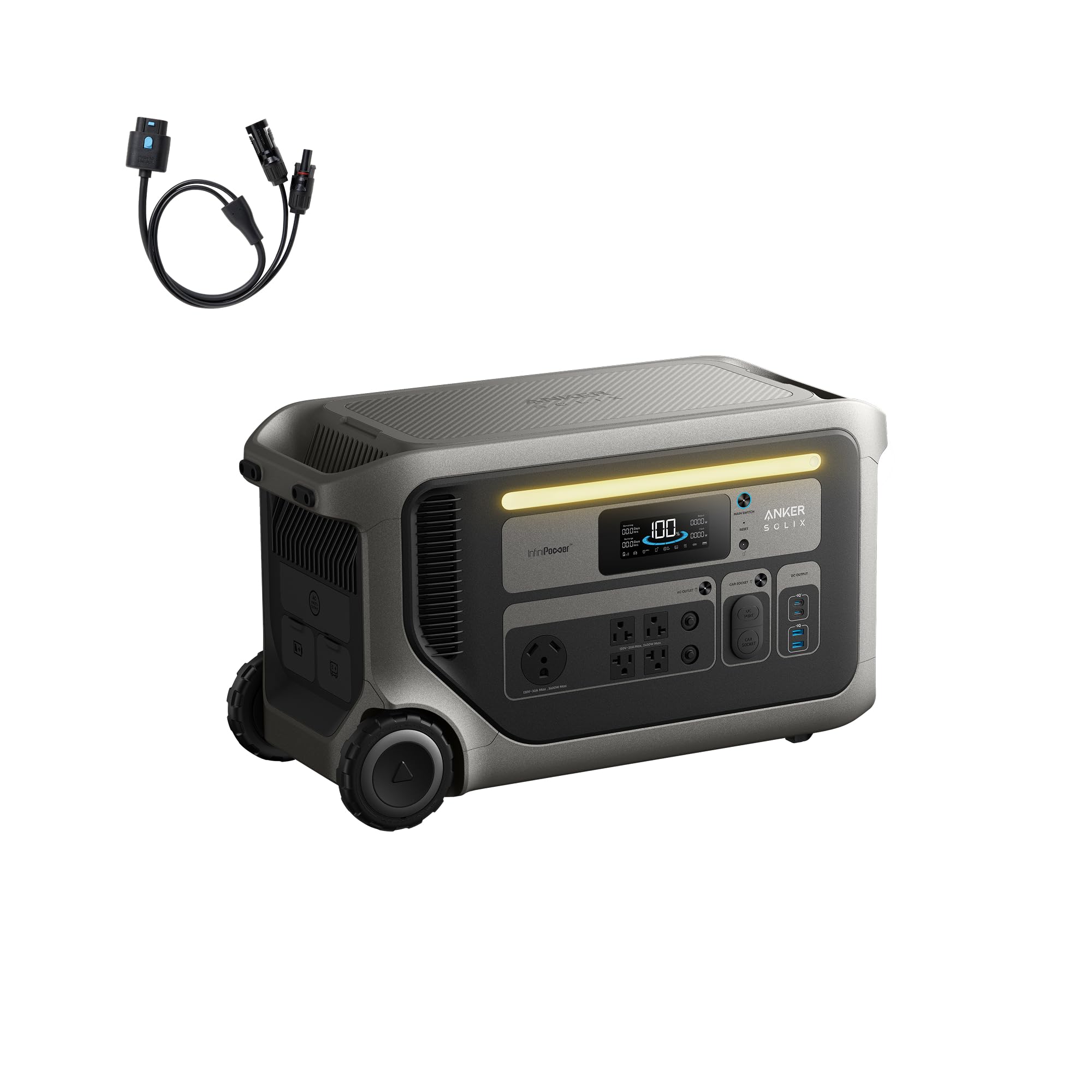
A rolling 3kWh wall that recharges off a generator while it powers the house
Most backup units make you choose between charging and powering. The Anker SOLIX F3000 does both at once, with 3,600W of pass-through charging — plug in a 120V fuel generator and run appliances at full power while the battery refills. That single feature is the reason this unit exists, and it is the one buyers keep mentioning. The 3,072Wh LiFePO4 starting capacity holds essential appliances for roughly 10 hours on its own, and it can expand to 24kWh with extra batteries, which Anker rates for up to 80 hours of outage coverage.
Standby waste here is nearly nonexistent. Anker rates 125 hours of AC idle standby, or roughly 42 hours of continuous runtime on a 190W fridge, thanks to an ultra-low idle draw — a real difference when every watt-hour counts in a multi-day outage. Solar input climbs to 2,400W across 165V or 60V ports, and the unit accepts 120/240V output depending on how you pair it. In a pinch, combining a fuel generator and solar hits a 6,000W recharge rate.
What earns the F3000 trust is straightforward reliability — owners use it for whole-home backup and report it handles serious loads. One buyer ran a 13,000 BTU rooftop RV air conditioner for six to eight hours on low cool. The honest reality check is the weight — this is where the unit gets its only negative aspect score. Buyers describe it as genuinely heavy even with the built-in wheels, and the Wi-Fi connection has a reputation for dropping, which means the app may not always reach it remotely.
What makes it different
- 3,600W pass-through charging from a generator while running appliances — no waiting for the battery
- Expandable to 24kWh with Anker batteries, so it can grow with the house
- 125 hours of AC idle standby and 42 hours on a 190W fridge keep the lights on longer
Where it costs you comfort
- 91.5 lb is a serious lift even on its wheels — plan a storage spot at floor level
- Wi-Fi dropouts mean the app cannot always reach the unit remotely
The right pick if: you already own a fuel generator and want to smooth out outages, cut noise, and add solar to the mix.
Different route if: you want backup without a generator — a station with more portable weight like the BLUETTI Elite 300 is easier to live with.
10. Jackery HomePower 3000 Portable Power Station, 3072Wh, 3600W AC Output
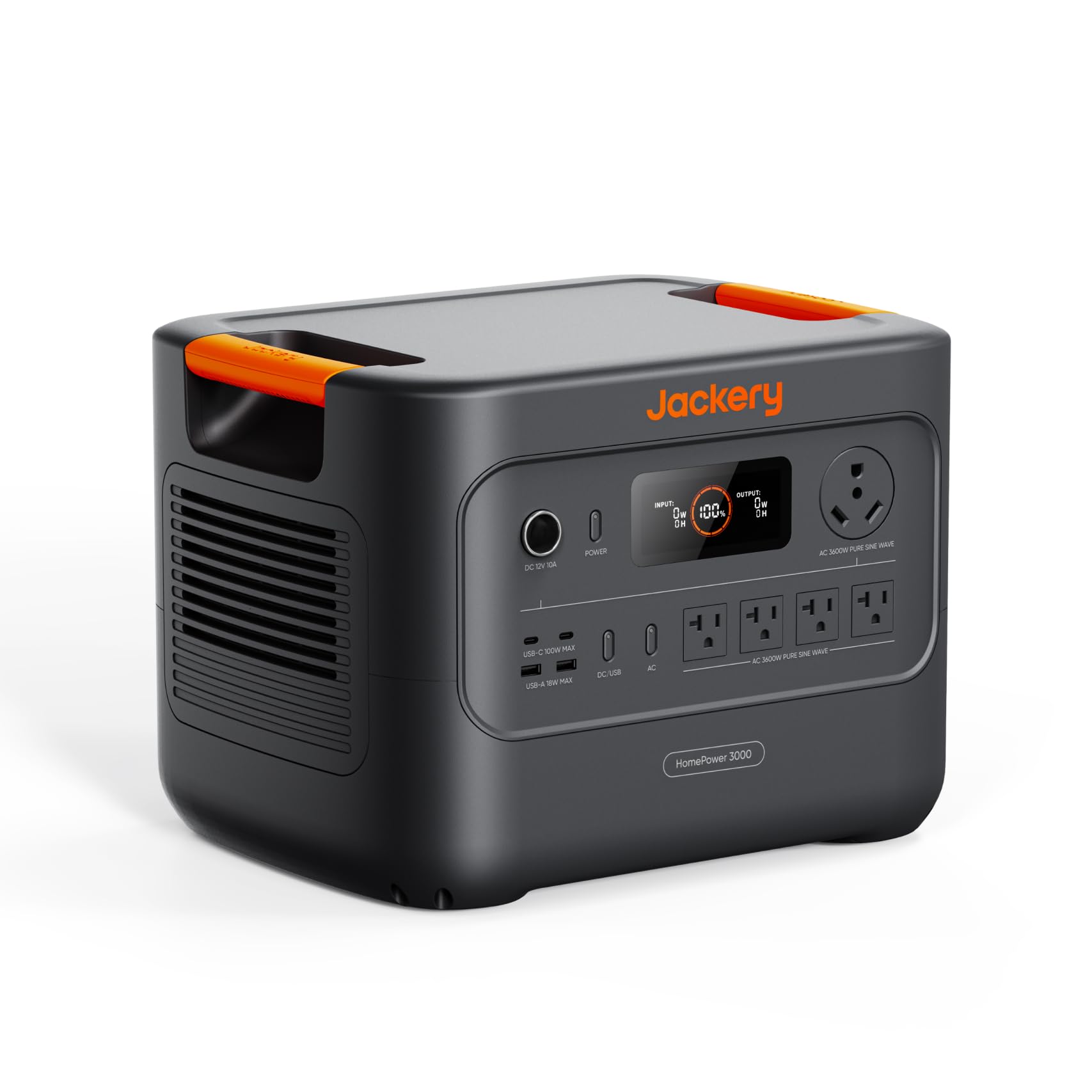
Three thousand watt-hours aimed squarely at multi-day home survival
For outright home survival, this is the pick built for it. The Jackery HomePower 3000 carries 3,072Wh of LiFePO4 capacity and 3,600W output with a 7,200W surge — enough to run a household for up to 15 hours and keep a refrigerator going for one to two days. The UL1778-certified UPS switches within ≤20ms, keeping security cameras, medical refrigerators, and Zoom calls alive through a storm without a reboot. Dual 100W USB-C PD ports fast-charge phones and drones, and a built-in TT-30 RV port gives camper owners plug-and-play power.
Recharging is fast for the class: full in 1.7 hours via hybrid AC and DC, or 2.2 hours via AC alone. Pair it with two 200W SolarSaga panels and you get to 80% in about nine hours of sun, and it also accepts a 12V car charger or a gas generator. Jackery’s ChargeShield 2.0 uses AI algorithms to boost charging speed and extend battery life, and the LiFePO4 cells are rated for 4,000 cycles while still holding 70% capacity.
Where reviewers point out it shines is raw performance and battery endurance — the unit carries office gear for days through an outage. The honest note is the fan: it hits about 60dB under any real load, which is too noisy for use as a permanent daily UPS beside a desk. Weight is the other real one — 59.5 lb with side grips covers short moves but is a two-person job up a flight of stairs.
The home-backup angle: 15 hours running household essentials and 1-2 days on a fridge is what a whole-house UPS should do in a real storm.
The honest catch: the fan runs noticeably under load and weight is close to 60 pounds — plan storage and placement accordingly.
Choose this if: you want a 3kWh home backup that can carry a house for a full day and a fridge for two.
Reconsider if: you need quiet daily desk-level UPS behavior — a smaller, quieter UPS unit is a better fit for that role.
11. EF ECOFLOW Portable Power Station 3600Wh DELTA Pro, 120V 3600W AC Output

A 3,600Wh power plant that thinks it is a whole-home battery system
When you need real whole-home muscle, the DELTA Pro plays in its own league. The 3,600Wh LFP battery starts at 3.6kWh and expands up to 25kWh with extra batteries and Smart Generators — meaning it can grow with your needs from outage protection into near-permanent power. A single unit puts out 3,600W AC, which expands to 4,500W with X-Boost, and pairing two units together reaches 7,200W. That is enough for the heavy-duty devices most stations cannot touch: heat presses, large appliances, big power tools.
Recharge is fast too — full in 1.8 hours on 240V outlets, 2.7 hours on standard 1800W wall current, or 2.8 hours with four 400W solar panels. EcoFlow rates the solar conversion efficiency at up to 23%. Fifteen output methods — including two USB-A, two USB-A Fast Charge, two USB-C 100W, five AC outlets, two DC outlets, one car port, and one Anderson port — let you power almost everything at once. The EcoFlow app works over Wi-Fi or Bluetooth for monitoring charge level, temperature, and charge/discharge timing.
Owners reach for this most confidently in mobile business setups — one buyer runs a heat press at vendor markets with no voltage drops. The honest limitation to know going in is weight, which is the one aspect buyers flag as negative. At 99 pounds, this unit needs a cart or a permanent home near the appliances it serves. Solar input is also capped at 15A, so a huge panel array cannot push more current than that.
Why it beats the field
- Starting at 3.6kWh and expanding up to 25kWh — the largest capacity ceiling in this roundup
- 3,600W AC output, 4,500W X-Boost, and up to 7,200W when paired with a second unit
- Five ways to charge, including 240V outlets, solar, car, EV station, and Smart Generator
What to weigh honestly
- 99 lb makes it a semi-permanent install rather than a grab-and-go station
- Solar input limited to 15A, capping compatible array size
For you if: you own heavy equipment, run a mobile business, or want a backup system that can grow toward whole-home capacity.
Overkill for: camping and light home backup where portability matters more than maximum wattage.
Understanding the Specs
Watt-Hours and Rated Watts
Watt-hours (Wh) measures how much energy a battery can store — your total fuel tank. Rated watts (W) measures how much power it can deliver continuously, which is the size of the spigot. A unit rated 2,400W can run an appliance that draws up to 2,400W while it runs, but the Wh total dictates how long. That is why a 2,048Wh station can keep a low-draw fridge running for tens of hours while a 153.6Wh UPS runs a 185W load for around three hours.
Surge Watts and Peak Output
Surge watts (or peak output) is the brief higher draw a motor- or compressor-driven appliance needs in the first moments after starting. A fridge compressor might need asurge of double its running wattage for a split second before settling. That is why units list both a rated number and a higher peak — like 2,400W rated with 4,000W peak, or 3,600W rated with 7,200W surge. If your appliance’s startup demand exceeds the surge figure, the unit shuts off to protect itself. Match the surge rating to your largest appliance’s startup draw.
Battery Chemistry: LiFePO4 vs Lead-Acid
LiFePO4 (lithium iron phosphate) is the battery chemistry used by nearly every modern power station here. It handles deep discharges, tolerates heat reasonably well, and is rated for thousands of charge cycles — one unit lists 5,000+ cycles and another 6,000+. Older sealed lead-acid UPS batteries cost less up front but are heavier, need replacing far more often, and typically run fewer deep cycles before losing capacity.
UPS Switchover Time and Sine Wave
UPS switchover time is how long a unit takes to jump from wall power to battery when the grid drops. Ten milliseconds is the fast end of this roundup and keeps computers and routers running without a hiccup. Twenty milliseconds is still fine for most home gear. Pure sine wave output means the electricity behaves like standard wall current; modified or stepped waveforms can make sensitive electronics misbehave, overheat, or shut down unexpectedly.
FAQ
How long will a power station keep a refrigerator running during an outage?
What is the difference between a UPS and a portable power station?
Does UPS switchover speed really matter for my computer?
Will a power station run a window air conditioner during a blackout?
How long do LiFePO4 batteries last in a backup power station?
Can I charge a power station with solar panels during a power outage?
Is a portable power station quieter than a gas generator?
How much capacity do I actually need for a home outage?
Can I expand the capacity of a power station later?
What happens if my appliance draws more than the station’s rated output?
Final Thoughts: The Verdict
For most homes, the battery for a power outage winner is the Anker SOLIX C2000 Gen 2 because it pairs a 2,048Wh LiFePO4 capacity with 2,400W rated output, a 58-minute full recharge, and a 9W standby draw that keeps a stored unit ready without slowly leaking empty. If you only need to protect a desk setup during short blips, the GOLDENMATE 1000VA/600W covers a home office quietly on LiFePO4 without the weight of a full station. And for heavy-duty whole-home backup where output wattage and expandability matter more than portability, the EF ECOFLOW DELTA Pro is the one to reach for — its 3,600Wh battery and 4,500W X-Boost output can grow to 25kWh as your needs do. The one honest nudge: decide first whether your priority is a light UPS you can tuck under a desk or a bulkier station that can run the fridge — buying for the smaller job and expecting the bigger one is the mistake we see most. Once the job is clear, the picks above cover every tier.
How We Picked
We do not accept paid placement. Every pick is matched to a real buyer and a real use-case; we do not hands-on test units.
Sources & Methodology
Specifications: manufacturer listings and product documentation. Review insights: verified customer reviews, as of September 2026. Pricing: not shown on this page (it changes often); check the current price via the retailer link.
As an Amazon Associate, KitchPrep earns from qualifying purchases. This does not affect which products we feature.
Related Guides
