
Specs are compiled from manufacturer listings and verified buyer reviews and can change over time — please confirm the key details on the product page before buying.
Tight corners are where a full-size angle grinder gives up — you cannot reach a weld bead inside a roll cage or a gasket surface you can hardly see. The fix is a cordless die grinder, and the Milwaukee 2486-20 M12 FUEL is the one to buy first: 24,500 rpm, the highest rating in this lineup, and just 1.2 lbs. The rest of this list covers the kits that hand you batteries and discs on day one, the 18V bruisers built for heavy weld dressing, and the premium options that let you leave the compressor switched off for good.
I’m Mohammad Maruf — the founder and writer behind KitchPrep. This guide is built by comparing the manufacturers’ published specifications and the patterns across verified customer reviews, so you get each pick’s real strengths and trade-offs instead of marketing spin.
Every pick below is judged on the things that actually decide a cordless die grinder: how fast the motor spins, whether the collet (the clamp that grips your 1/4-inch accessory shank) holds tight, and how long the battery really lasts under load. A cordless grinder trades some raw muscle for freedom from the hose, so the picks here hold real grinding speed without an air line. That trade-off is exactly what separates a good battery die grinder from one that stalls the moment you lean on it.
Our Picks at a Glance

How To Choose The Best Battery Die Grinder
Motor size is the number first-time buyers stare at, and it is the wrong one. A die grinder is a precision tool, and the two numbers that decide your results are how fast the spindle turns and whether the collet keeps a death-grip on your bit under load.
Spindle Speed Sets Your Cutting Speed
Check this number first, because it sets how fast you finish the job. A die grinder spinning at 25,000 RPM cuts through metal faster than one at 15,000 RPM, so a rusty weld seam clears in seconds instead of minutes. But higher RPM also means more heat and faster disc wear, so variable or multi-speed control lets you dial down for delicate work instead of scorching your material.
Collet Size and Condition
Nearly every tool here uses a 1/4-inch collet — that is the standard shank size for carbide burrs (hard metal cutting bits), flap wheels (layered sanding wheels) and cutoff discs. The collet is a wear part. It grips tight when new and slowly loosens with use, so a snapped or slipping collet is the most common real-world failure on any die grinder.
Battery Platform Lock-In
Already own Milwaukee, Makita, Ryobi or Bosch batteries? Then a bare tool that shares that platform saves you money and keeps you on one charger — one charger on the bench instead of two. Starting from nothing? A kit that includes two batteries gets you running the same day.
Quick Comparison
| Model | Best For | Max Speed | Power / Motor | Batteries Included | Amazon |
|---|---|---|---|---|---|
| Milwaukee 2486-20 M12 FUEL★ Best Overall | Overall precision work | 24,500 rpm | 0.3 HP Brushless | No (Tool Only) | Amazon |
| PropeLannt MGE890 (M18 Compatible)Best Value | Budget M18 owners | 25,000 rpm | Brushless | No (Tool Only) | Amazon |
| SEESII DG21 ProBest Starter Kit | Complete starter kit | 24,500 rpm | 0.4 HP Brushless | 2 x 2000mAh | Amazon |
| RYOBI PSBDG01B ONE+ HP | Ryobi platform owners | 22,000 rpm | Brushless | No (Tool Only) | Amazon |
| Bosch GWG12V-20SN | Compact precision | 15,000 rpm | Brushless | No (Tool Only) | Amazon |
| Makita XDG01Z | Field and site work | 25,000 rpm | Cordless | No (Tool Only) | Amazon |
| Milwaukee 2784-20 M18 FUEL | Heavy material removal | 20,000 rpm | Brushless | No (Tool Only) | Amazon |
| Bosch GWG12V-20SB23 Kit | All-day cleanup kit | 15,000 rpm | Brushless | 2 x 3Ah | Amazon |
In‑Depth Reviews
1. Milwaukee 2486-20 M12 FUEL Lithium-Ion In line Die Grinder (Tool Only)
Our pick — over 4.5★ from 650+ verified ratings; the strongest balance of quality and price.
The bench tool that spins to 24,500 rpm and pulls you out of impossible tight corners.
This is the one that reaches into a roll cage and grinds a weld bead you can barely see. Its straight shaft turns a 1/4-inch accessory (the standard shank size for burrs, wheels and discs) at up to 24,500 rpm — fast enough to keep a flap wheel cutting instead of smearing. At 1.2 lbs it is the lightest tool here, and that weight matters most after the tenth minute of holding it upside down.
Its 0.3 HP motor is rated by Milwaukee at 20% more output than a pneumatic grinder (one powered by compressed air). That is a real advantage because you are not dragging an air hose or waiting on a compressor to catch up. You get four RPM modes (revolution settings — how many times the spindle turns per minute) plus a variable-speed trigger, so you can drop to a crawl for a delicate burr pass and open it up to clear material. It runs on the M12 battery you may already own from other tools in that line.
What wins people over is the build quality — the kind that gets talked about constantly in the review pages — followed by how adjustable that speed control feels in the hand. An industrial mechanic who runs this as an everyday tool noted the collet grips tight when new but loosens over time, and that it is best treated as a light-DIY-and-hobby unit rather than a replacement for a pneumatic die grinder. That is an honest ceiling worth knowing before you buy. The Milwaukee 2486-20 is the only pick here that lands the whole package of speed, precision and compact size at once — it spins faster than the Bosch GWG12V-20SN, whose 15,000 rpm is built for control instead.
What Owners Applaud
- 24,500 rpm max speed outruns the 22,000 rpm RYOBI and the 15,000 rpm Bosch compact options
- 1.2 lbs makes it the lightest tool in this lineup — 1.3 lbs lighter than the 2.5 lb SEESII kit
- Four-mode RPM control plus variable-speed trigger for everything from a delicate burr to full-material removal
Where It Gives Ground
- Runs through battery faster than a corded or M18 tool, and it is not built for heavy load — it can bog on thick cuts over 1/16-inch metal
- The collet loosens over years of use, so plan to replace it eventually
Choose This If: You wrench in tight spots and want the most precise, fastest-spinning cordless option in this lineup.
Think Twice If: You are hogging material off thick steel all day — the M18 or a pneumatic will hold up better under that load.
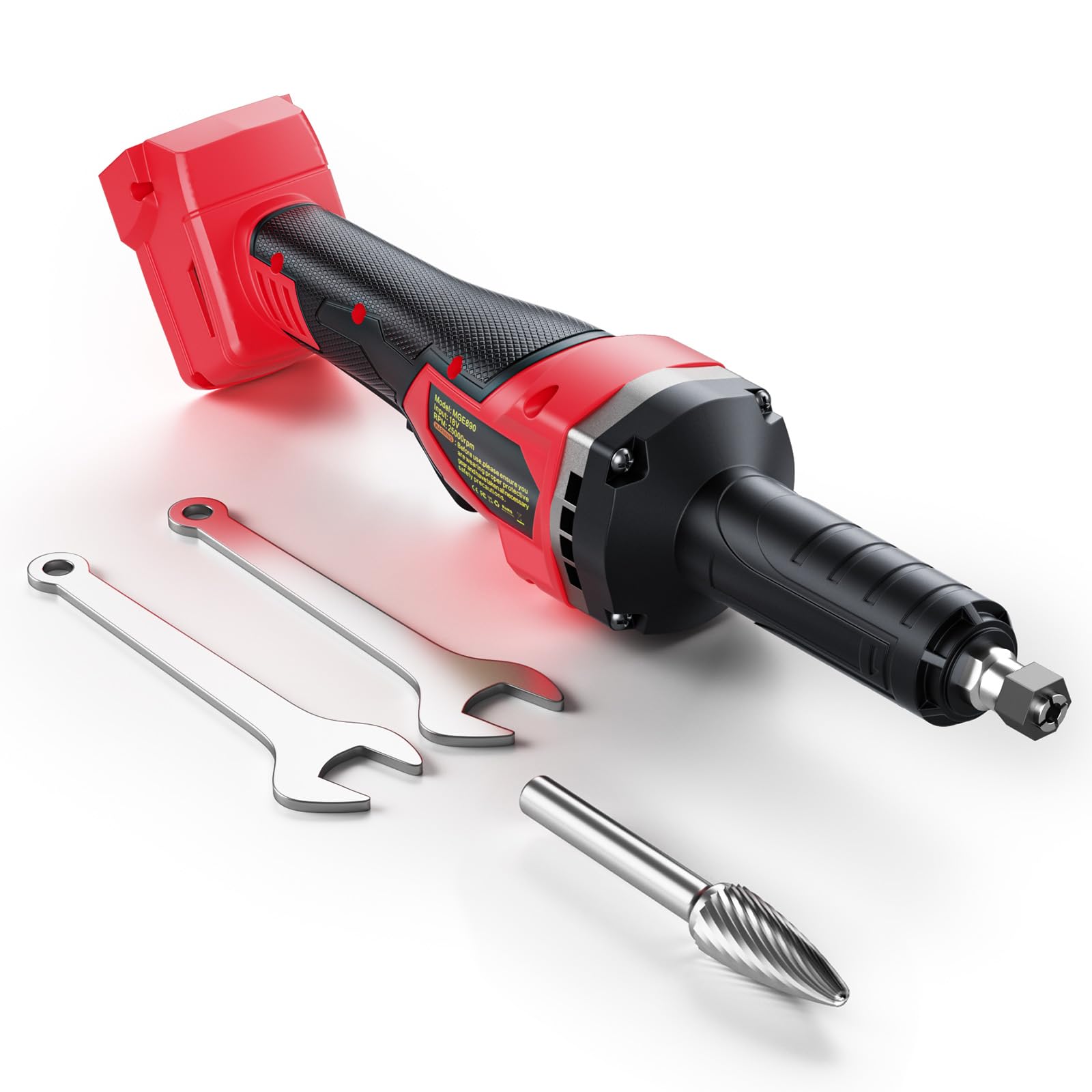
2. Die Grinder Compatible with Milwaukee 18V Battery 1/4″ Collect 25000RPM
Spins at 25,000 rpm — the fastest here — for a fraction of the name-brand price.
If you already own Milwaukee 18V batteries and want a die grinder for the price of a bare accessory, this is the one to look at. Its brushless motor (one with no carbon brushes to wear down) turns at 25,000 rpm — that tops the 24,500 rpm Milwaukee 2486-20 and the 22,000 rpm RYOBI above. That brushless design runs cooler and, per the maker, delivers 25% longer runtime than a brushed motor.
You get a 1/4-inch collet, a built-in power protection system that shuts down on overload, low voltage, overheating and short circuits, and a bonus carbide tungsten grit grinding bit in the box. Buyer after buyer reports it fires up and runs smoothly on Milwaukee batteries, and it eliminates the compressor entirely for small cleanup jobs. The RPM is high, the price is entry-level, and it handles metal and wood without complaint.
This is a tool for the occasional user. It has the lowest rating in this group, and one report describes it losing its spin when pressed against thicker aluminum track with a cutoff blade — this is not a heavy production machine. Buyers report it handled rivets, metal shaping, and weld spatter just fine when the pace stayed reasonable. For a spare bench grinder sitting next to a compressor you no longer want to start, this gets you there cheaply.
Best For Weekend Cleanup: Deburring, weld spatter removal, and quick wood carving when you already own the batteries.
The Honest Catch: It wants a 4Ah or larger battery to perform well, and it lacks the torque for extended heavy cutting.
Reach For This If: You have spare Milwaukee 18V packs and want a spare grinder without spending name-brand money.
Look Past It If: Your work is production-level grinding on thick stock — it lacks the staying power for that.
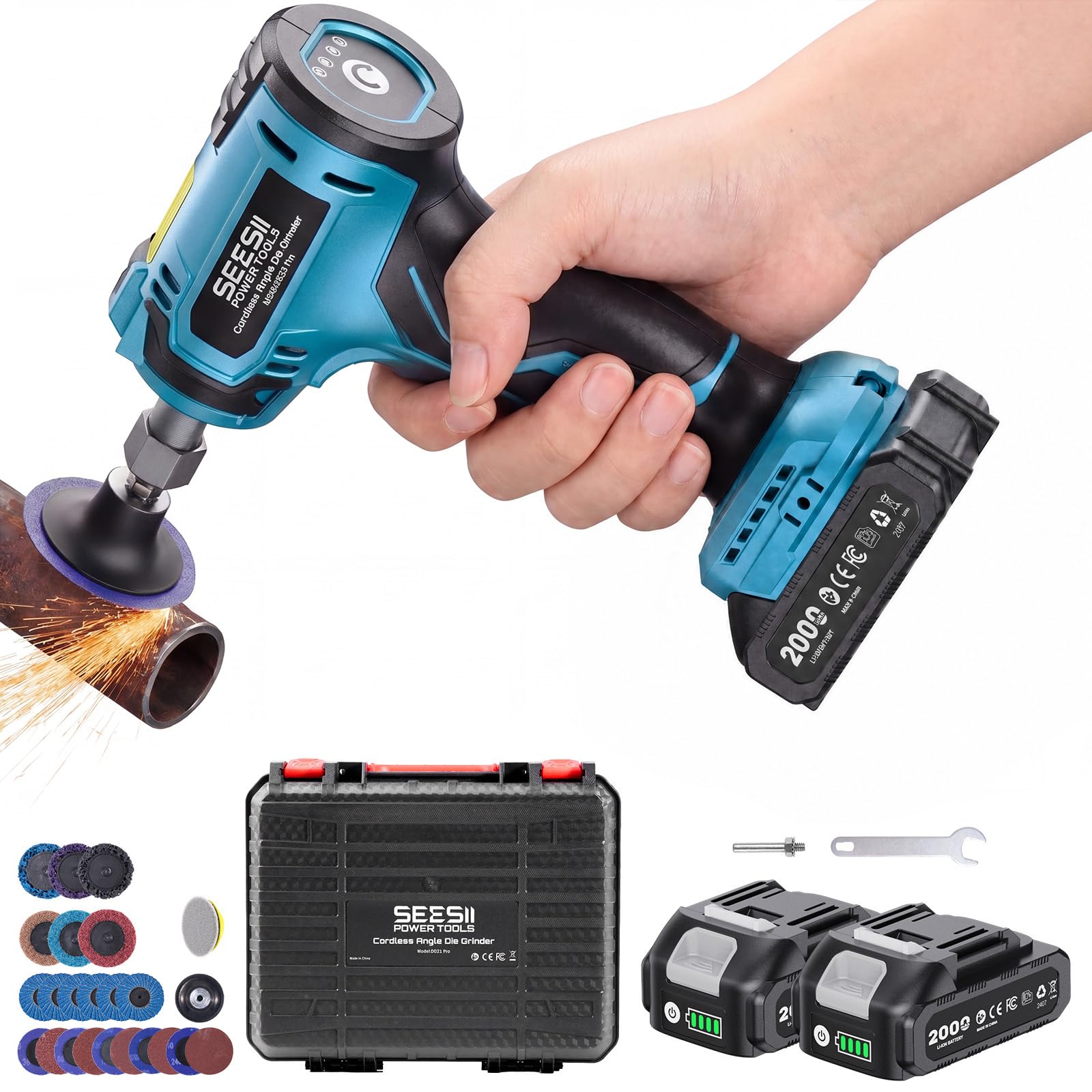
3. SEESII 1/4″ Right Angle Die Grinder Kit w/ 2 Batteries, 23PCS 2″ Accessories
Open the case and grind — batteries, discs and a 0.4 HP motor, all in one box.
Everything you need to start working is in this box, so you do not add a second purchase before your first cut. It comes with two 2000mAh batteries (mAh is milliamp-hours — a capacity rating, so a bigger number means a longer run per charge) and a charger, plus a 23-piece 2-inch accessory kit — flap discs, sanding discs, non-woven wheels, diamond discs and a wool polishing wheel. The 0.4 HP brushless motor is the most powerful here, edging the Milwaukee M12’s 0.3 HP and hitting up to 24,500 rpm.
It is a 90-degree right-angle body — meaning the head sits perpendicular to your hand — so it reaches under a car or into tight engine bays at angles a straight-shaft tool cannot match. Four speed settings let you start at 10,000 rpm for tough metal and ramp to 24,500 rpm for polishing. Those two batteries together give a combined 40 to 50 minutes of runtime, so you swap one out mid-job instead of stopping.
What buyers point to first is quality, closely followed by how it performs — it holds speed through deep grinding without stalling for most owners. But it is the heaviest tool here at 2.5 lbs, more than double the 1.2 lb Milwaukee. It also carries a warning: the tool gets hot and hits its thermal limit if you run it continuously, so pace your work and keep your hand off the motor’s air slots.
Why It Earns Its Place
- Only pick here that includes two batteries, a charger and 23 accessories
- 90-degree right-angle head reaches under a car and into tight engine spaces
- Highest power rating of the group at 0.4 HP, backed by a three-year manufacturer warranty
Worth Knowing Before You Buy
- At 2.5 lbs it is the heaviest tool here, so long sessions take a toll on your wrist
- Run it continuously and it will hit a thermal limit and need to cool
The Clear Pick If: You want to start grinding the moment the box arrives without buying batteries separately.
skip it if: You already own a strong battery platform or need the lightest possible tool for overhead work.
4. RYOBI ONE+ HP 18V Brushless Cordless Compact 1/4 in. Right Angle Die Grinder (Tool Only)

Turns any ONE+ stack of batteries you already own into a 22,000 rpm right-angle grinder.
Ryobi owners get a cordless die grinder here without buying into a new battery system — that is the whole reason this pick exists. Owners mention it holds speed on the top two of its four settings and does not stall under load.
For rust removal with a wire wheel, weld cleanup, and surfboard repair work, owners reach for it over their pneumatic grinders because there is no hose and no compressor. It has an integrated spindle lock (a built-in brake that holds the shaft so one wrench swaps accessories), plus a variable-speed trigger. Ryobi rates it at up to 2 times the power of a pneumatic grinder, and owners who run both say it keeps pace.
The one thing to check on arrival is the collet — a report describes a defective unit where a 1/4-inch bit would not seat at all, though this reads as a rare manufacturing miss rather than a design flaw. Customers note the performance and the four speed settings are the two things they bring up most, with welding projects getting the heaviest use. Its 22,000 rpm sits below the 24,500 rpm Milwaukee 2486-20, so if top-end spindle speed is the deciding factor, look there instead.
Honest Read: A genuinely strong right-angle grinder with a lower max speed than the Milwaukee or Makita, offset by real torque and four usable settings.
One Thing To Check: Confirm your 1/4-inch bits seat cleanly in the collet before your return window closes.
Right For You If: You own RYOBI ONE+ batteries and want a cordless right-angle grinder without buying a new platform.
Consider Alternatives If: You need the top-end RPM for high-speed precision work — the Milwaukee or Makita above spins faster.
5. Bosch GWG12V-20SN 12V Max Brushless 1/4 In. Right Angle Die Grinder

A 1.2 lb right-angle grinder built to reach where a full-size tool never fits.
Some jobs are more about reaching than grinding, and at 1.2 lbs with a small grip, this tool slips into gaps a bigger angle grinder cannot enter. The right-angle head keeps the tool body out of your line of sight, so you can actually see the cut. It tops out at 15,000 rpm — well below the 25,000 rpm cordless options — so it is built around control, not raw speed.
The control features are where it shines. Five speed options sit at your fingertips alongside a status display showing tool, battery and speed, plus a variable-speed trigger and a brake system that stops the wheel quickly. That brake matters in tight work, because the wheel stops spinning before you set the tool down. A spindle lock makes accessory swaps quick, and the brushless motor stretches battery runtime. An owner who compared it against the Milwaukee 12V called the Bosch the smoother, more refined tool, lighter and more compact.
What to weigh honestly: this is a light-duty machine. It handles deburring and Roloc pads well, but it will not hog material with a carbide cutter the way an 18V tool would. Battery compatibility draws mixed reactions, which mostly depends on whether you are already in Bosch’s 12V system. It is also the priciest per-RPM pick here, so buy it for the compactness, not the speed.
The Compact Advantage
- 1.2 lbs and a small grip make it the most maneuverable right-angle option here
- Five speed settings with a battery and speed status display
- Brake system stops the wheel fast — a safety plus in tight work
Where It Falls Short
- 15,000 rpm max is the slowest here — it will not hog material like an 18V tool
- Battery compatibility depends on whether you already own Bosch 12V packs
Buy It For: Precision, reach and comfort in confined spaces where control beats brute speed.
Not For: Heavy material removal on thick metal — step up to an 18V machine for that job.
6. Makita XDG01Z 18V LXT Lithium-Ion Cordless 1/4″ Die Grinder, Tool Only
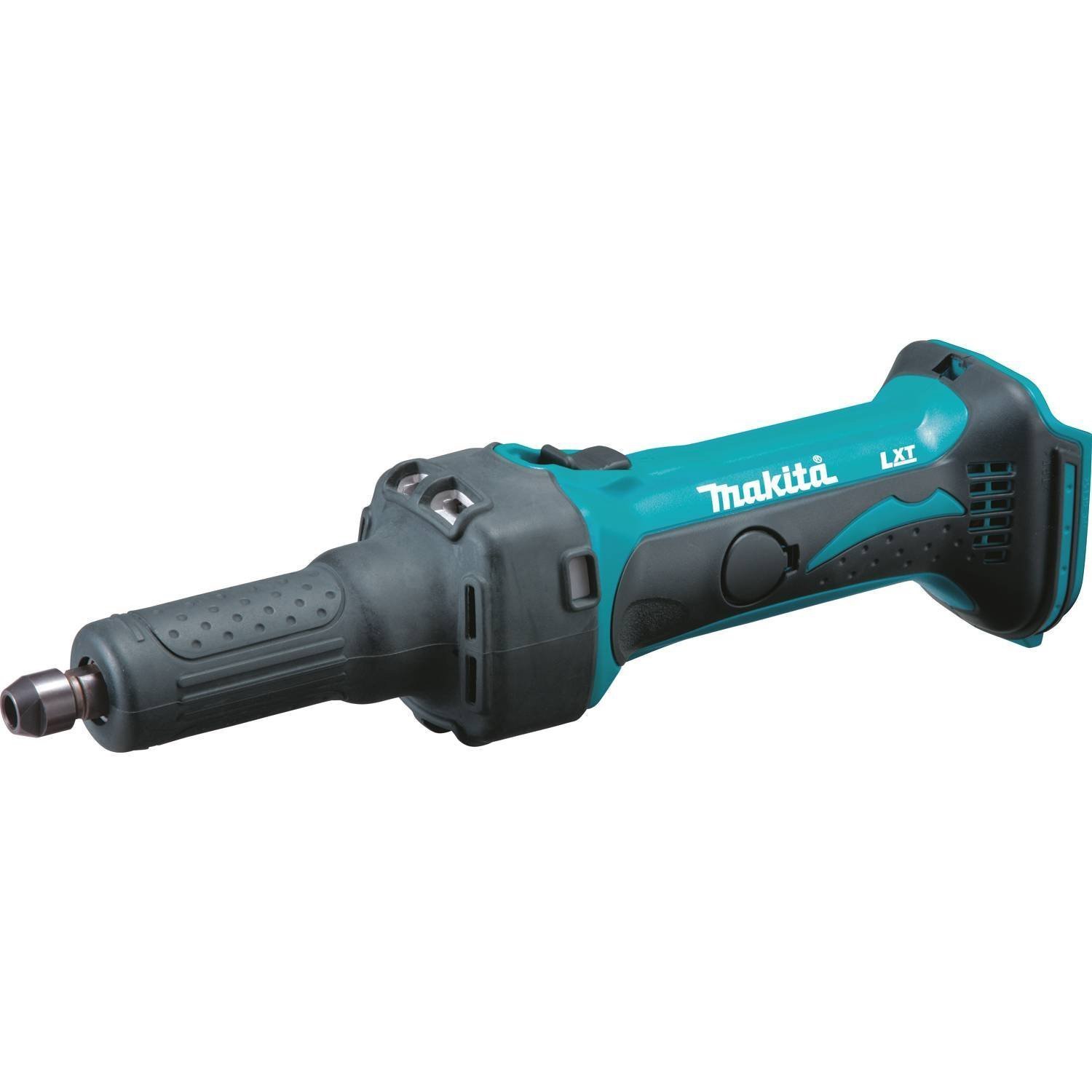
The 25,000 rpm site tool that goes up in the boom instead of dragging an air line.
The tradesperson making a last-minute fix on site is who this tool is aimed at. It runs to 25,000 rpm, matching the fastest tools here, and it is built for real field abuse. A buyer who uses it to hone out holes in red iron and deburr field cuts called it perfect for those quick fixes when you are up in a boom. It also replaced a pneumatic grinder (an air-powered tool) for another owner, who found it quieter with less hassle.
The compact barrel grip and slide switch with lock-on make it comfortable to run for long stretches, so your hand does not cramp on a long pass. The vent slots are angled to blow exhaust air away from your hands. A built-in LED protection circuit with over-torque control guards the motor, and the light flashes red when the battery needs a charge. The 5Ah battery lasts most jobs, and swapping spares keeps you moving.
Two honest snags stand out. Battery life is mixed — it will run through packs quickly on continuous work, so carry spares. And the brush caps reportedly fall out and refuse to stay seated, an annoyance one owner solved with tape. It is also occasionally too big to squeeze into the tightest spots. Neither is a reason to pass, but both are worth knowing before you commit.
The Site-Tool Case: Fast 25,000 rpm spindle, a compact barrel grip, and a lock-on switch built for one-handed field adjustments.
What To Plan Around: It drains batteries fast on long sessions and the brush caps can work loose — pack spares and a roll of tape.
The Right Call If: You work off a truck and need reliable, fast cordless grinding with no air line.
Second-Guess It If: You want a light bench tool — at 4 lbs it is heavier than the compact picks here.
7. Milwaukee 2784-20 M18 FUEL 1/4″ Die Grinder, Brushless (Tool Only)

The 18V bruiser for cutting welded parts and hogging real material.
When the job is material removal rather than precision, this is the tool to grab. Its POWERSTATE brushless motor is built for corded-level performance with carbide burrs and flap wheels up to 3 inches, and Milwaukee rates the brushless design at up to 10X the tool life of a brushed motor because it has no wearable components. A long-term owner reports it never stalls even under body weight and cuts welded parts and hydraulic hoses that stop lesser tools.
It runs at 20,000 rpm, and with the M18 REDLITHIUM XC5.0 battery pack (sold separately) it delivers over 20 minutes of grinding. That is enough to dress a whole run of welded joints without hunting for a charger. The same owner found a 9Ah pack never died during non-stop work. REDLINK PLUS electronics handle communication between battery and tool for protection and performance. It fits all 1/4-inch shank accessories.
The trade-off is built into its design. It has a fixed 20,000 rpm speed with no variable control, so it cannot slow down for delicate work — several buyers wish it had one. It is also heavy and large, limiting its reach into tight spaces, and its power and performance draw mixed reactions from owners pushing it hard. Where the 1.2 lb Milwaukee 2486-20 slips into tight corners, this one is built to eat thick steel. This is a high-output machine, not a finesse tool.
The Power Argument
- 20,000 rpm brushless motor built for corded-level performance on carbide burrs and 3-inch flap wheels
- Over 20 minutes of grinding on an XC5.0 pack, and far longer on a 9Ah
- Never stalls under load, even cutting welded parts and hydraulic hose
The Finesse Cost
- Fixed 20,000 rpm with no variable speed — awkward for detailed or delicate passes
- Heavy and large, so it struggles in tight spaces where the compact picks shine
Built For You If: You cut and grind heavy steel and want cordless power that never bogs down.
Wrong Tool If: You need fine speed control for detailed work — its single 20,000 rpm speed is not adjustable.
8. Bosch GWG12V-20SB23 12V Max Brushless 1/4 In. Right Angle Die Grinder Kit with (2) 3 Ah Batteries
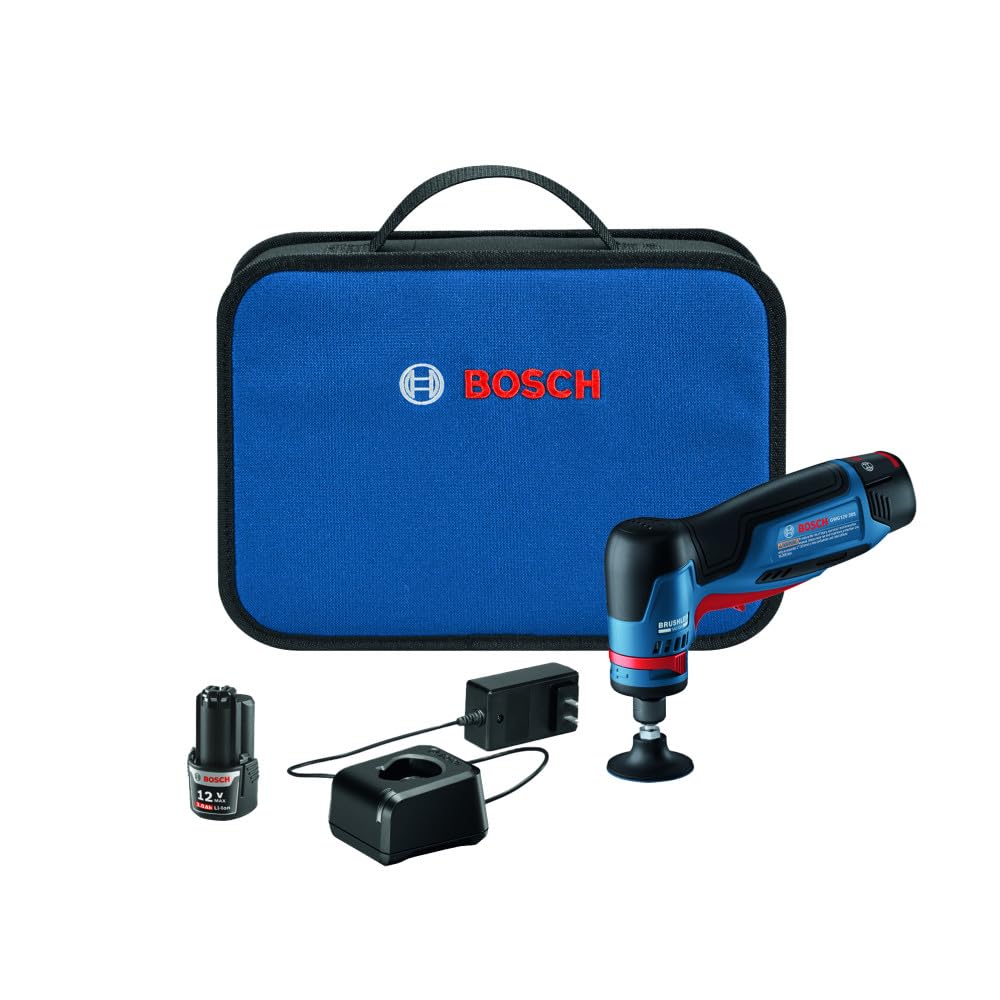
Two 3Ah batteries, five speeds, and the control to sand for hours without fatigue.
Two 3Ah batteries and a charger come in this box, so you can sand from the moment it lands — no separate battery purchase, no waiting. It ships with the grinder, collet, nut, 17mm wrench and a carrying bag. Like its sibling it runs to 15,000 rpm and uses the same five-speed interface with a status display showing tool, battery and speed readings. The brushless motor stretches runtime across extended sanding sessions.
The functionality is the headline — it is what owners single out first, with the power it puts through a scuff pad coming second. Someone using it on cylinder heads and old gasket removal was surprised by how many tasks it opened up, and a woodworker who shaped rough bowl blanks for hours a day found it light enough to avoid fatigue. Where the tool-only Bosch is a compact precision pick, this kit makes it a full workday companion.
The catch is battery duration on long sanding runs. One owner reports roughly 15 minutes per charge while sanding — enough for a gasket cleanup, less so for a full afternoon of shaping. A Dewalt adapter stretched that considerably, at the cost of bulk and access to narrow spots. If most of your work is light cleanup, the batteries go the distance; if you are grinding hard for hours, plan on a higher-capacity pack. For fit, finish and control it earns its premium standing.
what separates it: A five-speed compact right-angle grinder with two included 3Ah batteries and a carrying bag — ready the moment it lands.
Where It Asks Patience: Heavy continuous sanding drains a charge quickly, so a bigger battery is a smart add-on for long jobs.
Made For You If: You want a controlled, low-fatigue right-angle grinder for sanding, cleanup and detail work with batteries included.
Look Elsewhere If: Your day is non-stop heavy grinding — the battery drain will keep you tied to the charger.
Understanding the Specs
RPM and RPM Control
RPM stands for revolutions per minute — how many times the spindle spins in a minute, and it sets how fast your accessory cuts. A 25,000 rpm tool removes material faster than a 15,000 rpm one, so a weld seam clears quicker. But higher speed also generates more heat and wears discs quicker. Multi-speed or variable control lets you slow down for a delicate pass and speed up to clear metal, so a 4-mode or 5-speed tool tends to be more versatile than a single-speed design.
Collet and Battery Platform
The collet is the clamp that grips your accessory’s shank — nearly all tools here use the standard 1/4-inch size for carbide burrs, flap wheels and cutoff discs. It is a wear part that tightens when new and loosens over time, so treat it as replaceable. Battery platform is the other big one: a bare tool that runs on packs you already own saves money, while a kit with included batteries gets you started immediately.
FAQ
What is the difference between a die grinder and an angle grinder?
Will a battery die grinder replace my pneumatic die grinder?
Which battery platform should I commit to?
What size accessories fit these grinders?
How long do the batteries actually last while grinding?
Can a 12V die grinder do real metal work?
What does variable speed control do for me?
Do I need eye and lung protection when grinding?
Why does my die grinder stall or bog down under load?
Final Thoughts: The Verdict
The pick most people should reach for first is the Milwaukee 2486-20 M12 FUEL — it spins faster than almost everything here at 24,500 rpm, weighs just 1.2 lbs, and it is the crowd favorite that thousands of owners have put through real shop work. If you want everything in one box on day one, the SEESII right-angle kit hands you two batteries
Related Guides
