
Specs are compiled from manufacturer listings and verified buyer reviews and can change over time — please confirm the key details on the product page before buying.
You want a CO2 monitor that runs on batteries so it keeps watch even during a power cut or in a spot without an outlet. The catch is that the best one for you depends on one thing: do you want a simple alarm that tells you to open a window, or a full air-quality station that tracks trends on your phone? This guide cuts through the noise to show you which battery-powered models actually earn their place on your shelf and which ones have quirks you will not want to live with. It adapts to human-like matching, so not every pick is the exact same size or style, but every one here runs on battery power.
I’m Mohammad Maruf — the founder and writer behind KitchPrep. This guide is built by comparing the manufacturers’ published specifications and the patterns across verified customer reviews, so you get each pick’s real strengths and trade-offs instead of marketing spin.
CO2 monitors are a wellness upgrade, not a safety requirement like smoke detectors. Find the right battery co2 alarm that tells you when to crack a window and when to keep the room sealed.
Our Picks at a Glance

How To Choose The Best Battery CO2 Alarm
You want a CO2 monitor that fits your room and your routine, not one packed with features you will never use. Before you buy, decide how you will power it, how often you want it to beep, and if you need data beyond the on-screen number.
Sensor Technology: NDIR versus Photoacoustic
The sensor inside decides how accurate and how pricey the monitor is. NDIR sensors (which use an infrared light beam to measure how much CO2 absorbs the light) are the industry standard for stable, long-lasting readings. Photoacoustic sensors, like the Sensirion PASens tech in a few picks here, measure the pressure change when light hits CO2 molecules — they are also precise but more compact and energy-efficient, which is why portable units use them.
Power Source and Battery Life
Battery-powered monitors let you put them anywhere, but check what “battery” really means. A built-in lithium pack (like a 1000mAh or 2500mAh one) is handy, but you have to remember to charge it. A model that takes standard AAA batteries can run for months on one set, with no charging to think about.
Alarm Systems and Alert Customization
An alarm only helps if you can hear it without it driving you mad. Pick a model where you can set the CO2 level that triggers the beep, and check if the volume is adjustable or can be muted — some units have a piercing siren you cannot turn off.
Quick Comparison
| Model | Best For | Sensor Type | Power Source | CO2 Range | Amazon |
|---|---|---|---|---|---|
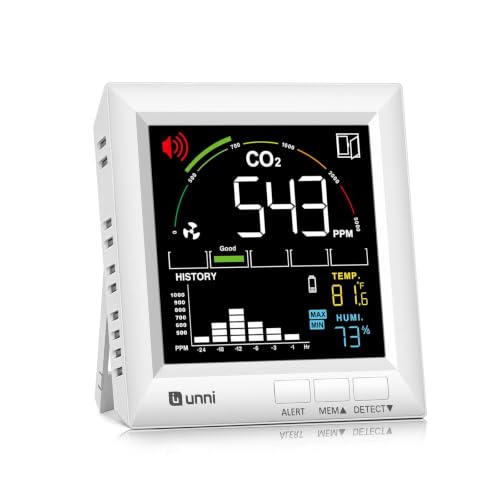
| U UNNI CO2 Monitor★ Best Overall | Compact home wall-mount use | Photoacoustic | USB + 3xAAA Backup | 400-5000 PPM | Amazon |
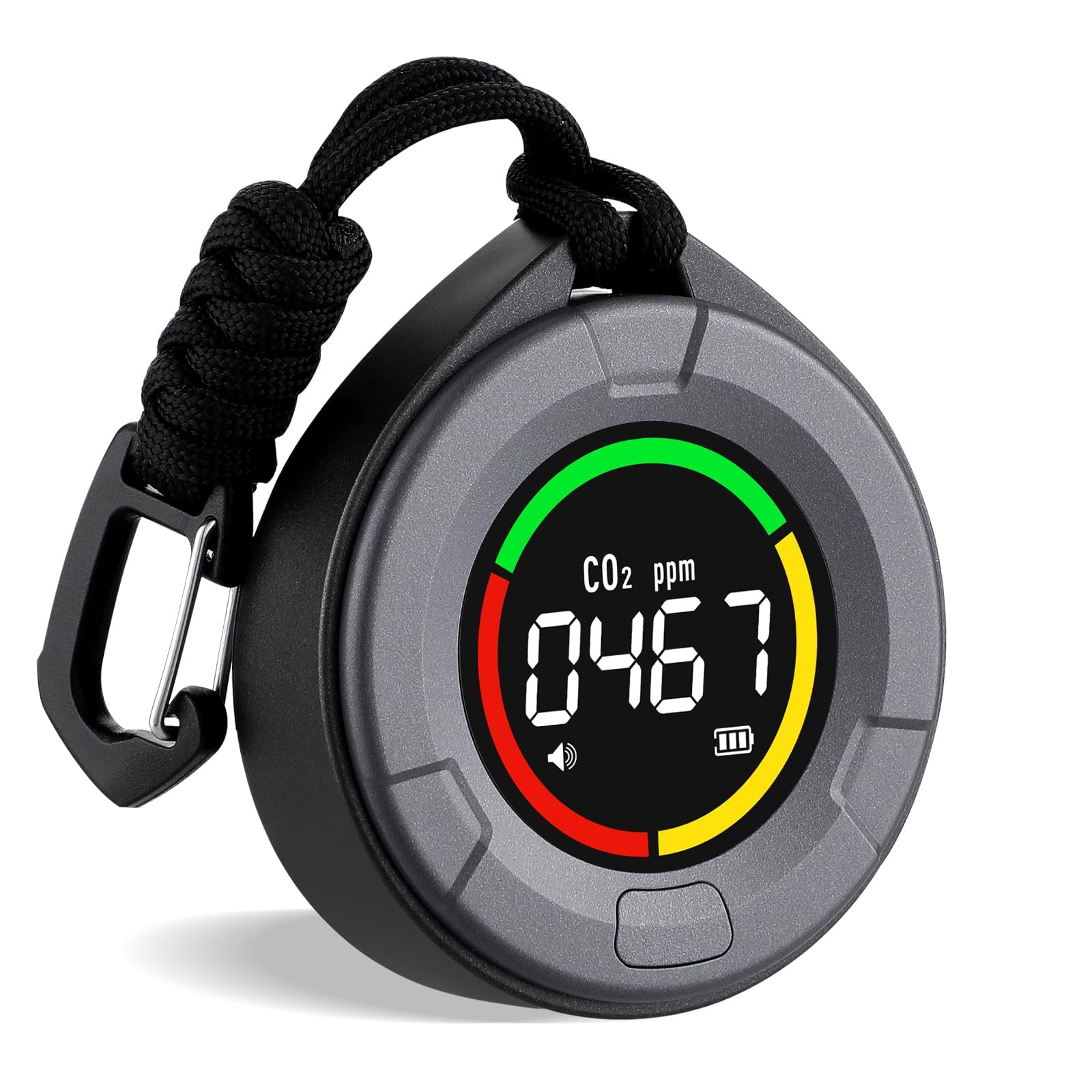
| INKBIRDPLUS PTH-10CMost Portable | Travel-ready portability | NDIR (Photoelectric) | Built-in 1000mAh Battery | 400-5000 PPM | Amazon |
| Newentor C1Best Value | Multi-function clock display | PASens (Photoacoustic) | USB + AAA Backup | 400-5000 PPM | Amazon |
| LifeBasis 11-in-1 | Broad pollutant coverage | NDIR + Laser | Built-in 2500mAh Battery | Not specified | Amazon |
| SwitchBot Meter Pro | Smart home connectivity | NDIR | Built-in Battery (12 mos) | 400-9000 PPM | Amazon |
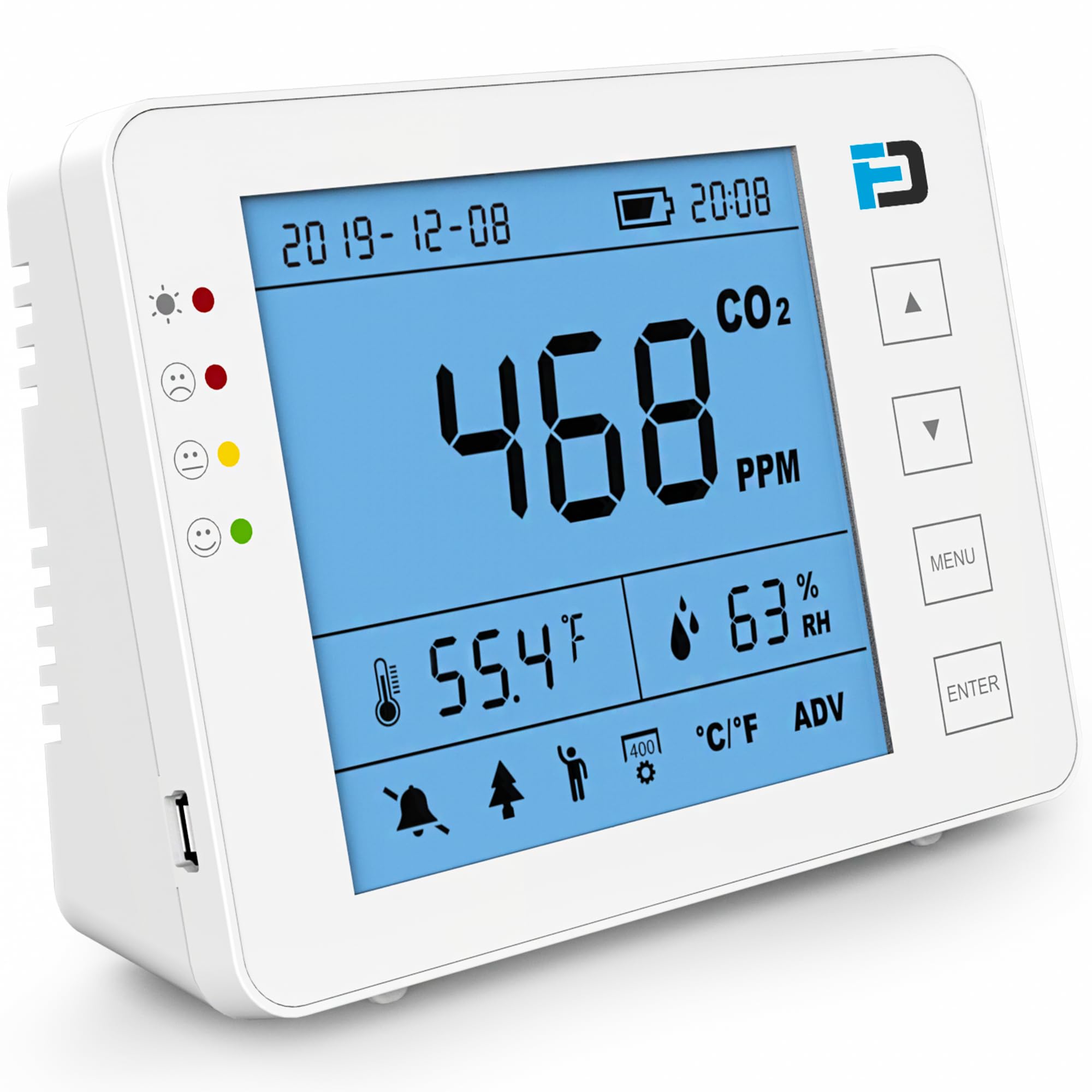
| Forensics FD-CO2000 | Classroom compliance | NDIR | Built-in Li-Ion + USB | Not specified (1ppm sensitivity) | Amazon |
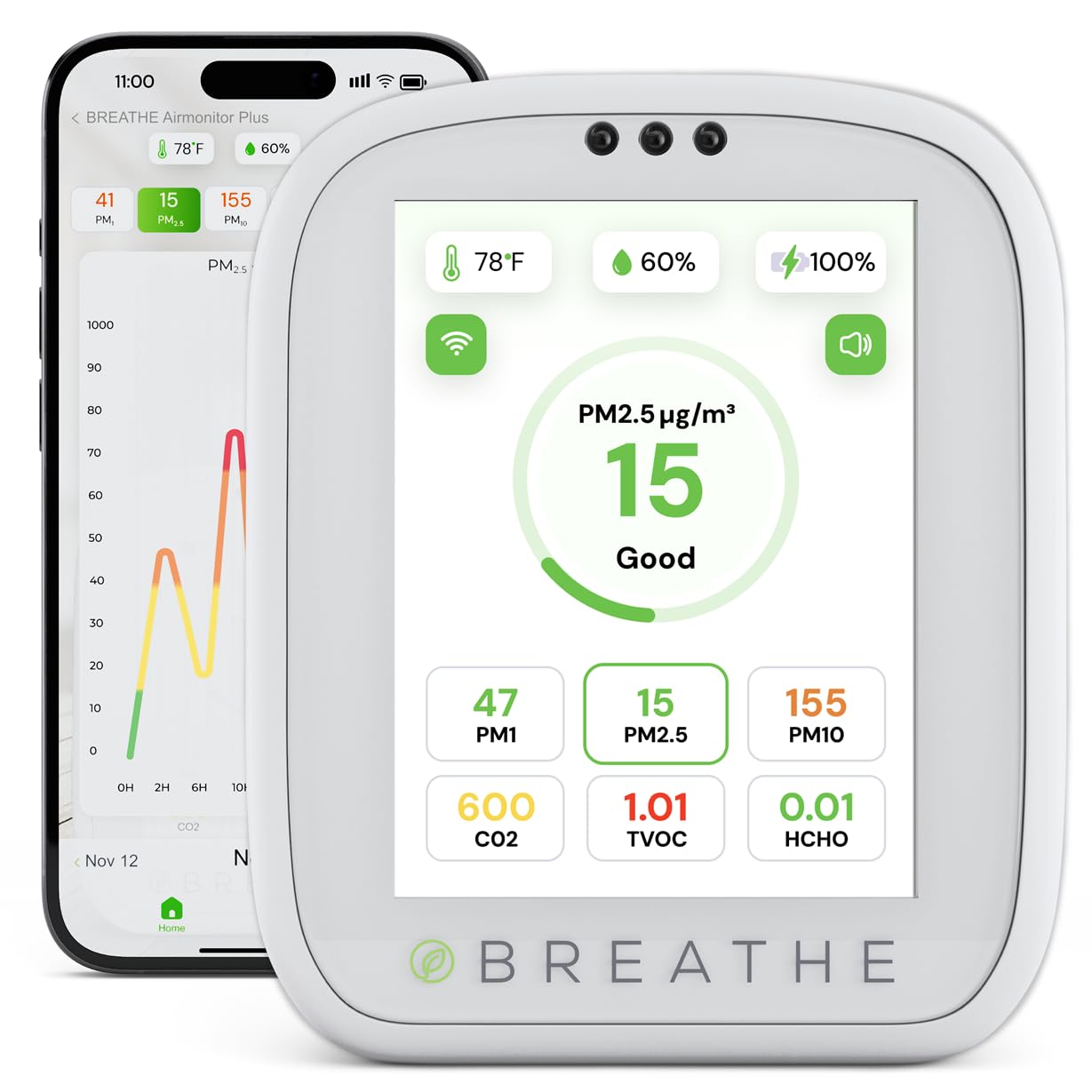
| BREATHE Airmonitor Plus | Professional data tracking | NDIR + Laser | Built-in Rechargeable (6 hrs) | Not specified | Amazon |
| Gain Express A017755 | Professional measurement accuracy | NDIR | Battery (included) or 9V Adaptor | 0-9999 PPM | Amazon |
| Temtop M2000 2nd Gen | Professional environmental surveys | NDIR (SenseAir) | Rechargeable Battery | Not specified | Amazon |
In‑Depth Reviews
1. U UNNI CO2 Monitor with Photoacoustic Sensor
Our pick — over 4★ from 300+ verified ratings; the strongest balance of quality and price.
The plug-in monitor that keeps watch through a blackout thanks to its AAA battery backup.
This one earns its spot for wall-mount flexibility without a single power source. It reads real-time CO2, temperature, and humidity via a Swiss-made photoacoustic sensor that detects 400 to 5000 PPM (parts per million, the standard air-quality unit) with an accuracy of +/- 5% plus 50 PPM — precise enough to tell you when to open a window during or after indoor cooking. Plugged into USB, the display stays on; if power blips, 3 x AAA batteries (not included) take over, so you never lose sight of your air quality.
Reviewers consistently report this unit is accurate and quick to respond, with one buyer even testing it in the car: with recirculation on, readings climbed to 870-950ppm. The full-color screen stays readable from across the room, and the adjustable alarm volume and backlight mean it fits a bedroom without blaring at 3 AM. The design is classic and sturdy, and it works straight from the start — no internet or app needed, just wall power or batteries.
Weighing in at 150 g, it is not designed to be a pocket companion, but rather a fixed sentinel for your living room, grow tent, or RV. The catch is that the screen noticeably fades when running on battery alone, so it is less pleasant to read in a prolonged outage — treat the backup as a safety net rather than a primary display mode.
What wins people over
- Accurate Swiss photoacoustic sensor respected for its precision in the 400-5000 PPM range
- Triple power flexibility: USB when you want it, AAA batteries (not included) when you do not
- Adjustable alarm volume and backlight for bedroom-friendly use
- Large, clear display readable several feet away, per multiple buyers
The honest trade-offs
- Screen fades noticeably when running purely on battery power
- Some buyers found its air-quality thresholds more conservative than competitor brands
- Batteries are not included in the box, so you will need to supply your own AAAs
Reach for it if: you want a set-and-forget monitor for a fixed spot in your home that survives power cuts on AAA backup.
Think twice if: you need a device you can carry around all day — its battery mode dims the display.
2. INKBIRDPLUS Portable CO2 Detector (PTH-10C)
A featherweight 4.96-ounce CO2 sniffer with a 72-hour battery for life on the move.
This is the unit you clip to a bag or hang from a lanyard when you want to know the air quality in a stuffy office, a hotel room, or your car. Slightly lighter than the Newentor at 4.96 ounces versus 4.8 is a negligible gap — both vanish into a pocket. The built-in 1000mAh lithium battery takes about 3 hours to charge fully and then runs for roughly 72 hours, so you can leave the charger at home on a long trip.
The full-color LCD is bright enough to read even in direct sunlight, which is a common sticking point for portable displays. And critically, accuracy is the most-praised trait here, with owners noting the NDIR sensor produces quick, consistent readings. The color-coded indicator lights give you a glanceable readout: green for good (400-699ppm), yellow for medium (700-1499ppm), and red for danger above 1500ppm.
You can set the alarm threshold yourself, which helps, but buyers report the low-battery warning is “deafening, cannot be silenced” — one owner said it went off in the middle of the night at a harmless 420ppm. If you plan to sleep near this device, think twice about that loud, unsilenceable beep before you buy.
Why it travels so well
- 72-hour run time from a 3-hour charge via the built-in 1000mAh battery
- Color-coded LED indicators make air quality readable at a glance
- NDIR sensor lauded for accuracy and consistency by the majority of owners
- Compact design with included lanyard for true portability
The real-world catches
- Low-battery alarm is piercing and cannot be silenced, per multiple owners
- Requires manual calibration in an open area before first use, which some miss
- The color thresholds may cause undue panic at levels that are actually safe
Pack it if: you travel, commute, or want to audit the air in different rooms and cars throughout the day.
Set it on the nightstand only if: you can tolerate an unsilenceable low-battery siren, because it will eventually wake you.
3. Newentor CO2 Monitor (C1)
A multi-talented desk companion that doubles as a clock and audible CO2 watchdog.
If you want a single device that replaces a bedside alarm clock and tracks your air, this is the one to beat. The Newentor packs a high-precision Sensirion PASens photoacoustic sensor, giving it the same sensor pedigree you would find in pricier gear, and its large display shows CO2, temperature, humidity, and the time all at once. It also functions as a programmable alarm clock with a snooze feature, which is a clever space-saving play for a nightstand.
Owners praise its real-world accuracy — one long-term bedroom test showed CO2 rising from 500ppm to 650ppm when sealed overnight, then dropping back to 400ppm after ventilating, giving you a tangible read on how your room breathes. Powered by USB with a AAA battery backup (the battery takes over when you unplug), you can move it between rooms without losing settings. The touch-sensitive screen dims for sleeping.
The catch is in the physical design: owners mention the touch screen can show temporary lines, and the build quality of the cord is flimsy (and it is not USB-C, which annoys modern phone users). It has no rechargeable battery, so the AAA backup is strictly for emergencies, not for true portability. Also, the kickstand is unstable on wire grid shelving, so you will want a flat surface.
Space-saver special: Replaces your alarm clock while serially tracking CO2 — a rare two-for-one in this category.
Better suited for: stationary spots like a nightstand or desk where its clock and dimming screen earn their keep.
4. LifeBasis 11-in-1 Air Quality Monitor

An 11-in-1 digital health dashboard that tracks CO2 plus particulates, formaldehyde, and VOCs.
This is for the data nerds who want more than CO2 — they want the whole picture. LifeBasis squeezes 11 different readings into one portable LCD: AQI, CO2, PM1.0, PM2.5, PM10, particles, HCHO (formaldehyde), TVOC, temperature, and humidity. It combines an NDIR infrared CO2 sensor with a laser particle sensor and a semiconductor sensor to pull this off, and it reports with both color-coded visuals and a ticking audible alarm when levels climb.
The 2500mAh battery is the biggest in this lineup, and LifeBasis rates it for 11-12 hours of continuous use on a single charge. That makes it a genuine all-day companion for someone who wants to check air quality in different rooms sequentially. The built-in stand lets you prop it anywhere, and the Type-C charging port is modern and convenient — no hunting for a proprietary cable.
Accuracy is where buyer experiences diverge sharply. While some found its PM2.5 readings correlated closely with EPA data during wildfire smoke, others found initial units glitchy and inaccurate versus contractor-grade equipment before the company fixed the issue via replacement. There were reports of fresh-from-the-box units arriving with defects, so buy with the knowledge that you may need to test it against a known reference and take advantage of the warranty.
Full-picture monitor: The only budget-friendly pick that also measures formaldehyde and particulates alongside CO2.
Who it suits: Allergy and asthma sufferers wanting to correlate symptoms with indoor pollutants, not just CO2 numbers.
5. SwitchBot Meter Pro CO2

The smart-home native that checks CO2 every second and sips its battery for up to 12 months.
This is the one to grab if you live in a smart-home ecosystem and want your air data flowing to your phone. The SwitchBot samples CO2 every 1 second with an impressively wide range of 400 to 9000 ppm, and the accuracy spec is tight — ±(50 ppm + 5% of reading). The big 92-millimeter display shows CO2, temperature, humidity, time, and date simultaneously on one clean screen, and its minimalist look fits right into a modern living room or bedroom aesthetic.
Battery life is the headline feature: the built-in battery is rated for up to 12 months of life between charges, which is absolutely the best in this lineup for set-and-forget operation. The device works with Home Assistant via a hub, which smart-home tinkerers consistently cite as a major plus for pulling CO2 trends into their automation dashboards.
The honest limitations: app notifications for alerts require a separate SwitchBot Hub, which is not included and adds to the cost. Buyer feedback on accuracy is split — some call it spot-on (outdoor readings around 400-450 ppm), while others report readings that only update every several minutes or get inconsistent. Several owners note that to keep the quick 1-second sampling you need it plugged in, but battery mode steps the check down to every 5 minutes to preserve that 12-month claim.
The smart-home appeal
- 20-second response time with 1-second refresh keeps you up to date fast
- Excellent 12-month battery life in standby mode
- Wide 400-9000 ppm measurement range covers extreme scenarios
- Wall-mount holes and clear display make it easy to position in any room
Before you buy
- Notifications and remote access require the separate SwitchBot Hub (not included)
- Reports of a freezeglitch in plugged-in mode that some owners hit
- Some buyers find the CO2 readings lag behind minute-to-minute changes
Choose this if: you already use SwitchBot or Hubitat devices and want your CO2 data part of a bigger home-automation scene.
Look elsewhere if: you just want a beep to open a window and do not want to research a separate hub.
6. Forensics Basic CO2 Meter (FD-CO2000)
A compliance-focused CO2 meter for classrooms that runs up to 8 hours on its Li-Ion battery.
Teachers, administrators, and facilities managers checking ventilation standards will find this meter speaks their language — it is explicitly marked AB841 compliant for classrooms, a California rule linking CO2 levels to acceptable ventilation. Its advanced NDIR sensor detects CO2 as low as 1 ppm, and the manufacturer promises a 10-year sensor life, so institutions can buy once and skip recalibration for a decade.
Power is flexible: a built-in Li-Ion battery gives up to 8 hours of operation and recharges via USB, or you can run it off wall USB power for continuous monitoring. At 200 g, it sits on a table or mounts to a wall, so it adapts from a classroom to a home office. Buyers consistently praise the build quality and confirm accurate reads in a windowless workspace — one owner saw levels swing from normal to unhealthy in an hour with the door shut, then recover within 10 minutes of opening it.
The screen is the weak point: readability only extends 1-2 feet before it gets hard to see, and the backlight cannot be left on. For a device meant to be glanced at across a classroom, that is a significant usability flaw, and it caused at least one return. Also, the alarm threshold maxes out at 1100ppm and cannot be disabled, only temporarily muted, which buyers find annoying when it triggers in the middle of the night.
Institutional pick: Built for measurable AB841 compliance, not for pretty bedside aesthetics.
Keep it close: This is a monitor you read up close, not across the room, so plan placement accordingly.
7. BREATHE Airmonitor Plus Gen 2
An 8-in-1 monitoring powerhouse with Wi-Fi, a 90-day data history, and a 6-hour portable battery.
This is for people who want to know not just that the air is bad, but why, when, and how to fix it. The BREATHE Airmonitor Plus Gen 2 measures CO2, PM1, PM2.5, PM10, TVOC (total volatile organic compounds), formaldehyde (HCHO), temperature, and humidity all at once. It links to a free app over 2.4 GHz Wi-Fi, giving you remote readings, configurable CO2 and PM2.5 alerts, historical graphs, and up to 90 days of stored data you can export as a CSV file for deeper analysis — a professional-grade feature set usually found on much pricier lab gear.
The Gen 2 upgrade specifically addresses portability with up to 6 hours of battery life, and you can keep it on USB-C power for continuous use. Owners confirm its real-world usefulness, noting how CO2 spiked to 4,500 in a poorly ventilated office before dropping to 405 once windows and fans were opened. The device also functions as a formaldehyde and VOC detector, alerting you when cleaning products or new furniture off-gas chemicals.
The recurring complaint is battery life — while it is rated for 6 hours, several customers note the actual run time is shorter, with one saying it drains in about an hour. The Wi-Fi setup can also be finicky (only 2.4 GHz, no Bluetooth fallback at all), and there is no way to fully mute the default alarm. If you plan to use this mostly plugged in, it is a brilliant desk companion; if you need true all-day untethered operation, the battery claims may over-promise.
Professional insights
- Tracks 8 air-quality parameters, not just CO2
- 90-day data history with CSV export for trend logging
- Formaldehyde detection catches off-gassing that CO2-only meters miss entirely
- App-based alerts with visual and audible alarms built in
Where it stumbles
- Battery life is the most-discussed negative, with some owners reporting far less than 6 hours
- Wi-Fi only (no Bluetooth) means it is useless in a location without a network
- Default alarm is loud and cannot be fully silenced
Buy it for: a fixed-desk, plugged-in health station where data export and formaldehyde tracking matter more than battery life.
Reconsider if: you need a grab-and-go device that will truly last hours off the charger.
8. Gain Express Portable CO2 Meter (A017755)

A field-grade yellow handheld that measures CO2 up to 9999ppm with a fast 30-second readout.
HVAC techs, safety officers, or anyone surveying air quality across many sites will find this the workhorse. Unlike sleek consumer units, the Gain Express is unapologetically professional — yellow, bulky, and built to carry by its handle into boiler rooms, factories, classrooms, or hospitals. Its standout feature is range: it detects CO2 from 0 up to 9999ppm, far beyond the 5000ppm ceiling of most home monitors, with a dual-mode battery system (4 batteries included) or a 9V adaptor that automatically cuts off the battery when plugged in.
Accuracy across the lower range is strong — within ±50ppm or ±5% of the reading up to 2000ppm — and reviewers specifically call out its consistency: “they are workhorses… battery lasts forever, accurate and consistent.” One office worker used it to pin down the source of afternoon brain fog, finding CO2 at 800-900ppm, then watched it drop to 430-500ppm after improving ventilation.
The user interface is where this unit shows its age. It is a “quirky late 1980’s design aesthetic” per one buyer, with debounced buttons, an RS232 output instead of modern USB-C, and no phone logging. The default alarm is set at 1000ppm, which some find too strict for public spaces, though it is adjustable and the threshold upper limit reaches 9900ppm. The screen is hard to read from anything beyond arm’s length, but for hand-held spot-checking that is acceptable.
Field-tool pedigree: Less polish, more reach — this meter goes where consumer units are too delicate to follow.
Think of it as: a diagnostic instrument for ventilation surveys rather than a living-room decor piece.
9. Temtop M2000 2nd Gen
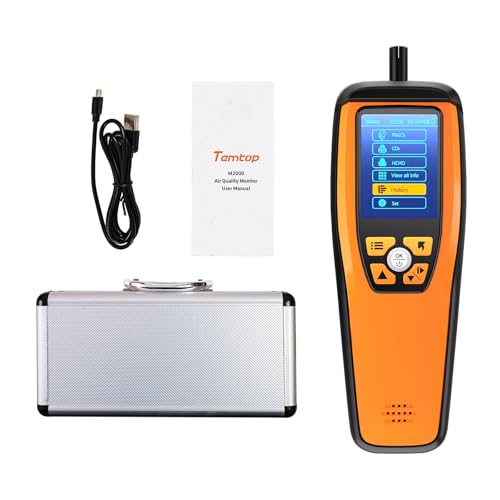
A top-shelf 8-in-1 instrument that pairs a SenseAir NDIR CO2 sensor with expert-grade data logging.
If price is no object and you want lab-adjacent credibility, the Temtop M2000 is the reference-class choice. It combines a SenseAir NDIR CO2 sensor (a respected name in professional sensing) with a Dart HCHO sensor and Temtop’s professional-grade particle sensor to deliver 8-in-1 monitoring of CO2, PM2.5, PM10, HCHO, particles, temperature, and humidity. The data logging is genuinely impressive — the RAM supports more than 3 months of continuous logging, and you can export the full data via USB for spreadsheet analysis.
Owners praise its rapid 2-second response time and its ability to zero-calibrate outdoors for accurate baseline readings. One long-term reviewer found it “accurate, consistent” and responsive to ventilation changes, calling it superior to prior meters they had owned. The colorful TFT display with backlight is easy to read in various lighting conditions, and the ergonomic design works whether it is sitting on a lab bench or riding along in a carry case during travel.
If you use it daily, be prepared for quirks. The PM2.5 low-end accuracy is limited to ±10 µg/m³, which reduces its usefulness for ultra-clean environments; some owners found the initial instructions unclear and needed customer support, though service response is described as excellent by multiple reviewers. The audible alarm is configurable, which is a relief if you want to avoid the false-alarm headaches of cheaper units.
The professional toolkit
- Fast 2-second response time gives you real-time changes, not lagging data
- 3+ months of continuous on-board data logging for trend analysis
- SenseAir sensor respected for stability and accuracy
- Comes with carry case, charging cable, and 12-month Temtop warranty
Consider the limits
- PM2.5 low-end accuracy is limited, reducing usefulness in very clean spaces
- Initial setup can require customer support due to unclear instructions
- An occasional unit arrives defective, so test early and use the warranty
Invest here if: you need verifiable, exportable data for research, HVAC commissioning, or professional environmental assessments.
Save your money if: you just want a friendly beep to remind you to open the bedroom window.
Understanding the Specs
PPM and the CO2 Scale
PPM stands for parts per million, and it is the unit every CO2 monitor speaks. Outdoor air usually sits around 400-450ppm. Indoors, levels above 1,000ppm start to make people feel drowsy or struggle to concentrate, and many monitors default their alarms to trigger somewhere in that range. Some picky users dislike units that alarm at 1,000ppm aggressively, so look for an adjustable threshold if you want to set your own comfort line.
NDIR versus Photoacoustic Sensors
NDIR (non-dispersive infrared) sensors shine an infrared light through an air sample and measure how much gets absorbed — they are the gold standard for stability. Photoacoustic sensors, including the Sensirion PASens tech used in several picks, measure the tiny pressure wave created when CO2 molecules absorb light. Both are accurate; the difference is mostly in size, energy draw, and cost, with photoacoustic tending to be more compact and battery-friendly.
Battery Configurations
There are three broad power designs. Built-in rechargeable lithium batteries (like 1000mAh or 2500mAh packs) are convenient but need a charging cable nearby and lose power over the years. Standard AAA battery slots give you flexibility and easy swaps, though you are buying batteries regularly. Some smart units claim multi-month battery life (up to 12 months on the SwitchBot), but know that quick-sampling modes drain faster, so read the fine print.
Alarm Volume and Control
An alarm that is too quiet misses the point, but a siren that is unsilenceable is its own kind of nightmare. Check three things: whether you can adjust the CO2 threshold that sets it off, whether the volume has multiple levels, and whether it can be fully muted for sleeping. Buyers across the category repeatedly flag deafening low-battery or high-CO2 alarms that cannot be turned off — treat alarm customization as a feature you will actually use, not a spec sheet line.
FAQ
What is a safe CO2 level in a bedroom?
How long does a battery CO2 alarm last before needing a charge?
Do these monitors work during a power outage?
Should I get a CO2-only monitor or a multi-gas air quality monitor?
What is the difference between an NDIR and a photoacoustic sensor?
Why does my CO2 monitor need to be manually calibrated?
Will a CO2 alarm wake me up at night?
Can I connect a CO2 monitor to my smart home system?
Are expensive CO2 monitors actually more accurate?
Final Thoughts: The Verdict
For most people, the battery co2 alarm winner is the U UNNI CO2 Monitor because it blends an accurate Swiss photoacoustic sensor, a large readable display, and a AAA battery backup for power cuts into one affordable package. If you want true portability and a 72-hour charge, grab the INKBIRDPLUS. And for smart-home owners who want their CO2 data on their phone with up to 12 months of battery, the SwitchBot Meter Pro is the one to reach for.
How We Picked
We do not accept paid placement. Every pick is matched to a real buyer and a real use-case; we do not hands-on test units.
Sources & Methodology
Specifications: manufacturer listings and product documentation. Review insights: verified customer reviews, as of September 2026. Pricing: not shown on this page (it changes often); check the current price via the retailer link.
As an Amazon Associate, KitchPrep earns from qualifying purchases. This does not affect which products we feature.
Related Guides
