
Specs are compiled from manufacturer listings and verified buyer reviews and can change over time — please confirm the key details on the product page before buying.
If you want the short answer: a battery carbon monoxide alarm is the only kind you can put exactly where the gas actually gathers, and the Kidde KN-COB-LP2 is the one most households should start with. Because CO is invisible and odorless, a battery alarm’s placement and power source decide whether it warns you in time. A battery model goes on the wall or the nightstand without an outlet, keeps watching through a blackout, and never competes for a socket behind the sofa.
I’m Mohammad Maruf — the founder and writer behind KitchPrep. This guide is built by comparing the manufacturers’ published specifications and the patterns across verified customer reviews, so you get each pick’s real strengths and trade-offs instead of marketing spin.
Battery units split into two clear camps: replaceable AA or 9V cells you swap yourself, and sealed lithium packs that last the life of the sensor. Here is how to pick between them with a battery co alarm.
Our Picks at a Glance


How To Choose The Best Battery CO Alarm
Before you pick a brand, decide one thing: do you want to feed the alarm batteries, or forget about them entirely? A replaceable-cell unit uses standard AA or 9V batteries that you swap every few years, which keeps the running cost low and the alarm easy to service. A sealed lithium unit locks the battery inside for the life of the sensor, so nobody can borrow the cells for a remote and leave you unprotected.
Replaceable cells versus a sealed ten-year pack
Replaceable-cell alarms like the Kidde KN-COB-LP2 run on two AA batteries, so a fresh set is cheap and you control the schedule. The trade-off is upkeep — low-battery chirps arrive at inconvenient hours and you have to act. Sealed units such as the Kidde C3010 promise a ten-year sealed lithium supply with no replacement over the life of the alarm, which removes the maintenance chore completely. Pick replaceable if you like cheap servicing and travel flexibility; pick sealed if you know you will forget.
Sensor type and what the alarm can tell you
Every unit here uses an electrochemical sensor, a small cell that reacts chemically when carbon monoxide is present and triggers the alarm. That is the correct sensor for CO — it is not the same as the photoelectric smoke sensor in a combo unit. Some models add an LCD that shows real-time CO levels in parts per million, plus a peak-level memory of the highest reading recorded. If you want to see numbers rather than just hear a siren, choose a unit with a display.
Alarm loudness and where you put it
Look for an 85-decibel alarm — that is the standard loudness for a residential CO unit, roughly the volume of a blender running at the counter. An 85 dB alarm only helps if it is within earshot of the bed, so plan one unit per sleeping area. Battery operation is what makes that easy, since you are not hunting for an outlet near the bedroom ceiling.
Quick Comparison
| Model | Best For | Power Source | Alarm Loudness | Display | Amazon |
|---|---|---|---|---|---|
| Kidde KN-COB-LP2 | Most homes, lowest upkeep cost | 2 AA batteries (included) | 85 dB | LED status only | Amazon |
| First Alert CO400 | Travel and winter car kits | 9V battery (included) | 85 dB | LED status only | Amazon |
| X-Sense SC06 | One device covering smoke and CO | Sealed integrated battery | — | LCD with CO readings | Amazon |
| First Alert SMCO200 | Slim ceilings in small rooms | AA batteries | Audible alert | — | Amazon |
| Kidde C3010 | Zero-maintenance protection | Sealed 10-year lithium | Alarm pattern (4 beeps, 5 sec silence) | No digital display | Amazon |
| First Alert CO710A | Watching CO levels and room temperature | Sealed 10-year lithium | Audible | Backlit digital, CO or temp | Amazon |
| Siterwell GS828A | Hotel rooms and rental stays | 2 AA alkaline (installed) | 85 dB at 3 meters | LCD with real-time CO | Amazon |
In‑Depth Reviews
1. Kidde Carbon Monoxide Detector, Battery Powered CO Alarm with LEDs, Test-Reset Button, Low Battery Indicator, Portable
The two-AA workhorse that sits on a shelf or hangs on a wall without ever touching your wiring.
If you want one alarm that does the job in most homes, this is it. It runs on two AA batteries, so it keeps watching through a power failure — exactly the moment a furnace or water heater is still burning fuel while the lights are out. Setup needs no wiring at all: mount it on a wall with the included screws and drywall anchors, or just stand it on a tabletop. It measures 1.5″D x 4.5″W x 2.75″H and weighs 8 ounces, which is small enough to disappear on a shelf.
The 4.7-star reputation here is built on function, and that is the trait owners single out above everything else — 845 counted mentions of it working as it should, far ahead of every other comment. The alarm itself is genuinely loud at 85 decibels with a red LED that lights when CO is present, and a green LED that confirms the unit is powered. An event memory logs the last time carbon monoxide was detected or the unit was last tested, so you can tell whether a chirp was real. Value shows up second in the feedback, which tracks: a replaceable-cell alarm is the cheapest long-term path because a new set of AA cells costs almost nothing.
The honest catch is maintenance. Battery life and reliability land in mixed territory in the review data — some units run their cells for years, others report a short-lived set or a faulty unit from the start. A fresh AA set is a trivial fix, and Kidde backs the alarm with a 10-year limited warranty, but you do have to pay attention to the low-battery chirp. There is also an important comparison against the pricier First Alert CO400 above: this one is 4.5 inches wide versus 5 inches, and it gives up 3.2 ounces in weight, 8 ounces against 11.2 — a slimmer, lighter package for roughly the same protective job.
What earns it the top spot
- Runs on 2 AA batteries and keeps detecting during a power failure — no outlet, no wiring, no electrician
- 85-decibel alarm with a red LED, plus a green LED that confirms the unit is live at a glance
- Event memory records the last detection or test, so you know whether a chirp meant something
- Under nine ounces and slim enough to stand on a shelf or mount on a wall
Where it asks something back
- You own the battery schedule — a low-battery chirp means it is time to swap the AA cells
- A handful of units arrive dead or develop a fault early, which is what the 10-year limited warranty is for
- No digital CO readout, so you get an alarm and an LED rather than a number on a screen
Start here if: you want dependable CO coverage in the most rooms for the least ongoing cost, and you are fine swapping two AA cells every few years.
Consider the alternative if: you know you will ignore a chirp — the sealed-battery Kidde C3010 below removes that chore entirely.
2. First Alert Battery Carbon Monoxide Alarm
A pocket-sized CO400 that rides in a hotel bag or a winter car kit as easily as it hangs on a bedroom wall.
This is the one to grab if you sleep somewhere that is not your house. It is small and light enough for a suitcase — buyers report carrying it into hotel rooms, and one owner keeps two-packs on hand specifically for a winter car bag in case of being stuck in a blizzard. That makes sense, because an idling car in deep snow is a classic CO scenario. It ships with a 9V battery already in the box, so it works the moment you pull the tab.
Underneath, it is the same proven recipe as the Kidde at the top: an electrochemical sensor, an 85-decibel alarm, and no wiring whatsoever. The size difference is worth knowing if space is tight — this unit measures 1″D x 5″W x 3″H against the Kidde’s 1.5″D x 4.5″W x 2.75″H, so it is thinner but wider and taller. It is also the heavier of the two at 11.2 ounces versus 8 ounces, which you notice only if you are packing it. First Alert covers it with a 5-year limited warranty and an end-of-life chirp that tells you when the whole unit needs replacing rather than just the battery.
The recurring note in the feedback is battery condition on arrival — most units come ready to go, but a dead 9V in the box does happen. That is a one-battery fix, not a reason to pass. The bigger structural point is lifespan: the 5-year warranty and end-of-life signal mean you are replacing the alarm sooner than the ten-year sealed models further down this list. Owners who replaced an identical older CO400 that had timed out describe it as a direct, trouble-free swap.
Why travelers pick it: an 85-decibel alarm, an included 9V battery, and a footprint that fits a carry-on — it monitors continuously even when the hotel power is out.
What to plan around: the 5-year limited warranty and end-of-life chirp mean a full unit replacement comes sooner than on ten-year models, and an occasional box arrives with a flat battery.
Reach for this if: your CO risk travels with you — hotel rooms, rentals, a car kit — and you want an alarm that sets up in seconds without an outlet.
Look elsewhere if: you are protecting a fixed home and would rather never think about batteries again; the sealed ten-year units below suit that better.
3. X-Sense Smoke & Carbon Monoxide Alarm, SC06, 1-Pack
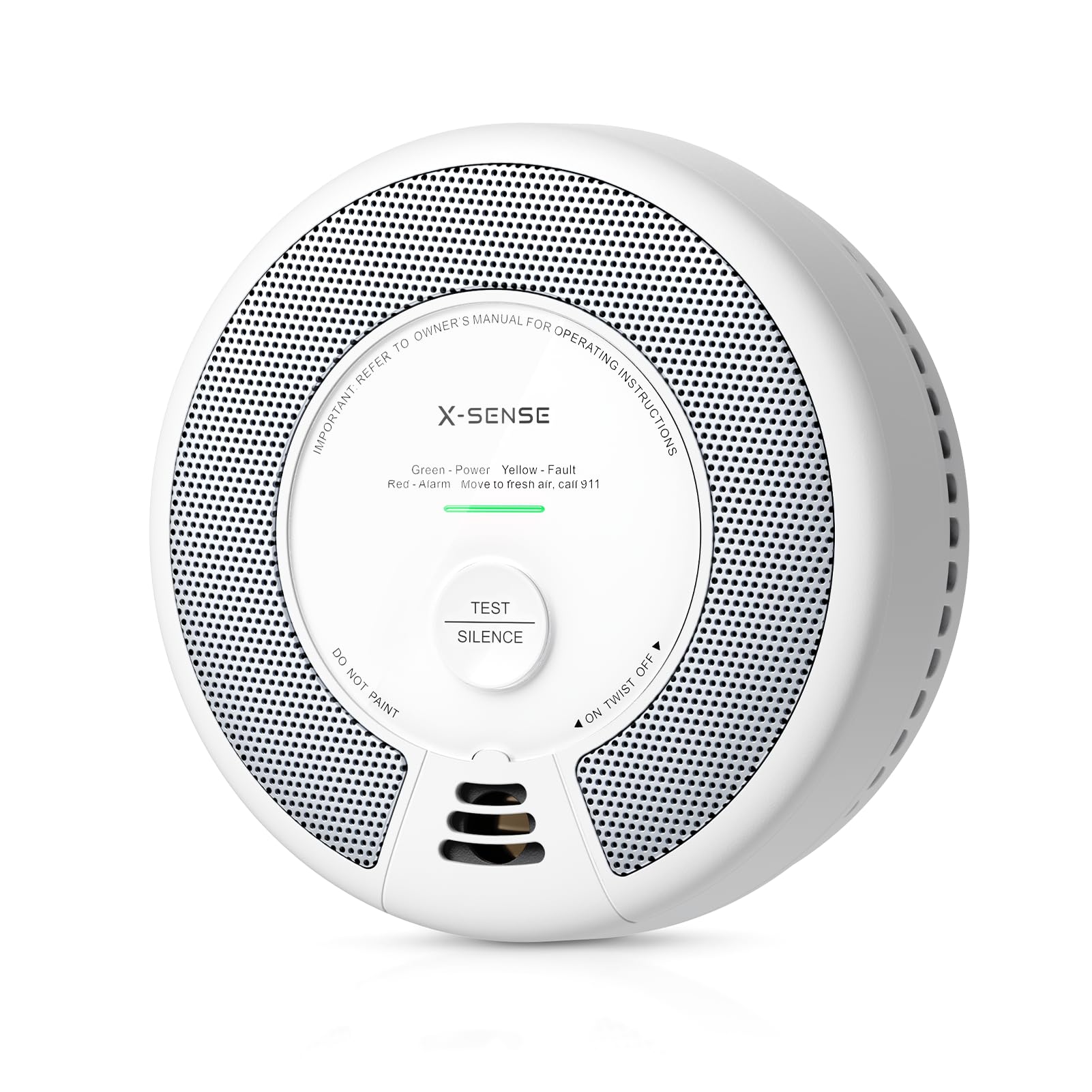
One ceiling puck that watches for smoke and carbon monoxide at the same time, with a screen that shows live CO levels.
Two sensors in one housing means one install instead of two. The SC06 pairs a photoelectric smoke sensor (one that “sees” smoke particles scatter light) with an electrochemical CO sensor, and it is ETL Listed to the UL 217 and UL 2034 safety standards. Mounting needs no rewiring — the bracket, screws, and anchor plugs are in the box, so it goes on a wall or ceiling with a screwdriver. The large LCD shows real-time carbon monoxide levels in the surrounding air along with battery level and working status.
The selling point that surprises people is the sealed battery. Owners mention not realizing the cell was integrated until it arrived — and that is a genuine advantage, because when it finally dies the alarm prompts you to replace the whole unit, which is exactly the moment most people would otherwise shrug and keep a dead detector on the ceiling. The sealed design is rated to last ten years, which lines up neatly with the sensor’s own working life.
Honest scaling on the downside: this is the least-reviewed pick in the guide, and a small share of units arrive dead — no green light, a test button that does nothing, and a sealed battery you cannot reseat. That is a return, not a design flaw, but it is worth testing the moment it lands.
Strong points worth paying for
- Smoke and CO detection in one unit, cutting a ceiling install in half
- Sealed integrated battery rated for ten years, with a prompt to replace the whole alarm when it ends
- LCD shows real-time CO levels, battery level, and working status in plain view
- ETL Listed to UL 217 and UL 2034, no rewiring, bracket and hardware included
Things to weigh first
- Not the alarm for you if you already run fresh smoke detectors on every level — you are paying for a second smoke sensor
- The sealed cell cannot be swapped, so an early fault means returning the entire unit
- Some units arrive non-functional from the start; test it the day it arrives
The smart buy if: you want to add smoke and CO coverage in one trip up the ladder and prefer a sealed battery you never touch.
Skip the combo premium if: your smoke alarms are already current — buy a CO-only unit and save the difference.
4. First Alert Battery Combination Smoke & Carbon Monoxide Alarm

Half the depth of a standard alarm, so it hugs the ceiling instead of hanging off it.
Headroom, cabinet clearance, a low beam — some ceilings punish a bulky detector. This First Alert is built around exactly that problem: the slim profile design is half the depth of a standard alarm, which is the single reason to pick it over a fatter combo unit. It runs on AA batteries, so it keeps monitoring through an outage, and the dual protection covers smoke and carbon monoxide from one housing. Its Precision Detection sensing technology is designed to cut down cooking nuisance alarms while still giving early warning in a fire emergency.
Installation is the trait owners praise above all others — 28 counted mentions, ahead of build quality at 24 — and the pattern fits: reviewers describe a few-minute job with an easily accessible test button. Battery life shows up as a positive in the feedback too, with notes of lasting ten years without changes. An end-of-life warning chirps when it is time to replace the whole unit rather than just the cell.
The thing to keep an eye on is the dual-alarm behavior. False alarms come up in the feedback, and the value question is genuinely split — some owners call it worth it, others do not. There is also a single report of a unit that would not seat into its own base, which is a manufacturing slip rather than a pattern. If nuisance tripping near a kitchen is a known issue in your home, this is worth a second thought.
The ceiling-clearance argument: half-depth profile, AA battery operation for outage coverage, and Precision Detection sensing aimed at cutting cooking false alarms.
The counterweight: dual-alarm false triggers appear in the feedback, and a slim housing in a tight corner still needs a clear path for smoke to reach the sensor.
Made for: rooms where a standard-depth combo alarm is too chunky for the ceiling or cabinet above it.
Think twice if: your current smoke detector already trips on cooking — the dual-alarm sensitivity here may test your patience.
5. Kidde low-maintenance Carbon Monoxide Detector Alarm with 10 Year Sealed Battery | Model C3010

The alarm you install once and never feed — the battery is sealed in for the life of the unit.
No battery tray, no annual swap, no chirp at 2 a.m. The C3010 uses a sealed-in lithium power supply rated for the ten-year life of the alarm, which removes the single most common way a CO detector ends up dead: someone borrows the batteries and never replaces them. It takes that further with self-activation — the unit turns on automatically the moment you slide it onto the mounting bracket, so there is no switch to forget. Installation is the most-praised trait in the feedback by a wide margin, and it is easy to see why when the entire job is one bracket and one slide.
The status language on this one is unusually detailed. A green LED flashes every 30 seconds to confirm it is operating. If CO is detected, the red LED pulses and the alarm sounds in a pattern of four short beeps, five seconds of silence, then four more beeps, cycling for four minutes before slowing to a pattern once a minute. An amber LED flashing every second means fault mode, a single beep every 30 seconds signals an error, and a beep every 60 seconds means low battery. Event memory flashes the red LED every 60 seconds to flag that a high CO level was detected within the last 14 days.
What buyers don’t love: noise cuts the other way here. This is loud — the feedback flags volume as the one recurring gripe, which is a feature for a safety device and a nuisance for a bedroom wall. It also carries no digital readout, so the model without the display shows status through LEDs only, unlike the CO710A below which puts actual numbers on a screen. Size works in its favor, though: at 1.5″D x 4.5″W x 2.75″H and 4 ounces, it is the lightest unit in this guide and small enough for creative mounting spots.
Why the sealed design wins
- Sealed-in lithium supply rated for the full ten-year life of the alarm — no battery replacement, ever
- Self-activates on the bracket, so there is no power switch to forget
- Detailed LED code: green for power, red pulse for CO, amber for fault, plus 14-day event memory
- 4 ounces and compact enough for tight or awkward wall positions
Fair warnings before you hang it
- Genuinely loud — the recurring complaint in the feedback — so think about bedroom placement
- No digital CO readout on this model; you get LED signals rather than numbers
- When the ten years are up, the whole unit is landfill — you cannot service it
The right call for: landlords, rentals, and anyone who has ever found a CO alarm with the batteries removed — the sealed cell makes that impossible.
Second-guess it if: you want to see actual CO numbers, in which case the First Alert CO710A is the display version of this same idea.
6. Carbon Monoxide Detector, Temperature Display, 10-Year Battery

A CO alarm that doubles as a room thermometer, with a screen you can actually read the numbers on.
A backlit digital display changes what an alarm can do: instead of a red light telling you something is wrong, the CO710A shows you the CO level itself, or switches to ambient room temperature. There is also a peak level feature that retrieves the highest concentration of carbon monoxide the unit has measured, so a brief spike that already faded still leaves a record. Power comes from sealed ten-year lithium batteries, which means continuous protection for a decade with no replacement. The compact housing sits on a tabletop or mounts to a wall.
The placement flexibility is what makes this genuinely useful rather than decorative. Because the battery is permanent, one owner describes finding a spot for it without it taking up a plug — the unit goes where the risk actually is, not where the nearest outlet happens to be. Another notes the ten-year expected life as the reason for the purchase. Electrochemical sensing is the underlying technology, the same detection method as every other CO alarm here. Setting it up is a quick job, and it works either standing on a shelf or fixed to a wall.
Now the catch, and it is a specific one: the temperature display reads in Celsius and cannot be changed. That is confirmed in the feedback and it is a real annoyance for anyone in the United States expecting Fahrenheit, since even the product pictures show it. If the thermometer is the reason you are buying this, know that going in. If you are buying it for the CO display and the peak memory, the temperature readout is a bonus you may simply ignore.
What the screen buys you: live CO levels or room temperature on a backlit display, plus peak-level memory of the highest concentration recorded, all on sealed ten-year lithium power.
The one thing to know: that temperature reading is fixed in Celsius and cannot be switched, so treat it as a secondary feature rather than the main event.
Suits you if: you want to watch CO numbers rather than just hear a siren, and ten-year sealed power matters more than a swappable cell.
Move on if: a Fahrenheit room-temperature readout is what drew you to this model — that setting is not available.
7. Siterwell Travel Carbon Monoxide Detector 7 Year Product Life

Stands on a hotel dresser, hangs on a wall at home, and shows live CO numbers on its screen either way.
The GS828A is built for people who do not trust the alarm in someone else’s room. The LCD displays real-time CO levels rather than just a status light, and a three-color LED goes red, green, or yellow to signal an alarm, normal power, or a fault. It is ETL Listed with a built-in advanced electrochemical sensor, and it alarms at no less than 85 dB at 3 meters — that is the distance-to-loudness spec that tells you it will wake you from across a bedroom. It runs on two AA alkaline batteries that come installed, so it starts working after a 30-second air sampling period.
Reliability is what owners value most here, with easy setup close behind, and the travel use case comes up on its own — a hotel-room dresser is a named placement in the feedback. Wall-mounted or free-standing, it fits homes, hotel rooms, garages, and classrooms. Setup is genuinely pull-and-go: batteries are already in the unit, so you pull the tab, wait through the air sample, and set it down or screw the bracket to the wall.
Two things are worth flagging honestly. The battery situation is a mixed bag — the included AA cells mean it works immediately, but this is not a ten-year sealed unit, so replacements are in your future. And the status light blinks roughly every 40 seconds, which some owners find distracting in a bedroom; one notes it as the one thing that would make it better, along with wanting a mounting option that does not need drilled holes. The manufacturer rates the product life at seven years and backs it with a three-year limited warranty.
Where it pulls ahead
- LCD shows real-time CO levels, not just an alarm light — you see what the sensor sees
- 85 dB or louder at 3 meters, enough to wake a sleeper across the room
- Batteries pre-installed and it runs free-standing or wall-mounted, ideal for hotel rooms and rentals
- ETL Listed with an advanced electrochemical sensor and a three-year limited warranty
Honest trade-offs
- Runs on replaceable AA alkaline batteries, not a sealed ten-year cell, so plan on changing them
- The status light blinks about every 40 seconds — noticeable on a bedside table
- Wall mounting needs drilled holes; there is no adhesive option in the box
Buy it for: travel and second locations where you want visible CO numbers and a battery unit that works the second you unbox it.
Pick a sealed model instead if: you would rather never think about the batteries — this one asks for periodic swaps.
8. First Alert SC5 Battery Smart Smoke & Carbon Monoxide Alarm
Alarm loudness and the 85 dB figure
Loudness is measured in decibels, and 85 dB is the residential standard for a CO alarm. To put it in everyday terms, that is roughly the volume of a kitchen blender running at the counter — loud enough to pull you out of sleep if the unit is in or near the bedroom. The Siterwell unit goes a step further in its spec sheet by rating its alarm at no less than 85 dB at 3 meters, which tells you the volume holds up at a distance rather than only right next to the device. Placement decides whether that 85 dB reaches the bed, so one alarm per sleeping area is the practical rule.
FAQ
How long do the batteries in a battery CO alarm actually last?
Should I buy a CO-only alarm or a combo smoke and CO unit?
What does the end-of-life chirp mean and do I replace the battery or the whole unit?
Will a battery carbon monoxide alarm work during a power outage?
Is a 10-year sealed battery better than replaceable AA batteries?
Can I take a battery CO alarm on a trip or in a hotel room?
Does the First Alert SC5 work with my existing Nest Protect setup?
What does the CO level display actually show on these alarms?
How many CO alarms does a typical home need?
Do these alarms need WiFi or an app to work?
Final Thoughts: The Verdict
For most homes, the battery co alarm to buy is the Kidde Carbon Monoxide Detector, Battery Powered CO Alarm with LEDs — it holds the highest rating class in this guide, runs on cheap AA cells, keeps detecting through a blackout, and gives you an 85-decibel alarm plus event memory for the lowest ongoing cost of anything here. If you want to stop thinking about batteries entirely, grab the Kidde C3010 and let its sealed ten-year lithium supply cover the whole life of the alarm. And for travel or a hotel room, the First Alert CO400 is the one to reach for — light enough for a carry-on, loud enough at 85 decibels to wake you, and running on a 9V battery that ships in the box. Whichever you choose, put one near every place you sleep — with no smell to warn you, the alarm is your only signal.
How We Picked
We do not accept paid placement. Every pick is matched to a real buyer and a real use-case; we do not hands-on test units.
Sources & Methodology
Specifications: manufacturer listings and product documentation. Review insights: verified customer reviews, as of September 2026. Pricing: not shown on this page (it changes often); check the current price via the retailer link.
As an Amazon Associate, KitchPrep earns from qualifying purchases. This does not affect which products we feature.
Related Guides
