
Specs are compiled from manufacturer listings and verified buyer reviews and can change over time — please confirm the key details on the product page before buying.
If your drawer is full of half-dead AA cells and a charger that only works in pairs, the fix is simpler than you think. The right charger tops up each battery on its own, so one weak cell never drags down three good ones. This guide walks you through nine chargers that actually do that, plus the ones that read out voltage, capacity, and internal resistance so you can spot a dying battery before it ruins a device.
I’m Mohammad Maruf — the founder and writer behind KitchPrep. This guide is built by comparing the manufacturers’ published specifications and the patterns across verified customer reviews, so you get each pick’s real strengths and trade-offs instead of marketing spin.
You will see how bay count, charge current, and cell chemistry decide which unit fits your gadgets. Here is what separates a genuinely useful battery charger for rechargeable batteries from a drawer filler.
Our Picks at a Glance


How To Choose The Best Battery Charger for Rechargeable Batteries
Three things decide whether a charger is worth your money. How many bays it has, whether each bay works alone, and whether it can tell you what is happening inside the cell. Get those right and you will stop throwing away batteries that were never actually dead.
Independent slots versus paired charging
A paired charger treats two batteries as one job, so it keeps pumping current into both until the weaker one finishes. An independent-slot charger watches each battery separately and stops when that battery is full. If you run mixed-age cells in a camera flash or a game controller, independent slots are the difference between a two-year battery and a five-year one.
Charge current and how long a top-up really takes
Chargers advertise current in amps or milliamps. More current means a faster fill but more heat, and heat is what shortens battery life. A charger that can drop to a low trickle once a cell nears full is gentler than one that blasts at its top rate the whole way. Look for a unit that either offers selectable current or a documented low trickle stage.
Which chemistry you actually need
NiMH (the rechargeable chemistry behind most AA and AAA cells) and Li-ion (the lithium chemistry behind 18650 cells) need different chargers. A NiMH charger will refuse or misread a lithium cell, and a lithium charger can damage a NiMH cell. Match the charger to the batteries you own, then check whether the bays accept the sizes you use most.
Quick Comparison
| Model | Best For | Bays | Chemistry | Input | Amazon |
|---|---|---|---|---|---|
| Eneloop Panasonic K-KJ17MCA4BA★ Best Overall | Xbox and gamepad duty | 4 individual | NiMH | 100–240V AC | Amazon |
| Amazon Basics 8 Count with ChargerBudget Champion | First-time converts | 4 | NiMH only | 120V AC | Amazon |
| XTAR VC4HMost Versatile | Flashlight and vape cells | 4 | Li-ion and NiMH | 5V USB-C | Amazon |
| EBL 12-Bay FY-1209 | Household battery hoards | 12 | NiMH / NiCd | 5V Type-C | Amazon |
| Tenergy TN162 | Cars and road trips | 8 | NiMH / NiCd | 12V car and AC | Amazon |
| Panasonic BQ-CC63SBA | Filling eight cells at once | 8 individual | NiMH | 120V AC | Amazon |
| BT-C2400 Opus | Testing and reviving cells | 4 independent | NiMH / NiCd | 240V AC | Amazon |
| EBL 12+2 Bay Universal | C, D and 9V batteries | 12+2 | NiMH / NiCd | 110V AC | Amazon |
| Panasonic BQ-CC65 | Diagnostic-level control | 4 individual | NiMH | 5V USB | Amazon |
In‑Depth Reviews
1. Eneloop Panasonic K-KJ17MCA4BA Advanced Individual Cell Battery Charger Pack with 4 AA 2100 Cycle Rechargeable Batteries
Our pick — over 4.5★ from 14,000+ verified ratings; the strongest balance of quality and price.
The battery pack that made disposable AAs feel like a waste of money
This is the bundle that turns a game controller habit into a one-time purchase. You get four AA cells rated for 2,100 recharge cycles each, and the charger tops up every battery in its own slot instead of pairing them. That means you can drop in one tired cell from a flashlight and three fresh ones from a camera without the charger guessing. Each of the four slots carries its own LED light, so you see exactly which battery is still working.
They ship already charged from the factory using solar power, and Panasonic rates them to hold up to 70% of their charge after ten years in storage. In high-drain gear like work lights, buyers report these cells outlast their old Energizer rechargeables by nearly double. At 2,000 mAh per AA, a wireless controller runs a full evening session on one charge.
Two things to know before you open the box. Owner reports make clear you have to pull the small plastic strip out of the charger before it will work — skip that and nothing charges. The manual is thin, and a few people discovered a high-resistance cell will blink rather than charge, which is the charger refusing to overheat on a battery it cannot handle. Both are quirks, not flaws, and they do not change how this setup performs day to day.
What buyers rave about
- Each battery charges on its own circuit — no waiting on a paired partner
- 2,100 recharge cycles per cell, with 2,000 mAh capacity per AA
- Ships pre-charged and ready straight out of the pack
- Four separate LED indicators show the status of every slot
Where it asks patience
- You must remove an internal plastic strip before the first charge
- AAA cells seat loosely and need a gentle push to settle
- Charges overnight rather than in an hour
The well-tested default: this is the one to reach for if you want one box that solves controller, remote, and toy batteries for years.
Not for you if: you need to top up a batch of eight in one sitting — this holds four.
2. Amazon Basics 8 Count Rechargeable NiMh Batteries (4 AA & 4 AAA) with 4-Bay Battery Charger, Low Self Discharge, Pre-Charged, Type A (American) Plug, Black
Eight batteries and a four-bay charger that nails the basics
A starter kit for anyone still buying disposables. Four AA cells at 2,000 mAh and four AAA cells at 800 mAh arrive pre-charged, so you can load a remote the same day. The charger runs four bays, holds up to 1,000 recharge cycles per battery, and keeps the cells from draining to nothing in storage — Amazon rates them to hold 80% of their charge for up to 12 months. Plug it in, watch the LED blink slowly while charging and go solid white when done.
Timing is worth knowing up front. Two AA cells fill in about 3.5 hours, and four AA cells take about 7 hours. AAA cells move faster, hitting full in 2 hours for a pair or 4 hours for a set of four. That is a normal overnight rhythm for this price range, and it beats the blanket 7-hour charge time that shows on the spec sheet.
The honest caveat comes from owner experience. People tell Amazon’s review page the same story — these recharge quickly and cost very little, but their capacity runs noticeably shorter than standard alkaline cells in heavy use. The charger itself has no display, just the four indicator lights, and a couple of owners found the lighting pattern hard to read at first. Nearly a thousand ratings sit behind this pick at 4.4 stars, so the misses are the exception rather than the rule.
The value math: four AA plus four AAA plus a working four-bay charger in one box, with the cells pre-charged and rated for 1,000 cycles.
The trade-off: a plain LED system with no voltage or capacity readout — you trust the light, not a number.
Buy this instead of a name-brand starter kit: it covers remotes, toys, and controllers without a second trip.
Skip if: you want the charger to show actual charge data per slot.
3. 18650 Charger XTAR VC4H Battery Charger 4 Bays Updated 21700 Battery Charger USB C Charger Not Including Batteries
Four bays that read your battery back to you in numbers
If you own flashlights, vape mods, or power banks built around removable lithium cells, this is the charger that speaks their language. The VC4H handles almost every cylindrical rechargeable size you will meet, from small 10440 cells up to 21700 and 32650, and it also takes 1.2V NiMH and NiCd sizes from AAAA up through C and D. It even charges protected 20700 and 21700 cells, which many chargers refuse.
You can see exactly what each battery is doing, because the screen is the standout feature. Four slots each report charging current, battery voltage, battery capacity, and battery type, so you can spot a cell that is not holding what it should. You pick the rate yourself — 2A, 1A, or 0.5A — and XTAR recommends a 5V/3A power source to get the most from it. One important note from the listing: a 100W USB-C to USB-C cable will not work here, and the charger cannot power itself from a 100W source. The included cable is the safe bet.
Owners separate the fast from the slow clearly. A single NiMH battery can charge at 1A, but once you load two to four cells the rate drops to 0.5A, and people notice that drop. That makes the VC4H a fine everyday charger rather than a speed demon for a full tray. What wins the room is the display and the sheer battery-type coverage — one owner said it revived cells a Duracell charger had given up on.
Why it earns a slot: universal size support plus a per-slot LCD that shows voltage, current, and capacity as the charge runs.
What to accept: fill more than one bay and the current steps down to 0.5A, so a multi-cell top-up takes longer.
Pick this if you juggle lithium and NiMH cells and want to know exactly what each battery is doing.
Look elsewhere if you only ever charge AA and AAA and want the simplest possible four-bay charger.
4. EBL AA AAA Battery Charger 12-Bay Independent LCD Charger for Ni-MH Ni-CD
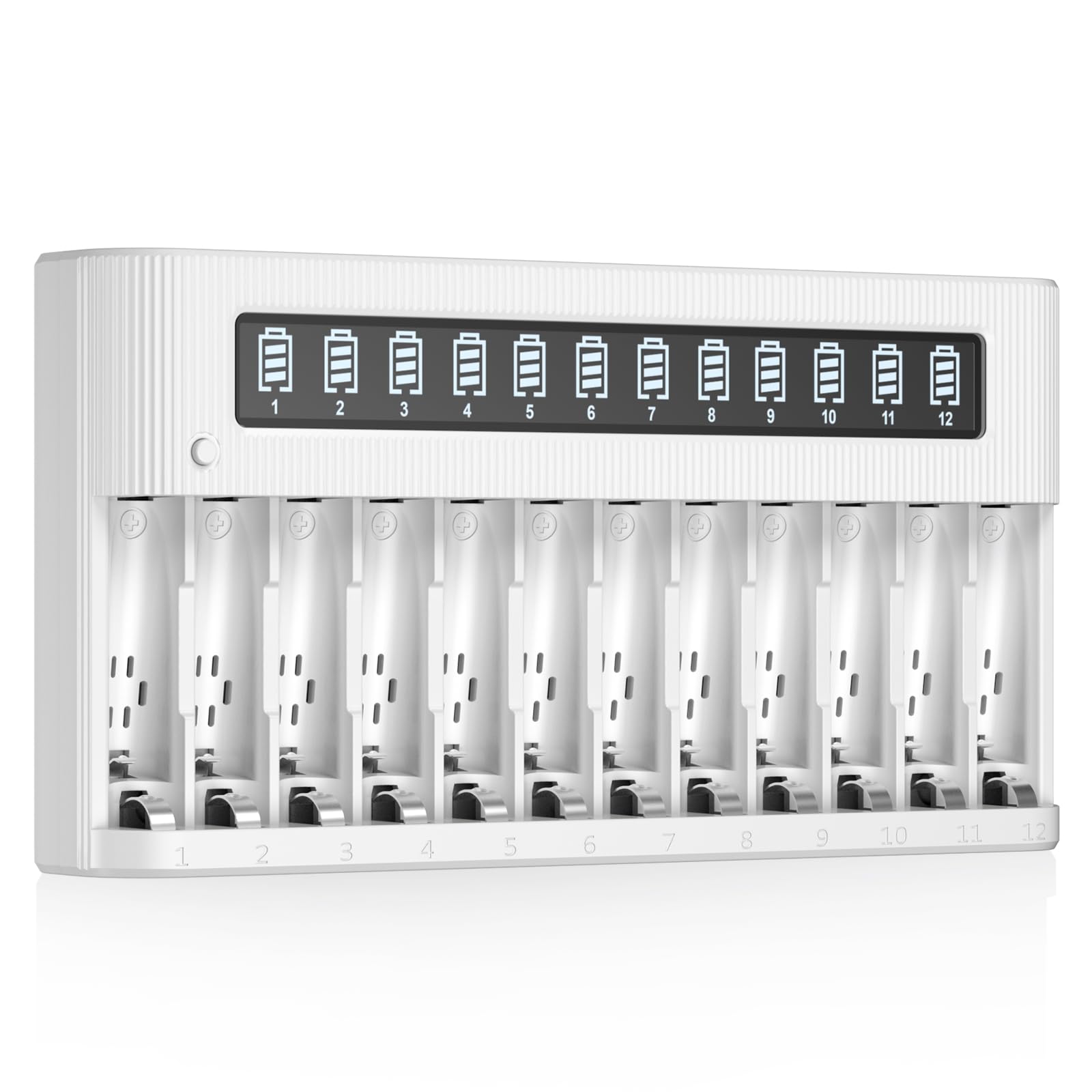
Twelve slots that run one battery or twelve with equal ease
For a house that burns through AA and AAA cells across remotes, mice, toys, and wireless mics, this is the tray that keeps the whole drawer topped. It charges anywhere from 1 to 12 NiMH or NiCd batteries at once, each slot working on its own, and the large LCD reports the real-time status of every cell as it fills. There is also a discharge button that cycles a battery to knock out the memory effect that builds up over months of partial charges.
Two details stand out on the spec sheet. The 12-slot input runs on 5V through a Type-C port, so the same cable that charges your phone can power it off a laptop, car charger, or power bank. And the safety package includes MCU control with -∆V detection, plus over-heat, over-current, and short-circuit protection that also flags a non-rechargeable or defective battery. The listed dimensions put it at 8.07 by 10.6 inches, so give it real shelf space.
The friction here is physical, not electrical. Owners mention batteries sit extremely snug in the slots and need real prying to remove — one person broke a nail working a cell loose from the positive terminal. A few also noticed that after a full charge and a short rest, some batteries read as incomplete and want another 40 minutes. Neither point touches the charging itself, which people describe as fast and reliable.
The case for the 12-bay
- Charges 1 to 12 NiMH or NiCd cells all at once
- Discharge mode helps clear memory effect on older batteries
- Type-C input works off a laptop, car charger, or power bank
- Clear LCD tracks each battery through the charge cycle
The snags to expect
- Batteries fit very tight and take effort to pull free
- Some cells need an extra spin in the charger to register full
- Takes up a decent footprint on a shelf
Made for the household that cycles through cells and wants one tray for everything it owns.
Fine to pass if you own a dozen batteries and no patience for tight slots.
5. Tenergy TN162 8-Bay Smart LCD Battery Charger for Rechargeable AA/AAA NiMH/NiCd Batteries

An 8-bay charger with a 12V car adapter for topping up cells on the road
Campers, road-trippers, and anyone who fills batteries for a family will get why this unit ships with two power paths. It runs off a standard AC outlet at home using the 12V input, and it includes a car port adapter so you can top up cells on the road. Eight bays each run independently, accepting anywhere from one to eight AA or AAA NiMH or NiCd batteries at a time.
Charging speed lands around 2.3 hours for the tray, with an AA rate of 500mA and an AAA rate of 250mA. The charger uses Delta-V detection to stop each slot the moment its battery is full, and it adds overheat and overvoltage protection on top of that. The LCD shows the progress of every cell, so you are never guessing which one still needs time. A refresh mode is built in for batteries that have been sitting idle in a drawer.
Two personality notes from the user side. The blue status light is bright enough that people turn the charger on its side at night to keep a bedroom dark. And at the fixed charge rate, a 1,900 mAh cell can take around six hours — a charger with selectable current will beat it there. Neither stops the TN162 from being the most travel-ready unit on this list.
The travel angle: an included 12V car adapter plus AC input means the same 8-bay tray works in a hotel room or from a car socket.
The measured catch: fixed charging rates mean a large cell can run about six hours, and the blue light glows bright at night.
Reach for this if you need eight batteries charged wherever you park.
Not the one if you want to dial the charging speed yourself.
6. Panasonic BQ-CC63SBA Advanced eneloop 8-Position Individual Rechargeable Battery 5-Hour Quick Charger with 8 LED Charge Indicator Lights

Eight bays, five hours, and batteries that stay cool the whole time
Where the four-bay chargers cap out, this one keeps going. Eight independent slots take any mix of AA and AAA cells at once, and Panasonic rates a full tray of AA eneloops to fill in about five hours, with AAA cells done in roughly three. Each slot has its own LED, so you can pull the finished ones without disturbing the rest. The Smart Charge circuit reads voltage per battery and stops at peak capacity, which is what keeps a cell alive through years of use.
The practical draw is the cord. A six-foot AC power cord is included and there is no bulky wall brick, so the charger plugs in and stays out of the way. It accepts eneloop and eneloop pro AA and AAA cells, and owners consistently describe the same experience — the batteries warm slightly, the charger itself stays cool, and the process takes no thought. A solid, quietly capable unit that fills eight cells while you sleep.
What you give up is information. The lights on this model are green only — on while charging, off when done — where earlier Panasonic chargers showed red, yellow, and green to indicate charge level. A few owners called that a step back, and it means you cannot glance at a finished battery and see how full it is in stages. It charges correctly; it just tells you less while doing it.
Where it shines: 8 independent bays with a rated five-hour AA fill and a Smart Charge circuit that halts at peak capacity.
Where it cuts corners: a single-green-light system with no staged charge-level readout.
The eight-cell workhorse for someone who owns a lot of eneloops and wants to fill them all at once.
Not ideal if you want a charger that shows charge progress or voltage numbers.
7. BT-C2400 Battery Charger Analyzer Tester for AA AAA NiMH NiCd Rechargeable Batteries

A 4-channel analyzer that measures capacity and internal resistance to flag worn cells
Four channels here work like four separate chargers, each with its own backlit LCD showing capacity, voltage, elapsed time, and current for the battery inside it. You can set every channel on its own or lock them all together. Charge, Discharge, Refresh, and Test modes cover the full life of a battery, and the unit even measures internal resistance so you learn which cells are quietly wearing out.
The power ceiling is high. The charger handles cells up to a 20,000 mAh capacity limit, and it runs a low trickle charge of 7 to 14mA once a battery nears full — the kind of gentle finish that protects eneloops. Current runs up to 1,000mA across all four slots, with outer channels reaching 1,400mA. Dedicated AA and AAA slots mean no sliders to fight, and the charger runs cool through a full session.
This is the pick for old cells, not just new ones. It charges high-resistance batteries other units reject, using adaptive current to push through and revive them. What trips people up is the interface — the display can only show the latest test cycle, so keeping track of a Refresh pattern takes attention, and the printed manual is thin. The refresh mode also varies: some owners found it revived tired NiMH batteries, while others saw little change.
Why it earns the title
- Four independent channels, each with its own backlit LCD
- Charge, Discharge, Refresh, and Test modes plus internal resistance measurement
- Handles cells up to 20,000 mAh and revives high-resistance old batteries
- Low 7–14mA trickle finish is gentle on eneloops
Set your expectations
- Interfaces on the screen can be fiddly and only show the latest cycle
- Refresh mode results vary depending on how worn the battery is
- The included manual does little to explain the modes
Buy it if you want a charger that also measures your batteries, so you can separate the keepers from the dead weight.
Not for you if you want a set-and-ignore charger with no menu buttons.
8. EBL 12+2 Bay Universal Rechargeable Battery Charger for AA AAA C D 9V Ni-MH Ni-CD Batteries & 9V Rechargeable Batteries (AC Power Supply)

The only 14-slot tray here that also takes C, D, and 9V cells
You can charge almost any household battery you own, because most chargers stop at AA and AAA and this one does not. Fourteen slots cover 1 to 12 AA or AAA batteries, or 1 to 6 C or D cells, plus 1 to 2 9V cells — all NiMH or NiCd, from any brand. Every slot works independently, so a single battery charges without a partner. The 12 AA/AAA/C/D slots report through an LCD that shows charging status or flashes an error code for a damaged or improperly seated battery, while two LED indicators handle the 9V side, turning red while charging and green when full.
Safety circuitry follows the same pattern as the brand’s smaller unit — MCU control with -∆V detection, overheat and overcurrent protection, short-circuit protection, and detection that refuses a non-rechargeable or defective battery. An AC cable is included, and the amperage rating sits at 1,800mA. The whole tray measures 10.62 inches deep, so it needs a real surface to sit on.
The catch is mechanical. The flat metal contacts have no side walls, so loose cells can slide, and C batteries need to sit across two plates to make contact. One owner noted the prongs take two hands to lock in place. It also is not confirmed to work with batteries outside the EBL line, since one reviewer only ever tried EBL cells. For a household with lantern batteries and smoke-detector cells in the mix, though, nothing else here covers the range.
The range advantage: fourteen slots spanning AA, AAA, C, D, and 9V in one tray, at an 1,800mA rating.
The fiddly part: open contacts let batteries shift, and the prongs need both hands to seat.
The right pick for a mixed battery drawer that includes C, D, or 9V cells.
Overkill if your devices only ever take AA and AAA.
9. Panasonic BQ-CC65AKBBA Super Advanced eneloop pro and eneloop 4-Position Quick Charger with LCD Indicator Panel and USB Charging Port, Black

A 4-slot LCD charger that displays voltage, time, and mAh discharge per battery
This is the top of the Panasonic line, and the differences sit in the display. Four individual LCD indicators report charge and discharge time, battery cell voltage, and mAh discharge level for every eneloop or eneloop pro cell in the tray. Battery detection technology analyzes each battery the moment you drop it in, then ends that slot’s charging the instant the cell is full. If you have ever wondered whether a battery is actually holding its charge, this charger answers it in plain numbers.
Speed is part of the story. The charger will fill four fully drained AA or AAA eneloop pro cells in about four hours, two of them in two hours, or four standard eneloop cells in three hours and two in about 1.5 hours. A USB port rated 5V 1A lets you top up a phone or small device alongside your batteries, and the whole unit runs on a 5V input. A refresh mode brings old cells back through a drain-and-recharge cycle.
The only real complaint is the price of admission. Owners call it worth the extra cash, but it costs more than most chargers on this list, and it holds four batteries rather than eight. If your drawer is full of AA and AAA cells and you want the clearest picture of what each one is doing, that trade is easy.
What you pay for: a four-slot LCD panel that shows voltage, time, and mAh discharge per battery, plus a 5V 1A USB passthrough and 1.5-hour two-cell charging.
What you accept: four slots at a premium price, and a screen that is built for the user willing to read it.
The right buy if you want the most detailed view of every battery and only need to charge four at a time.
Look elsewhere if you need a full eight-cell tray or a simpler one-button charger.
Understanding the Specs
Bay count and independence
A bay is one slot that holds a single battery. Some chargers pair bays together, forcing you to load cells two at a time and charge them as a set. Independent slots are better for mixed-age batteries, because the charger stops each one on its own signal instead of waiting for the weakest cell. A 12-bay unit like the EBL tray charges one battery or twelve with no difference in how it manages them.
Charge current in amps and milliamps
Current is the speed dial on a charger. Higher current fills a battery faster and adds heat; lower current is gentler and takes longer. A charger rated 500mA (half an amp) will take longer on a big battery than one that can push 1A or more. The best units offer selectable rates so you can choose speed or gentleness, and the ones with a low trickle finish — like the 7 to 14mA stage on the BT-C2400 — protect your cells over the long haul.
FAQ
Will a NiMH charger charge lithium 18650 batteries?
How long does it take to fully charge AA batteries?
What does the discharge or refresh mode actually do?
Can I charge a single battery in any of these chargers?
Do these chargers have a USB port to charge my phone?
Will this charger work with generic or other-brand rechargeable batteries?
Is it safe to leave batteries in the charger after they finish?
How do I know when a rechargeable battery is worn out?
Can these chargers run off a USB power bank instead of a wall outlet?
Do I need to pull a plastic strip out before the first charge?
Final Thoughts: The Verdict
For most people replacing disposable batteries, the battery charger for rechargeable batteries to start with is the Eneloop Panasonic K-KJ17MCA4BA, because it bundles four 2,100-cycle AA cells with a four-slot charger that fills each battery on its own — a proven pairing for controllers, remotes, and toys. If your drawer also holds C, D, or 9V cells, reach for the EBL 12+2 Bay Universal, since it is the only tray here that covers those sizes. And if you want to know exactly what every battery is doing, the Opus BT-C2400 gives you the voltage, capacity, and resistance numbers to tell a keeper from a retiree. Whichever you pick, the jump to rechargeables pays off the moment a single controller and a couple of remotes stop eating disposables — start with the pick that matches the batteries you already own.
How We Picked
We do not accept paid placement. Every pick is matched to a real buyer and a real use-case; we do not hands-on test units.
Sources & Methodology
Specifications: manufacturer listings and product documentation. Review insights: verified customer reviews, as of September 2026. Pricing: not shown on this page (it changes often); check the current price via the retailer link.
As an Amazon Associate, KitchPrep earns from qualifying purchases. This does not affect which products we feature.
Related Guides
