
Specs are compiled from manufacturer listings and verified buyer reviews and can change over time — please confirm the key details on the product page before buying.
Lithium-ion packs are sensitive — a dumb charger can shorten their life or turn them into a safety risk, while a smart one balances cells, reads voltage, and stops at the right moment. This guide walks you through nine chargers across three tiers so you can match the right one to the tools and toys you actually own, from cordless drills to RC cars.
I’m Mohammad Maruf — the founder and writer behind KitchPrep. This guide is built by comparing the manufacturers’ published specifications and the patterns across verified customer reviews, so you get each pick’s real strengths and trade-offs instead of marketing spin.
Finding a dependable battery charger for lithium ion starts with matching its chemistry, slots, and current to what you charge daily.
Our Picks at a Glance


How To Choose The Best Battery Charger for Lithium Ion
You don’t need to be an engineer to pick the right charger for your lithium-ion (Li-ion) batteries — you just need to match the charger to what you actually own. A Ryobi lawn tool runs on one high-voltage pack, so it needs a simple single-port charger. An RC car uses multiple cells that must stay balanced, so it needs a balance charger with several leads. A flashlight hobbyist with loose cylindrical cells wants a multi-slot bay unit that charges several at once.
Chemistry and Cell Count First
Your charger must speak the same voltage language as your battery. A 40V Ryobi pack needs a dedicated 40V charger with its own cradle, while a 18650 cell charges fine in a bay that tops out at 4.2V (a single Li-ion cell’s full voltage). For RC packs, count the cells — a 4S pack is 4 cells in series — and check the charger supports that range without guessing.
Current, Slots, and Real-World Speed
Charging amps decide how fast a cell or pack refills, but faster isn’t always your friend. A 1A bay gently tops off an 18650, while a 7A RC charger can push a high-capacity race pack from flat to full in under an hour — if the pack is rated to accept that pace. Amp hours (the battery’s capacity) divided by the charge current is your rough hour count, so a 3.5A charger on a 7Ah drill pack takes about two hours.
Balance Boards vs Plug-and-Play Cradles
Loose cells and multi-cell RC packs introduce the concept of balance charging, where the charger evens out each cell’s voltage rather than just dumping current. If you only use one brand’s cordless tools, a cradle charger that clicks onto the pack is all you need — it handles the communication internally. Hobbyists mixing packs from Traxxas, Deans, and XT60 connectors will want a charger that exposes those leads.
Quick Comparison
| Model | Best For | Ports | Max Amps | Battery Types | Amazon |
|---|---|---|---|---|---|
| Venom Pro Duo★ Best Overall | High-power RC packs | 2 | 7 A | LiPo, LiHV, Li-ion, NiMH | Amazon |
| Nitecore UMS2Compact Powerhouse | EDC and vape cells | 2 | 3 A | Li-ion, IMR, NiMH, Ni-Cd | Amazon |
| Nitecore UMS4Most Versatile | Heavy multi-cell households | 4 | 3 A | Li-ion, IMR, LiFePO4, NiMH | Amazon |
| Bslite DC18RF | Makita 14.4V–18V tools | 1 | 3.5 A | Makita Li-ion | Amazon |
| KUNLUN OP401 | Ryobi 40V yard tools | 1 | 2 A | Ryobi 40V Li-ion | Amazon |
| Hiyiton V6 | Budget RC balance charging | 2 | 6 A | LiPo, Li-ion, NiMH, Pb | Amazon |
| XTAR VC8 | 8-cell bulk charging | 8 | 3 A | Li-ion, Ni-MH, AA, AAA | Amazon |
| Opus BT-C3100 | Cell testing and grading | 4 | 1 A | Li-ion, Ni-MH, Ni-Cd | Amazon |
| Aorika Dual 10A | Two 6S race packs at once | 2 | 10 A | LiPo, LiHV, Li-ion, NiMH | Amazon |
In-Depth Reviews
1. Venom Power Pro Duo LiPo Battery Charger
Our pick — over 4.5★ from 850+ verified ratings; the strongest balance of quality and price.
A dual-port powerhouse that refills two high-voltage LiPo packs while you watch the amps climb.
The Venom Pro Duo tops this list because it delivers serious charging speed for RC racers and drone pilots who fly hard and need to recharge fast. It’s a balance charger (a unit that keeps each cell in a battery pack at the same voltage) that pushes 7 amps (A) per port, and it runs two independent 80-watt (W) circuits at once. That means you can top off a 6S race pack (a six-cell battery) on one side while storage-charging a backup on the other — so you’re never grounded waiting for a single charge. Buyers back it up: It earns 4.6 stars across nearly 900 verified owners, with speed and reliability the most-praised traits.
Its 2 ports blow past the single-slot chargers down this list, more than doubling the throughput of the OP401 (which runs at just 2 A). What wins people over is speed — buyers report a 3500mAh 2S pack finished a full cycle in 58 minutes flat. It comes with 8 leads to handle Deans, EC3, EC5, JST, XT60, and more, so you won’t hunt for adapters when moving between your cars and quads. The built-in display adds a battery meter and temperature monitoring that halts the process at your set level, protecting both pack and charger.
The honest trade-off is investment — it’s the priciest option here, built for enthusiasts who fly or drive several packs a day, not casual hobbyists.
Dual-Bay Muscle: With 2 ports at 7 A each, it’s the fastest multi-pack option here, outrunning the OP401’s 2 A by a wide margin. a 58-minute full charge on a 3500mAh 2S is the speed to beat.
The One Trade-off: It’s a premium buy — slightly built for the serious racer.
Reach for it if: you’re racing cars, flying drones, or running high-capacity 6S packs and want two bays in one unit.
Look elsewhere if: your needs stop at a single 2S or 3S pack a few times a month.
2. Nitecore UMS2 Dual-Slot USB-C Charger
The travel-ready two-bay that tells you internal resistance and health with a glance.
The UMS2 is what you grab when your gear spans vape mods, headlamps, or a shelf of 21700 flashlights. It’s compact enough (5.56 oz) to slip in a bag, and it tops out at 3A on a single slot when paired with a 9V QC2.0+ adapter — a big speed jump on a desktop charger this size. The LCD reports voltage, charging status, and battery health in real time, so you know which of your cells is aging before it fails mid-hike.
Unlike the Venom above, this one needs an external USB power source — you bring the wall adapter or a power bank, which makes it a fantastic field companion. It handles 34250, 26650, 14500, and protected 21700 cells, and it auto-detects battery type to pick the right voltage curve. Quality is the standout — it’s a favorite among flashlight forum regulars who’ve upgraded from older single-bay units.
Plan around the lack of a bundled AC plug, and note the recurring durability gripe about the USB port if you’re rough with cables.
Why it travels well
- USB-C input means you can charge from any power bank or solar panel
- 20250 and 20700 cells fit without fiddling
Where it stumbles
- No wall plug in the box — a quality adapter is on you
- Manual print is tiny; download the PDF version
Pick this for: vapers, hikers, and photographers with a mixed drawer of protected cells who demand USB-C convenience.
Think twice if: you expect a ready-to-go unit with a wall adapter inside the box.
3. Nitecore UMS4 Four-Slot Intelligent Charger
Top off a whole drawer of cells at once while each slot decides its own safe current.
If your rechargeables outnumber your gadgets, the UMS4 is the central charging station you’re missing. It packs 4 independent slots to its smaller sibling’s 2, and it can run a 4-battery rotation simultaneously — all while hitting 3000mA per slot on quick-charge inputs. You get auto-detection of battery type and cell health ratings on the screen, so it flags a weak cell before it lands in your nightstand light.
It handles more than just standard 18650s — the spec list includes 20700, 21700, and LiFePO4 packs at 3.2V, which most generic bays won’t touch. With a fast QC source, a 3500mAh cell reaches 80% in about 55 minutes. All four slots are identical, and you can mix different sizes and capacities in a single session, which is perfect for a household that runs AA in a wall clock and Li-ion in a camera flash.
Like the UMS2, it’s USB-C only, so you’ll want a decent power source. The screen is bright — almost too bright for a bedroom nightstand, but that’s the most serious complaint you’ll find.
Central Command: Four independently controlled slots make it the best hub for mixed household cells, with more slots than the UMS2 (4 vs 2) and faster single-slot speeds than budget four-bay units.
Fit Note: Pairs best with a quality USB adapter — the charger itself is the smart part of the system.
Its lane: high-volume households and EDC enthusiasts rotating 4+ cells daily.
skip it if: a single 18650 for your vape is all you ever charge.
4. Bslite DC18RF Charger for Makita Batteries
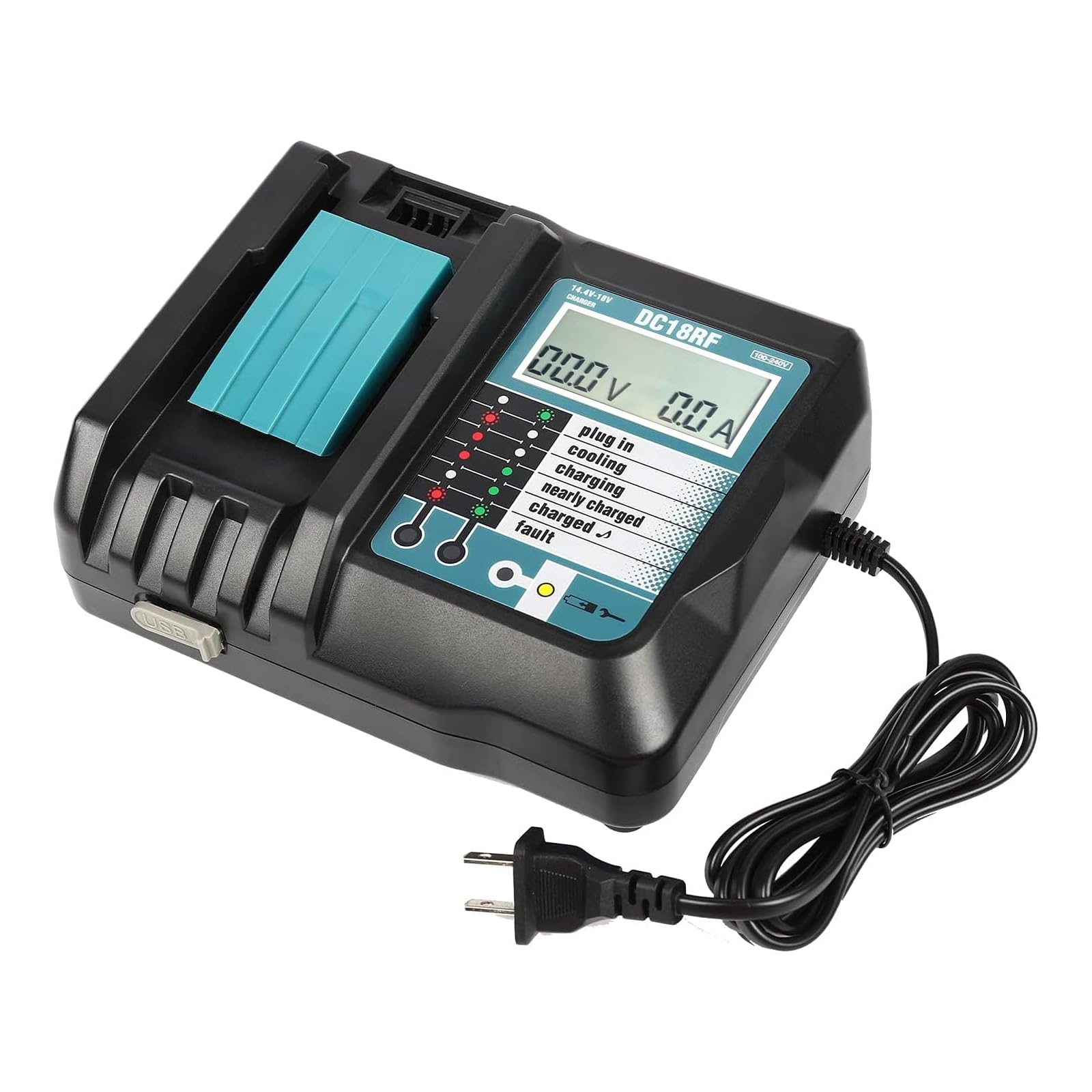
A replacement Makita-style charger that throws in an LCD screen and a USB port for your phone.
The Bslite DC18RF is a third-party stand-in for Makita’s own DC18RC / DC18RD chargers, so it clicks right onto genuine 18V packs like the BL1815, BL1830, and BL1860. It’s got a digital face that shows charging status, plus it works with the Makita 14.4V line too — one unit covers both voltages. Charging runs at 3.5 A, and owners mention it refills a completely dead 18V pack quickly, even from zero.
If you want a second charging spot in your workshop or garage without spending much, this is among the most budget-friendly ways to get one — and it tops out at just the right amperage for most hobby packs. The built-in USB port on the front charges your phone or a work fan, a handy extra if the charger sits near a bench outlet. Over 80 buyers specifically praise its speed and reliability, making functionality the standout feature.
One honest caveat: this is not an original equipment manufacturer (OEM) Makita part, so if you want a branded charger to keep your tool warranty intact, stick with the factory kit instead.
Value Play: One charger handles both Makita 14.4V and 18V battery sizes, unlike the yard-tool-specific OP401 which locks you into a single 40V line.
Get it if: you own Makita drills and impact drivers and want a second charging bay with a screen.
Pass if: you refuse to mix third-party chargers into a professional tool fleet.
5. KUNLUN OP401 40V Charger for Ryobi

The stand-in that keeps your Ryobi mower and trimmer packs ready through the whole season.
There’s no science experiment here — the OP401 is a dedicated cradle charger for Ryobi 40V packs, compatible with models from OP4015 up through OP40601. It feeds a steady 2 A, and the LEDs tell you when it’s charging (red) and when it’s done (solid green). That’s the entire interface, which is exactly what a homeowner wants when they’re juggling a leaf blower and a chainsaw battery. It plugs into a standard 120-volt outlet and runs on just 120W of input.
You’ll note it charges at under half the amperage of the Bslite above — a full 40V pack takes up to 3 hours according to the official spec. Functionality is the thing buyers praise most, with quality close behind, and the main warning from the manufacturer is to keep it out of high heat.
The catch is compatibility — this one is strictly for original Ryobi and KUNLUN 40V batteries, so don’t expect it to wake other brands. Customers note it’s a solid cheap fix for a lost or dead OEM charger, handling both 5 and 6 amp-hour packs without complaint. It’s compact and wall-mountable for storage.
Simple Math: At 2 A it trickles compared to the Bslite’s 3.5 A drill charger (that’s a 1.5-A gap), but a 40V yard pack doesn’t need race-car speed.
Perfect for: Ryobi 40V yard-tool owners who want a backup charger in the garage without paying OEM prices for a spare.
Not for: anyone running off-brand 40V batteries — the charger will simply refuse to play.
6. Hiyiton V6 6A Balance Charger
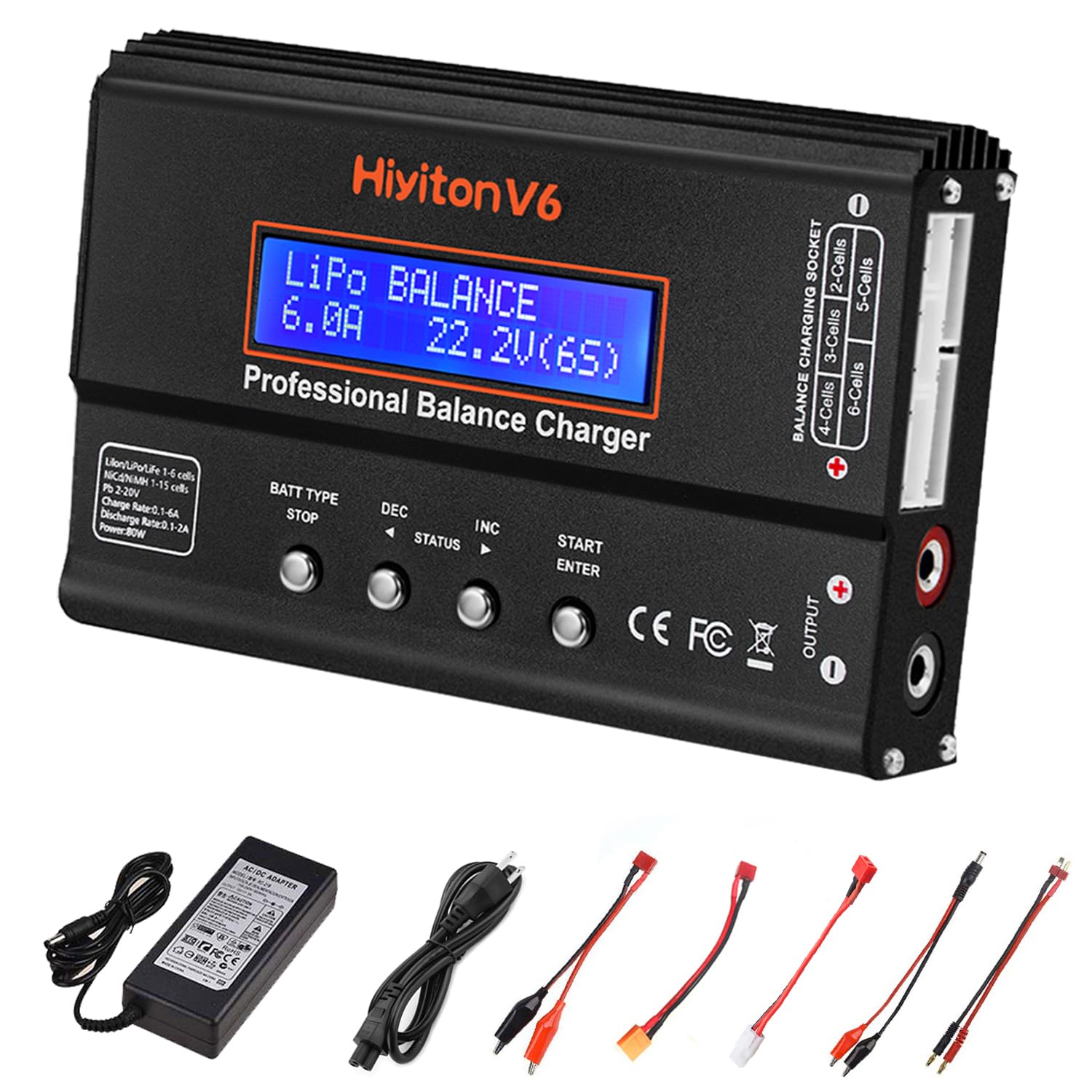
A budget balance charger that speaks fluent LiPo, LiFePO4, NiMH, and lead-acid.
Don’t let the price tag fool you — the Hiyiton V6 is a full-function balance charger that holds its own against far pricier units for casual bashers. It pushes 6 A into 1S–6S LiPo and Li-ion packs, with a built-in LCD that shows voltage and status for each cell. It can also handle LiFePO4 at 3.3V–19.8V and even SLA batteries, which is rare at this budget tier.
It comes bundled with Tamiya, XT60, Deans, and a T-crocodile clip cable, so you won’t need an adapter drawer. Long-term reviewers point out it safely handles balance and storage charging for 2S and 3S LiPo packs. Reviewers consistently mention it runs surprisingly cool and offers clear warning messages if it overheats.
The catch is the missing charging leads on some bundles, and the included power supply whines a bit audibly under load. Its 6 A output sits between the Venom’s 7 A and the budget floor, making it a genuine middle path for someone buying their first proper RC charger. Plus, the 2-year warranty adds a cushion if a newbie makes a wiring mistake.
What the money buys
- Supports a huge voltage range across LiPo, Li-ion, LiFePO4, NiMH, and Pb
- Bundle includes the key RC connectors — no extra cable shopping
Budget realities
- Some units arrive without dedicated charging leads
- The fan and PSU are audible during active charging
Your first RC charger: an ideal intro to balance charging without spending premium money.
Upgrade soon if: your fleet grows past 4S or demands simultaneous high-amp dual-port workflows.
7. XTAR VC8 Eight-Slot Charger with QC3.0 Wall Adapter

Eight bays of pure charging flexibility with a built-in capacity tester for recycled cells.
If you salvage 18650s from old laptop packs or just run a seriously over-equipped flashlight collection, the XTAR VC8 is the rack for you. It accepts 8 different batteries at once across a mix of sizes — anything from 10440 up to 21700 — plus AA, AAA, and C cells in Ni-MH chemistry. You can even mix different sizes in a single charge cycle, which is a convenience most multi-bay units can’t match.
It’s a full system given it includes a QC3.0 wall charger and USB-C cable. Users get a maximum 3 A per slot when resistance is low, and five selectable currents (3A down to 0.25A) to put gentler charges on older or fragile cells. The real feature is the “capacity test” mode on bays 1–4, which cycles a charge-discharge-charge to show you whether a used cell actually holds its rated capacity. For anyone buying reclaimed batteries, that reading is gold.
The most common gripe is that at full 8-slot load, the shared power limits each bay to around 500mA, so a full house charges slowly. And some shoppers say the tested capacity numbers come out lower than cell labels claim — a frustration when chasing maximum output from reclaimed gear.
Lab-Grade Screening: Its grading bays (4 of 8) are what push it past the Nitecore UMS4 for salvage-focused users, earning the battery-life praise it’s known for.
Built for: makers, vapers, and flashlight nerds rotating a huge cell inventory or testing reclaimed packs.
Overkill if: you own only two 18650s — a dual-bay charger costs half as much.
8. Opus BT-C3100 V2.2 4-Slot Analyzer

A legend among battery nerds that analyzes, refreshes, and grades cells like a lab bench.
The Opus BT-C3100 has been the gold standard for serious cell maintenance for years, and the V2.2 revision fixed earlier pulse issues that bothered eagle-eyed owners. It charges four independent slots at up to 1 A each, or 2 A when you use only slot 1 or slot 4. Charging current is selectable in precise steps — 200, 300, 500, 700, or 1000mA — letting you tailor the experience to exactly what each cell needs.
What separates this from the XTAR above is the 5 working modes: Charge, Discharge, Test, Quick Test, and Refresh. The “refresh” mode cycles a tired NiMH cell to reclaim capacity, while the full test routine (charge-discharge-charge) reveals true capacity in milliamp-hours with better accuracy than most consumers ever see. The backlit screen reports internal resistance, charged volume, and voltage across all four bays simultaneously.
It’s a fan-cooled unit, and owners note the V2.2’s fan keeps cells comfortable even in hot garages, though it hums at a slightly high pitch. Protected 21700 cells are too long for the bays without an adapter.
Diagnostic muscle
- 5 analyzer modes give you lab-level capacity and health data
- Real fan cooling in the V2.2 keeps batteries from stress
Power-user quirks
- Protected 21700 cells don’t fit without an adapter
- Fan noise is loud and high-pitched to some ears
If you test cells: this is your tool — the only one here with true capacity analysis and refresh modes.
If you just charge: a simpler bay charger will cost less and make less noise.
9. Aorika Dual 10A RC Balance Charger
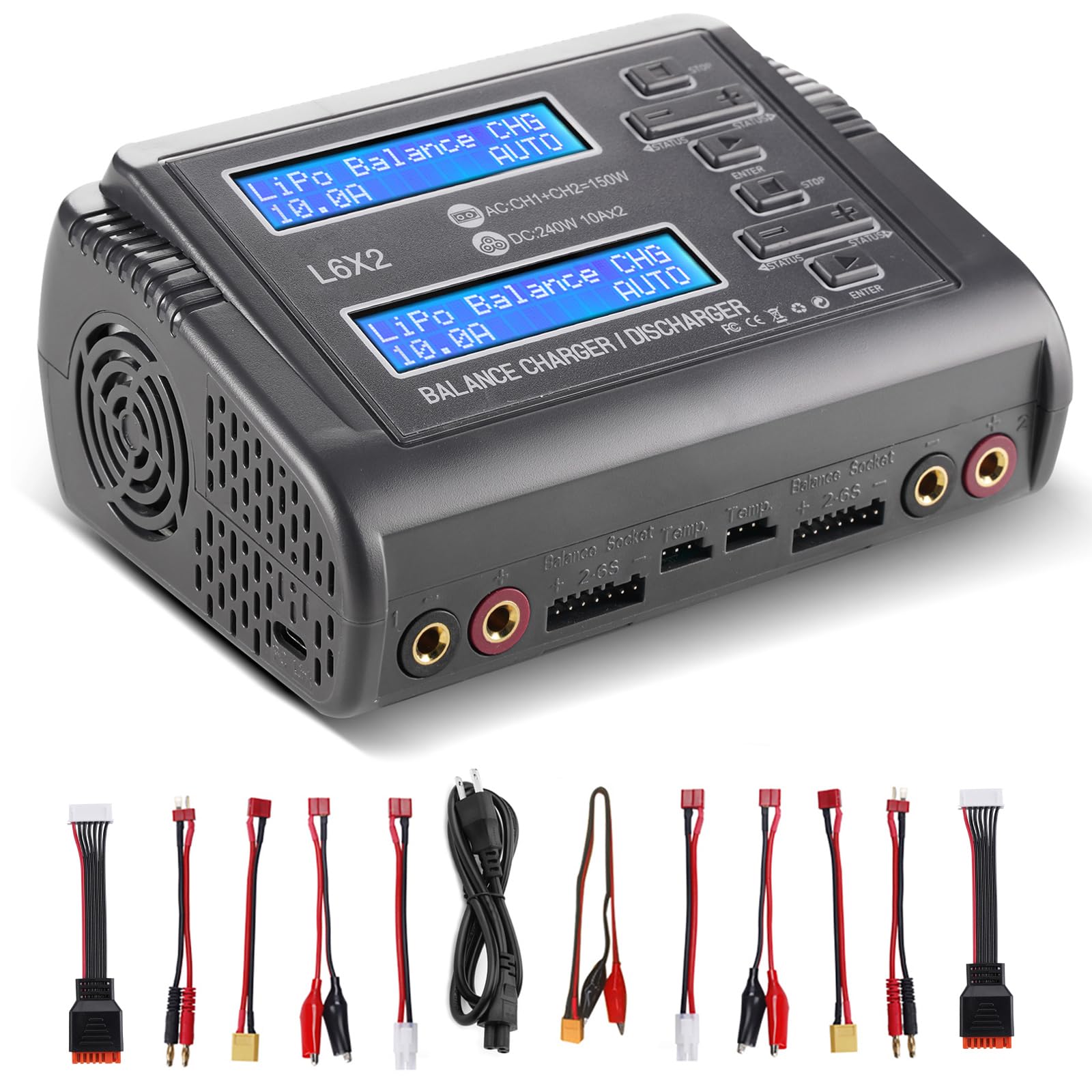
A twin-channel brute that can push 10 amps into two race packs without breaking a sweat.
This Aorika charger sits near the top of the lineup with genuine dual-channel capability — you’ve got two independent ports, each capable of delivering up to 10 A of charge current to its own battery. That makes it the amp king of this entire list, beating both the Venom’s 7 A and the Hiyiton’s 6 A. It’s rated for up to 150W on AC input or a huge 240W on DC, the latter open up its true potential when you wire it to a car battery or power supply.
Buyers report two 3S–4S packs charge together in about an hour, keeping race days on schedule. It folds in a smart “AUTO” cell detector that identifies how many cells you’ve attached, so there’s less to configure on the touch screen. A full array of safety features — over-current, over-voltage, and short-circuit protection — covers the essentials, and owners mention fans that stay quiet during charging.
There’s a learning curve in the menus, and the manual warns against pushing two 6S packs to the max simultaneously. Its 2.4 lb frame also takes up bench space, so if you need to fly light, look at the Venom instead.
Serious Speed: At 10 A per channel, it outdraws the Venom’s 7 A and the Hiyiton’s 6 A — king of the race-day pit table.
Mind the Heat: Dual 6S packs at full tilt stress the limits; it runs best on 2S–4S pairs.
For the busy basher: anyone rotating two vehicles at the track who wants both packs ready between heat runs.
Hold off if: you charge one pack at home — the dual power headroom goes unused.
Understanding the Specs
You Must Match Voltage and Chemistry
The first rule of charging lithium-ion is that the charger’s output voltage must exactly match your pack’s. A single 18650 cell charges to 4.2V, a 2S pack needs 8.4V, and so on. The bottom line: a charger labeled for Li-ion but set to the wrong cell count on an RC balance unit simply won’t top the pack off safely. Even tool batteries like Ryobi’s 40V line have their own chemistry nuances, which is why those cradles talk only to their own brand.
Charging Current Dictates Your Downtime
Amps determine how long a battery sits in the charger. A common rule of thumb: take the pack’s amp-hour rating, divide by the charger’s output, and you get approximate hours. A 6Ah Makita pack at 3.5 A takes around 1.7 hours, while a 2 A Ryobi cradle would need 3 hours for a similar-capacity 40V pack. Higher current means faster refills, but pairing a mega-amp charger with a small-cell pack risks overheating — check your battery’s max charge rate.
Balance Charging Keeps Multi-Cell Packs Alive
An RC pack isn’t one giant battery — it’s 1 to 6 individual cells strapped together. If one cell fills faster than the others, it gets overstressed and the whole pack wears out quicker. A balance charger (like the Venom or Aorika) monitors each cell through a small connector and evens out their voltages while charging. If your drone or RC spec says “balance charge required,” don’t skip a charger that offers it.
Input Power Is a Hidden Spec
Multi-slot chargers often need a strong USB power adapter to hit their fastest speeds. A QC-compatible wall plug can deliver 3 A to a single Nitecore slot, while a weak 5V/2A brick caps each bay at around 1 A. If you buy a USB-C charger without checking what feeds it, you’ll never open up its full potential. Some desktop units bundle the brick; others leave you to scrounge one from an old phone.
Charger Questions Answered
Can one Li-ion charger work for both my RC packs and my cordless drill?
What does a balance charger actually do that a regular one doesn’t?
Is it safe to leave a lithium battery on the charger overnight?
How long will a full charge take with a 2-amp cradle?
Can I charge a LiFePO4 battery in a standard Li-ion charger?
How do I know if a used 18650 cell is still worth keeping?
Will a third-party charger like the Bslite or KUNLUN shorten my battery’s life?
What’s the difference between a 1A, 3A, and 10A charger for the same battery?
What is storage charging and do I really need it?
Can I fast-charge a phone through the USB port on my tool battery charger?
Final Thoughts: The Verdict
For most RC enthusiasts, the battery charger for lithium ion winner is the Venom Power Pro Duo because it pairs dual-port speed with genuine balance charging and a feature set that grows with you. If your tool drawer runs on Makita packs, grab the Bslite DC18RF for its unbeatable blend of features and price. And for the household that topples over with loose 18650 and AA cells, the Nitecore UMS4 is the one to reach for — it’s the most balanced four-slot intelligence you can buy without crossing into lab-bench territory.
How We Picked
We do not accept paid placement. Every pick is matched to a real buyer and a real use-case; we do not hands-on test units.
Sources & Methodology
Specifications: manufacturer listings and product documentation. Review insights: verified customer reviews, as of September 2026. Pricing: not shown on this page (it changes often); check the current price via the retailer link.
As an Amazon Associate, KitchPrep earns from qualifying purchases. This does not affect which products we feature.
Related Guides
