
Specs are compiled from manufacturer listings and verified buyer reviews and can change over time — please confirm the key details on the product page before buying.
Buying a charger for a 12V lithium battery is not the same as buying one for an old lead-acid car battery. Lithium iron phosphate cells — the chemistry most people call LiFePO4 — need a charger that pushes a specific finish voltage and then stops, and a wrong or sloppy voltage curve is how batteries get damaged or never fill up. Below you will find the chargers that match 12V lithium packs properly, sorted by what each one actually does best, from watt-heavy models that refill a big bank in an afternoon to gentle maintainers you can leave connected all winter.
I’m Mohammad Maruf — the founder and writer behind KitchPrep. This guide is built by comparing the manufacturers’ published specifications and the patterns across verified customer reviews, so you get each pick’s real strengths and trade-offs instead of marketing spin.
You will see the amperage ratings that set charging speed, the activation feature that revives a battery the protection board has shut down, and the connector types that decide how easy the hook-up is in real life. Every pick below is a genuine match for a battery charger 12v lithium setup.
Our Picks at a Glance

How To Choose The Best Battery Charger 12V Lithium
Start with the number printed on your battery, because it decides everything else. A 12V lithium pack is really a 12.8V nominal pack, and it wants to be filled to about 14.6V and then held there briefly before the charger cuts off. If the charger finishes somewhere else, you either leave the battery half full or you keep pushing current into a cell that is already done.
Match the charging profile to your chemistry first
A lithium profile is not the same as a lead-acid profile, and a charger built only for flooded, gel, or AGM batteries will not treat a LiFePO4 pack correctly. Look for a charger that names LiFePO4 or lithium-ion in its compatibility list. If you own both kinds of battery, a selectable model saves you from buying twice.
Pick amperage by how fast you need the battery back
Amperage is the current rating in amps, and it sets how quickly a drained pack refills. A 10-amp charger is a steady overnight tool, while a 20-amp or 30-amp unit refills a large bank in a single afternoon. Bigger is not automatically better for every battery, though — a very small pack is happier on a gentler current.
Know what activation actually does
A lithium battery’s protection board, called a BMS, will shut the pack down to protect it when the voltage drops too low. Once the terminals read near zero volts, a normal charger often will not recognize the battery at all. A charger with 0V activation gives the pack a small wake-up current so the protection board resets and normal charging can begin.
The connector decides your daily routine
Alligator clips are fine for occasional use. Anderson connectors and M8 ring terminals are the ones people leave bolted to the battery permanently, so hooking up becomes a single click instead of opening a compartment and clamping every time.
Quick Comparison
| Model | Best For | Output | Amperage | Connector | Amazon |
|---|---|---|---|---|---|
| LiTime 12V 20A Lithium Battery Charger★ Best Overall | Big LiFePO4 banks, RV and solar | 14.6V | 20 A | Anderson 50A, M8 Terminal | Amazon |
| 20A Car Battery Charger, 12/24V Smart Trickle ChargerMost Versatile | Mixed battery collections, garages | 12V DC output | 20 A | Battery clamps | Amazon |
| Battery Tender 6V/12V, 2 AMP SelectableStorage Specialist | Motorcycles, mowers, long storage | 12V DC output | 2 A | Ring terminal and alligator combo | Amazon |
| LiTime 12V 10A Lithium Battery Charger | Smaller 12V LiFePO4 packs | 14.6V | 10 A | Anderson Connector | Amazon |
| E-FAST 12V 30A Lithium Battery Charger | Golf carts and trolling motors | 14.6V | 30 A | M8 terminals and 50A Anderson | Amazon |
| Redodo 12V 20A Lithium Battery Charger | Boats and RV house banks | 14.6V | 20 A | Anderson Connector | Amazon |
| KAISAL 12V 30A Lithium Battery Charger | Outdoor, marine and damp installs | 12V, 14.6V charge | 30 A | M8 terminals, alligator clips | Amazon |
| NOCO GENIUS10 10A Smart Battery Charger | Mixed garages, one charger for everything | 6V / 12V | 10 A | Battery clamps and eyelet terminals | Amazon |
| CTEK 56-926 Lithium US | Long-term lithium car battery care | 12V | 4.3 A | Alligator clips | Amazon |
In‑Depth Reviews
1. LiTime 12V 20A Lithium Battery Charger, 14.6V Output AC-DC, 0V Activation
Our pick — over 4.5★ from 950+ verified ratings; the strongest balance of quality and price.
The 20-amp workhorse that revives a sleeping lithium bank and then fills it properly.
This is the pick for RV owners, off-grid cabins, and anybody running a deep-cycle LiFePO4 bank that goes flat between trips. It pushes 20 amps to a 14.6V finish, which is the voltage a 12.8V lithium pack wants to see. That combination — proper finish voltage plus real current — is what separates a lithium charger from a lead-acid unit dressed up with a new label.
What wins people over is the wake-up function. If your battery’s protection board has shut the pack down and the terminals read near zero, the 0V activation feature nudges it back to life so normal charging can start. Buyers report the Anderson 50A connector as a genuinely nice touch: the leads click together firmly and you can leave the terminal side bolted to the battery. The full automatic run through constant current, constant voltage, then float and cut-off means you set it and walk away. Six protections cover over-temp, over-voltage, short-circuit, over-current, low-voltage, and reverse polarity — the mistakes that kill batteries. The aluminum housing and cooling fan keep it steady during long sessions.
One caveat worth knowing before you buy: the finish voltage is fixed at 14.6V and is not adjustable. That matters if your battery’s own protection board has a lower over-voltage limit, because then the charger and the battery can disagree and the pack will not take a full charge. Most owners never run into this, but if your battery datasheet lists a tight limit, check it first. On weight, this unit comes in at 2.9 pounds compared with the 1.2-pound YHCHKJ below — a real difference if you plan to carry it in a travel kit.
What earns the top spot
- 20 amps at a 14.6V finish — the correct profile for a 12.8V LiFePO4 pack
- 0V activation brings a protection-board shutdown battery back to life
- Anderson 50A and M8 terminal connections let you leave leads bolted on
- Six safety protections plus a 2-year warranty and phone or online support
Where it asks something of you
- The output voltage is fixed, with no adjustment for batteries that cap lower
- Not waterproof, so it stays out of marine and trolling-motor environments
- The cooling fan makes noticeable noise while it works
- The status LEDs are plain — fine, but not detailed
Reach for this if: you are charging a 100Ah or larger 12V LiFePO4 bank and want it refilled properly in a single sitting.
Look elsewhere if: your battery’s own protection board limits voltage below 14.6V — here the fixed output becomes a problem rather than a feature.
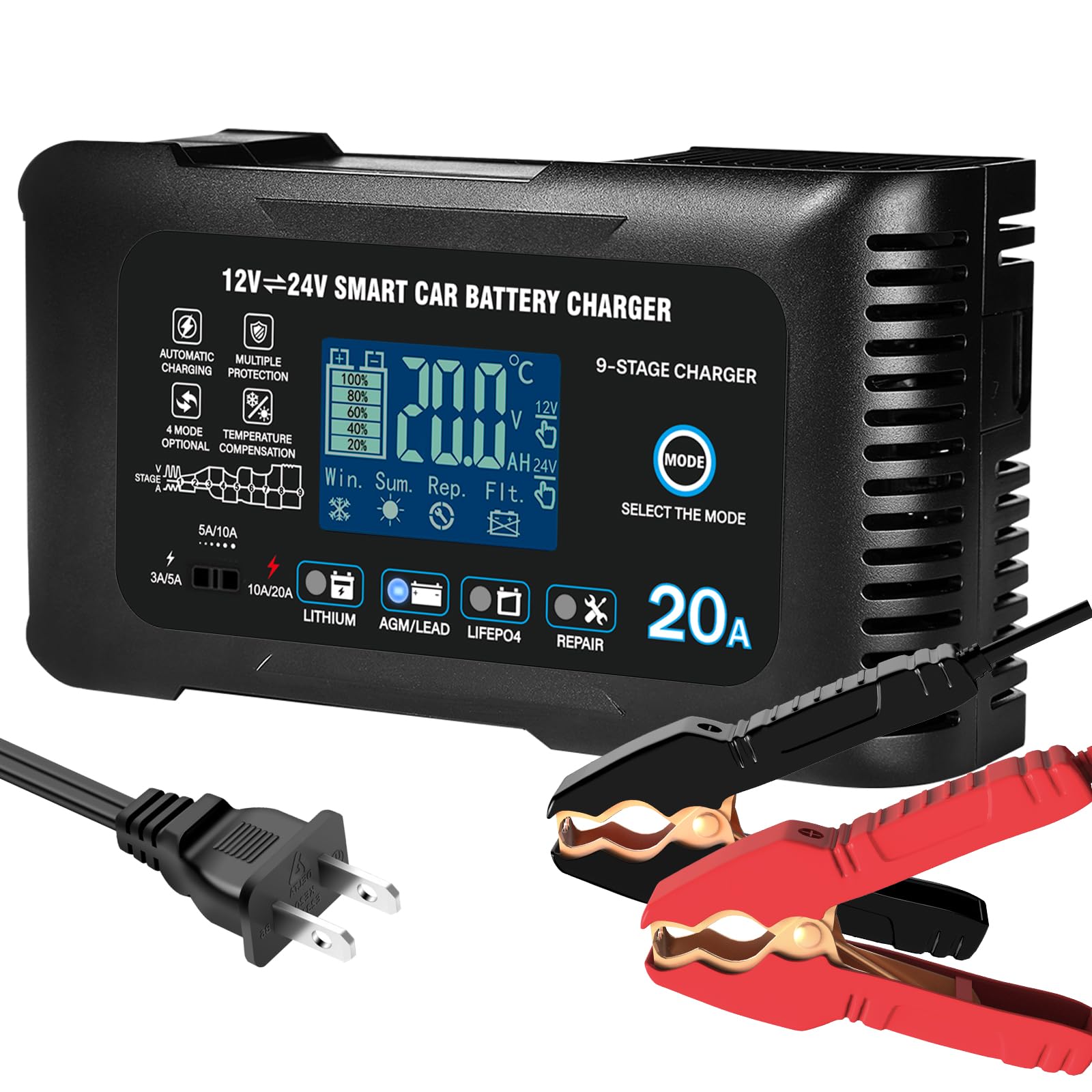
2. 20A Car Battery Charger, 12/24V Smart Trickle Charger & Maintainer
One charger that handles lithium and lead-acid, in 12V or 24V, with a screen that tells you what is happening.
If your garage holds a mix of battery types, this is the one to reach for. It charges lithium, LiFePO4, and lead-acid in wet, gel, and AGM form, and it works on both 12V and 24V systems. You pick the current yourself — 5A, 10A, or 20A on a 12V battery, or 3A, 5A, or 10A on a 24V one — so you can trickle a small pack gently or push 20 amps into a big truck battery. The LCD screen shows voltage, current, internal temperature, and charging percentage, so you never have to guess where you are in the cycle.
The repair mode is the standout. It uses pulse technology to break down sulfation on lead-acid plates, and the review pages sum it up: repair mode brought two deep-cycle marine batteries — two and five years old — back to full capacity. For lithium owners, the 0V activation handles the drained-past-the-protection-point case. The charger also runs temperature compensation, adjusting its output for hot and cold climates, with separate summer and winter modes shown on the screen. It weighs 1.2 pounds and measures 7.63 by 2.66 by 6.71 inches, so it tucks into a travel kit or a garage shelf easily. A 5-year service guarantee backs it.
Be honest with yourself about the speed. This is not a high-amp fast charger, and a fully drained battery can take most of a day to refill. One limitation you should read before you buy: the charger needs at least 2V present to start, so on a battery reading completely dead you need the manual Force Mode to get going — and it is not a jump starter, so it will not fire up a dead vehicle on its own.
The real draw: one box that covers 12V and 24V, lithium and lead-acid, charging and long-term maintenance — with a display that removes the guesswork.
Set your expectation on speed: a heavily drained battery can take the better part of a day, so plan ahead rather than expecting a quick top-up.
Best fit: a garage with several battery types that all need occasional charging and winter maintenance.
Think twice if: you need to revive a battery reading zero volts instantly or jump-start a car — this charger needs a small voltage present and does not boost a vehicle.
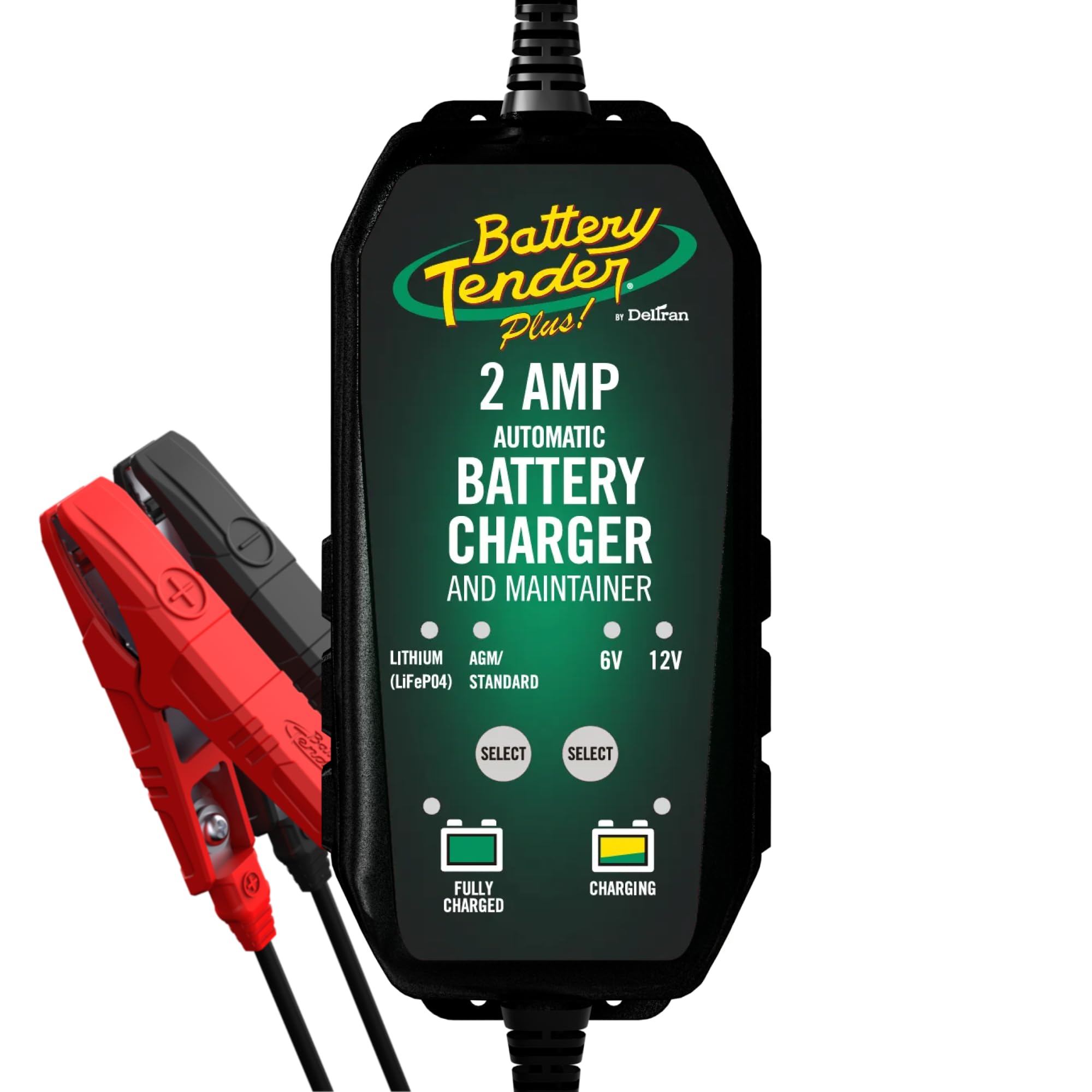
3. Battery Tender 6V/12V, 2 AMP Lead Acid & Lithium Selectable Battery Charger
The slow, patient maintainer built for machines that sit for months, not machines that get driven daily.
Powersports owners know the drill: the bike, the mower, and the generator all sit through winter, and every spring the batteries are weak. This is the tool for exactly that problem. It selects between 6V and 12V and covers flooded, AGM, and gel cell lead-acid as well as lithium, running a four-step program that finishes in float mode. That last stage holds the battery at a steady voltage instead of pushing more current in, which is what keeps a stored battery healthy rather than cooking it.
What earns the following here is how well it simply works. It comes with both a ring-terminal cable and an alligator clip cable, so you can leave the ring terminals bolted to a battery and just plug in. A two-color LED shows the state of charge, and if the voltage drops too far under load, charging resumes automatically at full output. People run it on mower batteries, bike batteries, and electric-start generators, and one owner kept an industrial battery topped up through an entire winter. The unit carries a 7-year warranty and lifetime customer support. It weighs 0.85 kg and stands 8.3 inches tall on its 1.87 by 3.86 inch base, small enough for a shelf or a cargo bay.
Here is the honest trade-off: at 2 amps, this is a maintainer, not a fast charger. Leave it on a small motorcycle battery and it is ideal; expect it to refill a large drained bank and you will wait. And there is a polarity-reversing connector in the bundle that some vehicles specifically need, so check your setup before you assume the included cables fit — a few owners have had to adapt. If your use case is storage rather than fast turnaround, though, the trade is the right one.
Why riders keep one: battery condition held steady through a whole off-season, on both 6V and 12V machines, with cables that let you leave the terminals attached.
Know what you are buying: 2 amps charges slowly by design, and the 7-year warranty reflects a tool meant to live on a shelf, not to rescue a dead car in a hurry.
Ideal owner: someone with a motorcycle, mower, or generator that sits idle and needs its battery kept ready.
Not the one for: fast refills of a large deeply drained battery — for that you want the higher-amp picks higher up this list.
4. LiTime 12V 10A Lithium Battery Charger for 12.8V LiFePO4 Batteries, AC-DC

Half the current of its 20-amp sibling, in a smaller body that suits a modest lithium pack.
This is the LiTime charger for owners with a smaller 12V (12.8V) LiFePO4 battery — think a single 100Ah pack in a small RV, a truck, or a solar setup, not a big parallel bank. It delivers 10 amps at a 14.6V finish using constant current and constant voltage modes, and it carries the same 0V activation that wakes a battery the protection board has shut down. Quality is the thing buyers notice most, followed closely by how it actually charges. It weighs 2.1 pounds and measures 7.09 by 3.58 by 2.03 inches, easier to stow than the 20-amp unit above.
The cooling story is worth spelling out. A built-in fan keeps charging stable in conditions from -4°F to 104°F, and the finish routine runs automatic transitions from constant current to constant voltage to float and cut-off. Multilevel protections cover over-temperature, reverse polarity, output short-circuit, and output over-voltage. The Anderson connector is a genuine convenience — you can leave the terminal side attached to the battery and snap the charger on when needed, with automatic shut-off once the pack is full. It carries FCC, CE, RoHS, and PSE certification plus a 2-year warranty.
Two things to weigh. First, the fan is audible while it works — not loud enough to be a problem, but you will hear it. Second, at 10 amps the charge takes longer than a 20-amp unit, and if your battery’s protection board shuts off before the charger finishes, you will need to reset it and let the cycle run again. It is also not waterproof, so keep it away from marine environments and trolling motors. For a single mid-size lithium pack, though, it is the right size of tool.
Where it lands: a well-built, correctly-profiled charger for a single 12V LiFePO4 pack, with the same wake-up feature as the bigger LiTime model.
Plan for it: 10 amps takes time, the fan is audible, and it is a dry-land charger only.
Pick this if: you are charging one 12V LiFePO4 battery and want the correct finish voltage in a compact body.
Pass on it if: you need the speed of a 20-amp unit or want to use the charger in marine conditions.
5. E-FAST 12V 30A Lithium Battery Charger, 14.6V LiFePO4 Charger with Aluminum Housing
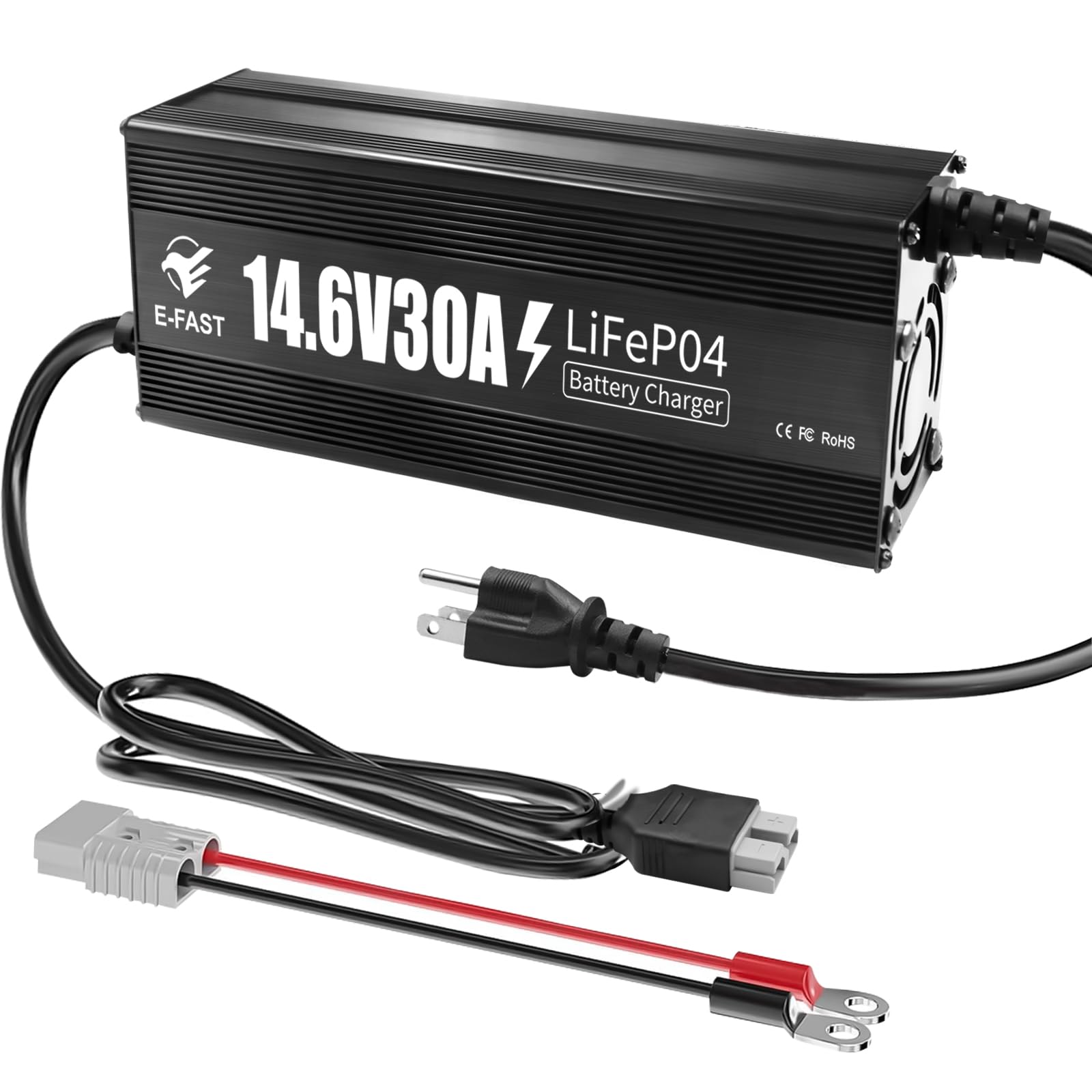
The one for golf carts and trolling motors — 30 amps that fills a 100Ah pack fast and stays cool doing it.
The spec that matters is the 30-amp current at a 14.6V finish, which is what lets this charger refill a 12V 100Ah LiFePO4 battery in about 5 hours in the maker’s stated theoretical figures. It is built for the batteries that live in hard-use machines: golf carts, RVs, off-grid solar banks, marine boats, and trolling motors, in the 40Ah to 300Ah range. On a 300Ah pack, owners find it runs surprisingly cool for the current it puts out and quiet enough to sleep near while it works. The aluminum housing and built-in fan do the heavy lifting on heat.
Connections are the nitty-gritty here, and this unit gives you two: heavy-duty M8 terminals and a 50A Anderson connector. That means it slots into whatever wiring your cart or boat already has rather than forcing an adapter. The LED indicator flips from red to green when the battery reaches full. Protection covers over-voltage, short-circuit, and over-temperature, with automatic transitions between constant current, constant voltage, and float cut-off. It is UL rated. There is a practical gotcha the manufacturer is upfront about: the charging minimum starting voltage is 2V, and it is not a jump starter — so it will not bring a completely dead bank back on its own.
The catch to think about before you buy is the missing screen. There is no display, so you cannot watch the state of charge in real time — one owner ended up buying a separate battery monitor just to see what was happening. If you like to see numbers while you charge, budget for that. If you just want to plug in and check the light later, it is a non-issue.
Standout strengths
- 30 amps at a 14.6V finish — the fastest refill on this list for a 12V lithium pack
- Dual connections: M8 terminals plus a 50A Anderson plug for existing wiring
- Aluminum housing with a cooling fan keeps it stable under heavy load
- UL rated with comprehensive over-voltage, short-circuit, and over-temperature protection
What to plan around
- No display, so you cannot monitor the battery’s state of charge while it works
- Needs at least 2V present to start and will not jump-start a fully dead battery
- It is a large, dedicated-bench charger, not the sort you toss in a glovebox
Made for: anyone with a 40Ah to 300Ah lithium pack in a golf cart, boat, or trolling-motor rig who wants the fastest refill.
Leave it if: you want to watch the state of charge while charging — you would need to buy a separate monitor.
6. Redodo 12V 20A Lithium Battery Charger, 14.6V Output for LiFePO4 Batteries

The 20-amp charger with a lock-tight Anderson plug, built for boat and RV house banks.
Redodo designed this one specifically for 12V (12.8V) LiFePO4 batteries, using a two-stage constant current and constant voltage algorithm that finishes at 14.6V. At 20 amps, it will take a 12V 100Ah battery to 50% in about 2.5 hours — the quick turnaround boat owners want when they come in off the water with a half-drained house bank. The aluminum case and two LEDs keep the package simple. It charges from 0V as well, so a battery the protection board has shut down can be reactivated.
What stands out to boaters is the connection. Where a lot of chargers ship with alligator clips, this one includes an Anderson connector that locks tight instead of slipping off a terminal in a moving boat. The trade-off is that you need the matching connectors on your batteries, or you swap between packs — several owners buy extras for exactly that reason. Protection covers reverse polarity, output short circuit, output overvoltage, and battery isolation, so the common mistakes do not damage the pack or the charger. The power supply is 110V input with a 20-amp current rating.
The honest downside is noise and feedback. The built-in fan is loud enough that it bothers some owners, and there is no recharge progress display — after a full charge, if you unplug and replug, it can take 10 to 20 minutes to show full again even without battery use. The unit works and most owners keep it, but if you charge in a quiet space or want granular progress readouts, those two quirks will nag at you. On a sailboat or in an RV, where a fan matters less, they fade into the background.
Why boaters like it: a 20-amp charge on the correct 14.6V profile, plus an Anderson connector that stays put on a moving deck.
The honest gripes: the fan is loud for some, and there is no progress display — replugging can take 10 to 20 minutes to read full again.
For the owner who: keeps a 12V LiFePO4 bank on a boat or RV and wants a connector that will not slip off.
Skip if: you charge in a quiet room or want a display showing you charge progress — this one is fast but quiet-averse and display-free.
7. KAISAL 12V 30A Lithium Battery Charger, 14.6V LiFePO4 IP67 Waterproof
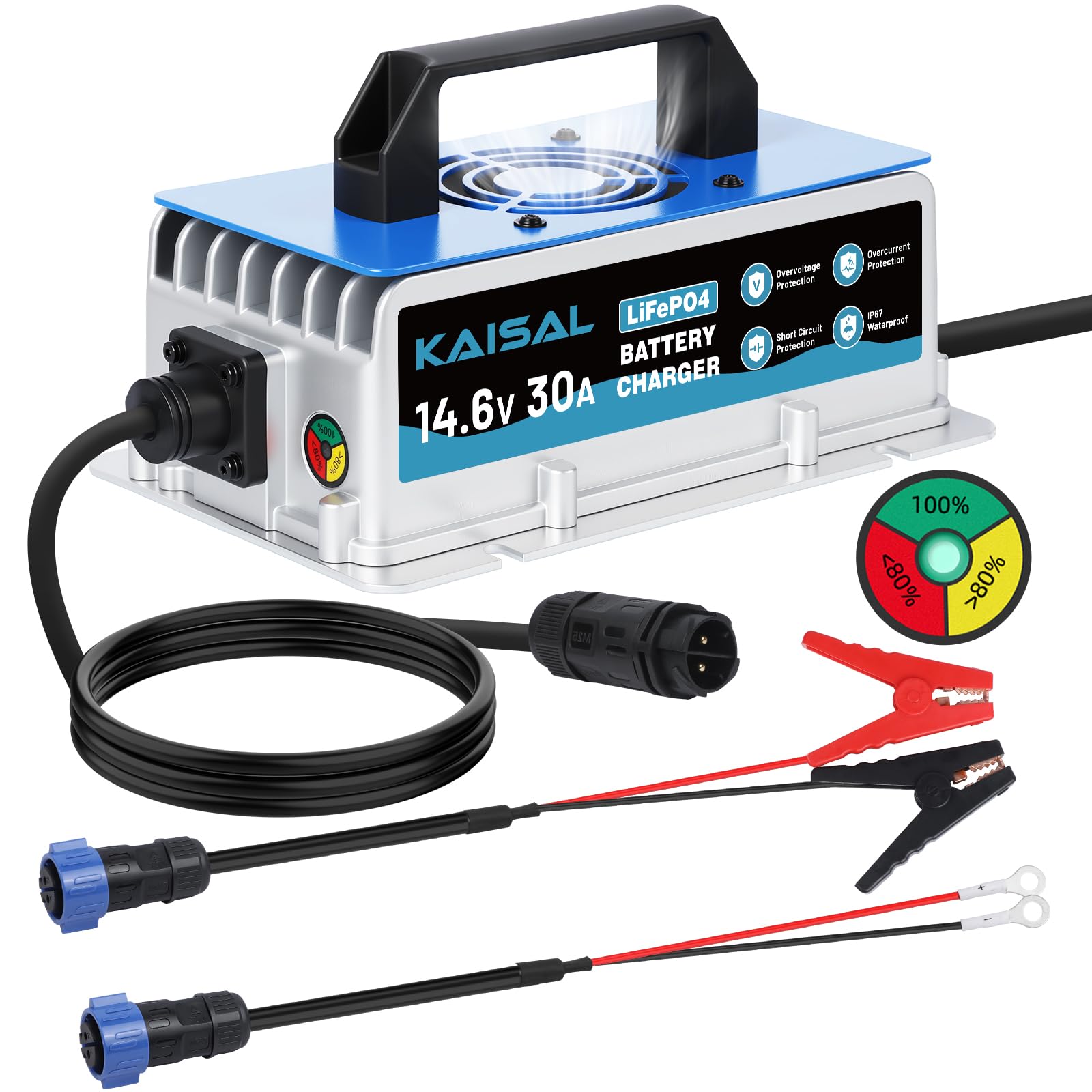
The 30-amp charger you can leave out in the weather, with a light that actually tells you where you are.
Most of the chargers here are dry-land tools, but this one seals up. The case is a one-piece die-cast aluminum body with an IP67 waterproof rating, and the cable itself carries IP68 — so water, dust, and vibration are not the threat they are to the others. It charges 12V (12.8V) LiFePO4 batteries at 30 amps to a 14.6V finish, drawing from a 100-120 Vac input, and it works for RV, marine, boat, solar, trolling motor, and off-grid setups. It weighs 5 pounds, so it is a fixed-mount tool rather than a pocket carry.
The status light is a genuine convenience. Green solid means standby or 0V wake-up mode; red fast-flashing is the pre-charge stage from 0 to 19%; red flashing is constant current from 20% to 79%; yellow flashing is constant voltage from 80% to 99%; green flashing is the final small-current top-off at about 100%; and green solid means fully charged. At a glance, you know exactly where the battery is. There are 8 protection functions — over-voltage, over-current, over-heating, no-load, short-circuit, reverse connection, over-charge, and timing — and if it runs continuously for 15 hours it stops on its own to prevent damage. The cable is 9 feet long, so you do not need an extension cord, and the 0V wake-up mode resets a battery the protection board cut off.
The honest note is the status light calibration. The color coding is precise on paper, but one owner found the state-of-charge LED did not flash yellow as described, so treat the sequence as a guide rather than a precision instrument. It also carries a 3-year service window, and every unit passes a full-load aging test before shipping.
Why it earns premium: IP67 waterproofing on the case and IP68 on the cable, 30 amps at 14.6V, 9 feet of reach, and 8 protection functions including a 15-hour auto stop.
The small print: the LED sequence does not always behave exactly as the manual describes, so read it as an indicator, not a gauge.
Choose this if: your charger lives outdoors, on a dock, or in a damp engine bay where waterproofing is non-negotiable.
Not needed if: you charge indoors on a dry bench — the waterproof premium is money you would not spend.
8. NOCO GENIUS10 10A 6/12V Smart Battery Charger, Trickle Charger & Maintainer

The one-brand-fits-all charger that handles lead-acid and lithium, charges dead batteries from 1 volt, and can be left connected indefinitely.
If you want one charger that handles everything on the property — car, motorcycle, mower, ATV, boat, RV — this is it. The GENIUS10 works on 6V and 12V lead-acid batteries (AGM, gel, SLA, VRLA, flooded, maintenance-free, deep-cycle) and on lithium-ion (LiFePO4) packs. It charges at 10 amps, with a 10-hour battery charge time reference and both a 72-inch AC cable and an 80-inch DC cable with clamps and integrated eyelet terminals in the box. It weighs 4 pounds, is designed in the USA, and carries a 3-year warranty.
The features that put it in the premium tier are Force Mode and the maintenance capability. Force Mode lets you manually charge a completely dead battery down to zero volts, and it can start charging from as low as 1 volt. For long-term care, it constantly monitors the battery and can stay connected indefinitely without overcharging. An integrated thermal sensor adjusts the charge based on ambient temperature — preventing overcharge in heat and undercharge in cold. Precision pulse charging detects and reverses battery sulfation and acid stratification, which is what restores a neglected battery. Buyers have used it to bring a Jeep battery from 40% to 90% overnight and, in one case, to revive a dead lithium battery in a Porsche Cayenne after a pricier charger failed. It comes with a mounting bracket, screws, and a Velcro strap for permanent installation.
Know the two things that trip people up. First, the instructions are long and the manual genuinely needs to be read — this is not a plug-and-forget-forever tool on day one. Second, the charge is slow, and owners find it takes days to bring a truly dead battery back. If your battery has been sitting for a long time, expect patience, not a quick turnaround.
The premium case: multi-chemistry support, Force Mode down to zero volts, thermal compensation, desulfation, and indefinite maintenance — one charger for a mixed garage.
The two catches: the manual is dense enough that you will need to read it, and a fully drained battery takes days, not hours, to recover.
Best for: a home with several vehicle types and batteries of different chemistries that need one reliable charger and maintainer.
Not for you if: you want a fast turnaround on a dead battery or prefer a charger with no reading required.
9. CTEK 56-926 Lithium US, Fully Automatic LiFePO4 Battery Charger, 5.0Ah – 60Ah

The maintainer for high-end cars that sit — precise, gentle, and safe to leave connected.
This is a charger built for a specific owner: the person with a lithium car battery in a vehicle that sits for weeks at a time. Modern cars draw a constant small current even when parked, and in cold weather a lithium pack loses charge fast. The CTEK 56-926 solves that with a patented 8-step program that recovers, charges, and maintains LiFePO4 batteries. It runs at 4.3 amps, is rated for 5.0Ah to 60Ah charging and maintenance up to 120Ah, and finishes with float and pulse maintenance to keep the battery topped without overcharging. It weighs 1.8 pounds and takes alligator clips — but the connector can be configured for permanent access so you do not have to open up the car or open the trunk every time.
The safety framing is what separates it in the premium tier. It operates spark-free, has reverse polarity protection, and delivers exceptionally clean voltage and current — no surges or spikes — so you do not need to disconnect the battery from the vehicle. Owners run it on a 70Ah lithium car battery with about a 6-hour full charge and confirm it works just like the lead-acid versions they used before. It gets warm during operation, which the maker treats as normal. Its indicator lights show charging status clearly, and the hook-up is simple enough that owners describe it as plug and play.
The practical limit is what it is not designed to do. At 4.3 amps this is a maintainer, not a fast charger — so it is the wrong tool for refilling a deeply drained large bank quickly. It is also best suited to the 5.0Ah to 60Ah range. And one owner noted that the vehicle can need an always-hot 12V port for the plug-in method, so check whether yours provides one before counting on that route.
Why premium car owners pick it: an 8-step LiFePO4 program, spark-free and reverse-polarity-safe operation, and clean power delivery that lets you leave the battery connected in the car.
Accept the slow profile: 4.3 amps is deliberate — this keeps a battery healthy over time rather than filling one quickly.
Right for: a modern car with a lithium battery that sits for weeks, where you want a safe, permanent maintainer.
Wrong for: fast refills of a drained cell or a big bank — for those, choose the higher-amperage picks earlier in this list.
Understanding the Specs
Finish voltage and why 14.6V keeps coming up
A 12V lithium battery is really a 12.8V nominal pack, and it charges at a higher voltage than it rests at. The number that keeps appearing in this category is 14.6V, because that is the finish voltage a LiFePO4 pack wants to see. A charger that stops somewhere else — often a lead-acid unit with a lower finish — leaves the battery underfilled, and one that pushes past the limit can trip the battery’s protection board. Some chargers lock that figure in with no adjustment; a few let you tune it. If your battery’s datasheet lists a tight voltage ceiling, match it before you buy. This is the difference, for example, between the LiTime 12V 20A and a charger that only offers a lead-acid profile.
Amperage and how it decides your wait time
Amperage is the current rating in amps, and it is the single biggest lever on how long you wait. A 10-amp charger refills a mid-size pack in a few hours; a 20-amp or 30-amp unit cuts that roughly in half or better. The sweep on this list runs from 4.3 amps at the gentle CTEK end to 30 amps on the E-FAST and KAISAL. Higher amperage is not automatically right for every battery — a small pack is happier on a modest current, and the maker’s stated ranges reflect that, such as the E-FAST design for 40Ah to 300Ah packs and the CTEK for 5.0Ah to 60Ah. Match the current to the pack you own.
0V activation and the protection board problem
Lithium batteries carry a protection board — a BMS — that shuts the pack down when voltage drops too low. Once that happens, the terminals read near zero and an ordinary charger will not recognize the battery at all. A charger with 0V activation sends a small wake-up current that resets the board and lets normal charging resume. It is the difference between reviving a battery and buying a new one, and it appears on the LiTime, Redodo, E-FAST, and KAISAL chargers here.
Connectors and where the cable reaches
The connector is what you touch every single charge cycle, so it matters more than its spec-sheet line suggests. Alligator clips suit occasional use. Anderson plugs and M8 ring terminals let you bolt the leads to the battery permanently so hook-up is one click. Cable length matters too — a 9-foot cord, like the KAISAL’s, means no extension cord, while a standard length keeps a charger close to the outlet. Pick the connector that matches how often you connect.
FAQ
Will a regular car battery charger work on my 12V lithium battery?
What does 0V activation actually do?
How long does it take to charge a 12V 100Ah lithium battery?
Can I leave a 12V lithium charger connected all the time?
Do I need an Anderson connector or are alligator clips fine?
Is a 30A charger too much for a small battery?
Will a 12V lithium charger also charge a 24V battery?
Why does my charger’s cooling fan make noise?
Can I charge my lithium battery while it stays in the vehicle?
Do I need a screen or display on my charger?
Final Thoughts: The Verdict
For most lithium owners, the battery charger 12v lithium winner is the LiTime 12V 20A — it gets the finish voltage right at 14.6V, wakes a sleeping battery with 0V activation, and gives you the Anderson 50A and M8 terminals that make everyday hook-up easy. If your garage mixes battery types and you want one charger for 12V and 24V, the YHCHKJ 20A Smart Trickle Charger is the versatile pick. And for keeping a lithium car battery healthy while it sits, the CTEK 56-926 is the one to reach for, with its 8-step program, spark-free operation, and clean power delivery.
If you want the fastest refill on this list for a big pack, look to the 30-amp E-FAST or KAISAL units — and if waterproofing is non-negotiable, the KAISAL’s IP67 case and IP68 cable are the deciding factor. Whatever you pick, match the amperage to your battery’s size, confirm the finish voltage suits your pack, and you will get years of proper charging out of a single well-chosen tool.
How We Picked
We do not accept paid placement. Every pick is matched to a real buyer and a real use-case; we do not hands-on test units.
Sources & Methodology
Specifications: manufacturer listings and product documentation. Review insights: verified customer reviews, as of September 2026. Pricing: not shown on this page (it changes often); check the current price via the retailer link.
As an Amazon Associate, KitchPrep earns from qualifying purchases. This does not affect which products we feature.
Related Guides
