
Specs are compiled from manufacturer listings and verified buyer reviews and can change over time — please confirm the key details on the product page before buying.
A bad crimp on a battery cable can pull free, corrode, or drop voltage exactly when your rig needs to start. The tool you use determines whether a crimp holds for years or fails, so this guide breaks down the eight best options to match your cable sizes.
I’m Mohammad Maruf — the founder and writer behind KitchPrep. This guide is built by comparing the manufacturers’ published specifications and the patterns across verified customer reviews, so you get each pick’s real strengths and trade-offs instead of marketing spin.
Whether you are terminating 4/0 welding cable or 8 AWG marine wire, finding the right battery cable crimper depends on matching the tool’s force and die range to the size of the lugs you crimp every day.
Our Picks at a Glance


How To Choose The Best Battery Cable Crimper
Choosing a battery cable crimper is really about matching the tool’s force and die range to the wire you terminate. The most common mistake beginners make is grabbing a small hand tool for a massive 2/0 cable, or buying a heavy hydraulic unit when they only ever touch 10 AWG wire. The right tool fits your biggest cable, your workspace, and your budget.
Match the force to the cable size
Thicker cables need more squeeze. A hand ratchet tool works fine for smaller wire like 22 AWG up to 6 AWG, but once you move into 2 AWG, 1/0, or larger battery and welding cable, you generally want a hydraulic crimper that generates several tons of pressure. A proper crimp compresses the lug tightly around the stranded wire to form a solid, gas-tight connection, which requires real force on bigger gauges.
Count the dies and check the range
Every tool crimps only the sizes its dies cover. Some kits include a few dies for common sizes, while others include a full set of 18 or even 32 dies that span a wide range. You also want to check whether the dies are marked with wire size and whether the tool covers the exact AWG of your cable — many buyers find they need to go one die size smaller than the label suggests for a tight fit.
Decide between hand ratchet and hydraulic
Your choice between a hand ratchet tool and a hydraulic one depends on how much force you want to apply yourself. Ratchet tools use a mechanical advantage that locks as you squeeze, and they work great for smaller gauges with minimal hand strength. Hydraulic tools use a pump handle to build pressure with far less effort, making them the better pick if you are crimping large lugs or doing many crimps in one sitting.
Look for genuinely useful extras
A built-in cable cutter saves you a separate trip to the toolbox, and a kit that bundles ring terminals and heat shrink tubing means you can finish the job in one purchase. But weigh the value of the accessories against their quality — some bundled terminals are thin-walled and not worth trusting on a critical connection, so factor the tool’s core ability first.
Quick Comparison
| Model | Best For | Force | Crimp Range | Included Dies | Amazon |
|---|---|---|---|---|---|
| TEMCo TH0005 V2.0★ Best Overall | Fleet & large-cable work | 11 US Ton | 10 AWG – 600 MCM | 32 | Amazon |
| iCrimp IWS-16Budget Champion | 8 AWG marine & auto | Ratchet hand tool | 22 – 6 AWG | Fixed jaws | Amazon |
| Tivorex AWG 10-1/0All-In-One Kit | All-in-one starter kit | Ratchet hand tool | 10 – 1/0 AWG | Rotary hex | Amazon |
| HKS HX-50B Kit | Winch wiring projects | Ratchet hand tool | 10 – 1 AWG | 6 rotary | Amazon |
| UTZIKO 10-Ton | Budget hydraulic power | 10 Ton | 12 AWG – 2/0 AWG | 9 | Amazon |
| iCrimp IWS-0801C | 8-1 AWG quick crimps | Ratchet hand tool | 8 – 1 AWG | Built-in dies | Amazon |
| YUZES YQK-70-A | Narrow-space hydraulics | 10 Ton | 12 AWG – 2/0 AWG | 9 | Amazon |
| TEMCo TH0006 V2.0 | In-vehicle 2/0 crimps | 5 US Ton | 12 AWG – 2/0 | 18 | Amazon |
In‑Depth Reviews
1. TEMCo Industrial Hydraulic Cable Lug Crimper TH0005 V2.0 (11 US TON)
Our pick — over 4.5★ from 600+ verified ratings; the strongest balance of quality and price.
The heavy hitter that turns stubborn 350 MCM lugs into firm, code-ready crimps.
You get 11 US tons of force here — enough to crush large lugs flat against the wire for maximum pull-out resistance, so a 350 MCM connection stays solid under heavy current and vibration. Buyers report it barely breaks a sweat on a 350 MCM lug, which tells you the tool has real headroom for the big battery and welding cables that stall smaller crimpers.
What makes it a standout is the die collection: 32 total sets split between 16 standard sizes for AWG 10 through 600 MCM and 16 plus sizes for the oddball heavy-cast or thin-wall lugs that never fit right. The dies conform to DIN industrial standards, and they imprint the size into the crimped terminal so an inspector can verify the work at a glance — a feature that matters if you are doing code-compliance work.
The trade-off for that power is mass. Buyers do report that pure copper 1/0 can need extra attention and that dies can slide if not seated carefully, but the recurring line is that this unit is portable, fast, and backed by a 5-year warranty from an American brand — with extra o-rings included for the hydraulic seals.
Where it earns its keep
- 32 dies span AWG 10 up to 600 MCM — nearly any lug you will encounter
- Forgives off-size lugs thanks to its dedicated plus-size dies
- 5-year warranty and a well-known US name behind it
What to watch for
- 11.23 kg weight makes it a bench tool, not a carry-everywhere tool
- Some pure-copper 1/0 lugs need a careful die choice for a perfect grip
Grab it if: you regularly terminate large cable from 1/0 up to 600 MCM and want one tool that covers nearly every lug on the shelf.
Think twice if: you only crimp small 8-10 AWG wire — a heavy 11-ton unit is overkill for that light work.
2. iCrimp Non Insulated Terminal Crimper IWS-16
The featherweight ratchet tool that handles 8 AWG boat rewiring with near-zero hand strain.
For marine and automotive work where you are wrapping lugs onto 8 AWG tinned wire, the thing everyone praises about this iCrimp is its labor-saving ratchet mechanism. The ratchet locks in as you squeeze, then auto-releases at the full crimp — which owners say takes minimal hand strength and delivers a clean, sturdy connection every time on 8 AWG tinned wire.
Quality is the most-discussed trait here, and it shows in the material choices. The jaws are S50C high-carbon steel with a black oxide finish for rust resistance, and each jaw is imprinted with its wire size so you can find the right slot at a glance. Unlike the heavier TEMCo above, this whole tool weighs just 0.55 kg, so it lives comfortably in a toolbox drawer or a boat’s electrical kit without hogging space.
The range covers 22 down to 6 AWG, which is perfect for smaller non-insulated terminals and splices — though the trade-off against a hydraulic unit is clear: it will not touch the big 2/0 and larger lugs where real tonnage is needed. Owners mention the crimps on 22 AWG can sit slightly off-center while 18-6 AWG are solid, and that the long handle takes a firm squeeze for full closure on the top end of its range.
Our take on it: this is the smart, low-cost answer for anyone who mainly terminates smaller-gauge battery and marine wire and wants a tool that feels easy in the hand. skip it if 2/0 or larger lugs are on your list — you will need a hydraulic unit instead.
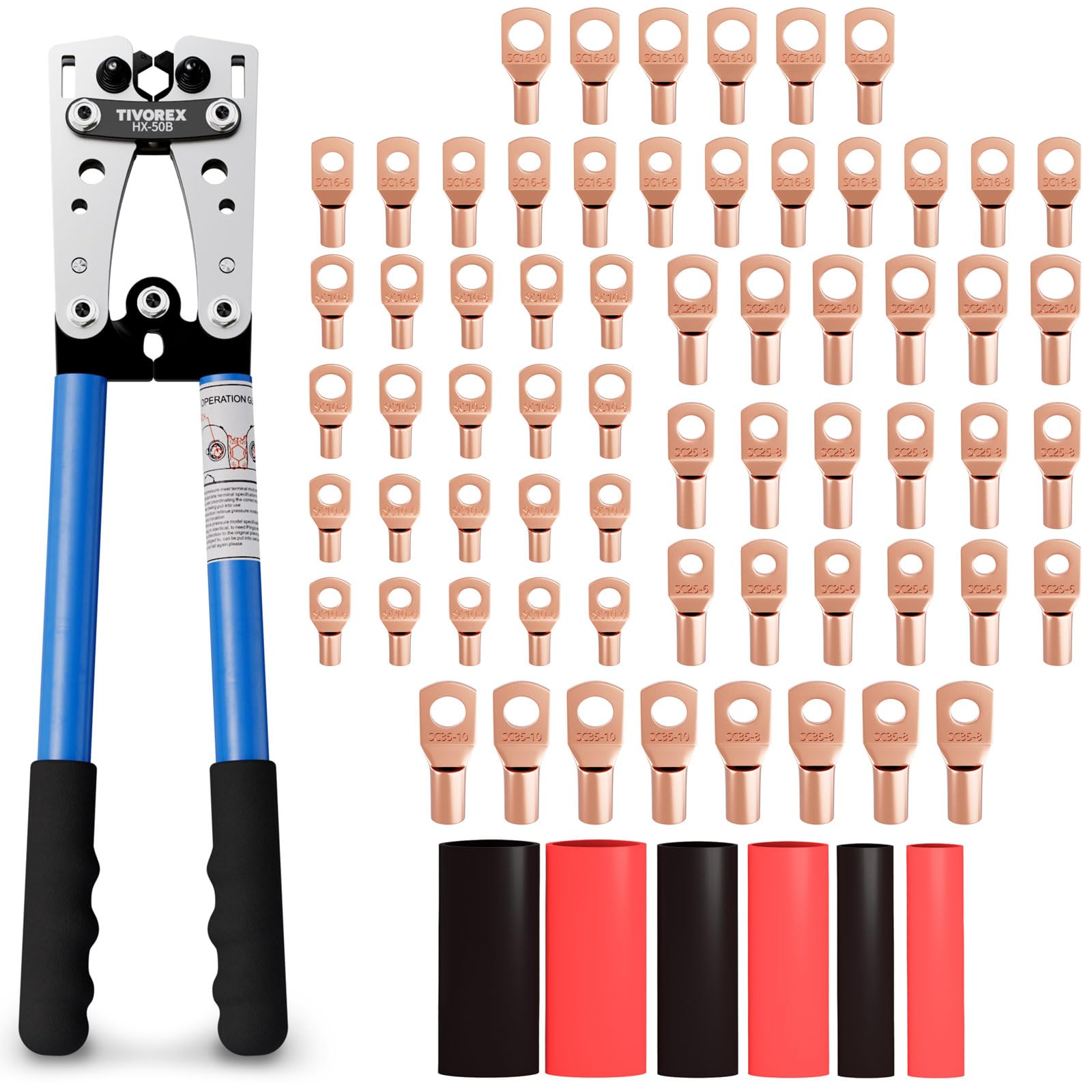
3. Battery Cable Crimper for AWG 10-1/0 by Tivorex
A rotating-die crimper that pairs a butter-smooth cable cutter with a full box of extras.
What wins people over on this Tivorex is the combination of a built-in cable cutter and a rotary hex die system. Instead of juggling loose dies, you press a screw, rotate the head to the size you need, and pull the ratchet — a flow buyers describe as simple, with the cutter slicing through thick cable so cleanly that the phrase “like butter” keeps coming up.
The kit arrives with 174 accessories: a full crimper plus 64 copper ring terminals in 8, 6, 4, and 2 AWG plus 110 pieces of heat shrink tubing. That makes it a genuinely complete starter setup if you are rewiring a car audio system or replacing heavy grounding cables and do not want to source terminals separately.
The catch, and it is an important one for safety-critical work, is that the included terminals get mixed reviews — several owners found them thin-walled and easy to pull off, while the crimper itself earns consistent praise. That leaves a clear verdict: buy this for the excellent tool and the convenience, and consider upgrading to quality terminals if the connection carries serious current.
What makes it handy
- One-touch rotary die adjustment means no loose dies to lose or swap
- Built-in cutter preps cable and leaves clean edges for a neat lug fit
- 174-piece bundle covers terminals and heat shrink for a full job
Know this before buying
- Bundled ring terminals are thin-walled per several owners — buy better lugs for high-current jobs
- The 1/0 gauge lug size is missing from the included terminal kit
Best suited to: the DIYer doing car-audio or home electrical work who wants one box with the crimper, cutter, and consumables all together.
Reach for another if: you need guaranteed-grade terminals for heavy current — the tool is great, the bundled lugs are not always.
4. HKS Battery Cable Lug Crimping Tool HX-50B with Cutter

A high-strength aluminum-alloy body that sheds weight without ditching the crimp quality.
HKS tackles the fatigue problem head-on with a handle made of high-strength aluminum alloy, bringing the whole tool to about 2.35 lbs. That makes it noticeably easier to manage during a winch install or a long wiring session compared with the hefty 11.23 kg TEMCo flagship — you get a 6-size rotating jaw covering 10, 8, 6, 4, 2, and 1 AWG, plus a separate wire cutter in the box.
The crimp jaw itself is cut by EDM wire cutting, a process that gives it precision and durability, and it locks into place with spring-loaded pins. Customers note the cutters are very sharp and slice through 6-gauge wire with ease, and that finished connections look professional once heat shrink is applied.
The honest friction point is sizing: the die numbers use mm markings that do not line up cleanly with AWG gauges, so you often have to eyeball the opening rather than read a direct match. A few owners note the larger sizes are not acceptable from the start and that the kit has no storage case, so you will want to keep the dies organized yourself.
Verdict from the bench: a genuinely light and capable kit for winch, trailer, and automotive battery work in the 10-1 AWG range — just expect a short learning curve matching dies to wire before you get perfect crimps. It suits the mobile installer who carries tools to the job.
5. UTZIKO 10-Ton Hydraulic Cable Lug Crimper
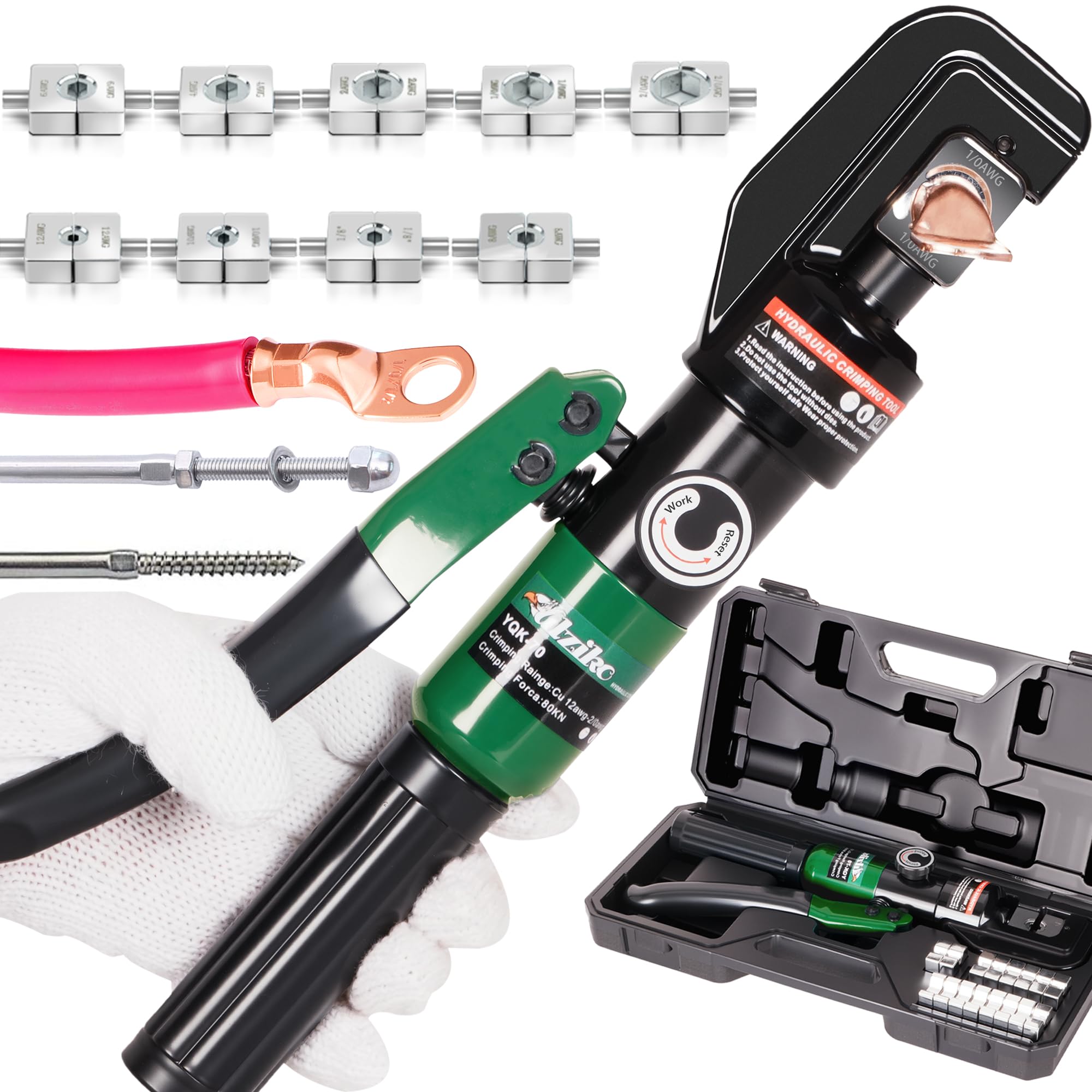
Hydraulic force on a budget, crimping 12 AWG to 2/0 lugs with a smooth one-hand pump.
If you want real hydraulic power without the premium price tag, this UTZIKO delivers a standard crimping force of 8 tons and a max of 10 tons across a 12 AWG to 2/0 AWG range. Owners say the hydraulic action is smooth, the dies swap easily, and the results on large lugs are clean and tight — steady, repeatable crimps that look factory-made.
Compared with the budget ratchet tools above, this is a big step up in capability for heavy battery cable work, yet it stays approachable for a one-time battery replacement job. The kit bundles 9 pairs of dies covering 12 AWG through 00 AWG plus a 1/8″ die for wire-rope railing work, along with spare seals and a plastic toolbox to keep it all organized.
There are two things to know going in. First, the dies can misalign slightly, so you need care seating the terminal before each crimp. Second, and this matches what owners of several hydraulic units report, the dies often run large — several buyers found an 8 AWG die was too big for labeled 8 AWG parts and got a better crimp by dropping one size down. It carries a one-year warranty, with replacements available for failures in that window.
Why it made the list: it is the cheapest genuine hydraulic crimper here, and it earns praise for making consistent, tight crimps on big lugs with minimal strain — a solid starting point into hydraulic territory.
6. iCrimp Heavy Duty Copper Lug Crimping Tool IWS-0801C
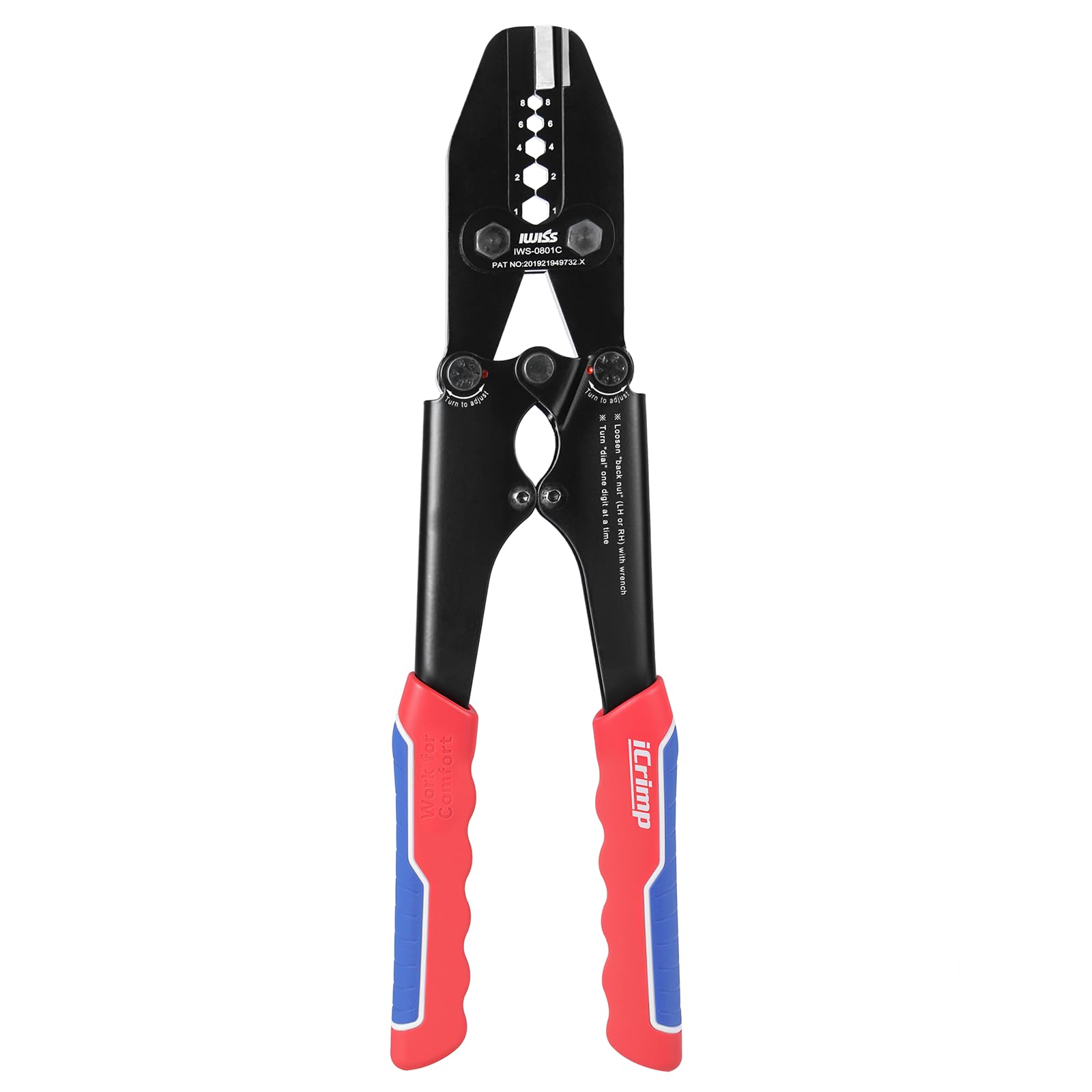
The hand-tool specialist that out-crimps budget hydraulics for 8-1 AWG terminal work.
For 8 down to 1 AWG copper lugs, this iCrimp is the tool the solar and marine crowd keeps coming back to — and the reason is the built-in dies. Because the dies are machined into the tool rather than swapped by hand, there are no loose pieces to fumble, and the crimping process speeds up noticeably compared with die-based tools like the UTZIKO above.
Construction starts with SCM-40 hardened steel, and owners describe it as heavy-duty with no worries about it falling apart. It also has a built-in cable cutter in the jaw, so you can size the cable, trim it, and crimp without switching tools. Buyers rate it a favorite for battery primary wiring splices, noting it works well even on 2 AWG wire and produces consistent crimps with UL-rated lugs.
The trade-off is that hand force does the work — there is no hydraulic assist, so heavier gauges need a firm squeeze. Some owners mention the gauge markings are not perfectly accurate and simply drop to the next smaller slot for a tight fit. Compared with cheap hydraulic units that a few reviewers watched fail quickly, this tool’s durability is exactly what earns the “reach for it for 8-1 AWG” reputation.
Why owners trust it
- Built-in dies mean no loose parts and faster crimping on the job
- SCM-40 hardened steel construction shrugs off hard daily use
- Integrated cable cutter trims and crimps in one tool
Keep in mind
- Manual squeeze required — no hydraulic assist for the largest lugs
- Gauge marks run slightly off; expect to size down for a tight crimp
Choose this when: your work stays in the 8-1 AWG range and you want a fast, durable, no-fuss hand tool that outperforms budget hydraulics on consistency.
Look to a hydraulic if: you regularly crimp 1/0 and larger where raw tonnage beats hand strength.
7. YUZES 10-Ton Hydraulic Crimping Tool YQK-70-A

A 10-ton head that rotates 180° to slip into engine bays and tight wire runs.
This YUZES earns its place with a feature the others lack: the crimping head rotates a full 180°, so you can work comfortably in narrow spaces like a car’s engine bay without fighting the tool’s angle. The YQK-70-A applies a massive 10-ton crimping force with an 11mm stroke, and the handle return spring plus auto-release button make one-handed operation genuinely possible.
Magnetic rails snap each of the 9 hexagonal dies firmly in place, which owners say eliminates the wobble that plagues cheaper hydraulic units — the dies click in and stay put. The kit covers 12 through 2/0 AWG plus a 1/8″ die for steel cable railing, and it bundles spare seal rings, a manual, and a portable storage box. One owner’s note captures the durability sentiment well after a heavy day: it crimped 15 double-ought cables without complaint.
Reviewers consistently advise going down one die size for a tight connection, as connectors can flare slightly with the labeled size. A few owners also found the dies sit a bit loose in the rails until you pack them, and the die stamps use three different numbering conventions, so read the markings carefully before you squeeze.
Standout feature: the 180° rotating head is a genuine advantage for in-vehicle and tight-space work that fixed-head hydraulic tools simply cannot match. It is the pick for the mechanic who refuses to crawl under the dash with a straight-barrel tool.
8. TEMCo TH0006 Hydraulic Cable Lug Crimper (5 US TON)

The little 5-ton TEMCo that delivers tool-truck quality crimps in confined spaces.
Where the big TEMCo TH0005 crushes 600 MCM lugs, this TH0006 is the same brand’s compact answer for the 12 AWG to 2/0 range — and its size is exactly the point. Owners call it small, compact, and powerful, ideal for in-vehicle work where a bulky head simply will not fit, which gives it a clear edge over the larger TH0005 for automotive battery cables.
It uses the same TRUE-HEX crimp-forming dies as its bigger sibling, applying uniform pressure on all sides for even compression and high pull-out resistance. The 18 dies split between 9 standard sizes and 9 plus sizes for the hard-to-fit lugs, and they are color-coded for easy identification. Buyers describe double-crimping — rotating the dies 60 degrees for a second pass — to produce clean results with no extrusions and no failures.
The minor complaint: the blow-molded case makes die retrieval a shuffle, and the pressure-release knob is unlabeled with only a QR-code manual. But the durability story is strong, with crimps holding up over time and owners calling it a step up from cheaper knockoffs, all under a 5-year warranty.
Why it stands out
- Compact frame performs well in confined spaces a full-size hydraulic cannot reach
- TRUE-HEX dies imprint size and deliver even, high-pullout crimps
- 5-year warranty and color-coded dies that swap easily
Minor gripes
- Blow-molded case makes die storage and retrieval a chore
- Pressure-release knob unlabeled; manual is QR-code only
Pick it for: in-vehicle and confined-space battery work up to 2/0 where you want TEMCo’s die quality in a body that fits where the big unit cannot.
Consider the TH0005 if: your lugs go beyond 2/0 and you need the extra tonnage and die range.
Understanding the Specs
Crimping force in tons
The force a hydraulic crimper applies is measured in US tons, and it sets the ceiling for what cable sizes you can terminate cleanly. A 5-ton unit like the TEMCo TH0006 handles up to 2/0 AWG, while an 11-ton unit like the TH0005 reaches 600 MCM. You can rarely apply too much force — the risk is having too little for a big lug, which produces a loose connection that can pull free under load.
AWG range and die count
AWG (American Wire Gauge) is the standard for wire thickness in North America — the lower the number, the thicker the cable, so 2/0 is much thicker than 10 AWG. Your crimper only works within the range its dies cover, and the die count tells you how flexible that range is. Tools with fixed or rotary jaws cover fewer sizes but never lose a die, while kit-style tools with 18 to 32 loose dies span far more lug sizes at the cost of fiddlier setup.
Hex vs indent crimp shape
Crimp dies produce different shapes, and the shape affects how evenly the lug compresses around the wire. True-hex dies squeeze from multiple sides at once for uniform pressure, which owners say gives high pull-out resistance and a cleaner result than a simple indent or flat-wing crimp. Some dies imprint the wire size into the metal, which helps with code-compliance inspections by leaving visible proof of the correct die used.
Hand ratchet vs hydraulic operation
A ratchet hand tool uses a locking mechanism that advances with each squeeze and auto-releases at full crimp — cheap, light, and fine for smaller gauges, but your hands do the work. A hydraulic tool uses a pump handle to build tons of pressure with far less effort, making it the right call for large lugs and repeated crimping. The trade-off is weight, with hydraulic units running several kilograms heavier than a 0.55 kg ratchet tool.
FAQ
What size battery cable crimper do I need for car audio or a winch install?
Is a hydraulic crimper always better than a hand ratchet tool?
Why do my crimped lugs pull off the cable?
Can one crimper handle both small 10 AWG wire and huge 2/0 battery cable?
Do the bundled ring terminals and heat shrink actually hold up?
What does a true-hex crimp die do that a standard die does not?
Is it normal to double-crimp a lug for a stronger connection?
How much force do I really need for a 2/0 battery cable?
Final Thoughts: The Verdict
The all-round winner for serious battery cable work is the TEMCo TH0005 V2.0 because its 11-ton force and 32 dies cover nearly every lug you will find, from 10 AWG up to 600 MCM, under a 5-year warranty. If your work sticks to 8-1 AWG marine or automotive terminals, the iCrimp IWS-0801C is the fast, durable hand tool owners reach for — and its built-in dies beat budget hydraulics on consistency. And if you need hydraulic power in tight engine-bay spaces, the YUZES YQK-70-A with its 180° rotating head and magnetically locked dies is the one that fits where fixed-head tools cannot. Whichever you pick, test your first crimp with a firm pull before you trust it with real current — the tool only does its job when the die size matches the wire.
How We Picked
We do not accept paid placement. Every pick is matched to a real buyer and a real use-case; we do not hands-on test units.
Sources & Methodology
Specifications: manufacturer listings and product documentation. Review insights: verified customer reviews, as of September 2026. Pricing: not shown on this page (it changes often); check the current price via the retailer link.
As an Amazon Associate, KitchPrep earns from qualifying purchases. This does not affect which products we feature.
Related Guides
