
Specs are compiled from manufacturer listings and verified buyer reviews and can change over time — please confirm the key details on the product page before buying.
A battery backup keeps your router, desktop, and TV running for the few minutes the power cuts out, long enough to save a document or finish a file transfer. The key is matching its power rating (how much electricity it can supply) to what you actually plug in, because a box rated too low for your gear will click off the moment you need it most. Every pick below is a true UPS (uninterruptible power supply — a box with a sealed battery inside that switches to battery power instantly), sorted by what it does best.
I’m Mohammad Maruf — the founder and writer behind KitchPrep. This guide is built by comparing the manufacturers’ published specifications and the patterns across verified customer reviews, so you get each pick’s real strengths and trade-offs instead of marketing spin.
You’ll see wattage ceilings, outlet counts, and runtime figures side by side, plus which units hold up when a brownout drags on for hours. If a box under your desk is the goal, this is the rundown of the best battery backup for a home office or entertainment shelf.
Our Picks at a Glance


How To Choose The Best Battery Backup
Buying a battery backup is really two decisions stacked together: how much power you need to carry, and how long you need to carry it. Get those two right and everything else — outlet layout, screen, software — is polish.
Start With Watts, Not VA
The headline number on a battery backup is its VA rating, short for volt-amperes. That figure describes the total electrical load the box can handle, but it is always the bigger of the two numbers you’ll see. The wattage rating sitting next to it is the one that tells you what real appliances the unit will accept. A box rated 900VA over 500W, for example, can carry far more than one rated 425VA over 240W.
To use it, add up the wattage printed on the back of each device you plan to protect. A router and modem together are typically light, while a desktop tower with a big monitor climbs fast. If your total sits near the ceiling, the unit will protest the moment it switches to battery — often by shutting down instead of helping.
Count Your Battery-Backed Outlets Separately
Most battery backups split their sockets into two groups. Battery-backed outlets keep running when the power dies. Surge-only outlets just absorb spikes and go dark with the rest of the house. A box advertising eight or twelve outlets may only have five or six that stay live, so check the split before you buy.
A few designs also space out the wider sockets on the row, which lets a chunky power adapter sit next to a standard plug without blocking its neighbor. That single detail saves a lot of frustration when you’re crouched behind a desk trying to fit everything in.
Decide How Long You Actually Need
Runtime is how many minutes the battery holds your gear up after the lights go out. Ten to twenty minutes is plenty for most people — that is enough time to save and shut down, or to ride through a flicker that would otherwise reboot your router and drop your connection for several minutes. Anyone who needs a machine to stay working through a longer outage should size up rather than hope.
Look For A Replaceable Battery
The sealed lead-acid cells inside these units wear out, usually after a few years. Some models let you pop in a new cartridge yourself with no tools and no downtime. Others seal the battery in for good, which means the whole unit becomes trash when the cells fade. If you plan to own the thing for years, that is worth checking before you commit.
Quick Comparison
| Model | Best For | Power Rating | Outlets | Surge Protection | Amazon |
|---|---|---|---|---|---|
| CyberPower ST900U★ Best Overall | Full desk and entertainment shelf | 900VA / 500W | 12 total | — | Amazon |
| APC BX1350MTop Performer | High-wattage workstations | 1350VA / 810W | 10 total | Coax + Ethernet | Amazon |
| Eaton Tripp Lite OMNI1500LCDTServer Room Ready | Server racks and CCTV | 1500VA / 810W | 10 total | 650 joules | Amazon |
| Staples TECH 650VA | Modem and internet only | 650VA / 360W | 8 total | Built-in | Amazon |
| SKE VL425 | Light networking gear | 425VA / 240W | 7 total | Built-in | Amazon |
| SKE VL625 | Home server and router stack | 625VA / 360W | 7 total | Built-in | Amazon |
| Eaton Tripp Lite BC600R | Tight cabinets and wall mounting | 600VA / 300W | 4 total | 190 joules | Amazon |
| CyberPower AVRG900LCD | LCD monitoring and NAS protection | 900VA / 480W | 12 total | — | Amazon |
| APC BR1350MS | Sensitive electronics and gaming rigs | 1350VA / 810W | 10 total | Coax + Ethernet | Amazon |
In‑Depth Reviews
1. CyberPower ST900U Standby UPS Battery Backup and Surge Protector
Our pick — over 4.5★ from 900+ verified ratings; the strongest balance of quality and price.
The slim line that carries a whole desk without hogging floor space
This is the box for someone whose desk has quietly turned into a small studio — a gaming tower, a home theater receiver, a big TV, and a router all fighting for sockets. It runs at 900VA with a 500 watt ceiling, and that 500W figure is the one that matters when you’re deciding what actually fits. Owners use it to carry everything from a micro ATX gaming PC to a small crock pot, and one setup runs it as a 7.1 home theater with a 50-inch TV attached.
What makes it the crowd favorite here is build and protection quality — the two things buyers bring up most about this unit. It also carries more raw capacity than the SKE VL425 at 900VA/500W against 425VA/240W, and twelve outlets against seven. Six of those sockets keep running on battery while the other six are surge-only, and four are spaced wide to swallow chunky adapters. CyberPower also backs it with a three-year warranty that covers the battery itself, plus a connected equipment guarantee.
The catch worth knowing is that this is a standby unit using simulated sine wave output, not a pure sine wave model. It’s the everyday budget-friendly choice, and the alarm will chirp while it’s on battery — most people disable it once the novelty wears off. Buyers also report that PowerPanel software, a free download, shows real-time load and voltage figures so you can see exactly how hard you’re pushing it.
Where it pulls ahead
- 500W ceiling and 12 total outlets, with six battery-backed and four spaced wide for big adapters
- Three-year warranty covering the battery, plus a connected equipment guarantee
- Free PowerPanel software reports real-time wattage and voltage so you can size your load honestly
What to weigh in
- Simulated sine wave output rather than pure sine wave — the trade-off at this tier
- The alarm is loud while running on battery, though it can be turned off
- Software is a separate download, not preinstalled
Made for the full-desk setup: anyone protecting a tower, a display, and networking gear from one slim box.
Think twice if: your hardware demands pure sine wave power or you want a screen on the front.
2. APC 1350VA/810W Pro UPS Battery Backup for Office Electronics, AVR, BX1350M
Enough wattage to hold a gaming rig through a flicker without flinching
If your machine draws serious power — a high-wattage graphics card, multiple drives, a couple of monitors — this is the tier where a battery backup stops being a toy. It delivers 1350VA with an 810W ceiling and claims up to 54 minutes of runtime at a 100W load. In practice that translates to a 5 to 15 minute shutdown window on a real gaming build, which is the difference between losing your session and closing it cleanly.
Ten outlets split five and five: battery-backed sockets for the essentials, surge-only sockets for peripherals. The unit also protects your coaxial and Ethernet lines, which matters more than people expect — a surge riding in on a cable line can take out a modem that a wall outlet protector never saw coming. AVR corrects low voltage from 88V back to a steady 120V, and the unit is ENERGY STAR certified at 92%+ efficiency.
Performance is the thing buyers rave about most on this model, and it’s the reason it lands here. Be realistic about the size, though: this is a tower form factor and it’s genuinely heavy, so plan a floor spot rather than a shelf. The battery is user-replaceable with the APCRBC123 cartridge, sold separately, so the unit can outlive its first set of cells.
Power you can lean on: an 810W ceiling and active PFC compatibility make this the pick for gaming PCs and multi-drive workstations, not just routers.
One honest limit: the tower footprint and weight mean it wants floor space, and the replacement battery cartridge is a separate purchase down the road.
Reach for this if: you’re feeding a power-hungry desktop and want line protection on your coax and Ethernet too.
Look elsewhere if: you need something that tucks onto a shelf or behind a media console.
3. Eaton Tripp Lite OMNI1500LCDT 1500VA UPS 810W 10 Outlets 650 Joules AVR LCD
The one that keeps a server rack and CCTV alive for hours, not minutes
If your gear cannot blink — a small business running a camera server, a home lab with networked drives, a router and modem that must stay up no matter what the grid does — this unit is built for you. It pairs 1500VA (volt-amperes, the total power it can deliver) with an 810W ceiling (watts, the real power your devices draw) and carries 650 joules of surge protection (joules measure how much energy a spike it can absorb) — the highest joule rating in this lineup, well ahead of the 190 joules on the compact Eaton Tripp Lite BC600R. It also filters 100 Mbps Ethernet (a wired network connection) and telephone/DSL lines, so surges cannot ride in through your data cables.
Reliability is what owners bring up most about it, and the long-haul stories back that up: machines that have run four-plus years on CCTV and network duty, surviving brownouts and breaker trips without dropping connected hardware. One owner reports the battery carrying a cable modem, a network drive, and a switch for several hours during an outage on cells that were already years old. AVR holds voltage steady anywhere from 92V to 150V without draining the battery at all.
The front LCD shows runtime, wattage load, overload state, and battery status, and the internal batteries swap out with the RBC51 cartridge. The annoyance to plan for is the display — it’s bright and it cannot be dimmed, so a bedroom or dark closet placement will glare at you. Software support is also worth checking against your operating system before you buy, since the monitoring utility has fallen behind on newer Windows versions.
What earns it a spot
- 650 joules of surge protection and line filtering on Ethernet and phone cabling, not just AC
- AVR corrects voltage from 92V to 150V back to 120V without using the battery
- User-replaceable RBC51 battery cartridge and a three-year limited warranty
Small print to factor in
- The LCD is bright and cannot be dimmed, which rules out a bedside spot
- Power Alert monitoring software has no released build for the newest Windows versions
- Tower form factor takes real floor space
Built for: small-business and home-lab setups where a camera server or storage array must stay online.
Pass on it if: you want a dimmable display or software guaranteed to run on the very latest operating system.
4. APC UPS 1350VA/810W Pure Sine Wave UPS for Computer, Electronics, BR1350MS
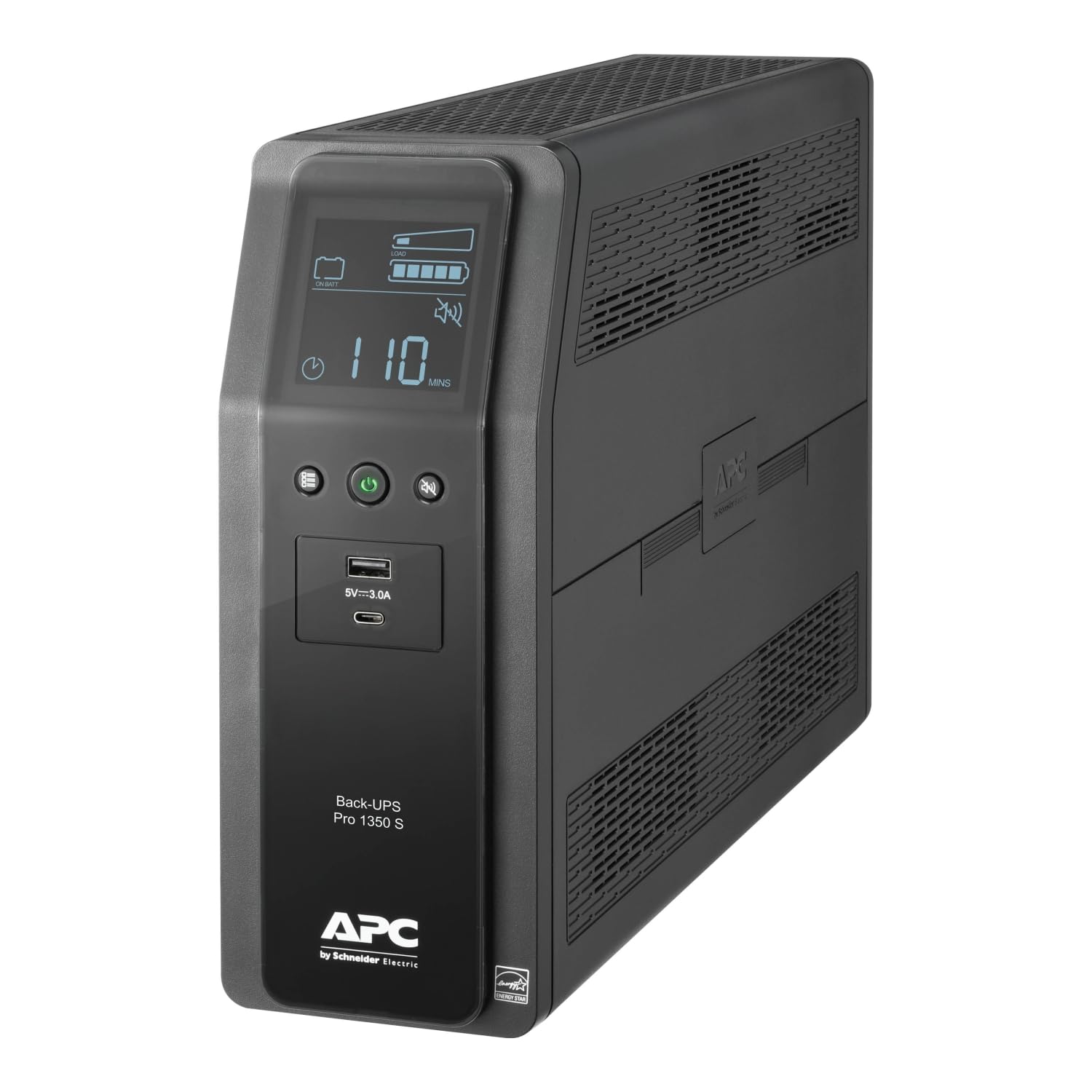
Smooth, utility-like power for hardware you’d rather not gamble with
Modern computers with active power factor correction can be fussy about what kind of electricity they’ll accept from a backup box, and that’s the exact problem this unit solves. It outputs pure sine wave power — the same shape the utility grid delivers — which keeps sensitive components running cooler and lets demanding machines ride through a cut instead of refusing the battery. It carries 1350VA over an 810W ceiling and claims up to 54 minutes of runtime at a 100W load.
Six of the ten outlets stay live on battery and four are surge-only, and like its APC sibling above, it protects coaxial and Ethernet lines from surges. The angled LCD shows remaining runtime, wattage load, and system status without you having to crawl behind the desk. There are USB-C and USB-A ports on board too, sharing 5V/3A, for topping up a phone without spending a battery-backed socket on it.
Real-world endurance is the theme across long-term APC owners: Multiple units have run smoothly for years, one entering its eighth year on original cells while often near its capacity limit. The practical caveat is the battery — it charges slowly at a stated 16 hours, so plan to give it a full day before you trust it, and the replacement is the APCRBC161 cartridge sold separately. Worth knowing too that a phone hung on the USB ports won’t charge while the unit is running on battery.
The sine wave advantage: clean, grid-shaped power plus active PFC-friendly output is why this is the pick for expensive builds and AV gear.
The slow-charge reality: a 16-hour charge time means you plan around day one, and the replacement battery is a separate purchase.
Your pick if: you’re protecting a costly workstation, gaming rig, or AV stack that needs proper sine wave power.
Skip the upgrade if: a basic standby box already covers your router and modem comfortably.
5. Eaton Tripp Lite BC600R 600VA Small UPS 300W Battery Backup Surge Protector
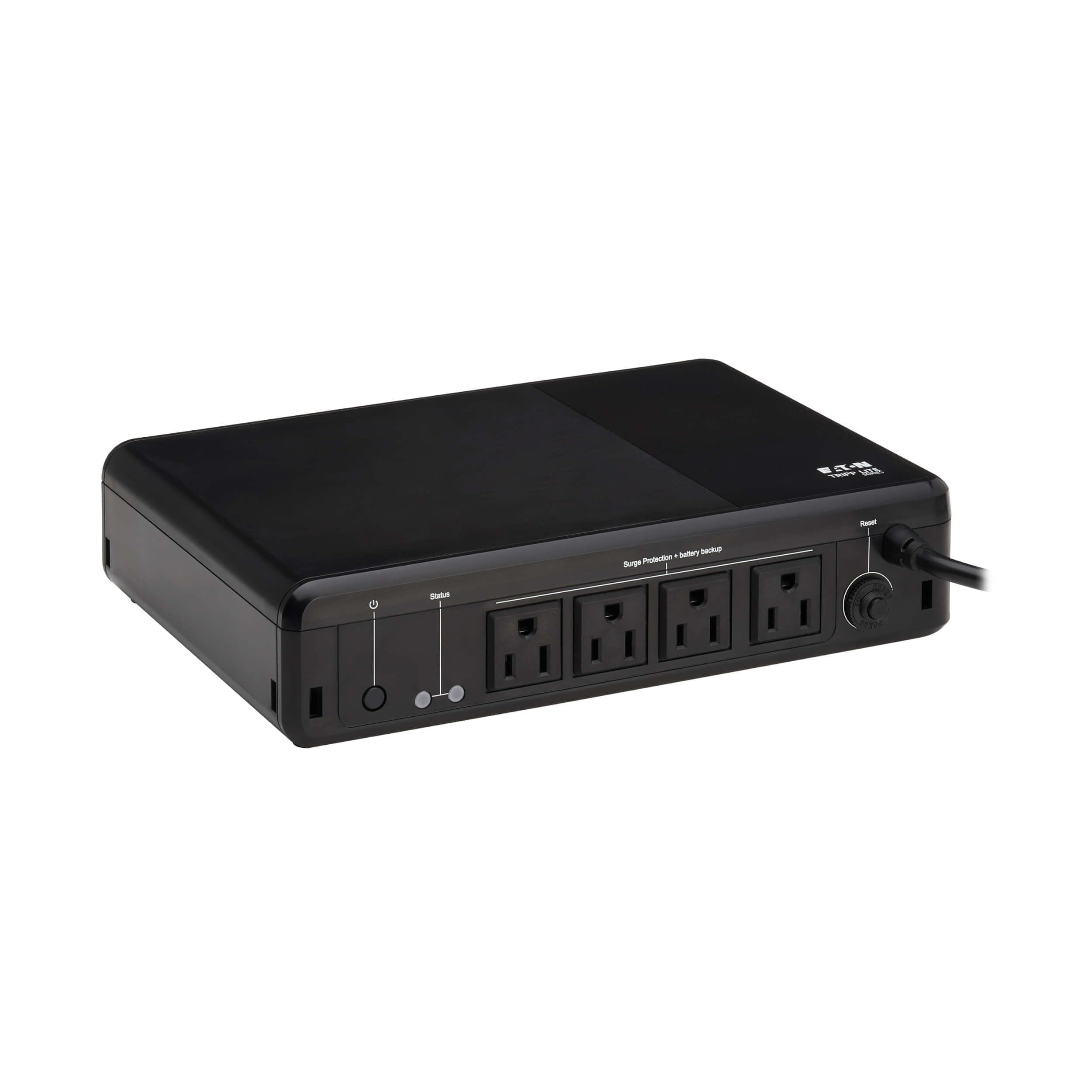
Palm-sized insurance for the modem that keeps your whole house online
Some of us don’t need to run a workstation through an outage — we need the internet to survive a two-second flicker so the router doesn’t vanish for four minutes. That’s this unit’s entire reason to exist. It runs 600VA with a 300W ceiling, carries four outlets, and weighs 4.4 pounds, so it disappears into a media box or a cramped cabinet without eating the space.
What sets this unit apart from everything else here is how you mount it. Keyhole slots on the bottom are spaced in a 100 x 100 mm VESA pattern (the standard bolt spacing used for wall and monitor brackets), so you can hang it out of the way instead of finding it a shelf. It also takes 190 joules of surge protection and an internal battery that swaps with Eaton’s AG-075D cartridge (a replaceable battery pack). Owners talk about reliability more than anything else, and retired electrical contractors are among the long-term users.
Be clear-eyed about the 300W ceiling: this is a router, modem, and VOIP box protector, not a desktop protector. A full-size tower with a large monitor will drain it in a very short window, and the unit is designed to restart itself automatically once power comes back regardless of charge level. The alarm behavior is mixed in owner accounts — some units beep, some don’t — so treat the noise as a coin flip rather than a feature.
Where it wins: VESA-pattern keyhole slots and a 4.4-pound body let you bolt it to a wall or tuck it into tight cabinetry.
Where it stops: the 300W ceiling keeps it firmly in router-and-modem territory — a full desktop will exhaust it fast.
Best for: network gear in a closet, media cabinet, or wall-mounted setup where space is the whole problem.
Not the one if: you’re trying to carry a desktop tower and monitor through an outage.
6. CyberPower AVRG900LCD Intelligent LCD UPS Battery Backup

The numbers-on-the-front model for people who want to see the load
Skip this one if you just want a silent black box. Come to it if you like knowing exactly how hard you’re pushing your backup — the front LCD reports load, voltage, and battery state at a glance. Under the hood it’s 900VA with a 480W ceiling and twelve NEMA 5-15R outlets, split six battery-backed and six surge-only. It also filters data lines, so a surge riding in on a phone cable can’t sneak past it.
Owners bring up power capacity most about this unit, and it holds up under real load. One desk running a main PC with three drives and a 32-inch monitor plus a laptop with a 28-inch display pulls roughly 175 to 200W and gets 18 to 20 minutes of battery, enough to bridge to a generator or land a clean shutdown. A single newer PC and monitor would stretch past 30 minutes. AVR (automatic voltage regulation, which smooths small dips and spikes) corrects minor fluctuations without touching the battery, and the unit is UL listed after lab testing.
Two honest notes. First, the alarm is frequent while running on battery and there’s no way to silence it — a real annoyance if outages are common where you live. Second, the LCD is bright enough that a bedroom placement will bug you. The battery is covered by a three-year warranty, and long-term buyers report the original cells delivering years of service before finally wearing out.
Why it holds its place
- Front LCD shows real-time load and voltage so you can see when you’re near the ceiling
- Twelve outlets, six battery-backed, with staggered spacing for oversized plugs
- Data line protection guards against surges traveling over telephone cabling
Where it grates
- The alarm cannot be disabled while the unit is on battery
- The LCD brightness is hard to live with in a bedroom or dark room
- It requires a live wall outlet to power on at all
Pick this one if: you want load readouts and a screen you can actually check from your chair.
Choose something quieter if: an un-silenceable alarm or a glowing display would drive you up the wall.
7. SKE VL625 625VA/360W UPS Battery Backup and Surge Protector with AVR, 7 Outlets, USB and Type-C Charging
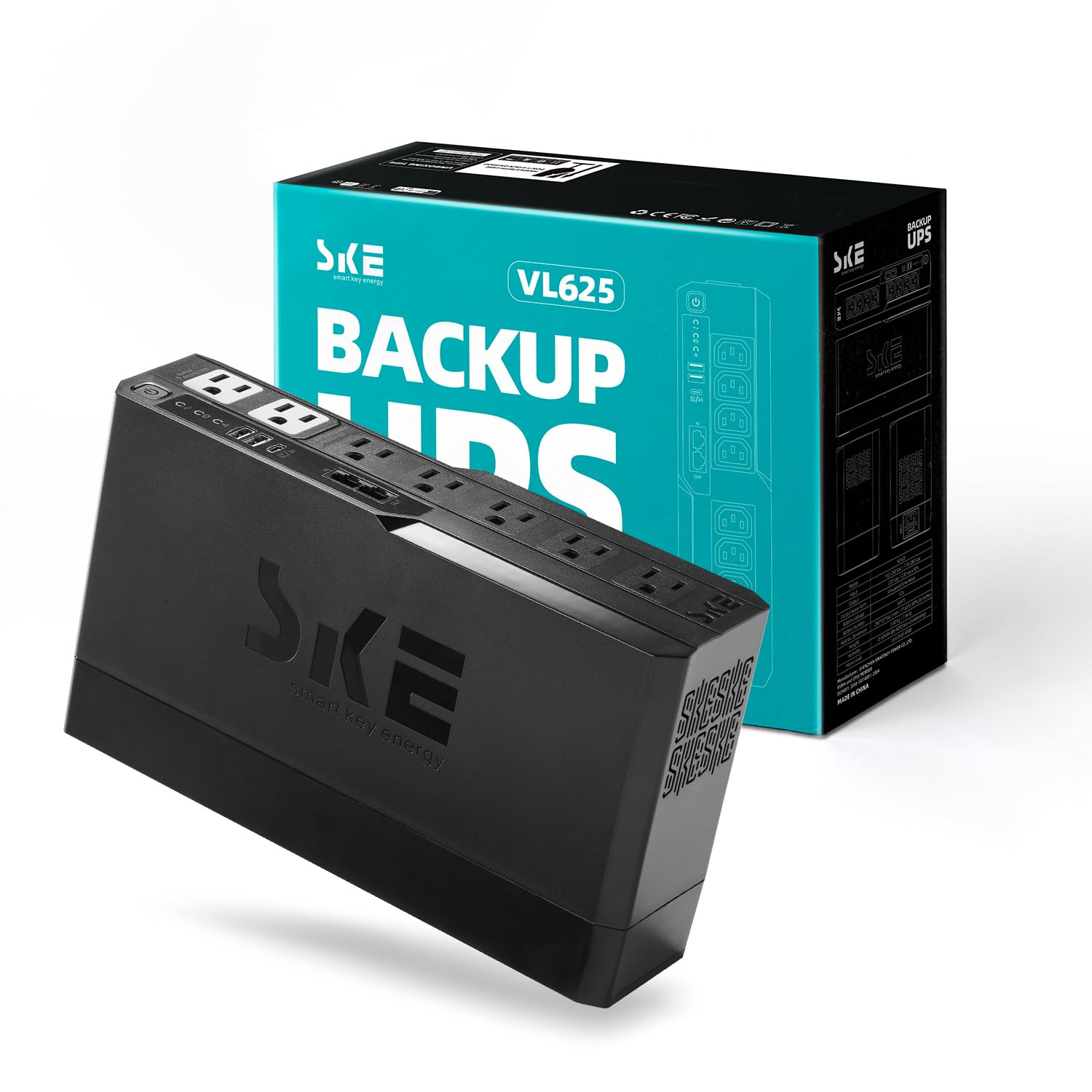
A vertical tower built to slot under a desk and out of the way
For a home server, a router, and a couple of monitors, this unit sits right between everyday protection and overkill. It runs 625VA with a 360W ceiling — a meaningful step up from the SKE VL425 at 425VA/240W — and its vertical tower footprint slips under a desk without claiming floor space the way a wide unit would.
The outlet count is seven: five battery-backed with surge protection, two surge-only. It also carries AVR to smooth voltage dips, plus USB and Type-C charging ports so your phone can top up without eating one of the protected sockets. The battery itself is user-replaceable, which stretches the unit’s useful life well past the first set of cells. Power quality is what buyers appreciate most here — home servers and networking gear ride through flickers cleanly on this box.
Two things to keep in mind. The function is the recurring gripe on this model, and a few owners mention a dead USB-C charging port from the start, so test that port the day it arrives. And the 625VA rating is honest about its limits: a gaming PC would not be a good fit for it, per owner feedback.
The sensible middle: 625VA and 360W cover a server, router, and monitors without overspending on capacity you’ll never use.
One to check early: the USB-C port is the weak point in owner feedback, so verify it works on arrival and lean on the warranty if it doesn’t.
Choose this: for a home server or router stack that needs to survive short outages without a huge footprint.
Step up instead if: you’re powering a gaming rig or anything that regularly sprints past 360W.
8. SKE VL425 425VA/240W UPS Battery Backup and Surge Protector with AVR, 7 Outlets, USB and Type-C Charging

The light-duty box for cable modems, routers, and one awkward recliner
This is the entry-level pick for a buyer with genuinely modest needs — a modem, a router, a network switch, maybe a couple of cameras. It runs 425VA with a 240W ceiling, which is honest about its scope: stay under 240W and it does the job, blow past it and it won’t. There are seven outlets, five battery-backed and two surge-only, plus USB and Type-C ports for charging phones and tablets without spending a protected socket.
It has one use case that surprises people: motorized furniture. An engineer recommended this type of unit for a motorized recliner, so that the chair can be safely lowered during an outage instead of stranding someone mid-tilt — a genuinely worthwhile reason to own one. For network gear the story is simpler: it keeps a router and modem up during quick blinks so your streaming doesn’t drop and your connection doesn’t reset.
Two fit-notes to plan around. The outlets sit side-by-side and close together, which makes chunky power bricks and right-angle plugs fight for space — the SKE VL625 has the same seven-outlet layout, so budget for slim adapters on this one. And the runtime is short by design; this is for brief interruptions, not for keeping a system working through a long outage.
What it does well
- Built-in AVR smooths voltage without switching to battery, so quick dips pass silently
- USB and Type-C ports free up protected sockets for actual electronics
- User-replaceable battery and a compact tower footprint that fits under a desk
Fit notes to plan for
- Outlets sit close together, so oversized power bricks will block neighbors
- The 240W ceiling and short runtime rule out desktops and gaming rigs
- A rare unit has arrived failing to hold a charge, so test it early
Right for: modem, router, and network gear that just needs to survive the blink.
Wrong for: anyone powering a desktop or expecting meaningful runtime under load.
9. Staples TECH 650VA UPS Battery Backup, 8 Outlets, Surge Protection, Black

The simplest way to keep a router and modem from rebooting every storm
When the goal is narrower than a whole desk — just keep the internet alive through the summer brownouts that Florida throws at a house — this is the box that makes the most sense. It lands at 650VA with a 360W ceiling and eight total outlets split between battery-backed and surge-only. That’s a 360 watt ceiling against the SKE VL425’s 240 watts, and eight outlets against seven, so it carries more for a similar footprint. It also has a compact design meant to sit under a desk.
Owners use it the way you’d expect: keeping a modem or Eero mesh node alive during brief summer interruptions so the connection doesn’t have to go through its three-to-four minute reboot dance. Power quality is the trait buyers mention most, and the value proposition is what lands it here. The unit works on plug-in alone — no software, no downloads, no setup menus. Just plug it in, press the button, connect devices.
The one behavior to know about is the beeping. When the unit is running on battery, it chirps on a roughly thirty-second cycle, easy to silence with a double-click of the power button but loud enough to grate during a long outage. The unit also carries a warning not to exceed the wattage limit — with a 360W ceiling, that’s worth respecting if you start adding devices.
The case for it: eight outlets and simple plug-in operation make it a straightforward set-and-use pick for internet backup.
What to know going in: the alarm beeps every thirty seconds on battery until you double-click it off, and 360W is the line to stay under.
Best fit: keeping a modem or mesh node online through frequent short outages without any software fuss.
Not for you if: a cycled beep you have to silence manually would be more trouble than the protection is worth.
Understanding the Specs
VA vs Wattage
VA, or volt-amperes, is the total capacity figure. It’s always the larger number on the box. Wattage is the real working limit — the amount of actual power your devices draw. A 900VA-rated unit might carry only 500W, and a 1350VA unit might carry 810W. When you’re adding up devices, add the wattage printed on each one and check it against the wattage rating, not the VA number. Staying well under the ceiling keeps the unit from groaning when it switches to battery.
AVR (Automatic Voltage Regulation)
AVR is the part that smooths small dips and spikes in your wall power — brownouts and momentary surges — without draining the battery at all. It corrects the incoming voltage back toward a steady 120V so your gear sees clean power even when the grid is misbehaving. When the outage is brief, AVR often handles it alone, which preserves battery charge for the actual blackouts when you truly need it. Units without AVR have to jump to battery for every little fluctuation, which wears the cells faster.
FAQ
How do I know which devices a battery backup can keep running?
What is the difference between battery-backed outlets and surge-only outlets?
How long will a battery backup keep my computer running during an outage?
Do I need pure sine wave power or is simulated sine wave enough?
Can I replace the battery myself when it wears out?
Why does my battery backup beep and how do I stop it?
Is a higher VA rating always better?
How long does it take a new battery backup to charge before it can protect my gear?
Do these units protect my internet and phone lines too, or just the wall outlets?
Will a battery backup work with a generator during an outage?
Final Thoughts: The Verdict
For most homes, the battery backup winner is the CyberPower ST900U because it carries 500 watts across twelve outlets — six of them live on battery — from a slim body that fits under a desk, and it backs the battery itself with a three-year warranty. If your gear is power-hungry and demands clean sine wave electricity (a smooth, steady AC waveform that sensitive electronics prefer), grab the APC BR1350MS instead. And for keeping a router and modem alive through a brief blink with no software to configure, the Staples TECH 650VA is the one to reach for — the crowd-backed pick here holds the stronger owner record, so start your shortlist there.
How We Picked
We do not accept paid placement. Every pick is matched to a real buyer and a real use-case; we do not hands-on test units.
Sources & Methodology
Specifications: manufacturer listings and product documentation. Review insights: verified customer reviews, as of September 2026. Pricing: not shown on this page (it changes often); check the current price via the retailer link.
As an Amazon Associate, KitchPrep earns from qualifying purchases. This does not affect which products we feature.
Related Guides
