
Specs are compiled from manufacturer listings and verified buyer reviews and can change over time — please confirm the key details on the product page before buying.
When the grid drops, the difference between a rough night and a normal one is how much stored energy you have ready. A solar battery backup stores energy from the grid or panels and discharges it the moment your home goes dark. That is why watt-hours of capacity, continuous output in watts, and LiFePO4 chemistry decide what you can actually run. This guide covers eleven units, from 25-pound carry boxes to a 30.72kWh server rack bank, matched to the outage length you actually get.
I’m Mohammad Maruf — the founder and writer behind KitchPrep. This guide is built by comparing the manufacturers’ published specifications and the patterns across verified customer reviews, so you get each pick’s real strengths and trade-offs instead of marketing spin.
Stored energy only helps if the watt-hours cover your fridge and your typical outage length. The picks below are ranked by that balance, and every figure comes from the maker’s published spec sheet. Here is the honest breakdown of the battery backup solar options worth your money right now.
Our Picks at a Glance
How To Choose The Best Battery Backup Solar
The unit that saves your night is the one whose watt-hours match your outage, not the biggest number on the box. Start by writing down what must keep running — a fridge, a router, a sump pump, a CPAP machine — and how many hours you normally lose power. Continuous watts, solar input, and switchover time all follow from those two numbers.
Match watt-hours to hours, not to hype
Capacity, measured in watt-hours, is your total stored energy — think of it as the size of your fuel tank. A 1024Wh unit holds roughly a kilowatt-hour, which is enough to run a modern fridge through an overnight outage. A 3072Wh unit carries three times that, so it can ride through a two or three day stretch. Divide your appliance’s wattage by the battery’s watt-hours to get a rough runtime before you buy.
Check continuous watts before peak watts
Continuous output is what the unit can run all day; peak output is a short burst for motor start-up. A fridge compressor pulls a heavy surge for a second, then settles down. If the continuous rating sits above your appliance’s running wattage, you are safe. Peak watts only matter for the one-second surge when a fridge or pump motor kicks on.
Insist on LiFePO4 chemistry
Lithium iron phosphate batteries, usually shortened to LiFePO4, hold their capacity through thousands of deep discharges. Older lead-acid packs fade after a few hundred cycles. If you plan to discharge the unit often, the chemistry is the difference between a decade of service and a short one. Every flagship in this roundup uses it.
Confirm your panel voltage falls inside the solar window
Solar input has both a watt ceiling and a voltage range. A panel pushing more volts than the input allows can damage the charge controller. Before buying panels, check the unit’s stated solar watt maximum and its acceptable input voltage range, then buy panels that sit comfortably inside both.
Quick Comparison
| Model | Best For | Capacity | Continuous Output | Weight | Amazon |
|---|---|---|---|---|---|
| EF ECOFLOW DELTA 3 Max★ Best Overall | Fridge, TV, and router backup in one carry | 2048Wh | 2400W | — | Amazon |
| BLUETTI Elite 100 V2Best for Travel | One-hand carry camping and quick outages | 1024Wh | 1800W | 25 lb | Amazon |
| PECRON F3000LFPBest Capacity Value | Multi-day home backup on a tighter budget | 3072Wh | 3600W | 63.3 lb | Amazon |
| Anker SOLIX S2000 | Quiet overnight fridge protection | 2010Wh | 1500W | 35.7 lb | Amazon |
| ABOK Ark3600 | Wheeled whole-room backup | 3840Wh | 3600W | 92 lb | Amazon |
| Anker SOLIX F3000 | Generator-ready hurricane season standby | 3072Wh | 3600W | 91.5 lb | Amazon |
| BLUETTI Elite 300 | RV power and tight-space 3kWh storage | 3014.4Wh | 2400W | 58 lb | Amazon |
| Jackery HomePower 3600 Plus | Multi-day household coverage with expansion | 3584Wh | 3600W | 77.2 lb | Amazon |
| EF ECOFLOW DELTA Pro | Heavy loads at home and on the road | 3600Wh | 3600W | 99 lb | Amazon |
| Jackery HomePower 3000 + 2x200W Panels | RV and off-grid with panels included | 3072Wh | 3600W | 59.5 lb | Amazon |
| ECO-Worthy Cubix100 6-Pack | Whole-home off-grid storage bank | 30.72kWh | — | 600 lb | Amazon |
In‑Depth Reviews
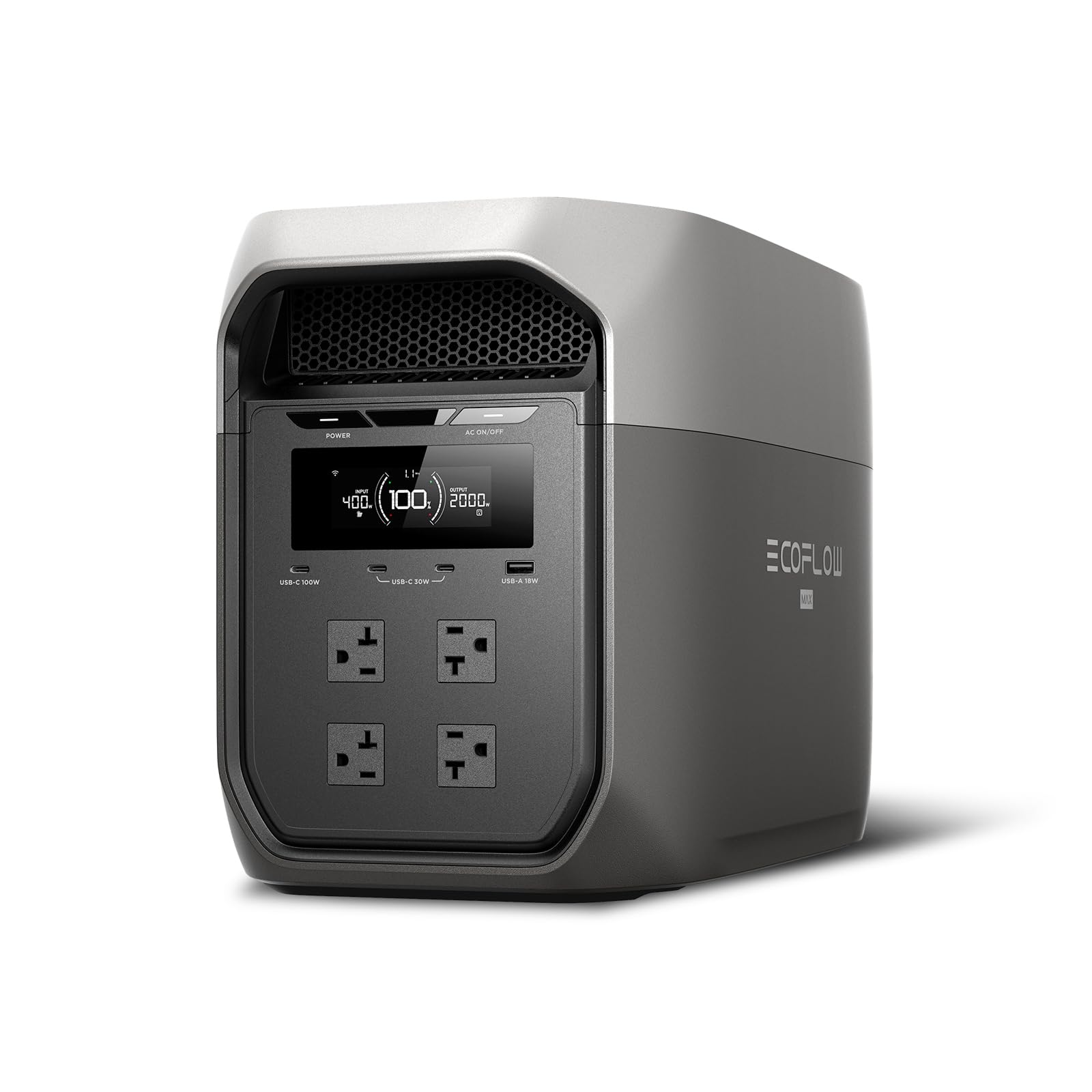
1. EF ECOFLOW DELTA 3 Max Portable Power Station, 2048Wh LFP Battery, 2400W
Our pick — over 4.5★ from 550+ verified ratings; the strongest balance of quality and price.
The 2048Wh all-rounder that refills its own tank in just over an hour.
If you want one box that covers a fridge, a router, and a television through a multi-hour outage, this is the box. Its 2048Wh LiFePO4 battery is the biggest of the lighter mid-tier units here, and the 2400W continuous output climbs to 3400W in X-Boost mode. That boost covers the heavy motors in a full-size fridge, a microwave, or a circular saw. Because it holds 2048Wh against the BLUETTI Elite 100 V2’s 1024Wh, it stores twice the energy of that compact pick — so your outage window roughly doubles before you need a recharge.
What wins people over is the recharge time. EcoFlow’s X-Stream charging takes it from empty to 80% in about 1.13 hours on a wall outlet, so an afternoon notice before a storm is plenty. It comes with a 10ms transfer time, meaning it hands power back to sensitive gear almost instantly, and the whole unit was built for a long service life on its LiFePO4 cells. Owners who bought it for aging parents during frequent outages say the multi-device support and clear display sold them.
It is a 4.7 rating across a six hundred plus ownership pool, and the stand-out praise is the value these buyers feel they got. The recurring gripe is the front buttons, which are hard to read in a dim room — worth knowing before a midnight outage. The included charging cable is an AC cord only, so panels come separately. And at roughly 1700W of wall charging the fan runs audibly, though it stays gentle and the battery temperature drops quickly once charging stops.
Where it earns its keep
- 2048Wh LiFePO4 capacity runs a fridge, TV, and router through a long outage
- 0 to 80% in about 1.13 hours on X-Stream AC charging
- 2400W continuous climbs to 3400W X-Boost for big appliance start-up
- 10ms transfer time keeps computers and routers live
What to know before you buy
- Front status buttons are dim and hard to read in low light
- Charging fan becomes audible around 1700W inputs
- Solar panels are not included — the AC cable is
Best for: A first serious home backup that needs to be ready in under two hours and carry heavy appliance surge.
Look elsewhere if: You need one-handed portability — this is a two-hand carry unit.
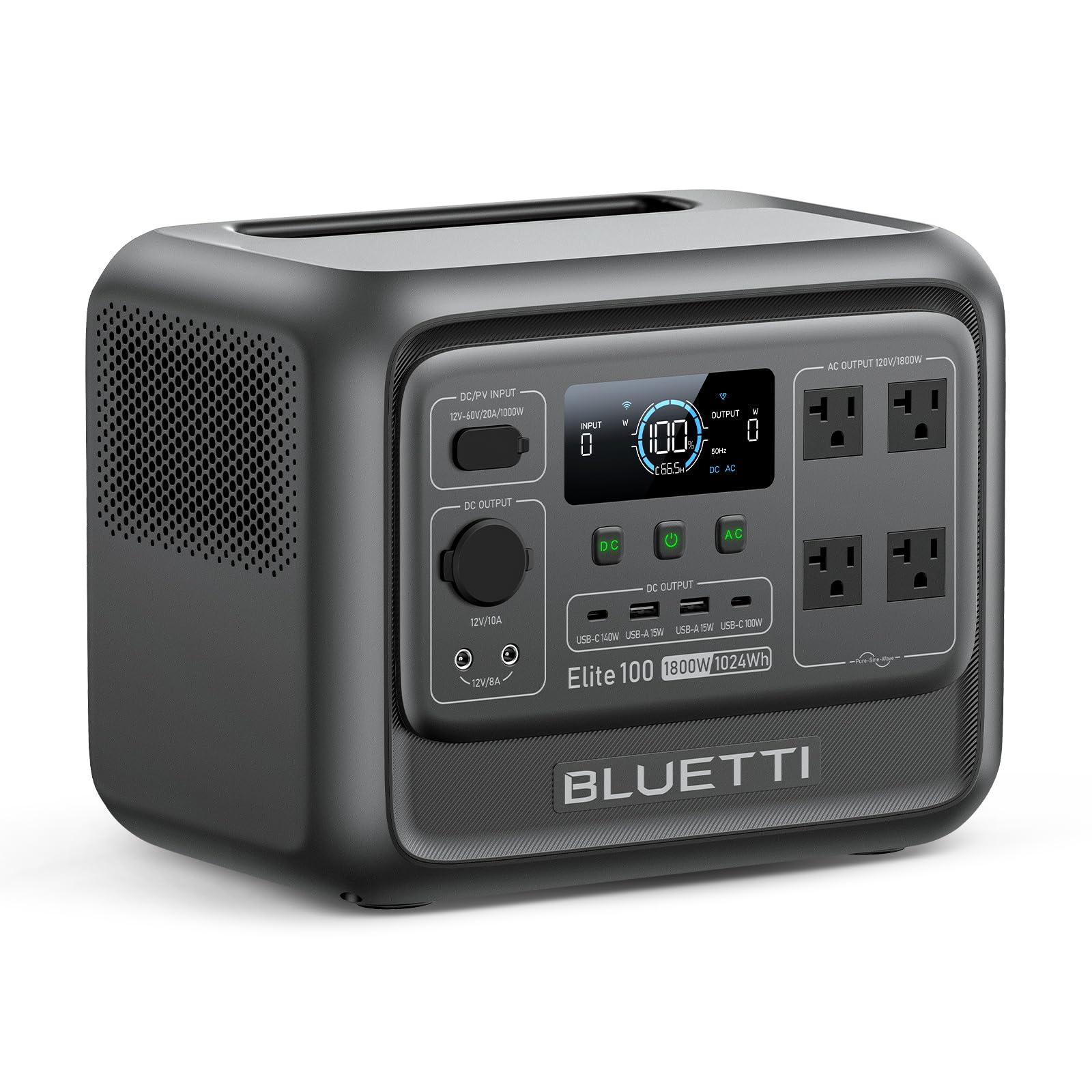
2. BLUETTI Elite 100 V2 Portable Power Station for Camping 1024Wh 1800W
Twenty-five pounds of quiet overnight power you can lift with one hand.
For someone carrying a unit up a cabin stair or to a telescope site, weight beats raw capacity. This one lands at 25 pounds in a build BLUETTI describes as 35% smaller and 30% lighter than comparable 1kWh stations. The 1024Wh capacity pairs with an 1800W AC output and a 3600W surge, and it runs up to 90% of everyday appliances. Compared with the DELTA 3 Max above, you give up about half the stored energy in exchange for a genuinely grabbable frame and a hidden handle.
Two features carry it for indoor and camper use. First, it recharges from 0 to full in roughly 70 minutes on 1200W TurboBoost wall charging, or from up to 1000W of solar. Second, the 10ms UPS switchover keeps a Wi-Fi router and PC alive through the flip, and silent mode trims the fan to about 30 decibels — quiet enough to sleep through. An astrophotographer running a telescope mount, two cameras, a mini PC, and a tablet drew roughly 60W at startup and 34W resting, and got 6.5 to 7 hours from a charge.
The recurring honest note is the solar side: owners call it easy but slow to refill on panels. The face value of “portable” is also overstated by one buyer’s own joking admission — it is a heavy 25-pound box, not a backpack item. The unit ships with an AC cable, solar cable, and grounding screw; a dedicated car charger is a separate accessory. It is a 4.5 rating over a large and still-growing buyer pool, the sort of number that comes from a product doing exactly what the box promised.
The quiet reality: At 30dB in silent mode this is a station you can keep next to the bed during an overnight outage, which is where most units reveal themselves as noisy.
The honest caveat: Solar top-up is functional but unhurried, and serious off-grid users will want panels with more wattage than the box ships with.
Reach for this if: You camp with gear, live in a small apartment, or want a UPS for a home office router that fits on a shelf.
Think twice if: You need more than a single night of fridge backup — 1024Wh sets a firm ceiling.
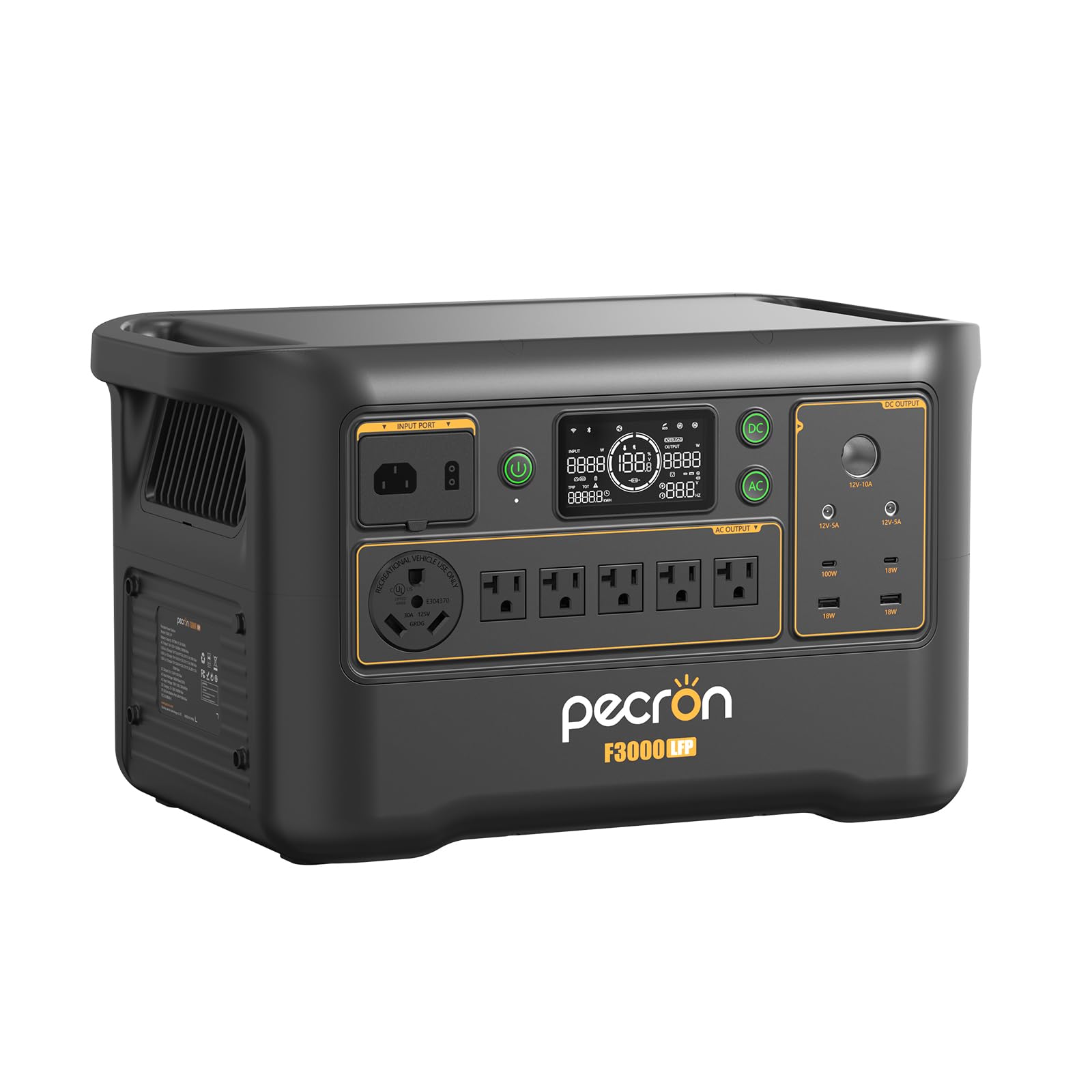
3. PECRON Portable Power Station F3000LFP, 3072Wh Solar Generator, 3600W
A three-kilowatt-hour workhorse that costs what a compact unit used to.
This is the pick for someone who needs multi-day coverage without jumping to the premium tier. The 3072Wh LiFePO4 battery runs a 3600W pure sine wave inverter, and the maker states that combination covers two to three days of home essentials. It holds the same 3072Wh as the Anker SOLIX F3000, though it does so in a heavier, larger frame that moves with wheels rather than a handle.
Performance is where this unit earns its reputation — measured buyers report it clears real loads without complaint. That same owner base found it runs a fridge on roughly 1200Wh where a competing station needed 500Wh, so the metering is honest. It recharges in about 2 hours on 1800W AC, or up to 1600W from solar with a 25 to 120V input range. Thirteen output ports include two 100W USB-C PD outlets, which covers a laptop, a phone, and a camera at the same time.
The honest trade-off is weight. At 63.3 pounds this is a cart or hand-truck unit, and owners say so plainly. The fan is also audible during heavy charging, and the matching EP3800 expansion battery needs a separate XT120-M cascade cable plus the base unit to function at all. Take the 4.5 rating as a real signal — buyers who value output per watt-hour love it, while buyers expecting pocket portability are the ones who grumble.
The value read: Cost-per-stored-watt-hour here is one of the tightest in the roundup, which is why owners keeping score on math land here instead of on the premium picks.
Honest limit: Deep panel shading below a hundred watts can stall solar input until conditions clear, so plan a clear-sky mounting spot.
Good fit: Households that want three kilowatt-hours of backup and are comfortable moving a 63-pound unit on a cart.
Poor fit: Anyone who plans to carry this up stairs without wheels or help.
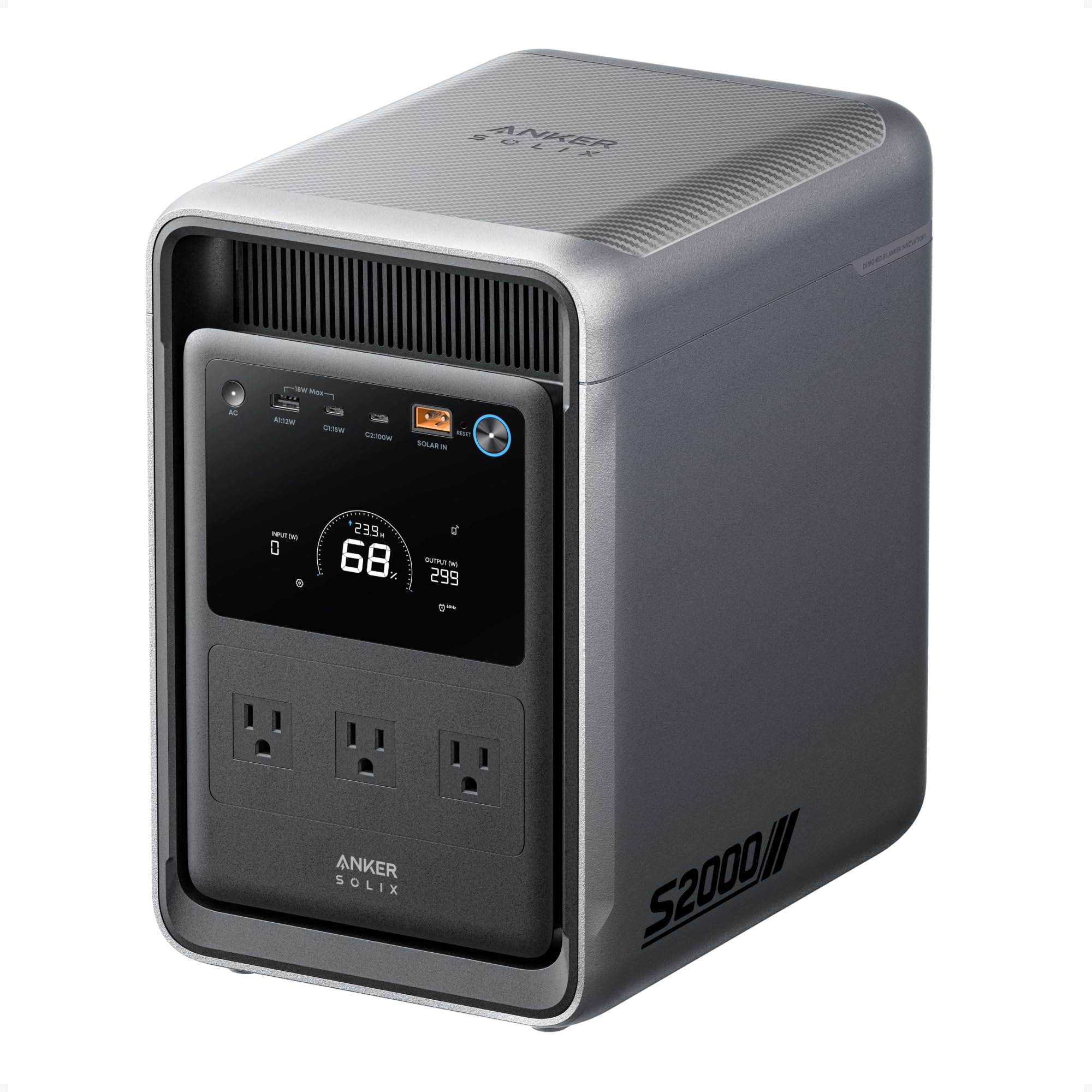
4. Anker SOLIX S2000 Portable Power Station, 2,010Wh, 3,000W Peak
A fridge-first 2kWh pack small enough to tuck beside the kitchen counter.
Anker built this one around one job: keeping a fridge cold through a long outage. At 2,010Wh with a 35-hour fridge runtime claim, the math is simple — a typical home fridge sips a few hundred watts and this battery holds enough for a day and a half. The 314Ah LFP cells inside are rated to 10,000 cycles, which the maker ties to a 15-year lifespan. That is roughly double the 5,000-cycle class of many rivals, so a long, patient ownership window is baked in.
The physical design is what surprises people. The unit is 30% smaller and 25% lighter than the industry average, sitting at 8.2 × 11.1 × 12.7 inches and 35.7 pounds. It slides into a corner, hides under a counter, and does not dominate a garage shelf. Eight outlets are split front and rear — the back set is meant for always-on appliances while the front handles day-to-day charging. The rear outlets run through a 10ms automatic switch, so a computer or router never notices the grid blink.
Six recharge paths include up to 400W solar input, an alternator charger, and a car outlet, so you can top this up almost anywhere. The recurring gripe is the fan, which spins up audibly during high-power charging — some owners find it notable, others never hear it. One owner running a full-size fridge through a thirteen-hour outage finished with roughly 30 percent of the charge remaining, which is the kind of field number that makes this one easy to recommend for the kitchen.
Small body, big numbers
- 2,010Wh capacity runs a fridge for about 35 hours
- 10,000-cycle LFP cells carry a 15-year lifespan claim
- 35.7 pounds and 30% smaller than the average 2kWh class
- 10ms UPS switchover for routers and computers
Small print worth reading
- No 12V DC port on the body
- No support for stacking expansion batteries
- Charging fan audibility is the most common note
Best when: Your priority is a quiet kitchen corner that keeps the fridge alive through one overnight window.
Skip if: You need to daisy-chain extra batteries for multi-day outages or want a 12V car socket on the unit.
5. ABOK Ark3600 Portable Power Station 3600W, 3840Wh LiFePO4 Battery
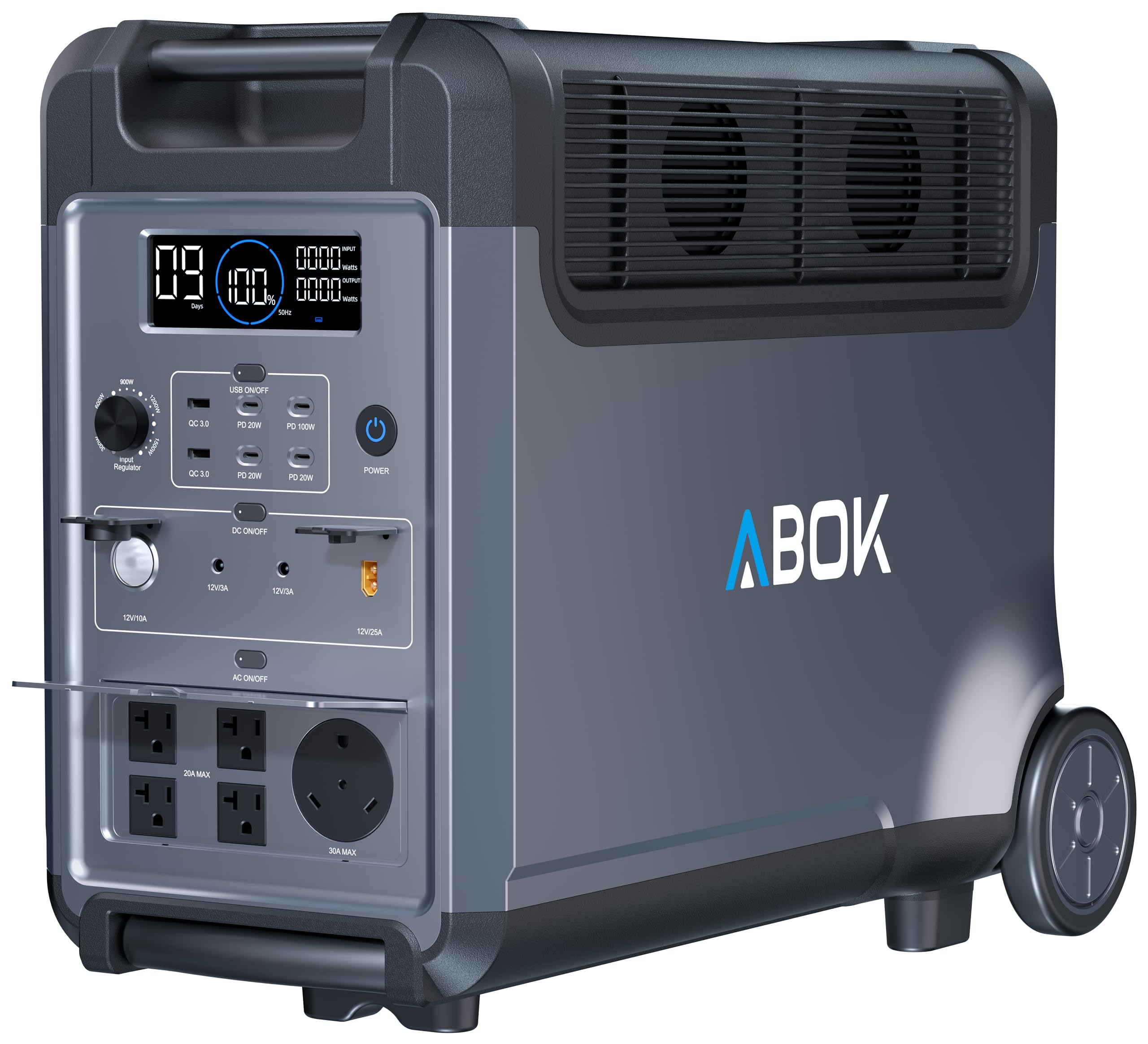
A 92-pound powerhouse that rolls itself around on suitcase wheels.
For a workshop or a van, moving 3840Wh of stored energy around used to mean a hand truck. This unit sidesteps the problem with a telescoping handle and durable wheels built into the 21.6 by 12.6 by 18.5 inch chassis, so a 92-pound frame travels like rolling luggage. Its 3600W output runs heavy loads, and the 4500W peak handles the start-up surge on motors and compressors. Capacity expands to 11520Wh with extra batteries, which is what makes it a genuine whole-room backup rather than a one-appliance box.
Recharge flexibility is where it shines in the field. The combined AC-plus-solar path refills it in about 1.29 hours, while AC alone takes 3 hours. A 1500W wall input, a 2000W solar input, and a 120W car input mean you are never truly stuck if the grid fails and the sun hides. Fifteen output ports include a 30A AC socket, four 20A AC sockets, three USB-C PD 20W, a USB-C PD 100W, and a 12V/25A XT60, which covers tools, laptops, and a fridge all at once.
What wins owners over is the value — a rare heavy unit that people say earns its price. Contractors run wet-vacs, heat guns, and a rotary hammer at once and finish the day with charge to spare. The honest limits are that heavy weight and a solar top-up that can crawl for days under a cloudy Washington sky. The matching app is workable but light on documentation, and the 120V-only output rules out any 240V appliance.
The reviewer take: As buyers put it, solar charging rounds the tank in “3ish days” of gray Pacific Northwest weather — plan for that, not for a single afternoon of sun.
Honest limit: There is no 240V path here, so dryers, large ranges, and central AC are out of scope.
Great for: Homeowners and contractors who want a wheels-in, plug-in, silent power bank that runs tools and a fridge in one weekend setup.
Not for: Anyone expecting to lift 92 pounds or run 240V appliances off it.
6. Anker SOLIX F3000 Portable Power Station, 3,072Wh, 6,000W
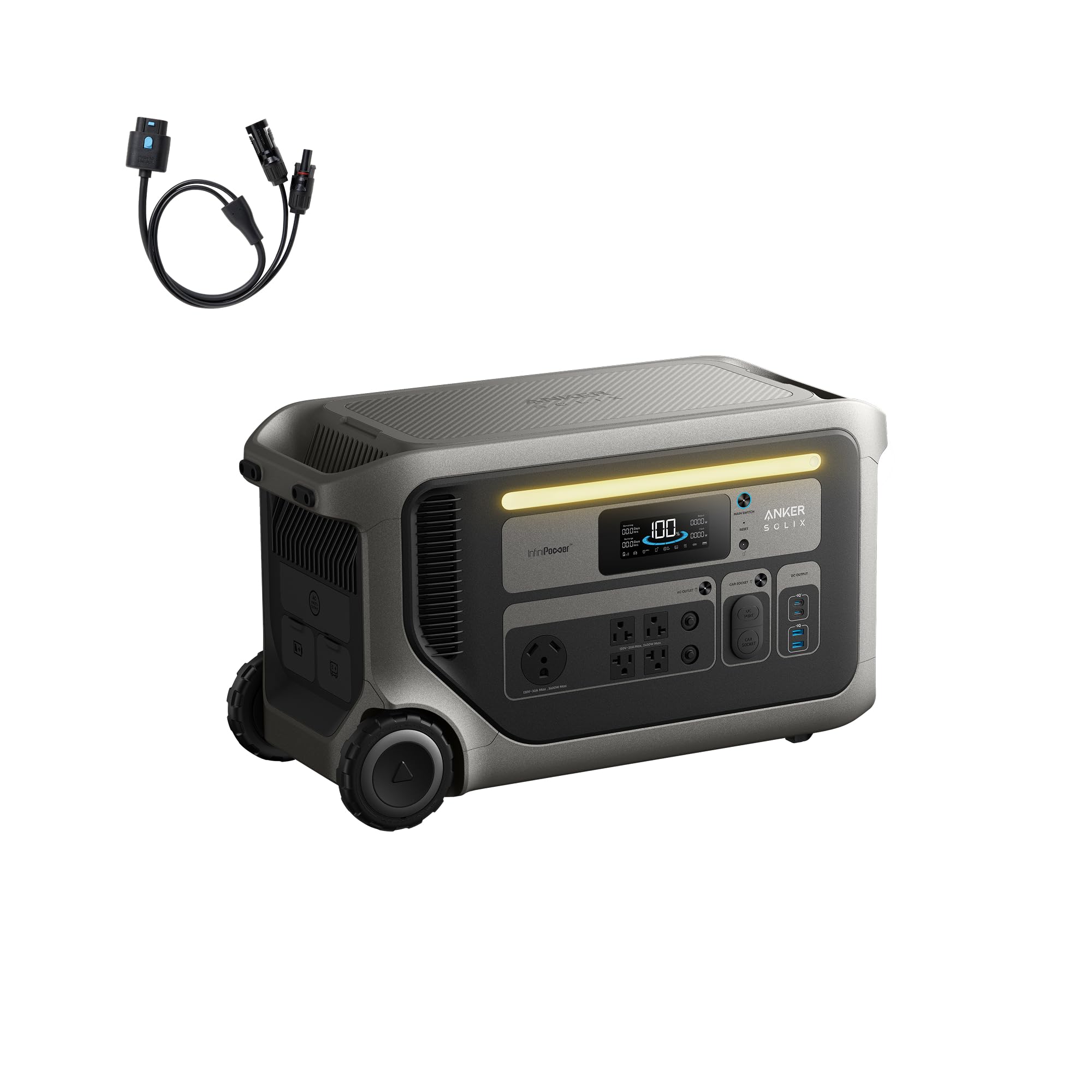
One of the few stations built to drink from a fuel generator when the sun hides.
Plenty of units can recharge from solar, but this is aimed at the homeowner who already owns a fuel generator and wants the battery to sit between it and the house. The 3,600W pass-through charging lets you run appliances at full tilt while the generator refills the 3072Wh cell, and the 3,600W output handles the load. Outage coverage scales: capacity starts at 3,072Wh and expands to 24kWh with extra batteries.
The recharge ceiling is what makes it stand out. When you combine a fuel generator with solar, the unit accepts up to 6,000W of input — among the fastest in this roundup. Used as a split system, two units pair to deliver 240V for demanding appliances, which is unusual at this tier. A single unit runs the essentials at 120V. On the standby front, the idle drain is low enough to hold its charge for about five days on the shelf, so it is ready when you pull it out.
Long-timers describe it as bulletproof once set up, with clear manuals and fast email support from Anker. The honest snags are weight — 91.5 pounds, which is firmly wheel territory — and the app, whose Wi-Fi connection occasionally drops, meaning you may need the physical buttons now and then. Neither of those stops the unit from doing its job; they simply confirm that this is a stationary whole-house helper, not a weekend camping toy.
Why homeowners pick it
- 3,600W pass-through charging lets you run loads while the battery refills
- Accepts up to 6,000W input when combined with a fuel generator plus solar
- 240V output when two units are paired for heavy appliances
- 5-day shelf standby before needing a top-up
Know before you commit
- 91.5 pounds requires wheels or a helper to move
- App Wi-Fi occasionally drops; buttons live on the unit
- Extra batteries needed for full 24kWh capacity
Pick this when: You already run a fuel generator or whole-house propane setup and want the battery in front of it.
Consider alternatives if: You need a unit that slides under an arm — this is a garage-floor resident.
7. BLUETTI Elite 300 Portable Power Station for RV & Home Backup 3014.4Wh
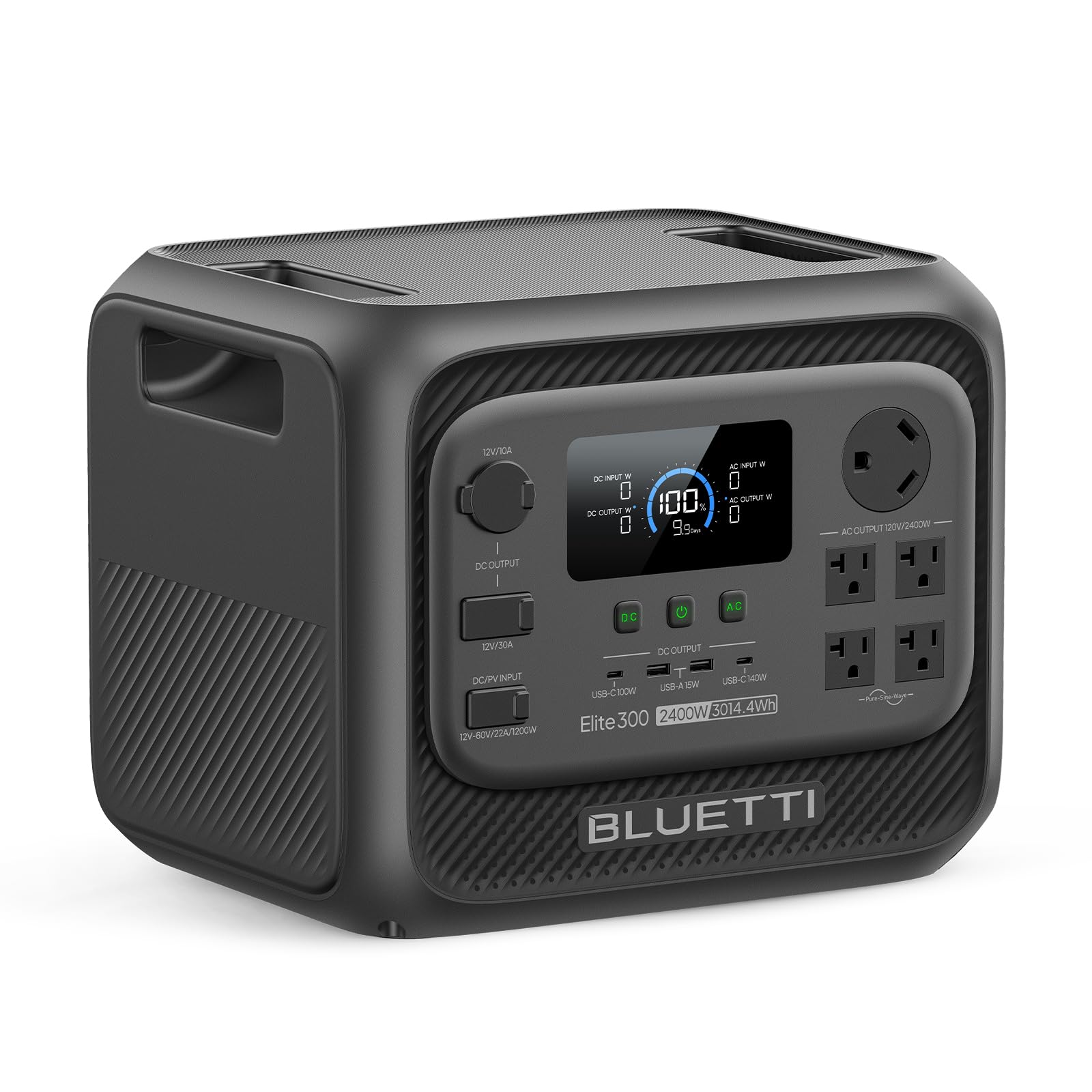
The smallest three-kilowatt-hour pack you can roll into an RV and forget about.
If your backup scenario has wheels under it, this one is purpose-built. The Elite 300 packs 3014.4Wh into a chassis the maker describes as 59% smaller than traditional stations of that capacity, and packs a real TT-30 RV outlet plus a 12V/30A DC output for diesel heaters and camper van fridges. The 2400W continuous output and 4800W surge cover motors and compressors, including the resistive loads like kettles that trip smaller stations.
Battery life is where owners notice the difference. With a 3014.4Wh LiFePO4 cell rated to 6,000 cycles, and 78-minute recharge on AC, this is a device meant to be cycled, not coddled. Ten-millisecond UPS switchover is fast enough to protect a home office router and computer during the brief blink before the unit takes over. The BLUETTI app handles monitoring and control, and the solar input accepts both portable and rigid panels up to a stated firmware-dependent ceiling.
The honest catch is a fixed 3000Wh capacity, so no battery stacking — this is one heavy internal battery, not an expandable platform. The solar cap is firmware-limited, and exceeding the open-circuit voltage can damage the MPPT controller and void the warranty, so panel shopping needs care. It is a 4.7 rating over a small and growing buyer pool, and the recurring praise is about how much capacity lives inside such a compact footprint.
RV-owner verdict: The TT-30 shore power plug is the single feature that makes this worth the price for anyone riding the road across multiple campgrounds — it removes a whole adapter rig from your tackle box.
One real limit: No expansion battery support means you buy this unit once, and its 3014.4Wh is the ceiling for the whole platform.
Strong fit: RVers and off-grid campers who want real camping-grade 3kWh backup in one cube.
Weaker fit: Homeowners planning to grow capacity with additional batteries down the road.
8. Jackery HomePower 3600 Plus Power Station, 3584Wh, 3600W AC

A whole-family pack sized to ride through days of outage, not hours.
This is the pick when the outage is measured in days. The 3584Wh battery expands to 21kWh per unit, or up to 43kWh across several units, and the maker sizes that to keep a three-person household running for over two weeks on a heavy draw. The 3600W single-unit output doubles to 7200W in parallel, and dual voltage means 120V for everyday items or 240V in parallel for dryers and pumps.
Safety and durability get equal weight. The battery cells are ceramic-membrane types tested at 302°F, designed to prevent thermal runaway from heat or overcharge, and rated for 6,000 cycles with a claimed 10-year lifespan. Cold-weather owners will note the maker states it keeps running through -4°F blizzards — rare territory for lithium packs. Recharge is fast: 2 hours on hybrid AC plus DC, 2.5 hours on wall AC alone, 4 hours on solar, or 2.5 hours from a fuel generator.
Mobility is the surprise. At 77.2 pounds this is described as the lightest 3.6kWh LFP station, with automotive-grade CTB construction and a luggage-style telescoping handle and wheels. Owners run cooking gear, fridges, small AC, and even power tools off it, and one household ran a full-size fridge, freezer, internet, and a power bed during an Arizona monsoon stretch. Campers note it rolls from car to tent with minimal lifting.
Where it dominates
- 3584Wh expandable to 21kWh single-unit or 43kWh across multiple units
- 3600W output climbs to 7200W in parallel for dryers and pumps
- 2-hour recharge on hybrid AC plus DC
- Ceramic membrane cells rated for 6,000 cycles
The honest trade-offs
- 77.2 pounds still demands the wheels or a second pair of hands
- Some RV charging circuits dislike the unit’s chopped sine wave output
- Expansion capacity lives in separate battery purchases
Give it the garage spot when: You want a cord-and-cart setup that scales up to whole-house capacity for extended outages.
Skip for now if: You plan to charge an RV’s own house battery through it, since some RV chargers object to the waveform.
9. EF ECOFLOW Portable Power Station 3600Wh DELTA Pro, 120V 3600W AC Output
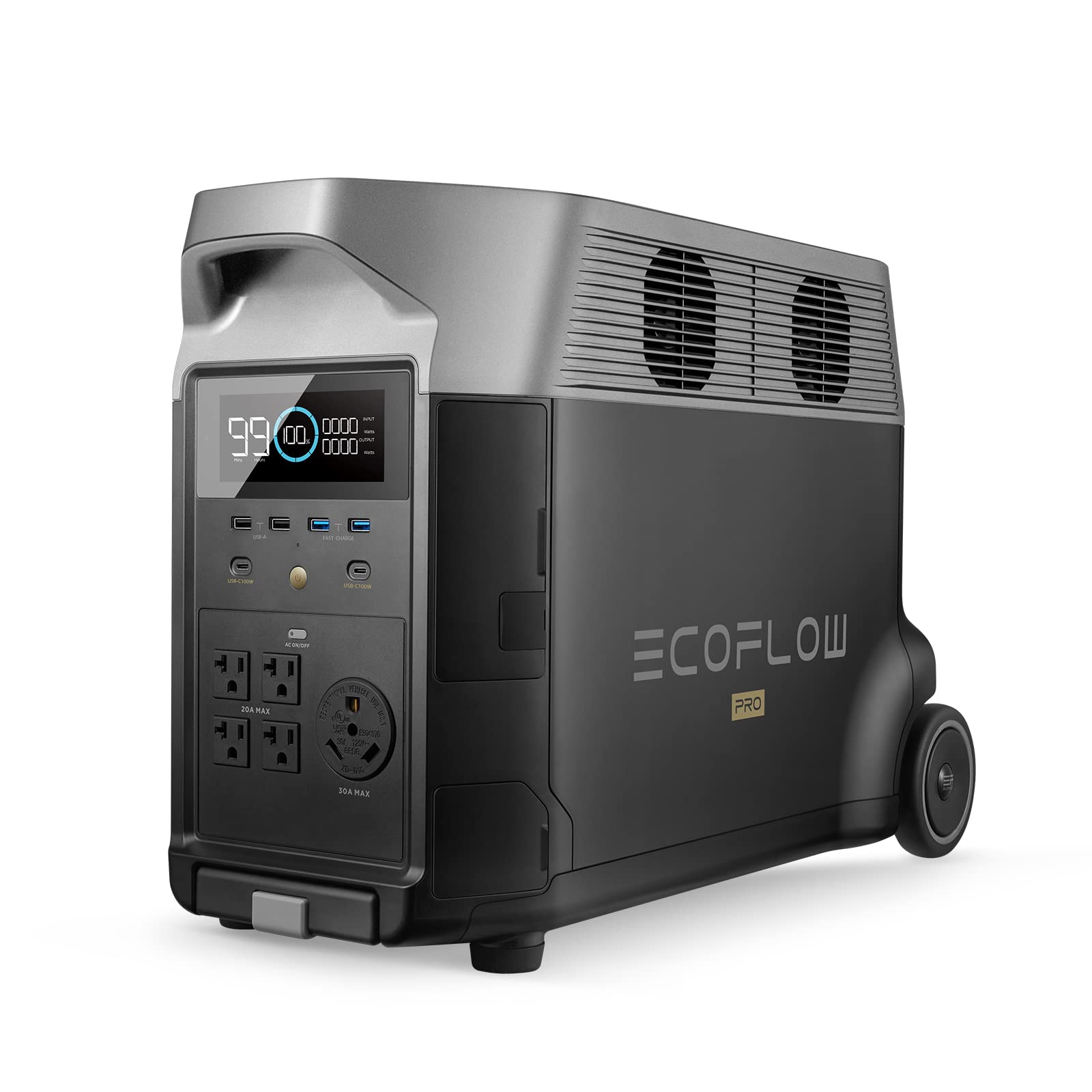
A 3600Wh platform built for heat presses today and whole-home backup tomorrow.
Every category has a workhorse, and this one is built for serious, repeatable load. Its 3600Wh LiFePO4 battery expands to 25kWh with extra batteries, and the 3600W AC output climbs to 4500W in X-Boost mode — or a parallel 7200W if you pair two units. Fifteen output methods include two 100W USB-C ports, five 120V AC outlets, a car outlet, and an Anderson port, which covers tools, laptops, cameras, and station gear in one brick.
Recharge speed is the headline. X-Stream charging brings it back to full in about 1.8 hours on a 240V outlet, 2.7 hours on standard 1800W wall power, or 2.8 hours on four 400W solar panels. The maker cites up to 23% solar conversion efficiency, which is on the higher end for panel-fed units. When used at vendor markets running a heat press, owners found zero voltage drops and enough capacity for multiple press cycles, which tells you the inverter holds under sustained heavy load.
The recurring complaint is solar input being capped at 15 amps, which limits how fast panels alone can charge the big battery. Owners also note the weight — 99 pounds — as a real physical fact of life. The 4.6 rating over a large owner pool is carried mostly by performance and reliability, so a buyer who checks the solar limit before buying panels is likely to be very happy here.
Performance proof: This unit runs a heat press across a full market day without voltage sag — exactly the load condition that exposes weak inverters.
Solar-side caution: The 15-amp solar input ceiling means you cannot shortcut your recharge; wall or generator power is the fast path.
Match made for: Mobile vendors, off-grid workers, and homeowners ready to scale the platform toward 25kWh.
Think again if: Solar-only charging is your plan — the input cap slows refills to a crawl.
10. Jackery HomePower 3000 and 2x200W Solar Panels, 3072Wh, 3600W AC Output
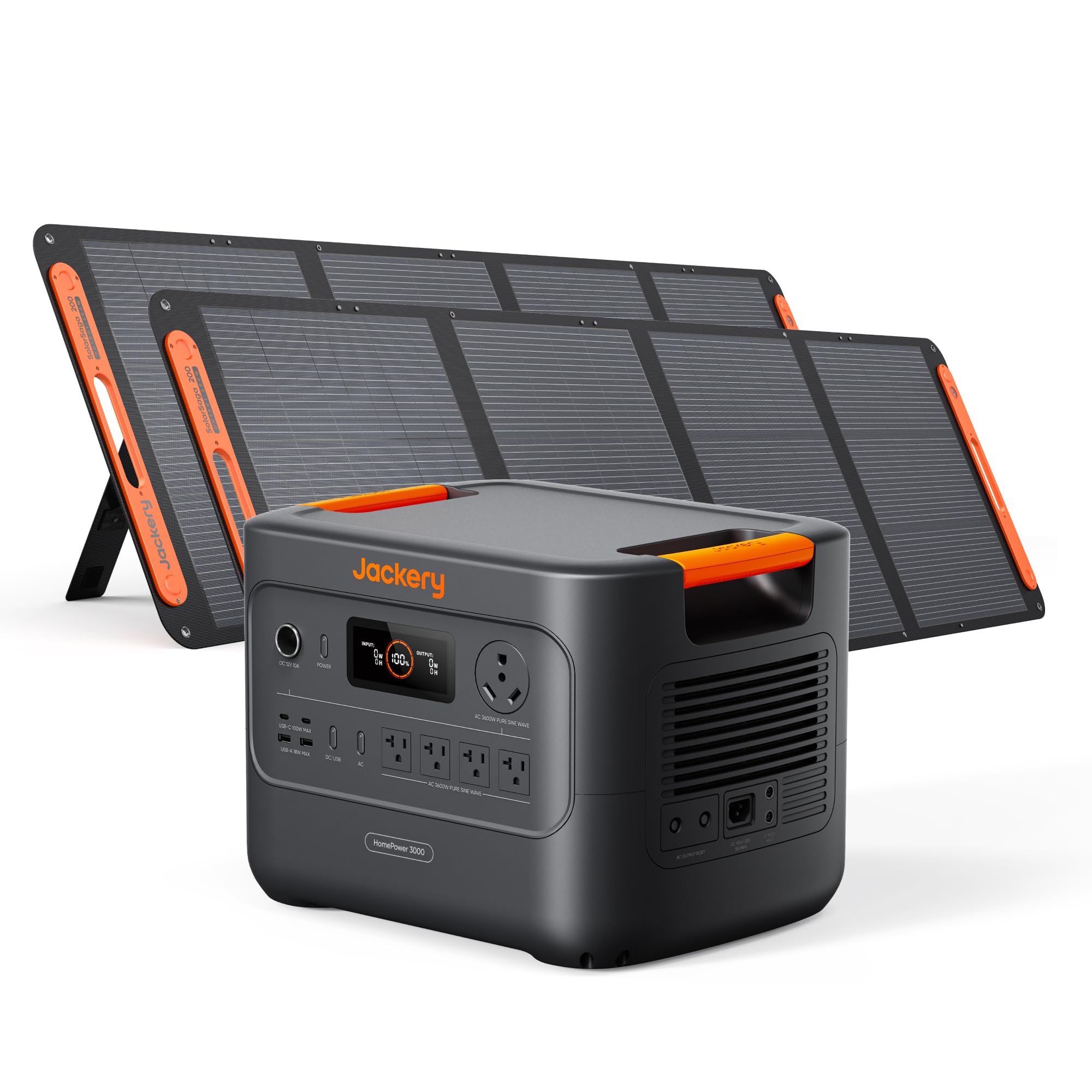
Battery and panels going off-grid together with no extra shopping trip.
If you want to be solar-capable on day one, this is the only pick in the roundup that ships with its own panel pair. The 3072Wh LFP battery runs a 3600W output with a 7200W surge, and the two 200W panels give you 400W of panel-fed input right from the start. That means a household can charge while the sun is up and run the fridge and router after dark without ever touching a wall outlet.
The battery alone runs a household for up to 15 hours and keeps a refrigerator going for one to two days. Its UL-certified UPS switches in ≤20ms, which is fast enough to keep security cameras, Zoom calls, and pet feeders running through the grid transition. The chassis is stated as 47% smaller and 43% lighter than comparable 3kWh stations, and the unit weighs 59.5 pounds — light enough for two people to move without a dolly.
Recharge is quick when the grid is on: 1.7 hours on hybrid AC plus DC, or 2.2 hours on wall AC alone. On the included panels alone it takes up to 9 hours to reach 80 percent. Owners running a 25-foot trailer with roughly 1800W of total draw reported it works well and the app tracks real usage reliably. The recurring note in reviews is that the app integration has limits and that support response can lag — worth knowing before you commit.
The bundled value: Because panels ship in the same box, you skip the ad-hoc matching that trips up every first-time solar buyer.
Honest limitation: The 4,000-cycle LFP pack holds 70 percent capacity over its rated life and uses the first solar connector only for the bundled panels — plan the wiring accordingly.
Right for: RVers, tiny-home owners, and anyone who wants backup plus solar in one purchase.
Wrong for: Buyers who need 240V output, expansion batteries, or immediate customer-service turnaround.
11. ECO-Worthy Cubix100 48V 600Ah Server Rack Battery LiFePO4 | 6 Pack 30.72kWh
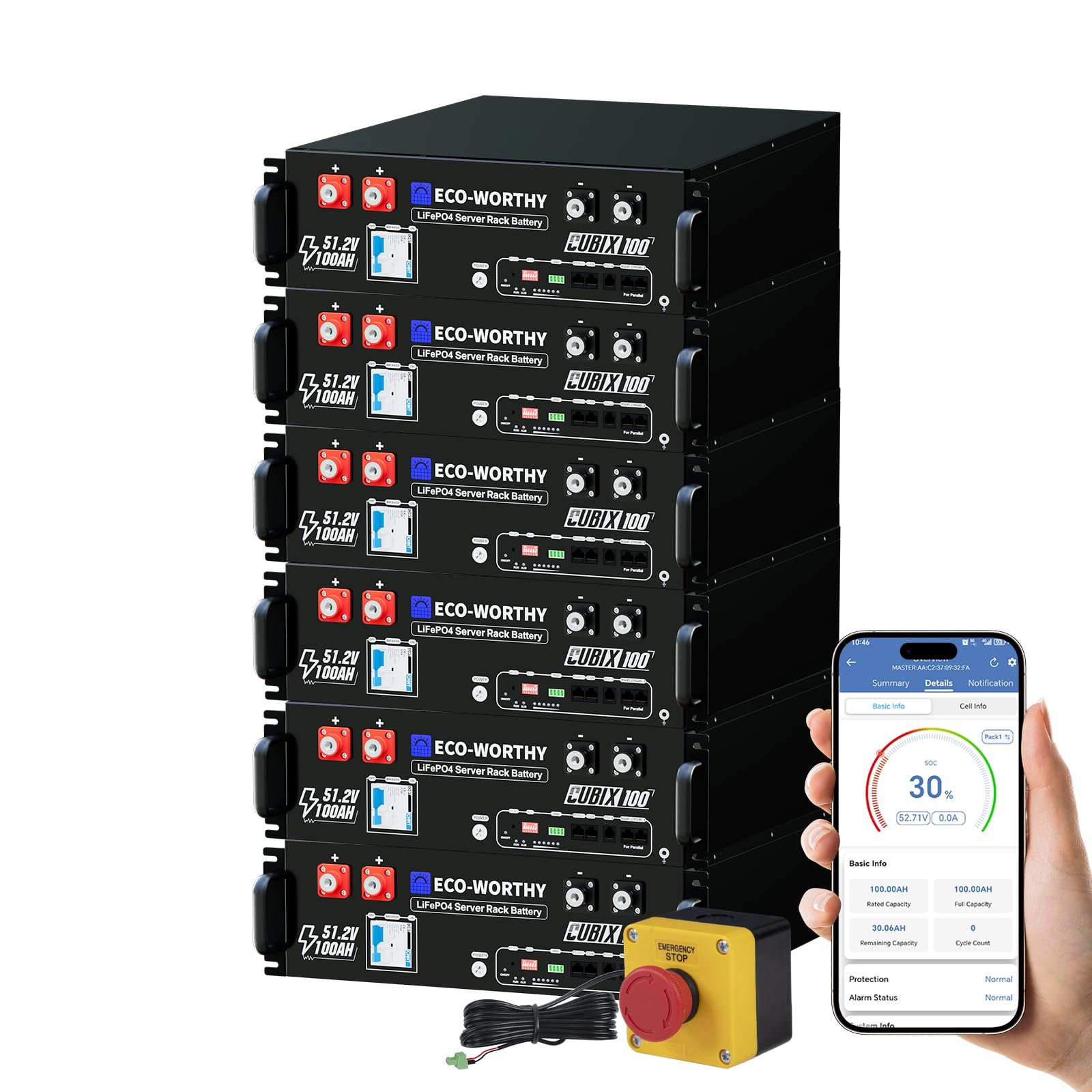
Six server rack batteries that together carry a whole house off-grid.
This is a different species from a portable station. The kit brings six 51.2V 100Ah batteries mounted in a server rack, for a combined 30.72kWh of storage — the maker sizes that to cover an entire household’s daily electricity demand. It is not a plug-and-go box, so plan a wall mount or rack, an inverter, and a licensed electrician if your local code requires one. What it does give you is real off-grid independence instead of a weekend patch.
Build quality is where owners recognize the difference. Grade A LiFePO4 cells, 2.56kW rated power per battery, and a 100A BMS with overcharge, over-discharge, short-circuit, and temperature protection. Each pack carries closed-loop CAN and RS485 communication that talks to mainstream inverters, plus Bluetooth and Wi-Fi monitoring through the ECO-WORTHY app. Vertical mounting saves floor space, and up to 32 units can parallel for up to 163.8kWh of total storage.
Safety listings carry weight: the pack has completed testing through Intertek for the UL9540 and UL1973 marks, and it is on the California Energy Commission list — all of which make it easier to tie into a permitted home system. The included kit covers parallel cables, communication cables, ground wires, terminal covers, and screws, so the build is well supported. The real requirement is planning and weight: at 600 pounds total, and with a separate shipping note on the RSD button, this is deliberate rather than casual.
What a real bank delivers
- 30.72kWh combined capacity across six 51.2V 100Ah batteries
- UL9540 and UL1973 listed plus California Energy Commission listed
- Closed-loop CAN/RS485 talks to mainstream inverters
- Scales to 32 parallel units for up to 163.8kWh
What the buyer plans for
- 600 pounds total — needs rack or wall mounting, not a closet shelf
- Inverter, wiring, and permitting are the buyer’s job
- RSD button is stated to ship separately from the main battery
The true off-grid fit: Homeowners building a permanent solar-plus-storage bank, or installers specifying a listed pack.
Not the right fit: Anyone wanting plug-and-play backup out of a single box.
Understanding the Specs
Capacity in watt-hours
Watt-hours, or Wh, are the size of the tank — they tell you how long the lights stay on once the grid drops. A 1024Wh station covers a fridge overnight. A 3072Wh station covers two to three days of a household’s essentials. A 30.72kWh bank covers the whole house. Pick your capacity by multiplying the wattage of what you must run by the hours you expect to be dark, then add headroom for start-up surges.
Continuous watts versus peak watts
Continuous watts is what the unit runs all day. Peak watts is a short burst for motor start-up. A fridge may pull a heavy spike for a second, then settle down. A 2400W continuous unit handles nearly every kitchen appliance short of a large electric range. If you plan to run power tools or central air, look for 3600W continuous output or higher. The X-Boost feature on some units carries this to a higher peak without a true step-up transformer.
LiFePO4 cycle life
Lithium iron phosphate, usually written LiFePO4, is the chemistry behind almost every serious station in this roundup. It tolerates thousands of deep discharges where older lead-acid packs fade after a few hundred. The numbers vary — 4,000 cycles, 6,000 cycles, and 10,000 cycles all show up on real spec sheets. If you cycle the battery often, the chemistry and the rated cycle count together decide whether it lasts a couple of years or more than a decade.
UPS switchover in milliseconds
A UPS, or uninterruptible power supply, is the automatic handoff from the wall to the battery when the grid fails. It is measured in milliseconds — the shorter, the safer for computers, routers, and medical devices. Ten milliseconds is considered fast enough that most electronics never notice. Twenty milliseconds still works for home-office gear. If you have a desktop computer, a NVR security recorder, or a PC doing regular work, this figure matters as much as total capacity.
Solar input watts and volts
Every station has a solar watt ceiling and a voltage range. A unit rated for 400W solar input cannot take a 600W panel array even if the panels physically fit. The input voltage window matters more — exceeding the maximum open-circuit voltage can damage the MPPT controller and void the warranty. Match panels to the published range before you buy, and remember that solar charging is weather-dependent, so a 400W array rarely delivers the full 400W under clouds.
Expandability and parallel ports
Expansion lets one battery bank grow with your needs, either by stacking extra batteries onto a single station or by paralleling separate stations. The benefit is that you do not buy a whole new box to add a second day of backup. The cost is that expansion batteries are usually sold separately and often need a specific cable. If utility is your priority, look for a unit whose expansion uses standard connectors instead of proprietary ones.
FAQ
How many watt-hours do I need to run a fridge for a day?
Will a battery backup solar system work in an apartment without any installation?
How long does the battery inside a solar backup station actually last?
Can I charge a portable power station from my car while driving?
Is a portable power station the same as a UPS for my computer?
What size solar panel can I connect without damaging the unit?
Can I run a sump pump or well pump off a battery backup?
Do these units work in cold weather or winter outages?
Can two units be combined to run a 240V appliance?
How much solar panel do I need to fully recharge the battery?
Final Thoughts: The Verdict
For most households, the battery backup solar winner is the EF ECOFLOW DELTA 3 Max. It pairs 2048Wh of LiFePO4 storage with a 2400W continuous inverter and an X-Stream recharge that gets you back to 80 percent in about an hour, which is the balance between readiness and raw capacity that matters when a storm sneaks up. The runner-up value match is the PECRON F3000LFP, whose 3072Wh is the same as the premium Anker SOLIX F3000 for noticeably less outlay — excellent if you can cart 63 pounds and want more days of coverage. And for RVers and off-grid campers who want a real TT-30 shore power plug in a compact 3kWh footprint, the BLUETTI Elite 300 is the pick that most directly solves their problem.
How We Picked
We do not accept paid placement. Every pick is matched to a real buyer and a real use-case; we do not hands-on test units.
Sources & Methodology
Specifications: manufacturer listings and product documentation. Review insights: verified customer reviews, as of September 2026. Pricing: not shown on this page (it changes often); check the current price via the retailer link.
As an Amazon Associate, KitchPrep earns from qualifying purchases. This does not affect which products we feature.
Related Guides
