
Specs are compiled from manufacturer listings and verified buyer reviews and can change over time — please confirm the key details on the product page before buying.
If you clean for a living — offices, clinics, stairwells, vehicles — the cord is the enemy. You waste minutes hunting outlets, dragging 100 feet of cable around corners, and tripping over it on staircases. A battery backpack vacuum puts the motor on your back and the cord in the trash. Runtime, suction, and battery platform decide which unit fits your job — no single model wins on all three.
I’m Mohammad Maruf — the founder and writer behind KitchPrep. This guide is built by comparing the manufacturers’ published specifications and the patterns across verified customer reviews, so you get each pick’s real strengths and trade-offs instead of marketing spin.
Battery life, bag capacity, and battery platform compatibility are the three numbers that decide whether a cordless backpack vacuum actually saves you time. This breakdown of the best battery backpack vacuum covers what each spec means in real cleaning conditions.
Our Picks at a Glance
How To Choose The Best Battery Backpack Vacuum
A battery backpack vacuum is a vacuum you wear like a backpack, with no power cord. The motor and collection bin sit on your back, and a hose runs to a wand in your hand. That design lets you walk freely through offices, stairwells, and tight corners without hunting for an outlet. But the cordless part creates a new set of decisions. Here are the four that matter most.
Runtime and suction settings
Runtime is the number of minutes the vacuum runs on a full charge. Most models list two figures: one for low or normal suction and one for max speed. Higher suction drains the battery faster, so a vacuum listing 116 minutes on normal might only give you 33 minutes on max. If you clean large commercial spaces in one pass, you want a machine with a long normal-setting runtime — or a system that lets you hot-swap batteries mid-shift.
Battery platform and compatibility
Many cordless backpack vacuums are sold as bare tools, meaning no battery and no charger are included. If you already own tools on that brand’s battery platform, you save money by reusing those batteries. If you do not, you need to buy batteries and a charger separately. Some units also work with third-party battery adapters, though the manufacturer’s own batteries are the safest match for power draw and fit.
Bag capacity and filtration
Bag capacity is measured in quarts or gallons. A smaller bag means you stop more often to empty or replace it, which slows a big job. Larger capacity — three or four quarts — suits whole-building cleaning. Filtration matters just as much. A HEPA filter captures fine particles, which is important when you clean around dust, drywall debris, or allergens. Two-stage HEPA systems extend the life of the main filter by trapping coarse debris first.
Quick Comparison
| Model | Best For | Runtime (Normal) | Capacity | Weight | Amazon |
|---|---|---|---|---|---|
| Milwaukee M18 Fuel 3-in-1 Backpack Vacuum★ Best Overall | Job sites and vehicle interiors | — | — | 15.3 pounds | Amazon |
| Milwaukee M18 Fuel Backpack Vacuum (Bare Tool)Bare Tool Pick | M18 owners who skip bundled batteries | — | 1 gallon | — | Amazon |
| Makita XCV09Z Backpack Dry Vacuum | Dog hair and drywall dust on hard floors | 116 minutes | 4.5 pounds | 12.4 pounds | Amazon |
| Sanitaire Transport Commercial Backpack Vacuum | Commercial cleaning crews | 70 minutes | 4 quarts | 15 pounds | Amazon |
| Makita XCV09PT Backpack Vacuum Kit | Buyers who want everything in one box | 116 minutes | 0.5 gallons | — | Amazon |
| ProTeam GoFit 3 Cordless Backpack Vacuum | Smaller frames and lighter daily loads | 51 minutes | 3 quarts | 12.8 pounds | Amazon |
In‑Depth Reviews
1. Milwaukee Electric – M18 Fuel 3-in-1 BACKPK Vacuum
The job-site workhorse that swaps between backpack, canister, and handheld duty without a cord.
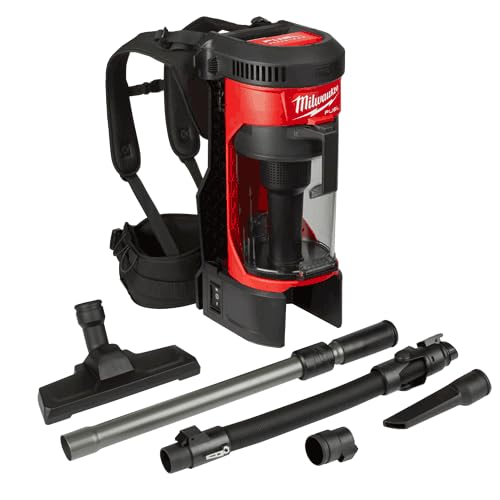
The Milwaukee M18 Fuel 3-in-1 is the pick for contractors, vehicle detailers, and anyone already invested in the M18 battery platform. It weighs 15.3 pounds, and it uses cyclonic technology — a spinning airflow that separates dust from air before it reaches the filter, which keeps the filter cleaner for longer and makes emptying the bagless bin simple. The removable harness is the standout feature: unhook it and the unit converts into a canister or handheld configuration, so one machine handles floors, crevices, and tool adapters.
Milwaukee built this for serious suction and convenience. Buyers report “fantastic suction” and describe it as quieter than a wheeled Shop-Vac, comfortable on the back, and fast on large hard floors. The HEPA filter and the on-board storage for the flexible hose, telescoping wand, floor tool, and crevice tool round out a genuinely versatile kit. For a crew hauling gear between rooms, the payoff is no cord to plug in or trip over.
The trade-off is battery drain. This vacuum pulls a lot of power, and Milwaukee’s own owners mention it can empty a 5Ah battery (a 5 amp-hour pack, the battery’s capacity rating) in roughly 20 minutes of continuous running, so heavy users need multiple batteries on rotation. Some also find it heavier than expected once loaded. For short, powerful bursts of cleaning — job sites, cars, quick office passes — it is tough to top. For marathon whole-building shifts, plan your battery strategy first.
What earns its keep
- Three configurations from one tool — backpack, canister, and handheld — via the removable harness
- Cyclonic technology keeps the filter running clean and the bagless bin easy to empty
- HEPA filter plus on-board storage for hose, wand, floor tool, and crevice tool
- Owners consistently praise the suction and describe it as quieter than a wheeled Shop-Vac
Where it asks for patience
- High power draw drains a 5Ah battery in roughly 20 minutes of continuous use
- At 15.3 pounds it runs heavier than the Makita XCV09Z, which sits at 12.4 pounds
- A few owners wish for more included attachments
Strap it on if: you run M18 batteries already and need one cordless machine for job-site, garage, and vehicle cleanup.
Plan around this first: keep spare batteries charged, because continuous full-speed cleaning drains a 5Ah pack fast.
2. Milwaukee M18 Fuel 3-in-1 Backpack Vacuum – No Charger, No Battery, Bare Tool Only
The same Milwaukee platform in its most stripped-down form — no battery, no charger, just the tool.
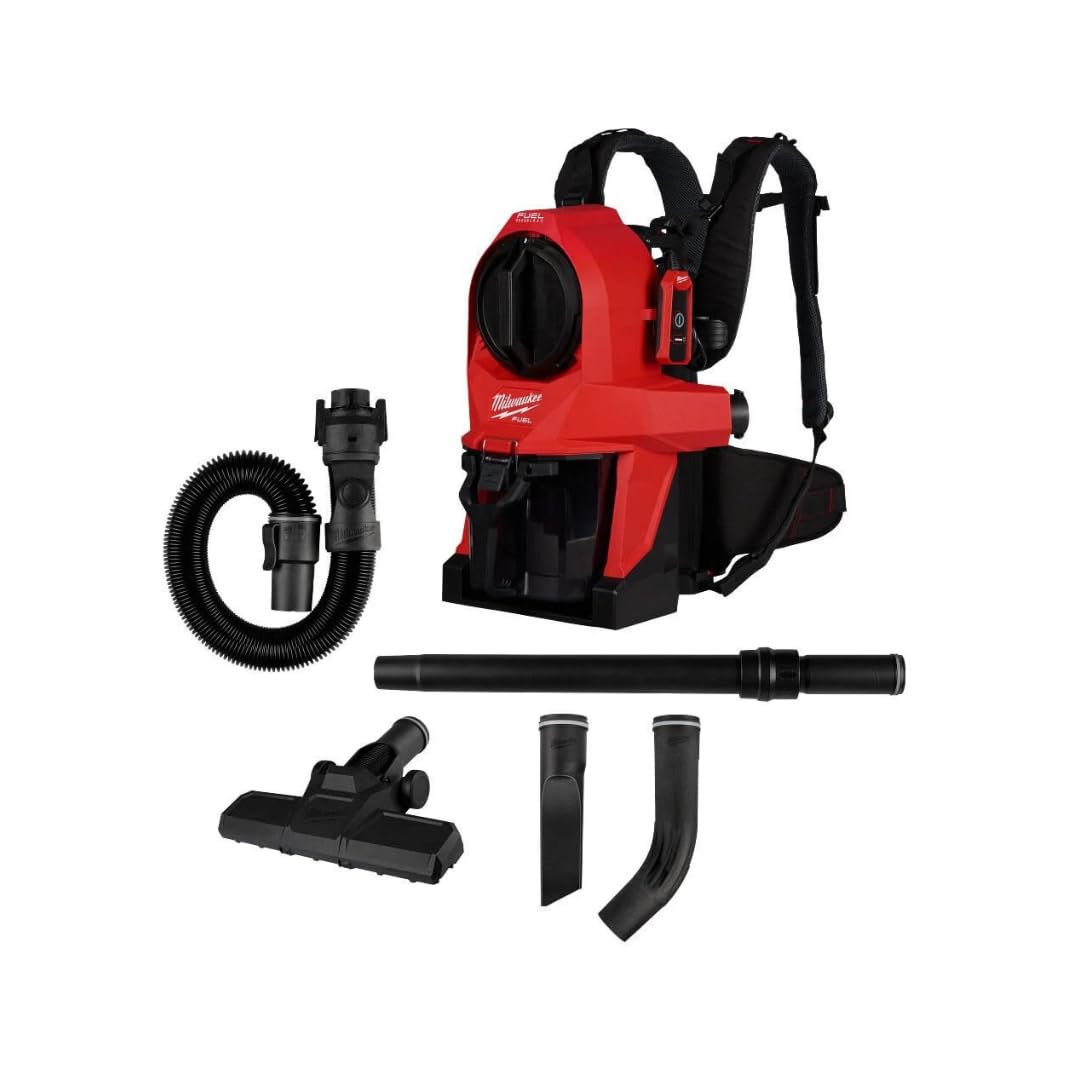
This is the bare-tool version of the M18 Fuel backpack vacuum, aimed at buyers who already own M18 batteries and a charger. The headline spec is the brushless motor, which the maker claims delivers up to 2X suction compared to traditional job site vacs and runs cooler and quieter because it eliminates carbon brushes. It carries a certified HEPA filter, a high/low switch, and it ships with a flex hose, telescopic extension wand, crevice tool, floor tool, and a dust extractor adapter.
Milwaukee also positions this unit as an OSHA compliance solution — meaning it is built as an objective-data dust management tool for specific applications involving respirable crystalline silica dust. If you work in demolition, concrete, or restoration, that framing matters. The form factor is a true backpack, and it uses the same cyclonic technology and removable harness as the standard M18 3-in-1.
Because it is a bare tool, your real cost depends on the batteries you already own, and a 1-gallon capacity is on the small side for long jobs. It is best matched to existing M18 users who want the tool without paying for another battery. Buyers describe it as “little heavier then I thought,” but the recurring verdict is that it simply works.
Who this is for: M18 owners who want the OSHA-focused HEPA backpack vac without duplicate batteries or a charger in the box.
Keep in mind: the 1-gallon capacity and bare-tool packaging mean you supply the power yourself.
Built for M18 households: if you already run Milwaukee batteries, this is the budget route into the same 3-in-1 platform.
Look elsewhere if: you own no M18 batteries — a kit bundle makes more sense than buying power separately.
3. Makita XCV09Z 18V X2 LXT Lithium-Ion (36V) Brushless Cordless 1/2 Gallon HEPA Filter Backpack Dry Vacuum, Tool Only

Long runtime and a light frame — the XCV09Z trades raw capacity for hours of cordless cleaning.
The Makita XCV09Z leads with runtime. On the normal setting it runs up to 116 minutes of continuous operation, dropping to 33 minutes on Max, using two 18V LXT 5.0Ah batteries (sold separately as a bare tool). At 12.4 pounds it is considerably lighter than the Milwaukee M18 Fuel at 15.3 pounds, which matters when the machine sits on your back for an hour. The brushless motor generates 70 CFM of suction power and 44 inches of water lift, and it eliminates carbon brushes so the motor runs cooler and lasts longer.
Filtration is a strong point here. The two-stage HEPA filter captures 99.97% of particulates 0.3 microns and larger, which extends the life of the main filter and suits allergy-conscious and drywall-dust cleaning. Customers note it excels at dog hair on hardwood and drywall dust, and many appreciate the extendable wand and low-profile pivoting head. The disposable filter dust bag is quick to swap.
The real limitation is airflow once the bag loads up. The bag is small, and several owners note that suction drops as it fills, so you replace bags often on big jobs — though the bags themselves are inexpensive. Some find it underpowered for heavy carpet. Compared to the Milwaukee above, this Makita wins clearly on runtime and weight but gives up ground on torque for tough debris. If you clean large hard-surface areas in long stretches, the runtime is the reason to pick it.
Pick this for long, light-duty runs: big hard-floor spaces where 116 minutes of normal-setting runtime beats raw muscle.
Know before you buy: the half-gallon bag fills quickly, so budget for frequent replacement bags on heavy jobs.
4. Sanitaire Transport Commercial Cordless Backpack Vacuum with Adjustable Wand, Dual 24V Batteries

A commercial crew machine with swap-and-go dual batteries and a four-quart bin for whole-building runs.
The Sanitaire Transport is built for professional cleaning operations that cannot stop to recharge. It runs on a dual 24V battery system — two removable batteries you can charge and swap for continuous sessions — with up to 70 minutes of runtime on normal and 40 minutes on continuous Boost speed. The four-quart capacity is generous, meaning fewer stops to empty. Its sealed HEPA filtration system removes a high share of fine particles, and the brushless motor is paired with lightweight-but-durable plastics and metal trim support.
Owners praise its quiet operation, durability, and speed. Reviewers point out it is super quiet, durable, and fast — one describes cleaning a 10,000 sq. ft. office in 30 to 40 minutes on a charge. The handheld controls let you check battery life without taking the pack off, and the clippable remote puts power right at hand. For a commercial operation, the two-year commercial warranty and cordless safety on stairs and around clients are real practical advantages.
The recurring gripe centers on the charger, which some report stopping after several months, and the attachment connection — an older screw-on style that takes two hands and a long tube that can feel awkward in tight rooms. It weighs 15 pounds, so it is not the lightest on this list despite the maker calling it lightweight. For solo residential cleaning it is more machine than you need; for commercial crews, the dual batteries and four-quart bin earn their place.
The standout feature: dual 24V batteries you swap for uninterrupted cleaning, backed by a four-quart bin and sealed HEPA filtration.
The trade-off: a screw-on attachment connection and a long wand that owners say needs design updates, plus charger reliability as the most-cited concern.
Suits commercial teams: crews that clean large offices daily and need swappable batteries, quiet operation, and a big bin.
Overkill for home: a single-home cleaner will not use the dual-battery system or four-quart capacity to their potential.
5. Makita XCV09PT 18V X2 LXT (36V) Brushless Cordless 1/2 Gallon HEPA Filter Backpack Dry Vacuum Kit (5.0Ah)

The XCV09Z all boxed up — two 5.0Ah batteries, a dual-port charger, and every tool you need.
This is the same Makita backpack vacuum as the XCV09Z, but sold as a complete kit. It ships with two 18V LXT 5.0Ah batteries and a dual-port charger, so you can start working the moment it arrives rather than hunting for power. The brushless motor delivers 70 CFM of suction power and 44 inches of water lift, with up to 116 minutes of continuous operation on normal and 33 minutes on Max. A two-stage HEPA filter captures 99.97% of particulates 0.3 microns and larger, and the 0.5-gallon capacity keeps the load manageable.
The kit is the reason to choose this version over the bare tool — no separate battery and charger shopping, and the dual-port charger tops up both packs at once. Buyers point to low-carpet and bare-tile performance as its strong suit, and the light body plus adjustable harness make long passes easier on your back.
Unlike the bare XCV09Z, the kit solves the power problem but keeps the same half-gallon limitation — the bag fills quickly and you will want a supply of replacements. Some owners question whether the whole package justifies its premium price, and suction is the most-debated trait in that read. Compared to the bare Makita, this one is the better route if you own no LXT batteries yet.
Choose the kit if: you want the Makita runtime and HEPA filtration without separately buying batteries and a charger.
Falls short for: heavy-carpet cleaning, where owners say suction is the weak point.
6. ProTeam GoFit 3 Cordless 4Ah, 3 qt. Commercial Backpack Vacuum with Xover Multi-Surface Telescoping Wand Tool Kit
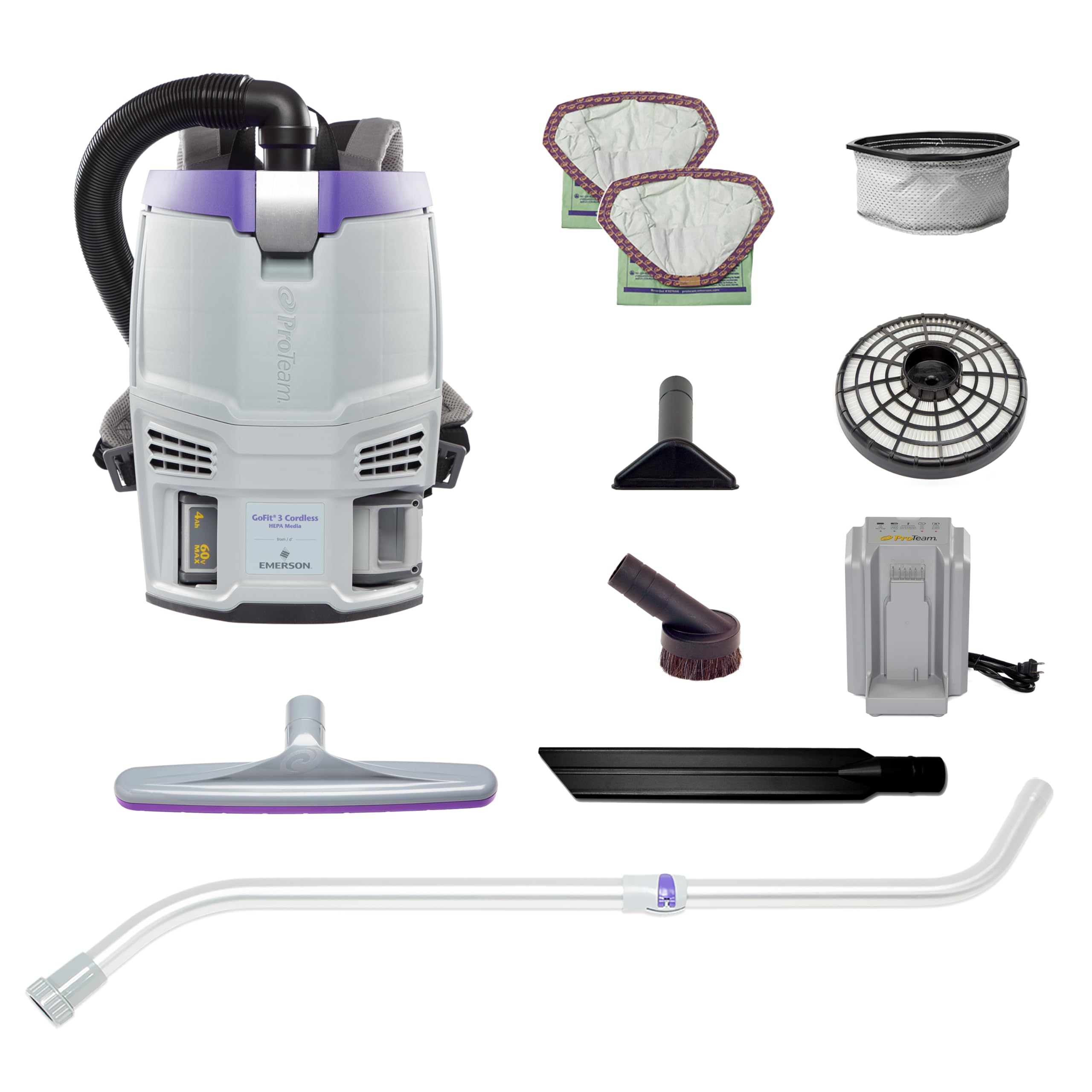
The lightest mid-size option here, built for smaller frames and quick apartment-style cleaning.
ProTeam markets the GoFit 3 as its smallest cordless cleaning solution, and the spec backs that up — it weighs 12.8 pounds with the battery installed, which is the lightest of the mid-size group. The interchangeable quick-adjust harness uses a four-step system that needs no tools, so it adapts to a wide range of body types. Runtime runs approximately 51 minutes on low and 39 minutes on high with the 4Ah battery, and the battery recharges in about 61 minutes. A three-quart capacity and the ProLevel Filtration System round out the package.
The main draw is cordless freedom: no plugging and unplugging between rooms, easy maneuvering, and good reach from the telescoping wand. Owners say it handles tile floors and vents well and feels light on the back despite the battery. The four-step harness is the feature that wins over anyone who has wrestled with a fixed-strap pack.
Where it asks for patience is suction on carpet. This unit has no rotary brush, so it is better suited to bare floors than deep carpet, and owners describe the suction as weaker than corded models. A loose battery fit is the most-cited annoyance — a few report it falling off during use. The three-quart bag is also on the smaller side for heavy commercial work. It is best framed as a light-duty pro tool for hard surfaces and tight spaces, not deep carpet.
Where it shines: the quick-adjust four-step harness and 12.8-pound weight make it the easiest pack here to wear for long stretches.
Its honest limit: no rotary brush and lighter suction mean carpet is not its job — bare floors are.
Made for smaller cleaners: if a heavy pack wears you down, this is the lightest comfortable option for hard-surface work.
Skip the carpet jobs: without a beater bar, it lacks the brush action deep pile demands.
Understanding the Specs
Runtime and suction settings
Runtime is how long the vacuum runs on a charge, and it always depends on the suction setting. Two-stage and high/low switches let you conserve power for detail work and switch to max for tough debris. A vacuum rated for over 100 minutes on normal may drop to well under 40 on max. Plan your cleaning around the normal setting if you need the full runtime, and switch to high only where the mess demands it.
HEPA filtration and bag capacity
A HEPA filter traps very fine particles, which matters when you clean around dust, drywall debris, or allergens. A two-stage HEPA system catches coarse particles first, extending the life of the main filter. Bag capacity — measured in quarts or gallons — decides how often you stop to swap the bag. Larger bins like three or four quarts suit whole-building cleaning, while half-gallon bags suit quick jobs but need frequent replacement.
FAQ
How long does a battery backpack vacuum actually run on one charge?
Can I use my own batteries with these vacuums?
Is a HEPA filter necessary for a backpack vacuum?
How often will I need to change the dust bag?
Are cordless backpack vacuums as strong as corded ones?
Which model works best on carpet?
How heavy is a battery backpack vacuum to wear?
Do these vacuums come with a warranty and replacement parts?
Can I use a backpack vacuum for both home and commercial cleaning?
Final Thoughts: The Verdict
For most people, the battery backpack vacuum winner is the Milwaukee M18 Fuel 3-in-1 because it converts between backpack, canister, and handheld duty while delivering the strong suction owners rave about — just keep spare batteries charged, since it drains a 5Ah pack (a 5 amp-hour battery, the capacity rating) in about 20 minutes of continuous use. If you want long runtime and a lighter frame for hard floors, the Makita XCV09Z at 12.4 pounds with up to 116 minutes on normal is the smart pick. And for commercial crews who need swappable batteries, a quiet machine, and a four-quart bin, the Sanitaire Transport is the one to reach for.
How We Picked
We do not accept paid placement. Every pick is matched to a real buyer and a real use-case; we do not hands-on test units.
Sources & Methodology
Specifications: manufacturer listings and product documentation. Review insights: verified customer reviews, as of September 2026. Pricing: not shown on this page (it changes often); check the current price via the retailer link.
As an Amazon Associate, KitchPrep earns from qualifying purchases. This does not affect which products we feature.
Related Guides
