
Specs are compiled from manufacturer listings and verified buyer reviews and can change over time — please confirm the key details on the product page before buying.
A battery and solar panel kit is how you keep the fridge, the router, and your phone alive when the grid drops — or when you are parked somewhere with no hookup at all. The number to get right first is watt-hours (Wh), the total energy the battery stores. That figure decides how long a fridge runs and how many devices you can charge in one outage. Everything else — output watts, solar input, port count — hangs off it.
I’m Mohammad Maruf — the founder and writer behind KitchPrep. This guide is built by comparing the manufacturers’ published specifications and the patterns across verified customer reviews, so you get each pick’s real strengths and trade-offs instead of marketing spin.
Some kits here cost more than others, and the gap is nearly always capacity and output, not build quality. What follows is a plain-English walkthrough of the nine setups worth your attention, the specs that actually change daily use, and who each one fits. Whether you are prepping for storm season or want quiet power at a campsite, this list covers the best battery and solar panel kits in each size class.
Our Picks at a Glance
How To Choose The Best Battery and Solar Panel
You are choosing between two things at once: how much energy you can store, and how fast you can put it back. A huge battery with a tiny panel is frustrating — it takes days to refill. A big panel with a small battery is wasteful. The right kit balances storage and recharge speed against the loads you actually run.
Start With The Load, Then Size The Battery
Write down what you want to power and how many hours per day. A refrigerator cycles on and off, so its average draw is far lower than its peak. Phones, laptops, and a Wi-Fi router are light loads. A space heater, microwave, or air conditioner is a heavy load and needs a high-output station. Watt-hours (Wh) tells you the total energy stored; divide your expected load by it to estimate runtime.
Match The Panel To Your Patience
Solar panels are rated at their ideal output in full sun. In partial shade or under cloud, real output drops, sometimes sharply. A folding panel in the 40W to 100W range is fine for topping up a small station while you hike or camp. If you want a full recharge in a single sunny day, look at the 200W-and-up kits. Portable panels fold down small, but they are still a bulky item in a packed car, so check the folded size before you commit.
Prioritize A Pure Sine Wave Output
Pure sine wave means the alternating current coming out of the AC outlets matches what your wall socket delivers at home. Electronics with motors, compressors, or sensitive boards — fridges, CPAP machines, laptops — run cleaner and quieter on it. Cheaper modified sine wave outputs can cause buzzes, overheating, or refusal to run at all on some devices, so it is worth confirming before you buy.
Understand Surge vs Continuous Watts
Every station has two power numbers: the continuous watts it can sustain, and the surge watts it can hit for a split second when a motor or compressor first kicks on. A fridge might draw only a few hundred watts running, but its startup surge can briefly spike much higher. If a station’s surge ceiling can’t clear that spike, the fridge simply won’t start. Always compare both numbers, not just the headline one.
Quick Comparison
| Model | Best For | Capacity | AC Output | Included Panel | Amazon |
|---|---|---|---|---|---|
| EF ECOFLOW Delta 3 Classic with 220W Solar Panel★ Best Overall | Whole-home essentials and CPAP overnight | 1024Wh | 1800W (3600W surge) | 220W bifacial | Amazon |
| Portable Power Station 350W with 40W Foldable Solar PanelBest for Camping | Camping, hiking, and small backup | 288Wh | 350W (600W surge) | 40W folding | Amazon |
| DaranEner Cubus 600L Solar Generator with 100W PanelsMid-Range Pick | RV trips and mid-size backup | 576Wh | 600W (1200W peak) | 100W | Amazon |
| GRECELL EB500 with 100W Solar Panel | Camping and portable travel power | 519.48Wh | 500W (1000W peak) | 100W monocrystalline | Amazon |
| Anker SOLIX C300 with 60W Solar Panel | Backpack portability and fast recharge | 288Wh | 300W (600W surge) | 60W folding | Amazon |
| EBL Acc2400 with 200W Solar Panel | Whole-home and RV heavy loads | 1843.2Wh | 2400W | 200W monocrystalline | Amazon |
| Jackery Explorer 2000 v2 with 2x200W Panels | Home backup with AC units | 2042Wh | 2200W | 2x200W | Amazon |
| ABOK Ark3600 with 400W Solar Panel | Contractor jobs, RV, and expanded capacity | 3840Wh (expandable) | 3600W (4500W peak) | 400W | Amazon |
| Jackery HomePower 3000 with 2x200W Panels | Whole-home essentials and RV hookup | 3072Wh | 3600W (7200W surge) | 2x200W | Amazon |
In‑Depth Reviews
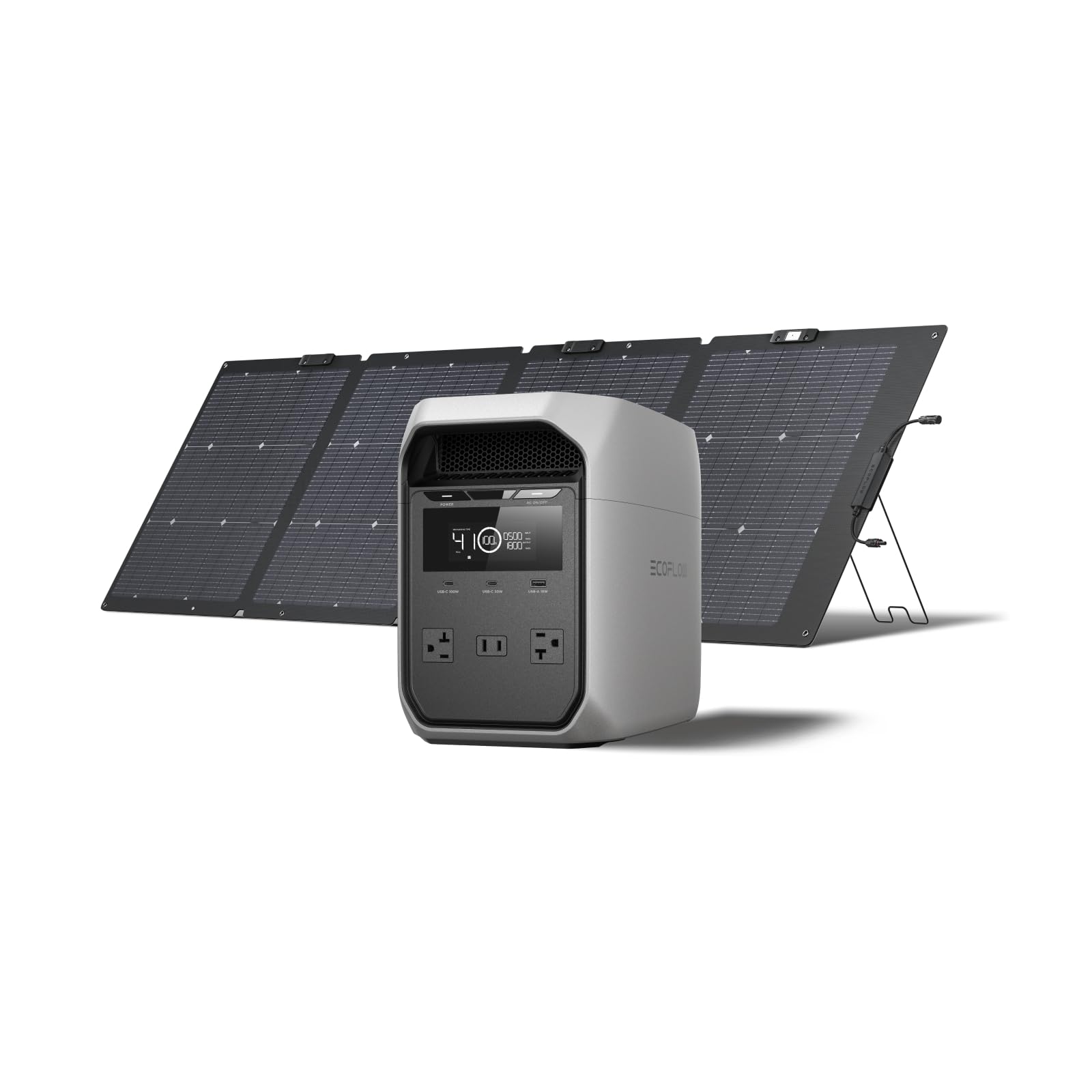
1. EF ECOFLOW Solar Generator Delta 3 Classic with 220W Solar Panel, 1024Wh
Our pick — over 4.5★ from 350+ verified ratings; the strongest balance of quality and price.
The every-room workhorse — a kilowatt-hour of stored power plus a panel big enough to refill it in a single sunny day.
For a household that wants one station to cover a fridge, a router, and a CPAP without switching anything around, this is the pick. It stores 1024Wh (watt-hours — about a full day of running a modern fridge at cycling draw), which is why it sits at the top of this list. The inverter delivers 1800W continuous and 3600W surge. Those two numbers are what let it start a compressor that would trip a smaller 300W unit immediately. The included 220W bifacial panel (bi-facial means it collects light on both the front and back faces) has a rated conversion efficiency of up to 25% thanks to N-Type cells.
Owners put the kit through real stress: one ran a CPAP and a 16-inch fan all night with charge left over, and another reported the 220W panels pulling 190–200W even in partial shade. That last figure is the real story — most folding panels fall much further in shade. The AC side charges 0–80% in 45 minutes with X-Stream AC charging, and the solar side reaches a full charge in about 5.8 hours with the included panel in good sun. Owners who relayed their own solar sessions back a slightly slower figure in cloud. A 10ms UPS switchover covers the PC or server in your office, so a brownout never crashes a call.
The single most talked-about quality here is the build — owners consistently call it premium and reliable. The one thing keeping a small percentage of buyers from five-star praise is value: some feel the price runs high for a 1kWh system once you add matching expansion gear. That is the honest trade-off. If you need expandable capacity, this one goes up to 2600W with X-Boost, and the LiFePO4 cells are rated for 10+ years of daily use. Power station and panel ship separately, so expect two deliveries.
What makes it the top pick
- 1024Wh storage plus 1800W continuous / 3600W surge covers fridges, microwaves, and power tools that smaller units cannot start
- 220W bifacial panel with up to 25% conversion efficiency reaches 190–200W in partial shade
- 0–80% wall charging in 45 minutes; full solar recharge in about 5.8 hours with the included panel
- Under-10ms UPS switchover protects PCs, servers, and medical devices during grid drops
- LiFePO4 cells rated for 10+ years of daily use
Where it asks a bit more
- Price sits at the top of the mid-range, and expansion gear adds cost on top
- Power station and 220W panel arrive as two separate deliveries, not one box
- Noticeable weight, though the handles make it manageable to move between rooms
Built for: Any home that wants a single always-ready station for fridge, router, and medical devices — with the solar panel that refills it in a sunny afternoon.
Look elsewhere if: You only need to keep phones and a fan alive during short outages — the cheaper Anker SOLIX C300 does that job for less power-station real estate.
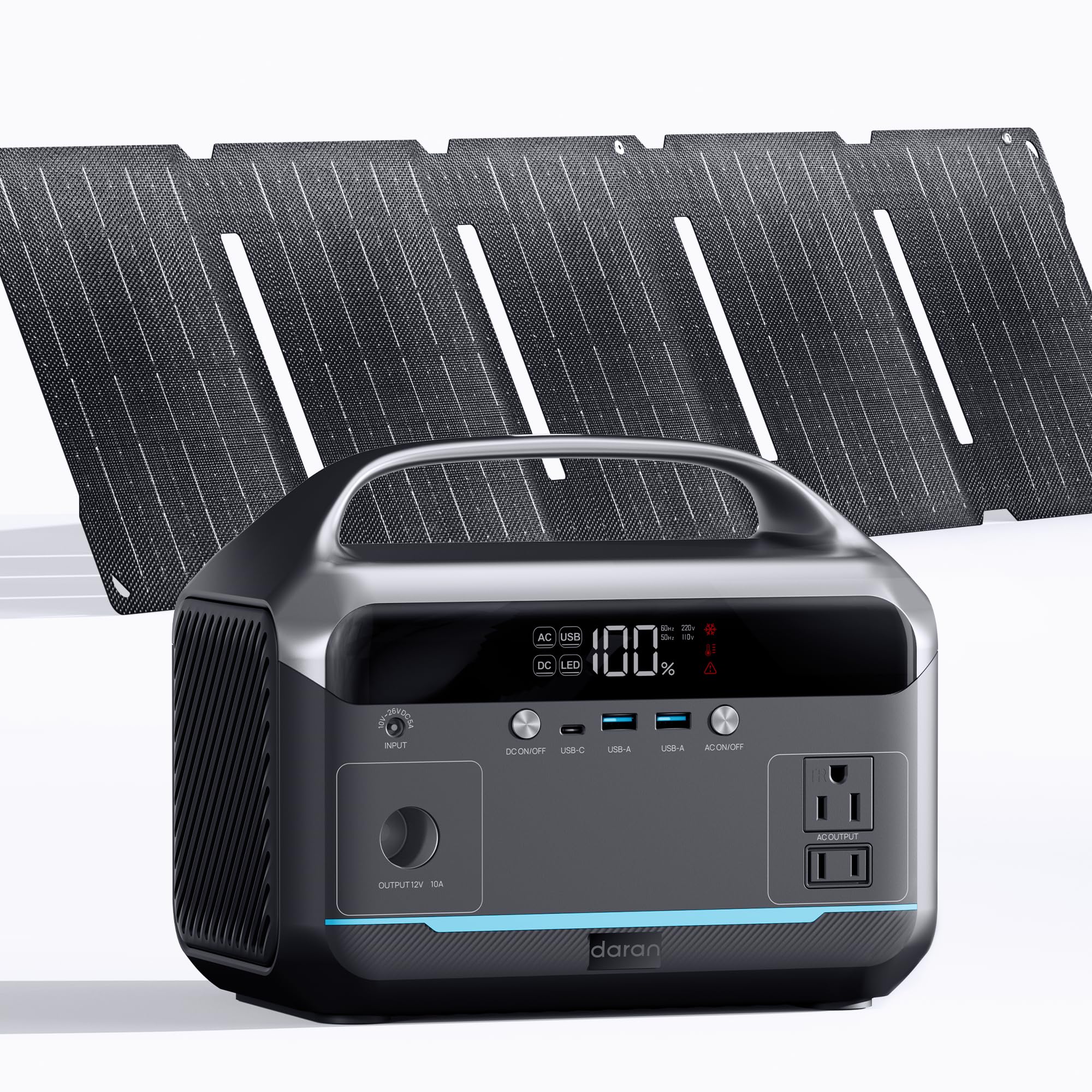
2. Portable Power Station 350W with 40W Foldable Solar Panel, 288Wh LiFePO4
The kit that lives in the tent bag — light enough to strap to a pack, quick enough to top off in an afternoon.
If your priority is a solar generator you can sling over a shoulder rather than wheel across a driveway, this DaranEner NEO is the move. At 8.2 lbs, it is a fraction of the weight of the big home-backup stations here — compare that to the 92-lb ABOK Ark3600 and the difference is night and day. Capacity is 288Wh with LiFePO4 cells (lithium iron phosphate — the chemistry that resists heat better and lasts longer than ordinary lithium-ion). AC output runs 350W continuous with a 600W surge ceiling, plenty for phones, laptops, a small fan, or a portable cooler.
Field reports paint the picture best: the recharge and portability are the standout specs. One buyer reports running a small portable AC/fan for about 7 hours while charging two phones, and still had over 70% left. Another ran a fan through a walk-in camping trip and packed the whole station inside a Harbor Freight ammo can. The included 40W folding panel uses mono cells with a built-in MPPT (maximum power point tracking — a chip that squeezes the most wattage out of changing sunlight) controller, so it keeps working even on hazy afternoons.
The station offers six charging ports total: 2 AC outlets (350W), 1 USB-C PD 60W, 2 QC 18W USB-A, and a 12V/120W car port. That port count covers a small family on a weekend trip without juggling cables. The honest limitation is solar speed. A 40W panel is a top-up tool, not a fast-recharge tool — plan on the wall outlet or a car port (up to 100W) for a quick refill. Buyers also note the DC/USB side has been a weak point on some units far from home, though the brand has replaced units free of charge when it happens. If you want a bigger panel and more forgiving solar math, step up to the DaranEner Cubus 600L with its 100W panel.
Perfect for a first solar kit: Light enough for backpacking, cheap enough to keep in the car, and enough ports for a family on a weekend.
Set your solar expectations: The 40W panel is a slow trickle charge — bring the AC cord if you need a full recharge in a hurry.
Grab this if: You want portable power that fits in a backpack and tops up on a folding panel that packs down with it.
skip it if: You need to run a fridge or a space heater — the 350W continuous ceiling simply won’t carry those loads.
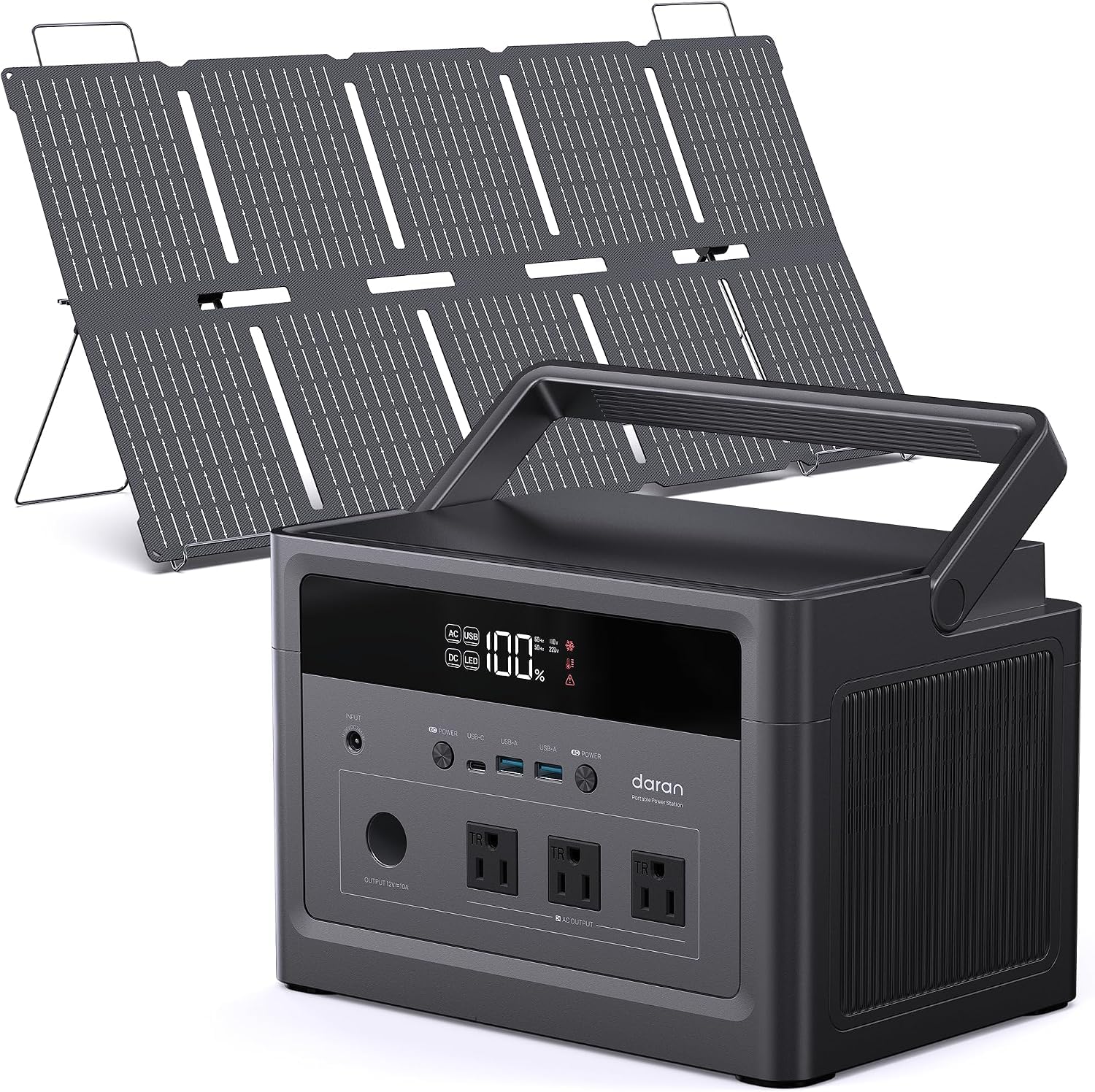
3. DaranEner Solar Generator with 100W Panel Included, Portable Power Station 1200W Peak
A camper-van companion — 576 watt-hours in a package light enough to lift out of a hatchback by yourself.
This DaranEner Cubus 600L sits right in the middle of the lineup: 576Wh of storage, 600W continuous output, and a 1200W peak. Peak is the short-duration ceiling the station can hit when a motor first kicks on, so a mini-fridge or a small air pump starts without tripping. The station weighs 13.67 lbs — noticeably lighter than the full-size home backups, and easy enough for one person to carry across a campsite.
You get a 100W solar panel in the box, and it connects with MC4 connectors (a standard plug type for solar cables) that click together easily and are hard to get wrong. Camper owners running three 100W panels side by side report the connectors click tight, and the 10AWG wire (a thicker wire gauge that loses less voltage over distance) keeps efficiency high. But several of the parallel-connector reviews are for a Y-branch adapter rather than the station itself, and those buyers report the cables ship in all-black rather than color-coded, so keep spare polarity stickers handy if you are wiring a bigger array.
The station packs seven ports: 3 AC outlets (110V pure sine wave), 1 USB-C PD 100W (fast enough to bring most laptops to 80% in half an hour), 2 USB-A at 18W, and a 120W car socket. That port count means a laptop, two phones, and a power tool can all be live at once. On runtime, owners have run a fan from 7:30 a.m. to 1 p.m. and ended up at 39% charge, so half a day of use on a light load is realistic. The known catch is recharge: the wall outlet takes five-plus hours for a full refill, and while the solar panel gets you there eventually, it is not a quick-turnaround solution if you are relying entirely on sun.
The weight advantage is real: At 13.67 lbs, this is a two-hands lift rather than a furniture move.
Recharge is slow by design: Five-plus hours on wall power means overnight charging is the right rhythm.
Pick this for: Camper trips, small RV power, and home backup where the station needs to move in and out of storage each season.
Think twice if: You want a Keurig or a coffee pot on it — reviewers report neither will run, so stick to fans, laptops, and small appliances.
4. GRECELL 500W Portable Power Station with 100W Solar Panel, 519.48Wh
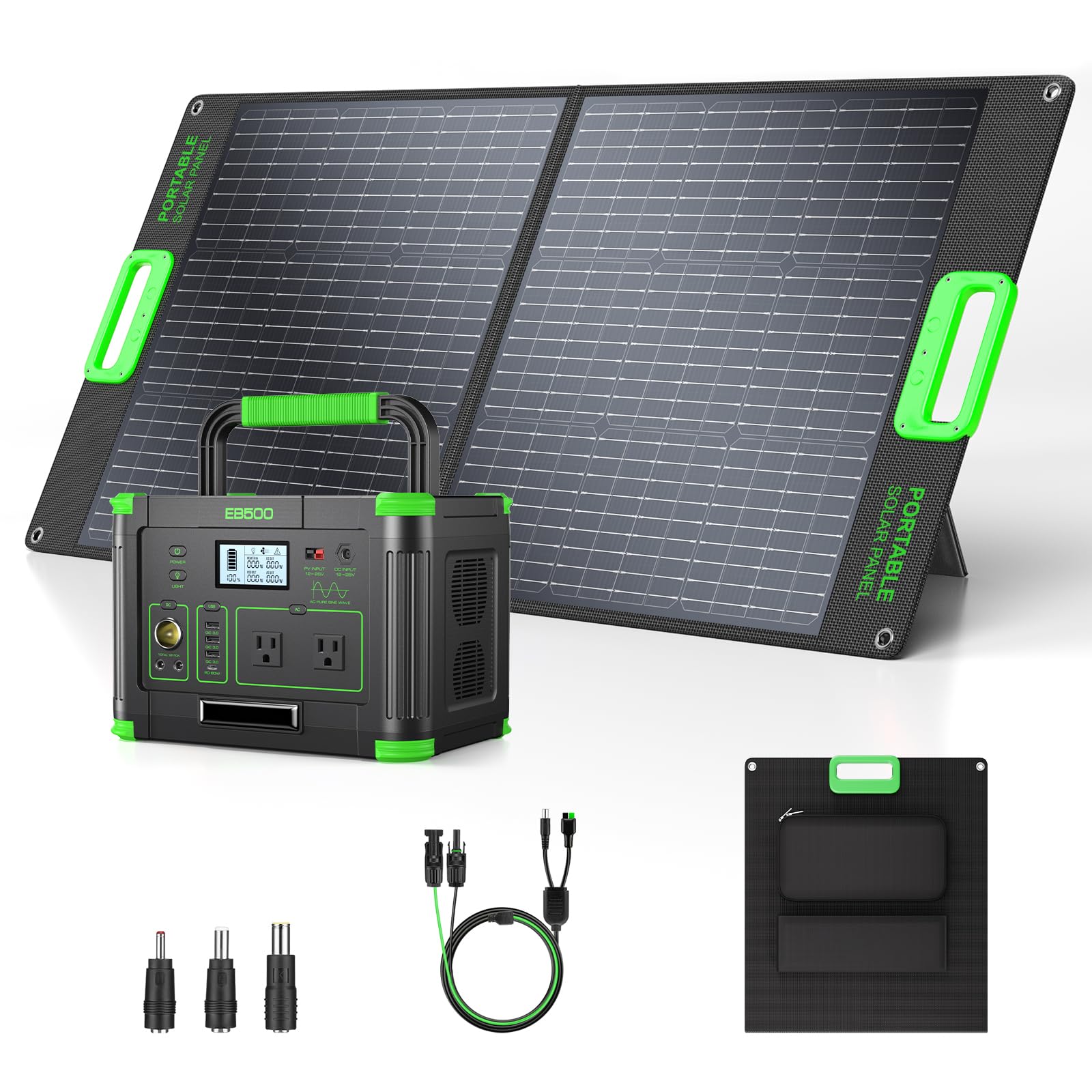
A port-juggler’s station — ten outlets including a wireless charging pad, in a footprint that fits beside the driver’s seat.
If you regularly charge a crowd of gadgets at once — three phones, a laptop, an action camera, and a wireless earbud case — this GRECELL EB500 is aimed at you. It stores 519.48Wh, delivers 500W continuous output, and peaks at 1000W. The port lineup is where it earns its spot: 2 AC pure sine wave outlets, 3 USB-A at 18W, 1 USB-C PD 60W, a DC car outlet, 2 DC 5.5/2.5 outputs, and a built-in wireless charging pad. That is ten live ports on a station you can move one-handed.
The included 100W monocrystalline panel converts sunlight at up to 23.5% efficiency and connects via a universal adapter kit, so it plays nicely with other power stations you might already own. The BMS (battery management system — the onboard chip that watches for overcharge, overvoltage, and overheating) looks after the lithium cells so you can leave it plugged in without stress. Build quality is the talking point in owner reviews, with durability and fit getting heavy praise. One owner runs three of these in a self-built solar setup at home alongside the EBL 1000-watt camp batteries, and reports they all fit into the case perfectly.
Where some owners push back is on the charging math. Runs off the AC outlet take about four hours for a full charge, and while the panel is rated at 100W, real-world solar gains can be very slow in less-than-ideal sun. A buyer who logged one hour of solar on a partly-charged unit saw only a two-point gain — a realistic number to keep in mind if you plan to run this on sun alone. The practical answer is to charge it from the wall the night before a trip and keep the panel for top-ups. For mild outages and camping trips, this is a well-made mid-capacity choice.
The port count is the draw: Ten outlets including a wireless charger means fewer adapters and fewer arguments over plugs.
Solar is a top-up, not a fast charge: Stay realistic about the sun in your region before planning around panel-only recharging.
Right for you if: You have a pile of small electronics and want them all plugged in on one portable station, no adapters needed.
Not the one for: Running kitchen appliances or anything with a heating element — that pushes well past 500W continuous.
5. Anker SOLIX C300 Portable Power Station with 60W Solar Panel, 288Wh, 300W

Built for the trail — a 288 watt-hour brick with an IP68 panel that shrugs off rain and mud.
If you want a battery you can carry in one hand and recharge fast, the Anker SOLIX C300 is the one to pick. It holds 288Wh (watt-hours, a measure of how much energy it stores), outputs 300W continuous with a 600W surge (a brief burst for motors), and packs eight ports: 3 AC outlets at 300W, a 120W car socket, 2 USB-C at 140W (fast enough to charge a laptop at full speed), 1 USB-C at 15W, and a USB-A at 12W. At 15.5 lbs it is not ultralight, but it fits into a backpack and the strap lets you carry it hand-free (strap sold separately).
What makes this pick stand apart from the cheaper 288Wh rival above is charging speed and the panel’s weather rating. The 60W folding panel is IP68 rated (sealed against dust and sustained water immersion), so a bit of rain does not end your charging session. Owners mention the panel hit around 40W in full sun and pushed the station to full charge by noon. Wall charging reaches 80% in about 50 minutes, and the lithium iron phosphate cells are rated for 3,000 cycles. The station also quiets down — it emits only 25dB at 3.3 feet, which is essentially library-volume.
Long-shift users have tested it hard: one ran a 240W laptop for roughly five hours on a 20–80W draw, another inflated a queen air mattress in 10–12 minutes and finished with 95% remaining. On solar, owners note the panel drops to 5–15W under overcast skies — which is normal for any 60W folding panel and worth knowing before planning a sun-only itinerary. The app is Bluetooth and WiFi capable, though a couple of owners wished it tracked history and had an auto-off. A handful of owners also wished for a few more USB ports on the DC side.
Fast, quiet, and weather-ready: 80% charge in 50 minutes, 25dB output, and an IP68 panel make this the most trail-friendly combo here.
Real-world solar is modest: The 60W panel hit around 40W in full sun, so a slow trickle is what you should expect off the grid.
The carry-friendly choice for: Backpackers, van-lifers, and campers who want reliable top-ups and quiet operation, rain or shine.
Not enough if: You need to run a fridge or a space heater — the 300W continuous ceiling rules out high-draw appliances.
6. EBL 2400W Portable Power Station with 200W Solar Panel, 1843.2Wh
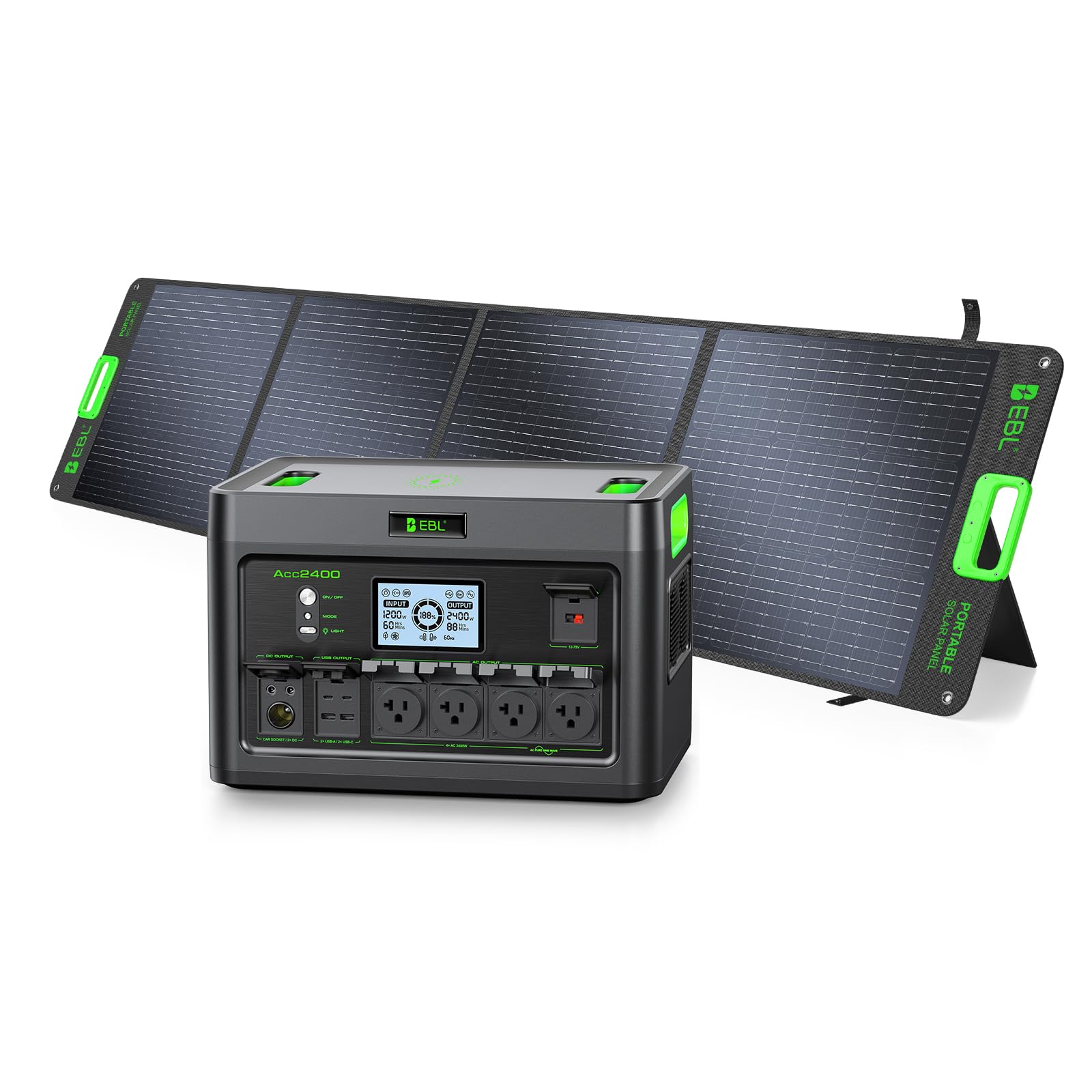
The high-output mid-range option — 1843.2 watt-hours and 2400 watts of output in a body you can still carry.
When you want serious capacity without crossing into the premium tier, this EBL Acc2400 is the crossover pick. It stores 1843.2Wh in LiFePO4 cells and pushes 2400W continuous output — enough for air conditioners, microwaves, and other heavy-load devices that would stall every 500W station on this page. Twelve ports run at once, including 4 AC outlets at 2400W, 2 USB-A at 18W, 2 USB-C at 100W PD, a wireless charging panel, a car port, and 2 DC ports. Laptops, fridges, and power tools can all be live at once.
A portable power station of this size shines in the recharge math. Wall charging finishes in 1.6–2 hours with the AC adapter, and the dual-input mode (solar + AC together at up to 1200W) reaches a full charge in 1.8 hours or less. Solar-only recharging with the included 200W monocrystalline panel (up to 23.5% efficiency) takes 6 to 14 hours depending on sun, and if you push the rig with a bigger array it can shave that considerably. Customers note running a 12V fridge all night, tracking laptop charging via the 100W USB-C port, and using the built-in light for overnight camping.
When you are away from a wall outlet, charging slows down — solar is capped at the design limits, and a SAE-to-MC4 connector mismatch (two different plug types that do not fit together) annoyed at least one owner who had to source the right cable. The station is 55 lbs, so it is a two-person lift if you are moving it into a basement or up stairs. Owners praise the display, which shows battery percentage and live wattage draw, and the reliability over multi-day camping trips. Budget-wise, this lands mid-range despite the heavy-lift power — a strong pick for anyone who needs a whole-home backup without premium price tags.
Where it wins: 2400W continuous output handles air conditioners and microwaves that trip smaller stations; 1.6–2 hours on wall power keeps you ready for the next outage.
The catch: Solar-only recharging runs 6 to 14 hours on the included panel, so plan around wall charging when it matters.
The right call for: RV owners, home-backup buyers, and anyone with air conditioners or microwaves in the picture.
Maybe skip if: You need a station you can throw in a backpack — at 55 lbs this is a lift-and-roll, not a carry.
7. Jackery Explorer 2000 v2 with 2x200W Solar Panels, 2042Wh, 2200W AC Output
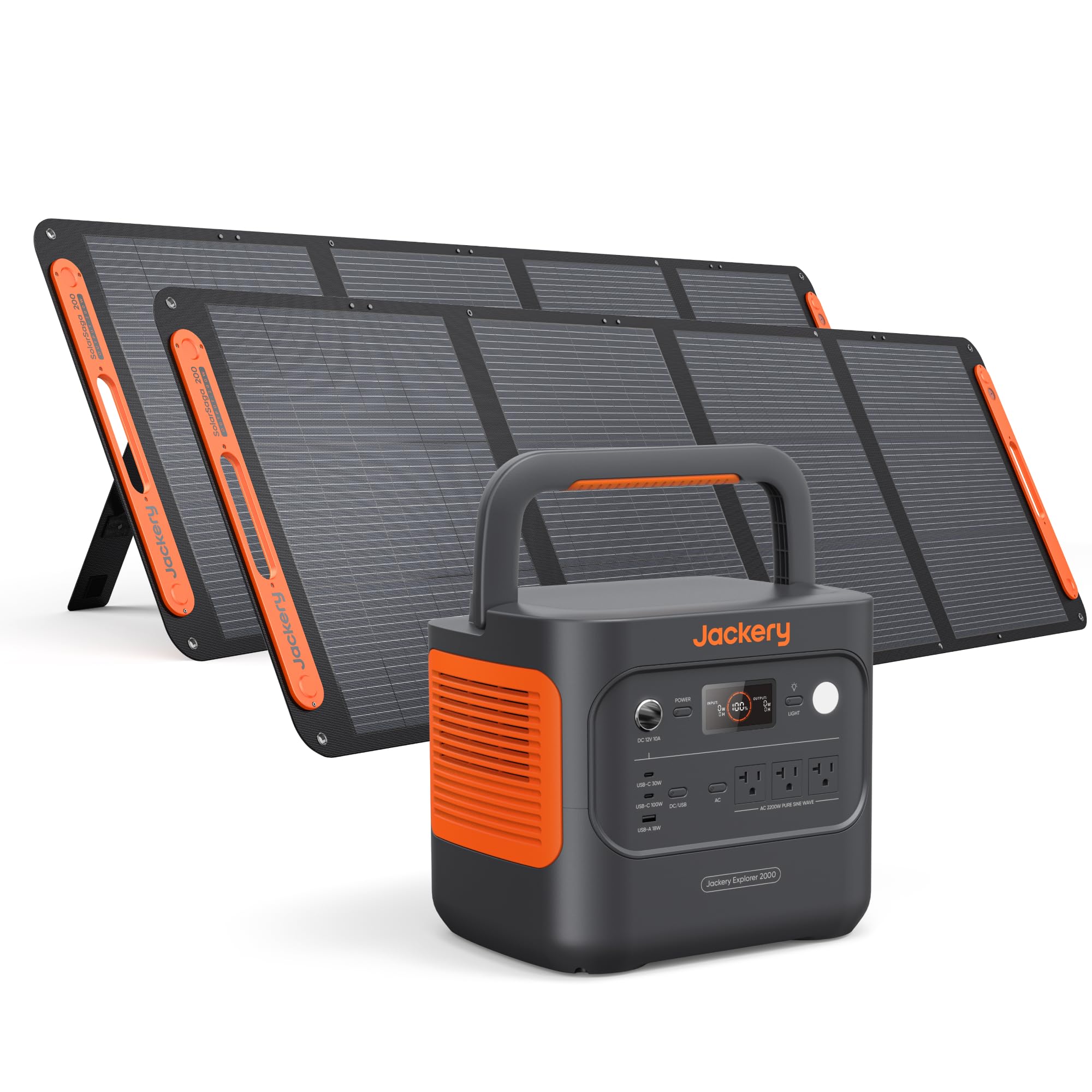
A whole-home sentry — over two kilowatt-hours, three AC ports, and a UPS switch fast enough to keep a PC online.
If your house already has a smart panel and you want backup that kicks in without you noticing, the Jackery Explorer 2000 v2 is built for that. It stores 2042Wh (watt-hours, a measure of energy capacity), outputs 2200W continuous across three AC ports, and switches to battery backup in 20ms (milliseconds) when the grid drops — fast enough that a PC or router never notices. The included kit ships with two 200W folding panels, which gives you 400W of solar input in good sun. In full sunlight owners have clocked individual panels at 200W; in partial cloud, they drop to around 30W, which is normal for any folding panel.
What sets this pick apart on the charger side is the speed. AC charging brings the station to 80% in 66 minutes, and Emergency Super Charging (activated in the app) reaches a full charge in 102 minutes. Silent Charging mode does a full charge in five hours at just 30dB, which is quiet enough to sleep in the same room. The station weighs 39.5 lbs, which is noticeably lighter than a traditional LiFePO4 2kWh unit — cells sit inside the chassis itself instead of in a separate pack, which is why it is smaller and easier to move.
Owner reports show this rig running real load. One buyer ran a window AC for 3.5 hours and landed at 45% charge; another powers a Starlink mini round the clock; a third says it will comfortably run a couple of freezers and a fridge. The recurring caveat is weight — a few owners note the station feels heavy despite the CTB (Cell-to-Body) engineering, and one flags that the solar panels can yellow grass underneath if they sit on a lawn. UL1778 test certified for UPS use, it is a solid choice if you want gas-generator freedom without fumes or fuel storage.
The switch speed is the win: 20ms UPS means a brownout never downs your PC, router, or security camera.
Weight still matters: 39.5 lbs means thinking about where it lives before you need it, not during an outage.
On your shortlist if: You have regular outages and want a silent, no-fume station that can carry an entire room through a multi-hour blackout.
Look past it if: You only need phone and lamp backup during rare short outages — smaller stations here will do the job for far less weight.
8. ABOK Ark3600 Portable Power Station with 400W Solar Panel, 2000W Solar Input
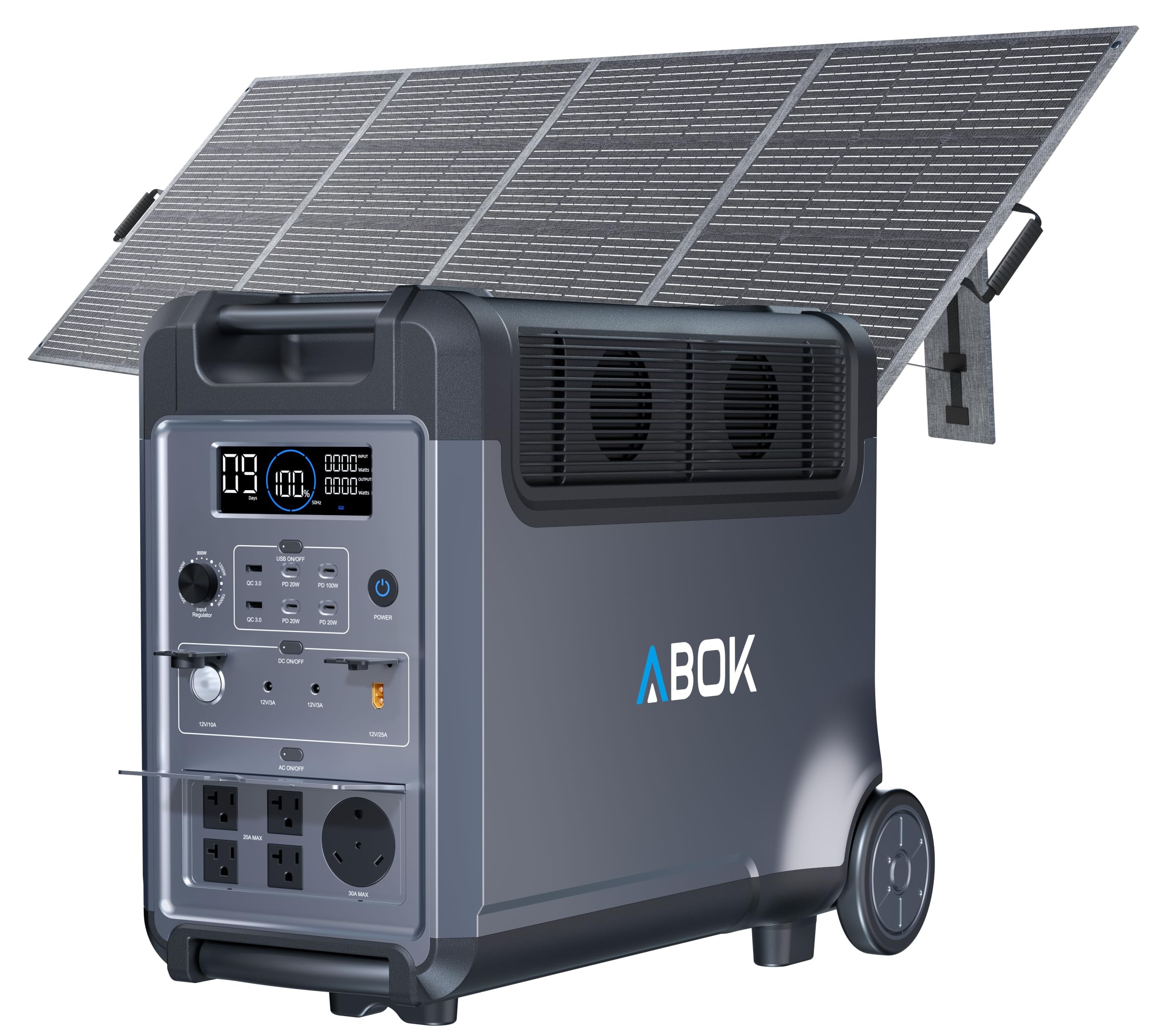
The jobsite answer — nearly four kilowatt-hours, contractor-grade output, and wheels to drag it where the power is needed.
If your use case is construction, disaster recovery, or powering two full-size refrigerators overnight, the ABOK Ark3600 is built for the load. It stores 3840Wh of LiFePO4 energy — expandable up to 11520Wh with matching battery packs — and outputs 3600W continuous with a 4500W peak. That is more than double the top of the mid-range tier, and it supports 99% of household appliances according to the manufacturer, from power tools to full-size fridges.
Charging is where it shines. Solar input accepts up to 2000W, the included 400W panel is a real array, and combined AC + solar charging brings the unit to full in about 1.29 hours with the right wall circuit. Solar-only charging takes three hours in good sun. A contractor who tested the station on the job ran a wetvac, a heatgun, and an SDS-Max drill simultaneously plus tool batteries and USB charging, and ended the day at 22% — a genuine heavy-load result you would not get from any 1kWh kit. The telescoping handle and wheels mean a single person can move it, despite the 92 lbs.
The two recurring caveats in owner reports are weight and solar patience. At 92 lbs, this is a wheeled appliance, not a lift — plan on ground-level storage. Solar-only charging reflects the weather: one owner in Washington’s cloudy stretch reported waiting 3ish days for a full charge from solar, even with the panel array. The pay-off for that trade is genuine house-scale capacity: one buyer ran a 58-quart fridge for more than two days and still had 64% left. Well worth the money according to most owners.
Contractor-grade output: 3600W continuous powers a wetvac, heatgun, and drill at once — no gas, no fumes, no cord.
Heavy and site-bound: At 92 lbs and 21.6″ long, this station wants a permanent corner of your garage or job trailer.
Built for: Contractors, disaster-prepared households, and anyone whose loads genuinely need 3600W of continuous power.
Overkill if: You only need phone and laptop backup — pick a smaller station and save the floor space.
9. Jackery HomePower 3000 with 2x200W Solar Panels, 3072Wh, 3600W AC Output
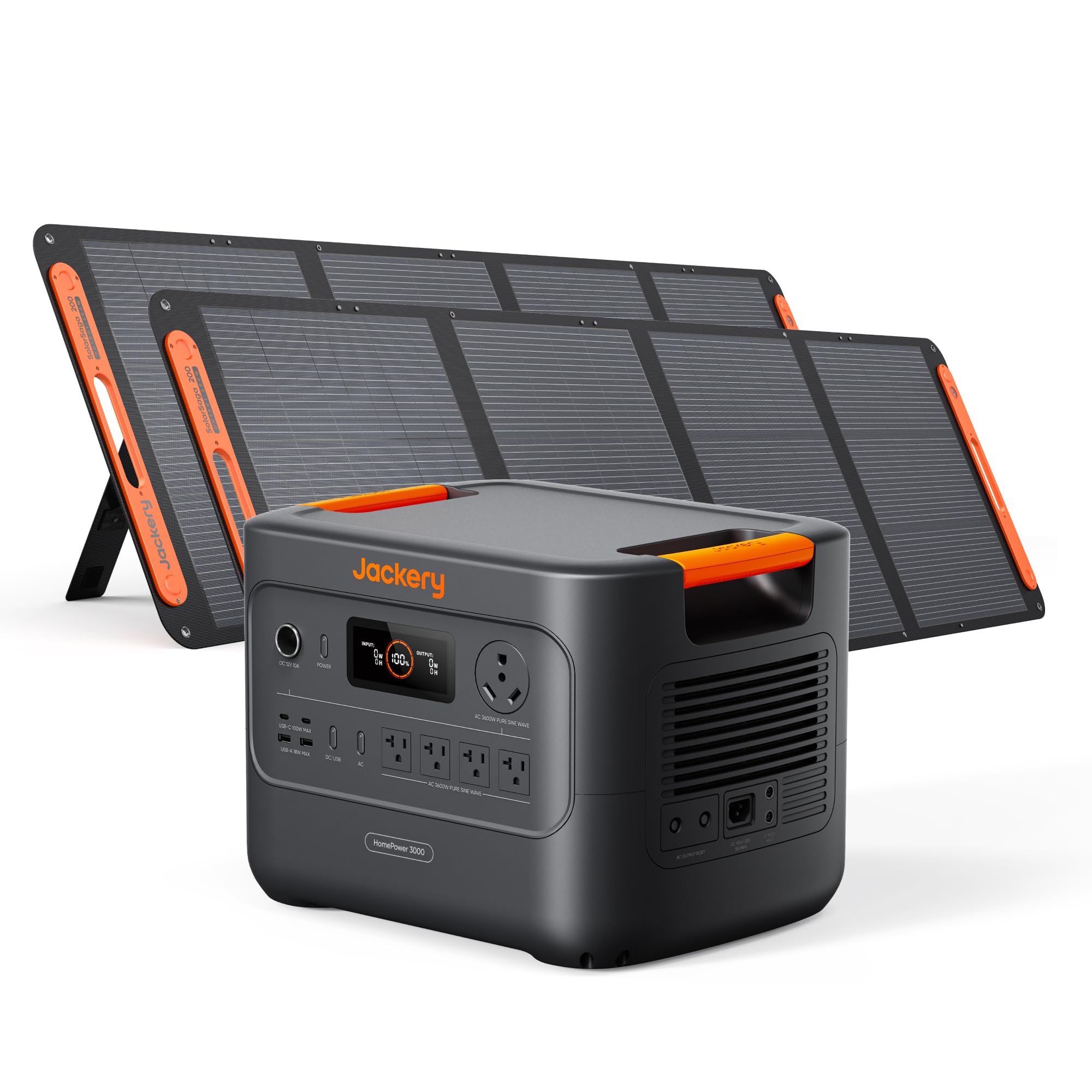
The home-first flagship — 3072 watt-hours with a TT-30 RV hookup and a UPS fast enough for Zoom calls.
This Jackery HomePower 3000 is what you buy when home backup is the primary job and camping is the bonus use case. It stores 3072Wh in LiFePO4 cells, outputs 3600W continuous with a 7200W surge, and packs in a TT-30 RV port for plug-and-play hookups — rare on a portable station and a big plus for trailer owners. The UPS switchover runs at ≤20ms and is UL-certified, so security cameras, medical fridges, and Zoom calls stay live through a grid drop. ChargeShield 2.0 runs on exclusive AI algorithms to speed up charging and extend the battery lifespan.
Owner reports run the gamut from serious to weekend-warrior. One buyer ran three refrigerators plus a freezer through a 4.5-hour outage and stayed running. Another powers everything in their trailer. A camper owner uses the station to run an A/C and microwave off-grid and calls it powerful and quiet. RV users tracking live wattage have noted around 1800W total draw as a typical usage ceiling on a 14AWG extension cord. The pairing with two 200W SolarSaga panels charges to 80% in about 9 hours of good sun — panel-dependent, and owners in shade-heavy regions will want more than two panels for full independence.
The honest caveat on this flagship is setup complexity. Recharging is fast via hybrid AC+DC in 1.7 hours, or 2.2 hours on AC alone. But one owner not on the Jackery app ecosystem found the unit non-returnable and had difficulty reaching human support, with an unexplained shutdown that resolved slowly. Sizing matters too: it is well-suited to small trailers and a couple of core home circuits, but a full off-grid rig with an inverter will outrun its capacity. Still, for most home-backup buyers the combination of 3072Wh, ≤20ms UPS, and CTB (Cell-to-Body) construction — Jackery calls it the world’s first 3kWh portable station to use this design — is worth the premium nod.
The RV-friendly flagship: A TT-30 RV port plus a UL-certified UPS is a rare combination on any portable station.
Setup rewards research: Non-returnable and app-reliant — check the connectivity and support path before ordering.
Worth the premium for: Whole-home essentials backup, small-trailer RV users, and anyone who needs a UL-certified UPS on medical equipment.
Look at the Ark3600 instead if: You need contractor-grade output and much bigger storage — 3840Wh expandable versus 3072Wh here.
Understanding the Specs
Watt-Hours (Wh)
Watt-hours are the size of the tank. A 1024Wh station (like the Delta 3 Classic) holds roughly double the energy of a 519.48Wh station such as the GRECELL EB500, which is the main reason for the price gap between tiers. Divide your expected device load into the watt-hour figure to estimate runtime — a phone that draws 5W gets hours from any station here; a fridge that cycles at 150W average is a much shorter window. Capacity, not output rating, decides how long a blackout feels.
Continuous vs Surge Watts
The continuous figure is what the station can run all day. The surge figure is the brief spike it can handle when a motor or compressor first powers on. A 500W station with a 1000W peak (like the GRECELL EB500) can start a microwave but will not sustain air conditioning. The Jackery HomePower 3000 and the ABOK Ark3600 both run 3600W continuous with 7200W and 4500W peaks respectively — that headroom is what makes them home-backup stations rather than camping toys.
LiFePO4 vs Lithium-Ion
LiFePO4 is a specific lithium chemistry that trades a little weight for far better heat resistance and much longer cycle life. Most stations here — the EcoFlow Delta 3 Classic, the DaranEner Cubus 600L, the Anker SOLIX C300, the EBL Acc2400, and both Jackery models — use LiFePO4 specifically for that trade. The ABOK Ark3600 goes further, specifying over 4000 cycles and a lifespan up to 10 years. Cycle count is the figure to compare: the Anker SOLIX C300 and Jackery HomePower 3000 are rated for 3,000 and 4,000 cycles respectively.
Bifacial vs Standard Solar Panels
A bifacial panel collects light from both the front and back faces, which can boost output when the panel sits over a reflective surface like snow or pale ground. The EcoFlow 220W panel is bifacial with a front face rated at 220W and a rear face rated at 175W. Standard mono panels like the 100W GRECELL and 200W EBL are single-face but still deliver strong efficiency — both are rated up to 23.5% conversion. Folding panels are almost always single-face; if backpacking portability is the priority, the 40W Folding and 60W Anker panels fit that job.
FAQ
How many watt-hours do I actually need for a home blackout?
Can a portable power station run my refrigerator overnight?
Do the included solar panels recharge the station in a day?
What is the difference between pure sine wave and modified sine wave output?
How long do LiFePO4 batteries in these stations actually last?
Can I use a bigger solar panel than the one that ships with the kit?
Do these kits ship as one package or in separate boxes?
Can a solar generator replace a gas generator for home backup?
How do I connect a Jackery power station to its solar panels?
Are these stations loud enough to disturb sleep or a Zoom call?
How long does it take to refill the battery from a wall outlet?
Will the included folding panel survive rain and dust on the trail?
Final Thoughts: The Verdict
Picking the right kit means matching watt-hours and continuous output to the loads you actually power. The EF ECOFLOW Delta 3 Classic with 220W Solar Panel is the safest all-rounder: 1024Wh, 1800W continuous output, 3600W surge, and a bifacial panel that refills it in about 5.8 hours of good sun. It runs a CPAP all night on one charge, and the 10ms UPS switch protects the router or PC during a brownout. That is the combination most households need for a fridge, router, and CPAP.
If portability tops your list, the Anker SOLIX C300 gives you 288Wh, 300W output, a 60W IP68 panel, and 80% wall charging in 50 minutes in a backpack-sized package. For whole-home backup, the Jackery HomePower 3000 pairs 3072Wh with a UL-certified ≤20ms UPS and a TT-30 RV port, which is a rare combination for trailer owners who also want home-outage coverage. And if heavy loads or jobsite use is the goal, grab the ABOK Ark3600 — 3840Wh expandable to 11520Wh, 3600W continuous, and a 2000W solar input that refills it in 3 hours of full sun.
One final nudge: the Delta 3 Classic is the crowd favourite here at 4.6 stars across 300+ ratings, and the mid-range kits from DaranEner and GRECELL are the fastest routes to real backup power without overbuying. Whichever you pick, decide on watt-hours first, panel wattage second, and port count last.
How We Picked
We do not accept paid placement. Every pick is matched to a real buyer and a real use-case; we do not hands-on test units.
Sources & Methodology
Specifications: manufacturer listings and product documentation. Review insights: verified customer reviews, as of September 2026. Pricing: not shown on this page (it changes often); check the current price via the retailer link.
As an Amazon Associate, KitchPrep earns from qualifying purchases. This does not affect which products we feature.
Related Guides
