
Specs are compiled from manufacturer listings and verified buyer reviews and can change over time — please confirm the key details on the product page before buying.
If your solar panels make power all afternoon and your house still goes dark at night, the missing piece is storage, and the 48V lithium rack battery is what actually fixes it. This guide covers six home solar batteries — from single server-rack units you can grow one at a time to complete battery-plus-inverter kits that arrive ready to wire in.
I’m Mohammad Maruf — the founder and writer behind KitchPrep. This guide is built by comparing the manufacturers’ published specifications and the patterns across verified customer reviews, so you get each pick’s real strengths and trade-offs instead of marketing spin.
You will see which units stack into a rack, which ones arrive with a 10kW inverter already matched to the battery, and how many of each you can run side by side. The goal is simple: size your bank to one night of real consumption, not a week of worst-case assumptions.
Our Picks at a Glance
How To Choose The Best Batteries for Home Solar
To keep your lights on through the night, you need to know three numbers before you buy a home solar battery. First, how many kilowatt-hours (kWh — the total energy the battery holds) you need to ride through a night. Second, how many amps the built-in battery management system (BMS — the circuit board that guards against overcharge, over-discharge and short circuits) will let through. Third, how many units you can wire together later. Get those three right and the rest is mounting hardware.
Match the kilowatt-hours to one night, not one week
Most homeowners overbuy. A single 16.1kWh unit covers a full evening of lights, refrigeration and a couple of rooms of air conditioning for a normal household, while a 5.12kWh unit handles a pared-down essentials load. If you are not sure, start smaller and use the parallel-expansion path — several of these batteries let you stack more units onto the same bank later rather than replacing anything.
Check the BMS amp rating before you check the price
The amp-hour (Ah) figure tells you how much energy the battery stores; the BMS amp number tells you how fast it can deliver that energy. A 200A BMS supports high-draw appliances like well pumps and air conditioners, while a 100A BMS is happier with everyday household loads. Buying a big battery with a small BMS is the most common mismatch in DIY solar builds.
Confirm closed-loop communication and your local listing
Closed-loop communication lets the battery talk directly to your inverter, so charging stops at the right moment and you avoid overcharging. It sends state-of-charge and temperature over a CAN or RS485 cable (two common data cables). Before you buy, check two things: that the ports match your inverter brand, and that the safety listing on the label satisfies your local electrical inspector — some areas require a specific standard before a wall-mounted battery can be permitted.
Quick Comparison
Every row below uses the same three measures — usable capacity, the BMS amp rating, and the chemistry that determines cycle life — so you can scan the trade-offs in one pass.
| Model | Best For | Capacity | BMS Rating | Chemistry | Amazon |
|---|---|---|---|---|---|
| ECO-WORTHY Cubix100 48V 200Ah (2 Pack) | Growing a rack bank one module at a time | 100Ah per unit (2 included) | 100A | LiFePO4 | Amazon |
| ECO-WORTHY 48V Home Backup Power, 5120Wh + 5000W Inverter | A first all-in-one outage backup kit | 5120Wh | 100A | LiFePO4 | Amazon |
| 48V 300Ah LiFePO4 Wall Battery with Active Balancing | One big battery instead of three small ones | 15.36kWh | 200A | LiFePO4 | Amazon |
In‑Depth Reviews
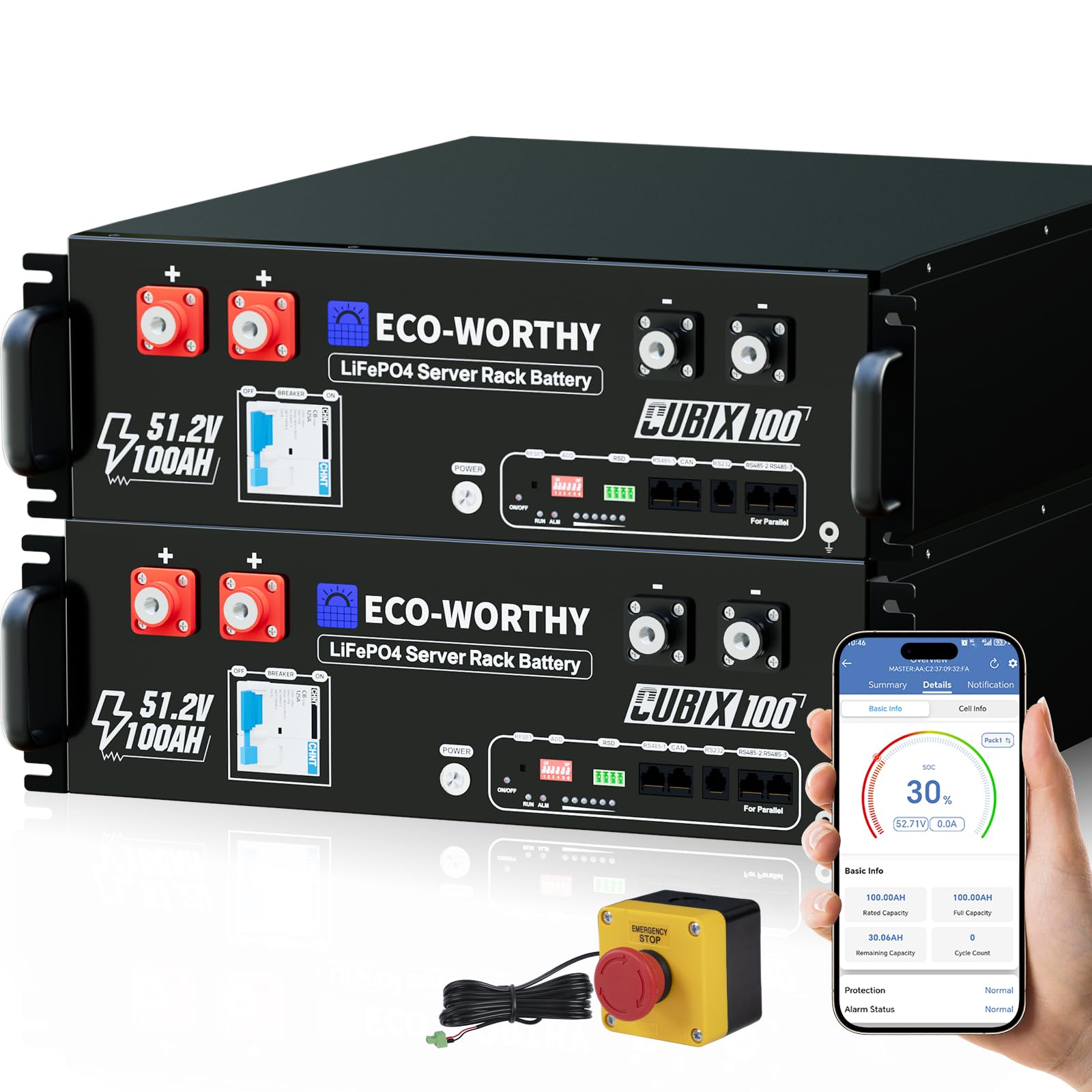
1. ECO-WORTHY Cubix100 48V 200Ah LiFePO4 Lithium Battery (2 Pack 48V 100Ah)
Two rack-ready 5.12kWh blocks that scale to a 163.8kWh bank without rewiring a thing
If you want a rack bank you can grow in stages, this is the pick. You get two 51.2V 100Ah LiFePO4 server rack batteries in one order, and each one holds 5.12kWh of usable energy. The amp-hour behind that number is what matters: an amp-hour (Ah) measures how much energy a battery stores, and at 100Ah per module you can add capacity a piece at a time rather than replacing the whole bank when your needs grow. The rack arrives with properly drilled and tapped mounting points and all the hardware, so getting a module in place is a matter of bolting it in and rolling the rack into position.
The closed-loop communication is the real story here. Each battery carries CAN and RS485 ports plus multiple communication protocols, which means it talks directly to leading integrated solar inverters instead of leaving you to guess at charge voltage. Owners who paired two of these with a Bluetti Apex 300 reported both units charging to 100% and running a near-full cycle with a close state-of-charge match, with capacity nearly tripled once both were in the loop. An off-grid setup running a Sungold 10kW inverter in a three-bedroom home has held steady with no issues over a month of daily cycling. And the expansion ceiling is serious: these parallel up to 32 units for up to 163.8kWh total, so the bank you start this weekend can grow into a whole-home system.
The metal case is what wins people over — buyers describe it again and again as a solid chassis rather than a plastic shell. Bluetooth and WiFi monitoring through the ECO-WORTHY app show state-of-charge from your phone. The honest catch is app depth: owners note the monitoring is basic, showing state-of-charge clearly but skipping time-left and time-to-charge estimates. The CAN handshake also has a rare quirk — one buyer’s first unit failed to connect with a Victron Cerbo GX, and the replacement was detected correctly, with the company covering a prepaid FedEx return in between. Treat that as a fit-check rather than a pattern, and buy through the listing so the return path is protected.
The case for the Cubix100
- Each of the two included units stores 5.12kWh at 51.2V and 100Ah, enough to bank a night of essentials on day one
- Parallels up to 32 units for 163.8kWh of total storage, so one purchase can become a whole-home system
- CAN and RS485 closed-loop ports with multiple protocols keep the inverter and battery in constant conversation
- Metal server-rack case with all hardware, parallel cables, comms cables and terminal covers in the box
Worth knowing before you buy
- The companion app is functional but basic — it reports state-of-charge without time-left or time-to-charge
- Each module is 200 pounds; a rack conversion is a two-person job with a furniture dolly
- Orders can arrive split across several packages at different times
The pick for: anyone building a 48V rack bank who wants UL9540, UL1973 and CEC listings on the label and the option to stack more modules later.
Plan around: the basic app display and the two-person lift — this is 200 pounds per unit on arrival.
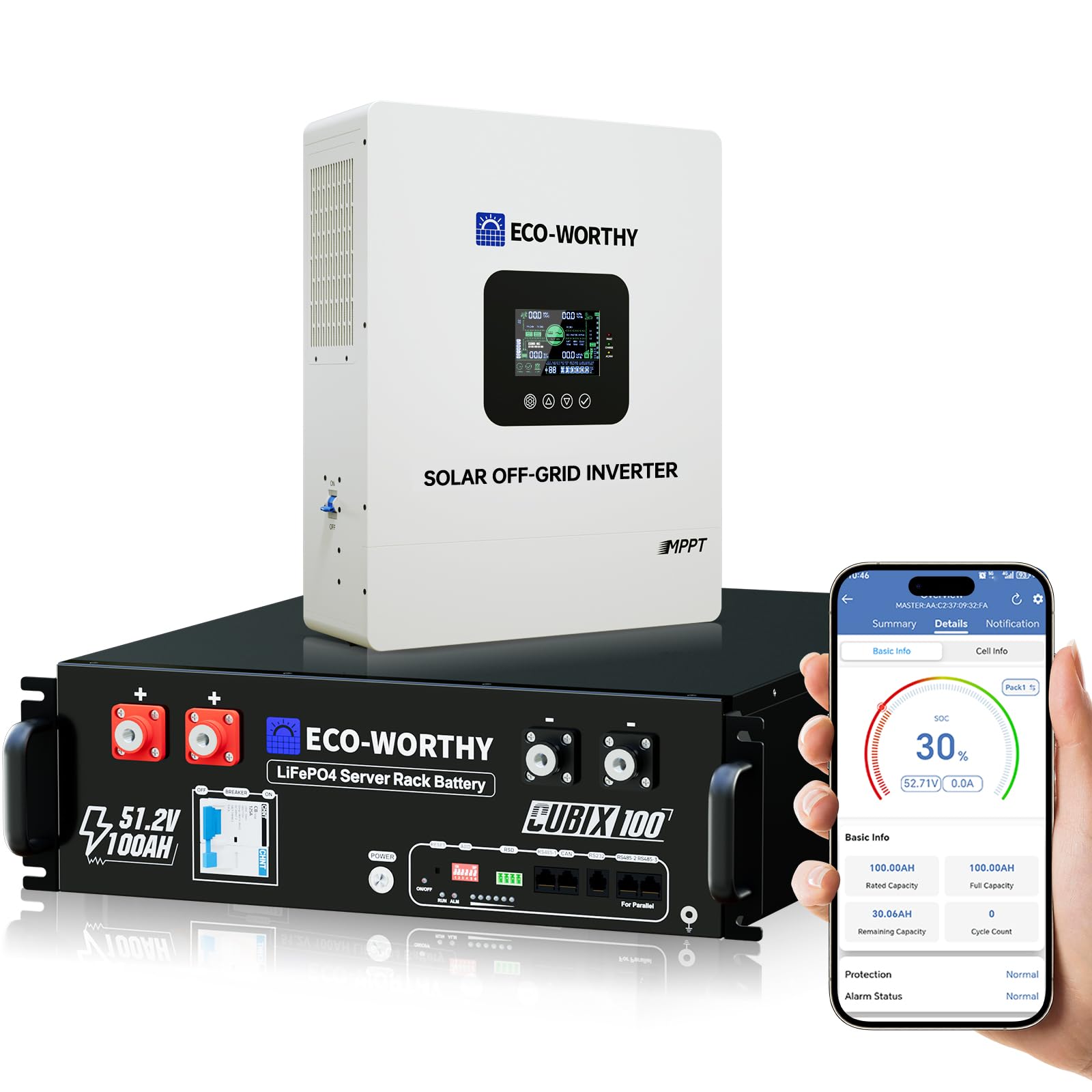
2. ECO-WORTHY 48V Home Backup Power, 5120Wh LiFePO4 Battery, AC 5000W Inverter
A matched battery-and-inverter kit for the first-time solar buyer who wants one box, not a shopping list
If you have never wired a 48V bank before, this kit removes the two decisions that trip up most beginners: which inverter to match and what charge voltage to program. It ships as one 51.2V 100Ah LiFePO4 battery plus a 5000W inverter, and together they deliver 5120Wh of capacity and 5000W of output. That inverter is a three-in-one unit — 5000W pure sine wave output (clean, appliance-safe AC power), a 100A MPPT charge controller that squeezes the maximum harvest out of your panels, and a battery charger all in one chassis. Peak output reaches 10000W for short motor-start surges, which is what lets a fridge or well pump kick on without tripping the system.
This kit quietly beats the standalone rack options on this list for grid-recharge speed. Buyers report the system charges at 25A from a 5000W generator in about 2.5 to 3 hours, and faster with a larger generator — a real advantage if you are topping up during a multi-day outage rather than waiting on the sun. One buyer sums it up: the kit is “an excellent all-in-one system for home backup or off-grid installations,” and the same owner calls the experience “very solid.” Owners with extended use describe it staying strong for a month straight without intervention. Owners with extended use describe it staying strong for a month straight without intervention.
The catch is documentation and setup support, and it is worth knowing upfront. The user manual is contradictory in places, and reaching support by email is slow — phone support is the reliable route, which matters when you are trouble-shooting a first install. Wire routing through the three knockout holes is fiddly, and the larger breakers and heavy-gauge cabling this system wants are not something to improvise. Also plan your receiving end: this order ships as separate packages, so the battery and inverter may not land on the same day.
Where it earns its spot: the built-in 100A MPPT controller and the 5000W pure sine output mean one purchase covers the battery, the solar charge path and the AC output — no matching spreadsheets required.
The honest trade-off: setup support is the weak link. Budget a phone call rather than an email thread, and read the manual knowing some of its steps contradict each other.
Reach for this if… you want a complete, UL1973 and UL1741 tested starter system and value a fast generator recharge over app polish.
Look elsewhere if… you already own a compatible inverter — the standalone Cubix100 rack modules above let you keep the gear you have.
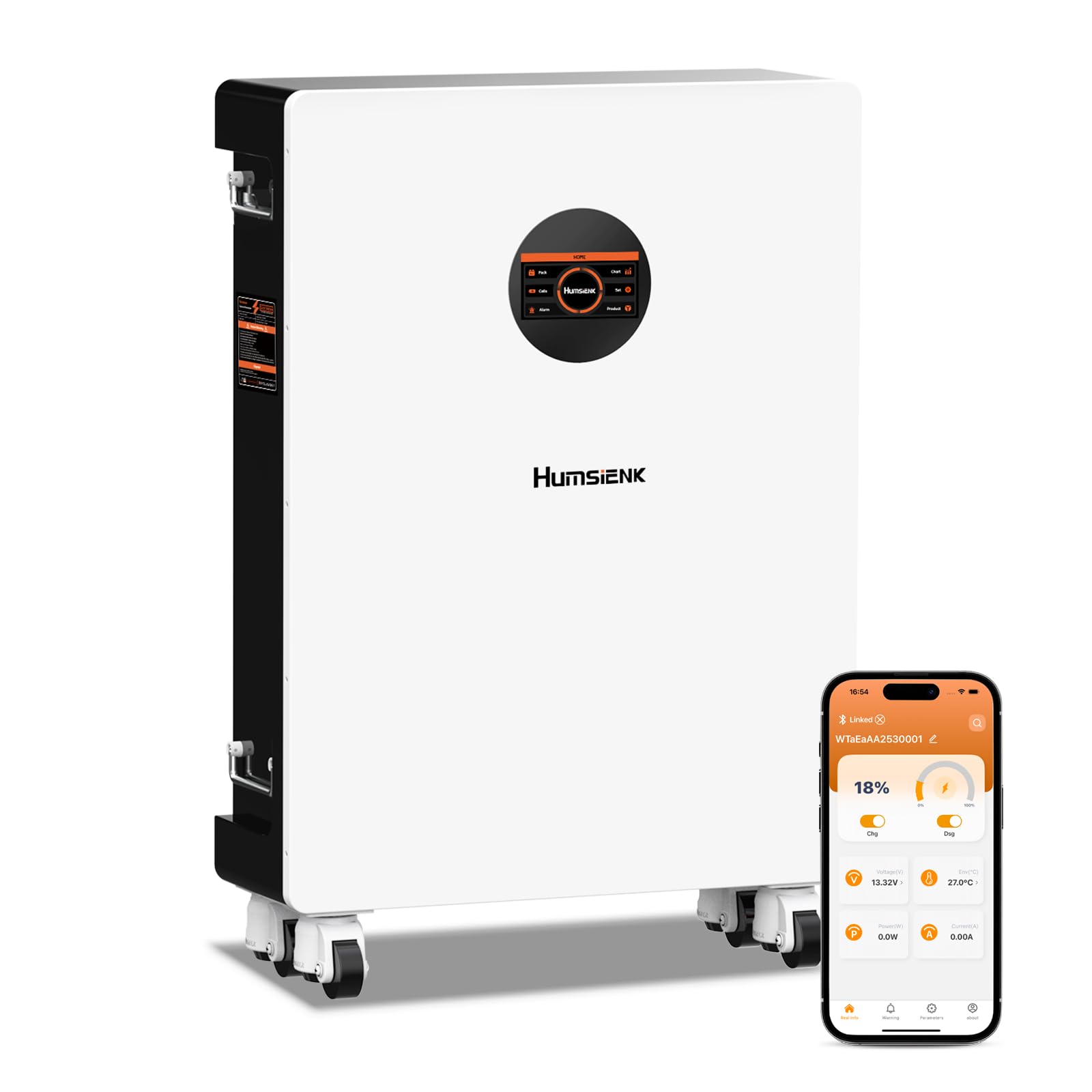
3. 48V 300Ah LiFePO4 Lithium Battery with Active Balancing & Built-in Wheels
One 15.36kWh cabinet that does the work of three batteries and still rolls into a corner
Three separate 48V 100Ah batteries in parallel take three sets of cables, three sets of terminals and three chances to miswire. This single unit does the same job in one cabinet: 15.36kWh of storage at 48V and 300Ah, with the whole thing running through one 200A BMS (the battery management board that blocks overcharge, over-discharge, over-current, over-voltage, short circuits and temperature extremes). That 200A ceiling is what lets it feed high-power inverters in the 7–10kW range and absorb instantaneous current surges like a motor start without browning out the house.
The cabinet measures a narrow 8.58 inches deep, which is roughly a third slimmer than a traditional energy-storage battery, and it rolls on built-in heavy-duty casters instead of needing a fixed wall footprint. Active balancing is the second headline feature — the BMS triggers at a 15mV cell difference, nudging every cell back into line so one weak cell does not drag the whole pack’s capacity down over the years. Charging works between 32°F and 131°F and discharging between -4°F and 140°F, covering a heated garage in winter and a hot utility room in summer alike. Owners put it through real extremes, too: one gold-camp setup in Alaska reports the battery working flawlessly, and an off-grid shed in Southwest Michigan is running well on two of them.
Buyers praise the build itself most — battery quality draws the most repeated praise in the feedback, and the metal housing with its 200A BMS sits behind that. The one reported failure mode is worth naming honestly: a defective unit can present as charging fully then dumping its charge in roughly twenty minutes even under a modest load, and the customer-service arm of the distribution chain can be slow to answer charging-issue emails. In that case the Amazon A-Z guarantee stepped in and covered a replacement. The other thing to note is documentation — the app shows state-of-charge well but leaves out cycle-count, and connecting battery-to-battery communication could use a clearer guide.
Why it wins on footprint: 15.36kWh in a 24.41 × 8.58 × 35.04-inch cabinet on casters — a full bank’s worth of storage that still leaves the floor in front of it clear.
Worth noting: CAN, RS485 and RS232 ports cover the major inverter brands including Victron, Growatt and SRNE, and the system expands up to 15 units for 230.4kWh if you ever outgrow one.
A clean fit for: anyone short on floor or wall space who wants a whole bank in a single rolling cabinet with a 200A BMS.
Think twice if… you want fast, chatty customer service on a first-time install — the distribution support side is the soft spot, and the Amazon return window is your safety net.
4. ECO-WORTHY Powermega 48V 314Ah LiFePO4 Battery, 16.1kWh Energy Storage
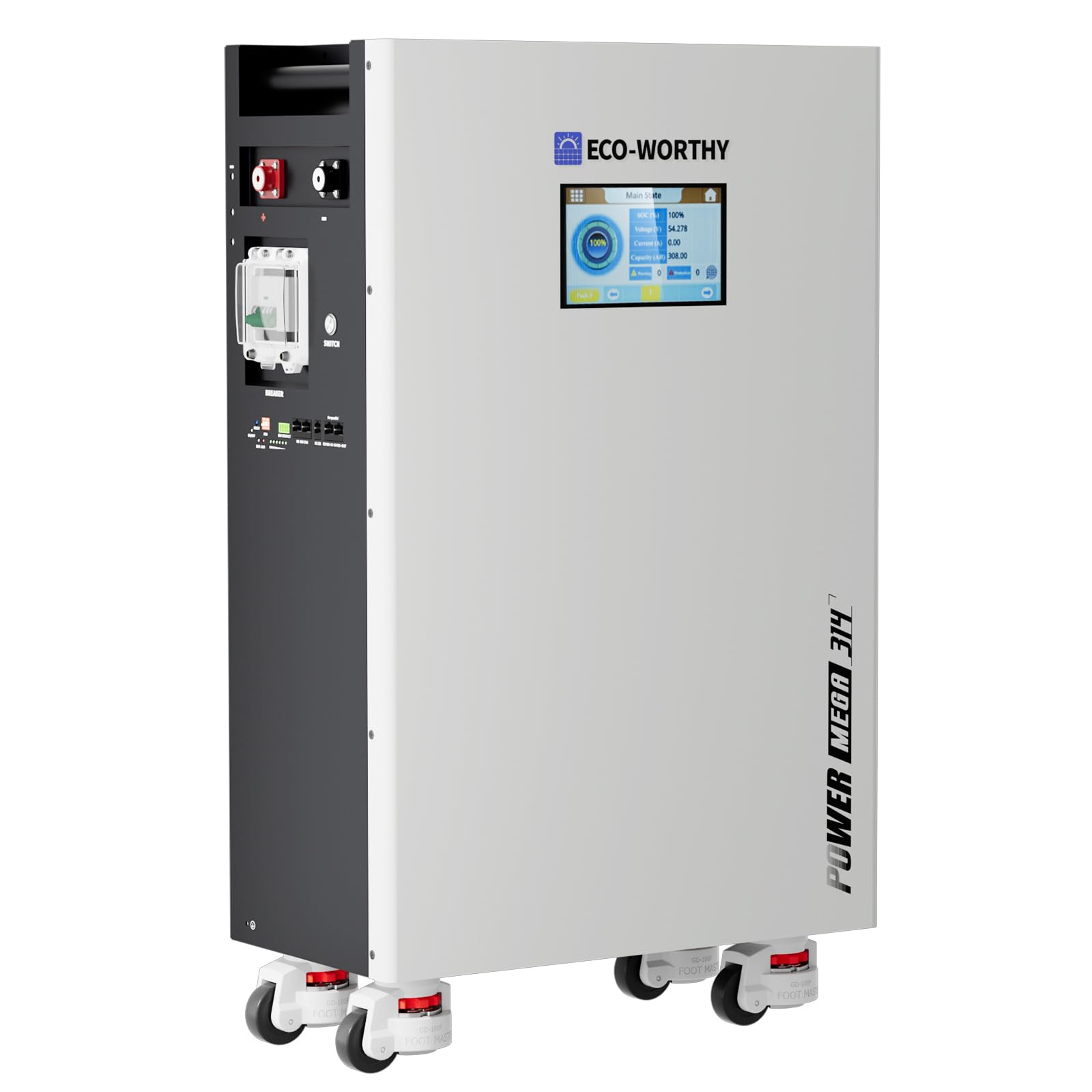
For most homeowners, the batteries for home solar winner is the ECO-WORTHY Cubix100 48V 200Ah 2 Pack — the highest-rated pick on this list with a strong review bank behind it, from the UL9540 and UL1973 listings on the label to the 32-unit, 163.8kWh expansion ceiling that lets the bank grow with your house. If you want one big cabinet with a 7-inch touchscreen and an aerosol fire-suppression module built in, grab the ECO-WORTHY Powermega 48V 314Ah. And for a whole-home 240V backup with the matched 10kW inverter already wired to the battery, the ECO-WORTHY Powermega 48V 314Ah with Liber 10KP is the one to reach for. We do not accept paid placement. Every pick is matched to a real buyer and a real use-case; we do not hands-on test units. Specifications: manufacturer listings and product documentation. Review insights: verified customer reviews, as of September 2026. Pricing: not shown on this page (it changes often); check the current price via the retailer link. As an Amazon Associate, KitchPrep earns from qualifying purchases. This does not affect which products we feature.
FAQ
What size battery do I need to run my house overnight?
Can I add more batteries later without replacing what I own?
Do these batteries need CAN or RS485 to talk to my inverter?
Is a 200A BMS really better than 100A for home use?
How long will a LiFePO4 home battery actually last?
What does UL9540 or UL1973 certification mean for my install?
Can these batteries run a 240V appliance like a dryer or central air?
Will these come delivered all at once or in pieces?
Where should I not install a home battery or inverter?
Is a battery-and-inverter kit better than buying each part separately?
Final Thoughts: The Verdict
How We Picked
Sources & Methodology
Related Guides
