
Specs are compiled from manufacturer listings and verified buyer reviews and can change over time — please confirm the key details on the product page before buying.
Fiberglass batt is the workhorse of home comfort — it slows heat from sneaking out in winter and creeping in during summer. But batt thickness, facing, and R-value decide whether a roll actually tames your attic or just lies there looking busy. This guide sorts the highest-rated batts by the job they genuinely fit — RV walls, HVAC ducts, and deep attic cavities — so you buy the right thickness the first time.
I’m Mohammad Maruf — the founder and writer behind KitchPrep. This guide is built by comparing the manufacturers’ published specifications and the patterns across verified customer reviews, so you get each pick’s real strengths and trade-offs instead of marketing spin.
Stop guessing between paper-faced rolls and rigid boards, and find the right batt fiberglass insulation for your exact cavity depth and temperature problem.
Our Picks at a Glance

How To Choose The Best Batt Fiberglass Insulation
Batt insulation is sold as soft rolls or rigid boards, and the one you need depends entirely on where the heat is leaking. Measure your stud or joist cavity depth first — that single number tells you the maximum R-value you can physically fit.
Match R-Value To Your Cavity Depth
R-value measures how well a material resists heat flow — higher numbers mean better insulation. A 12-inch-thick batt rated R-38 belongs in a deep attic floor, while a 2-1/4-inch roll rated R-7 suits the thinner walls of an RV. Stuffing a thick batt into a shallow cavity compresses it, which actually lowers its real-world performance.
Unfaced Or Kraft-Faced: Know Your Moisture Plan
Unfaced batts have no paper backing, so they let moisture pass through — they need at least 2 inches of vented air space to stay dry. Kraft-faced batts include a vapor barrier that blocks moisture, which suits exterior walls that already have their own ventilation strategy. Some batts, like the unfaced picks below, work for interior walls and attic floors but cannot be used for exterior walls.
Quick Comparison
| Model | Best For | Thickness | R-Value | Dimensions | Amazon |
|---|---|---|---|---|---|
| RecPro RV Fiberglass Insulation★ Best Overall | RV Walls | 2.25 inches | R-7 | 792″L x 15″W (Roll) | Amazon |
| F&L R6 Fiberglass Board | Soundproofing & HVAC | 1.5 inches | R-6 | 24″x48″ (Panel) | Amazon |
| Owens Corning R-38 Batt | Attic Floors | 12 inches | R-38 | 48″L x 24″W (Batt) | Amazon |
In‑Depth Reviews
1. RecPro RV Fiberglass Insulation (1-Pack)
A clean, thick roll that fits RV wall cavities and stays easy to handle during install.
RV walls are thinner than house walls, so this roll matches them properly. It’s 2-1/4 inches thick at an R-7 rating with a 15-inch width that fits standard RV framing bays. The roll stretches a full 792 inches long and covers 83.75 square feet, making it a single-purchase fix for a recreational vehicle’s temperature control.
Buyers consistently describe it as “clean and thick” and “easy to work with,” which matters when you’re contorting into tight camper cavities. One Spanish-language review sums up the value sentiment — translated, it says the product “performs well for its purpose, which is insulation” and that the buyer bought 2 without regret. A note for budget planners: it’s unfaced material, so you’ll want to ensure your RV wall assembly handles vapor control separately.
The trade-off is scope. This is a mild-climate insulation — the specifications position it for RVs “set for temperatures in the milder range,” not for extreme four-season boondocking. If your rig only needs to take the edge off summer heat and winter chill, the R-7 rating does that job cleanly.
Easy Installer: Buyers consistently praise its clean fibers and full thickness, noting it presses into place without fighting back.
Scope Check: Treat this as a comfort upgrade for milder climates rather than a deep-freeze armor; the R-7 rating and 2-1/4-inch thickness tell that story clearly.
Reach for it if: You own an RV that runs in mild temperatures and you want a full 83.75 square feet of unfaced, cuttable roll insulation in one box.
Think twice if: You need serious cold-weather protection — this one is thinner than the 12-inch attic batt above by a wide margin.
2. Owens Corning 512 SQFT R-38 Unfaced 24″ x 48″ Batt
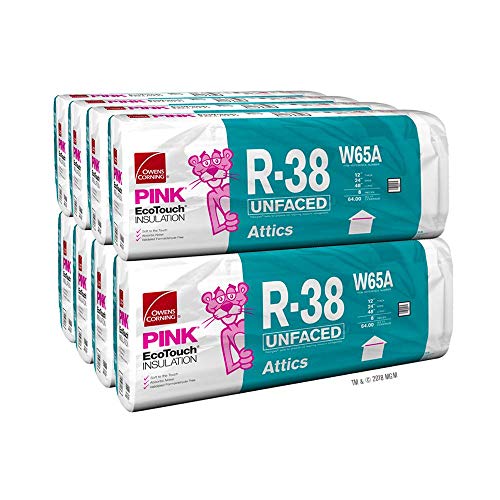
A 12-inch-thick batt that fills deep attic joists to block summer heat at the roofline.
If your attic floor has 2×12 joists, this batt is built to fill them completely. Each piece is a full 12 inches thick with an R-38 rating — the highest heat resistance here — and the unfaced design means you pair it with your own vented air space to keep moisture out. At 24 inches wide and 48 inches long, these batts drop cleanly between standard trusses without trimming.
The bulk listing is the real story for a whole-home job. You get 8 bags holding 8 batts each, for a total of 512 square feet of coverage — enough to span a generously sized attic. Buyers report the 4-foot batts are “easy to handle” and “made a huge difference in keeping our house cooler this summer!” Keep in mind this is strictly unfaced material with no paper backing — it works for interior walls, floors, ceilings, and vented attics, but not for exterior walls.
Delivery needs coordination. The seller requires a non-encrypted phone number within 24 hours of purchase, and the shipping itself was praised as courteous and weather-aware when conditions got rough. For the sheer scale of coverage per order, this is the batt stack that finishes an attic project in one delivery.
Why It Wins The Attic Job
- 12-inch depth delivers the category-leading R-38 rating
- 512 SQFT total spread across 8 bags of 8 batts
- Unfaced — works in floors, ceilings, and vented attics
Before You Commit
- Requires 2 inches of vented air space to prevent moisture
- Not for exterior walls — keep it to interior cavities
- Delivery needs a coordinated phone call with the seller
The attic answer: This is the pick for homeowners with deep 2×12 joists who want a single order covering 512 square feet — the crowd favorite at 4.9 stars with nearly 20 owner ratings.
Look elsewhere if: Your attic joists are shallower than 12 inches, since compressing this batt to fit would waste its R-38 potential.
3. F&L R6 Fiberglass Board Acoustic Insulation Panels

A rigid board that quiets ducts and cuts cleanly to size for precise fits.
Unlike the soft rolls above, this is a rigid board engineered to hold its shape — and that changes what you can do with it. Each panel is 1.5 inches thick with an R-6 rating, and the firm edges are designed for clean cuts and precise fits. That stiffness makes it ideal for wall cavities, studio acoustic treatment, and HVAC duct lining where a floppy batt would sag or bunch.
The soundproofing angle is the differentiator. Its dense core absorbs mid- to high-frequency sounds, cutting echo and reverb in studios and commercial acoustic barriers. Owners mention it “cut cleanly” on arrival and proved perfect for a small repair — one owner used it in a central air intake to stop condensation where warm house air met cold attic air, a recurring winter problem.
Just size your expectations for a single project. Each panel covers 576 square inches, and the measurements show the gap: at 48 inches long and 1.5 inches wide per the listing, this is a focused, piece-by-piece solution rather than a whole-attic order. For a duct wrap or a single wall cavity, that precision is exactly what you want.
Built For Precision Work
- Rigid core with firm edges cuts cleanly without crumbling
- Absorbs mid- to high-frequency sound — ideal for studios and ducts
- Multi-layer thermal protection for walls, ceilings, and HVAC
Know The Coverage Limits
- Covers only 576 square inches per panel — buy multiples for a room
- One buyer wished for fuller box packing to prevent compression
- R-6 rating is modest next to the R-38 attic batt above
Best for repairs and acoustics: Choose this rigid panel when you need clean cuts around a duct, vent, or small wall cavity — its stiffness beats any roll for that job.
Not your pick if: You’re insulating a whole attic; at 576 square inches per panel, you’d need dozens where the Owens Corning order covers 512 square feet in one delivery.
Understanding the Specs
R-Value And Thickness
R-value is the number that tells you how strongly a batt resists heat flow — higher means better insulation. Thickness is the physical depth of the batt, and the two are linked: the R-38 batt above is 12 inches thick, while the R-7 RV roll is just 2.25 inches. You must match thickness to your cavity depth, because a batt that’s too thick for its space gets compressed and loses performance.
Unfaced Vs Kraft-Faced
A facing is the paper or foil layer on one side of a batt that acts as a vapor barrier. Unfaced batts like the Owens Corning and RecPro picks have no paper, so they must sit in spaces with 2 inches of vented air to stay dry. The rigid F&L board’s sealed fiberglass core takes a different route, suiting it for duct lining where airflow does the moisture work.
FAQ
What does R-38 mean in batt insulation?
Can I use unfaced batt insulation on exterior walls?
How much vented air space does unfaced insulation need?
What is the difference between batt and rigid fiberglass board?
Can fiberglass batt insulation help with soundproofing?
How many square feet does each product cover?
Will the RecPro RV insulation fit my camper walls?
Is the R-38 batt delivery complicated to arrange?
What is the R-6 F&L panel best used for?
Which batt should I choose for a small repair job?
Final Thoughts: The Verdict
If you want one dependable pick, the batt fiberglass insulation winner is the Owens Corning R-38 Batt because its 12-inch depth and 512-square-foot bulk order solve a whole attic in a single delivery — and owners rate it the clear crowd favorite. If you need clean cuts for a duct or studio wall, grab the F&L R6 Rigid Board instead. And for RV walls in mild climates, the RecPro RV Roll is the one to reach for, with its easy-handling 15-inch width and unanimous praise for how cleanly it works.
How We Picked
We do not accept paid placement. Every pick is matched to a real buyer and a real use-case; we do not hands-on test units.
Sources & Methodology
Specifications: manufacturer listings and product documentation. Review insights: verified customer reviews, as of September 2026. Pricing: not shown on this page (it changes often); check the current price via the retailer link.
As an Amazon Associate, KitchPrep earns from qualifying purchases. This does not affect which products we feature.
Related Guides
