
Specs are compiled from manufacturer listings and verified buyer reviews and can change over time — please confirm the key details on the product page before buying.
If your bathroom counter is a tangle of phone cables and a bulky charging brick is hogging the only free socket, the fix is a bathroom vanity outlet that combines built-in shock protection with USB charging ports. That single swap gets you a safe, code-friendly receptacle and frees you from hunting for an adapter every morning.
I’m Mohammad Maruf — the founder and writer behind KitchPrep. This guide is built by comparing the manufacturers’ published specifications and the patterns across verified customer reviews, so you get each pick’s real strengths and trade-offs instead of marketing spin.
You will see which units are genuinely simple to wire in, which need a deeper electrical box behind the wall, and which countertop models hide away when you are done. Every pick below is a real bathroom vanity outlet option worth considering.
Our Picks at a Glance

How To Choose The Best Bathroom Vanity Outlet
A vanity outlet has one job that matters more than anything else: it has to fit the electrical box already in your wall. Model names that look identical on a shelf can be wildly different once you are standing at the sink with a screwdriver.
Check your box depth before you buy anything
A GFCI receptacle carries more internal parts than a plain outlet, so most of these units are physically deeper than what came out of your wall. If your existing metal or plastic box already holds several wire connections, a deep-body model can leave almost no room to fold the wires back in. Measure the depth and count how many cables run into the box — that single check rules out half the wrong picks before you order.
Decide if you need USB, and how much
A unit with USB Type-A and USB Type-C ports (the oval newer connector and the older rectangular one) lets you charge a phone, a tablet, or a smartwatch straight from the wall. Models with a single AC receptacle and two USB ports cut clutter, but you give up the second plug. If you regularly run a hair dryer plus a curling iron, you want two full AC outlets instead.
Trickier spots call for the pop-up style
When your vanity has no wall space for a receptacle — like a stone or quartz top with a mirror sitting flush to the surface — a pop-up countertop outlet drops into a drilled hole and rises when you tap it. You trade wall space for counter space, but you need clearance underneath for the unit to sink into.
Quick Comparison
| Model | Best For | Amperage | USB Ports | Mount Type | Amazon |
|---|---|---|---|---|---|
| Legrand Radiant 15A GFCI with USB★ Best Overall | Bathroom charging plus two AC plugs | 15 A | 2 USB-A | Wall receptacle | Amazon |
| in-Drawer Outlet KitHidden Power Pick | Hidden power inside a drawer or cabinet | 15 A | 2 USB-A | Drawer / cabinet | Amazon |
| TG GFCI Outlet 15 Amp 2-PackTwo-Pack Value | Value two-pack for a full remodel | 15 A | None | Wall receptacle | Amazon |
| LIDER GFCI Outlet 15A 2-Pack | Decorative finish on a budget | 15 A | None | Wall receptacle | Amazon |
| ELEGRP GFCI with USB A/C | Tight boxes and compact installs | 15 A | 1 USB-A 1 USB-C | Wall receptacle | Amazon |
| Greencycle 20A GFCI with USB | Higher-amperage bathroom circuits | 20 A | 1 USB-A 1 USB-C | Wall receptacle | Amazon |
| Leviton GUAC2-W GFCI with USB | 20A charging on an established brand | 20 A | 2 USB (A/C) | Wall receptacle | Amazon |
| ANNQUAN Pop Up Countertop Outlet | Countertop power with no wall socket | 12 A | 2 USB-C + 2 USB-A | Countertop pop-up | Amazon |
| Jgstkcity Pop Up Countertop Outlet | Kitchen islands and conference tables | 15 A | 2 USB-C + 2 USB-A | Countertop pop-up | Amazon |
In‑Depth Reviews
1. Legrand Radiant 15 Amp Tamper Resistant GFCI Outlet USB Type A White 1 Pack
Our pick — over 4.5★ from 600+ verified ratings; the strongest balance of quality and price.
Two AC outlets and two USB-A ports on one plate, so four devices charge without a wall brick.
Most people shopping for a sink-side receptacle want exactly this combination: a safe, code-required GFCI and a place to charge a phone without a wall brick. This Legrand gives you two USB-A ports that work with USB 2.0 and 3.0 devices and share 3.1A of total charging current, so a phone and a tablet can both top up overnight. The four connection points — two AC, two USB — are the reason it wins people over, and buyers put it plainly: “It’s nice to have four ports in the bathroom.”
What owners notice first is how solid it feels. The body is made of high-impact resistant thermoplastic (a tough plastic that resists cracking) with long-term blade retention (the metal contacts inside hold their grip), so plugs stay held firmly instead of loosening over months of daily use. Installation is a standard swap — replace any ordinary outlet with a screwdriver, using the back and side wire terminals that accept #10 to #14 AWG copper wire (the wire sizes found in typical home circuits).
Here is the catch, and it is the one real thing to plan around: this unit is deep. Several buyers flagged that it needs ample room in the electrical box, and one advised checking box depth before ordering because extra-deep boxes may be required when many wires are present. In new construction with roomy boxes it drops in cleanly; in a crowded old box you may be fighting the wires to get the plate flush.
Why this earns the top slot
- Two AC outlets plus two USB-A ports, so four devices share one plate
- 3.1A total shared USB output charges a phone and a tablet together
- High-impact resistant thermoplastic with long-term blade retention
- Back and side wire terminals accept #10 to #14 AWG copper wire
- Measured at 4.19″ long by 2.15″ wide, a clean fit against standard trim
The honest trade-offs
- Deeper body than a plain receptacle — verify box depth first
- Buyers frequently flag the cost as the weak point
- Some owners find the USB-A openings very tight at first
Worth installing if: you want your phone charger and both AC plugs living behind one clean wall plate.
Measure first if: your existing box is shallow or already stuffed with wire splices.
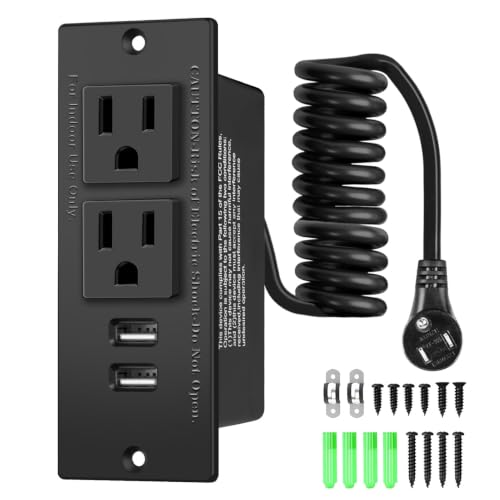
2. in-Drawer Outlet Kit: Two AC 15Amp Outlets & USB Ports, ETL Listed
Two 15A AC outlets and two USB-A ports mounted inside a drawer, with a retractable chain that adjusts to drawer depth.
If your countertop clutter is the real problem, moving power inside the drawer solves it at the source. This kit packs two 15 Amp AC outlets and two USB-A ports behind a drawer panel, with a retractable chain that adjusts to your drawer depth. The install spec that makes it practical is modest: as buyers report, “With simple installation steps, our product requires just a 2-inch space behind the drawer box.”
What sells it is the range of places it disappears into. The maker lists it for bathroom, bedroom, kitchen, office, dressing table, entryway table and bedside table drawers — anywhere you want keys, a watch and a phone tucked away while they charge. The body is built from ABS and polycarbonate plastic and the kit is ETL certified, a third-party safety listing that matters for anything wired into a home.
The honest limit is that it is not a wall replacement. That 2-inch clearance behind the drawer box is a hard requirement, and the unit is designed around the drawer rather than the wall — you are adding a station, not swapping the receptacle by your mirror. It is also the lighter-duty pick here at 0.39 kg total, so treat it as a convenience upgrade rather than your primary vanity power.
The drawer that pays off: bathroom, entryway and kitchen drawers all qualify, and owners use it anywhere a counter needs to stay clear.
Reach for this if: your phone and watch charging already happens on a cluttered counter and you want it gone.
Look elsewhere if: you actually need to replace the GFCI receptacle on the wall.
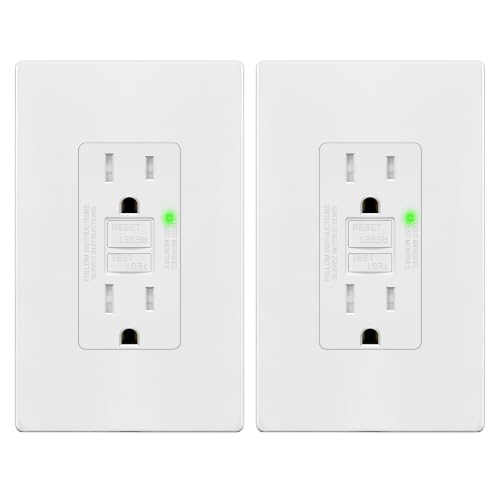
3. TG GFCI Outlet 15 Amp, Electrical Tamper-Resistant Receptacle, Self-Test
Two 15A GFCI receptacles with screwless wall plates in one box, for replacing every bathroom outlet at once.
When you are changing every outlet in a bathroom renovation, buying them in pairs is the difference between one trip and three. This TG package includes two units plus matching wall plates, and the faceplate is screwless, so there are no visible screws interrupting the finish. It is rated at 15A, 125V, 60Hz with a feed-through rating of 20A, which is the number that tells you how much downstream load the unit can carry.
Safety here comes in layers, not just one feature. The electronics cut power within milliseconds of detecting a fault (a fraction of a second), there is a built-in self-test, and an LED indicator tells you what is happening in plain language — solid green means correct wiring, blinking red flags an open neutral (a loose or missing neutral wire), and solid or blinking red means the unit tripped and needs resetting. An anti-interference design is built to stop nuisance tripping from motors, washers and exhaust fans — the classic weak point for a bathroom receptacle near a fan.
One thing to accept before you buy: this is a plain GFCI (a ground-fault circuit interrupter that cuts power when it senses a leak) with no USB ports, so it is the pick for safety coverage rather than charging convenience. Functionality and quality are what win people over here, and the honest note is that value gets mixed reactions — most buyers are satisfied, though a few feel it lands at the higher end for what is a bare receptacle. Pair it with one of the USB models above if charging is the goal.
What you are really buying: two ETL-listed units, two screwless plates, and clamp-type back terminals that speed up wiring compared to traditional screw-only connections.
Compared with the single-pair framing of some competitors, the two-pack makes more sense for a full refresh — and the anti-interference design is a genuine differentiator in a room with a vent fan.
Best matched to: a homeowner replacing every bathroom outlet at once and wanting safety coverage over charging ports.
Skip this one if: you need USB charging built into the receptacle itself.
4. LIDER GFCI Outlet 15Amp, GFCI Receptacle, ETL Listed, Matte White, 2-Pack
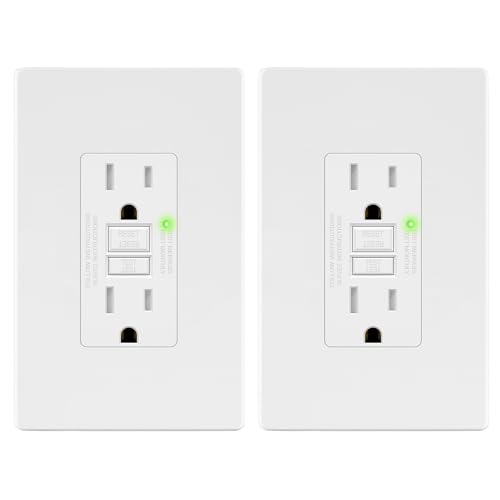
A brushed gold finish that matches cabinet hardware and hides the screws behind a screwless plate.
Some people replace outlets purely because the old white plastic looks tired against a new vanity, and for them the appearance is the whole point. This LIDER two-pack comes in a brushed gold tone that buyers match to cabinets and hardware, with one owner describing it as making the space “look custom and high end.” The matte finish and screwless wall plate keep the look uninterrupted, and the units carry the same ETL listing (a safety certification), 15A, 125V, 60Hz rating and 20A feed-through rating as their plainer siblings.
The functional side is identical in shape to most self-test units: fast-response ground fault protection, reset and test buttons, self-testing, and an LED readout that confirms wiring or flags a fault. Tamper-resistant shutters meet 2017 NEC Article 406.12, the code clause covering the sliding shutters that block a foreign object from a socket — worth having if small hands are ever near the sink.
Be aware of two things from the owner experience. First, the gold tone is a design choice, and some find it reads a touch cooler than expected against their other hardware. Second, reliability draws mixed feedback — plenty report it works well from the start, while a small number report failures after months of service; if you want the finish, buy it for the finish, and know the safer bet is a brand with more service history behind it. This is the pick for the aesthetics-first buyer, not the spec-maximizer.
What the finish buys you
- Brushed gold tone matched to cabinets and fixtures
- An appearance that makes a half bath read as a custom build
- Screwless wall plate with no visible hardware
- Tamper-resistant shutters per 2017 NEC Article 406.12
What to weigh honestly
- Reliability is a mixed report — some units last, some do not
- No USB ports, so charging still needs a separate adapter
- Color tone varies against other brushed hardware in the room
Buy it for: the visual match with your vanity hardware, when style outranks raw spec talk.
Think twice if: you want the most predictable long-term service life above all else.
5. ELEGRP GFCI Outlet with USB Ports, 15 Amp Self-Test GFCI Combination with USB Ports, 24W Max Total Output

A single AC outlet plus USB-A and USB-C sharing 24W, built to fit standard boxes without a deeper cavity.
Where the deeper GFCI models above can leave you wrestling wires into a crowded box, this ELEGRP is built around the opposite problem. It is specifically structured to fit standard electrical boxes without needing a deeper box, and its single AC outlet plus USB-A and USB-C ports share a total output of 24W. The idea is fewer simultaneous connections and less clutter, and owners charge phones and even install it inside custom bathroom medicine cabinets.
The safety hardware is thorough for the size. It self-tests every 5 seconds, uses a patented dual-coil arrangement, and includes a reset-disable system — the outlet cannot be reset once it reaches the end of its service life, which forces a replacement rather than letting a dead GFCI masquerade as protection. It is tested to exceed UL requirements with over 6,000 endurance cycles, double the UL standard of 3,000, a real durability figure rather than a slogan. A smart chip also manages the USB ports against overvoltage, overload, overheating and short circuits.
The trade-offs are specific. This unit uses a single AC outlet rather than a duplex, and one buyer notes the terminal screws cannot back out far enough for a hooking method — you must use the clamp-style connections instead. The unit is also larger than a standard GFCI, so fitting it into a tight box takes patience. And it is not weather resistant, so it belongs near the vanity rather than directly beside a shower or tub.
what separates it: that 5-second self-test and the 6,000-cycle rating — a genuine figure that beats the standard 3,000 cycles UL asks for.
Pick this for: small standard boxes where a full-size GFCI simply will not seat, plus modern USB-C devices.
Pass if: you want two full AC outlets side by side at the sink.
6. Greencycle 20 Amp GFCI Outlet with USB C & USB A Ports, 2PK Self Test GFCI Electrical Outlet Combination
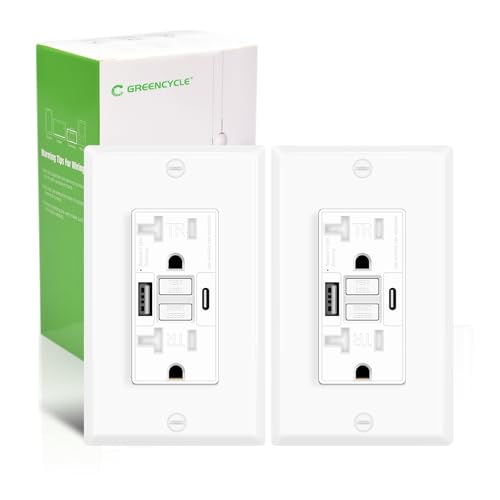
Two 20A GFCI units, each with a USB-A and a USB-C port rated 5V/4.8A max.
This is the higher-amperage option for anyone whose bathroom circuit is wired for it. The units are rated 20A at 125V and trip on a true ground fault within 20 milliseconds — that is 0.02 seconds, the fastest response figure quoted in this whole roundup. The USB side covers both connector generations with a Type-A and a Type-C port, each with a maximum output of 5V/4.8A, so phones, tablets, smartwatches, and even an air conditioner-sized load on the AC side are all handled by one box.
The monitoring is where Greencycle leans in. The outlet auto-checks itself every 2 minutes, and the indicator light reports status in four states — green for normal operation, flashing red during self-test, solid red when tripped, and off when there is a fault. Safety shutters are child-proofed for homes with little ones, the kit carries ETL certification, and the 2-pack includes wall plates, screws and a manual, with a 5-year service commitment behind it.
Two honest caveats. The snap-on cover can be fiddly to attach and one buyer spent real time fitting it; more importantly, the outlet needs to be installed in electrical boxes at least 2 inches deep, so check that before ordering. And heed the maker’s own warning — do not back the terminal screws out too far and never loosen them with power tools.
Where the 20A rating earns its keep
- 20A/125V rating for higher-capacity circuits
- Trips within 20 milliseconds — 0.02 seconds on a real fault
- USB-A and USB-C each rated 5V/4.8A max output
- Self-test every 2 minutes with four-state LED feedback
- Child-proof shutters in a kid-friendly home layout
What to plan around
- Needs a box at least 2 inches deep
- Snap-on cover takes patience to seat correctly
- Over-tightening or power tools on the terminal screws will damage it
The right call if: your circuit handles 20 amps and the bathroom serves multiple high-draw gadgets.
Not for you if: your existing box is shallower than the required depth.
7. Leviton GFCI Outlet with USB-A/C, Tamper-Resistant, 20 Amp, GUAC2-W, White

A 20A GFCI with two USB ports totaling 4.8A — the most charging power in this roundup.
If you already trust the brand that was probably in your wall to begin with, this is the natural swap. The GUAC2-W pairs a 20A GFCI receptacle with two USB charging ports totaling 4.8A, and the maker claims that figure delivers more than twice the charging power of other GFCI USB outlets. It carries the same continuous ground-fault protection, automatic self-testing, and status indicator light as the rest of the lineup, and at 7.04 ounces its metal and plastic build feels solid in the hand.
The standout advantage over the USB-C models above is charging speed for newer devices: the smart chip pushes power aggressively to the port so phones and tablets top up faster rather than trickling. Owners who charge a phone while getting dressed find it a genuine daily time-saver — the review pages call it “a time-saver” — and the two ports mean you are never waiting for a shared cable.
The catch is depth. This outlet requires an extra-deep wall box for installation, and the wall plate sells separately — so you will need to buy a plate if you do not have one from a prior Legrand job. That box requirement is the same hurdle the top pick faces, and it is the one thing to verify before you commit.
The charging edge: 4.8A of total USB power on a 20A outlet is the most charging capacity here, and the maker claims it more than doubles competing GFCI USB outlets — though that claim comes from the spec sheet, not from independent testing.
Choose this when: you want maximum charging speed and a familiar brand name.
Check first: the extra-deep box requirement and the fact that you must buy a wall plate separately.
8. ANNQUAN 3.15″ Pop Up Countertop Outlet Wireless Charger 20W USB 800J White
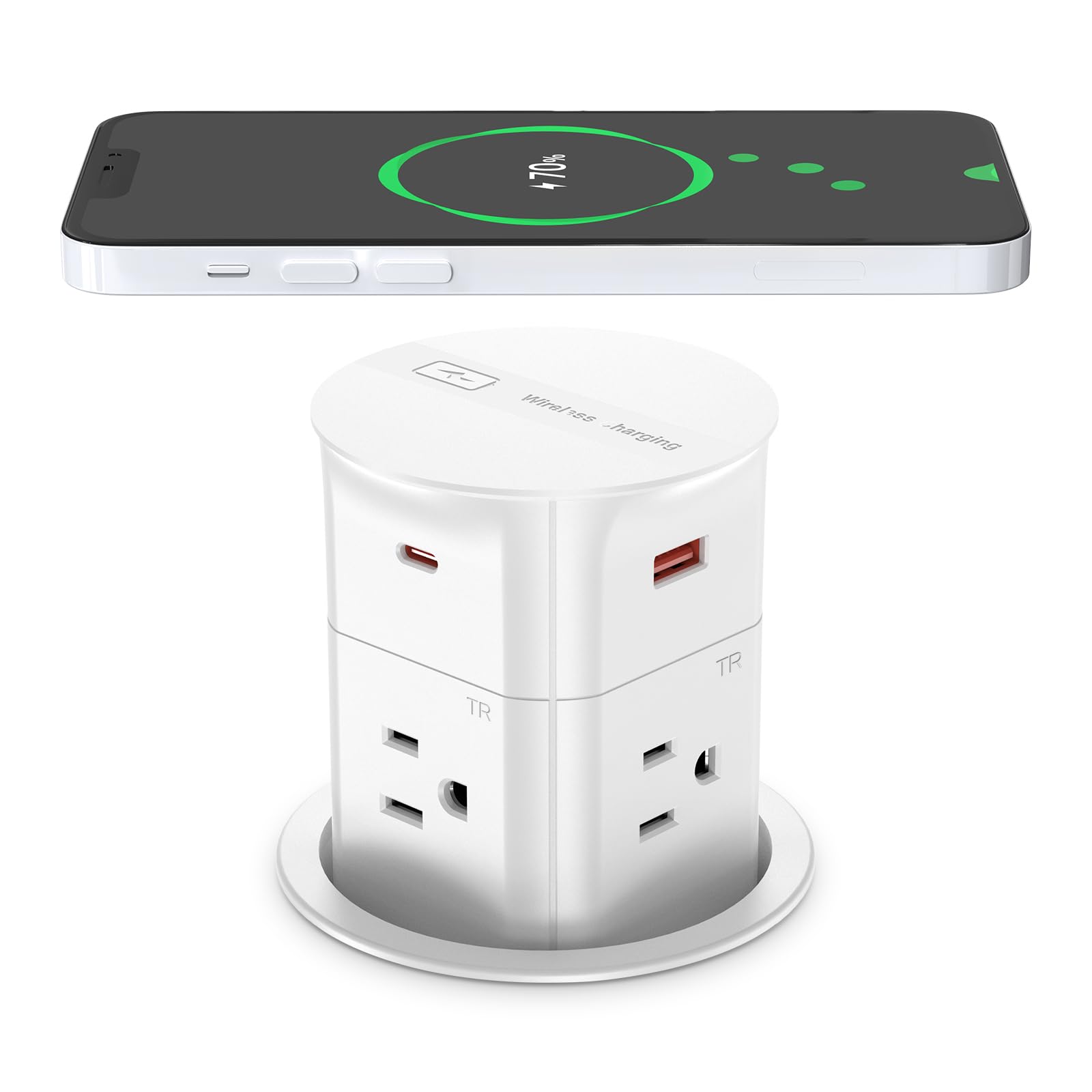
Drops into a 3.15-inch drilled hole and rises on a tap, with 4 AC outlets, 2 USB-C, 2 USB-A and a 15W wireless pad.
When there is no reachable wall receptacle behind the mirror, this pops up out of the counter itself. It fits a 3.15-inch drilled hole and holds 9 devices in total — 1 wireless charging pad, 4 AC outlets, 2 USB-C ports and 2 USB-A ports. The AC side runs 800J/125V/12A/1500W, the USB-C port peaks at 20W and the USB-A at 18W, and the 6-foot 16AWG cord gives you some reach to the supply. The 15W wireless panel on top charges a phone or earbuds even when the unit is closed flat.
Owners value the trick more than they expect to — the pop-up sinks to 10 inches beneath the counter when you are done, so the surface goes back to a clean line and the unit locks solid whether it is up or down. The surge protection is rated at 800 joules (a measure of how much energy spike it can absorb), a real figure for spike absorption, and it is a practical answer for a solid-surface vanity or kitchen island where you cannot cut a standard wall box.
Two things to know before you drill. The maker asks you to pop it up and down more than 5 times to activate the spring mechanism, and to press with 3 or more fingers in the middle of the panel so the spring engages fully. Second, the unit needs clearance underneath — one owner needed an existing outlet below for space, and another noted that adding a second unit would mean modifying a drawer. Install it once, in the right spot.
Why countertop owners like it
- Charges up to 9 devices from one unit
- 15W wireless pad works even when the panel is down flat
- 800J surge protection with a 6FT 16AWG cord
- Sinks 10 inches below the counter when hidden
- Fits a standard 3.15-inch (80mm) drilled hole
Where it asks more of you
- Needs clearance beneath the counter for the cable
- Spring mechanism must be activated before first use
- Requires a drilled hole — no undoing it once cut
Reach for this if: you have a solid countertop with no wall socket behind it and want charging that disappears when idle.
Steer clear if: you cannot drill into the surface or fit a cable underneath it.
9. Jgstkcity Pop Up Countertop Outlet with 15W Wireless Charger, 20W USB C Ports, Flush Mount Tamper Resistant

For the kitchen island that was never wired for a wall outlet at all.
This is the taller-spec sibling of the countertop idea above. It fits the same standard 3.15-inch hole and drops to 10 inches beneath the counter when concealed, but runs a 15A/125V rating with 800 joules of surge protection and a heavier 1875W capacity spec. It packs 4 tamper-resistant receptacles, 2 PD 20W USB-C ports, 2 USB-A ports and a 15W wireless charging pad into the same rising column — the fastest USB-C standard in this roundup at PD 20W.
Owners use it on kitchen islands, where slabs never get a wall receptacle, and in conference tables, where a custom build can hide three of them along one edge. The fire-resistant housing and tamper-resistant slots handle the safety side, and the flush recessed face blends into quartz and stone when the unit is down. Installation is drop-in and tighten, quoted at around 15 minutes of work.
Here is where the trade-off lives: the spring action is stiff at first. Owners who installed two on a kitchen island report it is hard to pull up and push down until the mechanism breaks in, so expect a firm press in week one, not a feather touch. It is also the highest-capacity pop-up here, so make sure the circuit behind it can supply what you plug in.
What improve this model: that PD 20W USB-C pairing — the fastest charging standard in this lineup — plus 4 AC outlets and a 15W wireless pad all in one rising column.
Versus the ANNQUAN above, the Jgstkcity runs a higher 15A rating instead of 12A, which matters if you are plugging in a kettle or a higher-draw appliance on the island.
Choose if: you want the highest-amperage pop-up for a kitchen island or conference table with no wall socket.
Note the spring: the pop-up is stiff until it wears in, so it is not the pick for a delicate tabletop.
Understanding the Specs
Amperage and the 15A vs 20A choice
Amperage is how much electrical current the outlet is built to carry. A 15-amp unit is the standard for a bathroom circuit, while a 20-amp model handles more demand at once — useful if the vanity shares a circuit with a hair dryer and other gadgets. Match the outlet to the wiring and the breaker behind it; a 20A outlet needs a circuit wired for it, so check the label on your panel before swapping in the higher-rated version.
USB output and charging speed
The USB figure you care about is total output, usually quoted in watts or amps. A 24W total charger splits that power across its ports, while one model here delivers 4.8A total on two ports. The connector type matters too: USB Type-A fits older cables, USB Type-C fits newer phones and laptops. A unit with both is the flexible pick.
FAQ
Can I replace a standard bathroom outlet with a GFCI USB model myself?
Will a 20 amp GFCI work on a 15 amp bathroom circuit?
How much room behind the wall do I need?
Do these come with a wall plate included?
What does the LED indicator light actually tell me?
How much power can a bathroom GFCI USB outlet really deliver to a phone?
Is a GFCI outlet the same as a regular outlet?
Can I use a pop-up countertop outlet instead of a wall outlet?
Do these USB outlets charge newer USB Type-C phones and laptops?
How long does a GFCI outlet last before it needs replacing?
Final Thoughts: The Verdict
For most bathrooms, the bathroom vanity outlet winner is the Legrand Radiant 15A GFCI with USB because it combines two AC outlets with two USB-A ports and the high-impact thermoplastic build that keeps plugs seated over years of use. If your wall box is too shallow for a full-size GFCI, the ELEGRP compact model fits standard boxes and adds USB-C. And if there is no reachable wall socket at all, the Jgstkcity pop-up rises out of the countertop itself.
How We Picked
We do not accept paid placement. Every pick is matched to a real buyer and a real use-case; we do not hands-on test units.
Sources & Methodology
Specifications: manufacturer listings and product documentation. Review insights: verified customer reviews, as of September 2026. Pricing: not shown on this page (it changes often); check the current price via the retailer link.
As an Amazon Associate, KitchPrep earns from qualifying purchases. This does not affect which products we feature.
Related Guides
