
Specs are compiled from manufacturer listings and verified buyer reviews and can change over time — please confirm the key details on the product page before buying.
A steamy RV bathroom that won’t clear out can turn a morning routine into a sticky mess. You need a fan that moves air fast, runs on your house battery, and seals tight against rain and road dust. This guide sorts the roof-mounted replacements from the wall-mounted spot coolers so you pick the right one for your rig.
I’m Mohammad Maruf — the founder and writer behind KitchPrep. This guide is built by comparing the manufacturers’ published specifications and the patterns across verified customer reviews, so you get each pick’s real strengths and trade-offs instead of marketing spin.
Here is the honest breakdown of the best bathroom fan for an rv, with the specs that matter and the real-world quirks owners live with.
Our Picks at a Glance


How To Choose The Best Bathroom Fan for an RV
An RV bathroom fan does two jobs at once: it yanks out shower steam before it condenses on every surface, and it vents odors when the toilet is used. The right unit for you depends on where it mounts, how much air it moves, and whether you can live with its noise.
Measure your roof or wall opening first
The single biggest mistake is buying a vent that doesn’t match the rough opening already cut in your ceiling. Most standard RV roof vents use a 14.25-inch square hole, but tolerances vary by brand and year. Measure the actual hole before you order, and note your roof’s thickness too — some motorized lids need a deeper mounting flange.
Match the power to your battery bank
Nearly every real RV vent runs on 12-volt DC power, which is the same voltage your house batteries supply. That means no inverter needed. The draw matters more than you’d think: a high-speed brushless motor at 40 watts will drain a battery noticeably faster than a three-speed unit that peaks lower, so consider how much you boondock.
Decide between a roof vent and a wall fan
A roof-mounted vent replaces the existing hatch and pulls moisture straight up and out — the classic solution for a bathroom with a ceiling opening. If your rig has no roof hole in the bathroom, a wall-mounted oscillating fan is a workaround: it stirs the air and pushes it toward a nearby vent, but it doesn’t exhaust anything on its own.
Quick Comparison
| Model | Best For | Airflow | Speeds | Install | Amazon |
|---|---|---|---|---|---|
| Ventline Roof Vent★ Best Overall | Drop-in budget replacement | — | Single | 14.25″ x 14.25″ | Amazon |
| Heng’s 14″ White VentBest Value | Value roof replacement | — | Single | 14 1/2″ x 14 1/2″ | Amazon |
| Shinebella 8.5″ Wall FanCompact Pick | Bathrooms with no roof vent | — | 4 | Wall mount | Amazon |
| Heng’s Smoke Lid Vent | Style-forward camper retrofit | — | Single | Roof mount | Amazon |
| caqeg 14″ Roof Vent | Rain-safe all-weather use | 1200 cps | Single | 14″ x 14″ | Amazon |
| Starvent 6-Speed | Quiet sleep-friendly airflow | 1100 cfm | 6 | 14″ x 14″ | Amazon |
| Kohree 14″ Auto Lid | Hands-free auto-open vent | 934 cfm | 10 | 14″ x 14″ | Amazon |
| LED Ambiance Vent | Premium tech and mood light | 674 cfm | 4 | 14″ x 14″ | Amazon |
In‑Depth Reviews
1. Ventline RV Roof Vent White w/ 12V Fan
Our pick — over 4.5★ from 950+ verified ratings; the strongest balance of quality and price.
The plug-and-play roof vent that swaps into a 14.25-inch hole with zero fuss.
Buyers report this is the easiest kind of upgrade you can make: “Great value and plug-n-play replacement for my 12 year old Lance camper bathroom roof vent.” The kit lands complete with a garnish ring, putty tape, and screws, so you are not chasing extra hardware at the store. It is a 12-volt DC fan that bolts into a rough opening of 14.25″ x 14.25″ — the standard size that fits most factory RV holes.
The 6-pound weight gives it a solid, planted feel on the roof, and the white plastic wedge lid is painted to blend with most RV finishes. Installation is the clear crowd favorite, with owners swapping out cracked OEM units in an afternoon. The airflow draws the steam out of a wet bathroom, and the quiet operation means it won’t drown out conversation in the next room.
The trade-off shows up in the plastic: some owners mention the lid cracking within four months of use, and the build quality draws the most negative feedback. That makes it a smart value pick for a weekend camper rather than a full-timer who demands a decade of abuse. One owner noted the frame ran slightly smaller than their OEM unit and needed a little trim — so keep a sharp blade handy.
What wins people over
- Complete kit with putty tape, screws, and garnish ring included
- Fits the standard 14.25″ x 14.25″ roof opening
- Ran quietly in most installs, per owner feedback
The honest limits
- Plastic lid has cracked for some owners within a few months
- Frame can run slightly smaller than the OEM vent it replaces
Reach for it: if you want a budget-friendly, straightforward swap for a worn-out roof vent in a standard hole.
Think twice if: you park full-time in harsh sun and need a lid that will ignore UV damage for years.
2. HENG’S INDUSTRIES 14″ RV Roof Vent with White Wedge Lid
A no-frills roof vent that costs less than the RV store and installs without drama.
Customers note the price alone is the reason to look twice: “Less expensive than similar RV roof vents we priced at area RV supply stores, & it was not difficult to install.” The unit is a standard universal 12-volt powered fan with a white wedge lid, and it needs a rough cut-out of 14 1/2″ x 14 1/2″ in your roof. You will supply your own caulk or putty and screws, since mounting hardware is not in the box.
The build quality is what the crowd praises most — owners replacing cracked, squealing vents found the Heng’s unit sound and solid, and one who replaced a rattle-prone old fan confirmed this one stays quiet. The manual crank handle opens the lid, and the built-in mesh screen keeps bugs out while the fan runs.
It is not a luxury fan: there is a single speed, no reverse function, and the operation is a touch noisy at full tilt. One owner called the noise “acceptable for low price,” which is the right frame of mind. There are no printed instructions either, so this suits a confident DIYer who has swapped a vent before.
Standout trait: the quality-to-price ratio is the strongest in this lineup — owners repeatedly say it exceeds what the price suggests.
The catch: you are on your own for installation guidance and mounting sealant, and the single-speed motor hums more than a premium unit.
Buy it for: a straightforward, low-cost swap when your old roof vent is cracked and you already know how to wield a caulk gun.
Pass if: you need reversible airflow or whisper-quiet two-a.m. operation.
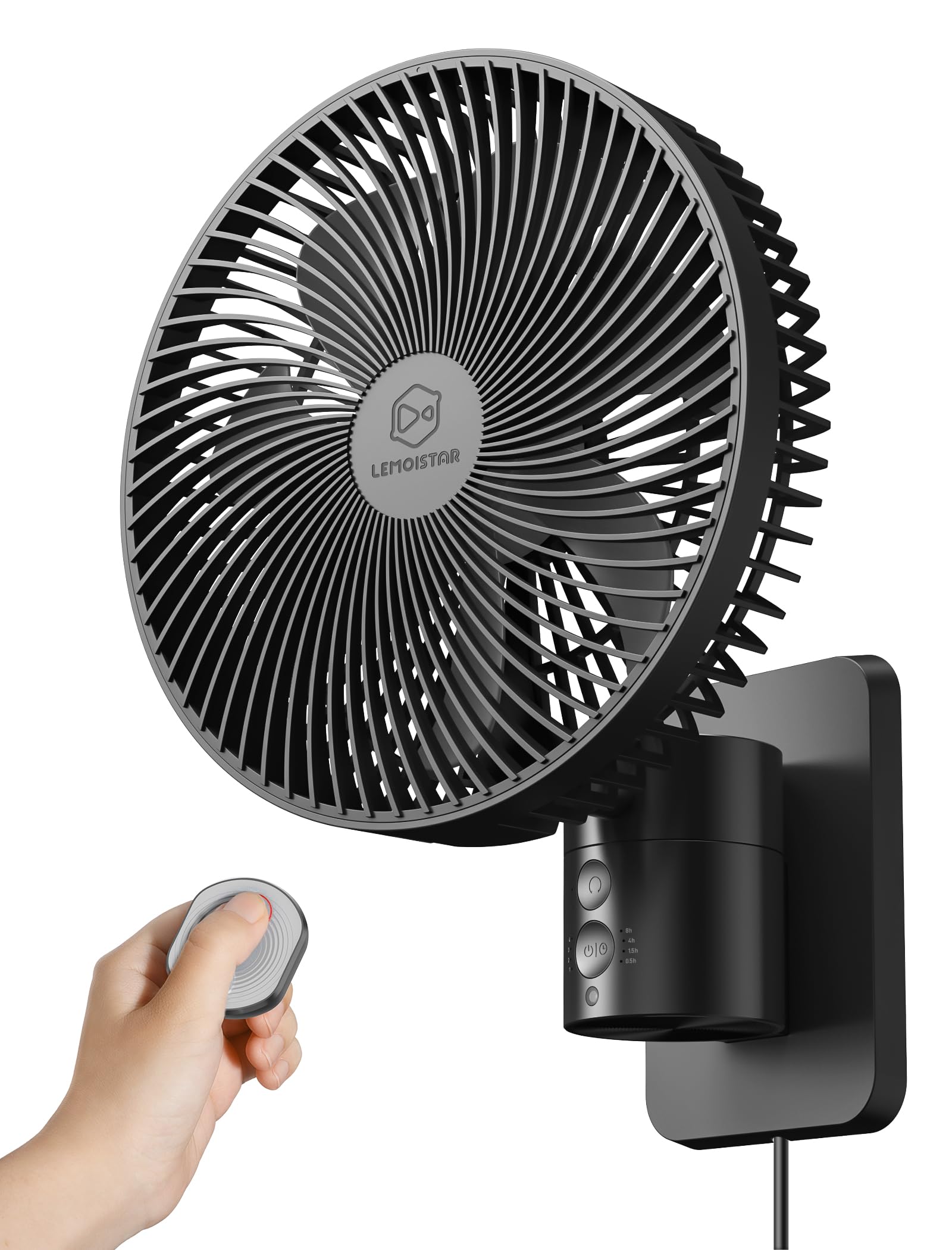
3. Shinebella 8.5-Inch Quiet Wall-Mounted Oscillation Fan
The wall-mounted spot cooler that saves counter space when your RV bathroom lacks a roof hatch.
This one is for rigs where a roof vent either does not exist or the existing hole is too small to bother with. The 8.5-inch fan mounts to the wall, makes a 90-degree self-turn plus a 120-degree manual swing, and covers a surprisingly wide area for its size. Owners call it ideal for an unventilated bathroom — it shoves stagnant air toward the nearest exit.
The 4 speed options give you fine control, and Seven balanced blades keep the breeze gentle and noise low on the softer settings.. The magnetic remote tucks onto the fan head’s center so it stops wandering off, and The timer offers 0.5, 1.5, 4, or 8-hour settings for automated cooling.. That 5.92-ft cord reaches most outlets without an extension.
There is a durability warning baked into the review history: a few units simply stopped spinning after a month or two, and one owner reported a rattle at the highest speed. This is a space-saving convenience, not a permanent structural fix — treat it as a portable assistant to a real roof vent, not a replacement for one.
Why it earns its spot: owners underline the value — it runs about half the cost of a marine-grade 12V fan with a bigger feature list.
Fair warning: some buyers hit an early failure, so keep the box and test it hard in the first weeks.
Best if: you want immediate air movement in a small bathroom without cutting a hole in the roof.
Look elsewhere if: you need an actual exhaust system that pulls moisture and odors out of the RV.
4. HENG’S INDUSTRIES 14″ Smoke Lid Roof Vent with 12V Fan

The darker-paned roof vent that upgrades an older camper’s look while moving the same air.
If your rig’s current vent is a dated white box and you want a sharper silhouette, this smoke-lid Heng’s unit swaps in with a roof mount and a 12-volt fan. The powder-coated alloy steel frame gives it more rigidity than a full-plastic build, and owners dropping it into older campers found the fit easy and the function solid. The smoke dome also filters harsh daylight, which keeps a small bathroom cooler and more private.
Quality is the dominant theme in owner feedback, with the fan’s functionality, appearance, and clean fit all earning consistent praise. It is a button-controlled exhaust fan that does the basic job without any learning curve. For someone replacing a broken original, it reads as a clear visual upgrade at a fair spend.
The reliability note cuts the other way: several owners reported the crank handle snapping after the first use, which is a genuine weak point on an otherwise well-regarded unit. One owner also flagged that the fan wire lacks a pass-through in the screen, requiring a drilled hole to avoid pinching. Expect to treat the handle gently and add a few minutes of install fiddling.
What stands out: the smoke-tinted, powder-coated look gives a modern edge that plain white vents cannot match.
What to watch: the manual handle is the most fragile part, and the wire routing takes a little extra care.
Go with this one if: you care how the roof looks from the campsite and want a sturdier frame than a budget all-plastic vent.
skip it if: you need zero-maintenance hardware and will not tolerate a delicate crank handle.
5. caqeg 14″ RV Roof Vent with 12V Fan

A roof vent designed to keep rain out and air flowing even with the lid shut.
This 14-inch square vent fits roofs from 1-1/4 to 2-1/4 inches thick, and the kit includes the white interior garnish, screws, and butyl tape so the install is a clean two-wire job. The 6-inch fan blades pull a rated 1200 centiliters per second of airflow, which is a healthy draft for a small bathroom. Owners building out vans found the fit exact and the function quiet, with one describing it as exactly what a camper build needed.
The design headline is the weather-proofing: you can run it while driving or during rain because the specially shaped vent keeps airflow moving even when the lid is closed. That means fresh air circulation on a muggy day without admitting a drop of water. The simple install is backed by printed instructions, and the butyl tape mounts the unit without drilling extra holes.
The mixed note is the all-plastic construction — some owners praise the build, while others point out that nothing about it feels heavy-duty. It is also a single-speed, non-reversible fan, so you get exhaust only, no intake mode. One owner said mounting took some muscle, calling it “hard to put on but its great.”
Defining strength: the closed-lid airflow is rare at this level — it keeps a stuffy bathroom tolerable even in a downpour.
Reality check: the plastic chassis and single-speed motor make this a solid budget utility, not a premium fixture.
Choose it for: rainy-season campers who want continuous airflow without babysitting the lid.
Not for: buyers who want multiple speeds or the ability to reverse the fan to blow cool outside air in.
6. Starvent RV Roof Vent Fan 6-Speed Reversible

The six-speed reversible fan that sleeps quietly at low RPM and blasts air when you need it.
This unit is the middle ground most RVers actually want: a roof fan with six variable speeds and a reversible blade that either pulls air in or pushes it out. At 1100 cfm, it moves substantial air volume., yet owners describe the lower speeds as whisper-quiet and perfect for sleeping. The motor slowly ramps up and down instead of slamming on, so there is no abrupt jolt of noise when you hit the button.
The smoked dome with transparent fan blades does double duty — it brings sunlight into the bathroom while filtering some brightness. The removable screen lifts out for easy cleaning, and the included white interior trim makes the ceiling-side install look finished. It fits the standard 14″ x 14″ opening and works with roofs from 1.16 up to 5.5 inches thick.
The honest counterweight is reliability: feedback is genuinely split, with some owners calling the fan fabulous and others reporting it stops working within half an hour. The button transitions are slow, the crank handle feels awkward, and one owner found the white lid glowed pink at night.
Why owners like it
- Quiet at slow speeds with a gentle start-stop ramp
- Reversible airflow pulls fresh air in or exhausts steam out
- Removable screen simplifies cleaning
Where it stumbles
- Some units have stopped working within the first half hour
- Slow button response and a clunky crank handle
Buy this if: you sleep near the bathroom and want a reversible fan that stays polite at low speed.
Be cautious if: you need guaranteed long-haul reliability — the failure stories are too common to ignore.
7. Kohree 14″ RV Vent Fan with Remote and Rain Sensor

The hands-free roof fan that opens its own lid, senses rain, and dials airflow from the couch.
This is the set-and-forget option. The Kohree unit packs a 934 CFM motor into a 14″ x 14″ roof opening, and the powered-lift lid opens and closes automatically. A built-in temperature sensor kicks the fan on when the interior passes 78.8°F and shuts it off when things cool down, so a stuffy bathroom never gets the chance to ripen. The rain sensor snaps the lid shut the moment drops start, and the remote controls speed from 1 to 10 plus reversible airflow direction.
Owners who swapped out pricier name-brand units found this one superior on noise — “the fan runs much quieter and it has a motorized lid with a controller” — and Its 50dB maximum output stays quiet even at top speed.. It draws just 25 watts in high-power mode., and the smoke, UV-proof lid filters harsh sun while letting natural light in. The kit includes screws and extra sealing tape to simplify the install.
The durability record is the dividing line: multiple reviewers point out the blades cracking and breaking within a year, and the knob can fall off. The rain sensor also triggers randomly for some, with one owner pulling the auto feature off entirely. Given the premium cost, this is a feature-rich fan that demands a tolerance for plastic parts under stress.
What you get
- Auto-open lid with rain sensor for leak-proof operation
- 10 speeds and reversible airflow from a full-function remote
- Quiet 50dB maximum with a 25W high-power draw
What you risk
- Blades have cracked and broken for several owners within a year
- Rain sensor can close the lid randomly with no rain in sight
Go for it if: you want automatic temperature and rain response with remote control from your bunk.
Hold off if: you expect a fan to survive years of daily use — the blade failures are the loudest negative theme.
8. LED Ambiance 14×14 RV Roof Vent Fan with Remote and Rain Sensor

The ultra-quiet brushless vent that doubles as a four-color night light for your rig.
This is the most feature-dense fan in the group. The brushless motor runs at ≤25dB — quieter than a whisper — and The brushless motor is rated to last five times longer than a standard brushed motor.. The built-in LED casts yellow, rose pink, blue, or white light, which makes this as much an ambiance piece as a ventilation tool. Four speeds from 3W to 40W keep the battery draw modest on the low settings, and the reversible airflow handles both steam and fresh-air intake.
The rain sensor closes the cover when a storm hits, and Patented curved blades with dynamic balance hold wind noise between 10 and 45dB across all four speeds.. It fits the standard 14″ x 14″ US opening and the 400 x 400 mm European size, with It is backed by a 3-year free parts warranty and lifetime support.. One owner noted it runs easily on solar power, which matters for off-grid boondockers.
Compatibility is the recurring snag — some buyers with Aliner models found the fit off, and one owner had to cut thin strips to make up mounting depth on a thick roof. The rain sensor closes the lid but only slows the fan rather than stopping it, which feels like a half-measure. At the top of the price range, this is for someone who wants lighting and smart controls bundled in one clean roof unit.
Signature strength: the combination of a whisper-quiet brushless motor and a four-color LED makes it the most livable fan for nightly use.
The caveat: roof thickness and odd cut-out sizes can demand extra trim pieces, and the rain sensor’s “slow, don’t stop” logic is a minor annoyance.
Pick this for: a full-feature upgrade with mood lighting, solar-friendly draw, and a real warranty behind the hardware.
Reconsider if: your roof is unusually thick or your opening is anything other than a clean 14-inch square standard.
Understanding the Specs
CFM and airflow
Cubic feet per minute measures how much air a fan pushes. For a small RV bathroom, you want a unit that clears steam before it condenses — look for a higher number when the space is tight and you value quick moisture removal over silence.
Reversible airflow
A reversible fan spins both directions, so it pulls fresh air in from outside or exhausts stale air out. That second mode is what pushes muggy bathroom air away, and it is a feature you will appreciate on humid summer nights.
12-volt DC power
This is the voltage your RV house battery already provides, so a 12V fan wires straight in without an inverter. The wattage draw tells you how hard it hits the battery — a 25W motor is gentle, while a 40W peak setting costs more on a long boondocking trip.
Rain sensor and auto lid
A rain sensor closes the vent lid automatically when water hits it, which protects your ceiling from leaks. An auto-lid adds a powered motor that opens and closes the hatch on command, so you control airflow from a remote instead of a manual crank.
FAQ
What size roof opening do I need for a standard RV vent?
Can I run a 12-volt RV fan while driving?
How much noise is too much for a bathroom fan?
What does a rain sensor actually do?
Is a roof vent better than a wall-mounted fan for an RV bathroom?
How do I know if a roof vent fits my RV’s roof thickness?
Do I need a reversible fan for my RV bathroom?
Will a standard 14-inch vent work in a European camper?
Final Thoughts: The Verdict
For most buyers, the bathroom fan for an rv winner is the Ventline Roof Vent because it drops into the standard 14.25-inch hole with the garnish, putty, and screws all included. If you want a value swap that undercuts the RV supply store, grab the Heng’s 14″ White Vent. And for a quiet, feature-rich upgrade with lighting and a rain sensor, the LED Ambiance Vent is the one to reach for.
How We Picked
We do not accept paid placement. Every pick is matched to a real buyer and a real use-case; we do not hands-on test units.
Sources & Methodology
Specifications: manufacturer listings and product documentation. Review insights: verified customer reviews, as of September 2026. Pricing: not shown on this page (it changes often); check the current price via the retailer link.
As an Amazon Associate, KitchPrep earns from qualifying purchases. This does not affect which products we feature.
Related Guides
